
Pulp Fiction, 1922 · page 111 of 185
Argosy All-Story Weekly, October 7, 1922 — page 111: what you’re looking at
A restored page from Pulp Fiction, 1922. Page through the whole issue in the reader above.
📄 Transcribed text from this page (OCR, searchable)
Machine-transcribed from the original scan — historical spelling and the odd misread are preserved.
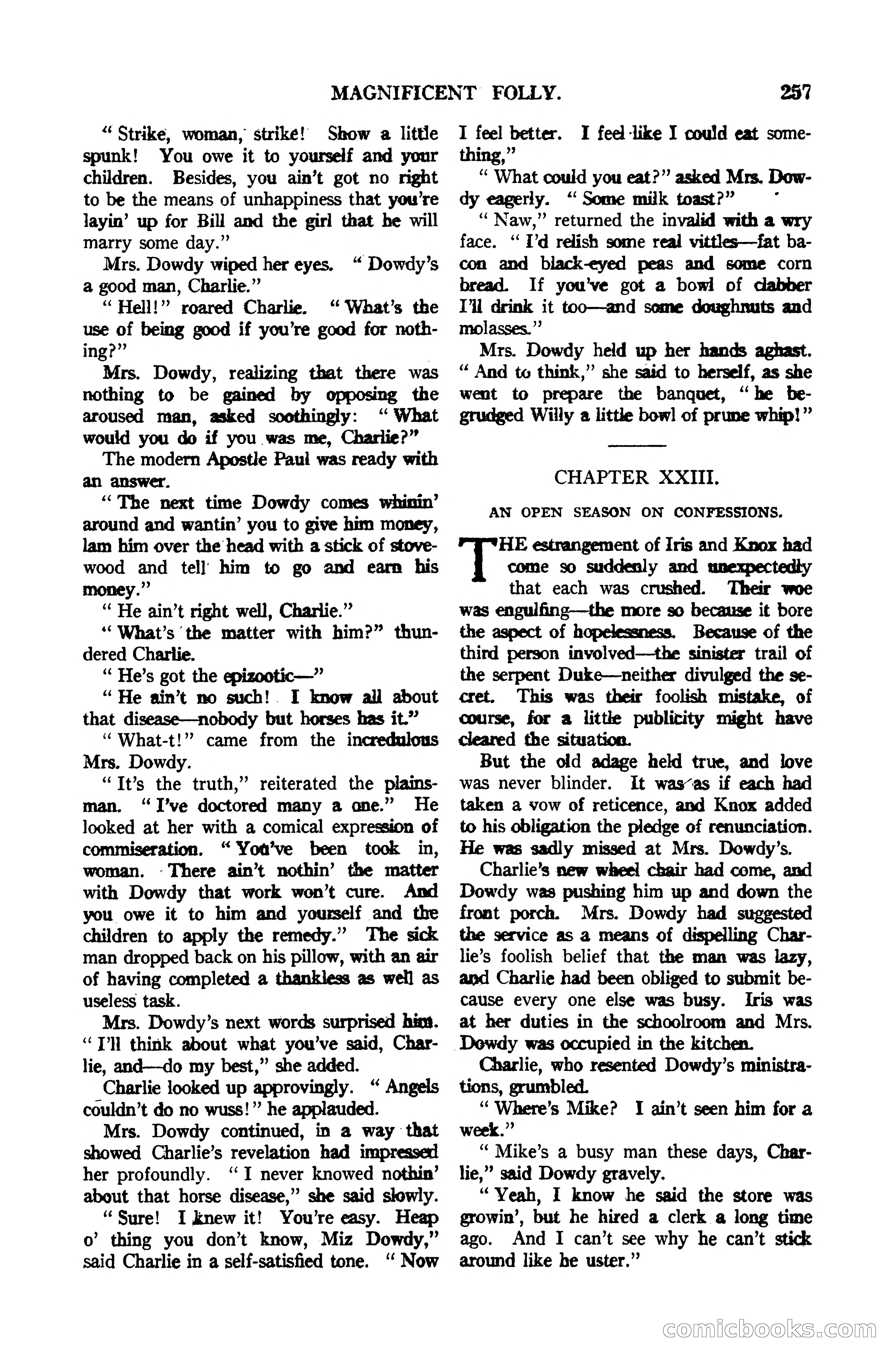
MAGNIFICENT FOLLY. ‘“ Strike, woman, strike! Show a little spunk! You owe it to yourself and your children. Besides, you ain’t got no right to be the means of unhappiness that you’re layin’ up for Bill and the girl that he will marry some day.” Mrs. Dowdy wiped her eyes. a good man, Charlie.” “Hell!” roared Charlie. ‘“ What’s the use of being good if you’re good for noth- ing?” | Mrs. Dowdy, realizing that there was nothing to be gained by opposing the aroused man, asked soothingly: “ What would you do if you was me, Charlie?” The modern Apostle Paul was ready with an answer. “The next time Dowdy comes whinin’ around and wantin’ you to give him money, lam him over the head with a stick of stove- wood and tell’ him to go and earn his money.” “ He ain’t right well, Charlie.” ‘“What’s ‘the matter with bim?” thun- dered Charlie. ‘“ He’s got the epizootic—” “He ain’t no such!. I know all about that disease—nobody but horses has it.” ‘““What-t!” came from the incredulous Mrs. Dowdy. “It’s the truth,” reiterated the plains- man. ‘I’ve doctored many a ane.” He looked at her with a comical expression of commiseration. “ Yoa’ve been took in, woman. - There ain’t nothin’ the matter with Dowdy that work won’t cure. And you owe it to him and yourself and the children to apply the remedy.” The sick man dropped back on his pillow, with an air of having completed a thankless as well as useless task. Mrs. Dowdy’s next words surprised hint. ‘TH think about what you’ve said, Char- lie, and—do my best,” she added. Charlie looked up approvingly. “ Angels couldn’t do no wuss!” he applauded. Mrs. Dowdy continued, in a way that showed Charlie’s revelation had impressex her profoundly. ‘I never knowed nothin’ about that horse disease,”’ she said slowly. “Sure! I knew it! You're easy. Heap o thing you don’t know, Miz Dowdy,” said Charlie in a self-satisfied tone. “ Now “ Dowdy’s 257 I feel better. I feel-like I could eat some- thing,” “What could you eat?” asked Mrs. Dow- dy eagerly. ‘‘ Some milk toast?” ‘“‘ Naw,” returned the invalid with a wry face. ‘Id relish some real vittles—fat ba- con and biack-eyed peas and some corn bread. If you've got a bowl of dabber I'll drink it too—and some doughnuts and molasses.”’ Mrs. Dowdy held up her hands aghast. “ And to think,” she said to herself, as she went to prepare the banquet, “he be- grudged Willy a little bow] of prune whip!” CHAPTER XXIII. AN OPEN SEASON ON CONFESSIONS. HE estrangement of Iris and Knox had come so suddenly and unexpectedly that each was crushed. Their woe was enguifing—the more so because it bore the aspect of hopelessness. Because of the third person involved—the sinister trail of the serpent Duke—neither divulged the se- cret. This was their foolish mistake, of course, for a little publicity might have cleared the situation. But the old adage held true, and love was never blinder. It was“as if each had taken a vow of reticence, and Knox added to his obligation the pledge of renunciation. He was sadly missed at Mrs. Dowdy’s. Charlie’s new wheel chair had come, and Dowdy was pushing him up and down the front porch. Mrs. Dowdy had suggested the service as a means of dispelling Char- lie’s foolish belief that the man was lazy, and Charlie had been obliged to submit be- cause every one else was busy. Iris was at her duties in the schoolroom and Mrs. Dewdy was occupied in the kitchen. Charlie, who resented Dowdy’s ministra- tions, grumbled. ‘‘ Where’s Mike? I ain’t seen him for a week.”’ ‘‘ Mike’s a busy man these days, Char- lie,” said Dowdy gravely. “Yeah, I know he said the store was growin’, but he hired a clerk a long time ago. And I can’t see why he can’t stick around like he uster.” Co DOOK 1e@