
Pulp Fiction, 1922 · page 118 of 185
Argosy All-Story Weekly, October 7, 1922 — page 118: what you’re looking at
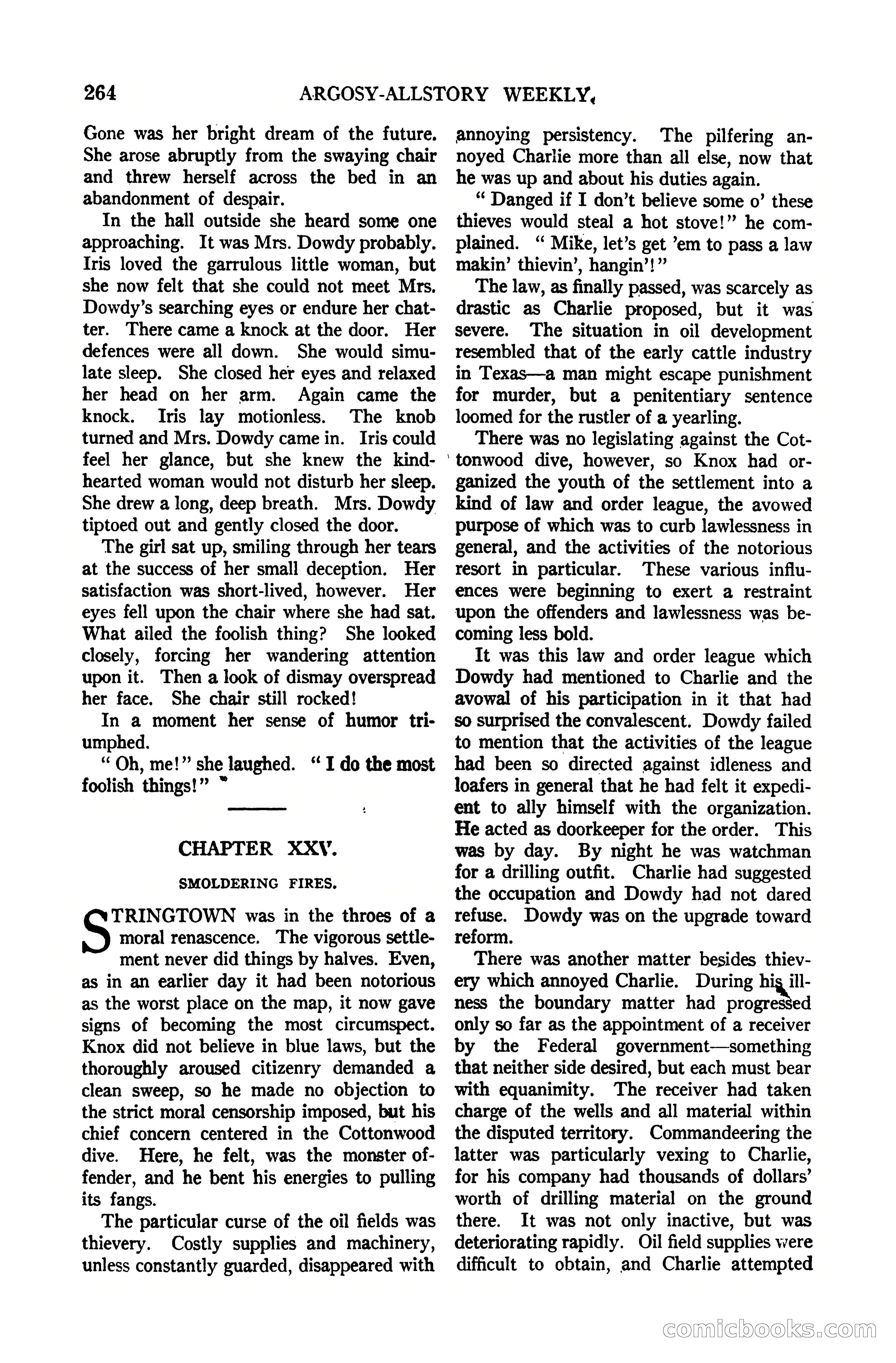
A restored page from Pulp Fiction, 1922. Page through the whole issue in the reader above.
📄 Transcribed text from this page (OCR, searchable)
Machine-transcribed from the original scan — historical spelling and the odd misread are preserved.
264 Gone was her bright dream of the future. She arose abruptly from the swaying chair and threw herself across the bed in an abandonment of despair. In the hall outside she heard some one approaching. It was Mrs. Dowdy probably. Iris loved the garrulous little woman, but she now felt that she could not meet Mrs. Dowdy’s searching eyes or endure her chat- ter. There came a knock at the door. Her defences were all down. She would simu- late sleep. She closed her eyes and relaxed her head on her arm. Again came the knock. Iris lay motionless. The knob turned and Mrs. Dowdy came in. Iris could feel her glance, but she knew the kind- hearted woman would not disturb her sleep. She drew a long, deep breath. Mrs. Dowdy tiptoed out and gently closed the door. The girl sat up, smiling through her tears at the success of her small deception. Her satisfaction was short-lived, however. Her eyes fell upon the chair where she had sat. What ailed the foolish thing? She looked closely, forcing her wandering attention upon it. Then a look of dismay overspread her face. She chair still rocked! In a moment her sense of humor tri- umphed. “Oh, me!” she laughed. “I do the most foolish things!” ~ CHAPTER XXV. SMOLDERING FIRES, TRINGTOWN was in the throes of a moral renascence. The vigorous settle- ment never did things by halves. Even, as in an earlier day it had been notorious as the worst place on the map, it now gave signs of becoming the most circumspect. Knox did not believe in blue laws, but the thoroughly aroused citizenry demanded a clean sweep, so he made no objection to the strict moral censorship imposed, but his chief concern centered in the Cottonwood dive. Here, he felt, was the monster of- fender, and he bent his energies to pulling its fangs. The particular curse of the oil fields was thievery. Costly supplies and machinery, unless constantly guarded, disappeared with ARGOSY-ALLSTORY WEEKLY, annoying persistency. The pilfering an- noyed Charlie more than all else, now that he was up and about his duties again. “* Danged if I don’t believe some o’ these thieves would steal a hot stove!” he com- plained. “ Mike, let’s get em to pass a law makin’ thievin’, hangin’!” The law, as finally passed, was scarcely as drastic as Charlie proposed, but it was severe. The situation in oil development resembled that of the early cattle industry in Texas—a man might escape punishment for murder, but a penitentiary sentence loomed for the rustler of a yearling. There was no legislating against the Cot- tonwood dive, however, so Knox had or- ganized the youth of the settlement into a kind of law and order league, the avowed purpose of which was to curb lawlessness in general, and the activities of the notorious resort in particular. These various influ- ences were beginning to exert a restraint upon the offenders and lawlessness was be- coming less bold. It was this law and order league which Dowdy had mentioned to Charlie and the avowal of his participation in it that had so surprised the convalescent. Dowdy failed to mention that the activities of the league had been so directed against idleness and loafers in general that he had felt it expedi- ent to ally himself with the organization. He acted as doorkeeper for the order. This was by day. By night he was watchman for a drilling outfit. Charlie had suggested the occupation and Dowdy had not dared refuse. Dowdy was on the upgrade toward reform. There was another matter besides thiev- ery which annoyed Charlie. During hig ill- ness the boundary matter had orogretsed only so far as the appointment of a receiver by the Federal government—something that neither side desired, but each must bear with equanimity. The receiver had taken charge of the wells and all material within the disputed territory. Commandeering the latter was particularly vexing to Charlie, for his company had thousands of dollars’ worth of drilling material on the ground there. It was not only inactive, but was deteriorating rapidly. Oil field supplies were difficult to obtain, and Charlie attempted comicboooks C©