
Pulp Fiction, 1922 · page 127 of 185
Argosy All-Story Weekly, October 7, 1922 — page 127: what you’re looking at
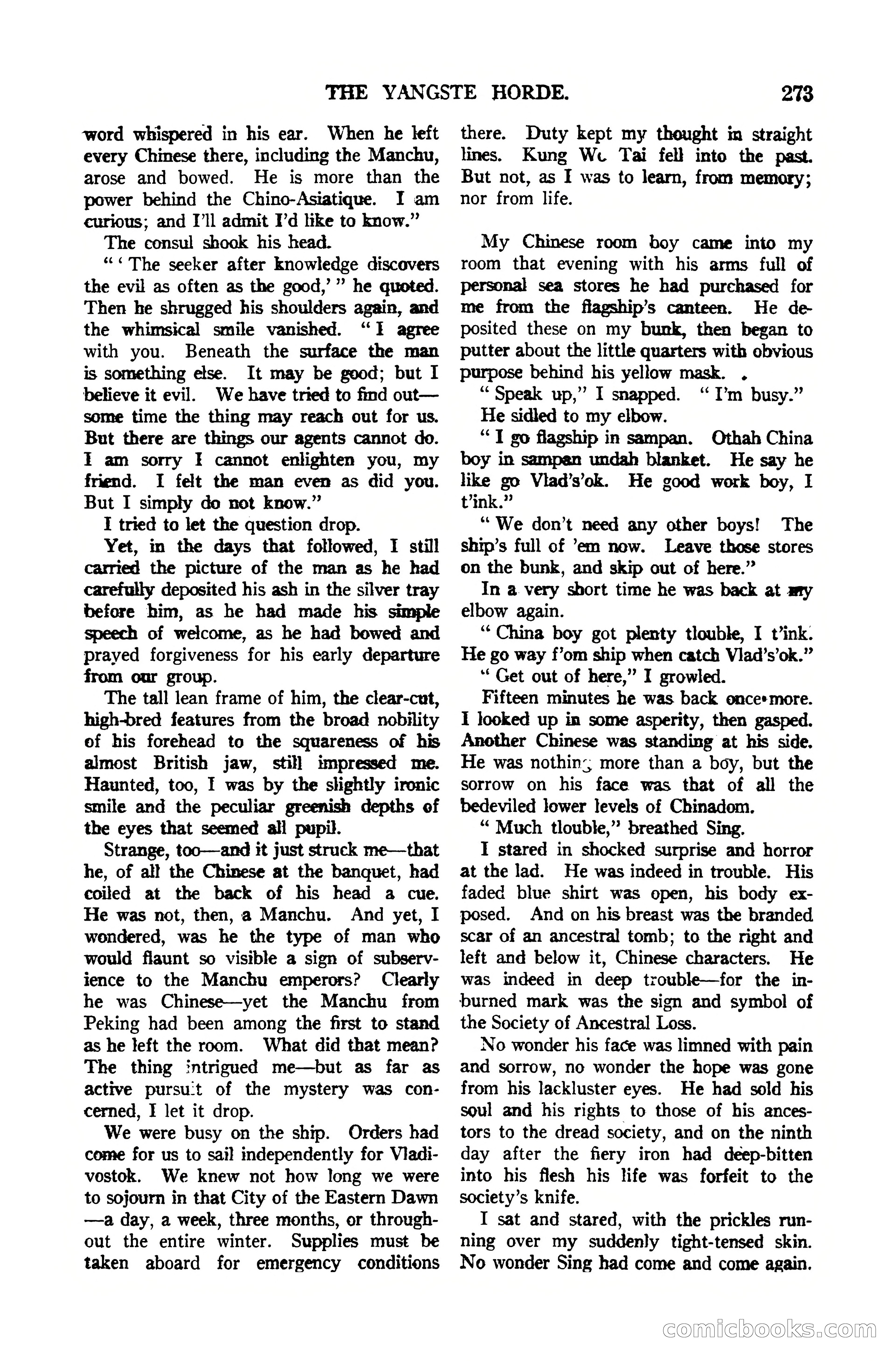
A restored page from Pulp Fiction, 1922. Page through the whole issue in the reader above.
📄 Transcribed text from this page (OCR, searchable)
Machine-transcribed from the original scan — historical spelling and the odd misread are preserved.
THE YANGSTE HORDE. ‘word whispered in his ear. When he left every Chinese there, including the Manchu, arose and bowed. He is more than the power behind the Chino-Asiatique. I am curious; and I’ll admit I'd like to know.” The consul shook his head. ““< The seeker after knowledge discovers the evil as often as the good,’”’ he quoted. Then he shrugged his shoulders again, and the whimsical smile vanished. “I agree with you. Beneath the surface the man is something else. It may be good; but I believe it evil. We have tried to find out— some time the thing may reach out for us. But there are things our agents cannot do. } am sorry I cannot enlighten you, my friend. I felt the man even as did you. But I simply do not know.” I tried to let the question drop. Yet, in the days that followed, I still carrred the picture of the man as he had carefully deposited his ash in the silver tray before him, as he had made his simple speech of welcome, as he had bowed and prayed forgiveness for his early departure from our group. The tall lean frame of him, the clear-cut, high-bred features from the broad nobility of his forehead to the squareness of his almost British jaw, still impressed me. Haunted, too, I was by the slightly ironic smile and the peculiar greenish depths of the eyes that seemed all pupil. Strange, too—and it just struck me—that he, of all the Chinese at the banquet, had coiled at the back of his head a cue. He was not, then, a Manchu. And yet, I wondered, was he the type of man who would flaunt so visible a sign of subserv- lence to the Manchu emperors? Clearly he was Chinese—yet the Manchu from Peking had been among the first to stand as he left the room. What did that mean? The thing ‘intrigued me—but as far as active pursu:t of the mystery was con- cerned, I let it drop. We were busy on the ship. Orders had come for us to sail independently for Vladi- vostok. We knew not how long we were to sojourn in that City of the Eastern Dawn —a day, a week, three months, or through- out the entire winter. Supplies must be taken aboard for emergency conditions 243 there. Duty kept my thought im straight lines. Kung Wc Tai fell into the past. But not, as I was to learn, from memory; nor from life. My Chinese room boy came into my room that evening with his arms full of personal sea stores he had purchased for me from the flagship’s canteen. He de- posited these on my bunk, then began to putter about the little quarters with obvious purpose behind his yellow mask. . ‘Speak up,” I snapped. ‘I’m busy.” He sidled to my elbow. ““T go flagship in sampan. Othah China boy in sampan undah blanket. He say he like go Viad’s’ok. He good work boy, I tink.” “We don’t need any other boys! The ship’s full of ’em now. Leave those stores on the bunk, and skip out of here.” In a very short time he was back at mry elbow again. ‘“‘ China boy got plenty tlouble, I t’ink. He go way f’om ship when catch Vlad’s’ok.” ‘* Get out of here,” I growled. Fifteen minutes he was back once»more. I looked up in some asperity, then gasped. Another Chinese was standing at his side. He was nothin;; more than a boy, but the sorrow on his face was that of all the bedeviled lower levels of Chinadom. “Much tlouble,” breathed Sing. I stared in shocked surprise and horror at the lad. He was indeed in trouble. His faded blue shirt was open, his body ex- posed. And on his breast was the branded scar of an ancestral tomb; to the right and left and below it, Chinese characters. He was indeed in deep trouble—for the in- burned mark was the sign and symbol of the Society of Ancestral Loss. No wonder his face was limned with pain and sorrow, no wonder the hope was gone from his lackluster eyes. He had sold his soul and his rights to those of his ances- tors to the dread society, and on the ninth day after the fiery iron had deep-bitten into his flesh his life was forfeit to the society’s knife. I sat and stared, with the prickles run- ning over my suddenly tight-tensed skin. No wonder Sing had come and come again. comicboooks C©