
Pulp Fiction, 1922 · page 36 of 185
Argosy All-Story Weekly, October 7, 1922 — page 36: what you’re looking at
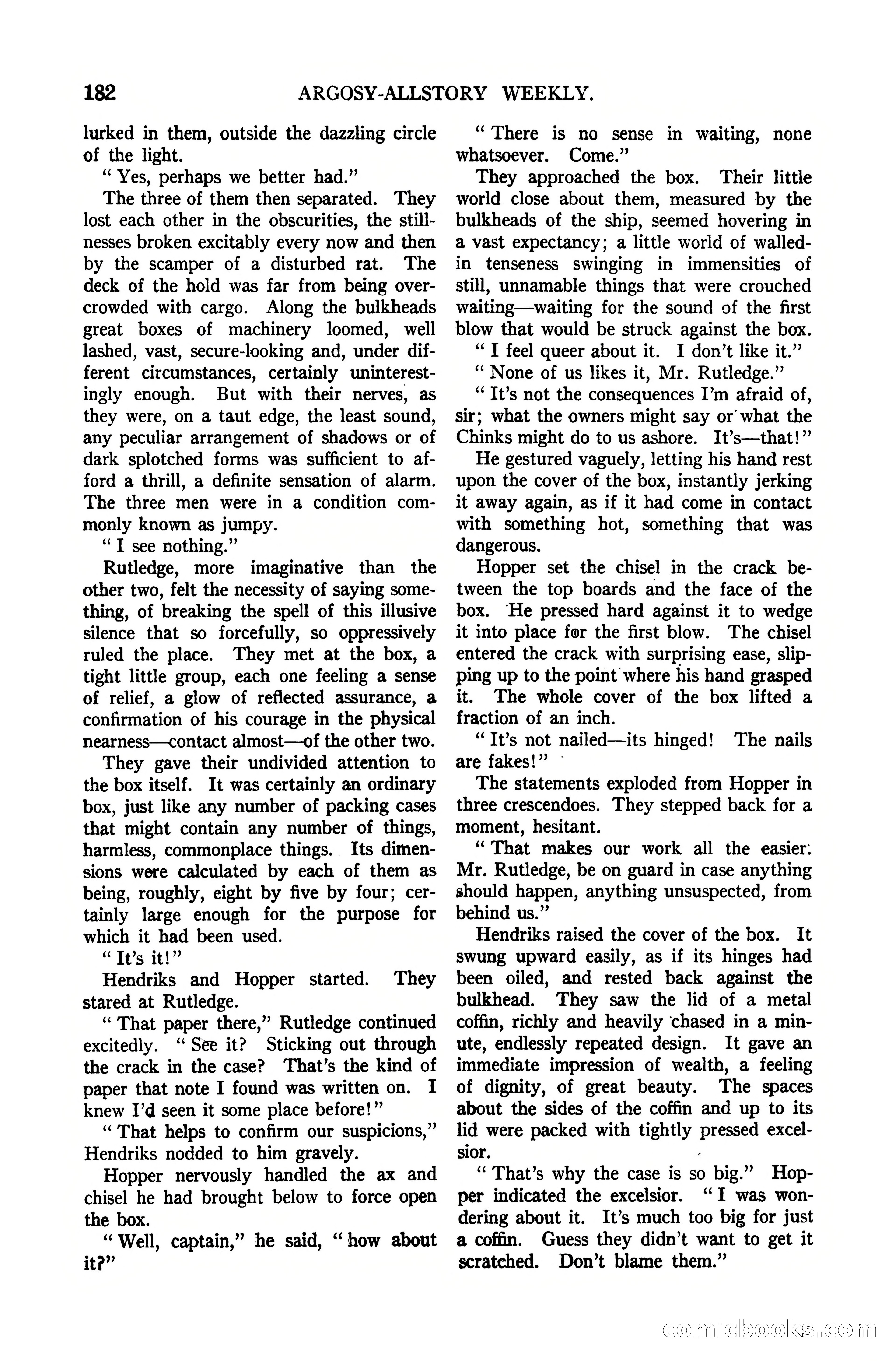
A restored page from Pulp Fiction, 1922. Page through the whole issue in the reader above.
📄 Transcribed text from this page (OCR, searchable)
Machine-transcribed from the original scan — historical spelling and the odd misread are preserved.
182 lurked in them, outside the dazzling circle of the light. “Yes, perhaps we better had.” The three of them then separated. They lost each other in the obscurities, the still- nesses broken excitably every now and then by the scamper of a disturbed rat. The deck of the hold was far from being over- crowded with cargo. Along the bulkheads great boxes of machinery loomed, well lashed, vast, secure-looking and, under dif- ferent circumstances, certainly uninterest- ingly enough. But with their nerves, as they were, on a taut edge, the least sound, any peculiar arrangement of shadows or of dark splotched forms was sufficient to af- ford a thrill, a definite sensation of alarm. The three men were in a condition com- monly known as jumpy. ‘“‘T see nothing.” Rutledge, more imaginative than the other two, felt the necessity of saying some- thing, of breaking the spell of this illusive silence that so forcefully, so oppressively ruled the place. They met at the box, a tight little group, each one feeling a sense of relief, a glow of reflected assurance, a confirmation of his courage in the physical nearness—contact almost—of the other two. They gave their undivided attention to the box itself. It was certainly an ordinary box, just like any number of packing cases that might contain any number of things, harmless, commonplace things. Its dimen- sions were calculated by each of them as being, roughly, eight by five by four; cer- tainly large enough for the purpose for which it had been used. “It’s it!” Hendriks and Hopper started. stared at Rutledge. “That paper there,” Rutledge continued excitedly. “See it? Sticking out through the crack in the case? That’s the kind of paper that note I found was written on. I knew I’d seen it some place before!” ‘That helps to confirm our suspicions,” Hendriks nodded to him gravely. Hopper nervously handled the ax and chisel he had brought below to force open the box. “Well, captain,” he said, “how about ite” They ARGOSY-ALLSTORY WEEKLY. “There is no sense in waiting, none whatsoever. Come.” They approached the box. Their little world close about them, measured by the bulkheads of the ship, seemed hovering in a vast expectancy; a little world of walled- In tenseness swinging in immensities of still, unnamable things that were crouched waiting—waiting for the sound of the first blow that would be struck against the box. ‘I feel queer about it. I don’t like it.” ‘“* None of us likes it, Mr. Rutledge.” ‘* It’s not the consequences I’m afraid of, sir; what the owners might say or what the Chinks might do to us ashore. It’s—that!”’ He gestured vaguely, letting his hand rest upon the cover of the box, instantly jerking it away again, as if it had come in contact with something hot, something that was dangerous. Hopper set the chisel in the crack be- tween the top boards and the face of the box. “He pressed hard against it to wedge it into place for the first blow. The chisel entered the crack with surprising ease, slip- ping up to the point where his hand grasped it. The whole cover of the box lifted a fraction of an inch. “It’s not nailed—its hinged! are fakes!” ~ The statements exploded from Hopper in three crescendoes. They stepped back for a moment, hesitant. “That makes our work all the easier: Mr. Rutledge, be on guard in case anything should happen, anything unsuspected, from behind us.” Hendriks raised the cover of the box. It swung upward easily, as if its hinges had been oiled, and rested back against the bulkhead. They saw the lid of a metal coffin, richly and heavily chased in a min- ute, endlessly repeated design. It gave an immediate impression of wealth, a feeling of dignity, of great beauty. The spaces about the sides of the coffin and up to its lid were packed with tightly pressed excel- sior. ‘“‘ That’s why the case is so big.” Hop- per indicated the excelsior. ‘‘ I was won- dering about it. It’s much too big for just a coffin. Guess they didn’t want to get it scratched. Don’t blame them.” The nails comiclbooolx C©