
Pulp Fiction, 1922 · page 39 of 185
Argosy All-Story Weekly, October 7, 1922 — page 39: what you’re looking at
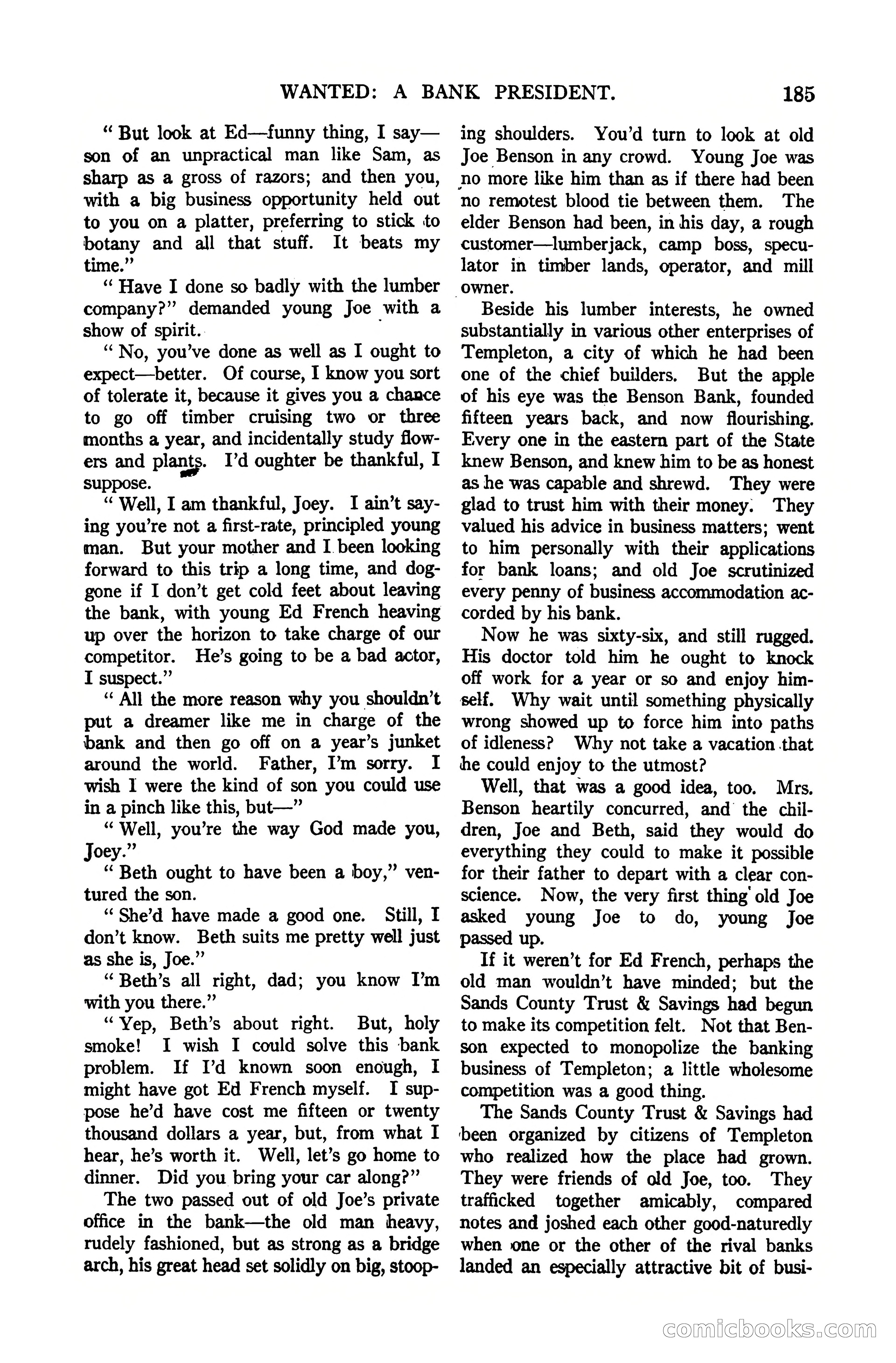
A restored page from Pulp Fiction, 1922. Page through the whole issue in the reader above.
📄 Transcribed text from this page (OCR, searchable)
Machine-transcribed from the original scan — historical spelling and the odd misread are preserved.
WANTED: A BANK PRESIDENT. “ But look at Ed—funny thing, I say— son of an unpractical man like Sam, as sharp as a gross of razors; and then you, with a big business opportunity held out to you on a platter, preferring to stick to botany and all that stuff. It beats my time.” ‘‘ Have I done so badly with the lumber company?” demanded young Joe with a show of spirit. “No, you’ve done as well as I ought to expect—better. Of course, I know you sort of tolerate it, because it gives you a chance to go off timber cruising two or three months a year, and incidentally study flow- ers and plants. I’d oughter be thankful, I suppose. “ Well, I am thankful, Joey. I ain’t say- ing you're not a first-rate, principled young man. But your mother and I been looking forward to this trip a long time, and dog- gone if I don’t get cold feet about leaving the bank, with young Ed French heaving up over the horizon to take charge of our competitor. He’s going to be a bad actor, I suspect.” ‘ All the more reason why you shouldn’t put a dreamer like me in charge of the bank and then go off on a year’s junket around the world. Father, I’m sorry. I wish I were the kind of son you could use in a pinch like this, but—” “Well, you’re the way God made you, Joey.” “ Beth ought to have been a boy,” ven- tured the son. ‘“¢ She’d have made a good one. Still, I don’t know. Beth suits me pretty well just as she is, Joe.” ‘“‘ Beth’s all right, dad; you know I’m with you there.” “Yep, Beth’s about right. But, holy smoke! I wish I could solve this bank problem. If I’d known soon enough, I might have got Ed French myself. I sup- pose he’d have cost me fifteen or twenty thousand dollars a year, but, from what I hear, he’s worth it. Well, let’s go home to dinner. Did you bring your car along?” The two passed out of old Joe’s private office in the bank—the old man heavy, rudely fashioned, but as strong as a bridge arch, his great head set solidly on big, stoop- 185 ing shoulders. You’d turn to look at old Joe Benson in any crowd. Young Joe was no more like him than as if there had been no remotest blood tie between them. The elder Benson had been, in his day, a rough customer—lumberjack, camp boss, specu- lator in timber lands, operator, and mill owner. Beside his lumber interests, he owned substantially in various other enterprises of Templeton, a city of which he had been one of the chief builders. But the apple of his eye was the Benson Bank, founded fifteen years back, and now flourishing. Every one in the eastern part of the State knew Benson, and knew him to be as honest as he was capable and shrewd. They were glad to trust him with their money. They valued his advice in business matters; went to him personally with their applications for bank loans; and old Joe scrutinized every penny of business accommodation ac- corded by his bank. Now he was sixty-six, and still rugged. His doctor told him he ought to knock off work for a year or so and enjoy him- self. Why wait until something physically wrong showed up to force him into paths of idleness? Why not take a vacation that he could enjoy to the utmost? Well, that was a good idea, too. Mrs. Benson heartily concurred, and the chil- dren, Joe and Beth, said they would do everything they could to make it possible for their father to depart with a clear con- science. Now, the very first thing’ old Joe asked young Joe to do, young Joe passed up. If it weren’t for Ed French, perhaps the old man wouldn’t have minded; but the Sands County Trust & Savings had begun to make its competition felt. Not that Ben- son expected to monopolize the banking business of Templeton; a little wholesome competition was a good thing. The Sands County Trust & Savings had ‘been organized by citizens of Templeton who realized how the place had grown. They were friends of old Joe, too. They trafficked together amicably, compared notes and joshed each other good-naturedly when one or the other of the rival banks landed an especially attractive bit of busi- comicboooks C©