
Pulp Fiction, 1922 · page 41 of 185
Argosy All-Story Weekly, October 7, 1922 — page 41: what you’re looking at
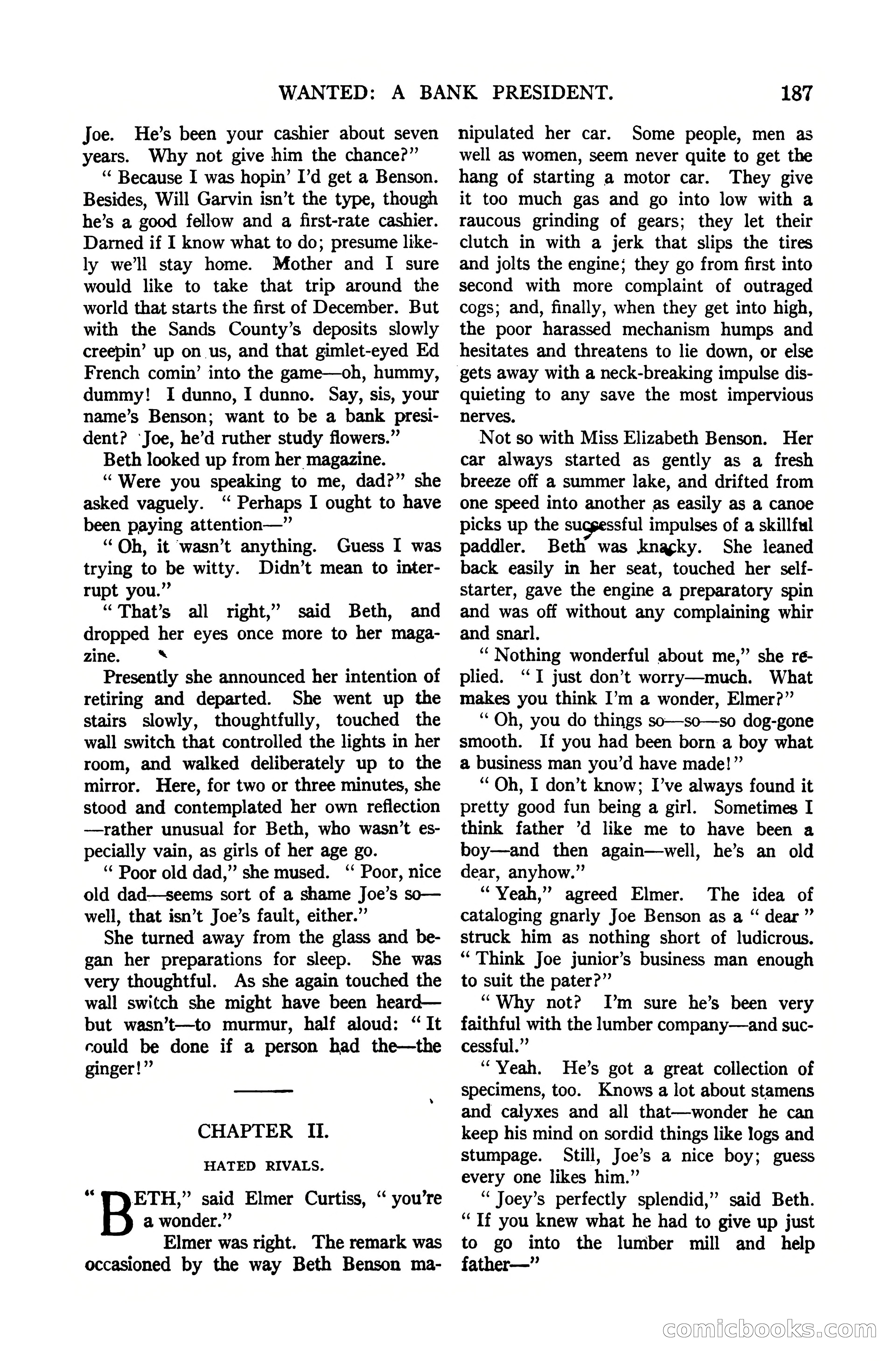
A restored page from Pulp Fiction, 1922. Page through the whole issue in the reader above.
📄 Transcribed text from this page (OCR, searchable)
Machine-transcribed from the original scan — historical spelling and the odd misread are preserved.
WANTED: A BANK PRESIDENT. Joe. He’s been your cashier about seven years. Why not give him the chance?” ‘“‘ Because I was hopin’ I’d get a Benson. Besides, Will Garvin isn’t the type, though he’s a good fellow and a first-rate cashier. Darned if I know what to do; presume like- ly we'll stay home. Mother and I sure would like to take that trip around the world that starts the first of December. But with the Sands County’s deposits slowly creepin’ up on us, and that gimlet-eyed Ed French comin’ into the game—oh, hummy, dummy! I dunno, I dunno. Say, sis, your name’s Benson; want to be a bank presi- dent? ‘Joe, he’d ruther study flowers.” Beth looked up from her magazine. ‘Were you speaking to me, dad?” she asked vaguely. ‘“ Perhaps I ought to have been paying attention—” “Oh, it wasn’t anything. Guess I was trying to be witty. Didn’t mean to inter- rupt you.” “That’s all right,” said Beth, and dropped her eyes once more to her maga- zine. “ Presently she announced her intention of retiring and departed. She went up the stairs slowly, thoughtfully, touched the wall switch that controlled the lights in her room, and walked deliberately up to the mirror. Here, for two or three minutes, she stood and contemplated her own reflection —rather unusual for Beth, who wasn’t es- pecially vain, as girls of her age go. ‘Poor old dad,” she mused. ‘“‘ Poor, nice old dad—seems sort of a shame Joe’s so— well, that isn’t Joe’s fault, either.” She turned away from the glass and be- gan her preparations for sleep. She was very thoughtful. As she again touched the wall switch she might have been heard— but wasn’t—to murmur, half aloud: “It could be done if a person had the—the ginger!” CHAPTER II. HATED RIVALS. “TyETH,” said Elmer Curtiss, “ you’re a wonder.” Elmer was right. The remark was occasioned by the way Beth Benson ma- 187 nipulated her car. Some people, men as well as women, seem never quite to get the hang of starting a motor car. They give it too much gas and go into low with a raucous grinding of gears; they let their clutch in with a jerk that slips the tires and jolts the engine; they go from first into second with more complaint of outraged cogs; and, finally, when they get into high, the poor harassed mechanism humps and hesitates and threatens to lie down, or else gets away with a neck-breaking impulse dis- quieting to any save the most impervious nerves. Not so with Miss Elizabeth Benson. Her car always started as gently as a fresh breeze off a summer lake, and drifted from one speed into another as easily as a canoe picks up the sucgessful impulses of a skillful paddler. Beth was knagky. She leaned back easily in her seat, touched her self- starter, gave the engine a preparatory spin and was off without any complaining whir and snarl. ‘““ Nothing wonderful about me,” she re- plied. ‘I just don’t worry—much. What makes you think I’m a wonder, Elmer?” ‘“Oh, you do things so—so—so dog-gone smooth. If you had been born a boy what a business man you’d have made!” ‘Oh, I don’t know; I’ve always found it pretty good fun being a girl. Sometimes I think father ’d like me to have been a boy—and then again—well, he’s an old dear, anyhow.” “*'Yeah,’’ agreed Elmer. The idea of cataloging gnarly Joe Benson as a “ dear ” struck him as nothing short of ludicrous. “Think Joe junior’s business man enough to suit the pater?”’ “Why not? I’m sure he’s been very faithful with the lumber company—and suc- cessful.” ‘Yeah. He’s got a great collection of specimens, too. Knows a lot about stamens and calyxes and all that—wonder he can keep his mind on sordid things like logs and stumpage. Still, Joe’s a nice boy; guess every one likes him.” ‘ Joey’s perfectly splendid,” said Beth. “Tf you knew what he had to give up just to go into the lumber mill and help father—” MICLOOOK C©