
Pulp Fiction, 1922 · page 64 of 185
Argosy All-Story Weekly, October 7, 1922 — page 64: what you’re looking at
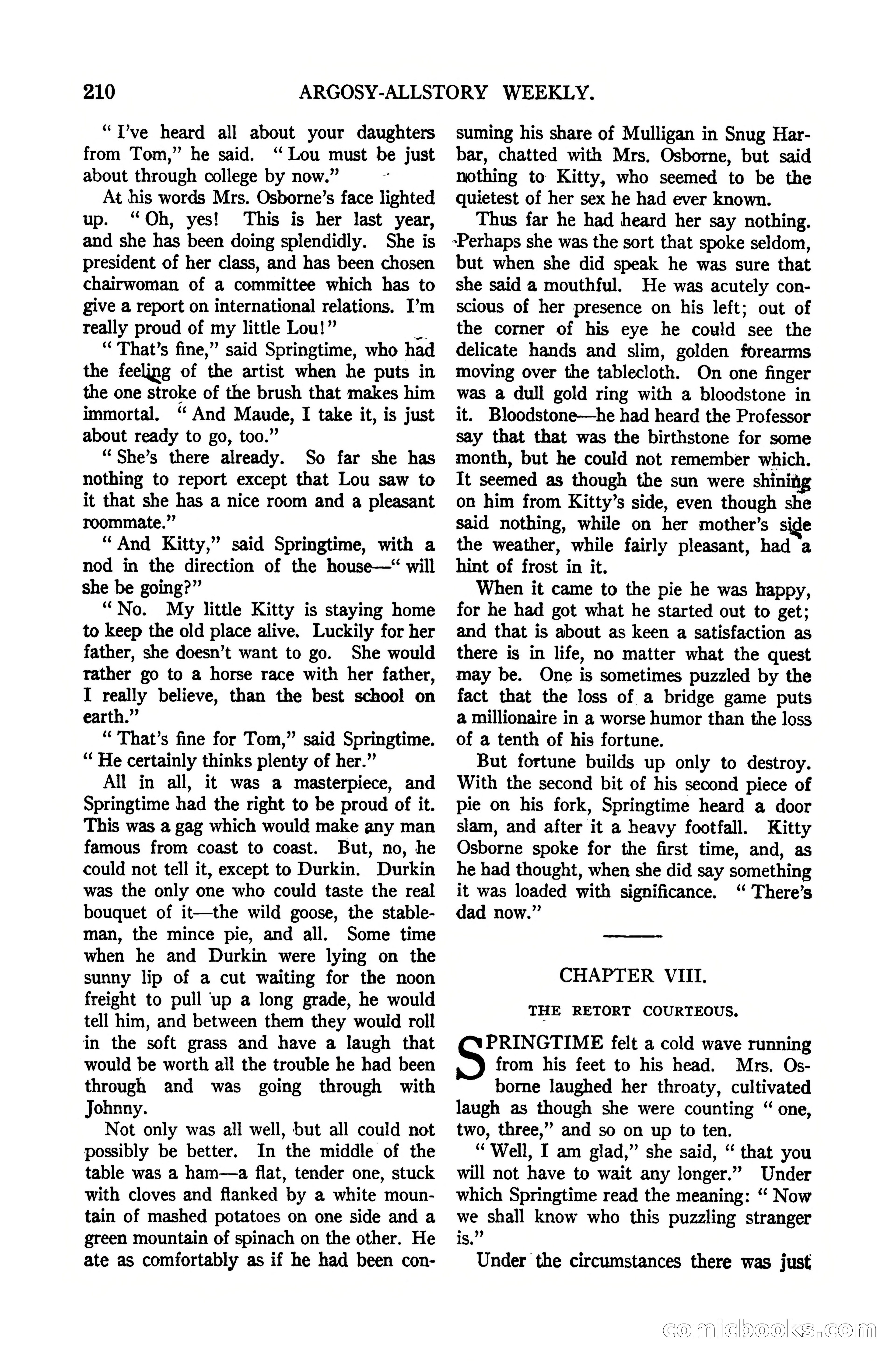
A restored page from Pulp Fiction, 1922. Page through the whole issue in the reader above.
📄 Transcribed text from this page (OCR, searchable)
Machine-transcribed from the original scan — historical spelling and the odd misread are preserved.
210 “T’ve heard all about your daughters from Tom,” he said. ‘ Lou must be just about through college by now.” At his words Mrs. Osborne’s face lighted up. “Oh, yes! This is her last year, and she has been doing splendidly. She is president of her class, and has been chosen chairwoman of a committee which has to give a report on international relations. I’m really proud of my little Lou!” . ‘“‘ That’s fine,” said Springtime, who had the feeling of the artist when he puts in the one stroke of the brush that makes him immortal. ‘‘ And Maude, I take it, is just about ready to go, too.” “‘She’s there already. So far she has nothing to report except that Lou saw to it that she has a nice room and a pleasant roommate.” “And Kitty,” said Springtime, with a nod in the direction of the house—“ will she be going?”’ “No. My little Kitty is staying home to keep the old place alive. Luckily for her father, she doesn’t want to go. She would tather go to a horse race with her father, I really believe, than the best school on earth.” ‘““ That’s fine for Tom,” said Springtime. “* He certainly thinks plenty of her.” All in all, it was a masterpiece, and Springtime had the right to be proud of it. This was a gag which would make any man famous from coast to coast. But, no, he could not tell it, except to Durkin. Durkin was the only one who could taste the real bouquet of it—the wild goose, the stable- man, the mince pie, and all. Some time when he and Durkin were lying on the sunny lip of a cut waiting for the noon freight to pull up a long grade, he would tell him, and between them they would roll in the soft grass and have a laugh that would be worth all the trouble he had been through and was going through with Johnny. Not only was all well, but all could not possibly be better. In the middle of the table was a ham—a flat, tender one, stuck with cloves and flanked by a white moun- tain of mashed potatoes on one side and a green mountain of spinach on the other. He ate as comfortably as if he had been con- ARGOSY-ALLSTORY WEEKLY. suming his share of Mulligan in Snug Har- bar, chatted with Mrs. Osborne, but said nothing to Kitty, who seemed to be the quietest of her sex he had ever known. Thus far he had heard her say nothing. ~Perhaps she was the sort that spoke seldom, but when she did speak he was sure that she said a mouthful. He was acutely con- scious of her presence on his left; out of the corner of his eye he could see the delicate hands and slim, golden forearms moving over the tablecloth. On one finger was a dull gold ring with a bloodstone in it. Bloodstone—he had heard the Professor say that that was the birthstone for some month, but he could not remember which. It seemed as though the sun were shiniig on him from Kitty’s side, even though she said nothing, while on her mother’s side the weather, while fairly pleasant, had a hint of frost in it. When it came to the pie he was happy, for he had got what he started out to get; and that is about as keen a satisfaction as there is in life, no matter what the quest may be. One is sometimes puzzled by the fact that the loss of a bridge game puts a millionaire in a worse humor than the loss of a tenth of his fortune. But fortune builds up only to destroy. With the second bit of his second piece of pie on his fork, Springtime heard a door slam, and after it a heavy footfall. Kitty Osborne spoke for the first time, and, as he had thought, when she did say something it was loaded with significance. ‘“ There’s dad now.” CHAPTER VIII. THE RETORT COURTEOUS. PRINGTIME felt a cold wave running S from his feet to his head. Mrs. Os- borne laughed her throaty, cultivated laugh as though she were counting “ one, two, three,” and so on up to ten. “Well, I am glad,” she said, “ that you will not have to wait any longer.” Under which Springtime read the meaning: “ Now we shall know who this puzzling stranger is.” Under the circumstances there was just COMmiclboo SS C©