
Pulp Fiction, 1922 · page 66 of 185
Argosy All-Story Weekly, October 7, 1922 — page 66: what you’re looking at
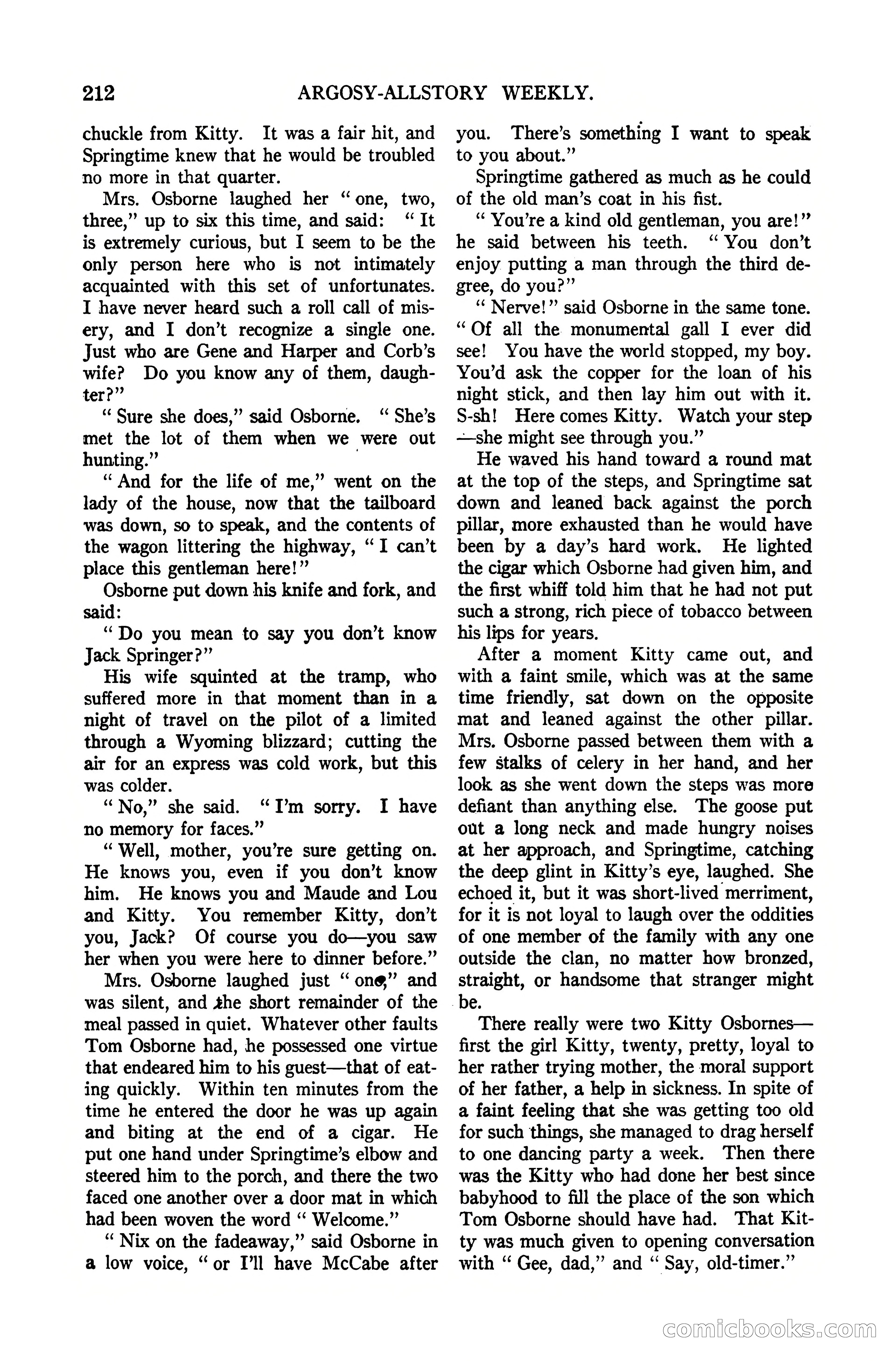
A restored page from Pulp Fiction, 1922. Page through the whole issue in the reader above.
📄 Transcribed text from this page (OCR, searchable)
Machine-transcribed from the original scan — historical spelling and the odd misread are preserved.
212 chuckle from Kitty. It was a fair hit, and Springtime knew that he would be troubled no more in that quarter. Mrs. Osborne laughed her “ one, two, three,” up to six this time, and said: “ It is extremely curious, but I seem to be the only person here who is not intimately acquainted with this set of unfortunates. I have never heard such a roll call of mis- ery, and I don’t recognize a single one. Just who are Gene and Harper and Corb’s wife? Do you know any of them, daugh- ter?” “Sure she does,” said Osborne. ‘“‘ She’s met the lot of them when we were out hunting.” | ‘“‘ And for the life of me,” went on the lady of the house, now that the tailboard was down, so to speak, and the contents of the wagon littering the highway, “I can’t place this gentleman here!”’ Osborne put down his knife and fork, and said: ‘“Do you mean to say you don’t know Jack Springer?” His wife squinted at the tramp, who suffered more in that moment than in a night of travel on the pilot of a limited through a Wyoming blizzard; cutting the air for an express was cold work, but this was colder. “No,” she said. “I’m sorry. I have no memory for faces.”’ “Well, mother, you’re sure getting on. He knows you, even if you don’t know him. He knows you and Maude and Lou and Kitty. You remember Kitty, don’t you, Jack? Of course you do—you saw her when you were here to dinner before.” Mrs. Osborne laughed just ‘“ one” and was silent, and the short remainder of the meal passed in quiet. Whatever other faults Tom Osborne had, he possessed one virtue that endeared him to his guest—that of eat- ing quickly. Within ten minutes from the time he entered the door he was up again and biting at the end of a cigar. He put one hand under Springtime’s elbow and steered him to the porch, and there the two faced one another over a door mat in which had been woven the word “‘ Welcome.” ‘“ Nix on the fadeaway,” said Osborne in a low voice, “or I’ll have McCabe after ARGOSY-ALLSTORY WEEKLY. you. There’s something I want to speak to you about.” Springtime gathered as much as he could of the old man’s coat in his fist. ‘You’re a kind old gentleman, you are!” he said between his teeth. ‘“ You don’t enjoy putting a man through the third de- gree, do you?” ‘* Nerve!” said Osborne in the same tone. “Of all the monumental gall I ever did see! You have the world stopped, my boy. You’d ask the copper for the loan of his night stick, and then lay him out with it. S-sh! Here comes Kitty. Watch your step —she might see through you.” He waved his hand toward a round mat at the top of the steps, and Springtime sat down and leaned back against the porch pillar, more exhausted than he would have been by a day’s hard work. He lighted the cigar which Osborne had given him, and the first whiff told him that he had not put such a strong, rich piece of tobacco between his lips for years. After a moment Kitty came out, and with a faint smile, which was at the same time friendly, sat down on the opposite mat and leaned against the other pillar. Mrs. Osborne passed between them with a few stalks of celery in her hand, and her look as she went down the steps was more defiant than anything else. The goose put out a long neck and made hungry noises at her approach, and Springtime, catching the deep glint in Kitty’s eye, laughed. She echoed it, but it was short-lived merriment, for it is not loyal to laugh over the oddities of one member of the family with any one outside the clan, no matter how bronzed, straight, or handsome that stranger might be. There really were two Kitty Osbornes— first the girl Kitty, twenty, pretty, loyal to her rather trying mother, the moral support of her father, a help in sickness. In spite of a faint feeling that she was getting too old for such things, she managed to drag herself to one dancing party a week. Then there was the Kitty who had done her best since babyhood to fill the place of the son which Tom Osborne should have had. That Kit- ty was much given to opening conversation with ‘“‘ Gee, dad,” and “ Say, old-timer.” COMmiclboo SS C©