
Pulp Fiction, 1922 · page 73 of 185
Argosy All-Story Weekly, October 7, 1922 — page 73: what you’re looking at
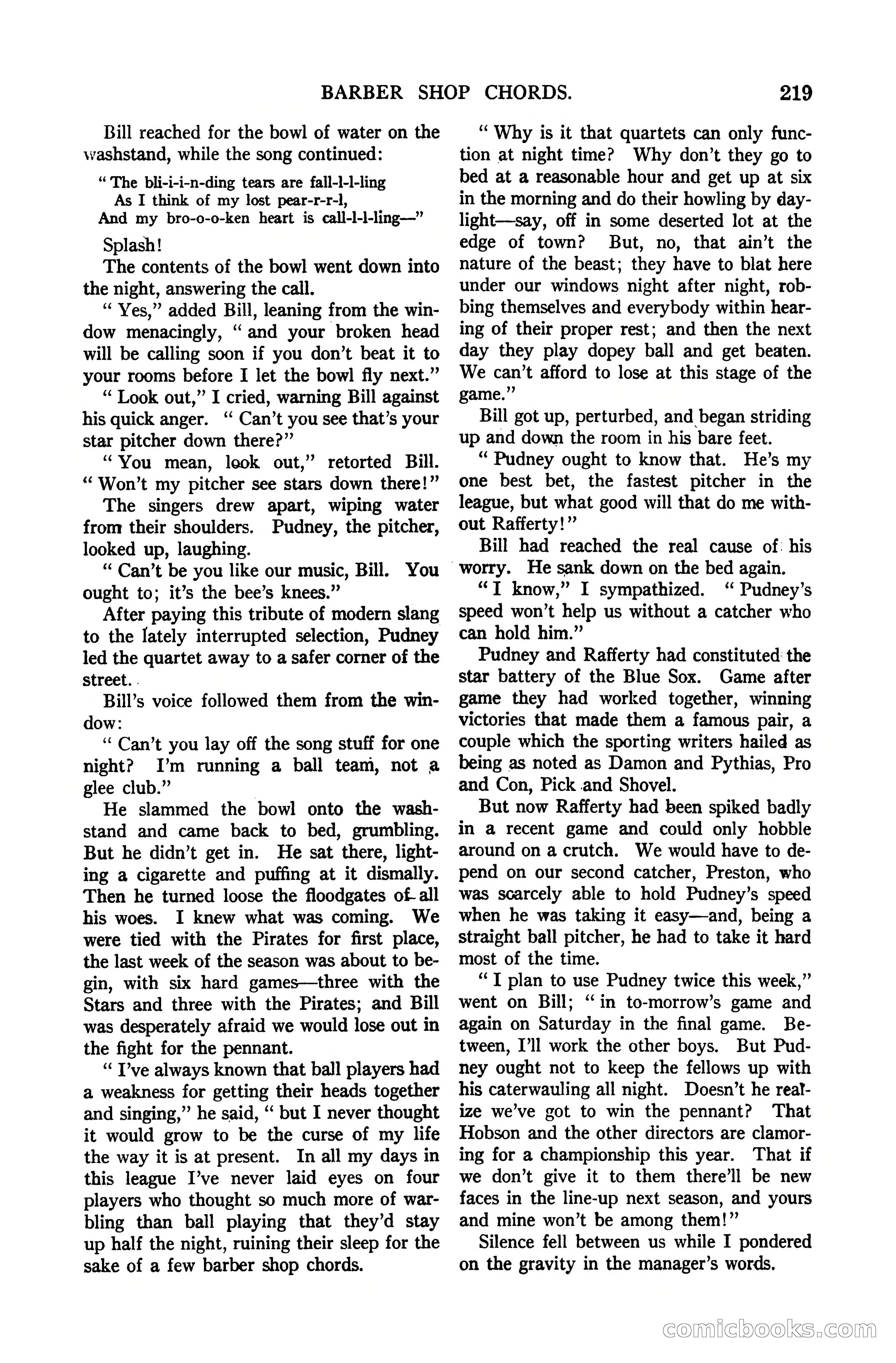
A restored page from Pulp Fiction, 1922. Page through the whole issue in the reader above.
📄 Transcribed text from this page (OCR, searchable)
Machine-transcribed from the original scan — historical spelling and the odd misread are preserved.
BARBER SHOP CHORDS. Bill reached for the bowl of water on the washstand, while the song continued: “ The bli-i-i-n-ding tears are fall-1-l-ling As I think of my lost pear-r-r-l, And my bro-o-o-ken heart is call-l-l-ling—” Splash! The contents of the bowl went down into the night, answering the call. “Yes,” added Bill, leaning from the win- dow menacingly, “and your broken head will be calling soon if you don’t beat it to your rooms before I let the bowl fly next.” “‘ Look out,” I cried, warning Bill against his quick anger. ‘‘ Can’t you see that’s your star pitcher down there?”’ ‘You mean, leok out,” retorted Bill. “'Won’t my pitcher see stars down there!” The singers drew apart, wiping water from their shoulders. Pudney, the pitcher, looked up, laughing. “ Can’t be you like our music, Bill. You ought to; it’s the bee’s knees.” After paying this tribute of modern slang to the lately interrupted selection, Pudney led the quartet away to a safer corner of the Street. . Bill’s voice followed them from the win- dow: ‘“Can’t you lay off the song stuff for one night? I’m running a ball team, not a glee club.” | He slammed the bowl onto the wash- stand and came back to bed, grumbling. But he didn’t get in. He sat there, light- ing a cigarette and puffing at it dismally. Then he turned loose the floodgates of- all his woes. I knew what was coming. We were tied with the Pirates for first place, the last week of the season was about to be- gin, with six hard games—three with the Stars and three with the Pirates; and Bill was desperately afraid we would lose out in the fight for the pennant. ‘“T’ve always known that ball players had a weakness for getting their heads together and singing,” he said, “‘ but I never thought it would grow to be the curse of my life the way it is at present. In all my days in this league I’ve never laid eyes on four players who thought so much more of war- bling than ball playing that they’d stay up half the night, ruining their sleep for the sake of a few barber shop chords. 219 ‘Why is it that quartets can only func- tion at night time? Why don’t they go to bed at a reasonable hour and get up at six in the morning and do their howling by day- light—say, off in some deserted lot at the edge of town? But, no, that ain’t the nature of the beast; they have to blat here under our windows night after night, rob- bing themselves and everybody within hear- ing of their proper rest; and then the next day they play dopey ball and get beaten. We can’t afford to lose at this stage of the game.” Bill got up, perturbed, and began striding up and down the room in his bare feet. “ Pudney ought to know that. He’s my one best bet, the fastest pitcher in the league, but what good will that do me with- out Rafferty!” Bill had reached the real cause of: his worry. He sank down on the bed again. “TI know,” I sympathized. ‘“ Pudney’s speed won’t help us without a catcher who can hold him.” Pudney and Rafferty had constituted: the star battery of the Blue Sox. Game after game they had worked together, winning victories that made them a famous pair, a couple which the sporting writers hailed as being as noted as Damon and Pythias, Pro and Con, Pick and Shovel. But now Rafferty had been spiked badly in a recent game and could only hobble around on a crutch. We would have to de- pend on our second catcher, Preston, who was scarcely able to hold Pudney’s speed when he was taking it easy—and, being a straight ball pitcher, he had to take it hard most of the time. “‘T plan to use Pudney twice this week,” went on Bill; “in to-morrow’s game and again on Saturday in the final game. Be- tween, I'll work the other boys. But Pud- ney ought not to keep the fellows up with his caterwauling all night. Doesn’t he real- ize we’ve got to win the pennant? That Hobson and the other directors are clamor- ing for a championship this year. That if we don’t give it to them there’ll be new faces in the line-up next season, and yours and mine won’t be among them!” Silence fell between us while I pondered on the gravity in the manager’s words. comiclbooolx C©