
Pulp Fiction, 1922 · page 82 of 185
Argosy All-Story Weekly, October 7, 1922 — page 82: what you’re looking at
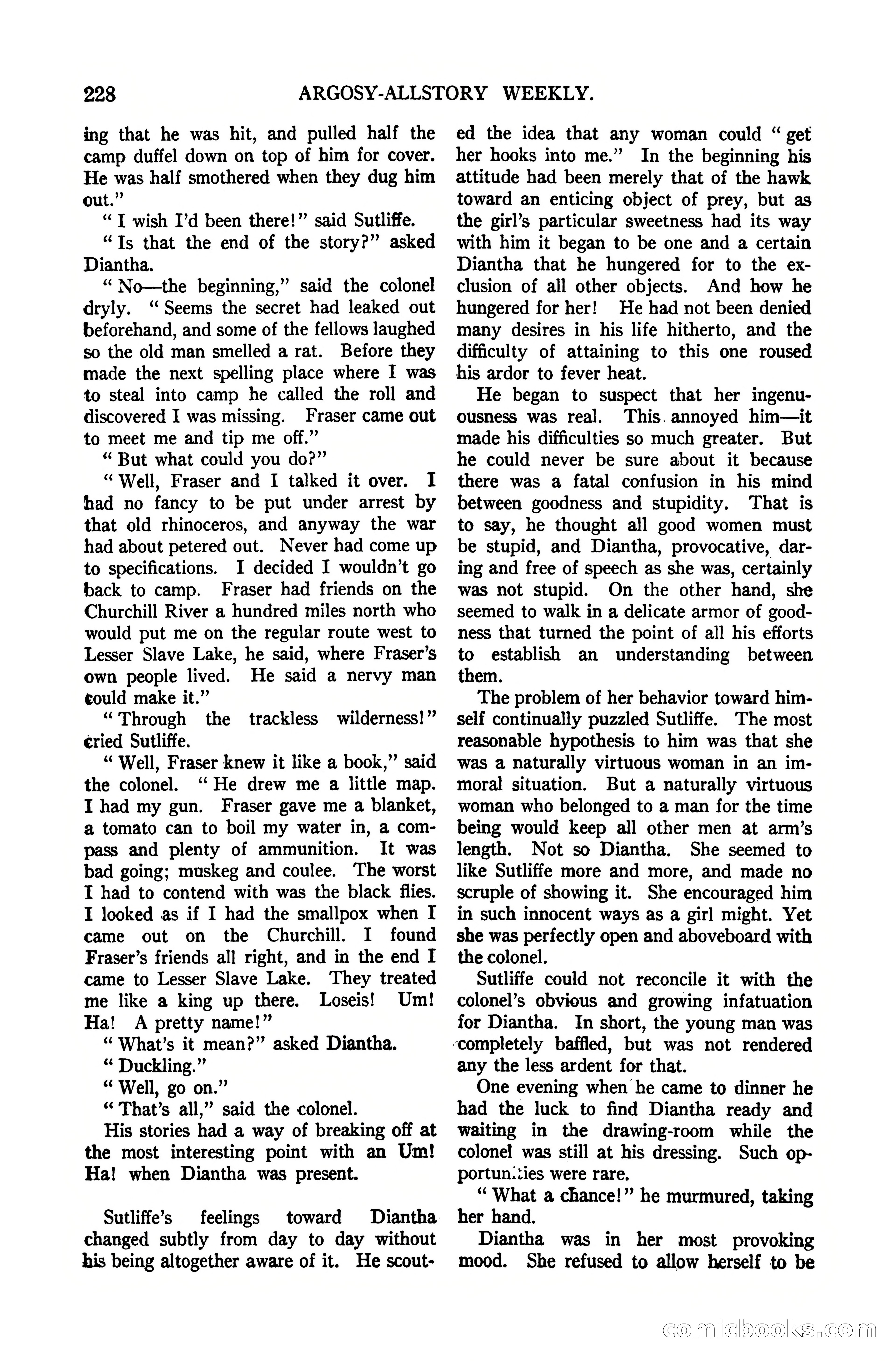
A restored page from Pulp Fiction, 1922. Page through the whole issue in the reader above.
📄 Transcribed text from this page (OCR, searchable)
Machine-transcribed from the original scan — historical spelling and the odd misread are preserved.
228 ing that he was hit, and pulled half the camp duffel down on top of him for cover. He was half smothered when they dug him out.” “T wish I’d been there!” said Sutliffe. “Ts that the end of the story?” asked Diantha. “ No—the beginning,” said the colonel dryly. ‘Seems the secret had leaked out beforehand, and some of the fellows laughed so the old man smelled a rat. Before they made the next spelling place where I was to steal into camp he called the roll and discovered I was missing. Fraser came out to meet me and tip me off.” “ But what could you do?” “ Well, Fraser and I talked it over. I had no fancy to be put under arrest by that old rhinoceros, and anyway the war had about petered out. Never had come up to specifications. I decided I wouldn’t go back to camp. Fraser had friends on the Churchill River a hundred miles north who would put me on the regular route west to Lesser Slave Lake, he said, where Fraser’s own people lived. He said a nervy man could make it.”’ “Through the trackless wilderness!” éried Sutliffe. “ Well, Fraser knew it like a book,” said the colonel. ‘‘ He drew me a little map. I had my gun. Fraser gave me a blanket, a tomato can to boil my water in, a com- pass and plenty of ammunition. It was bad going; muskeg and coulee. The worst I had to contend with was the black flies. I looked as if I had the smallpox when I came out on the Churchill. I found Fraser’s friends all right, and in the end I came to Lesser Slave Lake. ‘They treated me like a king up there. Loseis! Um! Ha! A pretty name!” “ What’s it mean?” asked Diantha. ** Duckling.” “Well, go on.” “ That’s all,” said the colonel. His stories had a way of breaking off at the most interesting point with an Um! Ha! when Diantha was present. Sutliffe’s feelings changed subtly from day to day without his being altogether aware of it. He scout- toward Diantha ARGOSY-ALLSTORY WEEKLY. ed the idea that any woman could “ get her hooks into me.” In the beginning his attitude had been merely that of the hawk toward an enticing object of prey, but as the girl’s particular sweetness had its way with him it began to be one and a certain Diantha that he hungered for to the ex- clusion of all other objects. And how he hungered for her! He had not been denied many desires in his life hitherto, and the difficulty of attaining to this one roused his ardor to fever heat. He began to suspect that her ingenu- ousness was real. This. annoyed him—it made his difficulties so much greater. But he could never be sure about it because there was a fatal confusion in his mind between goodness and stupidity. That is to say, he thought all good women must be stupid, and Diantha, provocative, dar- ing and free of speech as she was, certainly was not stupid. On the other hand, she seemed to walk in a delicate armor of good- ness that turned the point of all his efforts to establish an understanding between them. The problem of her behavior toward him- self continually puzzled Sutliffe. The most reasonable hypothesis to him was that she was a naturally virtuous woman in an im- moral situation. But a naturally virtuous woman who belonged to a man for the time being would keep all other men at arm’s length. Not so Diantha. She seemed to like Sutliffe more and more, and made no scruple of showing it. She encouraged him in such innocent ways as a girl might. Yet she was perfectly open and aboveboard with the colonel. Sutliffe could not reconcile it with the colonel’s obvious and growing infatuation for Diantha. In short, the young man was ‘completely baffled, but was not rendered any the less ardent for that. One evening when he came to dinner he had the luck to find Diantha ready and waiting in the drawing-room while the colonel was still at his dressing. Such op- portun.cies were rare. “What a chance!” he murmured, taking her hand. Diantha was in her most provoking mood. She refused to allow herself to be comicboooks C©