
Pulp Fiction, 1950 · page 119 of 132
Avon Fantasy Reader No. 14 — page 119: what you’re looking at
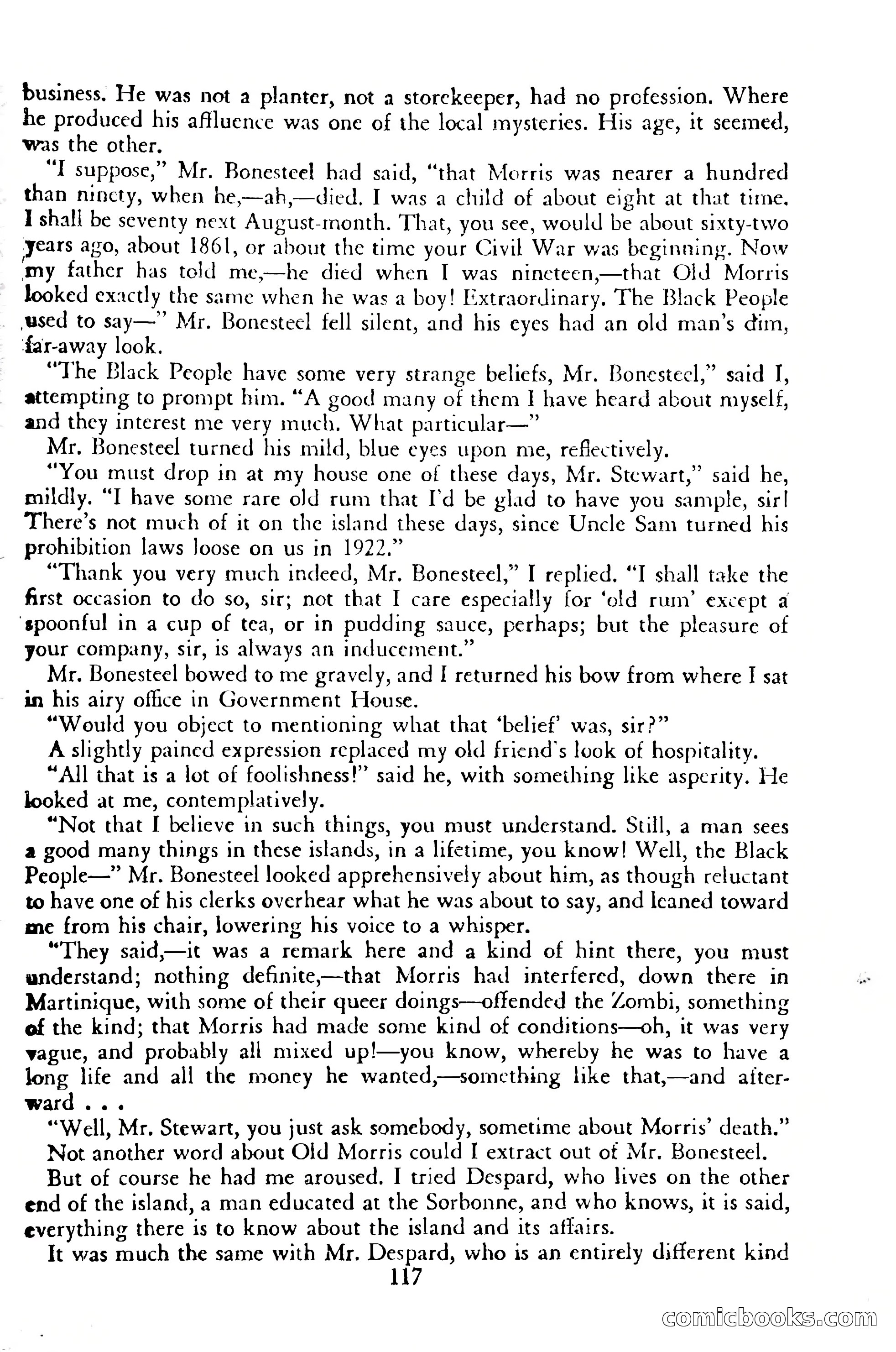
A restored page from Pulp Fiction, 1950. Page through the whole issue in the reader above.
📄 Transcribed text from this page (OCR, searchable)
Machine-transcribed from the original scan — historical spelling and the odd misread are preserved.
business. He was not a planter, not a storekeeper, had no profession. Where he produced his affluence was one of the local mysteries. His age, it seemed, was the other. “I suppose,” Mr. Bonesteel had said, “that Morris was nearer a hundred than nincty, when he,—ah,—died. I was a child of about eight at that time. I shall be seventy next August-month. That, you see, would be about sixty-two years ago, about 1861, or about the time your Civil War was beginning. Now my father has told me,—he died when I was nineteen,—that Old Morris looked exactly the same when he was a boy! Extraordinary. The Black People jused to say—” Mr. Bonesteel fell silent, and his eyes had an old man’s dim, far-away look. “The Black People have some very strange beliefs, Mr. Bonestecl,” said J, attempting to prompt him. “A good many of them I have heard about myself, and they interest me very much. What particular—” Mr. Bonesteel turned his mild, blue eyes upon me, reflectively. “You must drop in at my house one of these days, Mr. Stewart,” said he, mildly. “I have some rare old rum that I'd be glad to have you sample, sir! There’s not much of it on the island these days, since Uncle Sam turned his prohibition laws Joose on us in 1922.” “Thank you very much indeed, Mr. Bonesteel,” I replied. “I shall take the first occasion to do so, sir; not that I care especially for ‘old rum’ except a ‘spoonful in a cup of tea, or in pudding sauce, perhaps; but the pleasure of your company, sir, is always an inducement.” Mr. Bonesteel bowed to me gravely, and I returned his bow from where I sat in his airy office in Government House. “Would you object to mentioning what that ‘belief’ was, sir?” A slightly pained expression replaced my old friend's look of hospitality. “All that is a lot of foolishness!” said he, with something like asperity. He looked at me, contemplatively. “Not that I believe in such things, you must understand. Still, a man sees a good many things in these islands, in a lifetime, you know! Well, the Black People—” Mr. Bonesteel looked apprehensively about him, as though reluctant to have one of his clerks overhear what he was about to say, and leaned toward me from his chair, lowering his voice to a whisper. “They said,—it was a remark here and a kind of hint there, you must understand; nothing definite,—that Morris had interfered, down there in Martinique, with some of their queer doings—offended the Zombi, something of the kind; that Morris had made some kind of conditions—oh, it was very vague, and probably all mixed up!—you know, whereby he was to have a long life and all the money he wanted,—something like that,—and aiter- ward... “Well, Mr. Stewart, you just ask somebody, sometime about Morris’ death.” Not another word about Old Morris could [ extract out of Mr. Bonesteel. But of course he had me aroused. I tried Despard, who lives on the other end of the island, a man educated at the Sorbonne, and who knows, it is said, everything there is to know about the island and its affairs. It was much the same with Mr. Despard, who is an entirely different kind 117 comicbooks.com