
Pulp Fiction, 1868 · page 14 of 97
Ballou's Monthly Magazine, Vol. XXVII, No. 1 — page 14: what you’re looking at
A restored page from Pulp Fiction, 1868. Page through the whole issue in the reader above.
📄 Transcribed text from this page (OCR, searchable)
Machine-transcribed from the original scan — historical spelling and the odd misread are preserved.
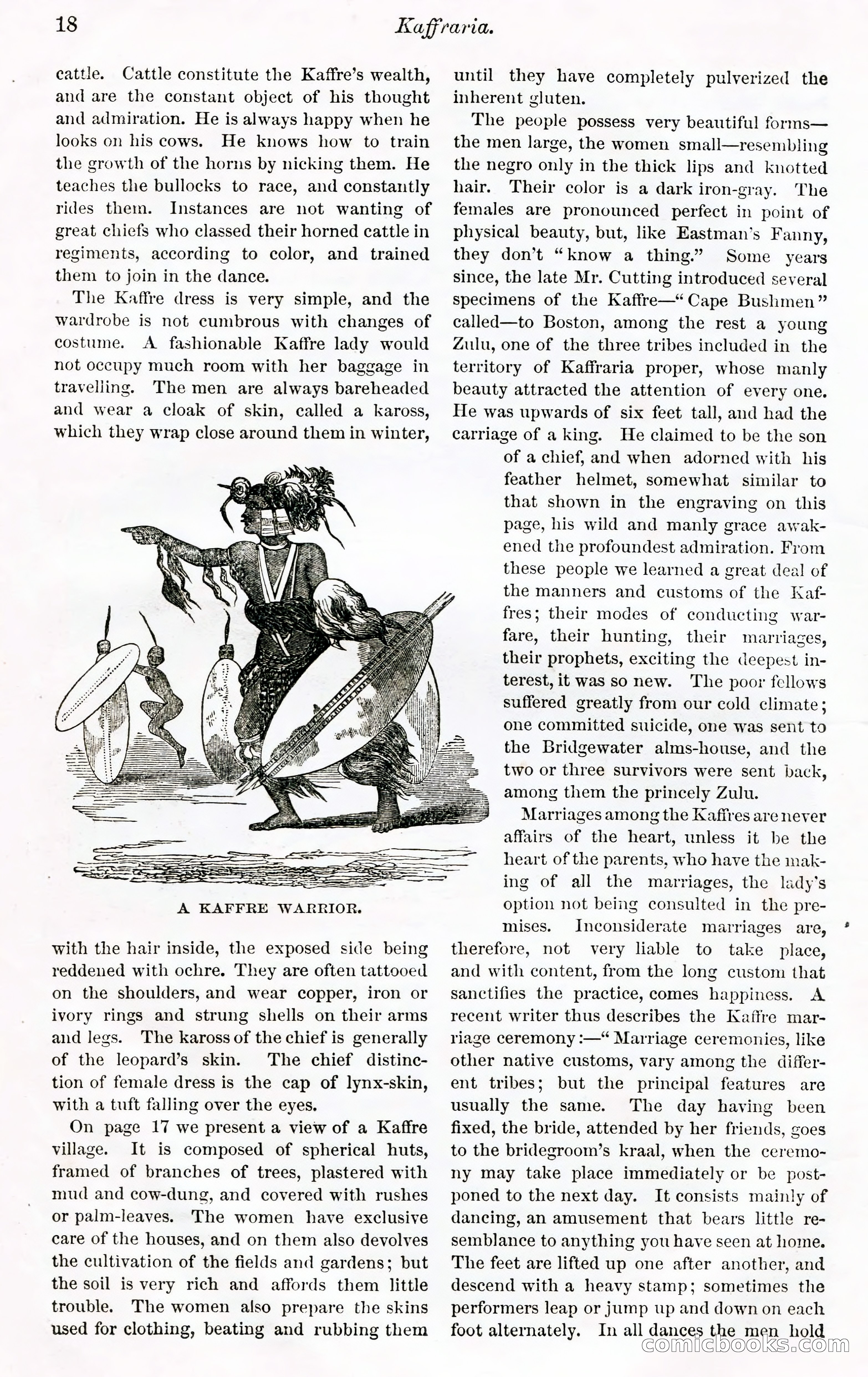
18 cattle. Cattle constitute the Kaffre’s wealth, and are the constant object of his thought and admiration. He is always happy when he looks on his cows. He knows how to train the growth of the horns by nicking them. He teaches the bullocks to race, and constantly rides them. Instances are not wanting of great chiefs who classed their horned cattle in regiments, according to color, and trained them to join in the dance. The Kaffre dress is very simple, and the wardrobe is not cumbrous with changes of costume. A fashionable Kaffre lady would not occupy much room with her baggage in travelling. The men are always bareheaded and wear a cloak of skin, called a kaross, which they wrap close around them in winter, Kaffraria. until they have completely pulverized the inherent gluten. The people possess very beautiful forms— the men large, the women small—resembling the negro only in the thick lips and knotted hair. Their color is a dark iron-gray. The females are pronounced perfect in point of physical beauty, but, like Eastman’s Fanny, they don’t “know a thing.” Some years since, the late Mr. Cutting introduced several specimens of the Kaffre—* Cape Bushmen” called—to Boston, among the rest a young Zulu, one of the three tribes included in the territory of Kaffraria proper, whose manly beauty attracted the attention of every one. He was upwards of six feet tall, and had the carriage of a king. He claimed to be the son of a chief, and when adorned with his feather helmet, somewhat similar to that shown in the engraving on this page, his wild and manly grace awak- ened the profoundest admiration. From these people we learned a great deal of the manners and customs of the Kaf- fres; their modes of conducting war- fare, their hunting, their marriages, their prophets, exciting the deepest in- terest, it was sonew. The poor fellows suffered greatly from our cold climate; one committed suicide, one was sent to the Bridgewater alms-house, and the two or three survivors were sent back, among them the princely Zulu. Marriages among the Kafires are never affairs of the heart, unless it be the A KAFFRE WARRIOR. with the hair inside, the exposed side being reddened with ochre. They are often tattooed on the shoulders, and wear copper, iron or ivory rings and strung shells on their arms and legs. The kaross of the chief is generally of the leopard’s skin. The chief distinc- tion of female dress is the cap of lynx-skin, with a tuft falling over the eyes, On page 17 we present a view of a Kaffre village. It is composed of spherical huts, framed of branches of trees, plastered with mud and cow-dung, and covered with rushes or palm-leaves. The women have exclusive care of the houses, and on them also devolves the cultivation of the fields and gardens; but the soil is very rich and affords them little trouble. The women also prepare the skins used for clothing, beating and rubbing them heart of the parents, who have the mak- ing of all the marriages, the lady’s option not being consulted in the pre- mises. Inconsiderate marriages are, therefore, not very liable to take place, and with content, from the long custom that sanctifies the practice, comes happiness. A recent writer thus describes the Kaffre mar- riage ceremony :—“ Marriage ceremonies, like other native customs, vary among the differ- ent tribes; but the principal features are usually the same. The day having been fixed, the bride, attended by her friends, goes to the bridegroom’s kraal, when the ceremo- ny may take place immediately or be post- poned to the next day. It consists mainly of dancing, an amusement that bears little re- semblance to anything you have seen at home. The feet are lifted up one after another, and descend with a heavy stamp; sometimes the performers leap or jump up and down on each foot alternately. In all dances the men_hold COMMUCLOOOKS 1 C@ an