
Pulp Fiction, 1868 · page 22 of 97
Ballou's Monthly Magazine, Vol. XXVII, No. 1 — page 22: what you’re looking at
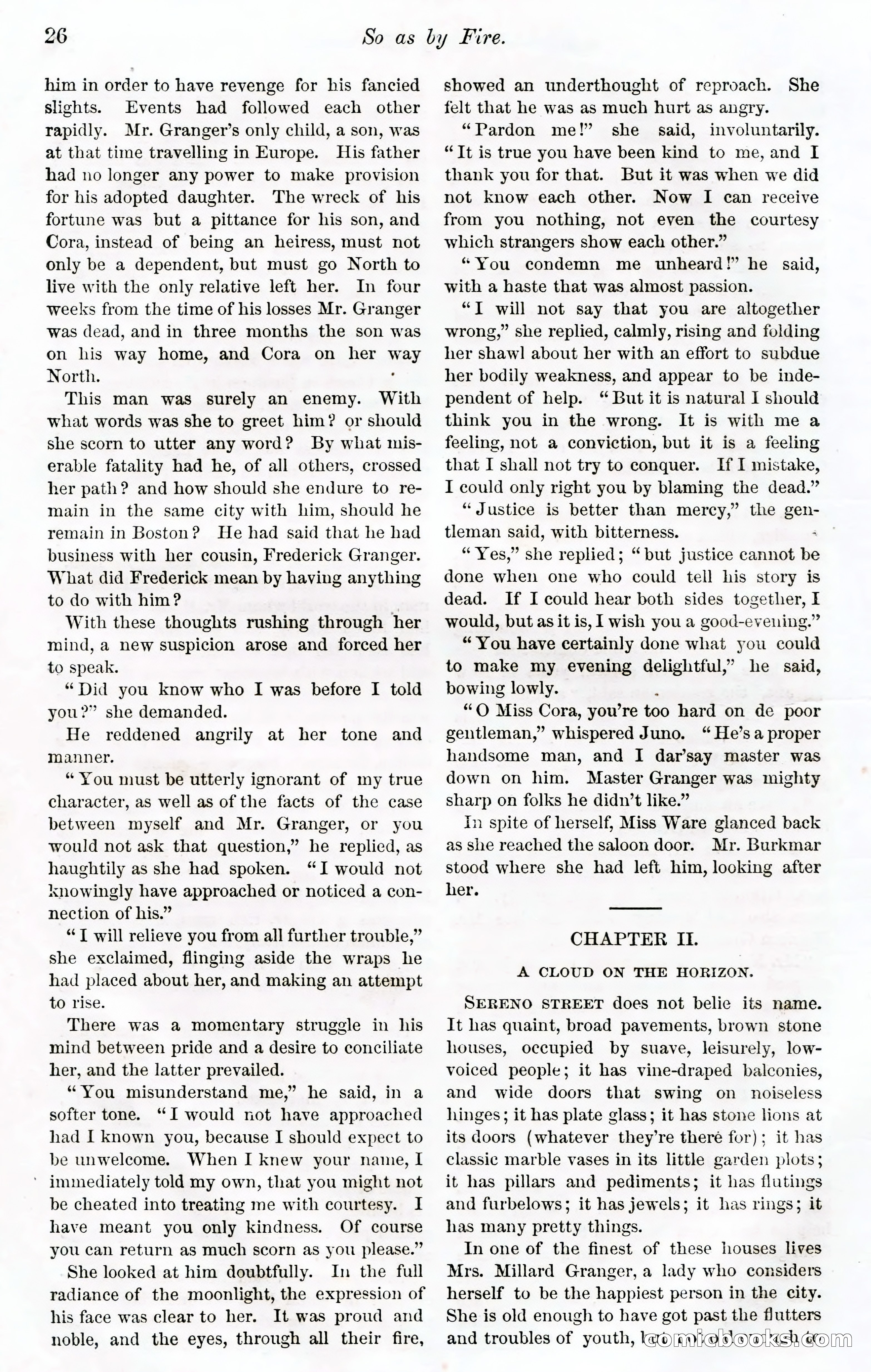
A restored page from Pulp Fiction, 1868. Page through the whole issue in the reader above.
📄 Transcribed text from this page (OCR, searchable)
Machine-transcribed from the original scan — historical spelling and the odd misread are preserved.
26 him in order to have revenge for his fancied slights. Events had followed each other rapidly. Mr. Granger’s only child, a son, was at that time travelling in Europe. His father had no longer any power to make provision for his adopted daughter. The wreck of his fortune was but a pittance for his son, and Cora, instead of being an heiress, must not only be a dependent, but must go North to live with the only relative left her. In four weeks from the time of his losses Mr. Granger was dead, and in three months the son was on his way home, and Cora on her way North. : This man was surely an enemy. With what words was she to greet him? or should she scorn to utter any word? By what mis- erable fatality had he, of all others, crossed her path? and how should she endure to re- main in the same city with him, should he remain in Boston? He had said that he had business with her cousin, Frederick Granger. What did Frederick mean by having anything to do with him ? With these thoughts rushing through her mind, a new suspicion arose and forced her to speak. “Did you know who I was before I told you?” she demanded. He reddened angrily at her tone and manner. “You must be utterly ignorant of my true character, as well as of the facts of the case between myself and Mr. Granger, or you would not ask that question,” he replied, as haughtily as she had spoken. “I would not knowingly have approached or noticed a con- nection of his.” *[ will relieve you from all further trouble,” she exclaimed, flinging aside the wraps he had placed about her, and making an attempt to rise. There was a momentary struggle in his mind between pride and a desire to conciliate her, and the latter prevailed. “You misunderstand me,” he said, in a softer tone. “I would not have approached had I known you, because I should expect to be unwelcome. When I knew your name, I ’ immediately told my own, that you might not be cheated into treating me with courtesy. I have meant you only kindness. Of course you can return as much scorn as you please.” She looked at him doubtfully. In the full radiance of the moonlight, the expression of his face was clear to her. It was proud and noble, and the eyes, through all their fire, So as by Fire. showed an underthought of reproach. She felt that he was as much hurt as angry. “Pardon me!” she said, involuntarily. “Tt is true you have been kind to me, and I thank you for that. But it was when we did not know each other. Now I can receive from you nothing, not even the courtesy which strangers show each other.” “You condemn me unheard!” he said, with a haste that was almost passion. “T will not say that you are altogether wrong,” she replied, calmly, rising and folding her shawl about her with an effort to subdue her bodily weakness, and appear to be inde- pendent of help. “ But it is natural I should think you in the wrong. It is with me a feeling, not a conviction, but it is a feeling that I shall not try to conquer. If I mistake, I could only right you by blaming the dead.” “ Justice is better than mercy,” the gen- tleman said, with bitterness. ‘ “ Yes,” she replied; “but justice cannot be done when one who could tell his story is dead. If I could hear both sides together, I would, but as it is, l wish you a good-evening.” “You have certainly done what you could to make my evening delightful,’ he said, bowing lowly. , “O Miss Cora, you’re too hard on de poor gentleman,” whispered Juno. “He’s a proper handsome man, and I dar’say master was down on him. Master Granger was mighty sharp on folks he didn’t like.” in spite of herself, Miss Ware glanced back as she reached the saloon door. Mr. Burkmar stood where she had left him, looking after her. CHAPTER II. A CLOUD ON THE HORIZON. SERENO STREET does not belie its name. It has quaint, broad pavements, brown stone houses, occupied by suave, leisurely, low- voiced people; it has vine-draped balconies, and wide doors that swing on noiseless hinges; it has plate glass; it has stone lions at its doors (whatever they’re theré for); it has classic marble vases in its little garden plots; it has pillars and pediments; it has flutings and furbelows; it has jewels; it has rings; it has many pretty things. In one of the finest of these houses lives Mrs. Millard Granger, a lady who considers herself to be the happiest person in the city. She is old enough to have got past the flutters and troubles of youth, w@ormyi@sd@w Ghoeonn