
Pulp Fiction, 1868 · page 24 of 97
Ballou's Monthly Magazine, Vol. XXVII, No. 1 — page 24: what you’re looking at
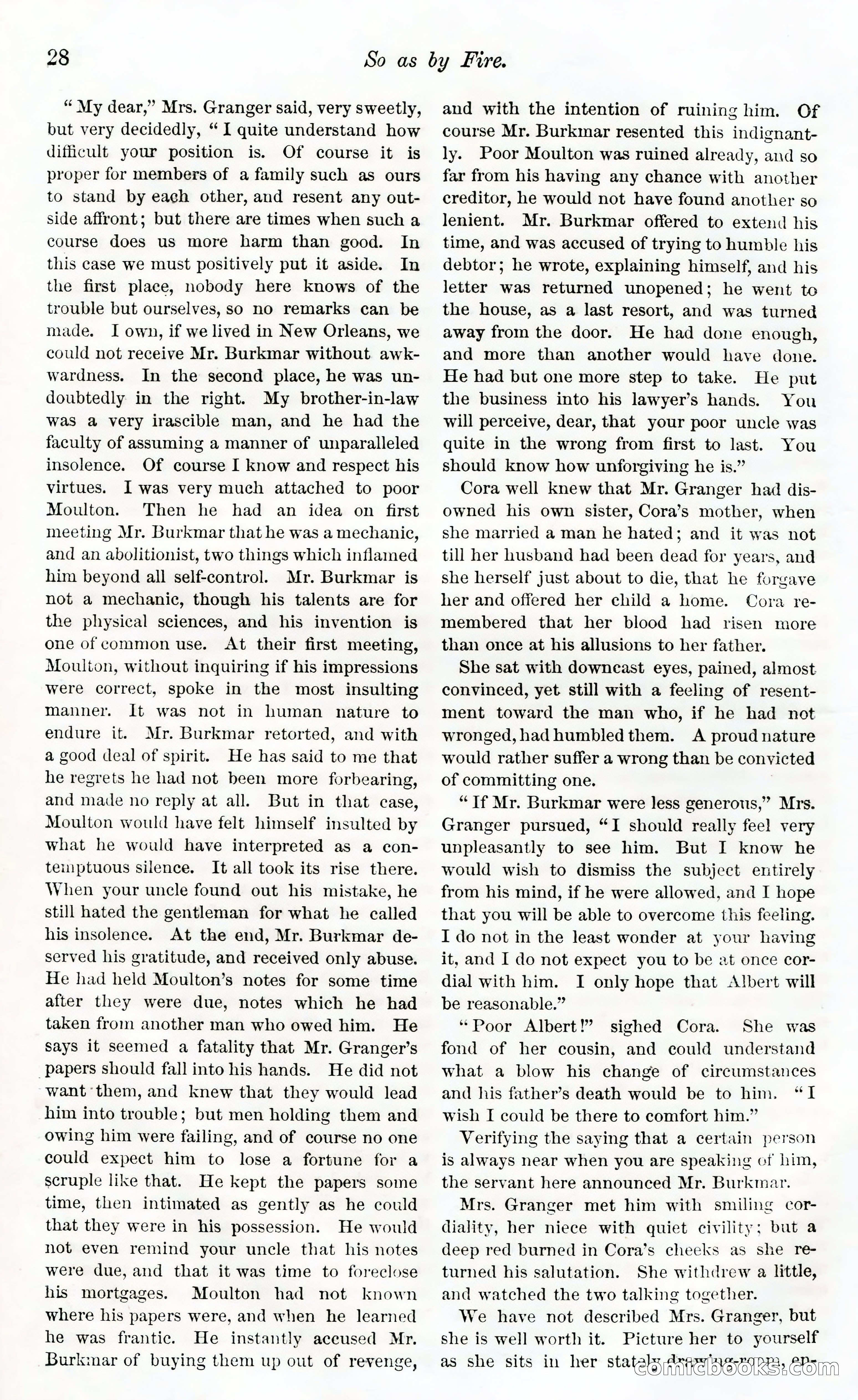
A restored page from Pulp Fiction, 1868. Page through the whole issue in the reader above.
📄 Transcribed text from this page (OCR, searchable)
Machine-transcribed from the original scan — historical spelling and the odd misread are preserved.
28 “ My dear,” Mrs. Granger said, very sweetly, but very decidedly, “ I quite understand how difficult your position is. Of course it is proper for members of a family such as ours to stand by each other, and resent any out- side affront; but there are times when such a course does us more harm than good. In this case we must positively put it aside. In the first place, nobody here knows of the trouble but ourselves, so no remarks can be made. I own, if we lived in New Orleans, we could not receive Mr. Burkmar without awk- wardness. In the second place, he was un- doubtedly in the right. My brother-in-law was a very irascible man, and he had the faculty of assuming a manner of unparalleled insolence. Of course I know and respect his virtues. I was very much attached to poor Moulton. Then he had an idea on first meeting Mr. Burkmar that he was a mechanic, and an abolitionist, two things which inflamed him beyond all self-control. Mr. Burkmar is not a mechanic, though his talents are for the physical sciences, and his invention is one of common use. At their first meeting, Moulton, without inquiring if his impressions were correct, spoke in the most insulting manner. It was not in human nature to endure it. Mr. Burkmar retorted, and with a good deal of spirit. He has said to me that he regrets he had not been more forbearing, and made no reply at all. But in that case, Moulton would have felt himself insulted by what he would have interpreted as a con- teuptuous silence. It all took its rise there. When your uncle found out his mistake, he still hated the gentleman for what he called his insolence. At the end, Mr. Burkmar de- served his gratitude, and received only abuse. He had held Moulton’s notes for some time after they were due, notes which he had taken from another man who owed him. He Says it seemed a fatality that Mr. Granger’s papers should fall into his hands. He did not want them, and knew that they would lead him into trouble; but men holding them and owing him were failing, and of course no one could expect him to lose a fortune for a scruple like that. He kept the papers some time, then intimated as gently as he could that they were in his possession. He would not even remind your uncle that his notes were due, and that it was time to foreclose his mortgages. Moulton had not known where his papers were, and when he learned he was frantic. He instantly accused Mr. Burkmar of buying them up out of revenge, So as by Fire. and with the intention of ruining him. Of course Mr. Burkmar resented this indignant- ly. Poor Moulton was ruined already, and so far from his having any chance with another creditor, he would not have found another so lenient. Mr. Burkmar offered to extend his time, and was accused of trying to humble his debtor; he wrote, explaining himself, and his letter was returned unopened; he went to the house, as a last resort, and was turned away from the door. He had done enough, and more than another would have done. He had but one more step to take. He put the business into his lawyer’s hands. You will perceive, dear, that your poor uncle was quite in the wrong from first to last. You should know how unforgiving he is.” Cora well knew that Mr. Granger had dis- owned his own sister, Cora’s mother, when she married a man he hated; and it was not till her husband had been dead for years, and she herself just about to die, that he forgave her and offered her child a home. Cora re- membered that her blood had risen more than once at his allusions to her father. She sat with downcast eyes, pained, almost convinced, yet still with a feeling of resent- ment toward the man who, if he had not wronged, had humbled them. A proud nature would rather suffer a wrong than be convicted of committing one. “If Mr. Burkmar were less generous,” Mrs. Granger pursued, “I should really fee! very unpleasantly to see him. But I know he would wish to dismiss the subject entirely from his mind, if he were allowed, and I hope that you will be able to overcome this feeling. I do not in the least wonder at your having it, and I do not expect you to be at once cor- dial with him. I only hope that Albert will be reasonable.” “Poor Albert!” sighed Cora. She was fond of her cousin, and could understand what a blow his change of circumstances and his father’s death would be to him. “TI wish I could be there to comfort him.” Verifying the saying that a certain person is always near when you are speaking of him, the servant here announced Mr. Burkmar. Mrs. Granger met him with smiling cor- diality, her niece with quiet civility; but a deep red burned in Cora’s cheeks as she re- turned his salutation. She withdrew a little, and watched the two talking together. We have not described Mrs. Granger, but she is well worth it. Picture her to yourself as she sits in her statala dnqaiyanqres ERs