
Pulp Fiction, 1868 · page 33 of 97
Ballou's Monthly Magazine, Vol. XXVII, No. 1 — page 33: what you’re looking at
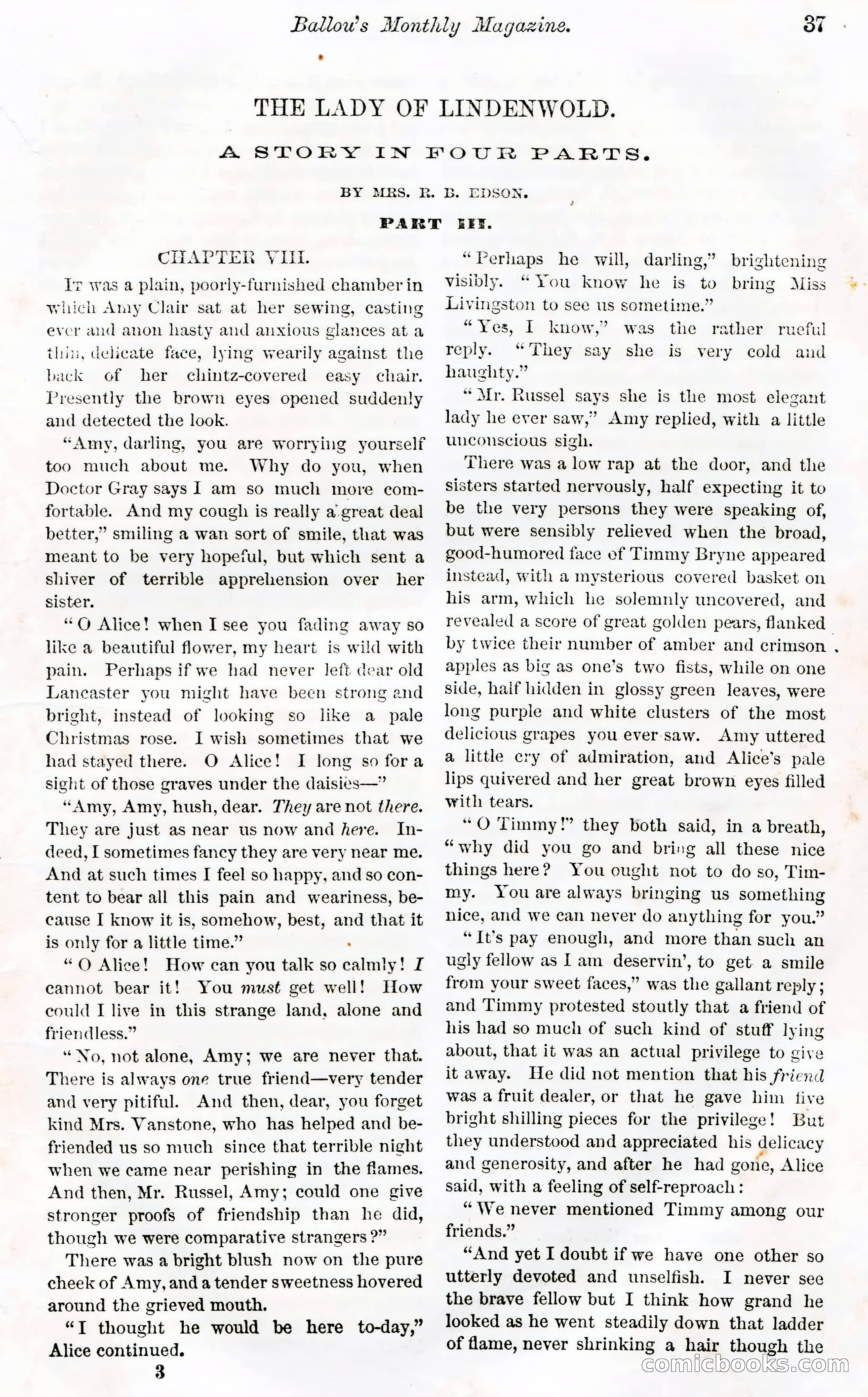
A restored page from Pulp Fiction, 1868. Page through the whole issue in the reader above.
📄 Transcribed text from this page (OCR, searchable)
Machine-transcribed from the original scan — historical spelling and the odd misread are preserved.
Ballou’s Monthly Magazine. THE LADY OF LINDENWOLD. kk SPronmy tw POU PAR Ts. BY MBS. R. B. EDSON. PART CHAPTER VIIL. Tr was a plain, poorly-furnished chamber in which Amy Clair sat at her sewing, casting ever and anon hasty and anxious glances at a thin, delicate face, lying wearily against the back of her chintz-covered easy -chair. Presently the brown eyes opened suddenly and detected the look. “Amy, darling, you are worryiug yourself too much about me. Why do you, when Doctor Gray says I am so much more com- fortable. And my cough is really a great deal better,” smiling a wan sort of smile, that was meant to be very hopeful, but which sent a shiver of terrible apprehension over her sister. “QO Alice! when I see you fading away so like a beautiful flower, my heart is wild with pain. Perhaps if we had never left dear old Lancaster you might have been strong and bright, instead of looking so like a pale Christmas rose. I wish sometimes that we had stayed there. O Alice! I long so fora sight of those graves under the daisies—” “Amy, Amy, hush, dear. They are not there. They are just as near us now and here. In- deed, I sometimes fancy they are very near me. And at such times I feel so happy, and so con- tent to bear all this pain and weariness, be- cause I know it is, somehow, best, and that it is only for a little time.” : “© Alice! How can you talk so calmly! I cannot bear it! You must get well! How eould I live in this strange land, alone and friendless.” “No, not alone, Amy; we are never that. There is always one true friend—very tender and very pitiful. And then, dear, you forget kind Mrs. Vanstone, who has helped and be- friended us so much since that terrible night when we came near perishing in the flames. And then, Mr. Russel, Amy; could one give stronger proofs of friendship than he did, though we were comparative strangers ?” There was a bright blush now on the pure cheek of Amy, and a tender sweetness hovered around the grieved mouth. “T thought he would be here to-day,” Alice continued. 3 REE. “Perhaps he will, darling,” visibly. brightening “You know he is to bring Miss ivingston to see us sometime.” “Yes, I know,” was the rather rueful reply. “They say she is very cold and haughty.” “Mr. Russel says she is the most elegant lady he ever saw,” Amy replied, with a little unconscious sigh. There was a low rap at the door, and the sisters started nervously, half expecting it to be the very persons they were speaking of, but were sensibly relieved when the broad, good-humored face of Timmy Bryne appeared instead, with a mysterious covered basket on his arm, which he solemnly uncovered, and revealed a score of great golden pears, flanked by twice their number of amber and crimson , apples as big as one’s two fists, while on one side, haif hidden in glossy green leaves, were Jong purple and white clusters of the most delicious grapes you ever saw. Amy uttered a little cry of admiration, and Alice’s pale lips quivered and her great brown eyes filled with tears. “OQ Timmy!” they both said, in a breath, “why did you go and bring all these nice things here? You ought not to do so, Tim- my. You are always bringing us something nice, and we can never do anything for you.” “It’s pay enough, and more than such an ugly fellow as J am deservin’, to get. a smile from your sweet faces,” was the gallant reply; and Timmy protested stoutly that a friend of his had so much of such kind of stuff lying about, that it was an actual privilege to give it away. He did not mention that his friend was a fruit dealer, or that he gave him five bright shilling pieces for the privilege! But they understood and appreciated his delicacy and generosity, and after he had gone, Alice said, with a feeling of self-reproach: “We never mentioned Timmy among our friends.” “And yet I doubt if we have one other so utterly devoted and unselfish. I never see the brave fellow but I think how grand he looked as he went steadily down that ladder of flame, never shrinking a hair though the coniclooks. corn