
Pulp Fiction, 1868 · page 36 of 97
Ballou's Monthly Magazine, Vol. XXVII, No. 1 — page 36: what you’re looking at
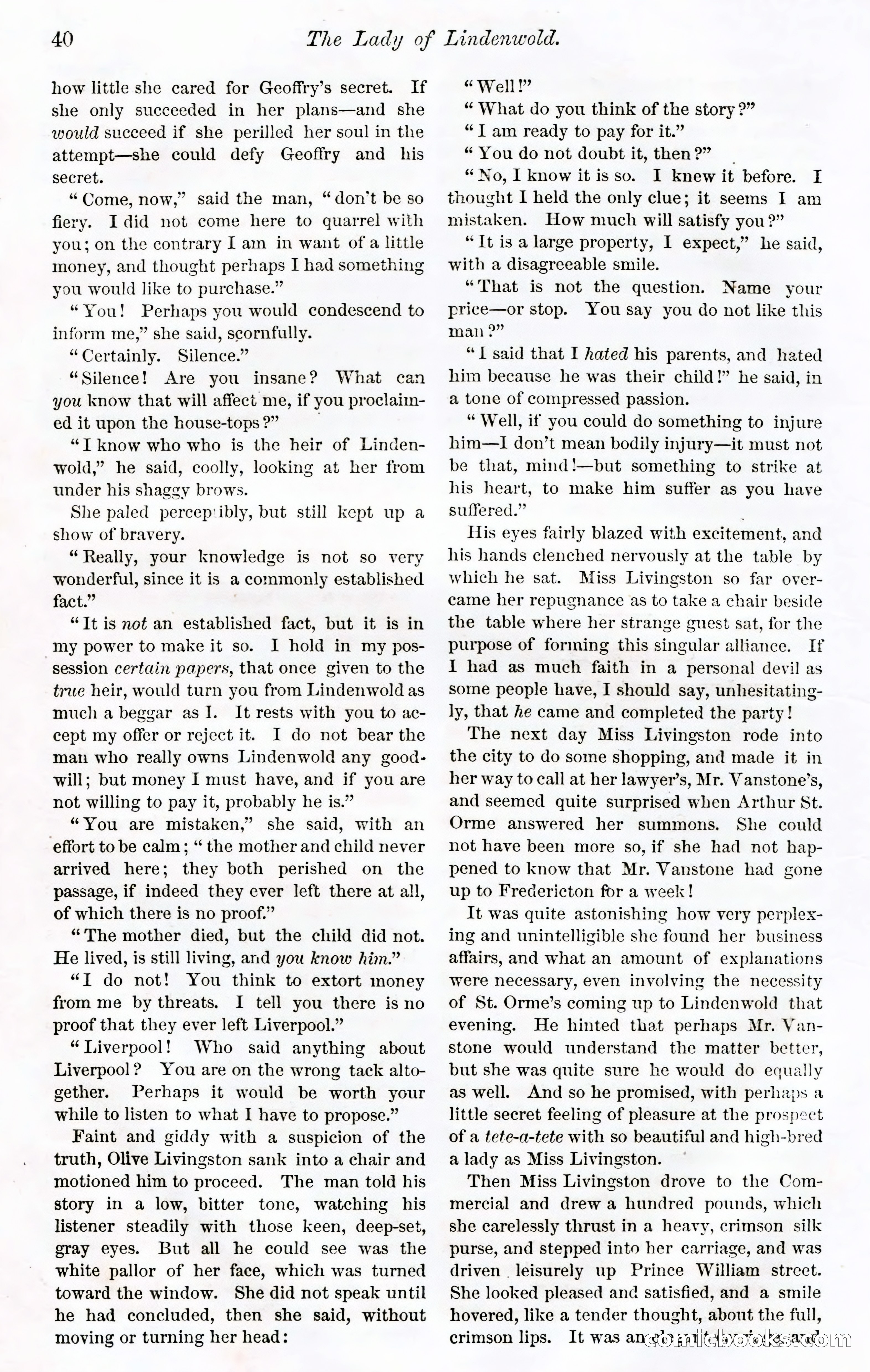
A restored page from Pulp Fiction, 1868. Page through the whole issue in the reader above.
📄 Transcribed text from this page (OCR, searchable)
Machine-transcribed from the original scan — historical spelling and the odd misread are preserved.
40) how little she cared for Geoffry’s secret. If she only succeeded in her plans—and she would succeed if she perilled her soul in the attempt—she could defy Geoffry and his secret. “Come, now,” said the man, “don’t be so fiery. Idid not come here to quarrel with you; on the contrary I am in want of a little money, and thought perhaps I had something you would like to purchase.” “You! Perhaps you would condescend to inform me,” she said, scornfully. “Certainly. Silence.” “Silence! Are you insane? What can you know that will affect me, if you proclaimn- ed it upon the house-tops 2” “T know who who is the heir of Linden- wold,” he said, coolly, looking at her from under his shaggy brows. She paled percep: ibly, but still kept up a show of bravery. “Really, your knowledge is not so very wonderful, since it is a commonly established fact.” “Tt is not an established fact, but it is in my power to make it so. I hold in my pos- session certain papers, that once given to the true heir, would turn you from Lindenwold as much a beggar as I. It rests with you to ac- cept my offer or reject it. I do not bear the man who really owns Lindenwold any good- will; but money I must have, and if you are not willing to pay it, probably he is.” “You are mistaken,” she said, with an effort to be calm; ‘ the mother and child never arrived here; they both perished on the passage, if indeed they ever left there at all, of which there is no proof.” “The mother died, but the child did not. He lived, is still living, and you know him.” “TI do not! You think to extort money from me by threats. I tell you there is no proof that they ever left Liverpool.” “Liverpool! Who said anything about Liverpool? You are on the wrong tack alto- gether. Perhaps it would be worth your while to listen to what I have to propose.” Faint and giddy with a suspicion of the truth, Olive Livingston sank into a chair and motioned him to proceed. The man told his story in a low, bitter tone, watching his listener steadily with those keen, deep-set, gray eyes. But all he could see was the white pallor of her face, which was turned toward the window. She did not speak until he had concluded, then she said, without moving or turning her head: The Lady of Lindenwold. “Well!” “ What do you think of the story ?” “TI am ready to pay for it.” “ You do not doubt it, then?” _ “No, I know it isso. I knew it before. I thought I held the only clue; it seems I am mistaken. How much will satisfy you ?” “It is a large property, I expect,” he said, with a disagreeable smile. “That is not the question. Name your price—or stop. You say you do not like this man 2?” “TY said that I hated his parents, and hated him because he was their child!” he said, in a tone of compressed passion. “ Well, if you could do something to injure him—I don’t mean bodily injury—it must not be that, mind!—but something to strike at his heart, to make him suffer as you haye suffered.” His eyes fairly blazed with excitement, and his hands clenched nervously at the table by which he sat. Miss Livingston so far over- came her repugnance as to take a chair beside the table where her strange guest sat, for the purpose of forming this singular alliance. If I had as much faith in a personal devil as some people have, I should say, unhesitating- ly, that he came and completed the party! The next day Miss Livingston rode into the city to do some shopping, and made it in her way to call at her lawyer’s, Mr. Vanstone’s, and seemed quite surprised when Arthur St. Orme answered her summons. She could not have been more so, if she had not hap- pened to know that Mr. Vanstone had gone up to Fredericton for a week! It was quite astonishing how very perplex- ing and unintelligible she found her business affairs, and what an amount of explanations were necessary, even involving the necessity of St. Orme’s coming up to Lindenwold that evening. He hinted that perhaps Mr. Van- stone would understand the matter better, but she was quite sure he would do equally as well. And so he promised, with perhaps a little secret feeling of pleasure at the prospect of a tete-a-tete with so beautiful and high-bred a lady as Miss Livingston. Then Miss Livingston drove to the Com- mercial and drew a hundred pounds, which she carelessly thrust in a heavy, crimson silk purse, and stepped into her carriage, and was driven leisurely up Prince William street. She looked pleased and satisfied, and a smile hovered, like a tender thought, about the full, crimson lips. It was an@oganta aorelresHatornn