
Pulp Fiction, 1868 · page 39 of 97
Ballou's Monthly Magazine, Vol. XXVII, No. 1 — page 39: what you’re looking at
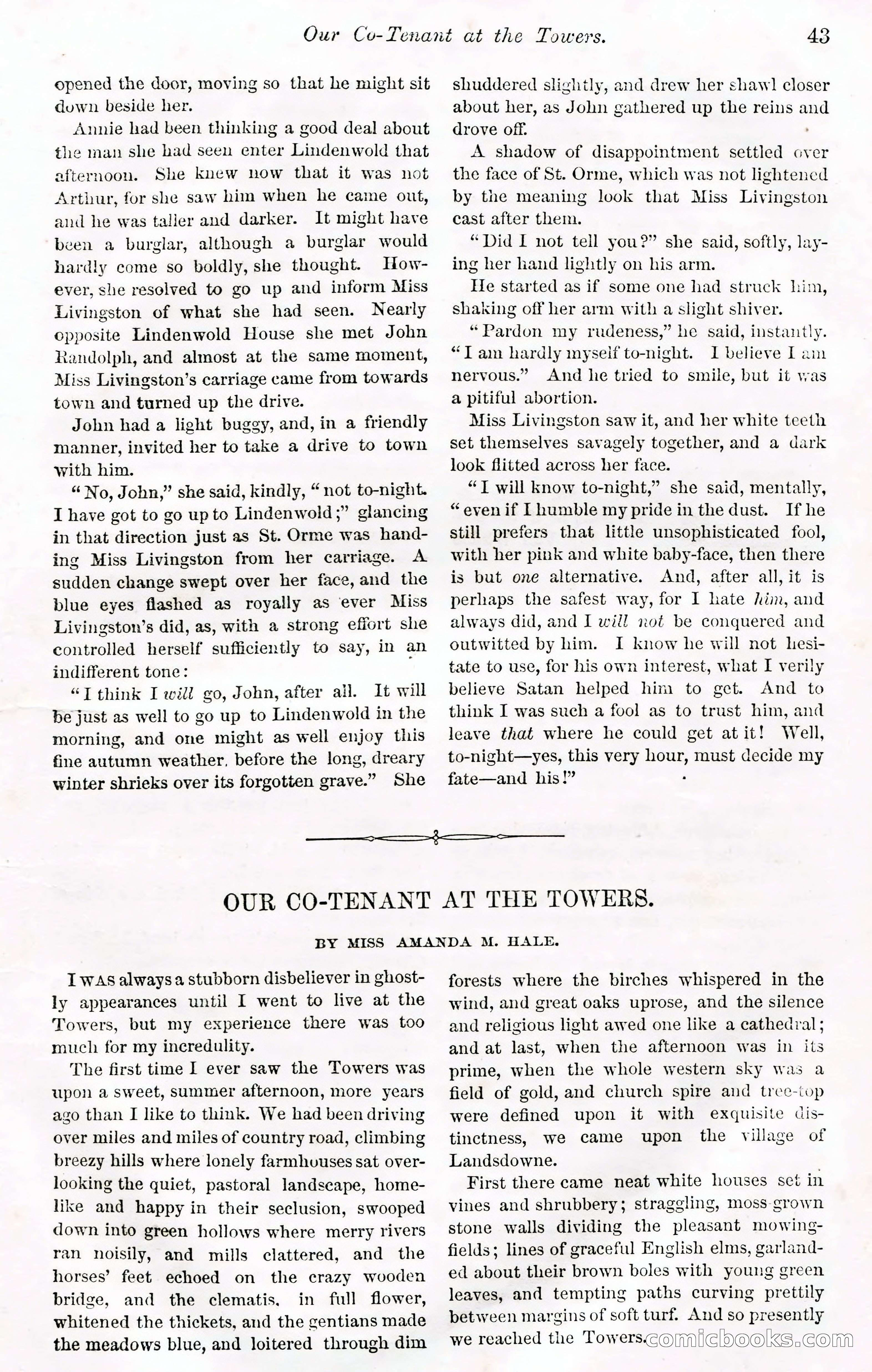
A restored page from Pulp Fiction, 1868. Page through the whole issue in the reader above.
📄 Transcribed text from this page (OCR, searchable)
Machine-transcribed from the original scan — historical spelling and the odd misread are preserved.
Our Co-Tenantét at the Towers. opened the door, moving so that he might sit duwn beside her. Annie had been thinking a good deal about ¢he man she bad seen enter Lindenwold that afternoon. She knew now that it was not Arthur, for she saw him when he came out, and he was taller and darker. It might have been a burglar, although a burglar would hardly come so boldly, she thought. How- ever, she resolved to go up and inform Miss Livingston of what she had seen. Nearly opposite Lindenwold House she met John Randolph, and almost at the same moment, Miss Livingston’s carriage came from towards town and turned up the drive. John had a light buggy, and, in a friendly manner, invited her to take a drive to town with him. “No, John,” she said, kindly, “ not to-night. I have got to go upto Lindenwold ;” glancing in that direction just as St. Orme was hand- ing Miss Livingston from her carriage. A sudden change swept over her face, and the blue eyes flashed as royally as ever Miss Livingston’s did, as, with a strong efiort she controlled herself sufficiently to say, in an indifferent tone: “JT think I will go, John, after all. It will be just as well to go up to Lindenwold in the morning, and one might as well enjoy this fine autumn weather, before the long, dreary winter shrieks over its forgotten grave.” She 43 shuddered slightly, and drew her shaw! closer about her, as John gathered up the reins and drove off. A shadow of disappointment settled over the face of St. Orme, which was not lightened by the meaning look that Miss Livingston cast after them. “Did I not tell you?” she said, softly, lay- ing her hand lightly on his arm. He started as if some one had struck him, shaking off her arm with a slight shiver. “Pardon my rudeness,” he said, instantly. “J am hardly myseif to-night. I believe I am nervous.” And he tried to smile, but it was a pitiful abortion. Miss Livingston saw it, and her white teeth set themselves savagely together, and a dark look flitted across her face. “T will know to-night,” she said, mentally, “even if [humble my pride in the dust. If he still prefers that little unsophisticated fool, with her pink and white baby-face, then there is but one alternative. And, after all, it is perhaps the safest way, for I hate him, and always did, and I will not be conquered and outwitted by him. I know he will not hesi- tate to use, for his own interest, what I verily believe Satan helped him to get. And to think I was such a fool as to trust him, and leave that where he could get atit! Well, to-night—yes, this very hour, must decide my fate—and his!” ; <i OUR CO-TENANT AT THE TOWERS. BY MISS AMANDA M. HALE. I wAs always a stubborn disbeliever in ghost- ly appearances until I went to live at the Towers, but my experience there was too much for my incredulity. The first time I ever saw the Towers was upon a sweet, summer afternoon, more years ago than I like to think. We had been driving over miles and miles of country road, climbing breezy hills where lonely farmhouses sat over- looking the quiet, pastoral landseape, home- like and happy in their seclusion, swooped down into green hollows where merry rivers ran noisily, and mills clattered, and the horses’ feet echoed on the crazy wooden bridge, and the clematis. in full flower, whitened the thickets, and the gentians made the meadows blue, and loitered through dim forests where the birches whispered in the wind, and great oaks uprose, and the silence and religious light awed one like a cathedral; and at last, when the afternoon was in its prime, when the whole western sky was a field of gold, and church spire and tree-iop were defined upon it with exquisite cis- tinctness, we came upon the village of Landsdowne. ; First there came neat white houses set in vines and shrubbery; straggling, moss grown stone walls dividing the pleasant mowing- fields; lines of graceful English elms, garland- ed about their brown boles with young green leaves, and tempting paths curving prettily between margins of soft turf. And so presently we reached the TowerseQpmpicloaoolks Coin