
Pulp Fiction, 1868 · page 5 of 97
Ballou's Monthly Magazine, Vol. XXVII, No. 1 — page 5: what you’re looking at
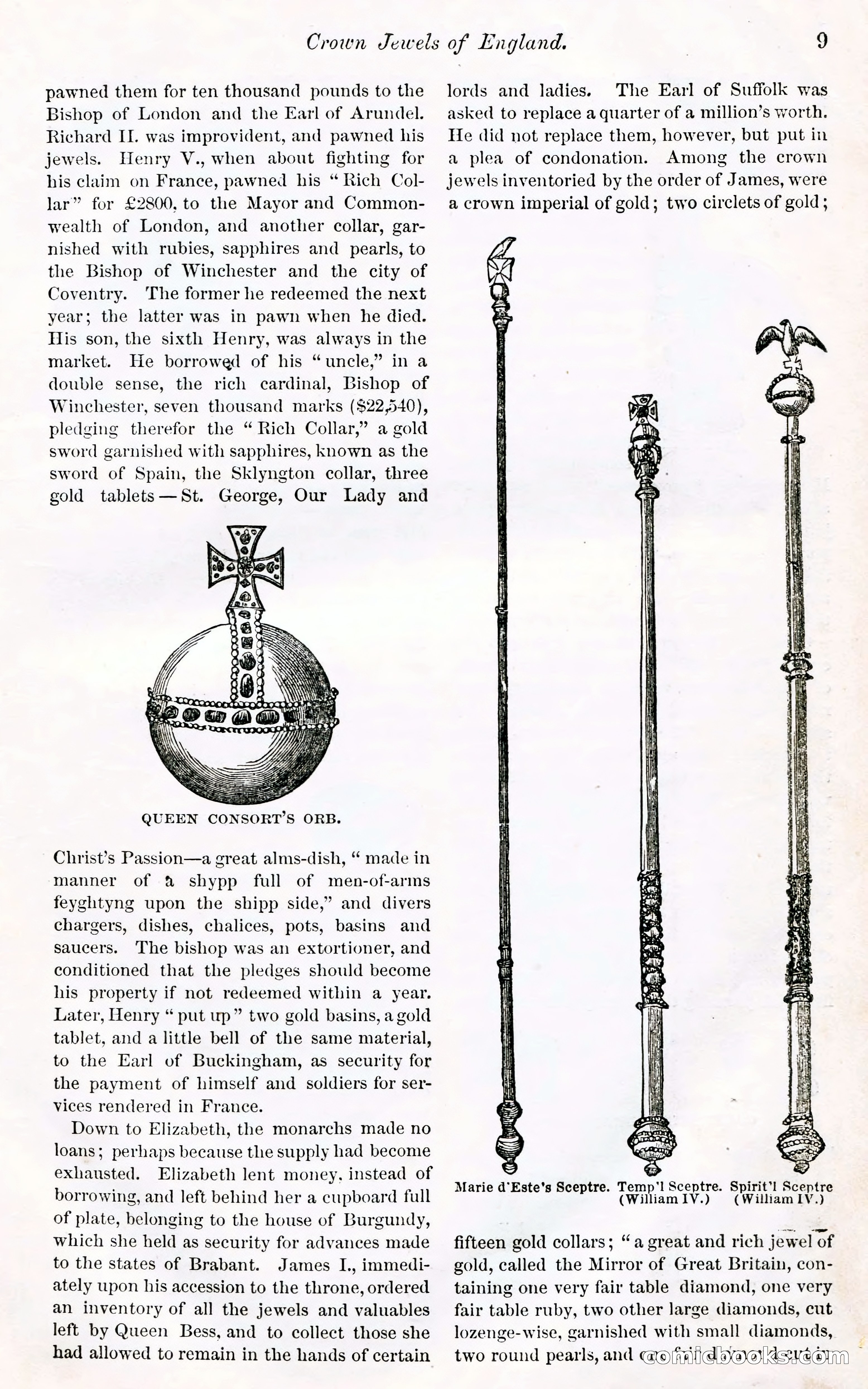
A restored page from Pulp Fiction, 1868. Page through the whole issue in the reader above.
📄 Transcribed text from this page (OCR, searchable)
Machine-transcribed from the original scan — historical spelling and the odd misread are preserved.
Crown Jewels of England. : , pawned them for ten thousand pounds to the Bishop of London and the Earl of Arundel. Richard II. was improvident, and pawned his jewels. Henry V., when about fighting for his claim on France, pawned his “ Rich Col- lar” for £2800, to the Mayor and Common- wealth of London, and another collar, gar- nished with rubies, sapphires and pearls, to the Bishop of Winchester and the city of Coventry. ‘The former he redeemed the next year; the latter was in pawn when he died. His son, the sixth Henry, was always in the market. He borrowed of his “uncle,” in a double sense, the rich cardinal, Bishop of Winchester, seven thousand marks ($22,540), pledging therefor the “ Rich Collar,” a gold sword garnished with sapphires, known as the sword of Spain, the Sklyngton collar, three gold tablets—St. George, Our Lady and QUEEN CONSORT’S ORB. Christ’s Passion—a great alms-dish, “ made in manner of & shypp full of men-of-arms feyghtyng upon the shipp side,” and divers chargers, dishes, chalices, pots, basins and saucers. The bishop was an extortioner, and conditioned that the pledges should become his property if not redeemed within a year. Later, Henry “ put up” two gold basins, a gold tablet, and a little bell of the same material, to the Earl of Buckingham, as security for the payment of himself and soldiers for ser- vices rendered in France. Down to Elizabeth, the monarchs made no loans; perhaps because the supply had become exhausted. Elizabeth lent money, instead of borrowing, and left behind her a cupboard full of plate, belonging to the house of Burgundy, which she held as security for advances made to the states of Brabant. James I., immedi- ately upon his accession to the throne, ordered an inventory of all the jewels and valuables left by Queen Bess, and to collect those she had allowed to remain in the hands of certain lords and ladies. The Earl of Suffolk was asked to replace a quarter of a million’s worth. He did not replace them, however, but put in a plea of condonation. Among the crown jewels inventoried by the order of James, were a crown imperial of gold; two circlets of gold; “a! oo Ves ¢ id 3, ane 4 Marie d'Este’s Sceptre. Temp‘! Sceptre. Spirit'l Sceptre (William IV.) (William LV.) fifteen gold collars; “a great and rich jewel of gold, called the Mirror of Great Britain, con- taining one very fair table diamond, one very fair table ruby, two other large diamonds, cut lozenge-wise, garnished with small diamonds, two round pearls, and c@@/(faiid seve) ASveolyy) —