
Pulp Fiction, 1868 · page 51 of 97
Ballou's Monthly Magazine, Vol. XXVII, No. 1 — page 51: what you’re looking at
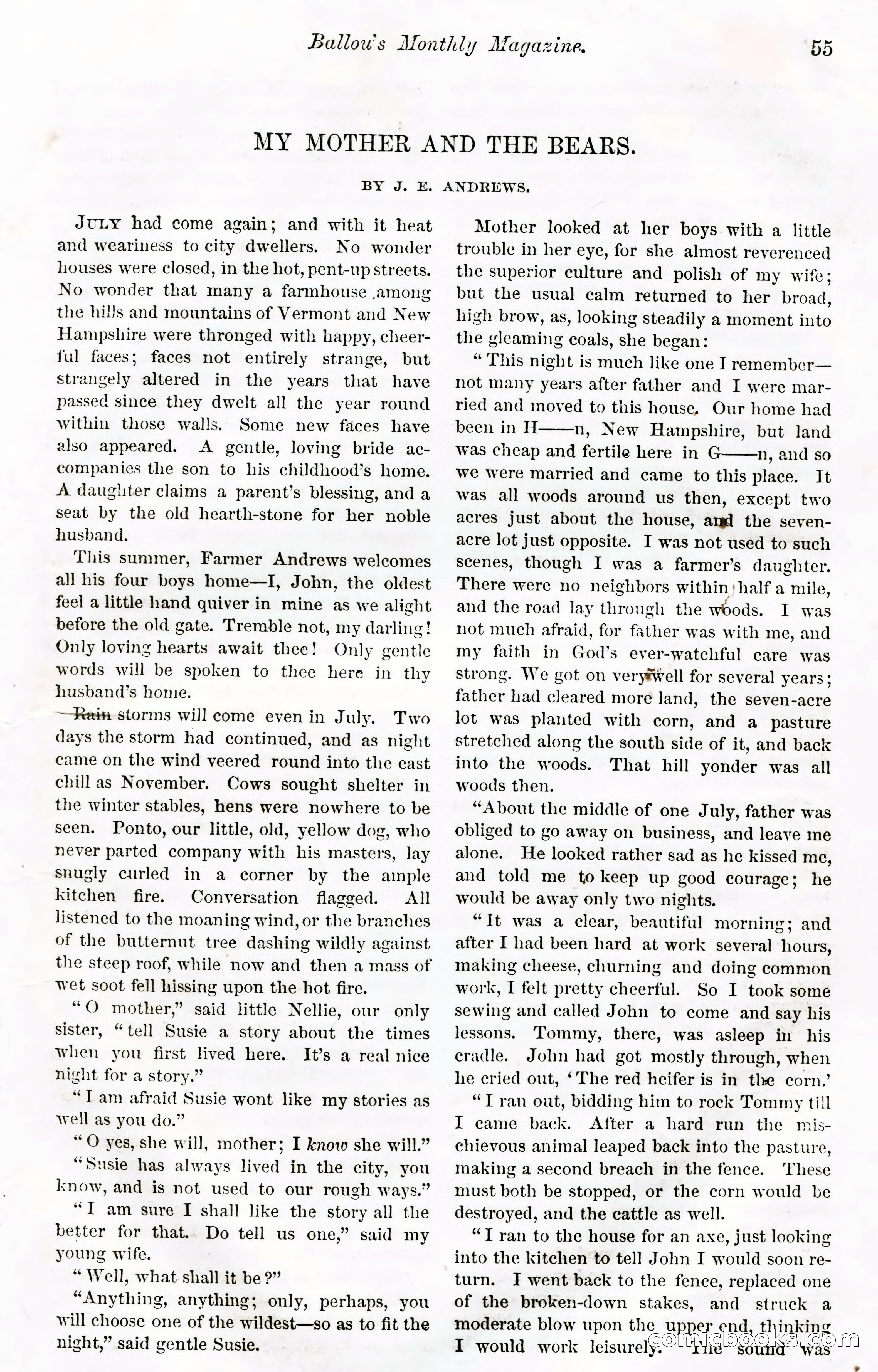
A restored page from Pulp Fiction, 1868. Page through the whole issue in the reader above.
📄 Transcribed text from this page (OCR, searchable)
Machine-transcribed from the original scan — historical spelling and the odd misread are preserved.
Ballou’'s Monthly Magazine. D5 MY MOTHER AND THE BEARS. BY J. E. ANDREWS. JULY had come again; and with it heat and weariness to city dwellers. No wonder houses were closed, in the hot, pent-up streets. No wonder that many a farmhouse among the hills and mountains of Vermont and New Hampshire were thronged with happy, cheer- ful faces; faces not entirely strange, but strangely altered in the years that have passed since they dwelt all the year round within those walls. Some new faces have also appeared. <A gentle, loving bride ac- companies the son to his childhood’s home. A daughter claims a parent’s blessing, and a seat by the old hearth-stone for her noble husband. This summer, Farmer Andrews welcomes all his four boys home—I, John, the oldest feel a little hand quiver in mine as we alight before the old gate. Tremble not, my darling! Only loving hearts await thee! Only gentle words will be spoken to thee here in thy husband’s homie. ~—kein storms will come even in July. Two days the storm had continued, and as night came on the wind veered round into the east chillas November. Cows sought shelter in the winter stables, hens were nowhere to be seen. Ponto, our little, old, yellow dog, who never parted company with his masters, lay snugly curled in a corner by the ample kitchen fire. Conversation flagged. All listened to the moaning wind, or the branches of the butternut tree dashing wildly against the steep roof, while now and then a mass of wet soot fell hissing upon the hot fire. “OQ mother,” said little Nellie, our only sister, “tell Susie a story about the times When you first lived here. It’s a real nice night for a story.” “Tam afraid Susie wont like my stories as well as you do.” “O yes, she will, mother; I know she will.” “Susie has always lived in the city, you know, and is not used to our rough ways.” “I am sure I shall like the story all the better for that. Do tell us one,” said my young wife. “Well, what shall it be 2” “Anything, anything; only, perhaps, you will choose one of the wildest—so as to fit the night,” said gentle Susie. Mother looked at her boys with a little trouble in her eye, for she almost reverenced the superior culture and polish of my wite ; but the usual calm returned to her broad, high brow, as, looking steadily a moment into the gleaming coals, she began: “This night is much like one I remember— not many years after father and I were mar- ried and moved to this house, Our home had been in H——n, New Hampshire, but land was cheap and fertile here in G——n, and so we were married and came to this place. It was all woods around us then, except two acres just about the house, amd the seven- acre lot just opposite. I was not used to such scenes, though I was a farmer’s daughter. There were no neighbors within ‘half a mile, and the road lay through the woods. I was not much afraid, for father was with me, and my faith in God’s ever-watchful care was strong. We got on very#well for several years; father had cleared more land, the seven-acre lot was planted with corn, and a pasture stretched along the south side of it, and back into the woods. That hill yonder was all woods then. “About the middle of one July, father was obliged to go away on business, and leave me alone. He looked rather sad as he kissed me, and told me to keep up good courage; he would be away only two nights. “It was a clear, beautiful morning; and after I had been hard at work several hours, making cheese, churning and doing common work, I felt pretty cheerful. So I took some sewing and called John to come and say his lessons. Tommy, there, was asleep in his cradle. John had got mostly through, when he cried out, ‘The red heifer is in the corn,’ “JT ran out, bidding him to rock Tommy till I came back. After a hard run the mis- chievous animal leaped back into the pasture, making a second breach in the fence. These must both be stopped, or the corn would be destroyed, and the cattle as well. “J ran to the house for an axe, just looking into the kitchen to tell John I would soon re- turn. I went back to the fence, replaced one of the broken-down stakes, and struck a moderate blow upon the upper end Biohe I would work leisurely iyo! SECO in