
Pulp Fiction, 1868 · page 79 of 97
Ballou's Monthly Magazine, Vol. XXVII, No. 1 — page 79: what you’re looking at
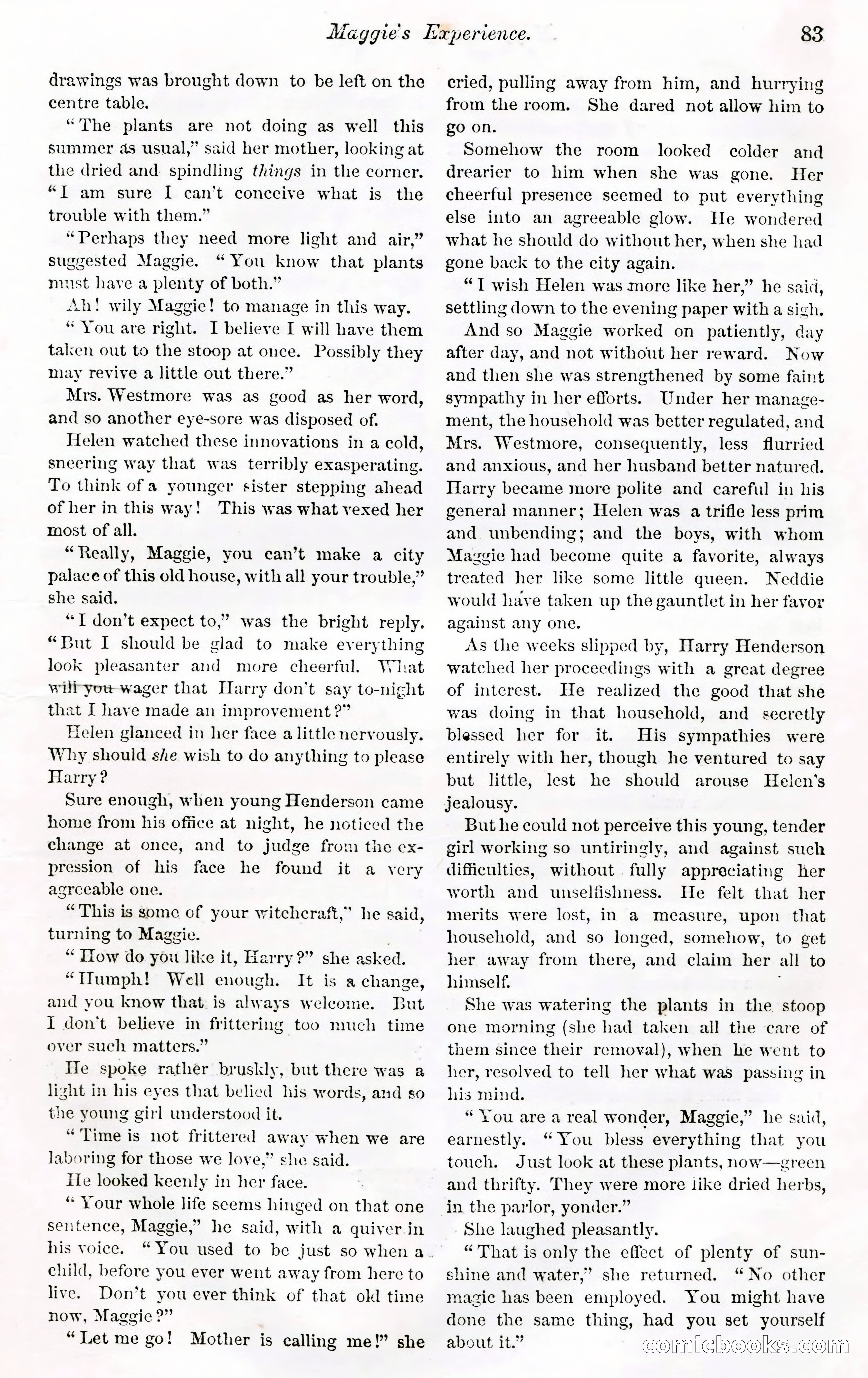
A restored page from Pulp Fiction, 1868. Page through the whole issue in the reader above.
📄 Transcribed text from this page (OCR, searchable)
Machine-transcribed from the original scan — historical spelling and the odd misread are preserved.
Maggie's Lxperience. drawings was brought down to be left on the centre table. “The plants are not doing as well this summer as usual,” said her mother, looking at the dried and. spindling things in the corner. “JT am sure I can’t conceive what is the trouble with them.” “Perhaps they need more light and _ air,” suggested Maggie. “ You know that plants must haye a plenty of both.” Ah! wily Maggie! to manage in this way. “ You are right. I believe I will have them taken out to the stoop at once. Possibly they may revive a little out there.” Mrs. Westmore was as good as her word, and so another eye-sore was disposed of. Melen watched these innovations in a cold, sneering way that was terribly exasperating. To think of a younger sister stepping ahead of her in this way! This was what vexed her most of all. “Really, Maggie, you can’t make a city palace of this old house, with all your trouble,” she said. “IT don’t expect to,” was the bright reply. “But I should be glad to make everything look pleasanter and more cheerful. What will you wager that Ilarry don’t say to-night that [ have made an improvement ?” Helen glanced in her face a little nervously. Vhy should she wish to do anything to please Harry? Sure enough, when young Henderson came home from his office at night, he noticed the change at once, and to judge from the ex- pression of his face he found it a very agreeable one. “This is some of your witchcraft,” he said, turning to Maggie. “ TTow do you like it, Harry ?” she asked. “Wumph! Well enough. It is a change, and you know that: is always welcome. Dut I don't believe in frittering too much time over such matters.” IIe spoke rather bruskly, but there was a light in his eyes that belied his words, and so the young girl understood it. “Time is not frittered away when we are laboring for those we love,” she said. IIe looked keenly in her face. “Your whole life seems hinged on that one sentence, Maggie,” he said, with a quiver.in his voice. child, before you ever went away from here to live. Don’t you ever think of that old time now, Maggie ?” “Let me go! Mother is calling me!” she “You used to be just so when a. 83 cried, pulling away from him, and hurrying from the room. She dared not allow him to go on. Somehow the room looked colder and drearier to him when she was gone. Her cheerful presence seemed to put everything else into an agreeable glow. He wondered what he should do without her, when she had gone back to the city again. “T wish Helen was more like her,” he said, settling down to the evening paper with a sigh. And so Maggie worked on patiently, day after day, and not without her reward. Now and then she was strengthened by some faint sympathy in her efforts. Under her manage- ment, the household was better regulated, and Mrs. Westmore, consequently, less flurried and anxious, and her husband better natured. Harry became more polite and careful in his general manner; Helen was a trifle less prim and unbending; and the boys, with whom Maggie had become quite a favorite, always treated her like some little queen. Neddie would have taken up the gauntlet in her favor against any one. As the weeks slipped by, Harry Henderson watched her proceedings with a great degree of interest. Ile realized the good that she was doing in that household, and secretly blessed her for it. His sympathies were entirely with her, though he ventured to say but little, lest he should arouse Helen's jealousy. But he could not perceive this young, tender girl working so untiringly, and against such difficulties, without fully appreciating her worth and unselfishness. He felt that her merits were lost, in a measure, upon that household, and so longed, somehow, to get her away from there, and claim her all to himself. She was watering the plants in the stoop one morning (she had taken all the care of them since their removal), When he went to her, resolved to tell her what was passing in his mind. “You are a real wonder, Maggie,” he said, earnestly. “ You bless everything that you touch. Just look at these plants, now—green and thrifty. They were more like dried herbs, in the parlor, yonder.” She laughed pleasantly. “That is only the effect of plenty of sun- shine and water,’ she returned. “No other magic has been employed. You might have done the same thing, had you set yourself about it.” connicloooks, cor