
Pulp Fiction, 1935 · page 116 of 132
Bill Barnes Air Adventurer, July 1935 — page 116: what you’re looking at
A restored page from Pulp Fiction, 1935. Page through the whole issue in the reader above.
📄 Transcribed text from this page (OCR, searchable)
Machine-transcribed from the original scan — historical spelling and the odd misread are preserved.
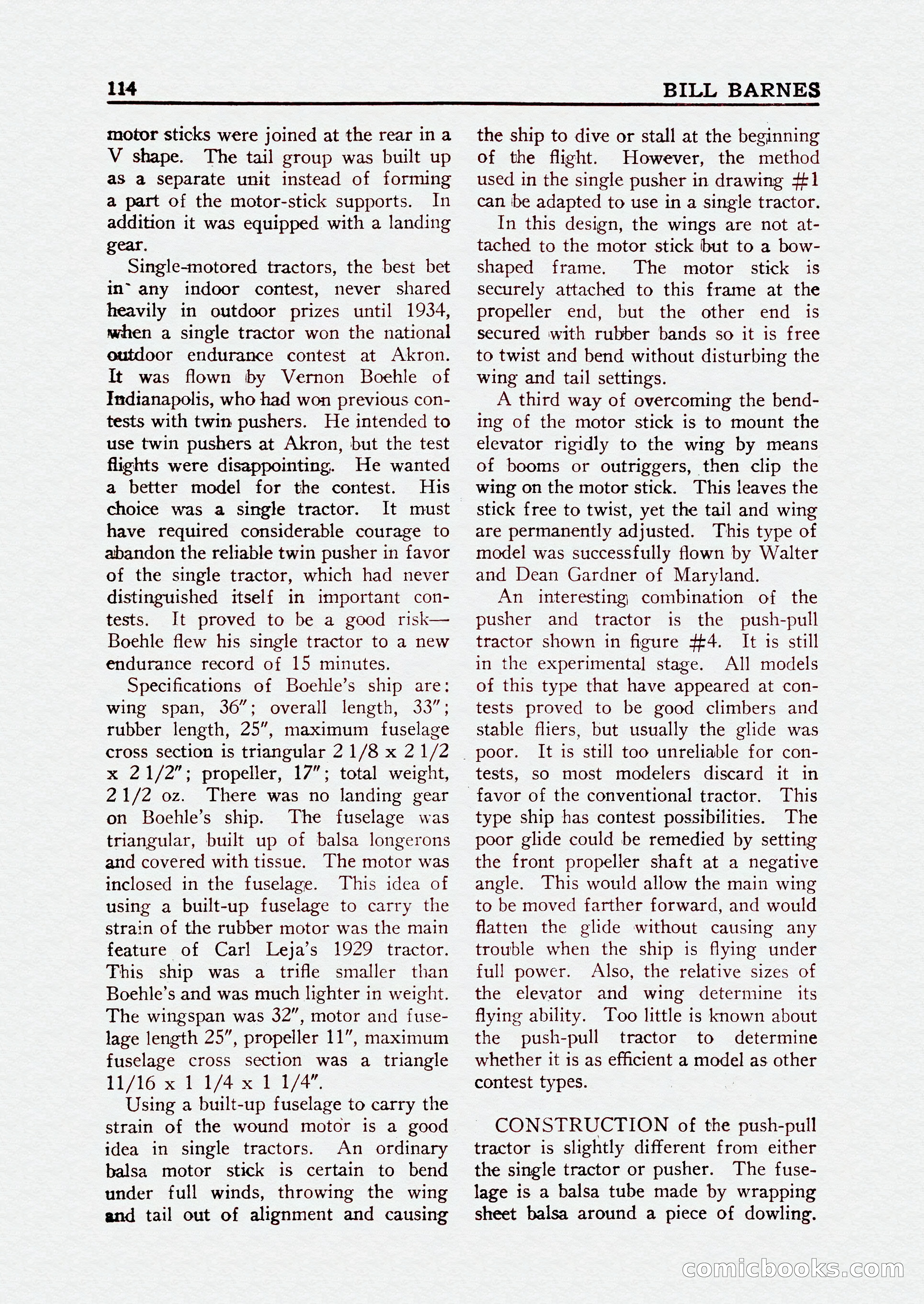
114 BILL BARNES motor sticks were joined at the rear ina V shape. The tail group was built up as a separate unit instead of forming a part of the motor-stick supports. In addition it was equipped with a landing gear. Single-motored tractors, the best bet in> any indoor contest, never shared heavily in outdoor prizes until 1934, when a single tractor won the national outdoor endurance contest at Akron. It was flown by Vernon Boehle of Indianapolis, who had won previous con- tests with twin pushers. He intended to use twin pushers at Akron, but the test flights were disappointing. He wanted a better model for the contest. His choice was a single tractor. have required considerable courage to abandon the reliable twin pusher in favor of the single tractor, which had never distinguished itself in important con- tests. It proved to be a good risk— Boehle flew his single tractor to a new endurance record of 15 minutes. Specifications of Boehle’s ship are: wing span, 36”; overall length, 33”; rubber length, 25”, maximum fuselage cross section is triangular 21/8 x 21/2 x 21/2”; propeller, 17”; total weight, 21/2 oz. There was no landing gear on Boehle’s ship. The fuselage was triangular, built up of balsa longerons and covered with tissue. The motor was inclosed in the fuselage. This idea of using a built-up fuselage to carry the strain of the rubber motor was the main feature of Carl Leja’s 1929 tractor. This ship was a trifle smaller than Boehle’s and was much lighter in weight. The wingspan was 32”, motor and fuse- lage length 25”, propeller 11”, maximum fuselage cross section was a triangle 11/16 x1 14x 1 1/4 Using a built-up fuselage to carry the strain of the wound motor is a good idea in single tractors. An ordinary balsa motor stick is certain to bend under full winds, throwing the wing and tail out of alignment and causing _ poor. favor of the conventional tractor. the ship to dive or stall at the beginning of the flight. However, the method used in the single pusher in drawing +1 can be adapted to use in a single tractor. In this design, the wings are not at- tached to the motor stick but to a bow- shaped frame. The motor stick is securely attached to this frame at the propeller end, but the other end is secured with rubber bands so it is free to twist and bend without disturbing the wing and tail settings. A third way of overcoming the bend- ing of the motor stick is to mount the elevator rigidly to the wing by means of booms or outriggers, then clip the _ wing on the motor stick. This leaves the It must stick free to twist, yet the tail and wing are permanently adjusted. This type of model was successfully flown by Walter and Dean Gardner of Maryland. An interesting) combination of the pusher and tractor is the push-pull tractor shown in figure #4. It 15 still in the experimental stage. All models of this type that have appeared at con- tests proved to be good climbers and stable fliers, but usually the glide was It is still too unreliable for con- tests, so most modelers discard it in This type ship has contest possibilities. The poor glide could be remedied by setting the front propeller shaft at a negative angle. This would allow the main wing to be moved farther forward, and would flatten the glide without causing any trouble when the ship is flying under full power. Also, the relative sizes of the elevator and wing determine its flying ability. Too little is known about the push-pull tractor to determine whether it is as efficient a model as other contest types. : CONSTRUCTION of the push-pull tractor is slightly different from either the single tractor or pusher. The fuse- lage is a balsa tube made by wrapping sheet balsa around a piece of dowling. oO COLA) Ghook CO