
Pulp Fiction, 1935 · page 120 of 132
Bill Barnes Air Adventurer, July 1935 — page 120: what you’re looking at
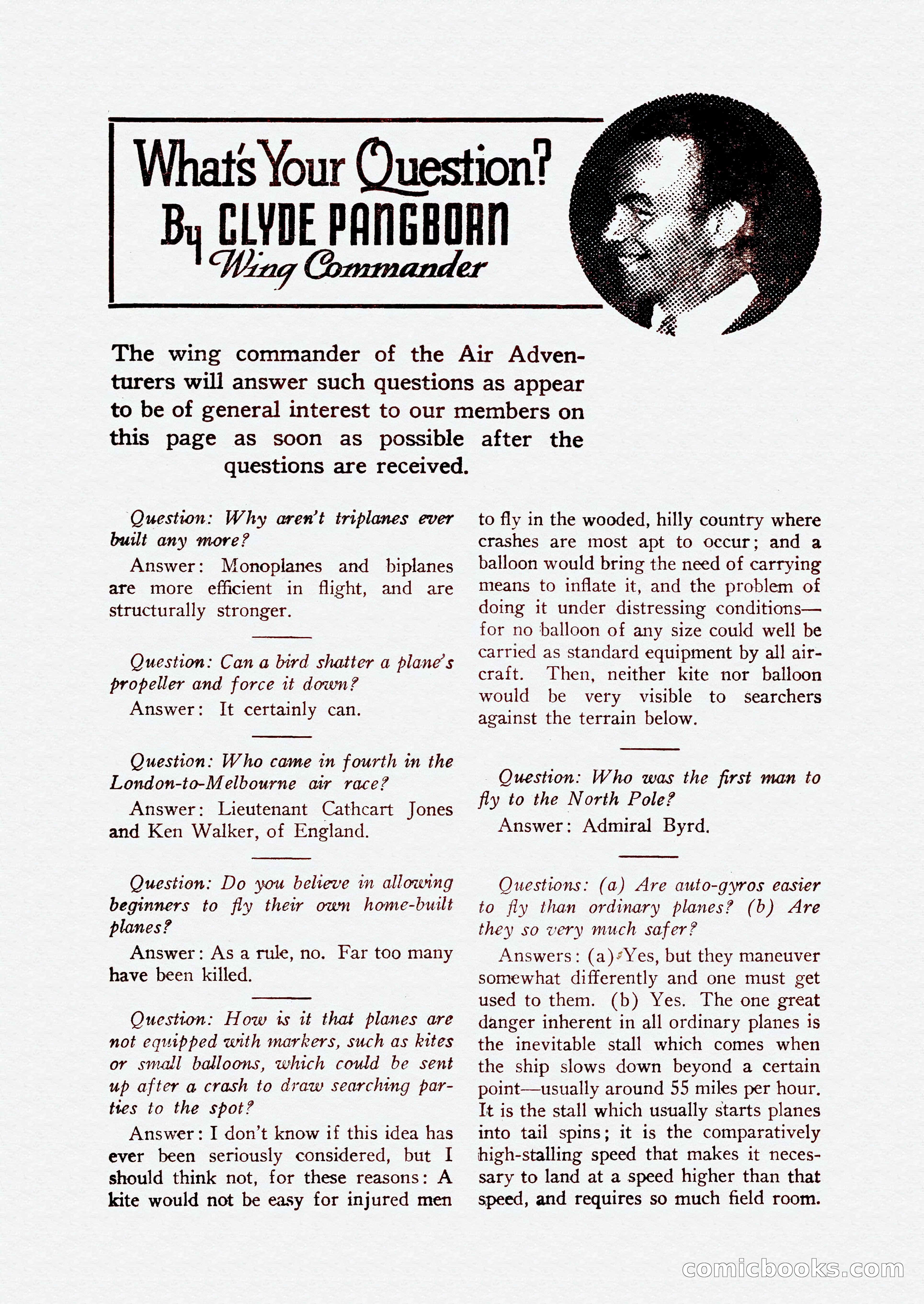
A restored page from Pulp Fiction, 1935. Page through the whole issue in the reader above.
📄 Transcribed text from this page (OCR, searchable)
Machine-transcribed from the original scan — historical spelling and the odd misread are preserved.
Whats Your Question? By CLYDE PANGBOAN Yang Commander The wing commander of the Air Adven- turers will answer such questions as appear to be of general interest to our members on this page as soon as possible after the questions are received. Question: Why aren’t triplanes ever built any more? Answer: Monoplanes and _ biplanes are more efficient in flight, and are structurally stronger. Question: Can a bird shatter a plane’s propeller and force 1t down? Answer: It certainly can. Question: Who came in fourth in the London-to-Melbourne aw race? Answer: Lieutenant Cathcart Jones and Ken Walker, of England. Question: Do you believe m allounng beginners to fly their own home-built planes? Answer: As a rule, no. Far too many have been killed. Ouestion: How ts it that planes are not equipped with markers, such as kites or small balloons, which could be sent up after a crash to draw searching par- ties to the spot? Answer: I don’t know if this idea has ever been seriously considered, but I should think not, for these reasons: A kite would not be easy for injured men to fly in the wooded, hilly country where crashes are most apt to occur; and a balloon would bring the need of carrying means to inflate it, and the problem of doing it under distressing conditions— for no balloon of any size could well be carried as standard equipment by all air- craft. Then, neither kite nor balloon would be very visible to searchers against the terrain below. Question: Who was the first man to fly to the North Pole? Answer: Admiral Byrd. Ouestions: (a) Are auto-gyros easter to fly than ordinary planes? (b) Are they so very much safer? Answers: (a)*Yes, but they maneuver somewhat differently and one must get used to them. (b) Yes. The one great danger inherent in all ordinary planes is the inevitable stall which comes when the ship slows down beyond a certain point—usually around 55 miles per hour, It is the stall which usually starts planes into tail spins; it is the comparatively high-stalling speed that makes it neces- sary to land at a speed higher than that speed, and requires so much field room. oO GomiiGcoook CO