
Pulp Fiction, 1935 · page 122 of 132
Bill Barnes Air Adventurer, July 1935 — page 122: what you’re looking at
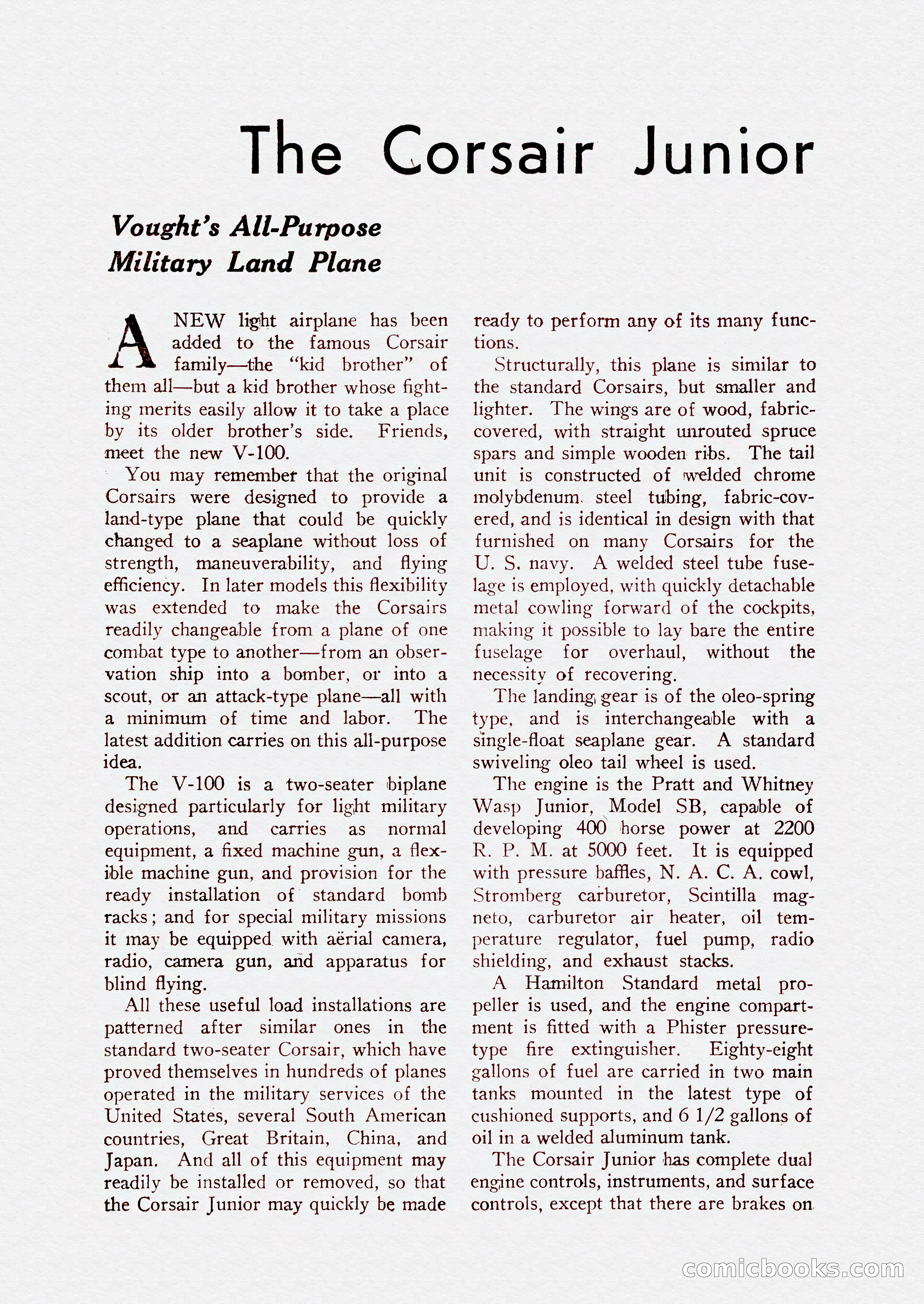
A restored page from Pulp Fiction, 1935. Page through the whole issue in the reader above.
📄 Transcribed text from this page (OCR, searchable)
Machine-transcribed from the original scan — historical spelling and the odd misread are preserved.
The Corsair Junior Vought’s All-Purpose Military Land Plane NEW light airplane has been A added to the famous Corsair ve family—the “kid brother” of them all—but a kid brother whose fight- ing merits easily allow it to take a place by its older brother’s side. Friends, meet the new V-100. You may remember that the original Corsairs were designed to provide a land-type plane that could be quickly changed to a seaplane without loss of strength, maneuverability, and flying efficiency. In later models this flexibility was extended to make the Corsairs readily changeable from a plane of one combat type to another—from an obser- vation ship into a bomber, or into a scout, or an attack-type plane—all with a minimum of time and labor. The latest addition carries on this all-purpose idea. The V-100 is a two-seater biplane designed particularly for light military operations, and carries as normal equipment, a fixed machine gun, a flex- ible machine gun, and provision for the ready installation of standard bomb racks; and for special military missions it may be equipped. with aerial camera, radio, camera gun, and apparatus for blind flying. All these useful load installations are patterned after similar ones in the standard two-seater Corsair, which have proved themselves in hundreds of planes operated in the military services of the United States, several South American countries, Great Britain, China, and Japan. And all of this equipment may readily be installed or removed, so that the Corsair Junior may quickly be made ready to perform any of its many func- tions. Structurally, this plane is similar to the standard Corsairs, but smaller and lighter. The wings are of wood, fabric- covered, with straight unrouted spruce spars and simple wooden ribs. The tail unit is constructed of welded chrome molybdenum. steel tubing, fabric-cov- ered, and is identical in design with that furnished on many Corsairs for the U. S. navy. A welded steel tube fuse- lage is employed, with quickly detachable metal cowling forward of the cockpits, making it possible to lay bare the entire fuselage for overhaul, without the necessity of recovering. The landing, gear is of the oleo-spring type, and is interchangeable with a single-float seaplane gear. A standard swiveling oleo tail wheel is used. The engine is the Pratt and Whitney Wasp Junior, Model SB, capable of developing 400 horse power at 2200 R. P. M. at 5000 feet. It is equipped with pressure baffles, N. A. C. A. cowl, Stromberg carburetor, Scintilla mag- neto, carburetor air heater, oil tem- perature regulator, fuel pump, radio shielding, and exhaust stacks. A Hamilton Standard metal pro- peller is used, and the engine compart- ment is fitted with a Phister pressure- type fire extinguisher. Ejighty-eight gallons of fuel are carried in two main tanks mounted in the latest type of cushioned supports, and 6 1/2 gallons of oil in a welded aluminum tank. The Corsair Junior has complete dual engine controls, instruments, and surface controls, except that there are brakes on oO CON) Ghook CO