
Pulp Fiction, 1935 · page 37 of 132
Bill Barnes Air Adventurer, July 1935 — page 37: what you’re looking at
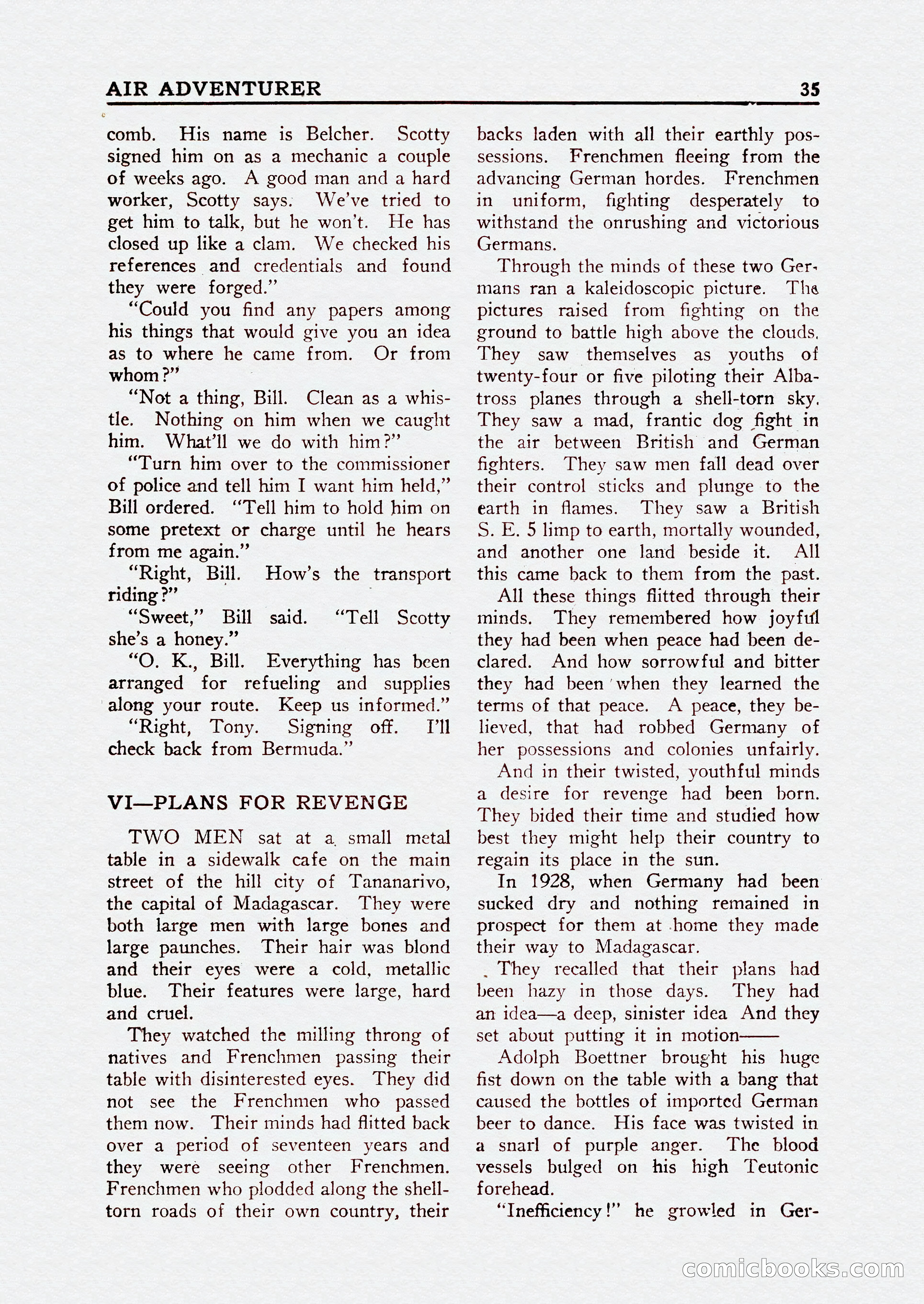
A restored page from Pulp Fiction, 1935. Page through the whole issue in the reader above.
📄 Transcribed text from this page (OCR, searchable)
Machine-transcribed from the original scan — historical spelling and the odd misread are preserved.
AIR ADVENTURER 35 comb. His name is Belcher. Scotty signed him on as a mechanic a couple of weeks ago. A good man and a hard worker, Scotty says. We've tried to get him to talk, but he won’t. He has closed up like a clam. We checked his references and credentials and found they were forged.” “Could you find any papers among his things that would give you an idea as to where he came from. Or from whom ?” 7 “Not a thing, Bill. Clean as a whis- tle. Nothing on him when we caught him. What’ll we do with him?” “Turn him over to the commissioner of police and tell him I want him held,” Bill ordered. ‘Tell him to hold him on some pretext or charge until he hears from me again.” “Right, Bill. How’s the transport riding ?” “Sweet,” Bill said. “Tell Scotty she’s a honey.” “O. K., Bill. Everything has been arranged for refueling and supplies along your route. Keep us informed.” Right, [ony = Sishing att. = (il check back from Bermuda.” VI—PLANS FOR REVENGE TWO MEN sat at a small metal table in a sidewalk cafe on the main street of the hill city of Tananarivo, the capital of Madagascar. They were both large men with large bones and large paunches. Their hair was blond and their eyes were a cold, metallic blue. Their features were large, hard and cruel. They watched the milling throng of natives and Frenchmen passing their table with disinterested eyes. They did not see the Frenchmen who passed them now. Their minds had flitted back over a period of seventeen years and they were seeing other Frenchmen. Frenchmen who plodded along the shell- torn roads of their own country, their backs laden with all their earthly pos- sessions. Frenchmen fleeing from the advancing German hordes. Frenchmen in uniform, fighting desperately to withstand the onrushing and victorious Germans. Through the minds of these two Ger- mans ran a kaleidoscopic picture. The pictures raised from fighting on the ground to battle high above the clouds, They saw themselves as youths of twenty-four or five piloting their Alba- tross planes through a shell-torn sky. They saw a mad, frantic dog fight in the air between British and German fighters. They saw men fall dead over their control sticks and plunge to the earth in flames. They saw a British S. E. 5 limp to earth, mortally wounded, and another one land beside it. All this came back to them from the past. All these things flitted through their minds. They remembered how joyful they had been when peace had been de- clared. And how sorrowful and bitter they had been’ when they learned the terms of that peace. A peace, they be- lieved, that had robbed Germany of her possessions and colonies unfairly. And in their twisted, youthful minds a desire for revenge had been born. They bided their time and studied how best they might help their country to regain its place in the sun. In 1928, when Germany had been sucked dry and nothing remained in prospect for them at home they made their way to Madagascar. _ They recalled that their plans had been hazy in those days. They had an idea—a deep, sinister idea And they set about putting it in motion Adolph Boettner brought his huge fist down on the table with a bang that caused the bottles of imported German beer to dance. His face was twisted in a snarl of purple anger. The blood vessels bulged on his high Teutonic forehead. “Inefficiency!” he growled in Ger- oO COMmIGhHoo S (©