
Pulp Fiction, 1935 · page 41 of 132
Bill Barnes Air Adventurer, July 1935 — page 41: what you’re looking at
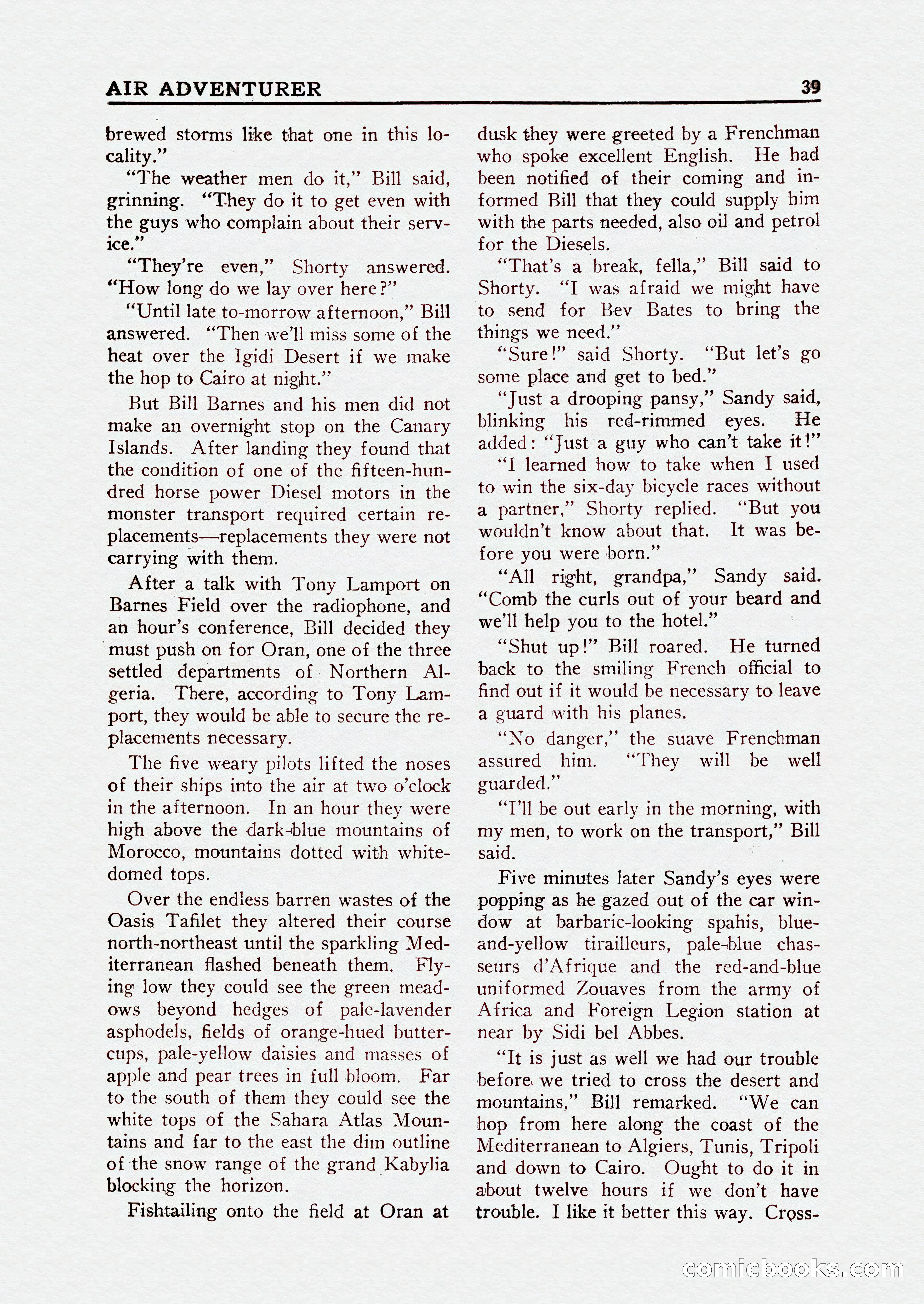
A restored page from Pulp Fiction, 1935. Page through the whole issue in the reader above.
📄 Transcribed text from this page (OCR, searchable)
Machine-transcribed from the original scan — historical spelling and the odd misread are preserved.
AIR ADVENTURER brewed storms like that one in this lo- cality.” “The weather men do it,” Bill said, grinning. “They do it to get even with the guys who complain about their serv- ice,” “They're even,” Shorty answered. “How long do we over here?” “Until late to-morrow afternoon,” Bill answered. “Then we'll miss some of the heat over the Igidi Desert if we make the hop to Cairo at night.” But Bill Barnes and his men did not make an overnight stop on the Canary Islands. After landing they found that the condition of one of the fifteen-hun- dred horse power Diesel motors in the monster transport required certain re- placements—replacements they were not carrying with them. After a talk with Tony Lamport on Barnes Field over the radiophone, and an hour’s conference, Bill decided they ‘must push on for Oran, one of the three settled departments of: Northern AlI- geria. There, according to Tony Lam- port, they would be able to secure the re- placements necessary. The five weary pilots lifted the noses of their ships into the air at two o'clock in the afternoon. In an hour they were high above the dark-blue mountains of Morocco, mountains dotted with white- domed tops. Over the endless barren wastes of the Oasis Tafilet they altered their course north-northeast until the sparkling Med- iterranean flashed beneath them. Fly- ing low they could see the green mead- ows beyond hedges of pale-lavender asphodels, fields of orange-hued butter- cups, pale-yellow daisies and masses of apple and pear trees in full bloom. Far to the south of them they could see the white tops of the Sahara Atlas Moun- tains and far to the east the dim outline of the snow range of the grand Kabylia blocking the horizon. Fishtailing onto the field at Oran at 39 dusk they were greeted by a Frenchman who spoke excellent English. He had been notified of their coming and in- formed Bill that they could supply him with the parts needed, also oil and petrol for the Diesels. “That’s a break, fella,’ Bill said to Shorty. “I was afraid we might have to send for Bev Bates to bring the things we need.” “sure! said Shorty; But lets go some place and get to bed.” “Just a drooping pansy,” Sandy said, blinking his red-rimmed eyes. He added: “Just a guy who can’t take it!” “T learned how to take when I used to win the six-day bicycle races without a partner,’ Shorty replied. “But you wouldn’t know about that. It was be- fore you were born.” “All right, grandpa,” Sandy said. “Comb the curls out of your beard and we'll help you to the hotel.” “Shut up!” Bill roared. He turned back to the smiling French official to find out if it would be necessary to leave a guard with his planes. “No danger,’ the suave Frenchman assured him. “They will be well guarded.” “T’'ll be out early in the morning, with my men, to work on the Cee ” Bill said. Five minutes later Sandy’s ce were popping as he gazed out of the car win- dow at barbaric-looking spahis, blue- and-yellow tirailleurs, pale-blue chas- seurs d’Afrique and the red-and-blue uniformed Zouaves from the army of Africa and Foreign Legion station at near by Sidi bel Abbes. “Tt is just as well we had our trouble before we tried to cross the desert and mountains,” Bill remarked. ‘“We can hop from here along the coast of the Mediterranean to Algiers, Tunis, Tripoli and down to Cairo. Ought to do it in about twelve hours if we don’t have trouble. I like it better this way. Cross- oO COmicloo S CO