
Pulp Fiction, 1935 · page 49 of 132
Bill Barnes Air Adventurer, July 1935 — page 49: what you’re looking at
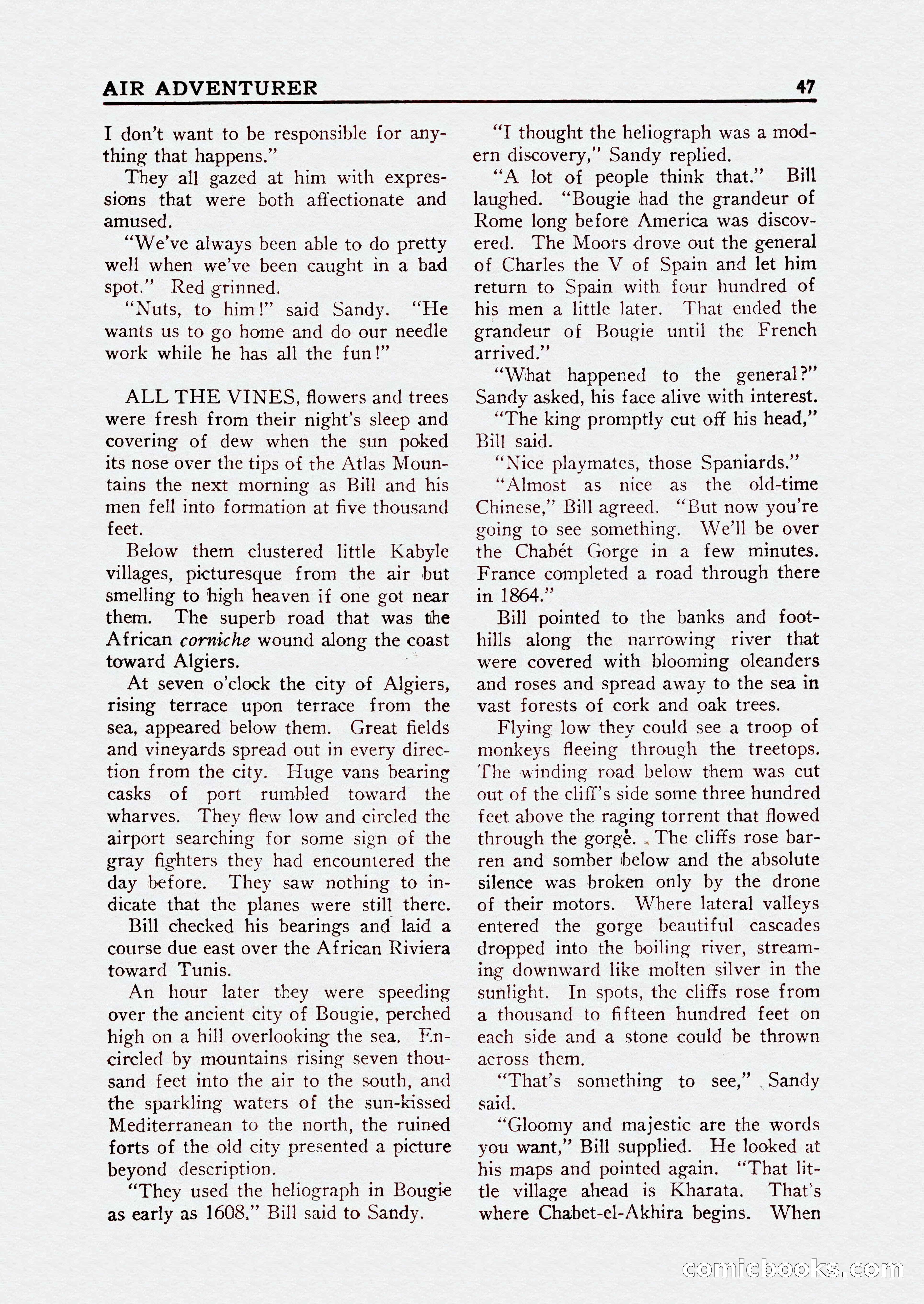
A restored page from Pulp Fiction, 1935. Page through the whole issue in the reader above.
📄 Transcribed text from this page (OCR, searchable)
Machine-transcribed from the original scan — historical spelling and the odd misread are preserved.
AIR ADVENTURER I don’t want to be responsible for any- thing that happens.” They all gazed at him with expres- sions that were both affectionate and amused, “We've always been able to do pretty well when we’ve been caught in a bad spot.” Red grinned. “Nuts; fo hin! said. Sandy. —-He wants us to go home and do our needle work while he has all the fun!” ALL THE VINES, flowers and trees were fresh from their night’s sleep and covering of dew when the sun poked its nose over the tips of the Atlas Moun- tains the next morning as Bill and his men fell into formation at five thousand feet. Below them clustered little Kabyle villages, picturesque from the air but smelling to high heaven if one got near them. The superb road that was the African corniche wound along the coast toward Algiers. = At seven o'clock the city of Algiers, rising terrace upon terrace from the sea, appeared below them. Great fields and vineyards spread out in every direc- tion from the city. Huge vans bearing casks of port rumbled toward the wharves. They flew low and circled the airport searching for some sign of the gray fighters they had encountered the day before. They saw nothing to in- dicate that the planes were still there. Bill checked his bearings and laid a course due east over the African Riviera toward Tunis. An hour later they were speeding over the ancient city of Bougie, perched high on a hill overlooking the sea. En- circled by mountains rising seven thou- sand feet into the air to the south, and the sparkling waters of the sun-kissed Mediterranean to the north, the ruined forts of the old city presented a picture beyond description. “They used the heliograph in Bougie as early as 1608.” Bill said to Sandy. 47 “T thought the heliograph was a mod- ern discovery,” Sandy replied. “A lot of people think that.” Bill laughed. “Bougie had the grandeur of Rome long before America was discov- ered. The Moors drove out the general of Charles the V of Spain and let him return to Spain with four hundred of his men a little later. That ended the grandeur of Bougie until the French arrived,” “What happened to the general?” Sandy asked, his face alive with interest. “The king promptly cut off his head,” Bill said. “Nice playmates, those Spaniards.’’ ‘Almost as nice as the old-time Chinese,” Bill agreed. “But now you're going to see something. We'll be over the Chabét Gorge in a few minutes. France completed a road through there in 1864.” Bill pointed to the banks and foot- hills along the narrowing river that were covered with blooming oleanders and roses and spread away to the sea in vast forests of cork and oak trees. Flying low they could see a troop of monkeys fleeing through the treetops. The winding road below them was cut out of the cliff’s side some three hundred feet above the raging torrent that flowed through the gorge. . The cliffs rose bar- ren and somber below and the absolute silence was broken only by the drone of their motors. Where lateral valleys entered the gorge beautiful cascades dropped into the boiling river, stream- ing downward like molten silver in the sunlight. In spots, the cliffs rose from a thousand to fifteen hundred feet on each side and a stone could be thrown across them. “That’s something to see,” .Sandy said. “Gloomy and majestic are the words you want,” Bill supplied. He looked at his maps and pointed again. “That lit- tle village ahead is Kharata. That's where Chabet-el-Akhira begins. When oO COMmiCcloo S CO