
A complete issue · 36 pages · 1928
Judge — November 3, 1928
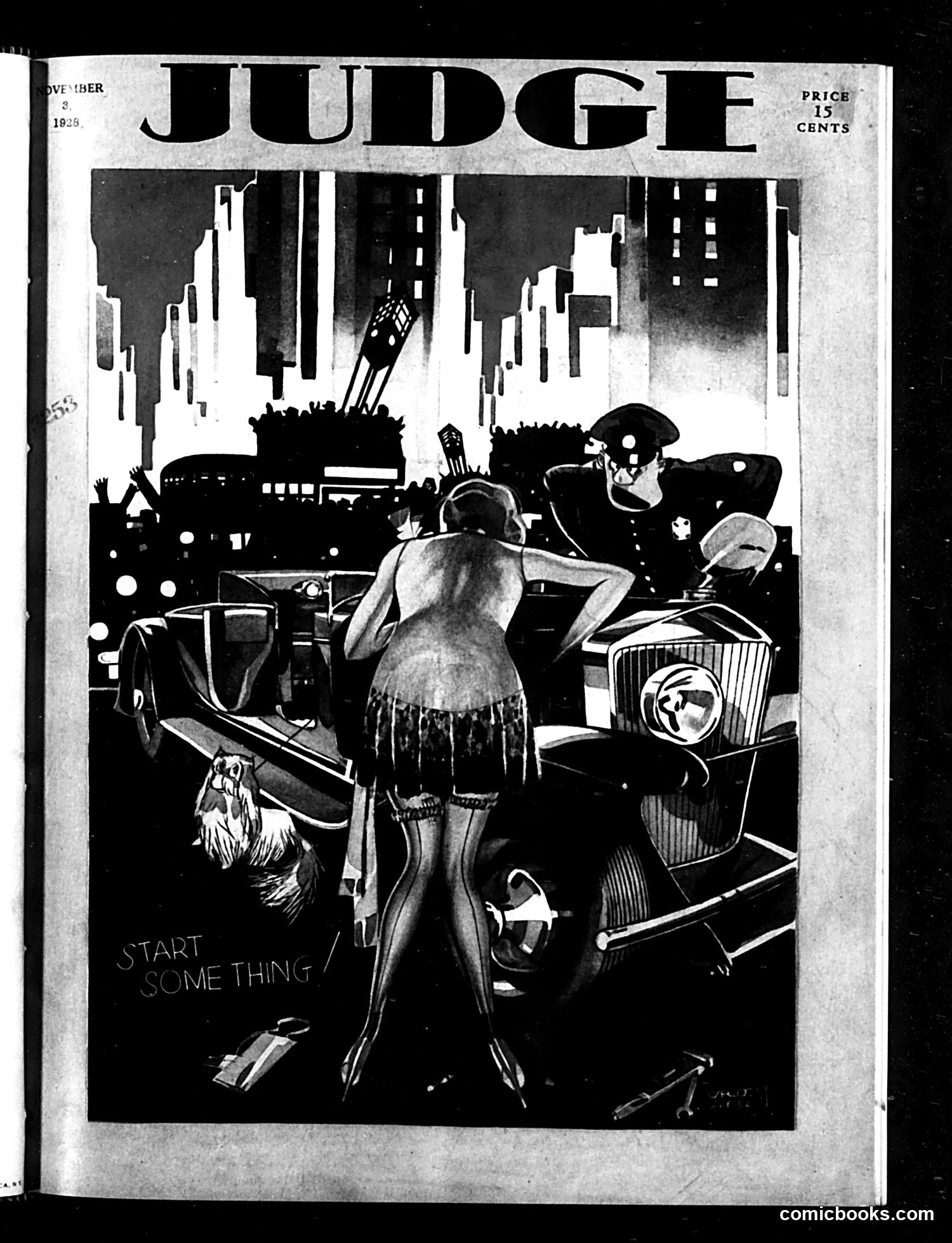
This cover depicts a woman in revealing attire approaching police officers and what appear to be military or uniformed officials amid 1920s automobiles and an urban skyline. The caption reads "START SOMETHING," suggesting she's provocatively attempting to incite trouble with authorities. The image likely satirizes the social tensions of the late 1920s, particularly interactions between civilians and law enforcement during Prohibition era. The woman's scanty clothing and forward behavior toward uniformed men represents the "modern woman" stereotype that conservative Americans found alarming during this period. Published in October 1929—just before the stock market crash—this reflects Judge's typical satirical commentary on contemporary social conflicts and changing moral standards.
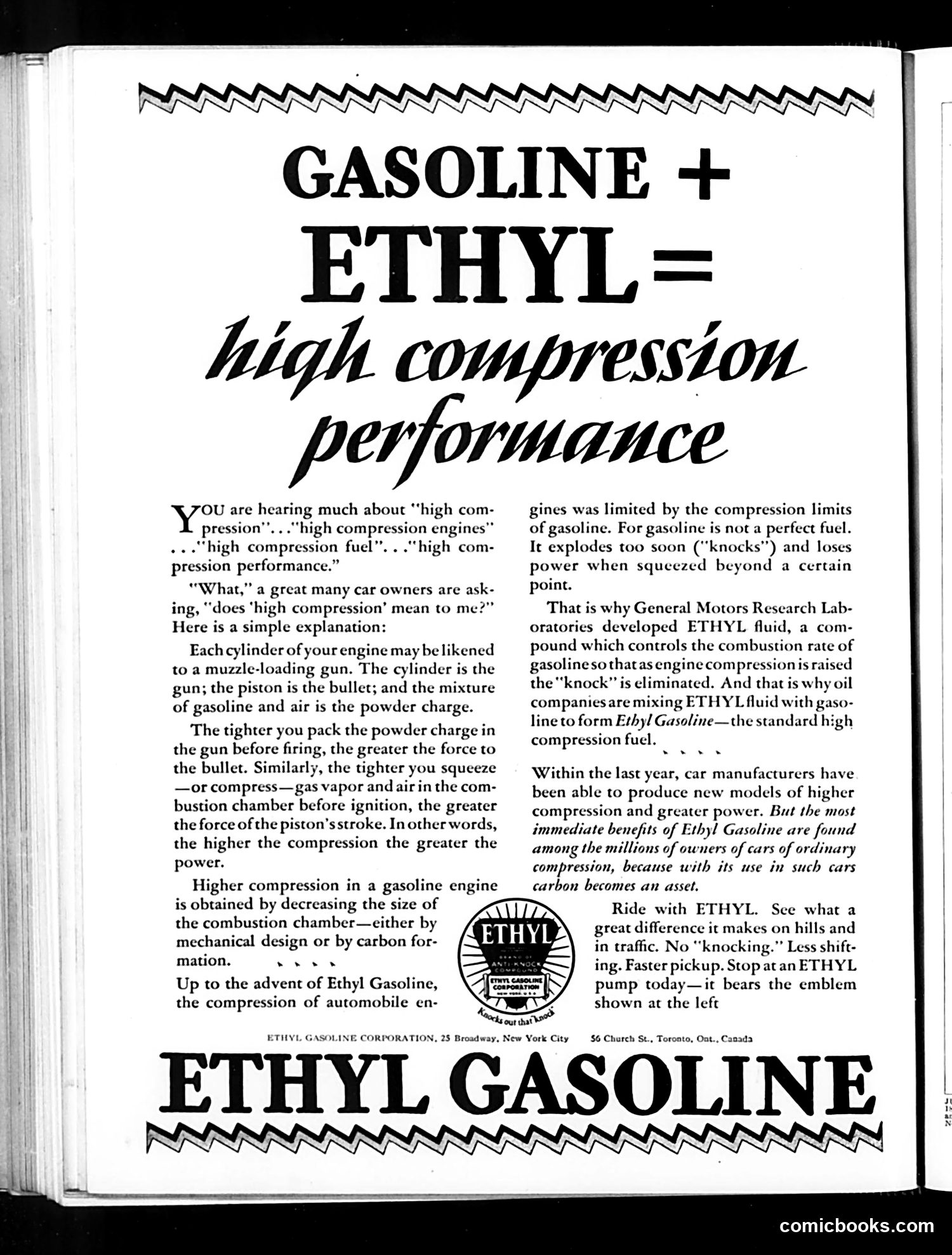
This page is **primarily an advertisement, not satire or editorial content**. It's a promotional piece for Ethyl Gasoline, published by the Ethyl Gasoline Corporation. The ad explains a technical concept to lay readers: engine compression and how adding ethyl fluid to gasoline improves performance. It uses an accessible analogy comparing cylinder compression to a muzzle-loading gun's powder charge. The "cartoon" element is minimal—just a circular emblem/logo for Ethyl brand at the center. There is **no political satire, caricature, or social commentary** on this page. This reflects Judge magazine's business model: satirical publications survived partly through advertising revenue. The page demonstrates how early 20th-century ads educated consumers about new automotive technology while promoting a specific fuel product.
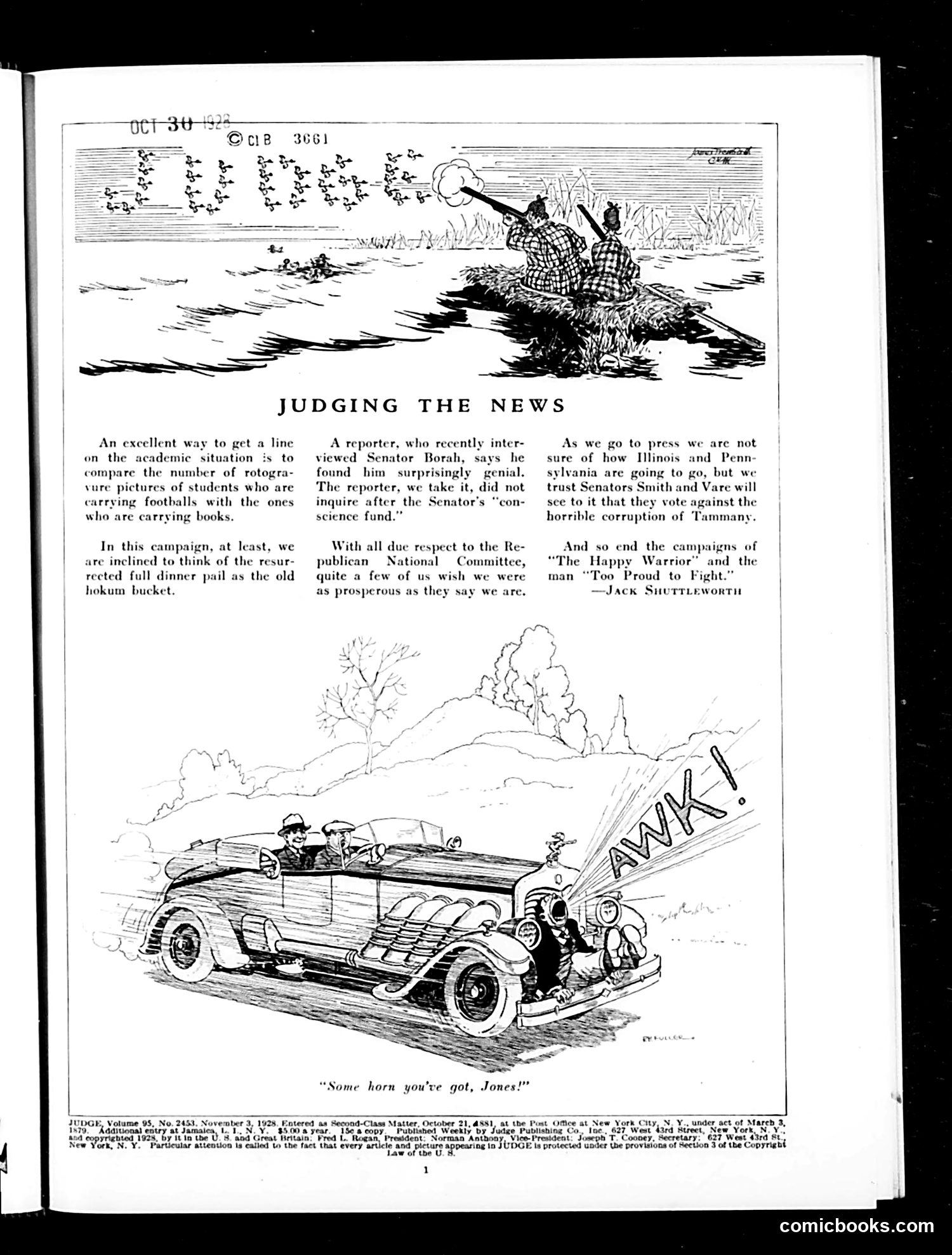
This page contains political commentary and two cartoons. The top cartoon depicts people on a log with a net, illustrating an article comparing college academics to football—criticizing students who prioritize sports over studies. The main lower cartoon shows a car accident with the caption "Some horn you've got, Jones!" The driver apparently honked his horn so aggressively that he caused a collision, suggesting satire about dangerous or excessive automobile horn use—a common public nuisance complaint in the 1920s. The "Judging the News" section includes commentary on Senator Borah, the Republican National Committee's campaign prospects, and mentions Illinois and Pennsylvania senators regarding "Tammany" (New York's political machine), placing this during the 1928 election season.
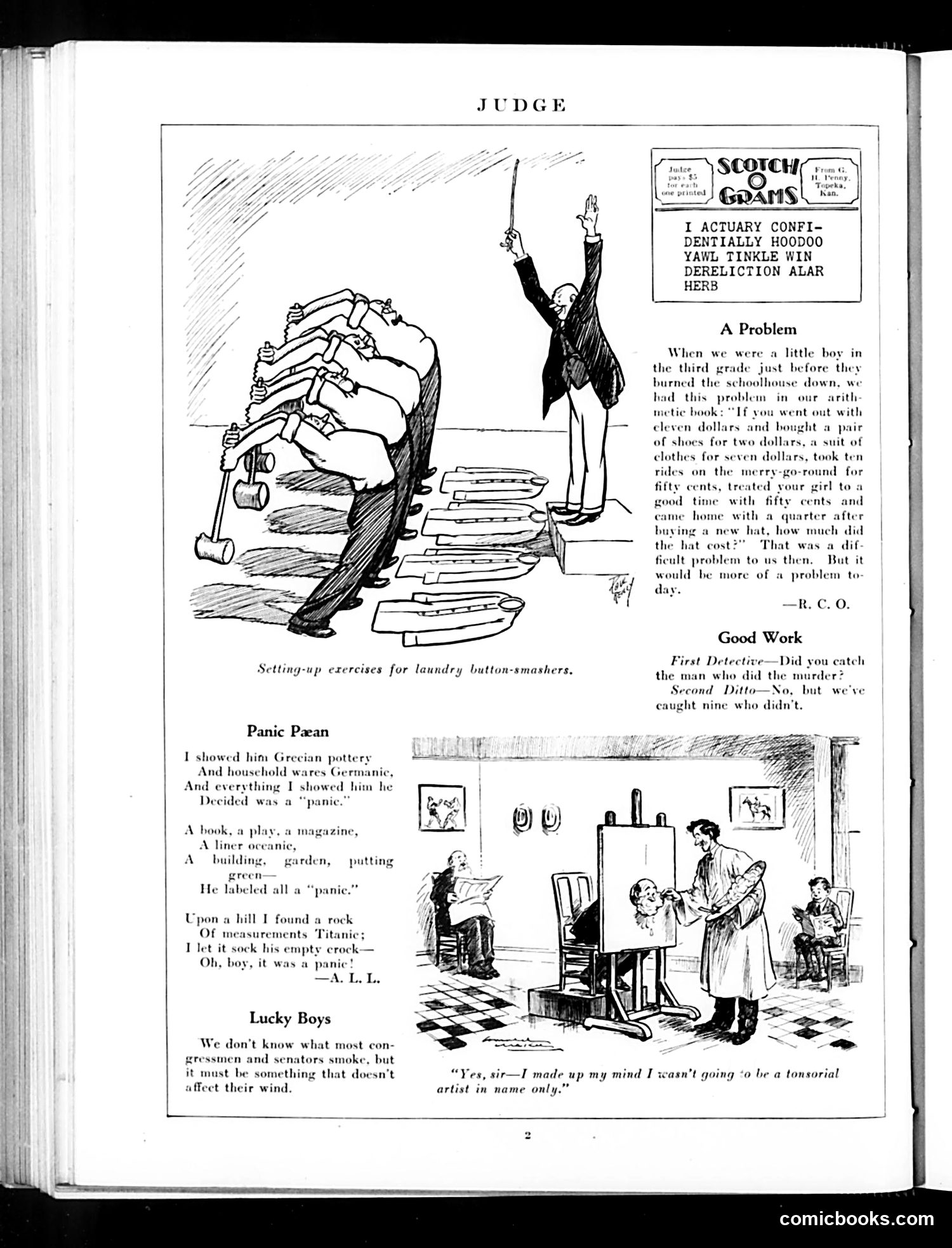
This page contains several unrelated humor pieces rather than a unified political cartoon: **"Setting-up exercises for laundry button-smashers"** depicts men doing calisthenics while holding mallets, satirizing overly vigorous laundry work that damages buttons. **"Panic Paean"** is a poem about someone's panic when showing guests various items (pottery, book, liner oceanic, etc.), suggesting anxiety about impressing others. **"Good Work"** is a brief joke about detectives catching nine innocent people while missing the actual murderer—satirizing law enforcement incompetence. **"Lucky Boys"** comments that smokers don't know what causes their cough but assumes it's something harmless. The bottom cartoon shows a woman telling a man she won't become a "tensorial artist in name only"—likely joking about women's hairstyling professions or refusing cosmetic work.
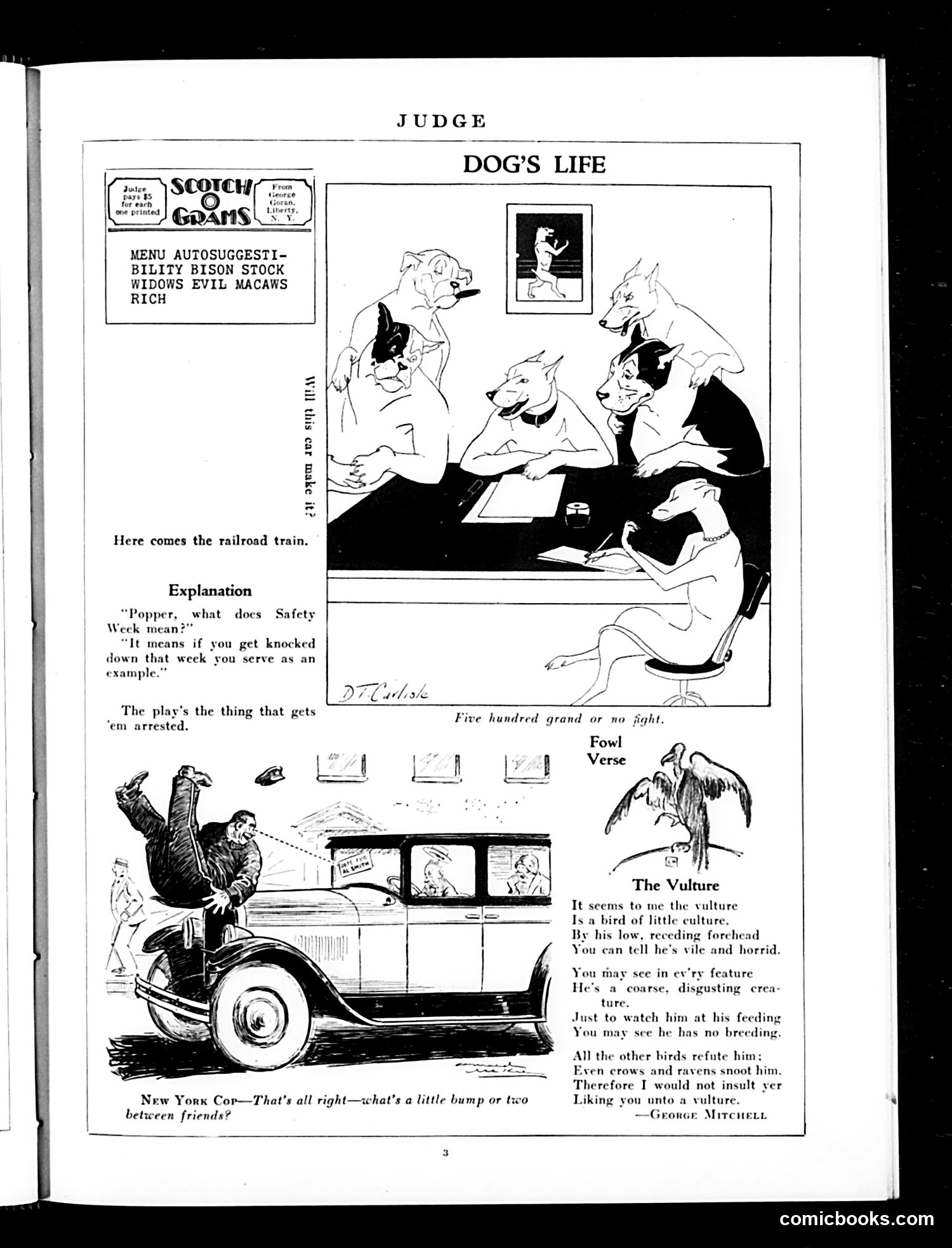
This page contains two distinct satirical pieces: **Top cartoon**: Dogs in business attire conducting a meeting about "Safety Week." The joke mocks corporate safety protocols as performative—Safety Week means "if you get knocked down that week you serve as an example." The satire suggests companies use safety programs mainly for appearances rather than genuine worker protection. **Bottom cartoon**: A chicken flying through a car window with caption "That's all right—what's a little bump or two between friends?" This appears to comment on reckless driving and casualness toward traffic accidents, likely reflecting 1920s-30s concerns about automobile safety and careless motorists. The "Fowl Verse" about vultures is unrelated social commentary on character.
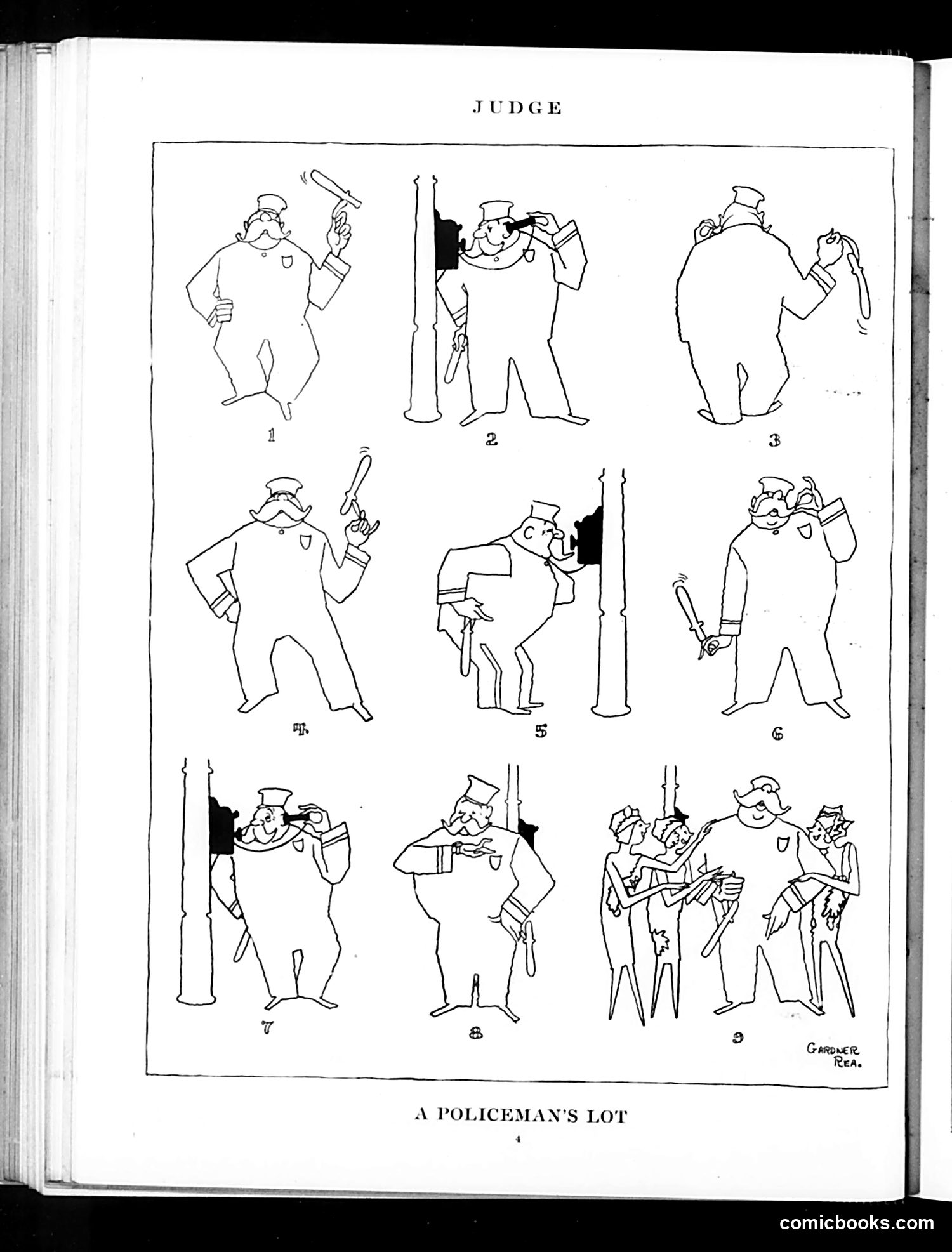
This page presents nine sequential cartoon panels depicting a rotund policeman in various comedic situations, titled "A Policeman's Lot." The humor appears to satirize the frustrations and indignities of police work through physical comedy and exaggeration. The panels show the officer engaged in duties including directing traffic, managing crowds, and dealing with disorderly civilians. Black silhouettes represent obstacles or antagonists he encounters—possibly anarchists, drunks, or other public nuisances common to turn-of-the-century urban policing concerns. The satire likely critiques both the incompetence of individual officers and society's chaotic public order problems. The title ironically invokes the famous Gilbert & Sullivan song "A Policeman's Lot Is Not a Happy One," reinforcing the joke that police endure thankless, degrading work managing urban disorder.
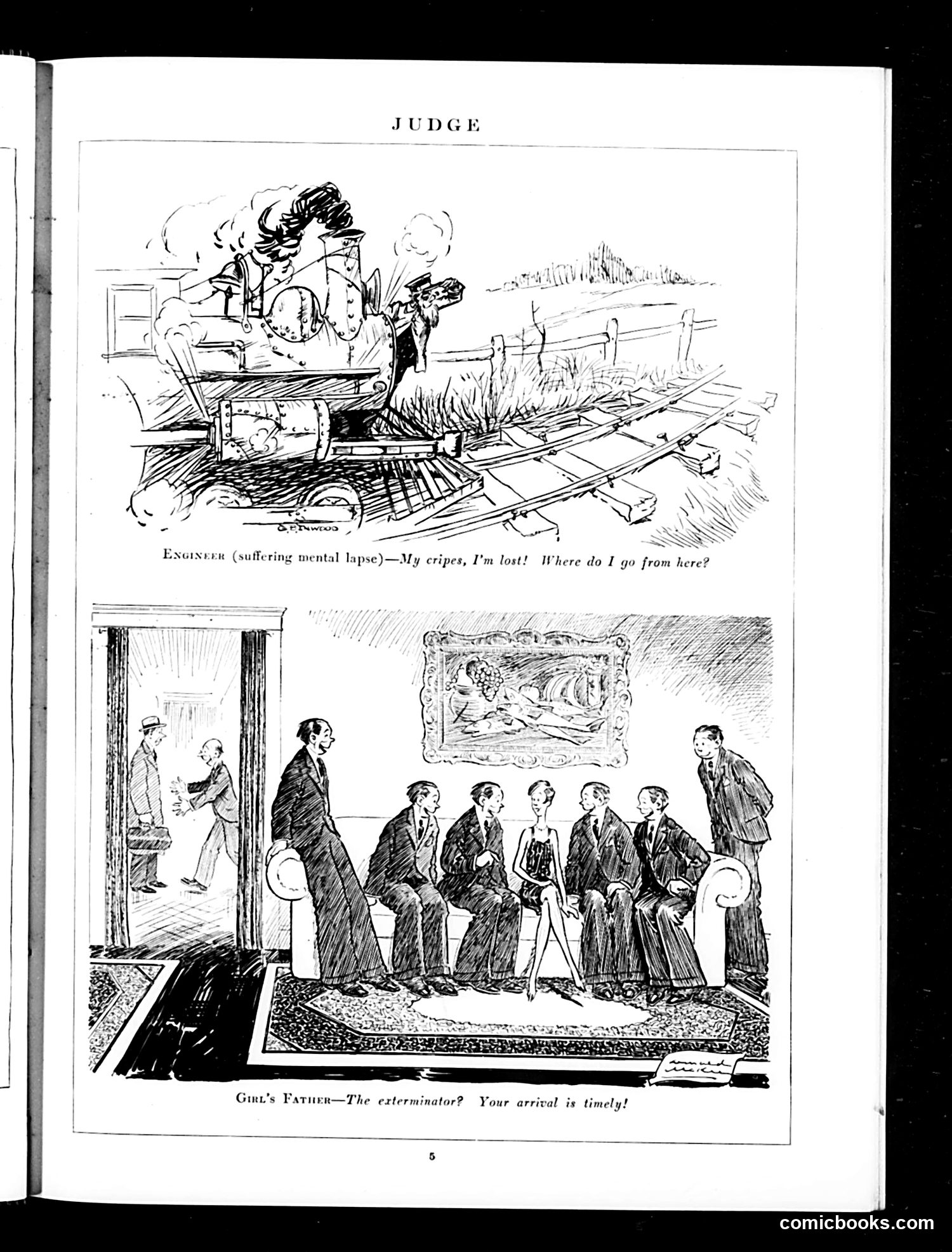
This page contains two satirical cartoons: **Top cartoon**: An engineer on a derailed train exclaims "My cripes, I'm lost! Where do I go from here?" The humor appears to mock an engineer's incompetence or confusion following a railroad accident. **Bottom cartoon**: Titled "Girl's Father—The exterminator? Your arrival is timely!" A well-dressed man arrives at a formal gathering while the girl's father welcomes him, apparently joking that he's an "exterminator." This likely satirizes social anxiety about meeting a suitor or an unwanted visitor, using darkly comic language suggesting the father views the newcomer as a pest to be eliminated. Both cartoons employ exaggerated situations and wordplay typical of Judge's satirical style, though their specific topical references remain unclear without additional historical context.
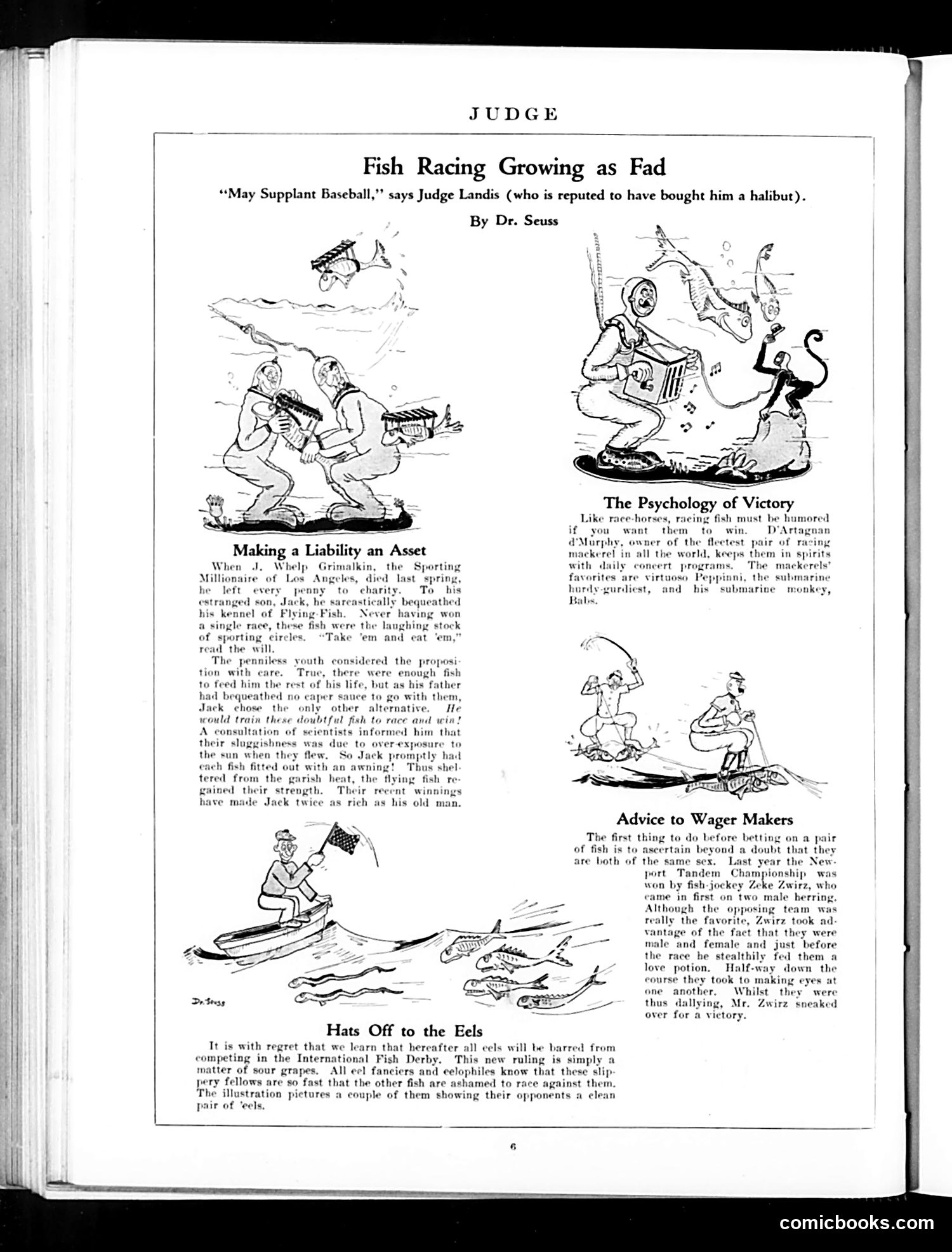
This 1920s Judge magazine piece satirizes the absurdity of fish racing as an emerging fad that threatens baseball's dominance. The headline references **Judge Landis**, the real baseball commissioner famous for cleaning up the sport after gambling scandals—here humorously accused of buying a halibut, suggesting even he's succumbed to fish racing mania. Dr. Seuss's cartoons mock the craze by presenting fish racing with mock-serious coverage: wealthy sportsmen training flying fish, betting on herring, and establishing championship competitions. The sections ("Making a Liability an Asset," "Psychology of Victory," "Advice to Wager Makers," "Hats Off to the Eels") parody actual sports journalism. The joke is that Americans were momentarily obsessed with this nonsensical activity, treating racing fish with the same intensity as legitimate sports. The satire suggests how easily fads capture public imagination, and how quickly established institutions (baseball) could be displaced by ridiculous novelties.
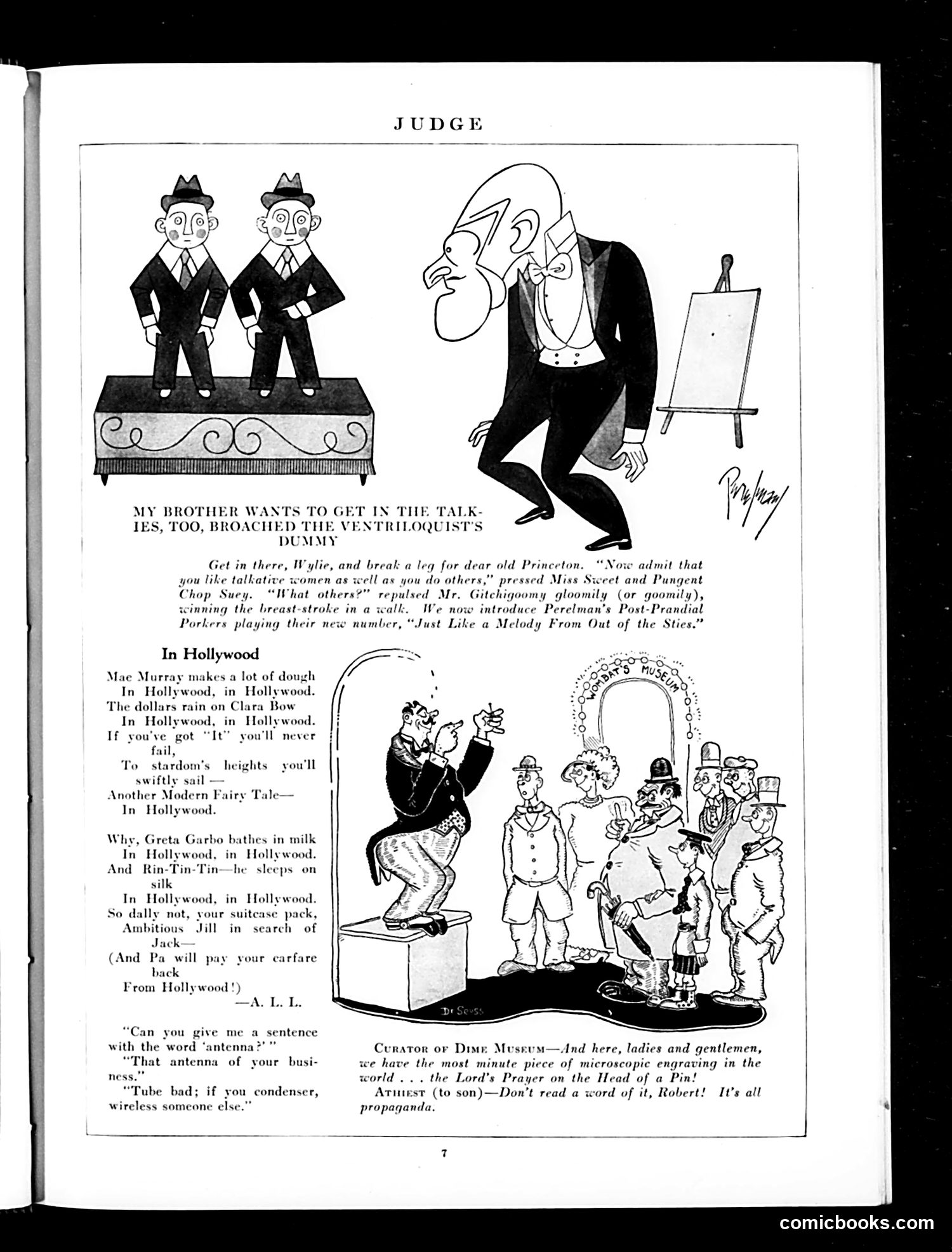
This page satirizes 1920s American culture through multiple vignettes: **Top cartoon**: Mocks the "talkies" (early sound films) by showing a ventriloquist's dummy wanting to break into movies—a joke about talkie actors being as wooden and controllable as dummies. References to Princeton and various characters suggest satire of shallow Hollywood aspirants. **"In Hollywood" song section**: Ridicules the era's movie star culture and the "it girl" phenomenon, mocking actresses like Mae Murray, Clara Bow, and Greta Garbo as frivolous and wealthy. The final verse jokes that ambitious young women will do anything—even have their fathers pay carfare—to chase stardom in Hollywood. **Bottom cartoon**: A dime museum curator displays a supposedly microscopic engraving of "the Lord's Prayer on a Pin's head." An atheist warns his son against reading it as "propaganda"—satirizing both religious spectacle-mongering and growing skepticism toward religious claims. Overall, the page lampoons Hollywood excess, consumerism, and cultural pretension of the Jazz Age.
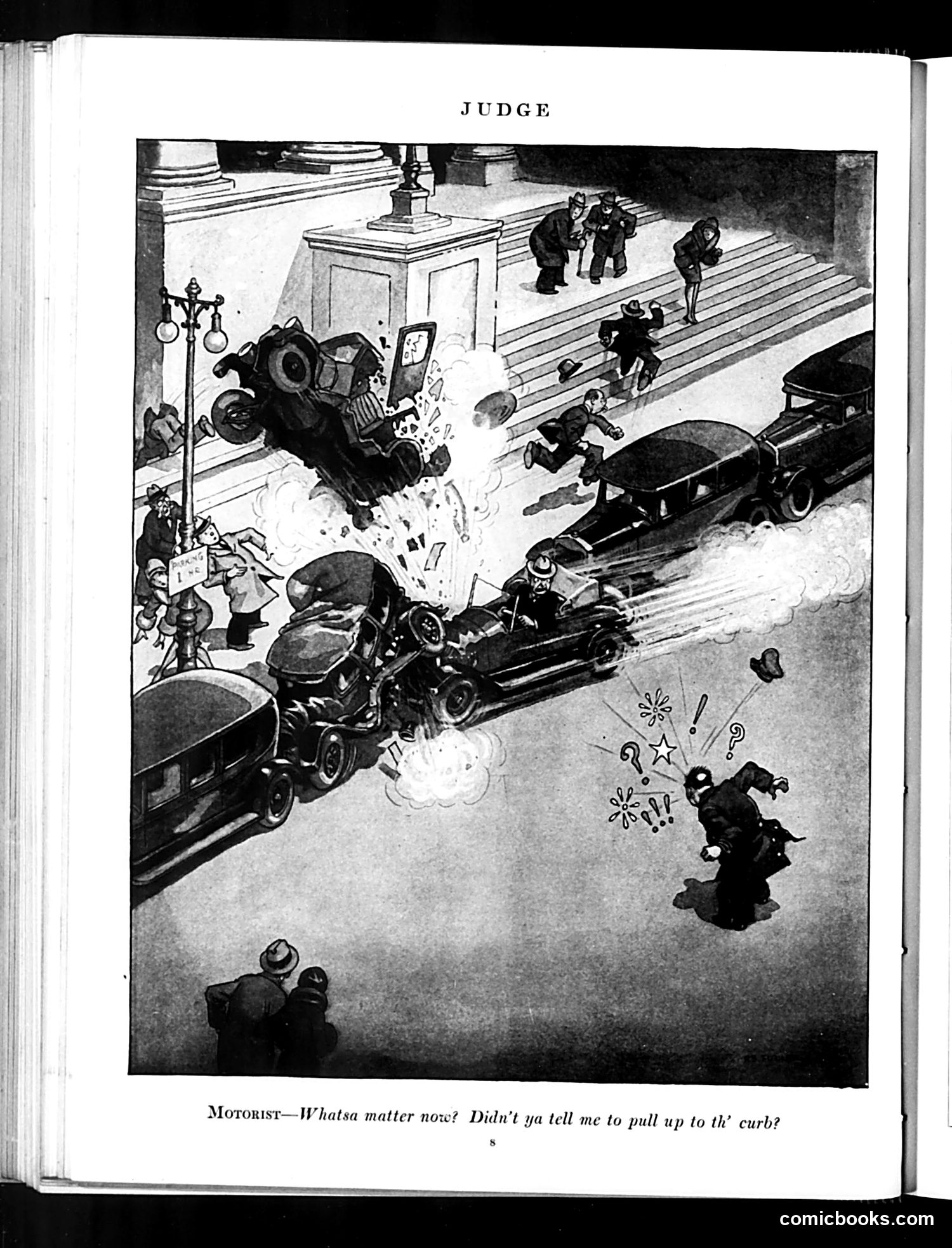
This page from *Judge* magazine features a satirical cartoon titled "JUDGE" depicting a chaotic street scene centered on a traffic accident involving multiple automobiles. The caption reads: "Motorist—What'sa matter noise? Didn't ya tell me to pull up to th' curb?" The cartoon satirizes early automobile traffic safety and driver behavior. The scene shows vehicles colliding dramatically near what appears to be a courthouse (visible columns in background), with pedestrians and officials scattered about in confusion. The motorist's defensive response—suggesting he followed instructions to pull to the curb—mocks drivers who cause accidents through recklessness while claiming innocence. The satire targets both careless driving and the absurdity of traffic situations in early-20th-century urban America, when automobiles were relatively new and accidents were common.
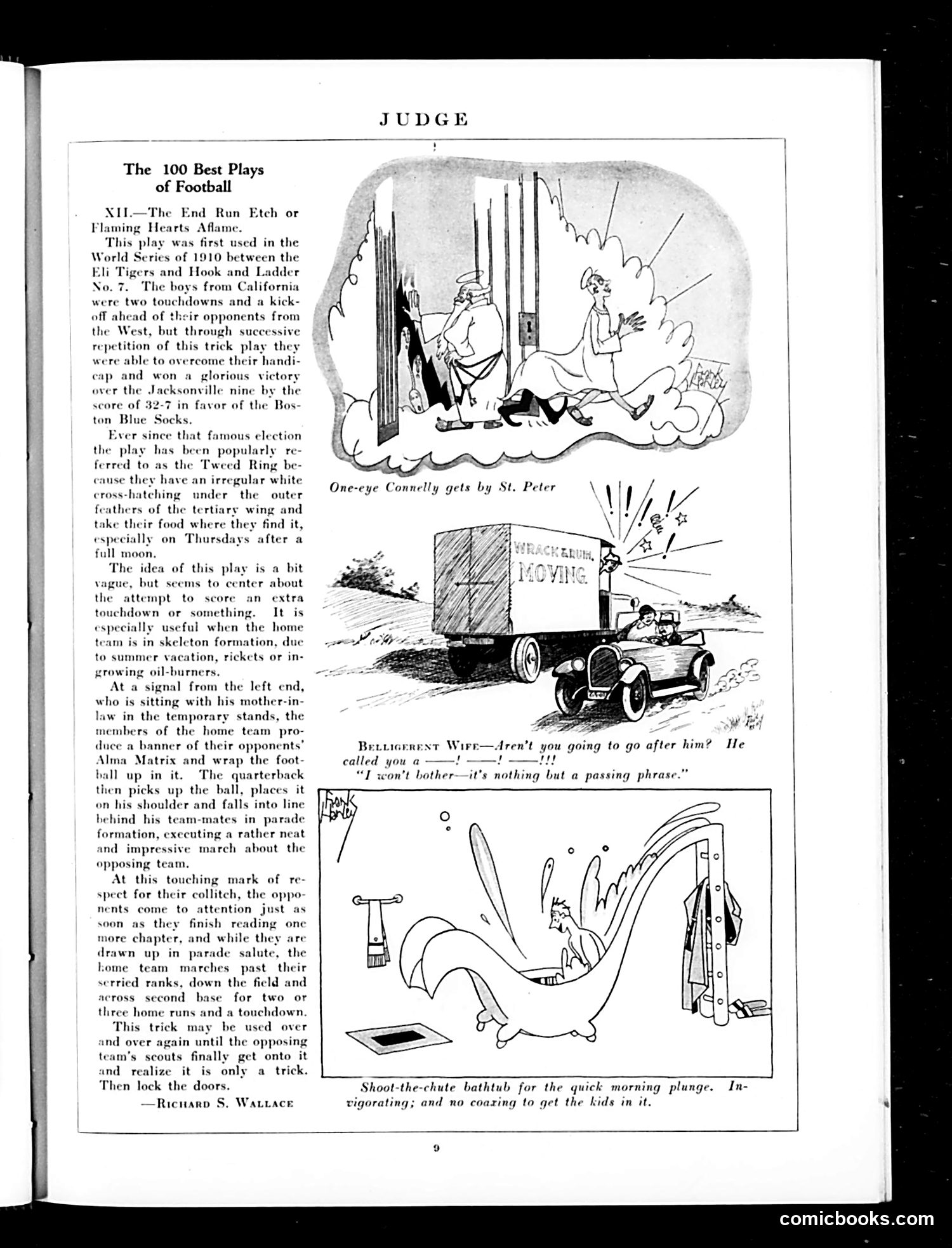
This page satirizes American football through absurdist humor, deliberately mixing football terminology with nonsense. The text describes "The End Run Etch" play from a fictional 1910 game between Yale and a fire department, absurdly claiming the winning score was 32-7 in favor of the "Boston Blue Socks" (a baseball team name, not football). The three cartoons below parody domestic life: one shows a car hitting a moving van, another depicts a wife's indignation at her husband's casual response to being insulted (calling insults mere "passing phrases"), and the third advertises a novelty bathtub slide for children. The humor relies on incongruity—treating football plays with mock-serious analysis while describing obviously impossible situations, mixing sports, mixing real and fake teams, and combining football with baseball terminology. This reflects Judge's style of absurdist satire typical of early 20th-century American humor magazines.
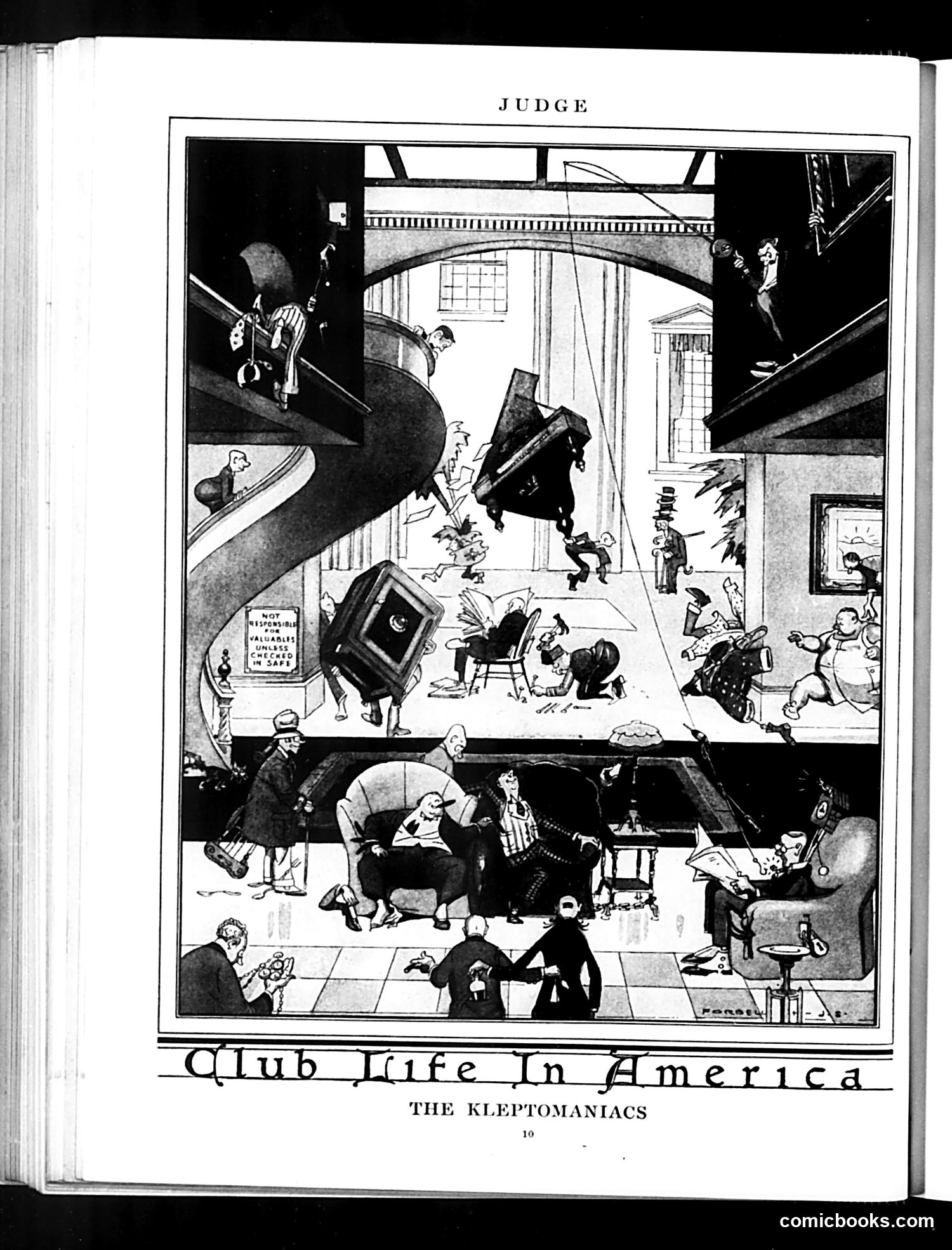
This satirical illustration depicts chaos in what appears to be an exclusive club or social establishment. The title "The Kleptomaniacs" suggests the cartoon mocks wealthy club members as compulsive thieves or morally corrupt individuals. The multi-level scene shows well-dressed figures engaging in various misdeeds—stealing, fighting, and general disorder—throughout the building's interior spaces. The architectural framing with multiple rooms and levels allows the artist to pack numerous vignettes of misconduct. The satire likely critiques the hypocrisy of America's wealthy elite, who present themselves as respectable members of exclusive clubs while actually behaving as criminals or vandals. The comparison of the upper class to "kleptomaniacs" suggests broader social commentary on corruption, greed, or moral bankruptcy among the privileged during the Gilded Age or Progressive Era.
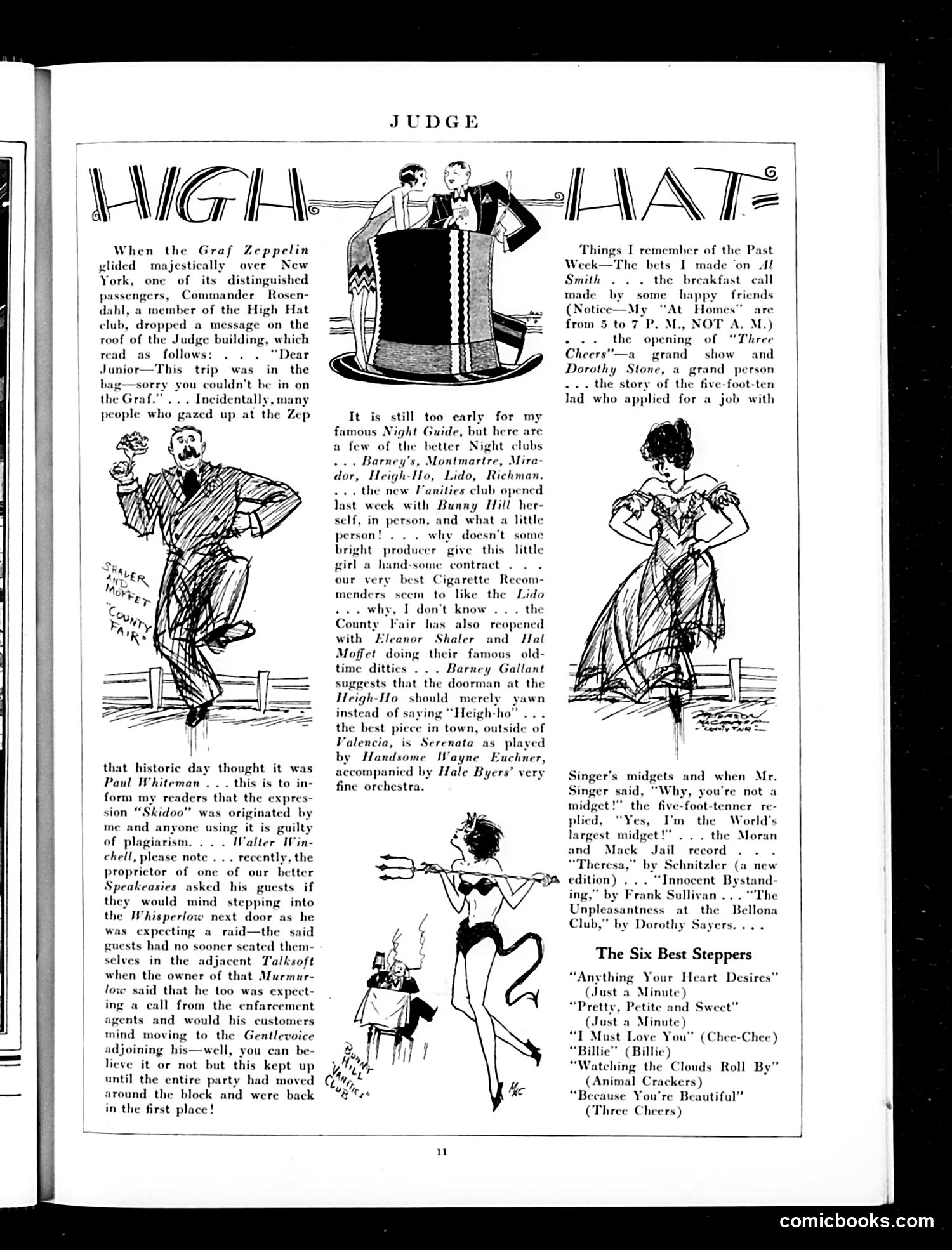
This is a society gossip and entertainment column from Judge magazine's "High Hat" section. The page combines satirical commentary on 1920s New York nightlife with social humor. **Key References:** - **Graf Zeppelin visit**: A real German airship that flew over New York; the joke is Commander Rosendahl (an actual passenger) dropping a message on Judge's building - **Paul Whiteman**: Famous bandleader of the era; comparing the blimp to him is the joke - **Speakeasy raids**: References Prohibition-era establishments ("Whisperlow," "Talksoft," "Gentlevoice"—punning names reflecting nervous owners worried about police raids) - **Al Smith**: Likely presidential candidate (1928) - **Nightclubs listed**: Real Manhattan venues (Barney's, Montmartre, Lido, County Fair) - **Performers mentioned**: Bunny Hill, Eleanor Shaler, Wayne Euchner, Hale Byers The column mocks Prohibition anxiety, celebrity gossip, and the pretension of nightclub culture. The illustrations show fashionable 1920s figures in typical Judge style.
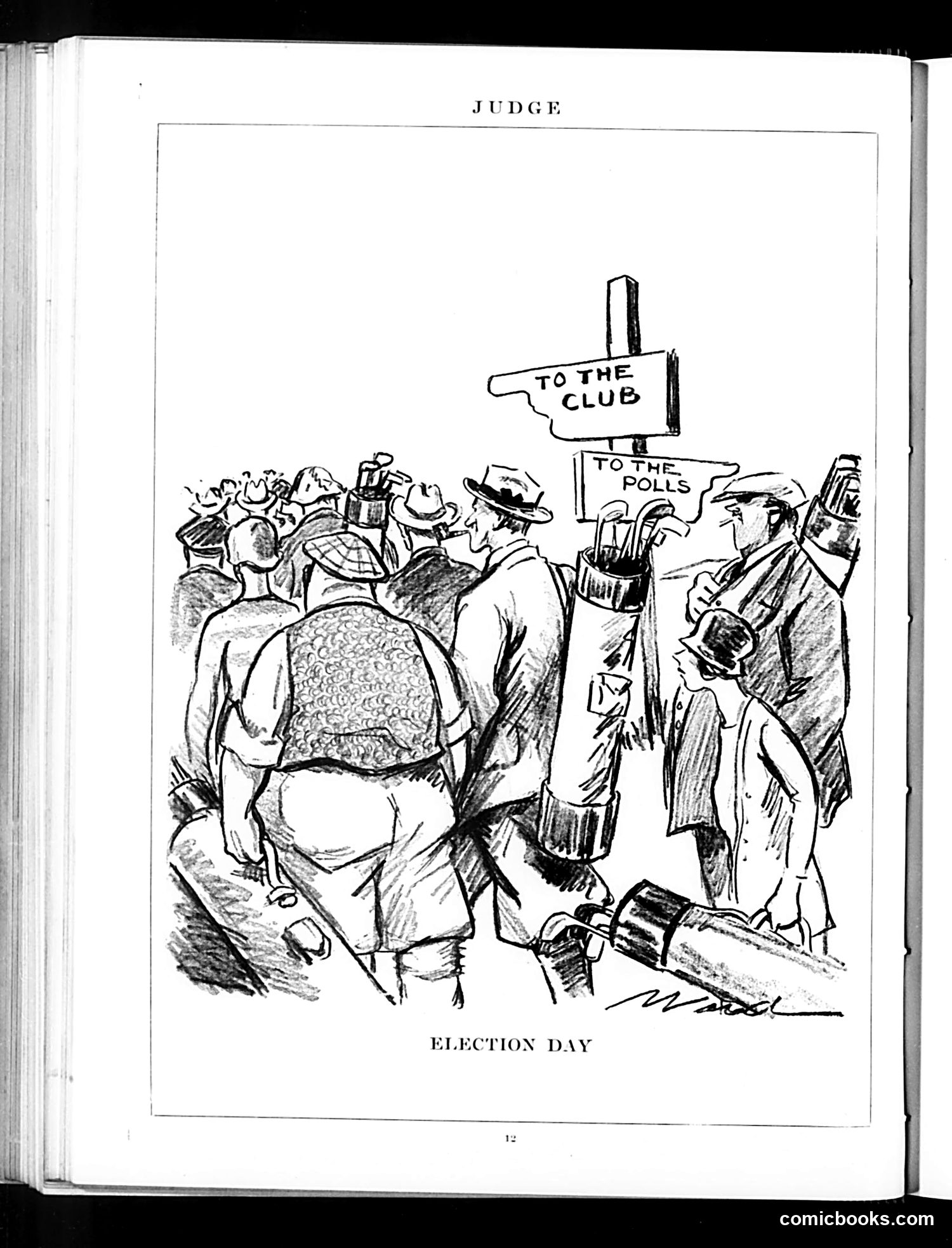
This political cartoon satirizes the chaos of Election Day voting. The central figure is a portly man (likely representing an average voter or political operative) surrounded by a crowd at a crossroads with directional signs reading "TO THE CLUB" and "TO THE POLLS." The satire appears to target the distraction and competing interests pulling voters away from their civic duty—toward social establishments ("the club") rather than the polling place. The exaggerated physicality of the central figure and the disorderly crowd suggest Judge is mocking either voter apathy, the influence of social gatherings over political participation, or the general chaos of democratic elections in this era. The cartoon's title and visual composition emphasize the tension between leisure and voting responsibility.
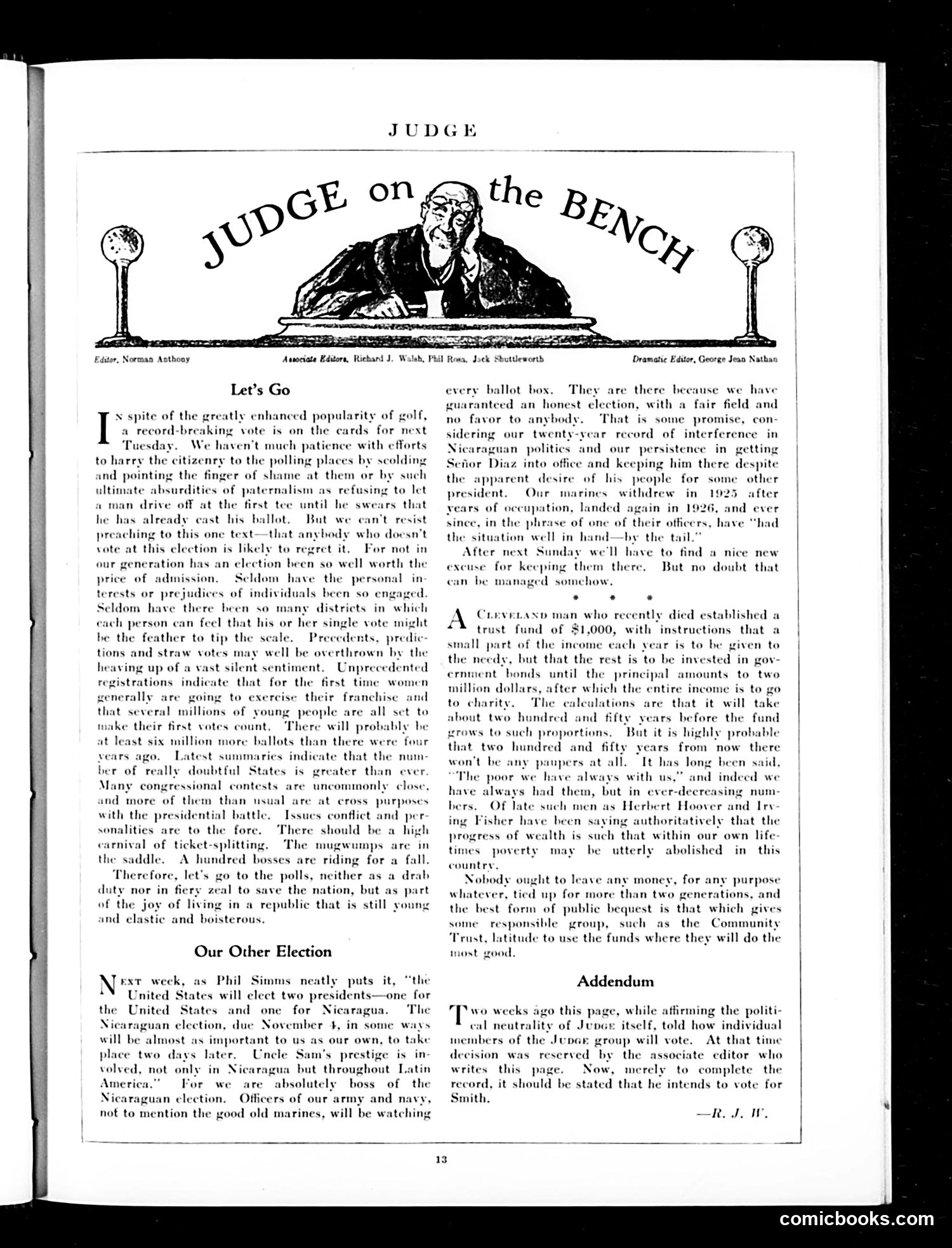
This editorial page addresses two major elections: the upcoming U.S. presidential vote and Nicaragua's concurrent election on November 4. **The Main Election:** The editors encourage voter participation, particularly noting this is the first election where women can vote nationally. They warn against voter suppression tactics (like preventing golfers from teeing off until voting) while emphasizing the election's importance given close congressional races and unprecedented numbers of young, first-time voters. **Nicaragua's Election:** The satire targets U.S. intervention in Latin America. The editors mock America's "guarantee" of an honest Nicaraguan election while acknowledging two decades of military occupation—marines withdrew in 1923 but returned in 1926. The cynical conclusion: after the election, America will simply invent a new justification for maintaining control ("can be managed somehow"). **Addendum:** A correction clarifies that an earlier Judge editorial claimed political neutrality regarding a Judge staff member's voting intentions—now stating the associate editor intends to vote for Smith. The page reflects Progressive-era skepticism about both American imperialism and domestic democratic participation.
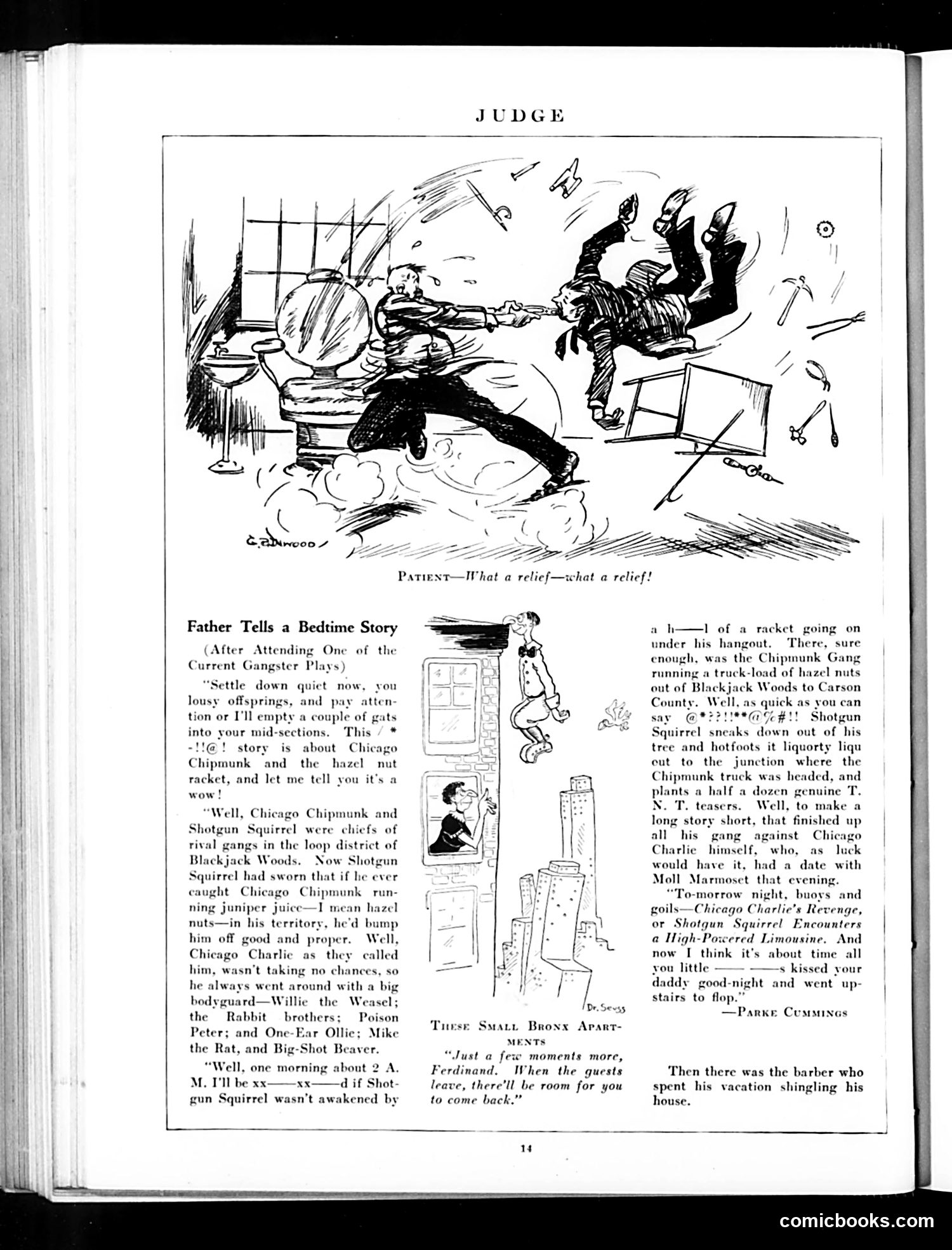
This page satirizes the popular "gangster plays" that were trendy in 1920s American theater. The top cartoon shows a judge being knocked backward—literal visual humor about courtroom chaos. The main piece, "Father Tells a Bedtime Story," parodies how these violent crime dramas had become so culturally pervasive that a father unconsciously mimics their brutal language and plots when telling his children a bedtime story. He uses gangster slang ("gats," "bump him off") and describes animal characters (Chipmunk, Squirrel, Weasel) engaged in a prohibition-era "hazel nut racket"—clearly mocking how crime dramas substituted animals for human criminals. The satire's point: these theatrical gangster plays were so influential and morally questionable that they were corrupting family life and normalizing violent criminal language as entertainment. It's social commentary on how popular media sensationalizes crime, dressed up as humorous domestic irony. The page also includes unrelated comic anecdotes about a barber and hotel guests—typical magazine filler.
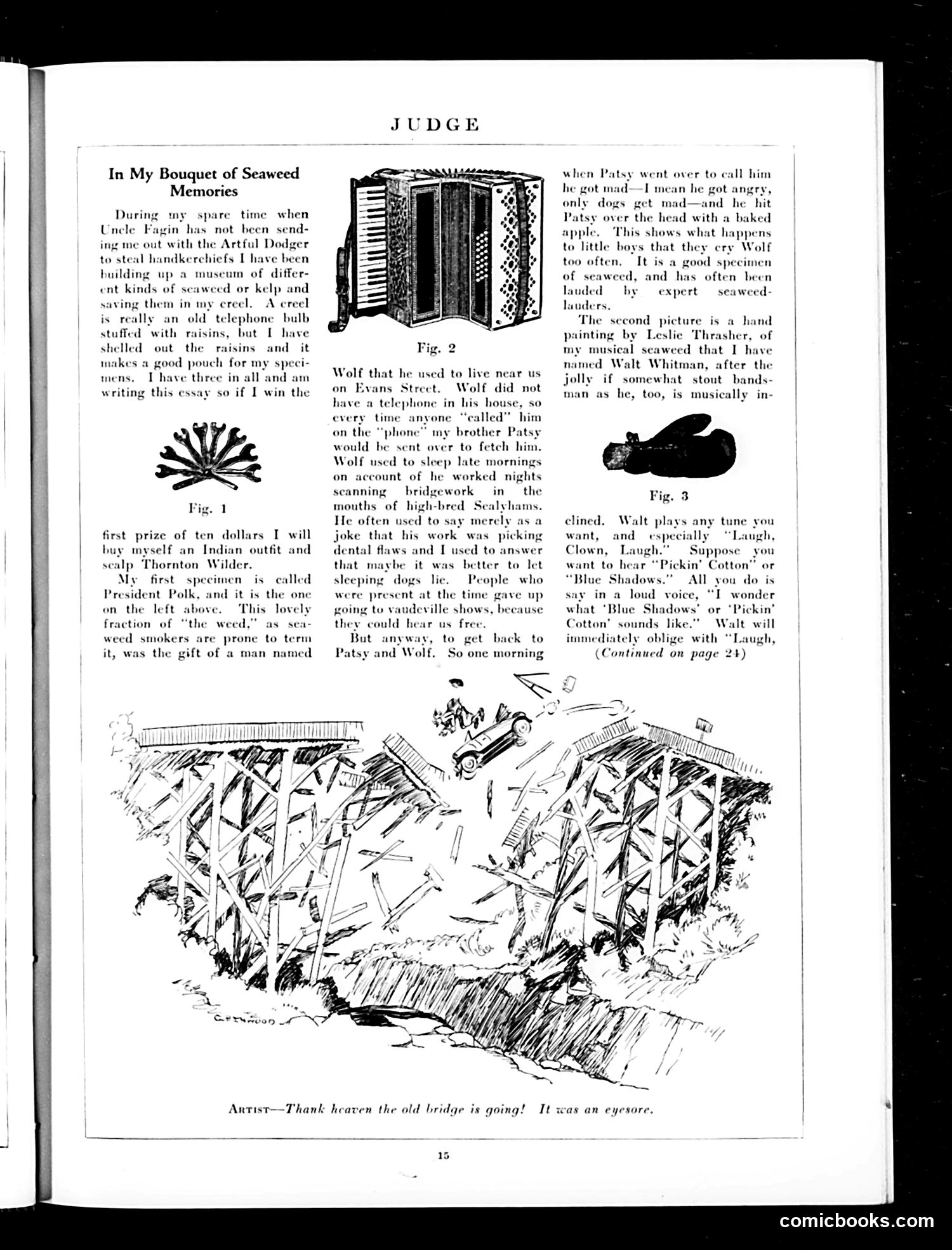
This appears to be a humorous essay titled "In My Bouquet of Seaweed Memories," written as a whimsical first-person account by someone collecting seaweed specimens. The piece references literary/cultural figures (Thornton Wilder, Walt Whitman, President Polk) as names for seaweed samples—a playful, absurdist naming convention. The main humor derives from the author's eccentric "museum," including the anecdote about a man named Wolf who hits a boy named Patsy with a baked apple when called on the telephone—establishing the author's deadpan, surreal comedic voice. References to "Uncle Fagin" and "the Artful Dodger" (Dickens characters) add to the deliberately meandering, nostalgic tone. The accompanying illustration of a collapsing bridge is captioned "Thank heaven the old bridge is going! It was an eyesore"—suggesting satirical commentary on urban decay or infrastructure, though the connection to the seaweed essay text remains intentionally unclear, typical of Judge's absurdist humor style.
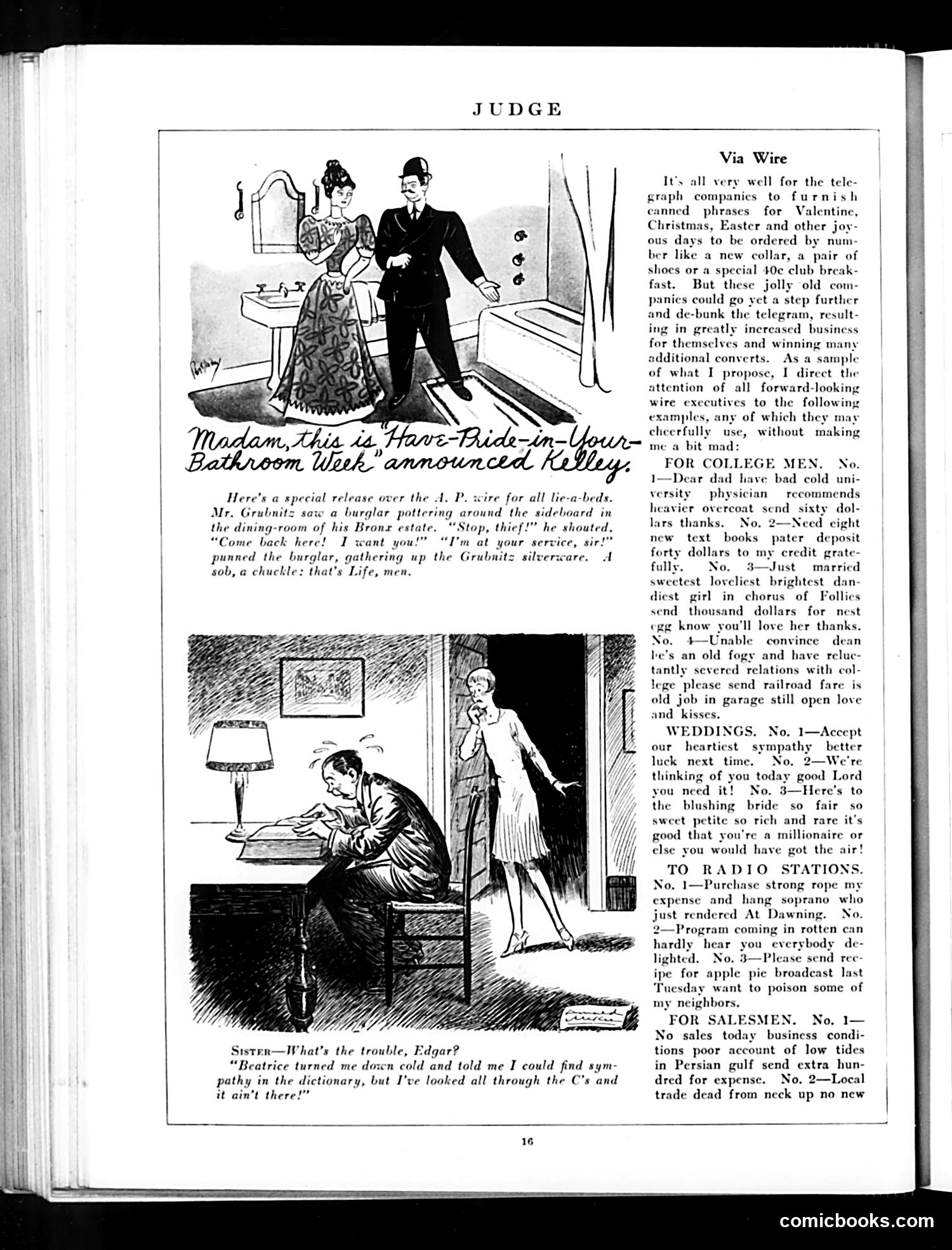
This Judge page contains two distinct cartoons and a satirical essay titled "Via Wire." **Top cartoon**: A man discovers a burglar in his dining room. Rather than calling police, he invites the burglar to steal his silverware, apparently finding the situation amusing. The joke plays on absurdist humor—wealthy people like "Mr. Grubnitz" are so detached they treat crime as entertainment. **Bottom cartoon**: A man tells his sister he was rejected romantically and searched a dictionary for "sympathy" under the letter C, finding nothing. It's a straightforward pun joke about both the word's location and emotional support. **"Via Wire" essay**: The author proposes telegraph companies should offer humorous "canned telegrams" for various occasions (college students requesting money, weddings, radio complaints, salesmen's excuses). It's satirizing how people use standardized messages and parodying the increasingly absurd excuses people might make—like blaming "low tides in Persian gulf" for poor sales. The overall tone mocks wealthy leisure-class attitudes and the era's growing reliance on pre-written communications.
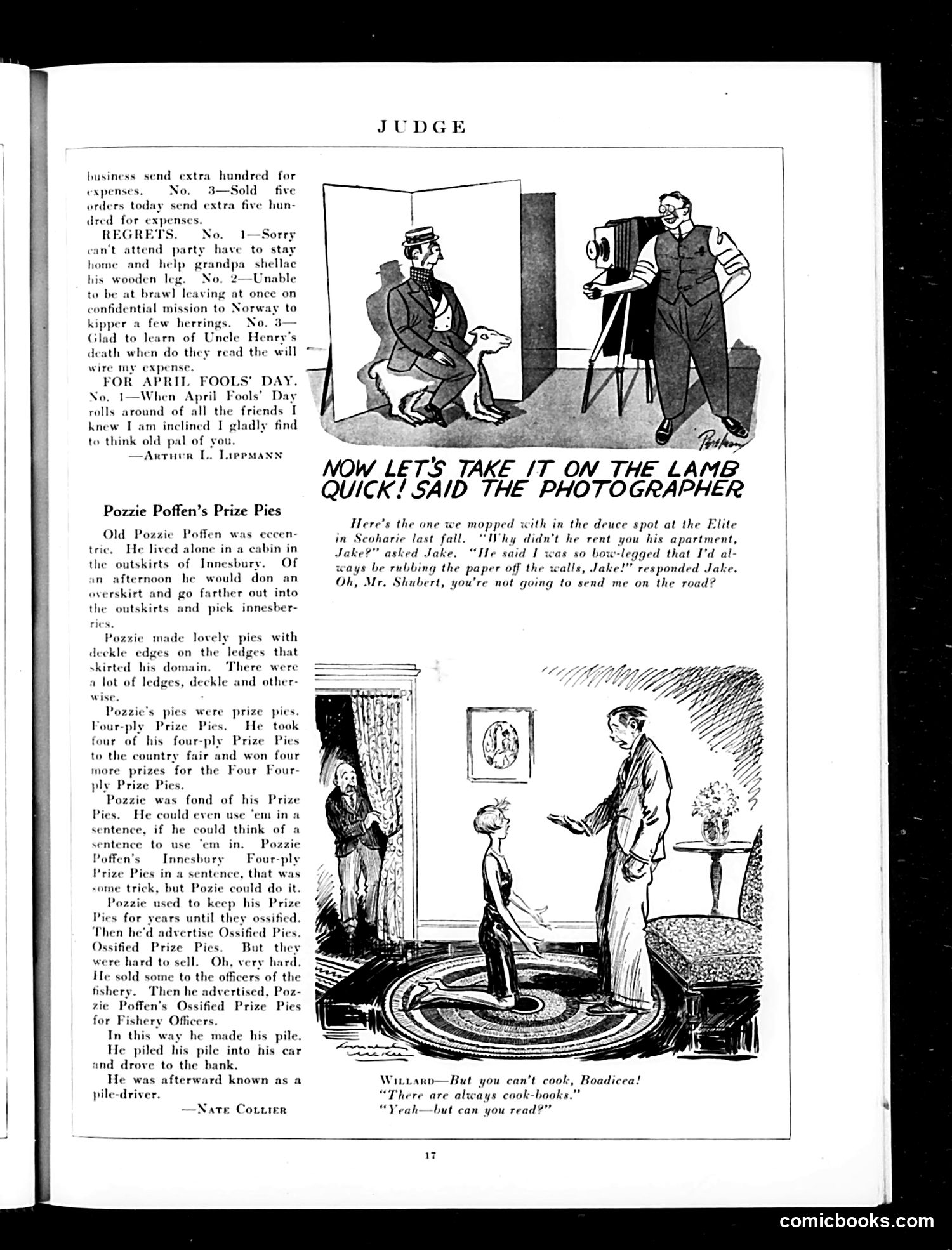
This page contains two distinct pieces of satirical content: **Upper section ("For April Fools' Day")**: Brief humorous excuses and regrets, parodying the flimsy reasons people give for declining invitations. The joke format was common to the era. **"Pozzie Poffen's Prize Pies"** (middle-left): A whimsical tall tale by Nate Collier about an eccentric hermit who makes pies so good he wins prizes, then cleverly markets his old, hardened "ossified" pies to fishery officers. The joke plays on wordplay and absurdist humor—a "pile-driver" becomes someone who literally drove a pile of money to the bank. **Two cartoon panels** (right side): The top shows a photographer rushing subjects ("take it on the lamb"—flee quickly). The bottom depicts domestic discord: a husband asks why his wife Boadicea can't cook, suggesting cookbooks. Her retort—"can you read?"—is a sarcastic jab at his intelligence, implying he's too stupid to follow instructions. This represents typical early-20th-century gender humor mocking marital incompatibility.
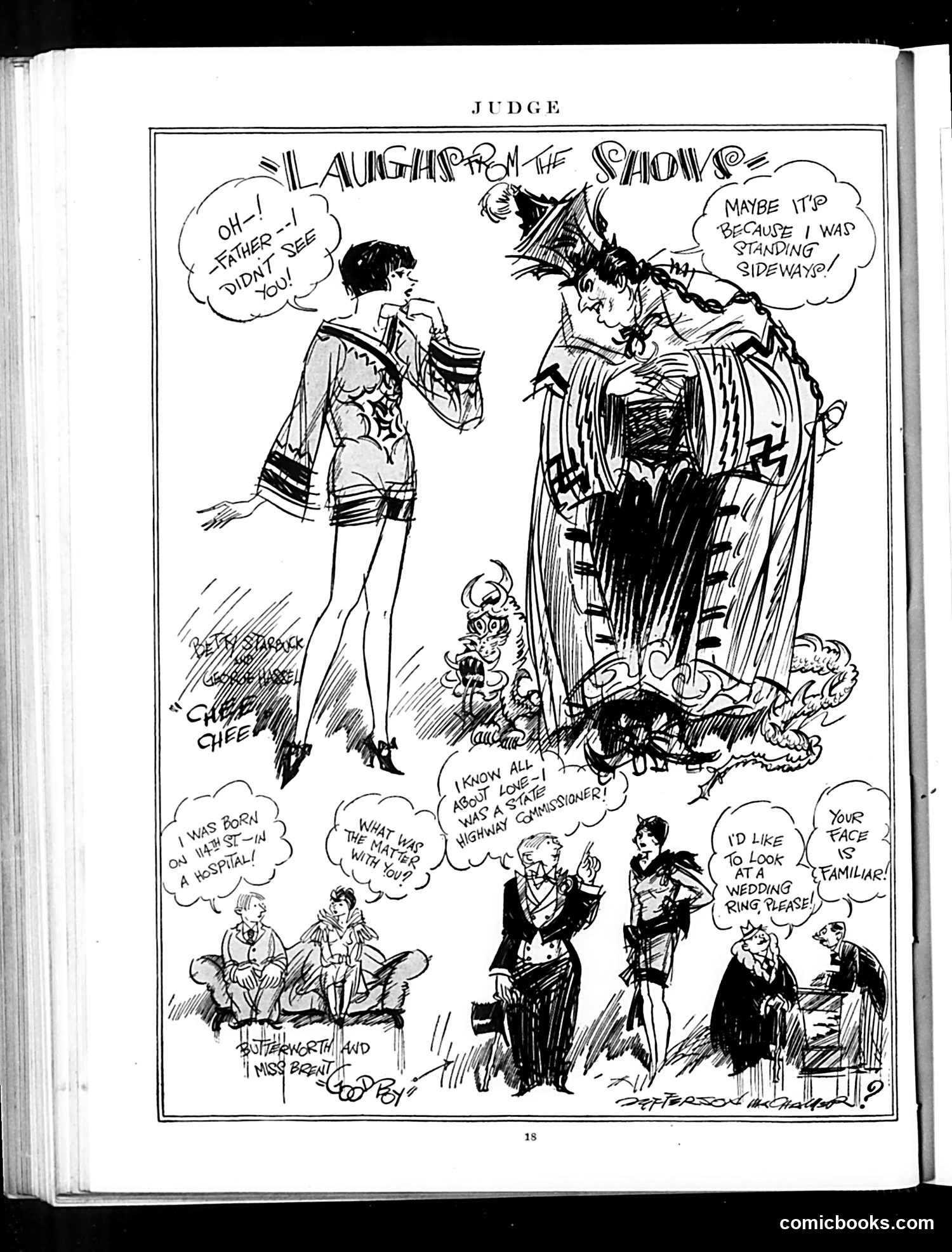
This satirical cartoon critiques a showgirl or entertainer's dubious backstory. The central figure, scantily dressed in performance attire, claims refined origins ("Oh father didn't see you!"), while other characters challenge her narrative with contradictory details: she was supposedly born in a hospital in 1943, yet claims aristocratic connections and refinement. The joke targets the common theatrical trope of performers inventing glamorous false identities. The surrounding characters—appearing to be audience members or acquaintances—expose inconsistencies in her fabricated biography ("What was the matter, your mother couldn't afford a real commissioner?"). The satire reflects mid-20th century skepticism toward show business personalities' manufactured personas and the gap between their public claims and actual backgrounds.
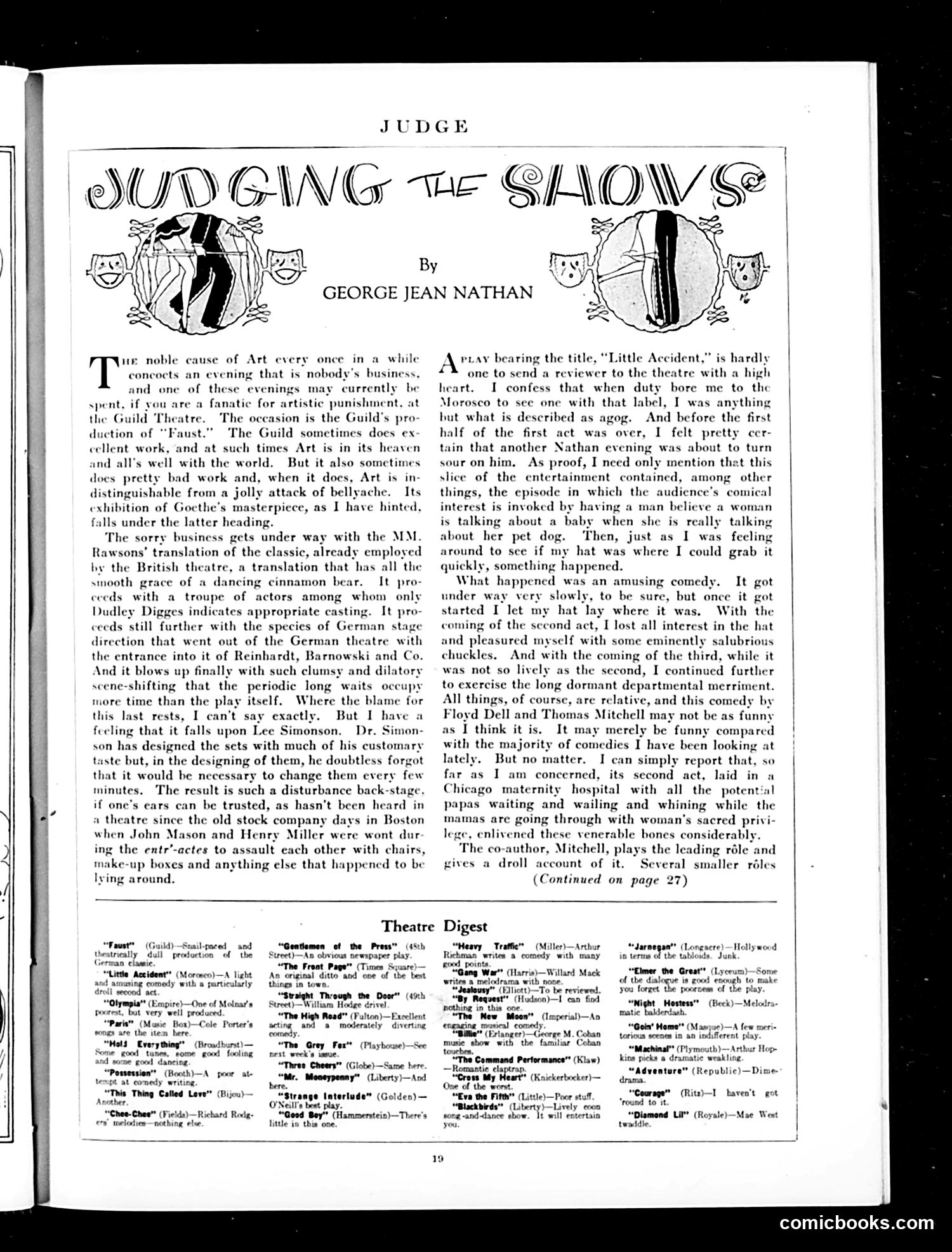
This is a theater review column by George Jean Nathan, a prominent drama critic of the early 20th century. The page contains no political cartoons—it's primarily text discussing theatrical productions. Nathan reviews two plays: the Guild Theatre's production of Goethe's "Faust" (which he harshly criticizes) and "Little Accident" at the Morosco Theatre (which he praises despite low expectations). His main complaints about "Faust" target the translation quality, acting, and particularly the scenic designer Lee Simonson, whose elaborate set changes caused such long delays between scenes that stagehands allegedly fought during intermissions. Nathan found the production technically incompetent and artistically pretentious. He praises "Little Accident"—a comedy by Floyd Dell and Thomas Mitchell about misunderstandings at a maternity hospital—for being genuinely entertaining, especially in the second act, despite its humble subject matter. The column represents elite theater criticism of the era, balancing artistic standards against entertainment value.
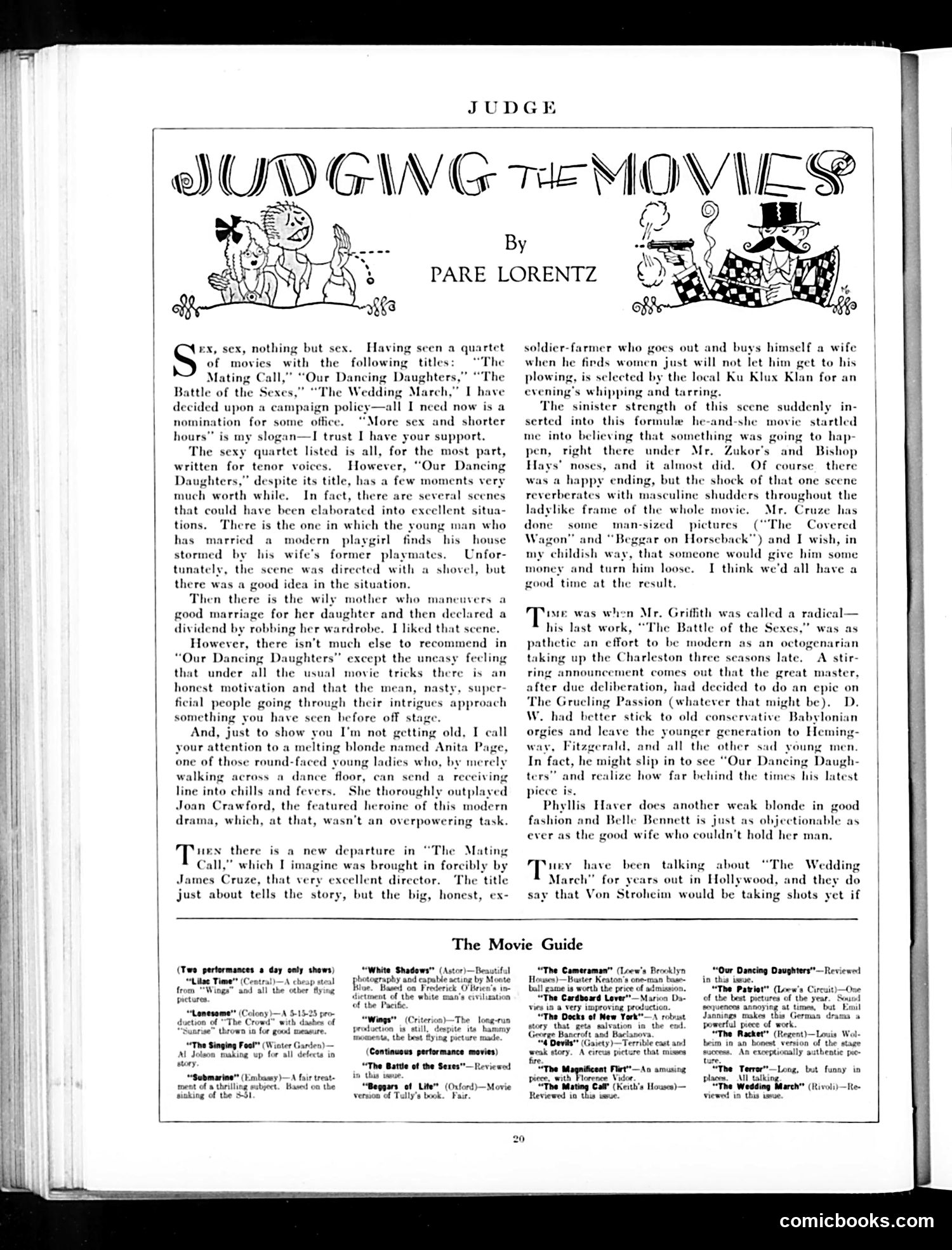
This is a film criticism column reviewing contemporary 1920s movies. The critic discusses several "sex films" including "Our Dancing Daughters," "The Mating Call," and "The Battle of the Sexes." The satire targets Hollywood's obsession with sex as a marketing device. Lorentz mocks the formula by proposing a political campaign platform: "More sex and shorter hours." Key critiques include: - **"Our Dancing Daughters"**: Despite its title, underwhelming except for scenes featuring actress Anita Page, whom he praises over star Joan Crawford - **"The Mating Call"**: Notable for a shocking KKK violence scene (whipping/tarring) that briefly interrupts the formulaic romance - **"The Battle of the Sexes"**: D.W. Griffith's outdated effort at modernity, compared to doing the Charleston "three seasons late" The column mocks Hollywood's "Ku Klux Klan" sequence insertion as transgressive yet ultimately resolved with a happy ending, and criticizes aging directors attempting trendy subjects they don't understand.
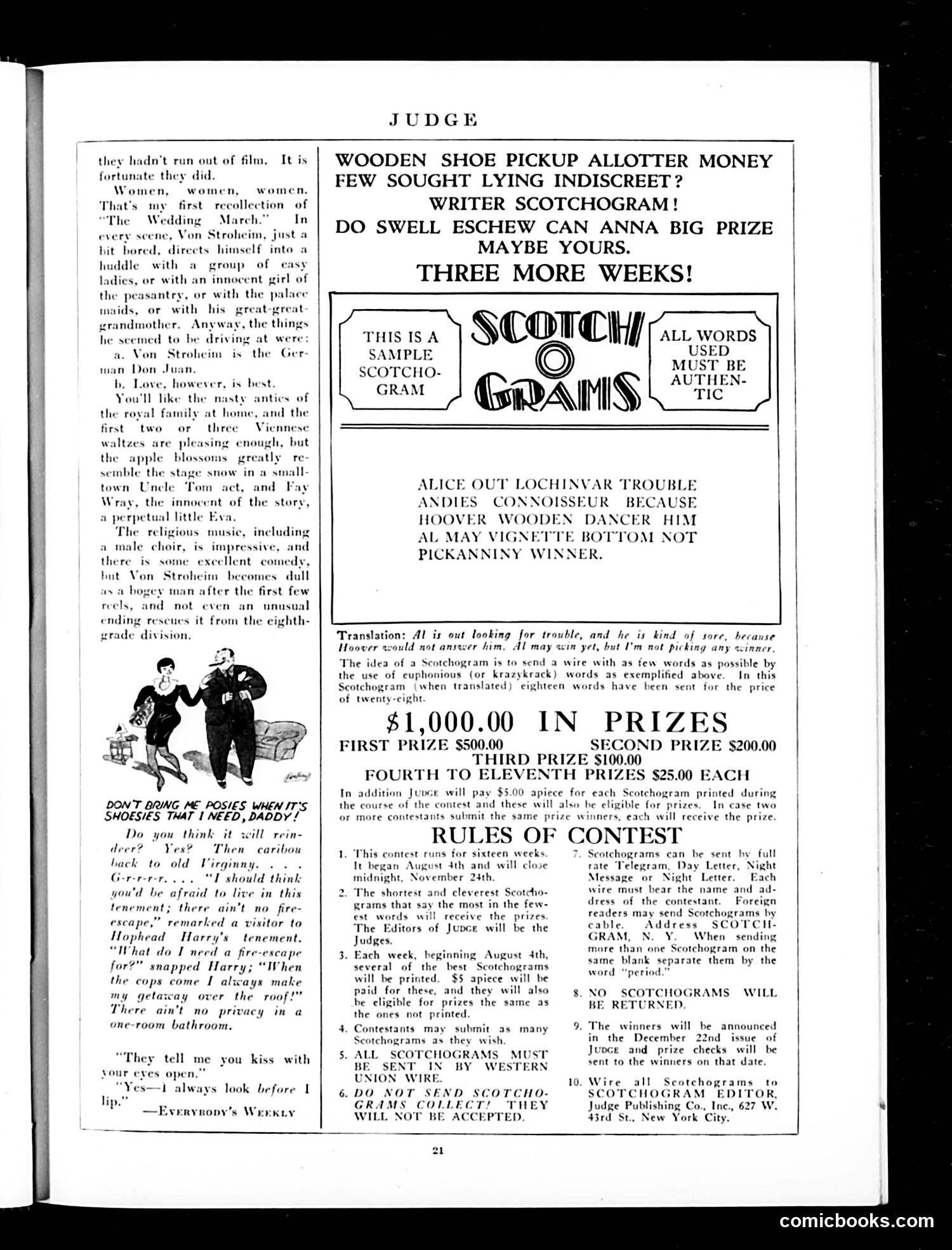
This page features a **Scotchogram contest**—a word-puzzle game where contestants create short telegrams using euphonious or made-up words that phonetically suggest longer phrases, saving telegraph costs. The example shown translates eighteen words into a compressed message using creative wordplay. The page also contains **film criticism** discussing Von Stroheim (likely director Erich von Stroheim), praising his direction while critiquing his acting style in what appears to be a recent movie production. Additional content includes **humorous vignettes**: jokes about apartment living, police evasion, and romantic mishaps. One cartoon shows a child requesting "shoesies" instead of flowers from their father. The contest itself—offering $1,000 in prizes over sixteen weeks—represents typical 1920s magazine engagement tactics, encouraging reader participation while promoting Judge's brand. The telegraph-themed competition reflects the era's communication technologies and cost-consciousness.
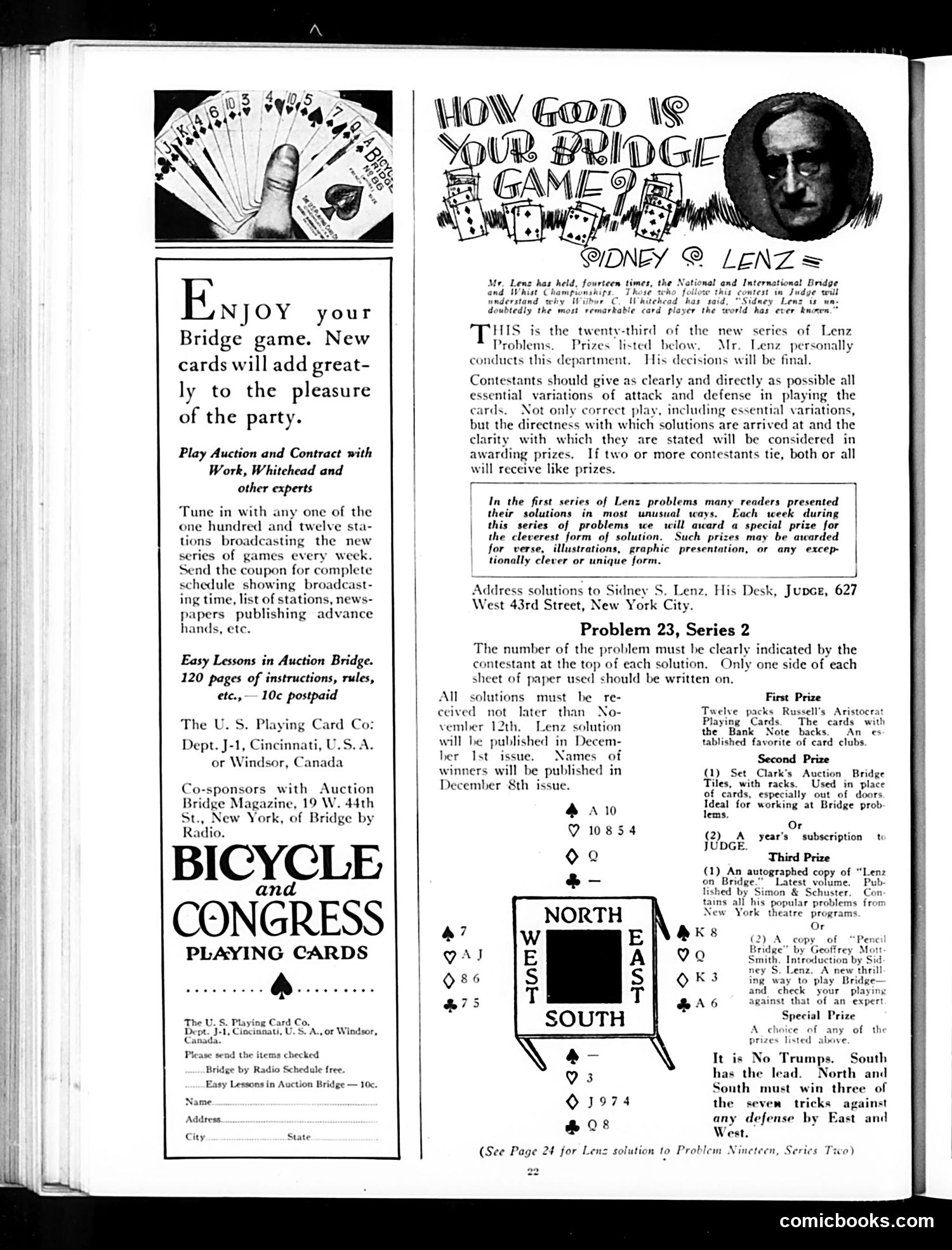
This page is primarily **advertising and instructional content** rather than political satire. It promotes bridge card games and playing cards while featuring a puzzle column. The main content is "Sidney S. Lenz Problems"—a recurring bridge strategy feature. Sidney Lenz was a renowned bridge champion (the text credits him with fourteen national and international championships). Judge published his weekly bridge puzzles as instructional content, offering prizes for clever solutions. The advertisements promote **Bicycle and Congress playing cards** and **bridge instruction materials**, reflecting bridge's popularity as a parlor game in this era (likely 1920s-30s based on styling). The page includes a sample bridge hand puzzle for readers to solve. There is **no political cartoon or satire** visible on this page—it's essentially a game/hobby column with integrated advertising, typical of Judge's mix of humor and commercial content.
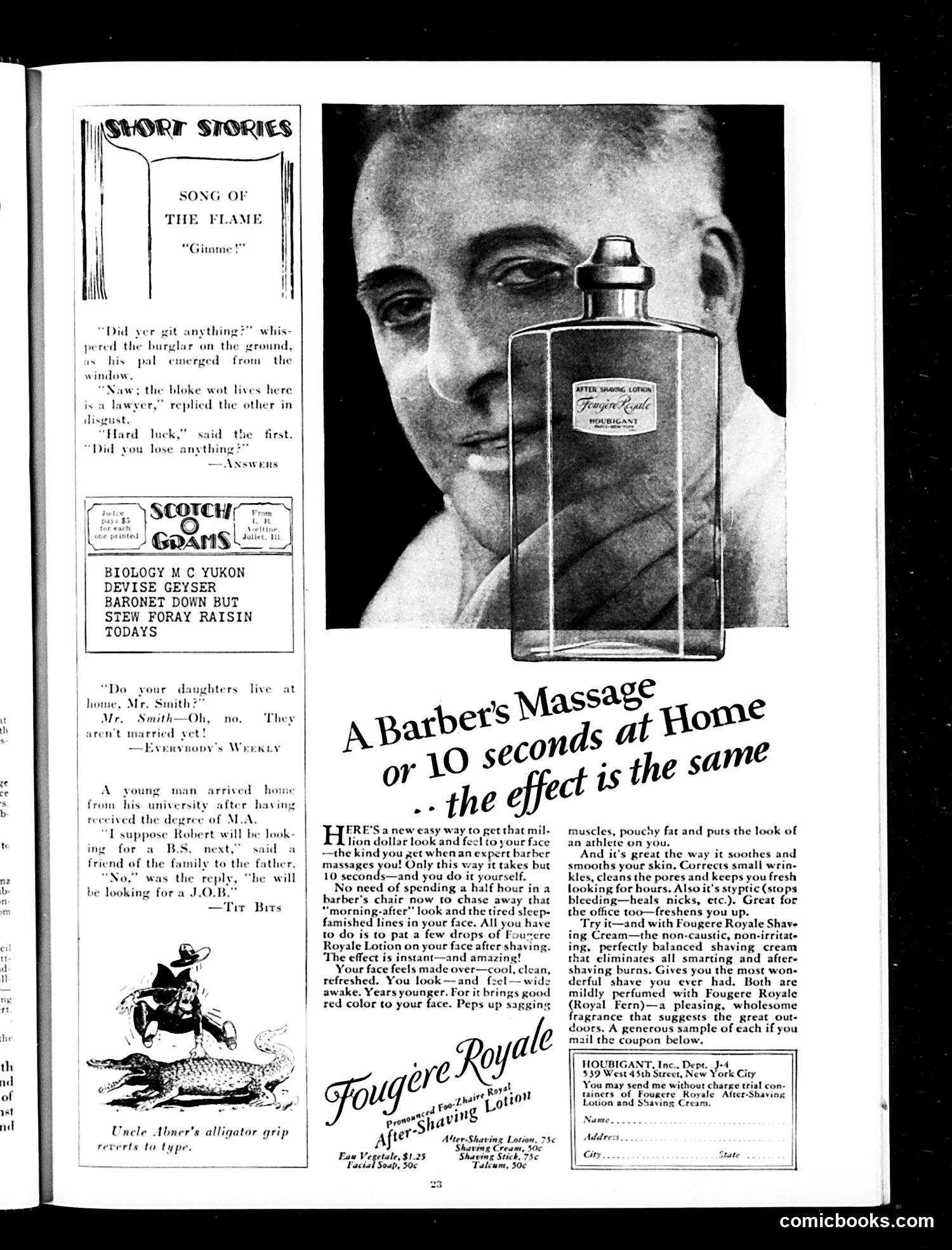
This page contains **short humor pieces and advertising**, not political satire. The **jokes** mock professional pretension and generational anxiety: - A burglar disappointed to find his victim is a lawyer (implying lawyers have nothing worth stealing—a class dig) - A father's dark humor that his M.A.-holding son will soon need a "J.O.B." (suggesting degree inflation and employment struggles) - Wordplay on "Scotch Grams" (puns on Scottish names like "Biology M.C. Yukon") The **main content** is a **full-page advertisement for Fougère Royale after-shaving lotion**, promoting the product's ability to make men look refreshed and youthful in seconds—solving "morning-after" fatigue and facial imperfections. The ad targets vanity and promises cosmetic transformation without barber visits. The page reflects 1920s consumer culture and gender anxieties about male appearance.
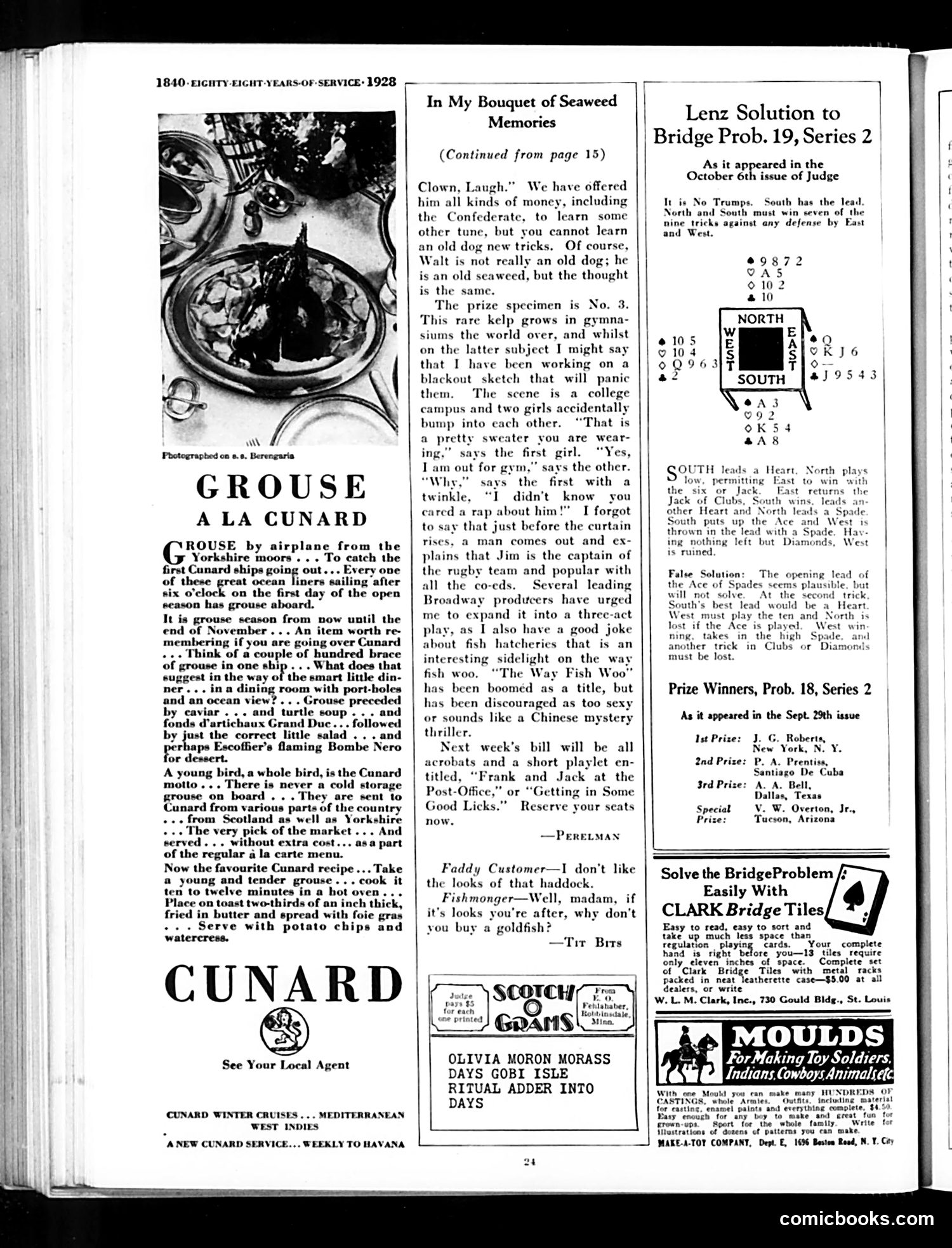
This page is primarily **advertising and entertainment content** from Judge magazine (1928). The dominant feature is a **Cunard cruise line advertisement** disguised as lifestyle editorial. It promotes the luxury of eating fresh grouse (game bird) on Cunard ocean liners, emphasizing that birds are flown from Scottish moors specifically for first-day sailings. The copy lists elaborate recipes and service details—a conspicuous consumption appeal to wealthy travelers during the Jazz Age. The accompanying photograph shows prepared grouse dishes. The page also includes: - A humor column by S.J. Perelman about seaweed specimens and failed theatrical sketches - A bridge problem solution - Small jokes about fish vendors - Advertisements for Clark Bridge Tiles and Moulds toy soldiers There's **no political satire** here—the content reflects 1920s consumer culture and luxury marketing aimed at Judge's affluent readership. The "satire" is gentle lifestyle humor rather than social critique.
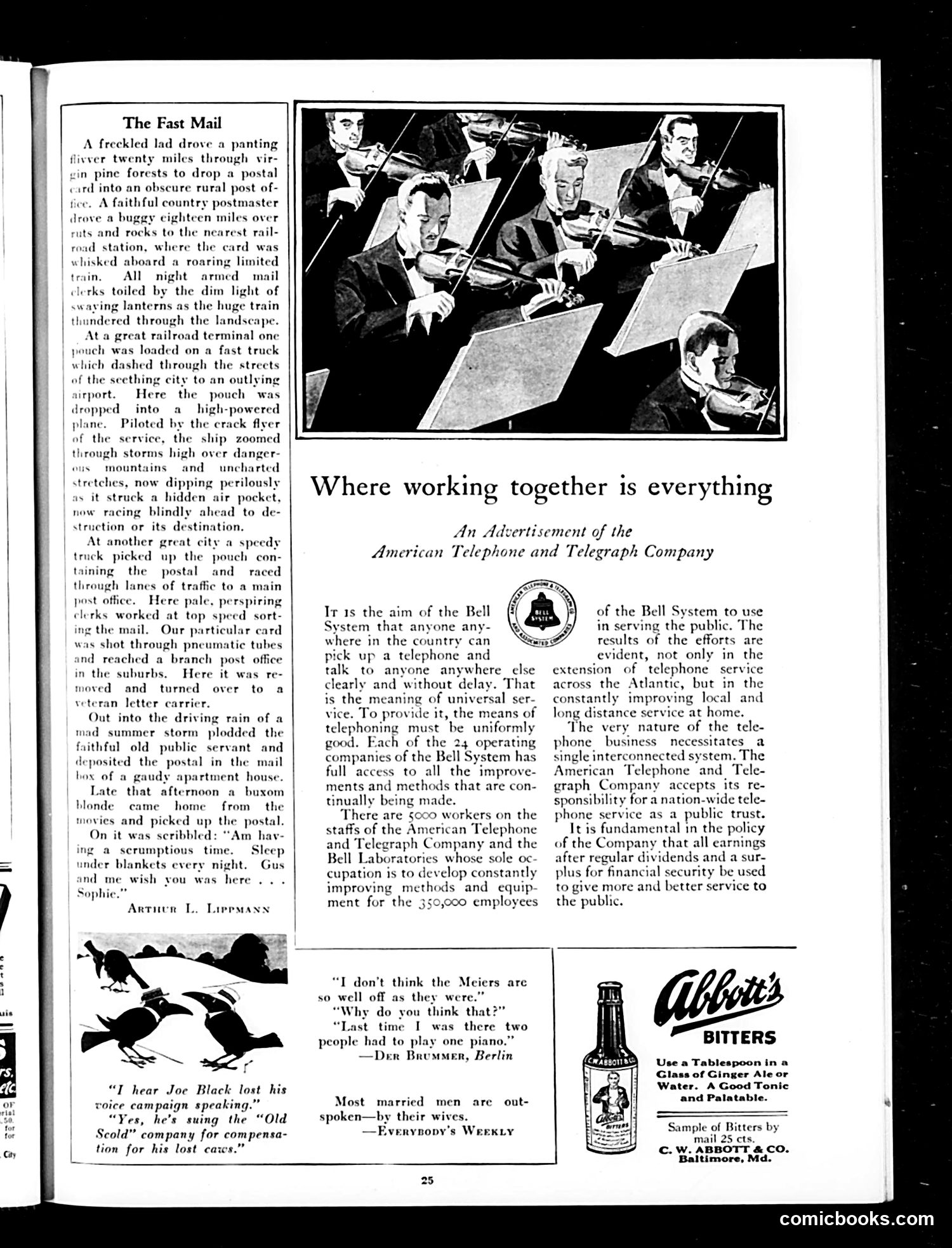
This page combines a humorous short story with corporate advertising. **"The Fast Mail"** (left) satirizes modern postal efficiency through absurd exaggeration. It traces a simple postcard's journey through increasingly elaborate means—car, train, plane, truck—involving countless workers laboring heroically through storms and danger. The punchline reveals the card's trivial message ("Am having scrumptious time..."). The satire mocks both the postal system's overcomplicated machinery and society's tendency to treat minor communications as momentous. **The Bell System advertisement** (right) uses this same sentiment differently: it celebrates interconnected infrastructure and worker coordination as virtuous public service. The irony is unintentional—while Judge mocked the postal system's excess, AT&T presents nearly identical organizational complexity as admirable progress. The page also includes minor jokes about marriage and voice loss, plus ads for Abbott's Bitters, typical of Judge's mixed content format.
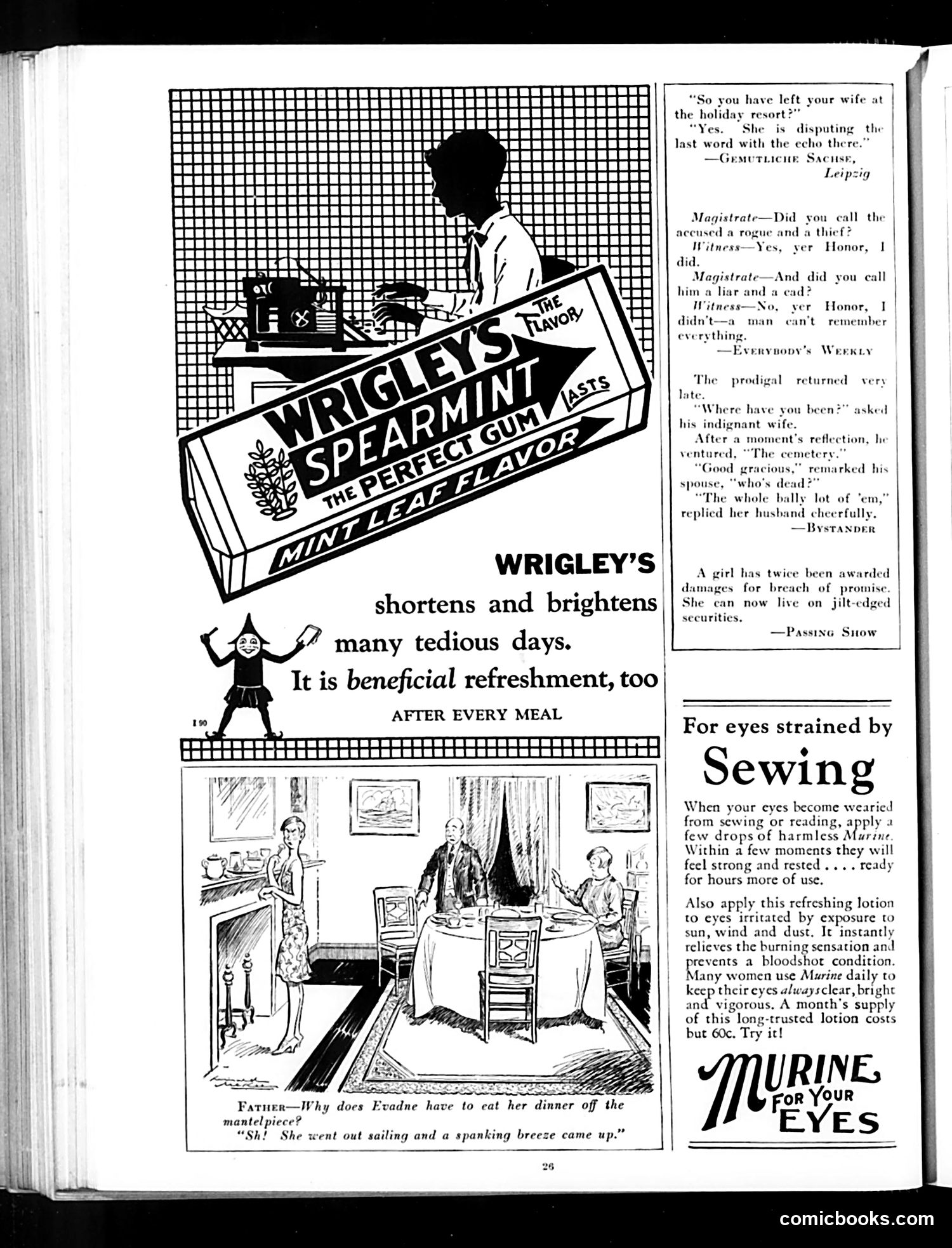
This page combines humor comics with period advertisements. The comics are brief jokes about marital discord and memory lapses—typical vaudeville-style humor of the era. One depicts a wife's stubbornness ("disputing the last word with the echo"), another shows a witness who can't remember all the insults he hurled, and a third involves a husband claiming he visited "the whole bally lot of 'em" (cemeteries) when questioned about his whereabouts. The advertisements reflect early 20th-century consumer products: Wrigley's Spearmint gum marketed as a mood-brightener for "tedious days," and Murine eye drops for strain from sewing—reflecting women's domestic labor. The dinner-off-the-mantelpiece joke plays on a sailing mishap resulting in a woman's exposure. The satire targets domestic relationships with gentle mockery of male forgetfulness and female assertiveness, while ads assume female readers concerned with household duties and appearance.
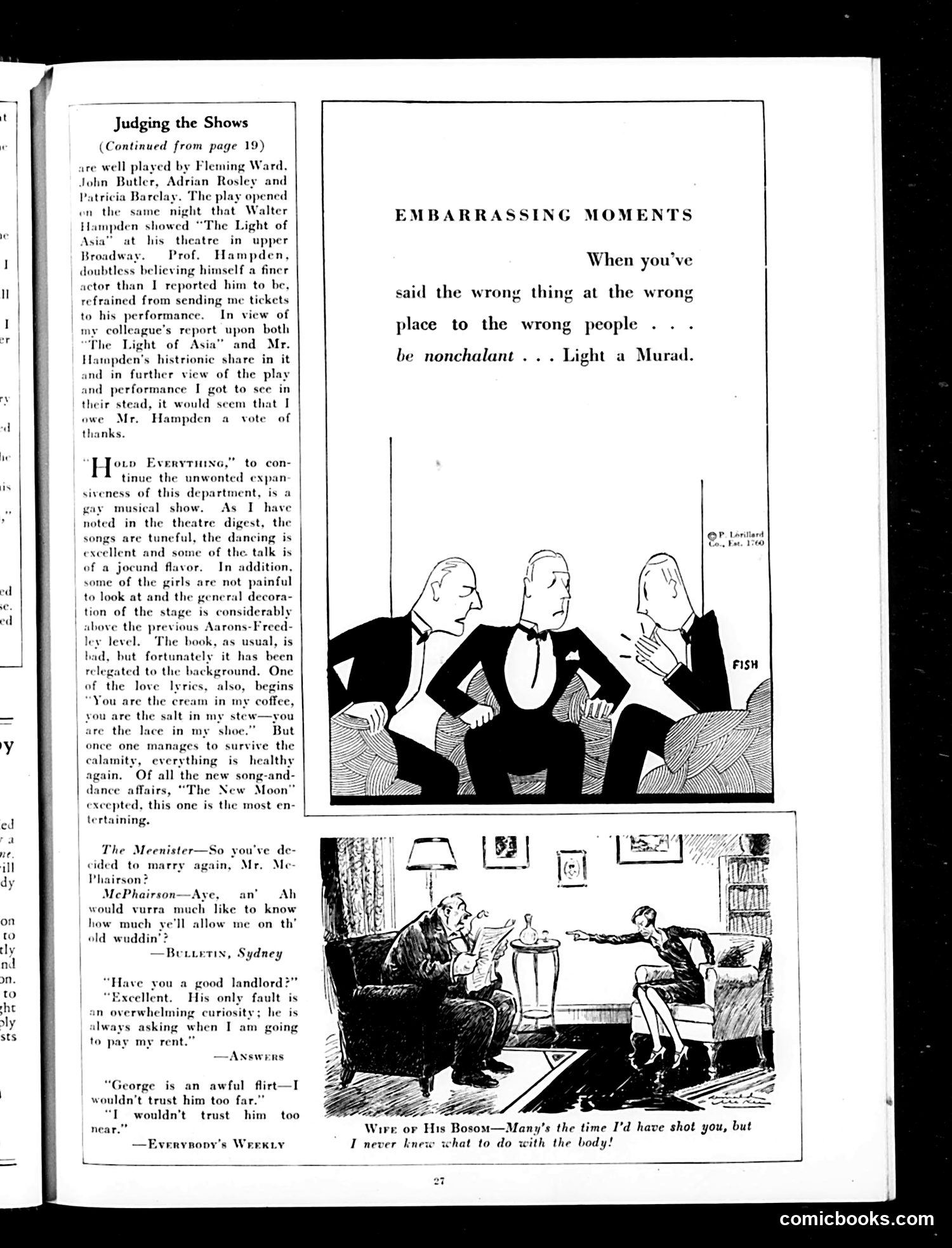
This page contains satirical theater reviews and two cartoon gags typical of 1920s American humor magazines. **Top cartoon ("Fish"):** Three men in formal wear appear shocked or dismayed—the joke's setup is unclear from the image alone, though the title suggests an awkward social situation. **Bottom cartoon:** A domestic scene where a wife threatens her husband with a gun, joking she'd have shot him except for the practical problem of disposing of his body. This represents period humor about marital discord—a common joke format portraying marriage as a battleground, played for laughs through exaggeration. The accompanying text reviews theatrical productions, including Walter Hampden's "The Light of Asia" and the musical "Hold Everything." The reviews are professional theater criticism with occasional cattiness (the critic notes Hampden didn't send tickets, implying professional pettiness). The **Murad cigarette advertisement** uses the "embarrassing moments" theme to sell cigarettes as a solution—lighting up supposedly helps one appear composed during social awkwardness.
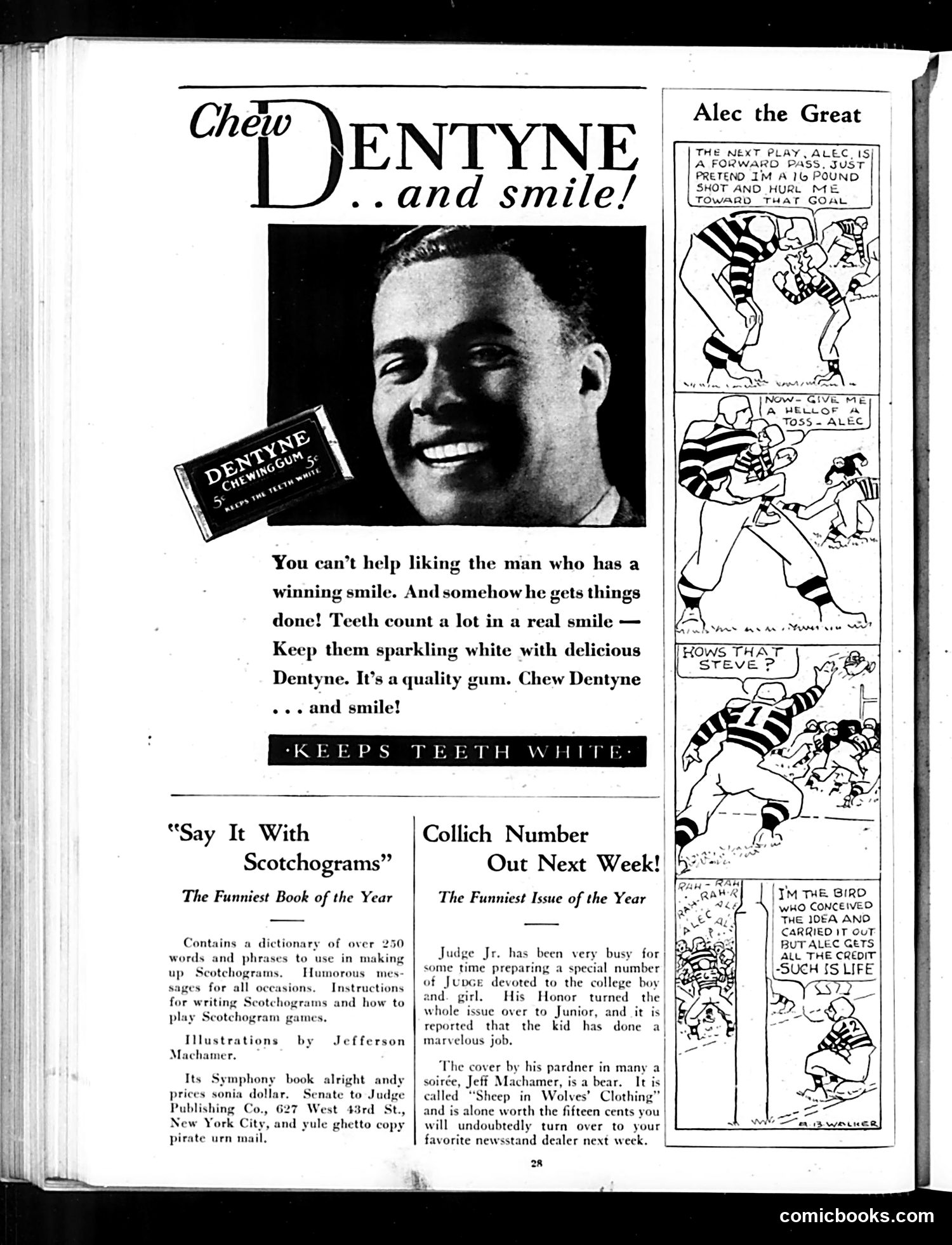
This comic strip satirizes a football player named Alec, likely a contemporary sports figure (unclear which specific player). The humor centers on a coach's strategy: he instructs Alec to pretend he's a 16-pound shot put and have himself hurled toward the goal like a projectile—absurd physical comedy playing on Alec's apparent value as a star player. The strip mocks both overconfident athletes and excessive football enthusiasm of the era. The repeated phrase "Hows that Steve?" suggests friendly ribbing among teammates. The page is primarily **advertising**: a Dentyne gum ad dominates, using a smiling man's photograph as endorsement. Below are book promotions ("Say It With Scotchograms," "Collich Number Out Next Week"), typical of Judge magazine's commercial content mixed with editorial cartoons. The overall context reflects 1920s-30s American sports culture and advertising strategies relying on celebrity endorsement and physical comedy.
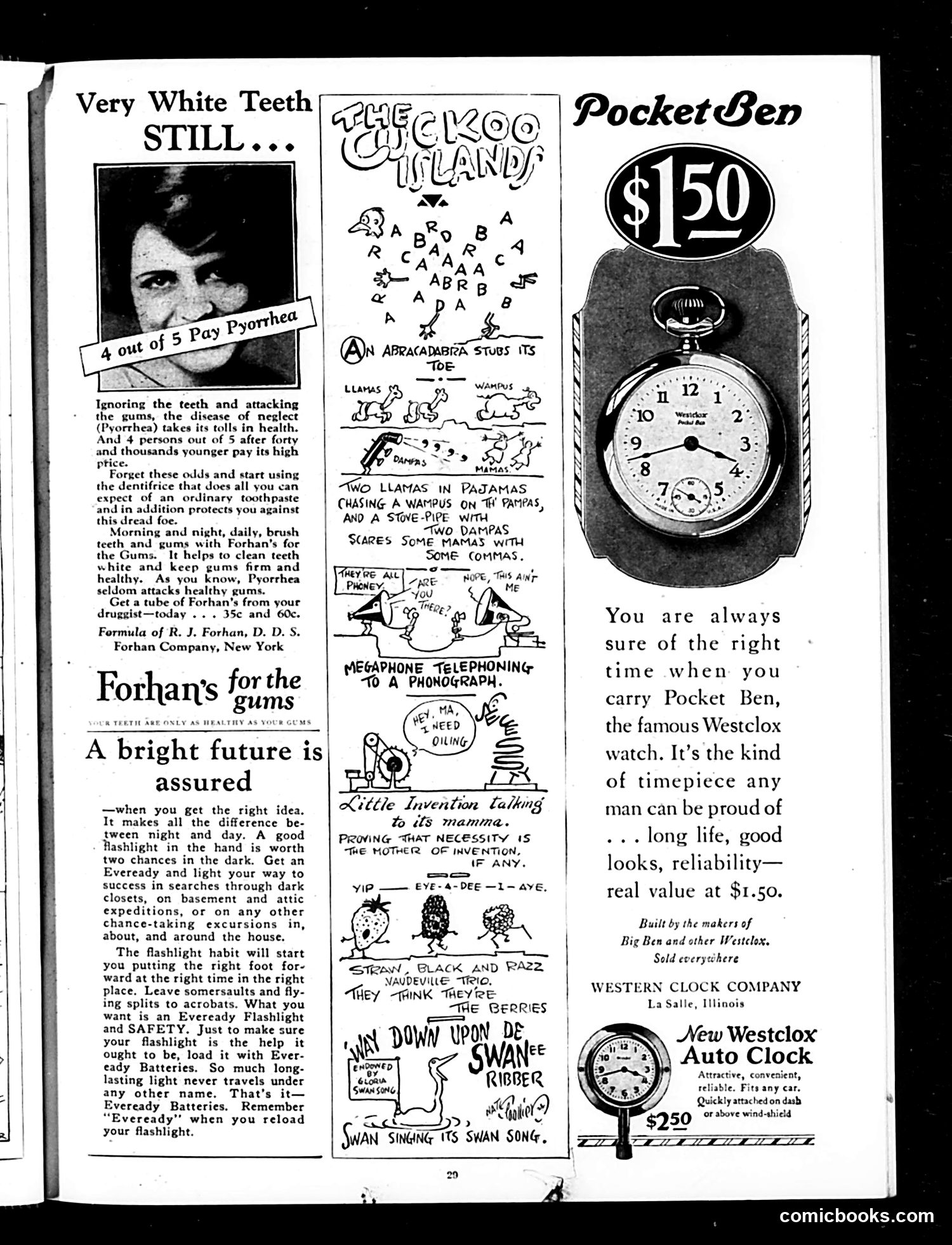
This page contains **three separate advertisements** with no political cartoons or satirical content. **Left side:** Forhan's toothpaste ad warns about pyorrhea (gum disease), claiming 4 of 5 people over 40 suffer from it. The ad uses fear-based marketing to sell the product as protection against tooth loss. **Center:** A humorous "nonsense" comic strip titled "The Cuckoo Islands" featuring absurdist wordplay and silly scenarios (llamas in pajamas, etc.). This appears to be filler entertainment rather than satire. **Right side:** Two watch advertisements—Pocket Ben ($1.50) and Westclox Auto Clock ($2.50)—emphasizing reliability and value. The page is primarily **commercial advertising** typical of early-to-mid 20th century magazines, using the humor strip as content filler between paid advertisements. There is no discernible political or social satire present.
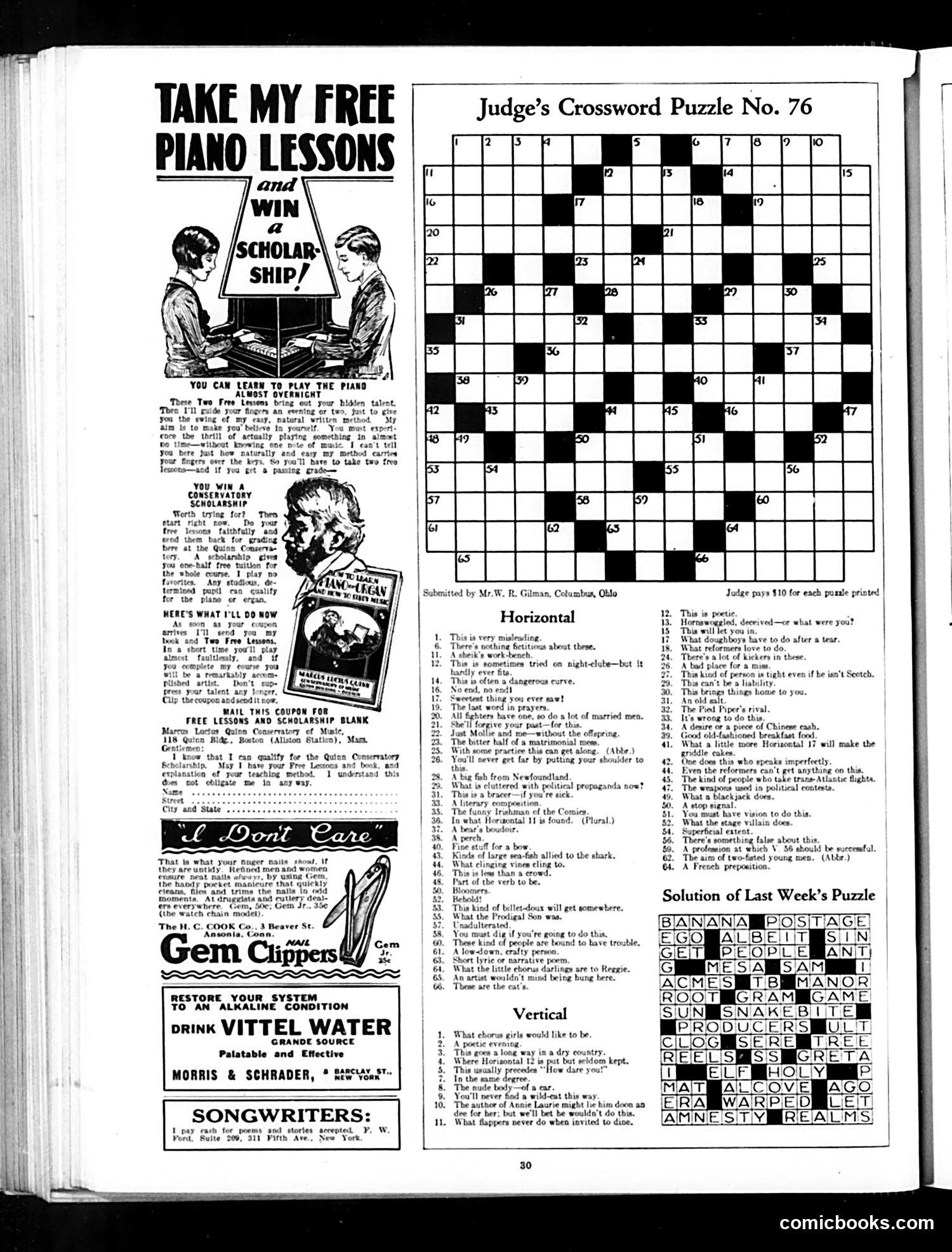
This page primarily contains **advertisements and a crossword puzzle** rather than satirical political cartoons. The main content includes: 1. **"Take My Free Piano Lessons" ad** — A common early-20th-century mail-order scheme promising rapid piano mastery and a conservatory scholarship to entice students to purchase lessons. 2. **"Gem Clippers" ad** — A pocket manicure tool advertisement. 3. **"Vittel Water" ad** — Promoting mineral water as health restoration through "alkaline condition," reflecting period pseudoscientific wellness marketing. 4. **Judge's Crossword Puzzle No. 76** — The primary feature, with clues mixing everyday humor with social commentary (references to "night-clubs," "reformers," "flappers," "blackjacks"). The crossword's clues contain period-specific cultural references (flappers not dining out, "doughboys" post-war, political weapons) that would have amused 1920s readers but require historical context today. This appears to be a typical **entertainment/puzzle page** from Judge rather than its signature satirical editorial content.
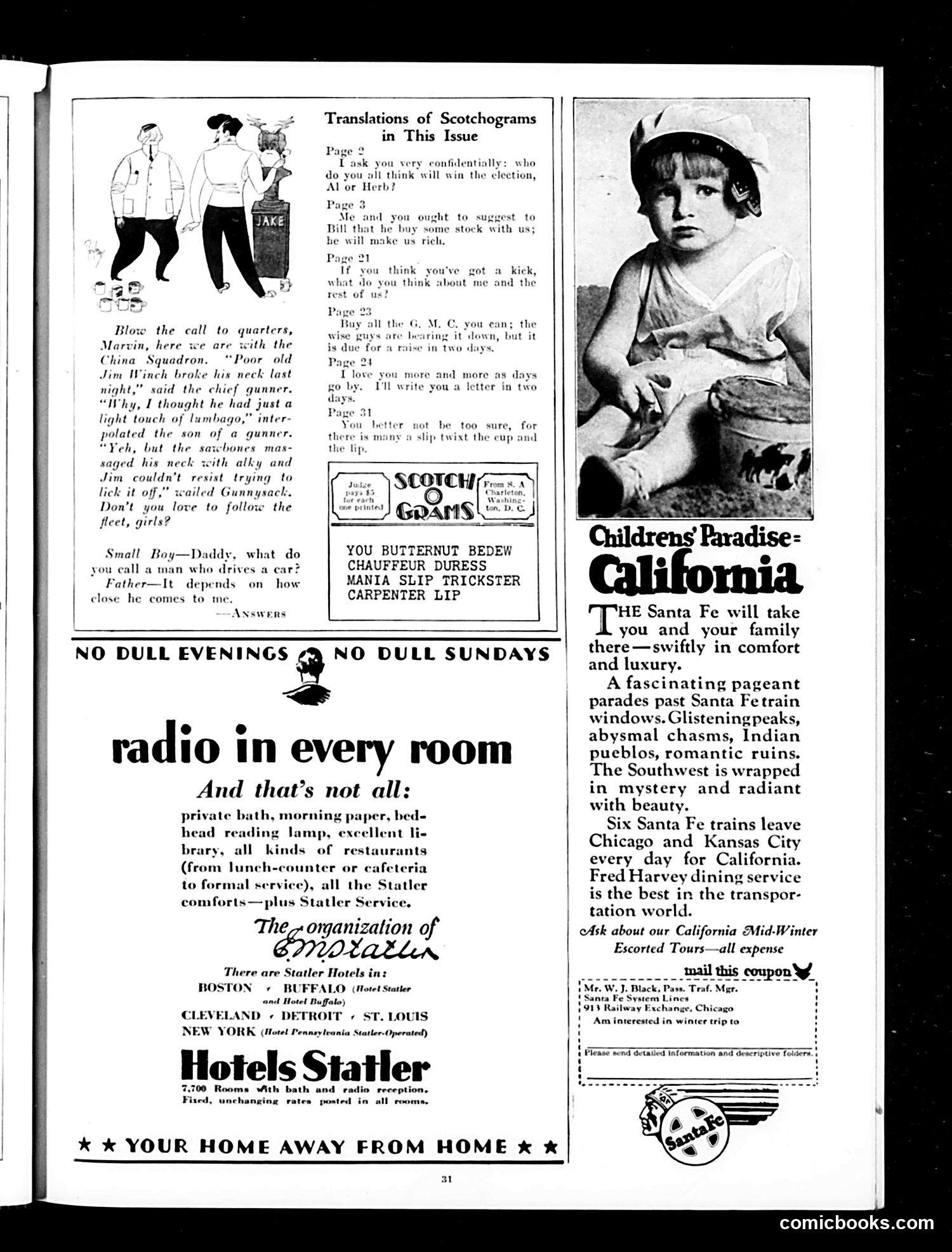
This page is primarily **advertising and filler content** rather than political satire. The visible cartoon depicts a naval anecdote about sailors in the "China Squadron." The humor is crude slapstick: a sailor named Jim Winch breaks his neck, and when a fellow sailor learns a doctor massaged it with alcohol, he jokes that Jim "couldn't resist trying to lick it off"—implying drunken desperation. Below this are two joke exchanges: one about predicting an election winner ("Al or Herb"—likely referencing the 1928 U.S. presidential race between Al Smith and Herbert Hoover), and a father-son joke about car drivers. The "Scotch Grams" feature appears to be phonetic wordplay translating Scottish dialect into English phrases (e.g., "You Butternut Bedew" = Scottish pronunciation of English words). The remainder of the page consists of **advertisements**: Hotels Statler, Atchison Topeka & Santa Fe Railway, and related travel services. This reflects Judge's commercial nature in the 1920s.
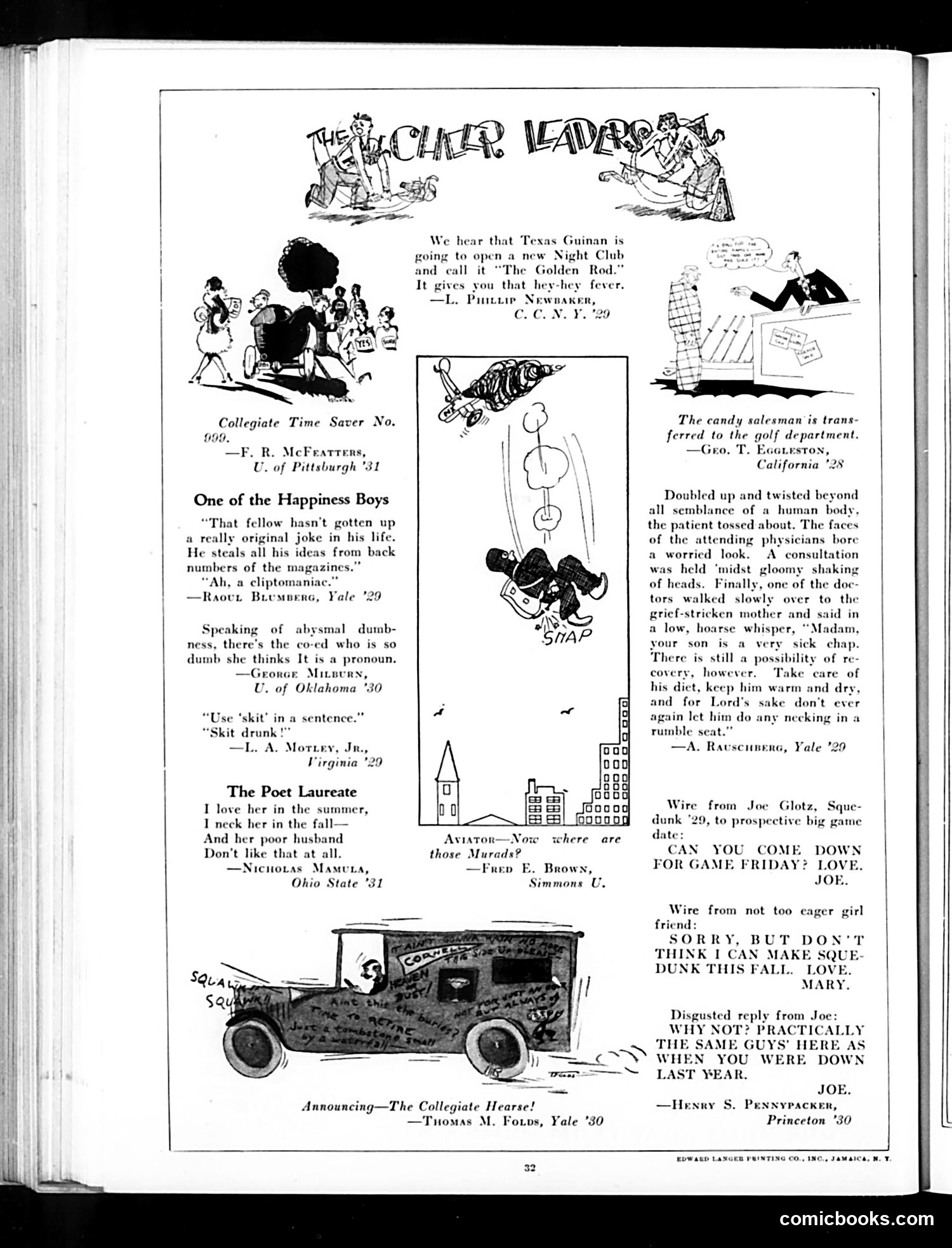
This is a humor page from Judge magazine featuring college-themed jokes and satirical commentary targeting 1920s-30s collegiate culture. The content includes: **Main themes:** - College life absurdities (plagiarized jokes, necking in "rumble seats," drinking slang) - Romantic/dating mishaps among students - Academic and social pretensions **Key references:** - "Rumble seat" — the exposed rear seating area of cars, notorious as a dating spot - "Skit drunk" — wordplay on collegiate drinking culture - References to real colleges (Yale, Princeton, Ohio State, Pittsburgh) - "The Collegiate Hearse" — dark humor about student recklessness - Murad cigarette ads (visible in era) **The satire targets:** Upper-class college students' shallow behavior, their tendency to recycle stale jokes, dangerous driving/necking practices, and romantic fickleness. The page presents itself as recording authentic student "wisdom" through attributed quotes, mock-earnestly presenting juvenile behavior as newsworthy. It's essentially making fun of college kids to an adult readership.
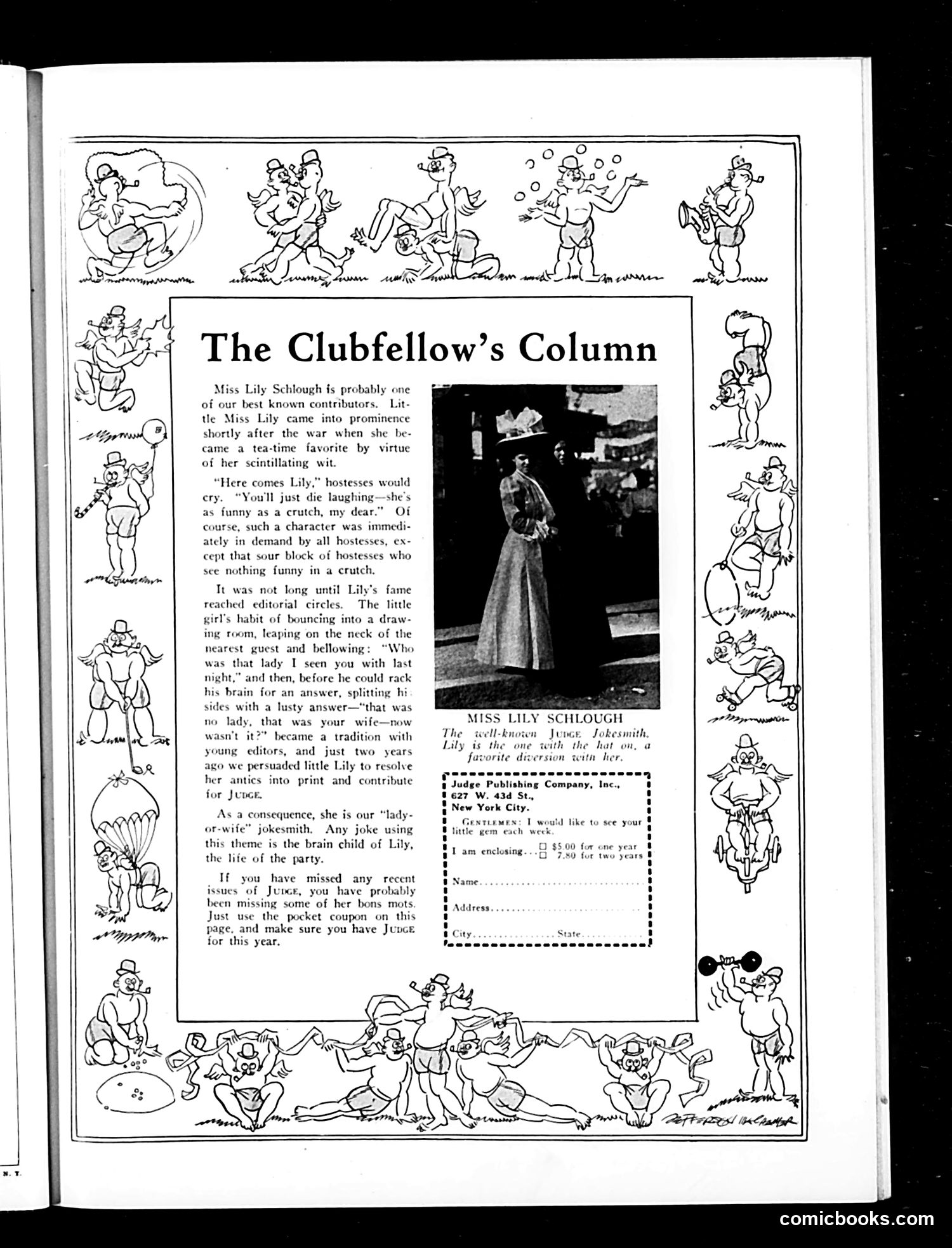
This page promotes **Lily Schlough**, a humor contributor to *Judge* magazine. The text describes her as a witty socialite whose comedic trademark is the "lady or wife" joke—a format where she'd ask embarrassing questions at parties, then deliver a punchline suggesting a woman wasn't respectable. The satire works on multiple levels: hostesses invite her for entertainment despite (or because of) her crude humor; the magazine celebrates her as their "lady-or-wife jokesmith"; and the decorative border shows cartoonish figures in exaggerated physical comedy, embodying the broad, slapstick style *Judge* favored. The subscription coupon encourages readers to keep current with her contributions. This reflects early 20th-century magazine culture where regular contributors became personalities. The humor—mocking both social pretension and women's respectability—was typical of *Judge's* satirical sensibility, though such jokes now read as simply offensive.
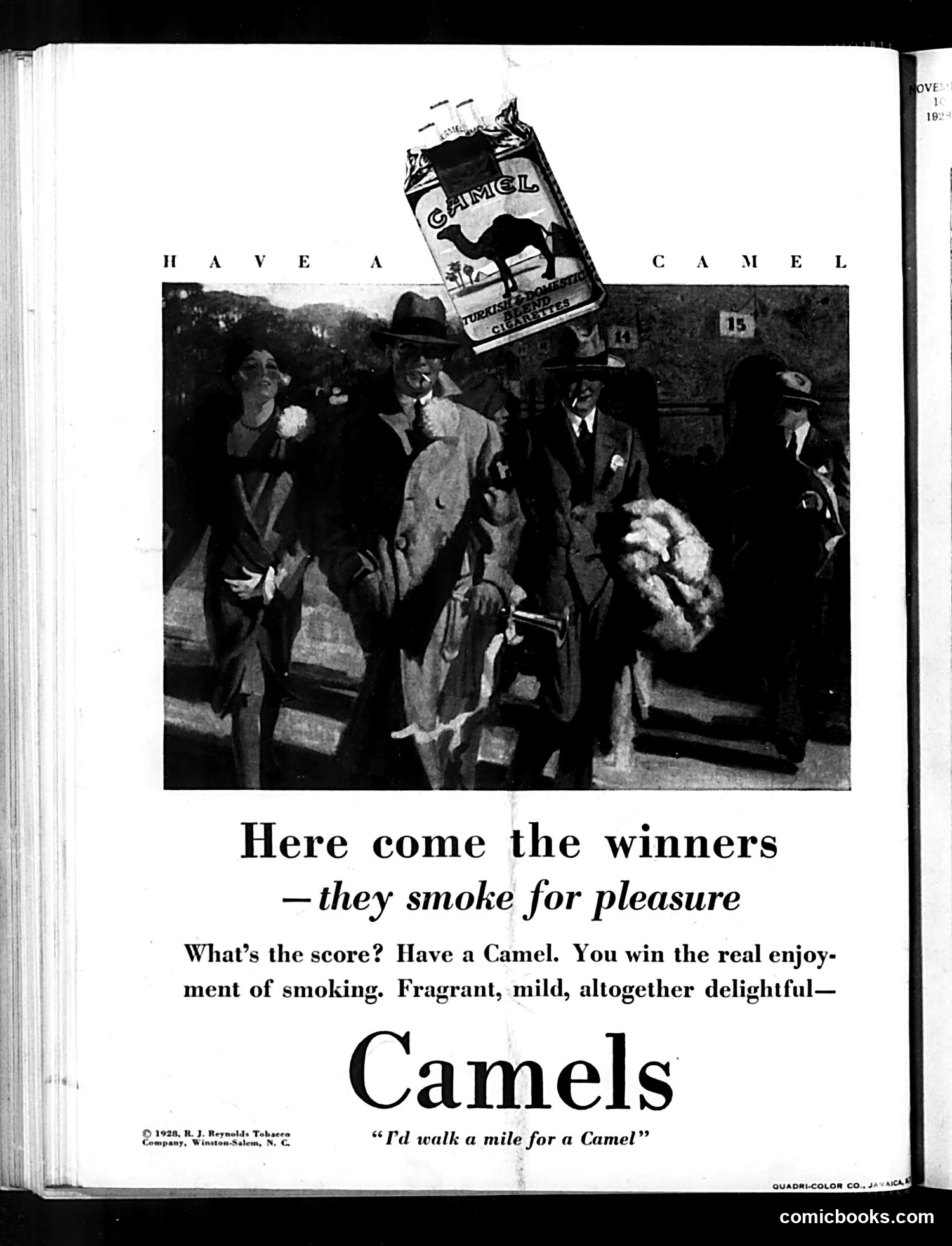
This is a **Camel cigarette advertisement**, not political satire. The page shows a group of well-dressed men and women in 1920s attire gathered around a large Camel cigarette package, with the headline "Here come the winners—they smoke for pleasure." The ad associates smoking Camels with success and social status, using the phrase "winners" to suggest that desirable, accomplished people choose this brand. The tagline "I'd walk a mile for a Camel" emphasizes the product's appeal. The "score" reference likely alludes to sports or competitive success, implying that smoking Camels is part of the winning lifestyle. This represents typical early 20th-century tobacco marketing that linked cigarettes to glamour, sophistication, and achievement—before the health dangers of smoking were widely acknowledged.