
A complete issue · 36 pages · 1929
Judge — January 5, 1929
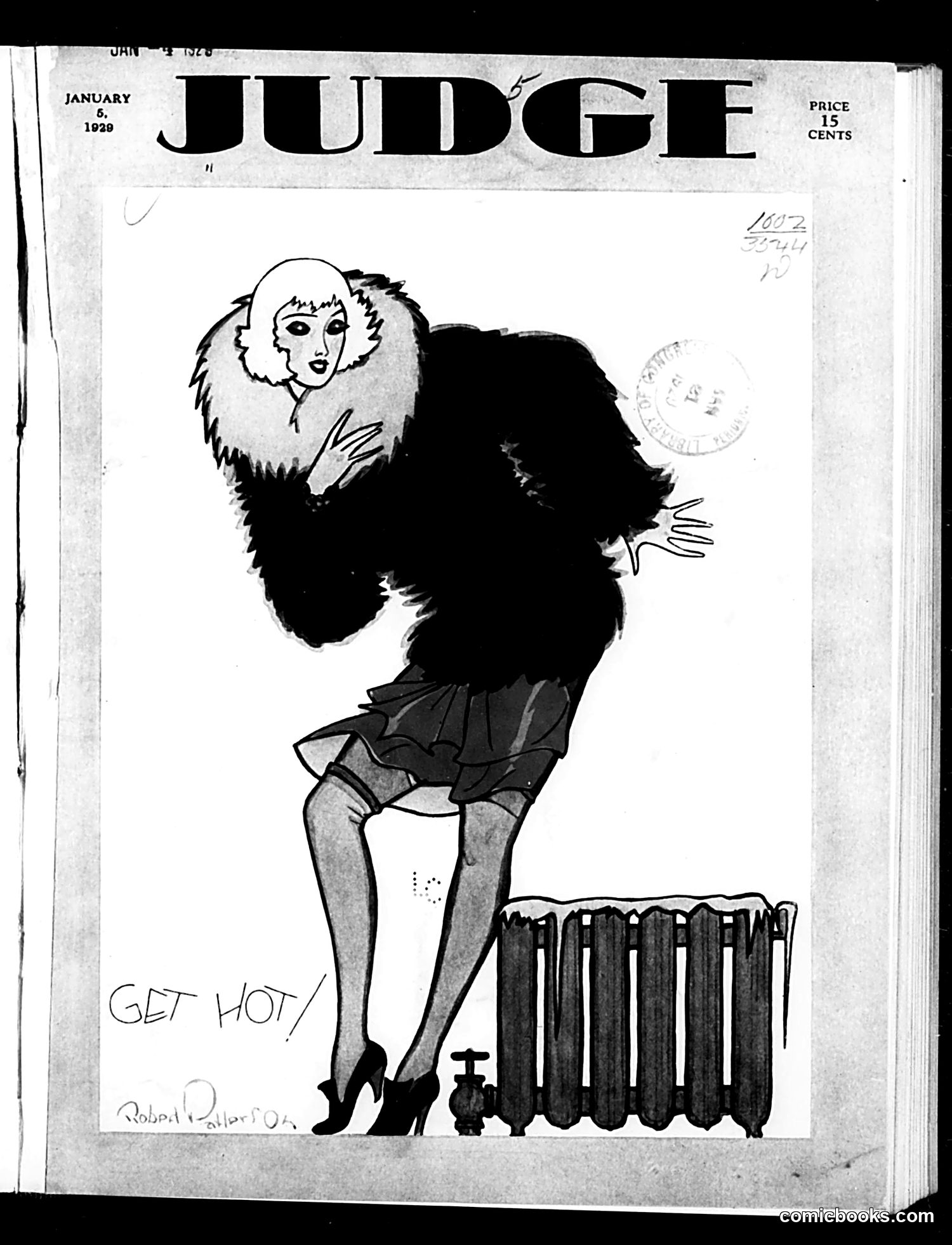
This cover by Robert Pallor depicts a stylishly dressed woman in 1920s attire—short skirt, fur stole, and heeled shoes—posing provocatively near a radiator, with the caption "GET HOT!" The satire targets the "flapper" culture and the sexual liberation associated with the Jazz Age. The woman's exaggerated pose and minimal clothing represent the period's loosening of Victorian social standards that shocked conservative Americans. The radiator likely plays on the double entendre—literal warmth from heating versus the slang meaning of sexual excitement or flirtation. This reflects Judge's satirical commentary on changing gender roles and morality during the 1920s, mocking both the progressive "modern woman" and society's anxieties about these transformations.
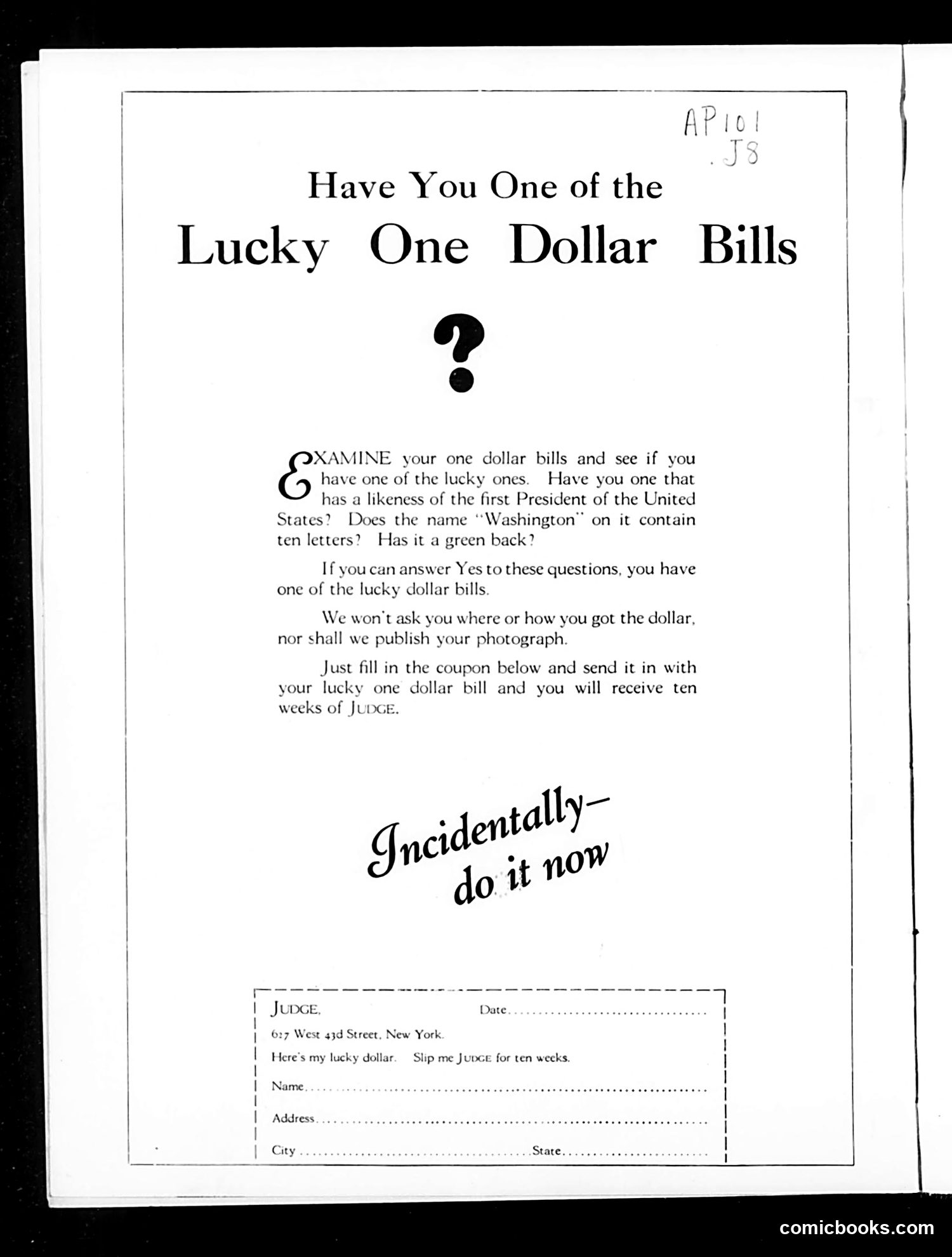
This page is **not a cartoon but a promotional advertisement** for Judge magazine itself, circa early 20th century. There are no political caricatures or satirical figures to identify. The ad promotes "Lucky One Dollar Bills"—a reader engagement campaign. Judge solicited readers to mail in $1 bills meeting specific criteria: featuring George Washington's portrait, containing his name spelled in ten letters, and having a green back. In return, subscribers would receive ten weeks of the magazine. The phrase "Incidentally—do it now" creates urgency. The coupon at bottom directed participants to send their dollar bill and contact information to Judge's New York office. This appears to be a **circulation-building gimmick** rather than satirical content, designed to generate subscriber acquisition and reader participation.
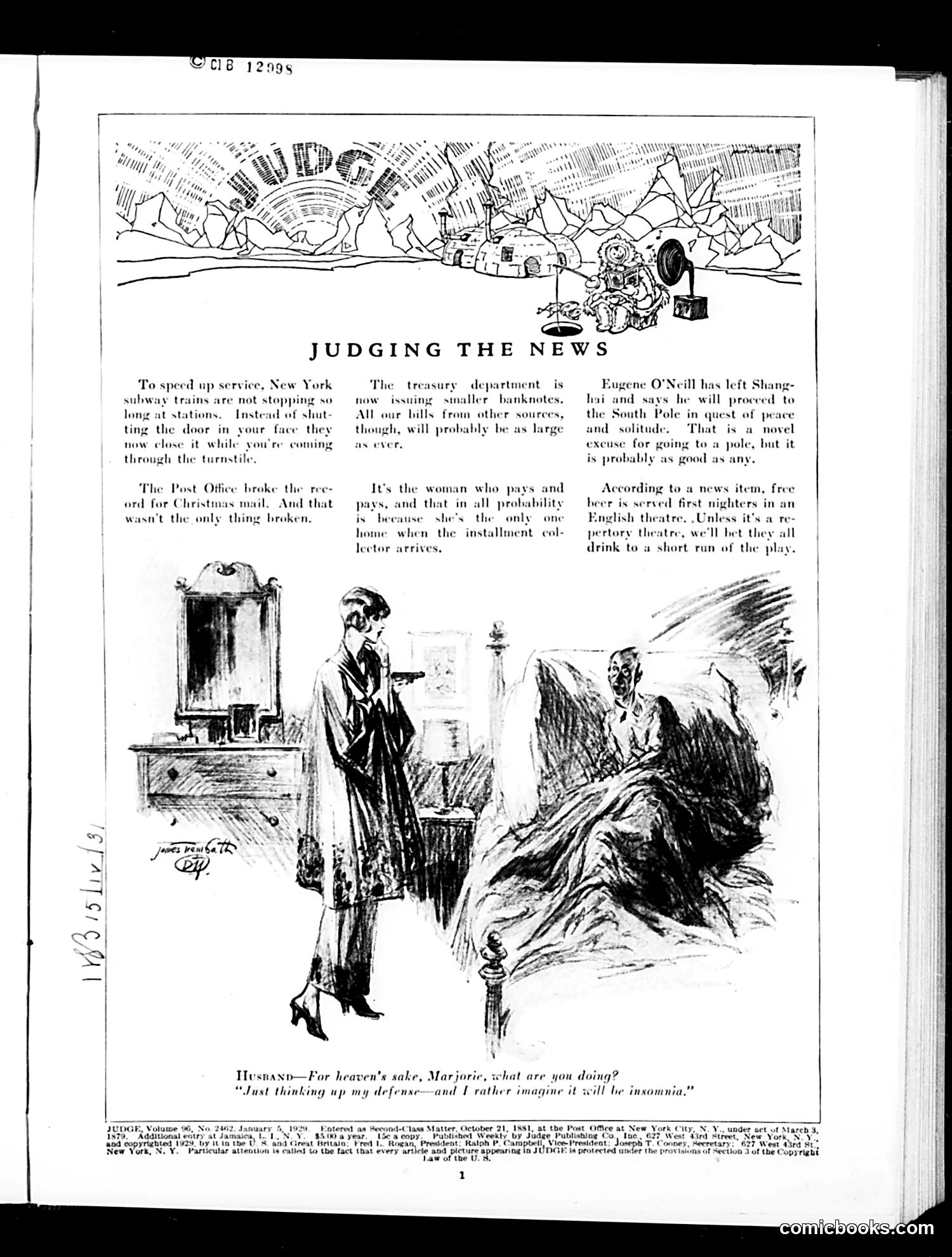
This satirical page mocks current events through brief commentary and illustration. The main cartoon depicts a husband and wife in a bedroom, with the husband anxiously pacing while the wife lies in bed. His caption reads: "For heaven's sake, Marjorie, what are you doing? 'Just thinking up my defense—and I rather imagine it will be insomnia.'" The joke satirizes marital anxiety, likely referencing contemporary divorce or infidelity scandals. The accompanying text snippets mock various institutions: New York's subway inefficiency, the Post Office's mail failures, the Treasury's currency design, and free beer at English theaters. The overall tone suggests satirizing governmental incompetence and societal absurdities of the late 1920s.
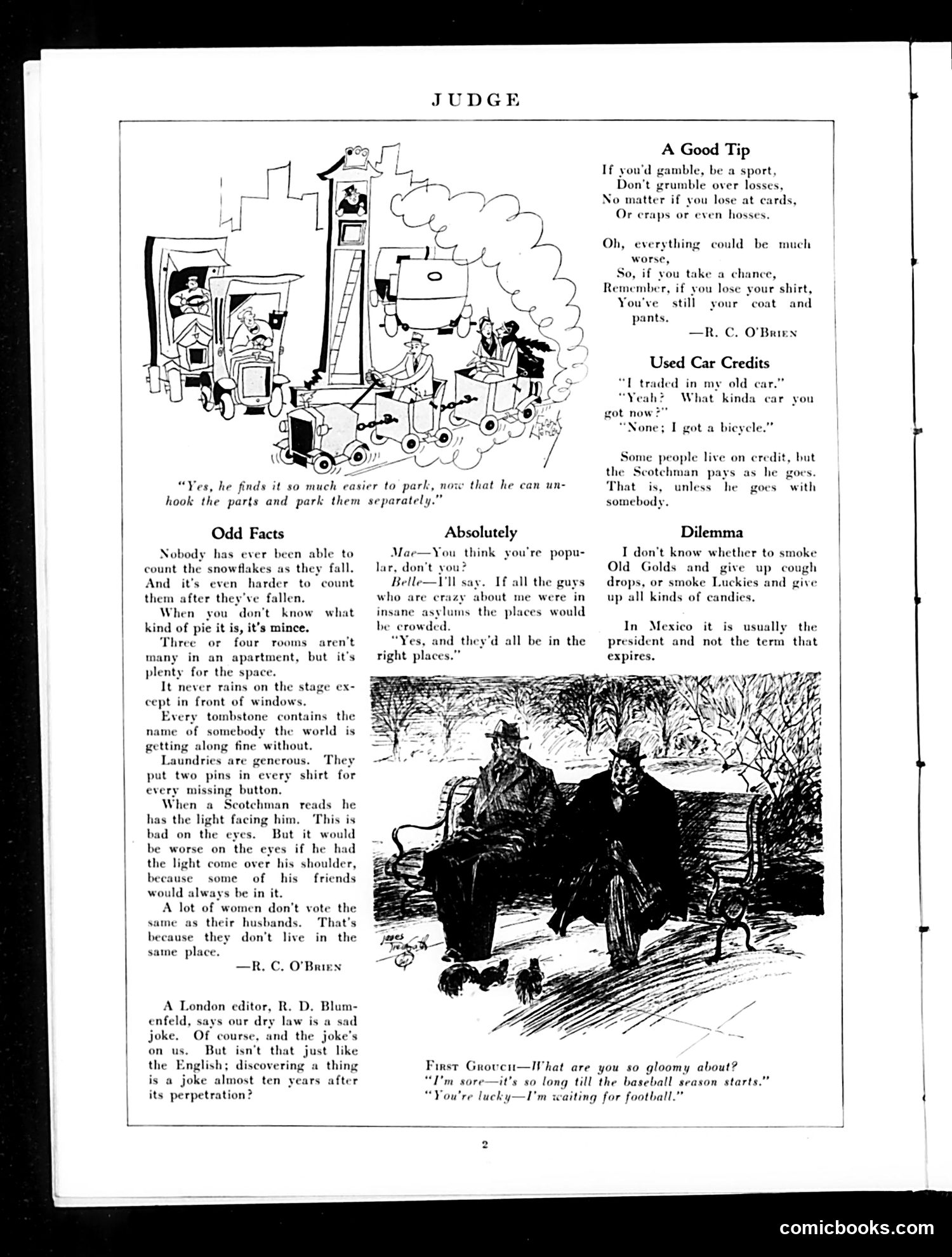
This page contains several short humorous pieces rather than a single political cartoon. The main illustration shows two men in conversation outdoors, with the caption about baseball season and "waiting for football." This appears to be gentle social humor about sports enthusiasm rather than political satire. The text sections ("Odd Facts," "Absolutely," "Used Car Credits," "Dilemma") are brief comedic observations on everyday American life—parking cars, dating, borrowing money, smoking preferences, and Mexican political terminology. The humor targets relatable social situations and minor cultural quirks rather than specific political figures or events. The attribution to R.C. O'Brien suggests these are general-interest comedy pieces typical of Judge's satirical but non-partisan approach to American society.
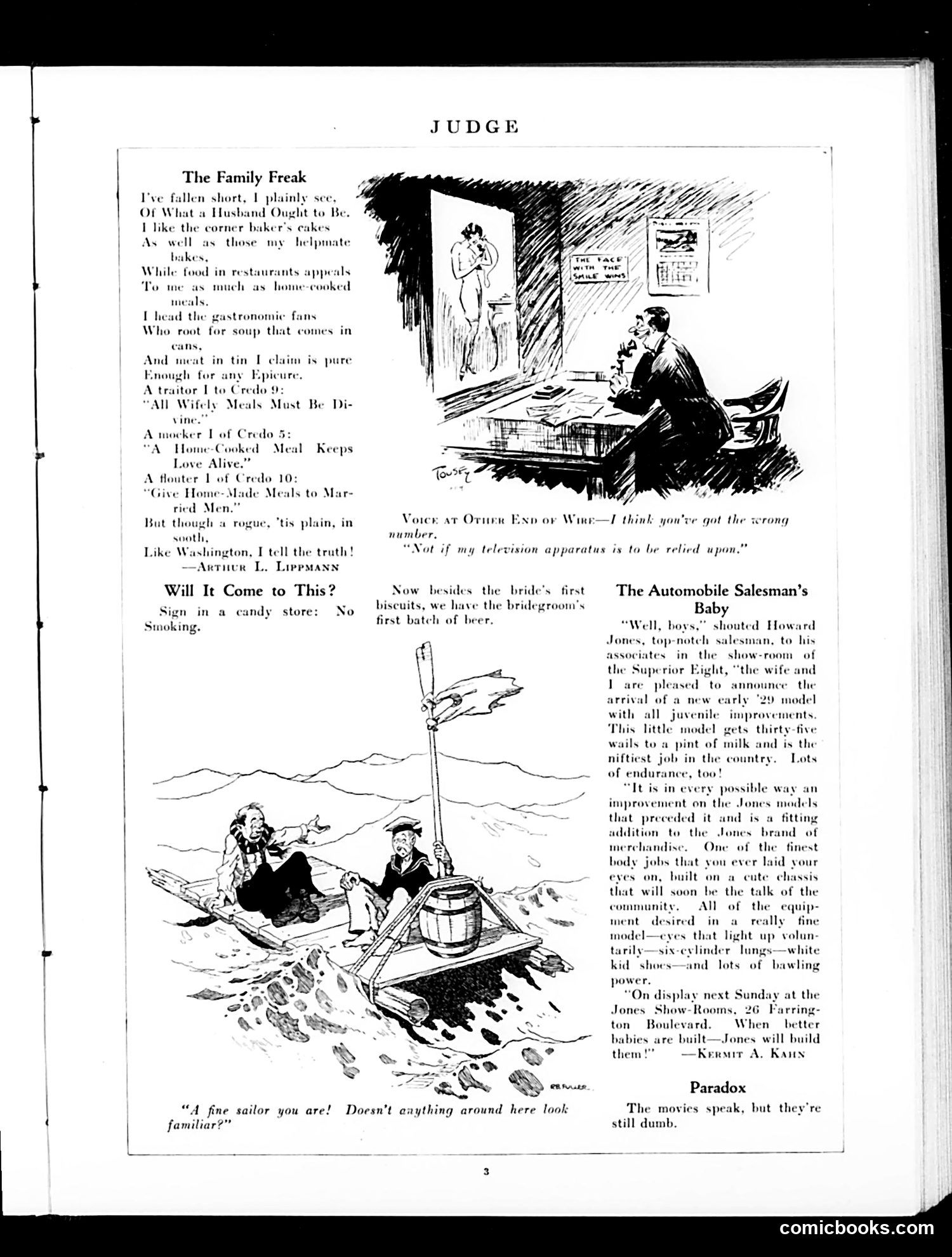
This page contains several distinct satirical pieces: **"The Family Freak"**: A poem mocking someone obsessed with gourmet food and restaurants while claiming to prefer home cooking—social commentary on affectation and hypocrisy among the affluent. **"Will It Come to This?"**: A cartoon showing two shipwrecked sailors on a raft, captioned "A fine sailor you are! Doesn't anything around here look familiar?" The joke appears to reference maritime incompetence or getting lost. **"The Automobile Salesman's Baby"**: A humorous piece about a car dealer announcing a new "early 29 model" automobile, with the joke being that he boasts about it with the same enthusiasm as announcing a newborn child. **"Paradox"**: A brief one-liner: "The movies speak, but they're still dumb." The page reflects early-to-mid 20th century American satirical humor targeting consumerism, social pretension, and emerging technologies like automobiles and talkies.
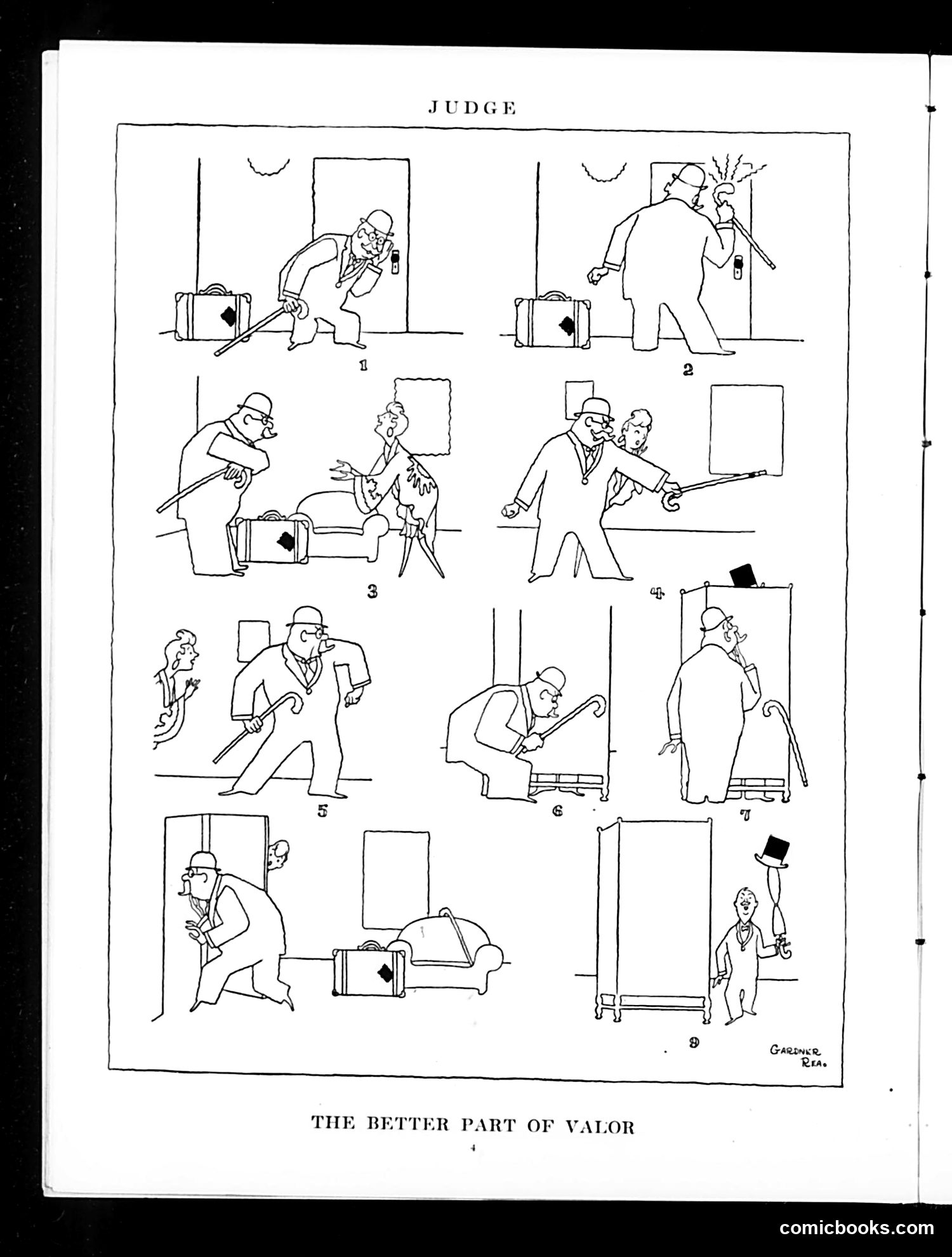
This comic strip satirizes cowardice disguised as prudence. The title "The Better Part of Valor" ironically references Shakespeare's phrase about discretion in retreat, but here shows a man repeatedly avoiding confrontation through increasingly absurd excuses and evasions. The sequence depicts the protagonist encountering various situations—fights, confrontations, legal troubles—where he consistently retreats, hides, or flees rather than face consequences. Each panel shows him scheming to escape responsibility: hiding in suitcases, avoiding people, sneaking away. The satire targets those who justify moral or civic cowardice as "wisdom." The recurring suitcase marked with a diamond suit suggests themes of traveling to escape problems rather than addressing them. Judge magazine uses this strip to mock characters who prioritize self-preservation over honor or duty.
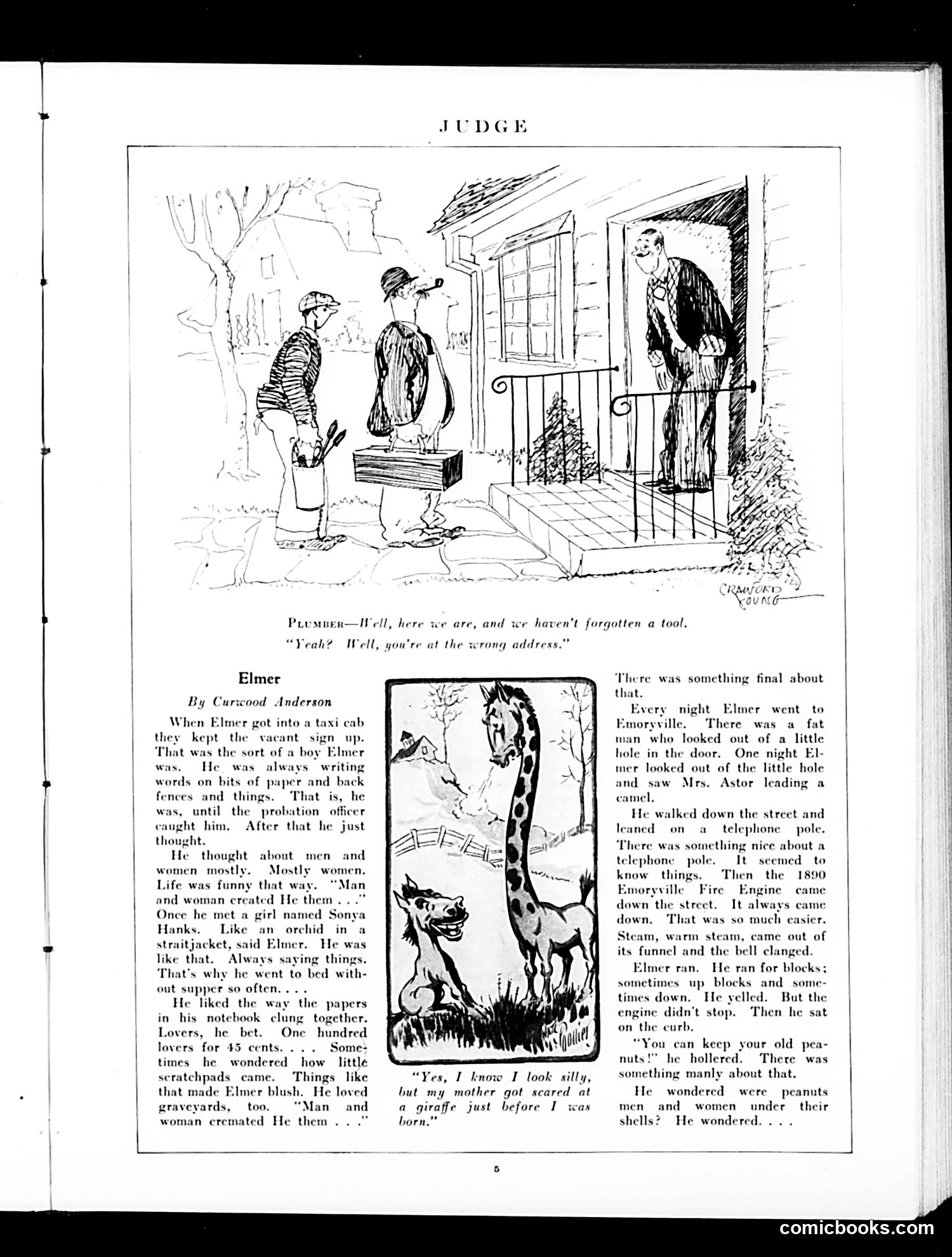
The main cartoon depicts two young boys at a house door confronting an adult man (the "Judge" figure), with the caption about arriving at the wrong address without a tool. This appears to be a visual setup for the accompanying story. The story "Elmer" by Curwood Anderson describes a taxi driver character who frequented Emoryville, observing life through a peephole in his door. The narrative seems mundane—noting Elmer's thoughts about men, women, and everyday observations like fire engines and telephone poles. The accompanying illustration shows animals (a giraffe and other creatures), seemingly unrelated to the main text, possibly a separate feature or unrelated illustration. The overall page lacks obvious political satire; it reads primarily as light character humor about urban working-class life and idle observations rather than political commentary.
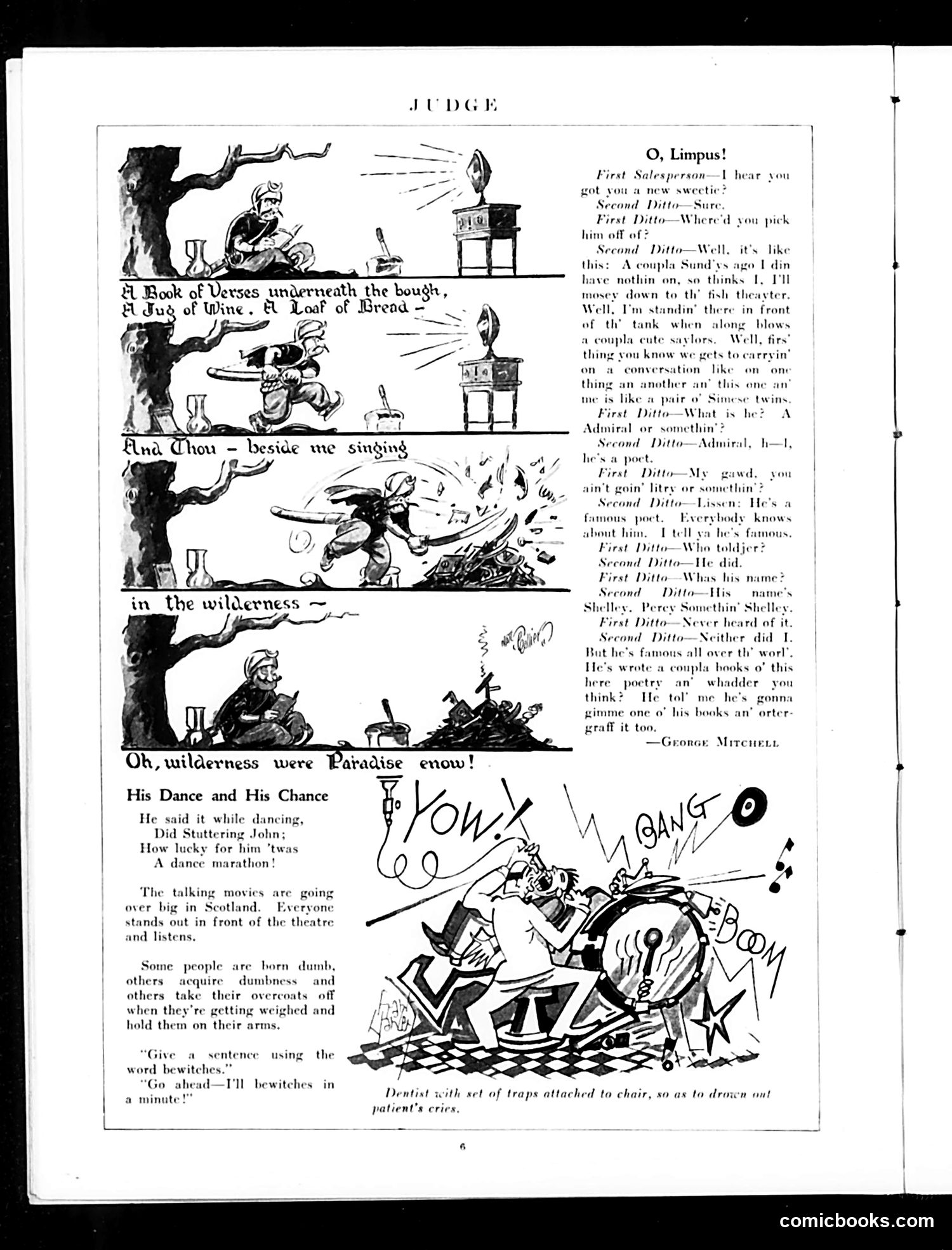
This page from *Judge* contains multiple satirical pieces typical of 1920s American humor: **"O, Limpus!" dialogue**: Two working-class women discuss meeting a poet at a fish tank/aquarium. The satire mocks both their lowbrow vernacular and the pretension of literary fame—they've never heard of Percy Bysshe Shelley, a canonical Romantic poet, yet accept he's "famous" because he says so. This ridicules both cultural ignorance and artists' self-promotion. **"His Dance and His Chance"**: References "Stuttering John" at a dance marathon, with a pun about his stutter being less noticeable amid dancing noise. The broader text mocks the talking-picture craze in Scotland and various forms of stupidity (being "born dumb," acquiring it, or removing overcoats while weighing oneself). **Bottom illustration**: Shows a dentist using mechanical traps attached to a chair to "drown out patient's cries"—dark humor about dental pain and incompetence. The humor relies on class-based comedy, wordplay, and absurdist exaggeration typical of interwar American satire magazines.
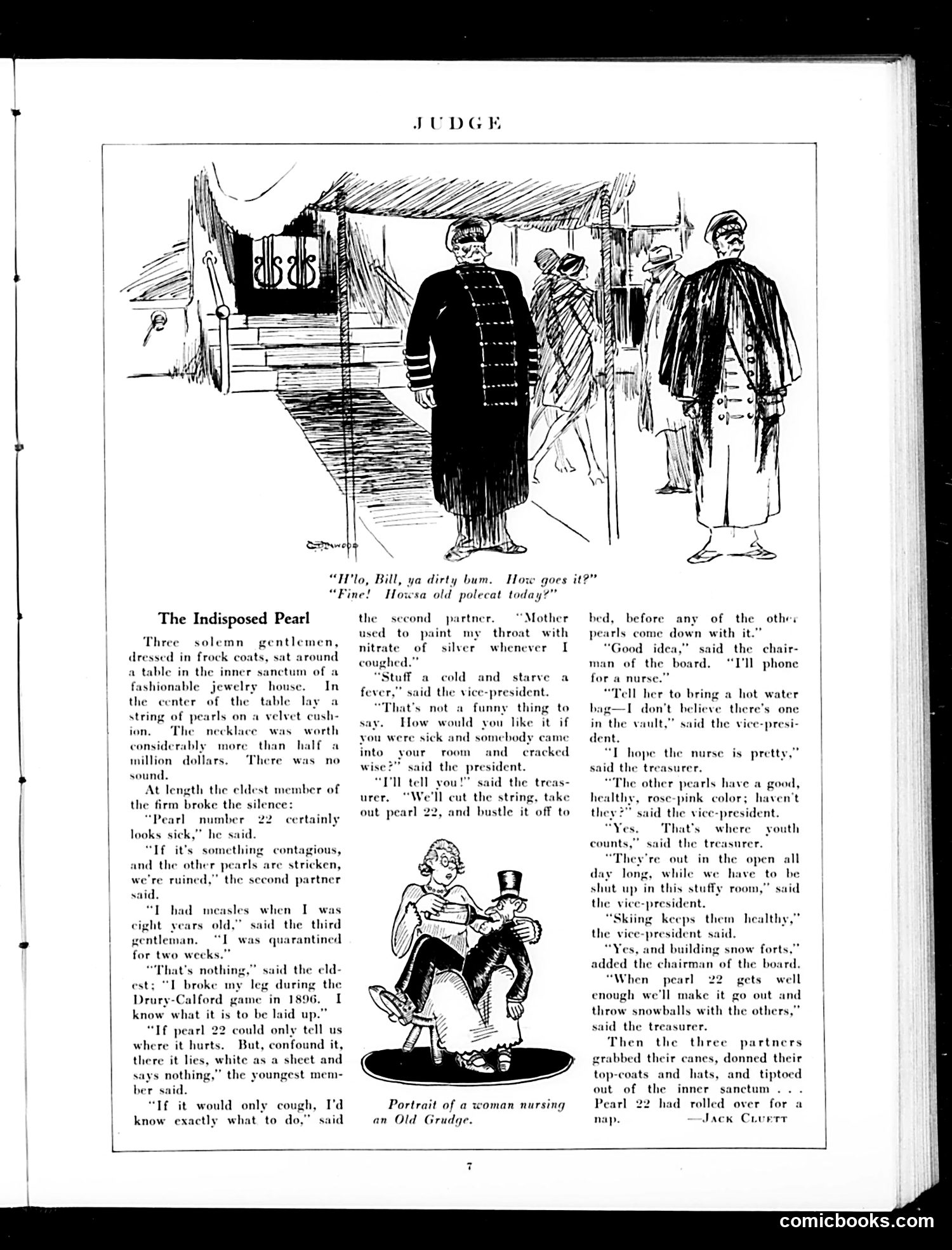
This satirical story concerns three businessmen debating whether to remove a contaminated pearl (numbered 22) from their collection at a fancy jewelry house. The pearl is "sick"—possibly infected or defective—and its presence threatens the others. The humor derives from treating the pearl's illness like a human patient requiring medical care (hot water bags, nurses). The men debate whether to isolate it, remove it entirely, or simply leave it alone and hope it recovers. The accompanying illustration shows a woman nursing a sick child, captioned "Portrait of a woman nursing an Old Grudge"—a separate satirical comment about maternal care and lingering resentments. The story's point appears to be social satire about how wealthy men handle problems: through uncomfortable debate rather than decisive action.
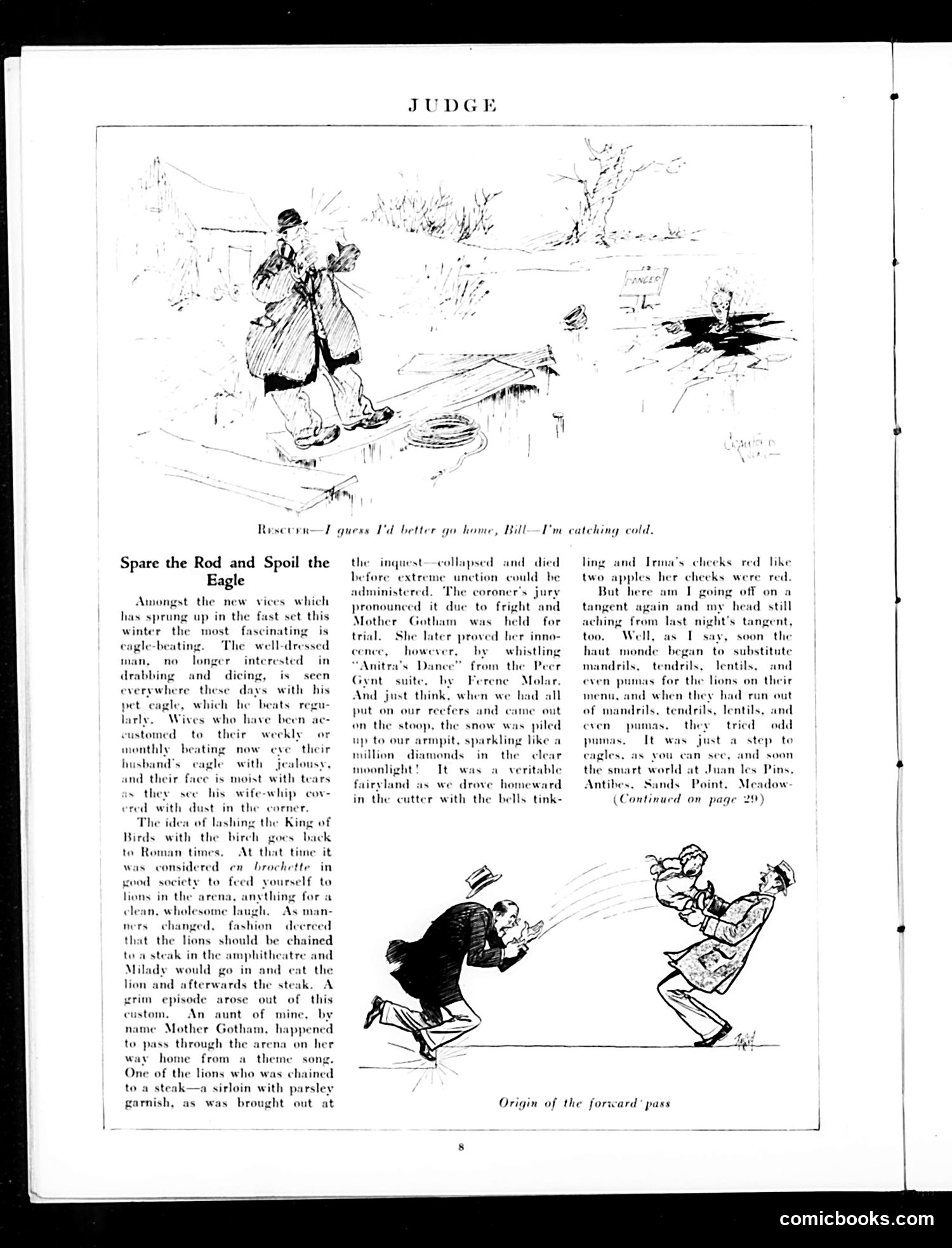
This page satirizes the wealthy elite's latest frivolous fad: "eagle-beating." The joke presents this as the fashionable replacement for older pastimes like gambling and fighting. The main text is a humorous narrative about a socialite named "Mother Gotham" who becomes entangled in a legal inquiry after an incident involving an eagle and a lion at an amphitheater. The piece mocks high society's obsession with absurd entertainment trends. The cartoons illustrate two scenes: the top shows a figure in winter weather with an eagle, captioned about catching cold; the bottom cartoon, labeled "Origin of the forward pass," depicts figures engaged in what appears to be early football-like activity, suggesting this ridiculous eagle-beating custom somehow inspired American football's forward pass. The satire targets wealthy society's mindless pursuit of novel amusements and their disconnect from sensible behavior—a common Judge magazine critique of the leisure class during the early 20th century.
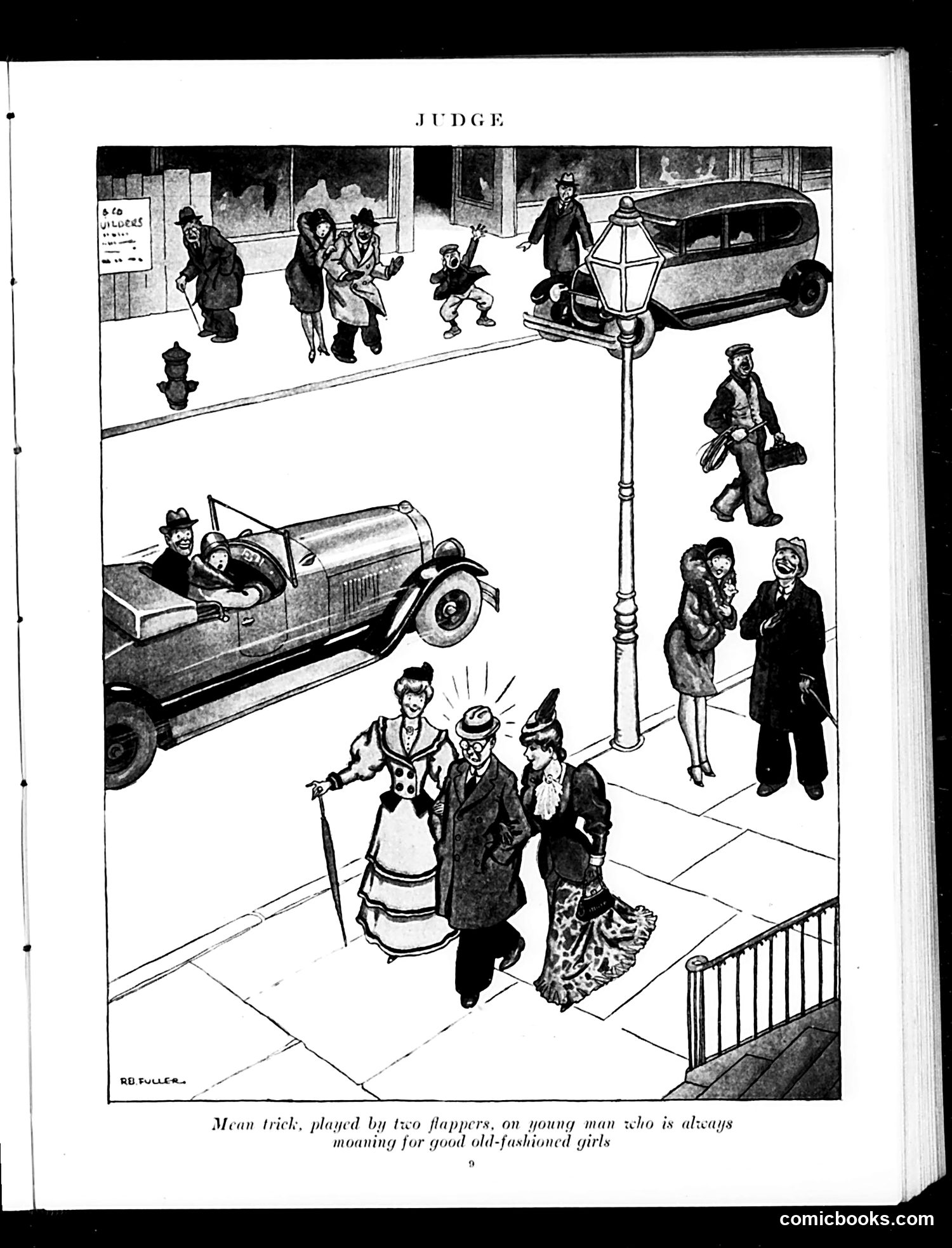
This cartoon satirizes the contradiction between men's nostalgia and reality. The caption describes a "mean trick" where two young women ("flappers"—the modern, independent women of the 1920s) target a young man who constantly complains about missing "good old-fashioned girls." The joke appears to be that the flappers are demonstrating he doesn't actually want old-fashioned behavior—he wants modern women. The scene shows urban street life with automobiles, fashionable dressed women, and various pedestrians, emphasizing 1920s modernity. The satire criticizes men who romanticize the past while actually desiring contemporary women, exposing a hypocritical nostalgia common among men of that era. The "trick" punishes his contradictory desires through humorous social exposure.
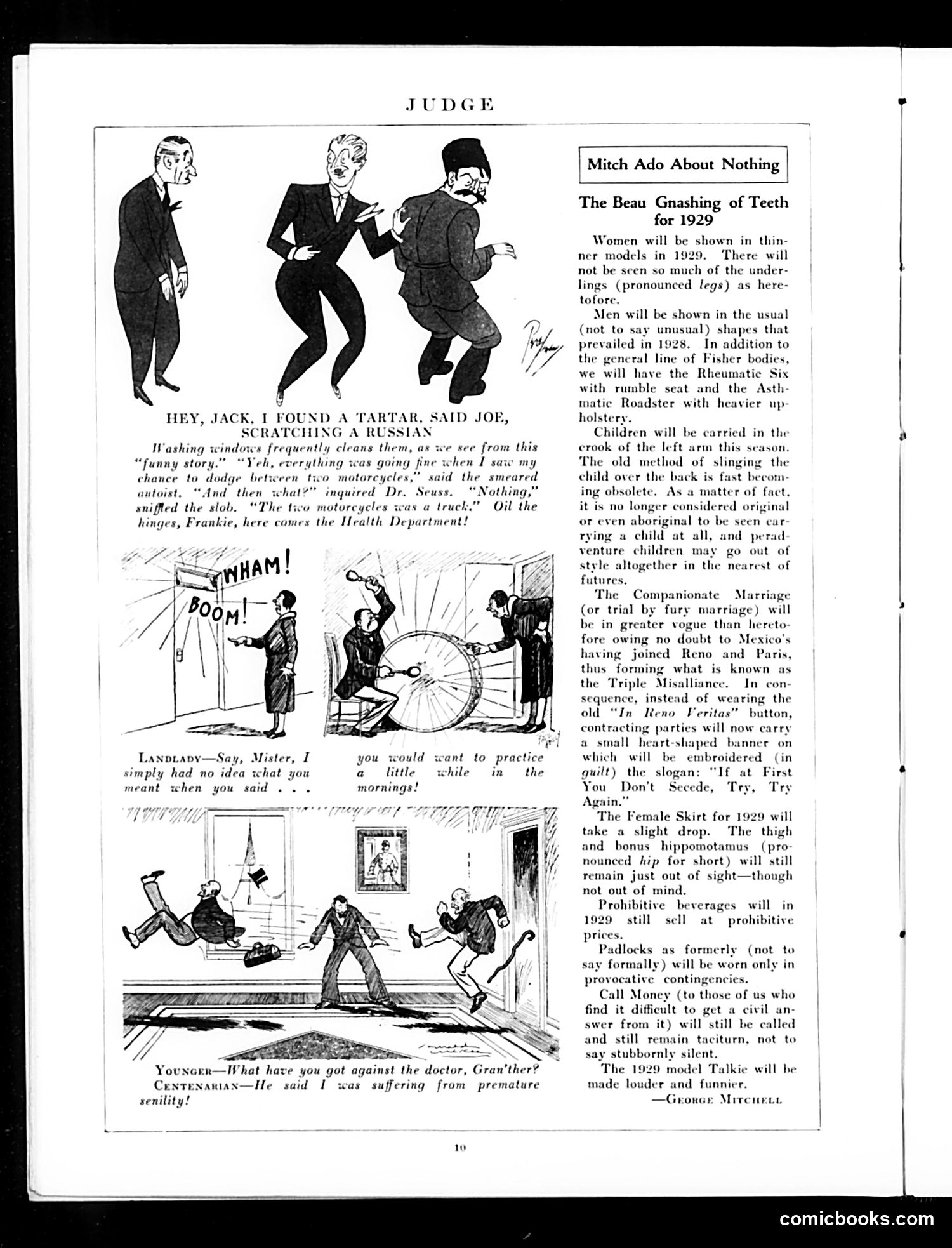
This Judge magazine page contains humor about 1929 fashion predictions and social trends. The top section mocks men's fashion with a visual gag about three men dancing awkwardly. Below are cartoon vignettes about domestic chaos—a landlady complaining about noise, people being thrown around a room—playing on slapstick comedy popular in the era. The right column's "Beau Gnashing of Teeth for 1929" is satirical social commentary predicting coming year trends: women's skirts will show less leg, children will be carried differently, "companionate marriage" (trial marriages gaining acceptance through cities like Reno, Nevada) will increase, and Prohibition-era illegal alcohol will remain expensive. The satire mocks contemporary anxieties about changing morality, fashion, and social norms during the Jazz Age. References to "Call Money" and financial matters suggest 1929's economic concerns pre-dating the stock market crash.
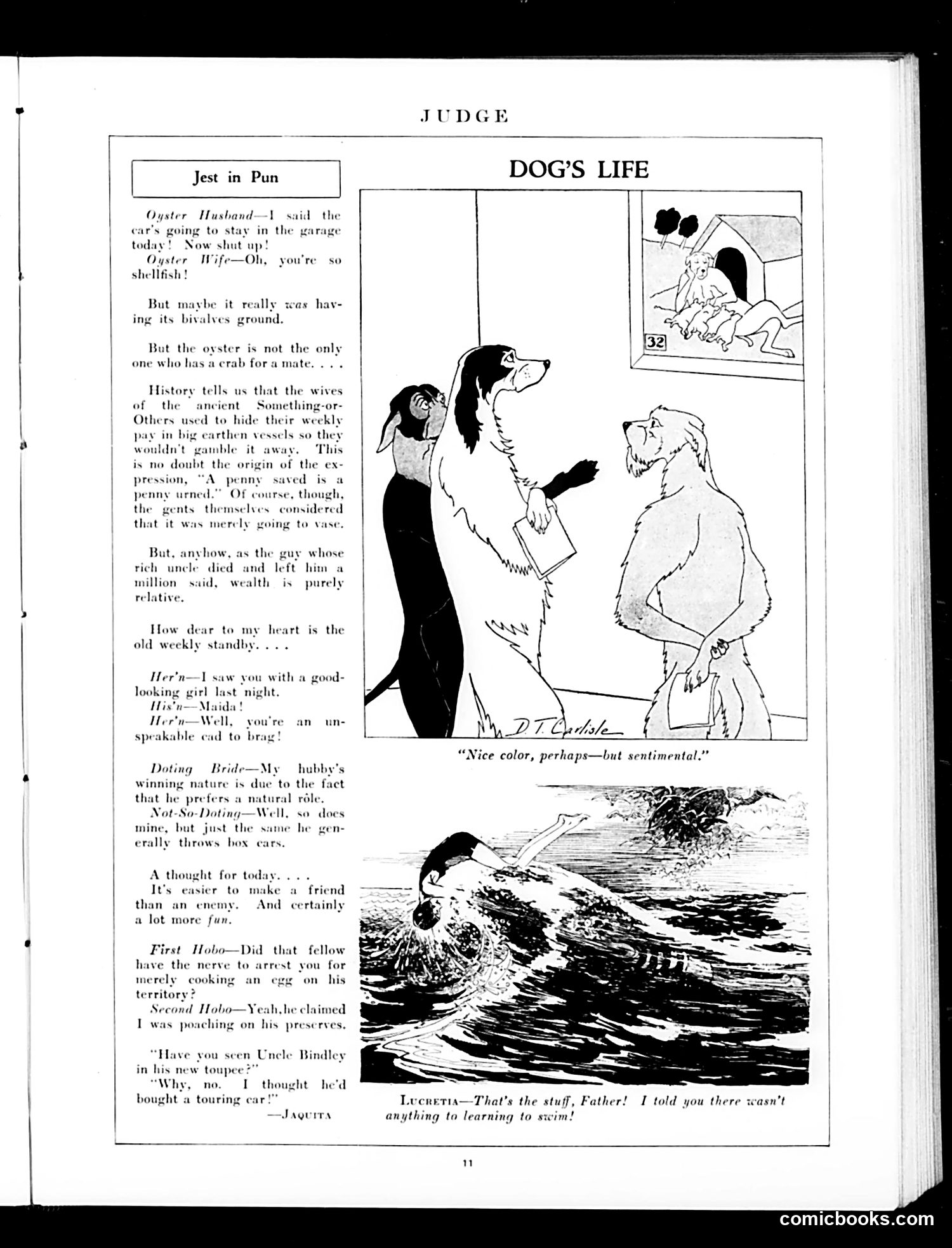
This page from **Judge** magazine contains wordplay humor typical of early 20th-century satirical publications, organized around three themes: **"Jest in Pun"** section presents puns on shellfish (oyster/crab as "mates"), historical domestic financial practices, and wealth relativity—lighthearted social observation rather than sharp satire. **"Dog's Life"** cartoon (top right) shows a woman presenting a dog to a man who dismisses it as "sentimental"—likely mocking sentimental Victorian aesthetics or consumerism, though the specific context is unclear. **Lower section cartoons** include a hobo joke about "poaching on preserves" (wordplay on cooking/hunting), and a brief exchange about Uncle Hindley's new "toupe" (hairpiece), with the punchline that he bought a touring car instead—poking fun at automobile culture and male vanity. The humor targets domestic life, class pretension, and consumer culture rather than specific political figures or events. This reflects Judge's general approach: gentle satire of American social manners and emerging modern lifestyles.
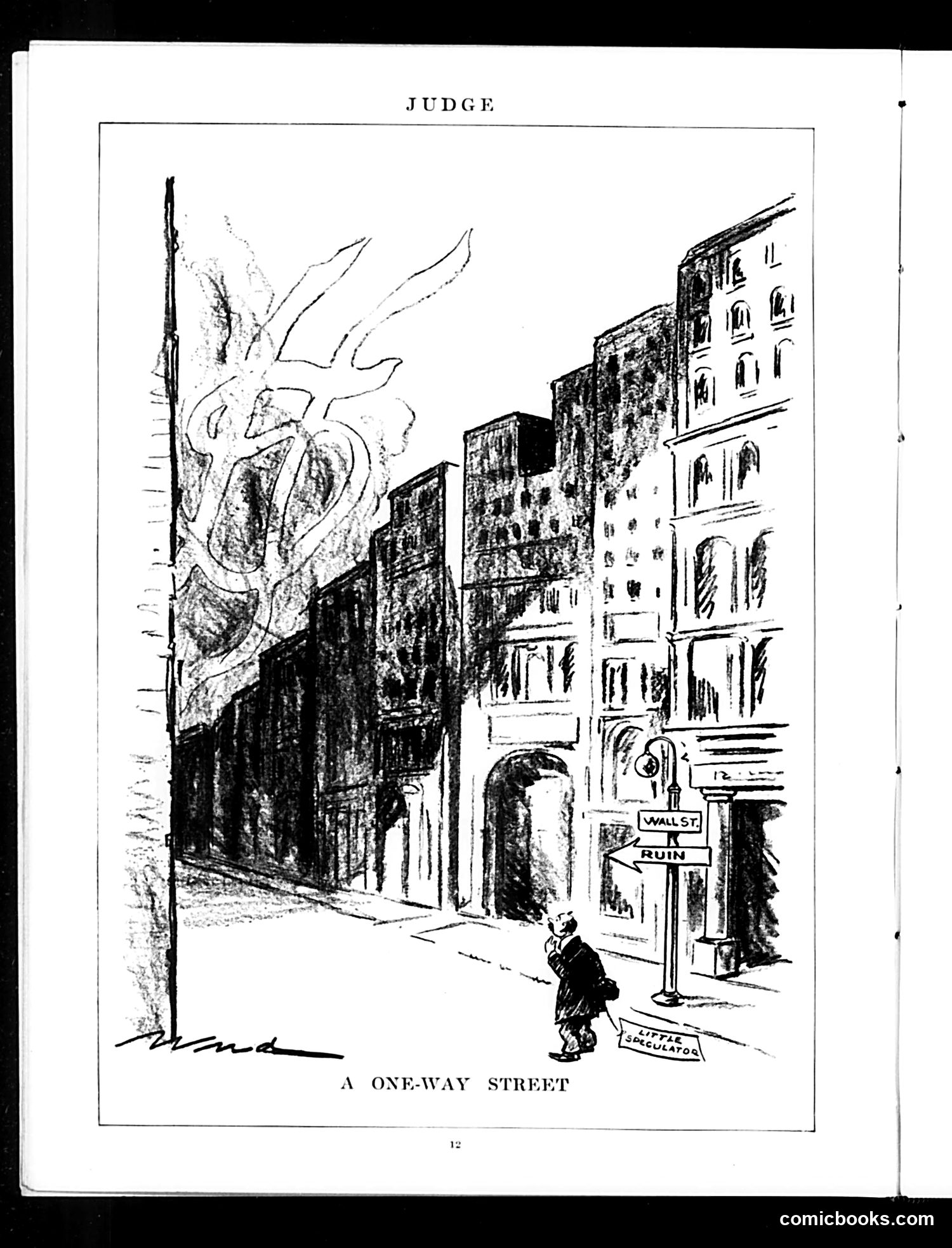
This cartoon depicts a Wall Street scene labeled "RUIN," showing a businessman walking past collapsed buildings and a dead tree. The imagery suggests economic devastation—likely referencing a financial crisis or market collapse that destroyed investors and businesses. The "one-way street" title is a pun: Wall Street becomes literally a one-way path to financial ruin, with no escape or reversal possible. The skeletal tree and ruined architecture emphasize the severity of the economic damage. Without the publication date visible, the specific crisis remains unclear—this could reference the 1929 stock market crash, an earlier panic, or another major financial collapse. The cartoon satirizes Wall Street's role in creating widespread economic destruction for ordinary people.
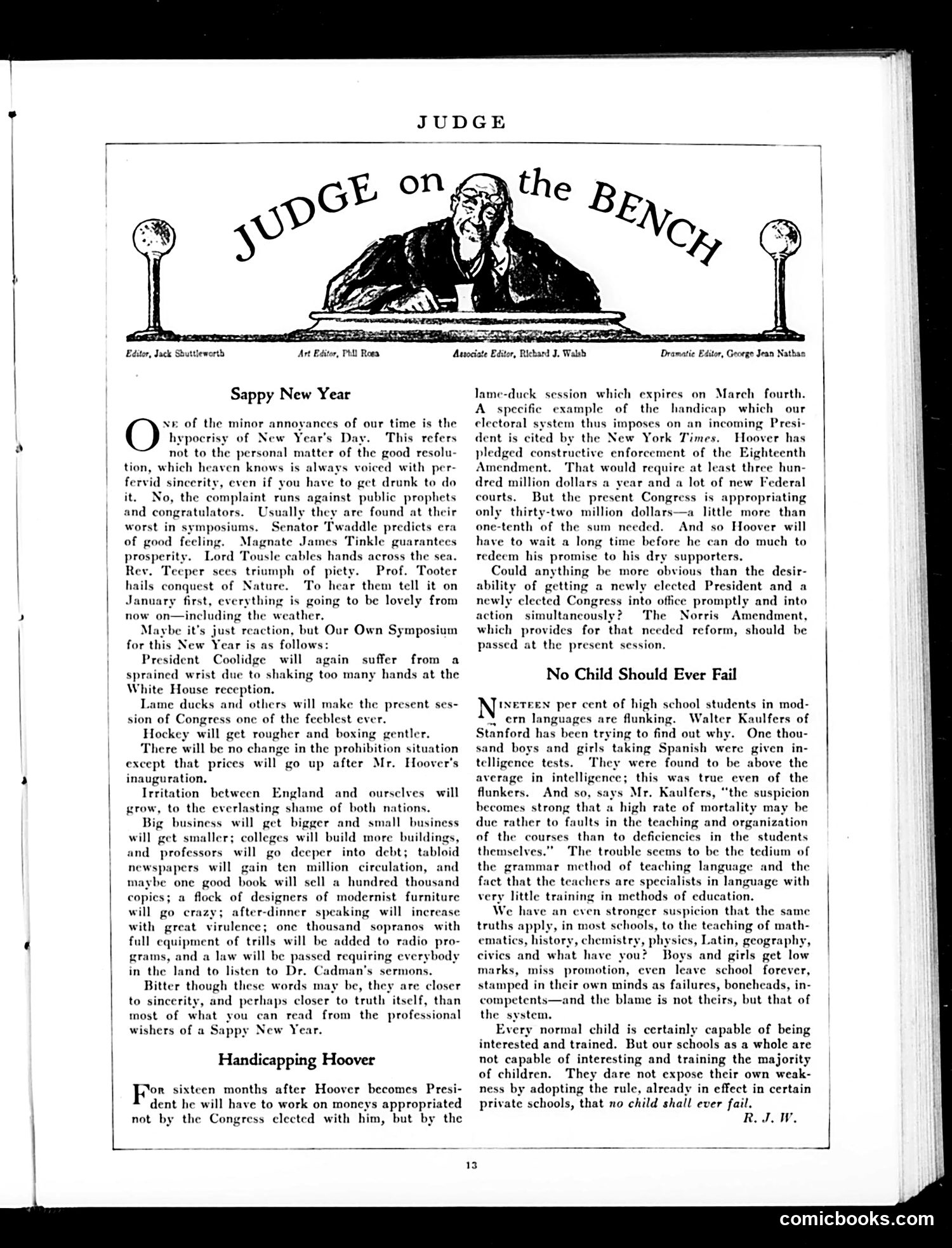
This page from Judge magazine (likely early 1929, given Hoover references) contains three satirical commentary pieces: **"Sappy New Year"** mocks the hypocrisy of New Year's predictions by public figures like politicians and business leaders who make grand promises. Rather than offering optimistic platitudes, Judge's "symposium" cynically predicts continued problems: Coolidge's sore wrist from handshakes, weak lame-duck Congress, Prohibition price increases, Anglo-American tensions, and growing business inequality. The satire suggests these professional "wishers" are dishonest. **"Handicapping Hoover"** critiques the electoral system's structural flaw: the incoming President (Hoover, inaugurated March 1929) cannot implement his agenda because Congress was elected under the previous administration and controls appropriations until March. The example given—Hoover's Prohibition enforcement pledge lacks sufficient funding—illustrates this problem. Judge advocates the Norris Amendment to fix this delay. **"No Child Should Ever Fail"** discusses Stanford researcher Walter Kaulfers' finding that high school students failing modern languages possess above-average intelligence, suggesting teaching methods rather than student ability are the problem.
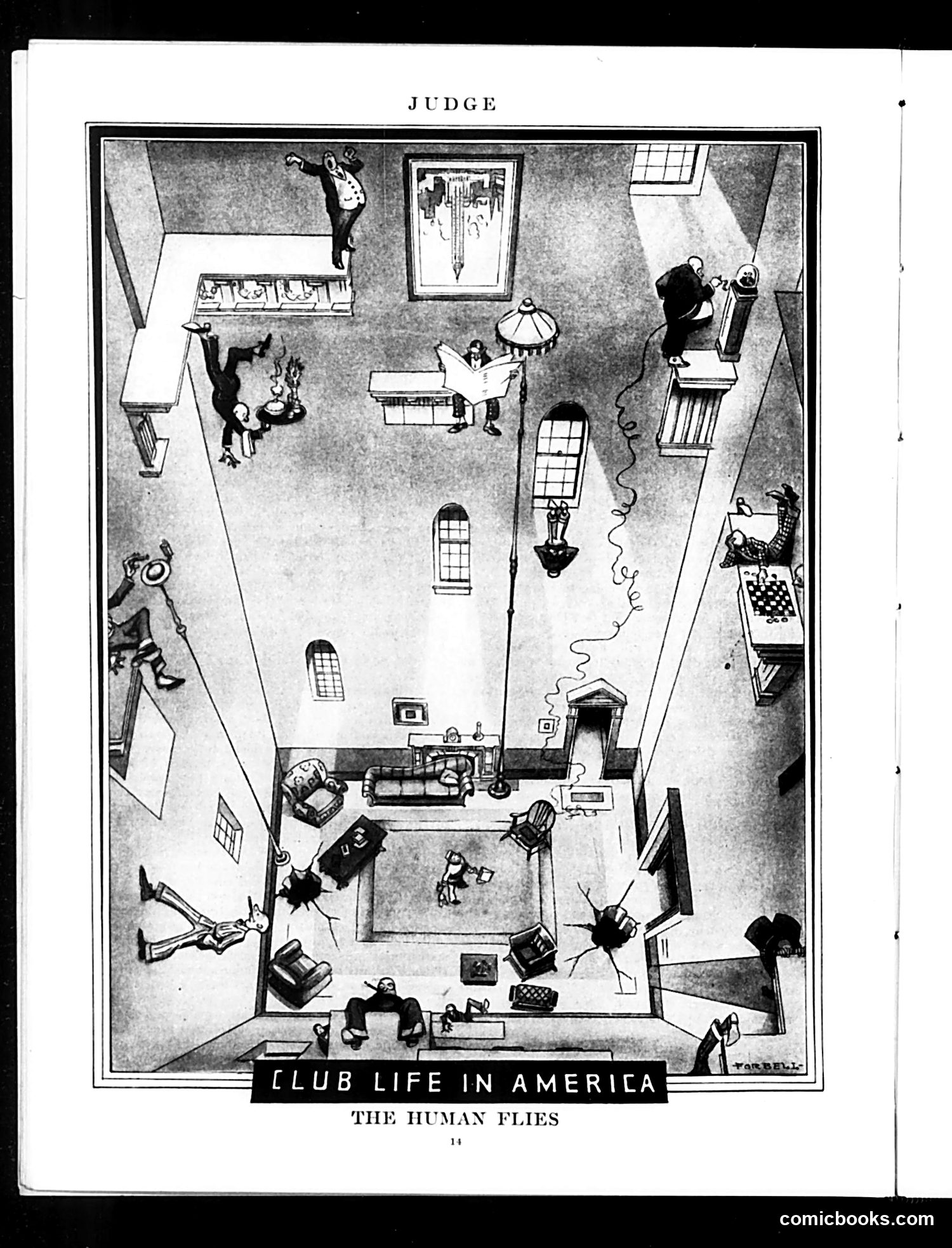
This is a satirical illustration of a gentlemen's club, viewed from above like an architectural plan. The cartoon depicts club members as "human flies" crawling and clinging to walls and ceilings in various undignified positions—some upside down, others scaling vertical surfaces. The satire appears to mock the behavior and dignity of club members, suggesting they behave like insects rather than civilized gentlemen. The title "The Human Flies" combined with the aerial perspective creates absurdist humor about "Club Life in America"—likely criticizing the pretensions or ridiculous conduct within exclusive American social clubs of the era. The artist is credited as "Cesare" (visible signature). The cartoon uses physical comedy and social commentary typical of Judge's satirical approach.
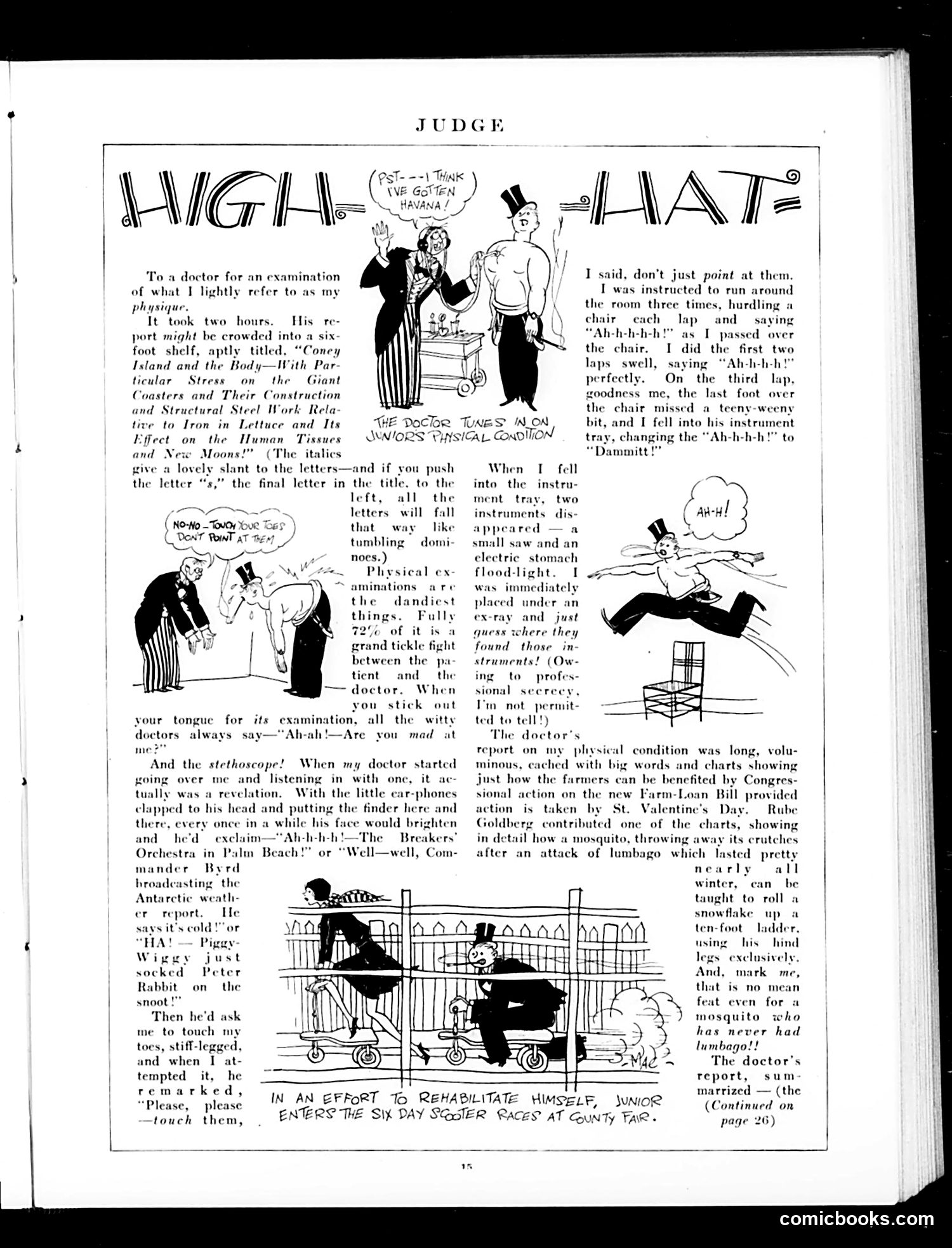
This page satirizes the absurdity of medical examinations through exaggerated humor. The narrator describes visiting a doctor for a physical that somehow produces a report comparing the human body to Coney Island roller coasters and farm economics—obvious nonsense. The satire mocks several targets: the pretentiousness of doctors using incomprehensible medical jargon; the tedium and indignity of physical exams (sticking out your tongue, touching your toes); and the disconnect between examination procedures and actual health diagnosis. The illustrations show slapstick moments—the narrator falling into medical instruments, the doctor's stethoscope picking up random radio broadcasts instead of heartbeats. The final caption reveals the punchline: the doctor prescribes rehabilitation through six-day bicycle racing at a county fair—an absurd "cure" that undercuts the entire medical profession's authority. The joke targets the era's medical pretension and quackery.
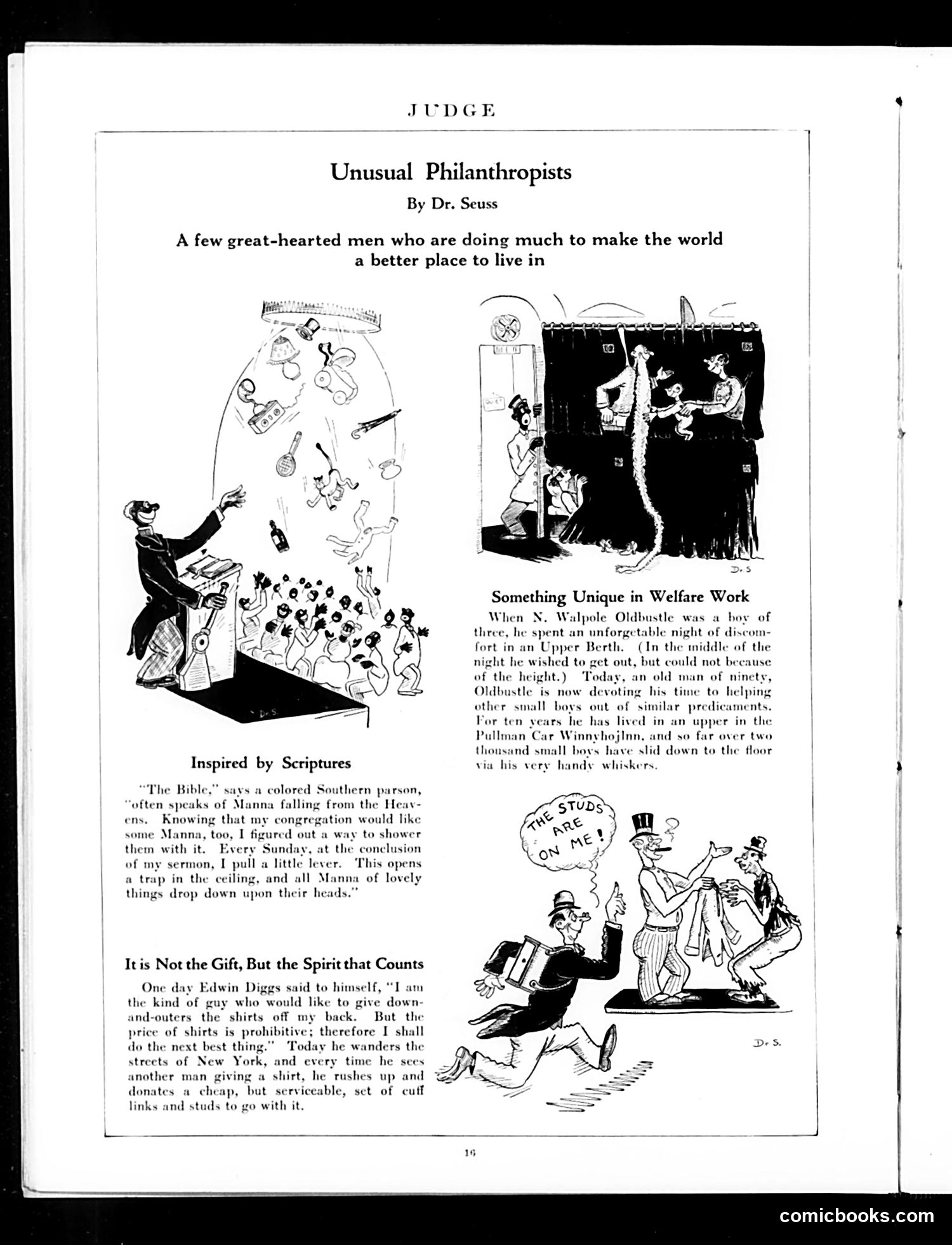
This Judge magazine article satirizes eccentric wealthy philanthropists through absurdist humor. Three examples mock well-intentioned but peculiar charity: **N. Walpole Oldbustle** helps boys exit upper berth train beds—solving a personal childhood trauma by living permanently in a Pullman car and assisting thousands of boys down. **A Southern parson** interprets Biblical "Manna from Heaven" literally, installing a ceiling trap to shower his congregation with objects during sermons. **Edwin Diggs** cannot afford giving shirts to homeless men, so instead rushes around New York donating cheap cuff links and studs to accompany shirts *others* are already giving. The satire mocks wealthy individuals whose charitable impulses are either self-indulgent (solving personal grievances), theologically confused (literal interpretation), or laughably inadequate (supplementary accessories). The point: genuine philanthropy requires more than eccentric gestures or half-measures—it demands serious commitment and practical understanding of actual need.
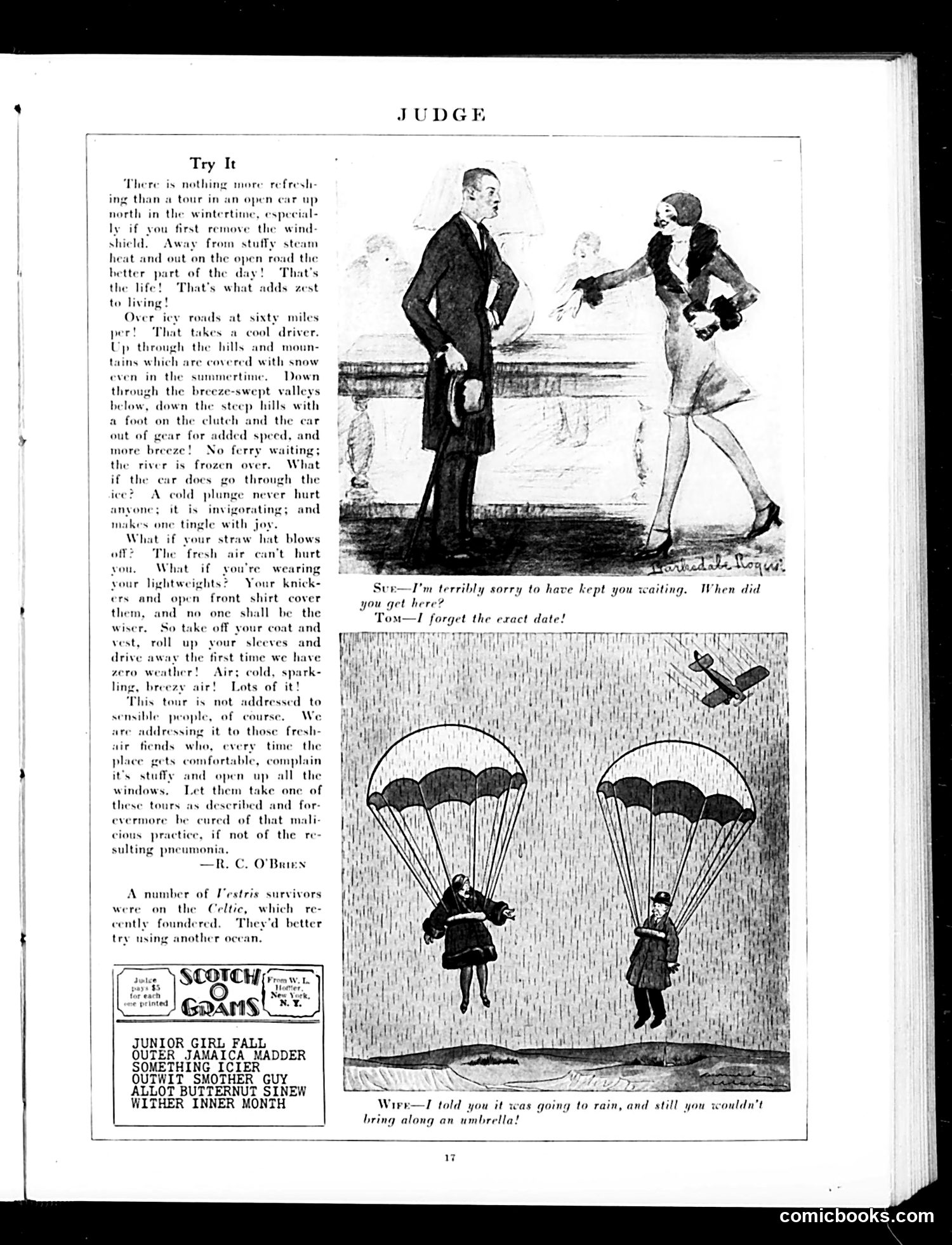
This page contains two satirical pieces targeting different audiences: **"Try It"** (left column with upper cartoon): A mock-serious article praising reckless winter driving—removing windshields, speeding on icy roads at 60mph, risking plunging through frozen rivers. The satire targets foolish young men who equate danger with excitement and masculinity. The author (R.C. O'Brien) sarcastically celebrates catching pneumonia as the ultimate thrill, ultimately mocking this behavior as the province of those lacking common sense. **Lower cartoon**: A domestic humor piece where a wife's pragmatic warning about rain goes unheeded by her husband, who forgot to bring an umbrella despite her prediction. The satire gently mocks husbands' selective memory and their tendency to ignore wives' sensible advice. Both pieces use exaggeration and irony typical of Judge's social commentary—criticizing poor judgment and recklessness (upper) and marital miscommunication (lower) through humorous scenarios.
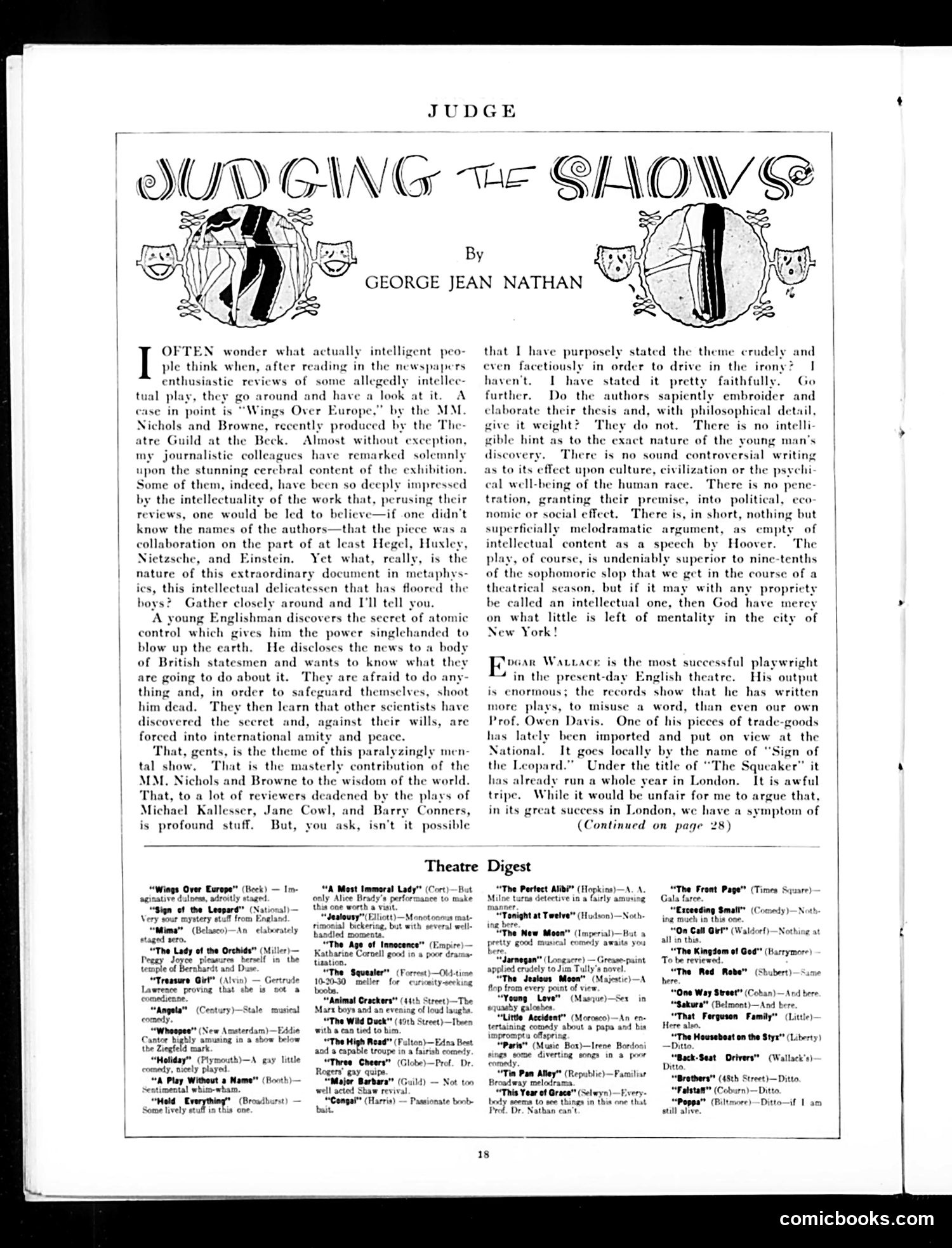
This is a theater review column by George Jean Nathan critiquing the play "Wings Over Europe" by Nichols and Browne. Nathan sarcastically attacks what he sees as pretentious critical reception of an intellectually shallow work. **The Satire:** Nathan mocks his fellow theater critics for praising the play as profound philosophical drama when its actual plot is simple and underdeveloped: a young Englishman discovers atomic weapons, tells British statesmen, they kill him, other scientists discover it too, and peace results. Nathan argues the authors provide no genuine intellectual engagement—no exploration of the discovery's nature, cultural impact, or philosophical implications. **The Point:** Nathan is satirizing critical groupthink and intellectual pretension in theater reviewing. Reviewers like those who praised Michael Kallesser and Barry Conners plays have become so deadened that they mistake mediocrity for genius, crediting the play with profundity it doesn't possess. The page includes a "Theatre Digest" of current Broadway shows—standard for Judge magazine's entertainment coverage.
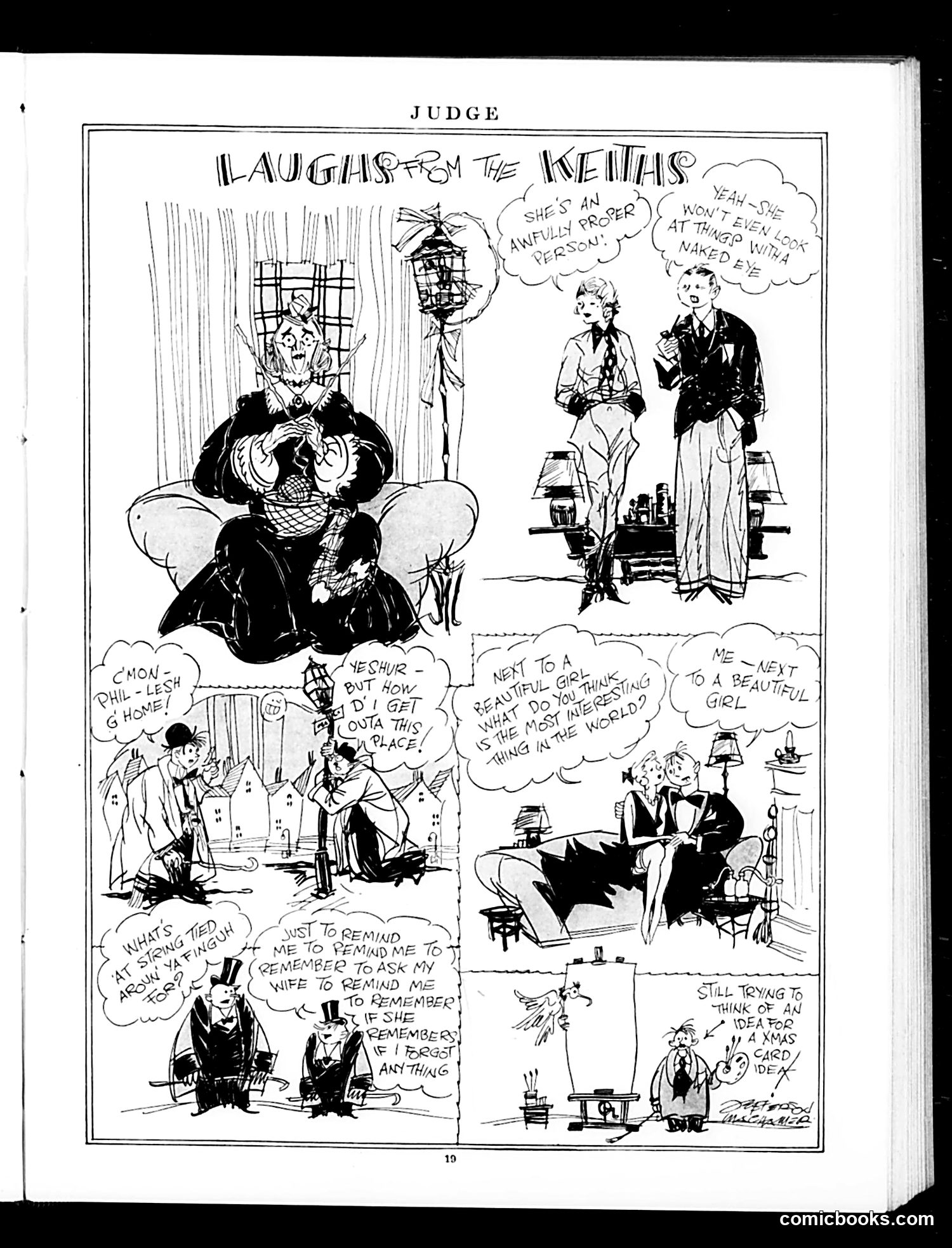
This multi-panel comic satirizes Keith (likely a public figure or character type of the era) through domestic and social situations. The cartoon depicts various comedic scenarios involving marriage, forgetfulness, and social awkwardness. Key elements include: - **Top panel**: A woman described as "an awfully proper person," contrasted with male observers making crude remarks - **Middle panels**: Scenes showing a husband unable to remember things without his wife's reminders—a common domestic comedy trope - **Running gag**: The husband's dependence on his wife to remember basic tasks and social obligations The satire mocks masculine incompetence in domestic life and the era's expectation that wives manage household details. The humor relies on recognizable relationship dynamics rather than specific political commentary. The "beautiful girl" subplot appears to reference romantic distraction as another source of male forgetfulness. The overall tone is gentle domestic humor typical of early-to-mid 20th century Judge magazine.
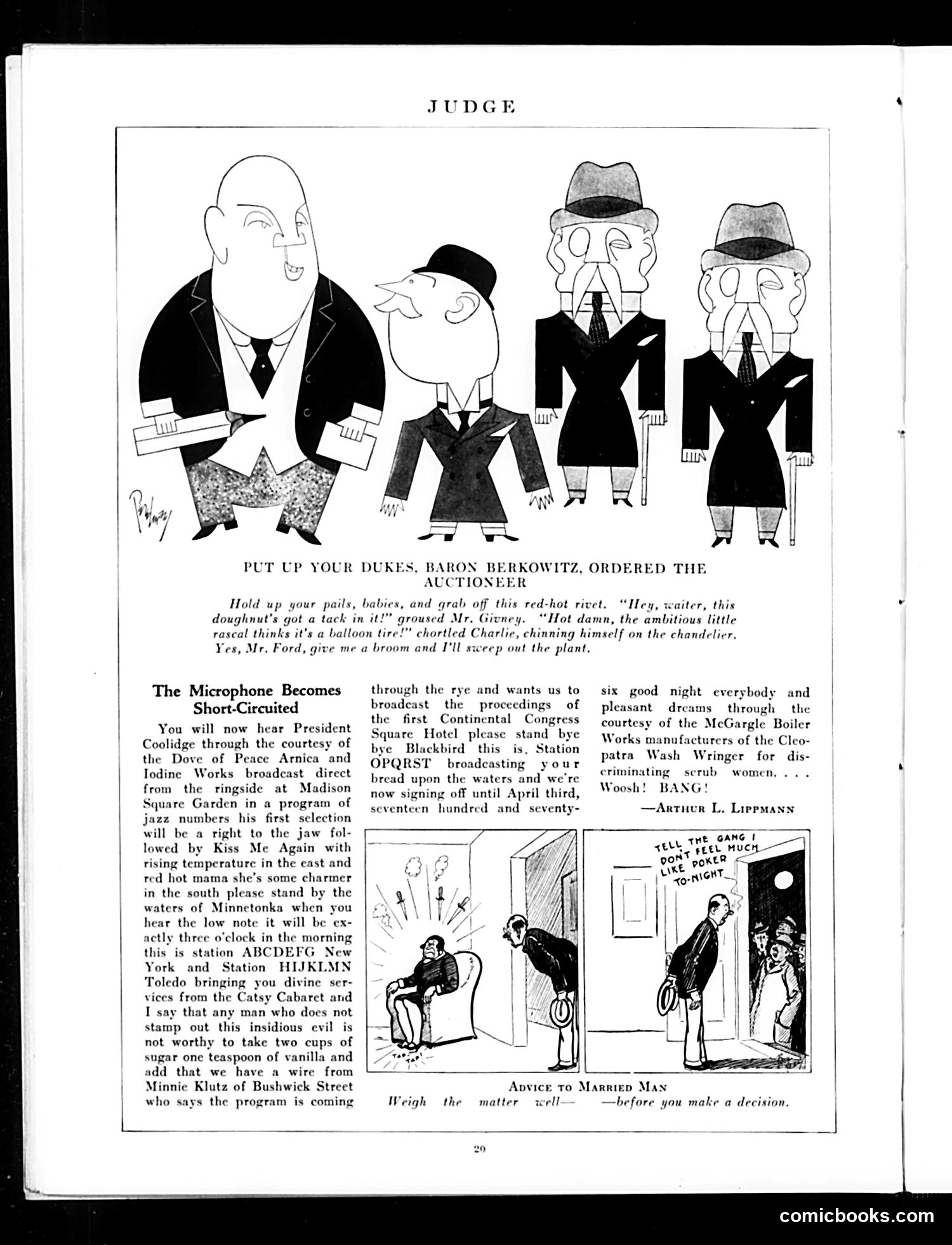
The top cartoon satirizes labor disputes at factories, likely Ford's plants (referenced in the dialogue). Baron Berkowitz, appearing to be a labor agitator or union organizer, is caricatured confronting factory management about working conditions—the "red-hot rivet" and "tack in the doughnut" representing workplace grievances and safety issues. "The Microphone Becomes Short-Circuited" parodies early radio broadcasting and President Coolidge's public image. It absurdly juxtaposes Coolidge announcing from Madison Square Garden boxing matches with radio station call letters, jazz music, and mundane household product advertisements. The satire mocks how commercial radio mixed political broadcasts with entertainment and advertising—a new and chaotic medium in the 1920s. The bottom cartoon, "Advice to Married Man," depicts domestic life humor: a man receiving counsel about decision-making before acting impulsively. The overall page reflects 1920s concerns: labor tensions, new mass media's growing cultural influence, and consumer culture.
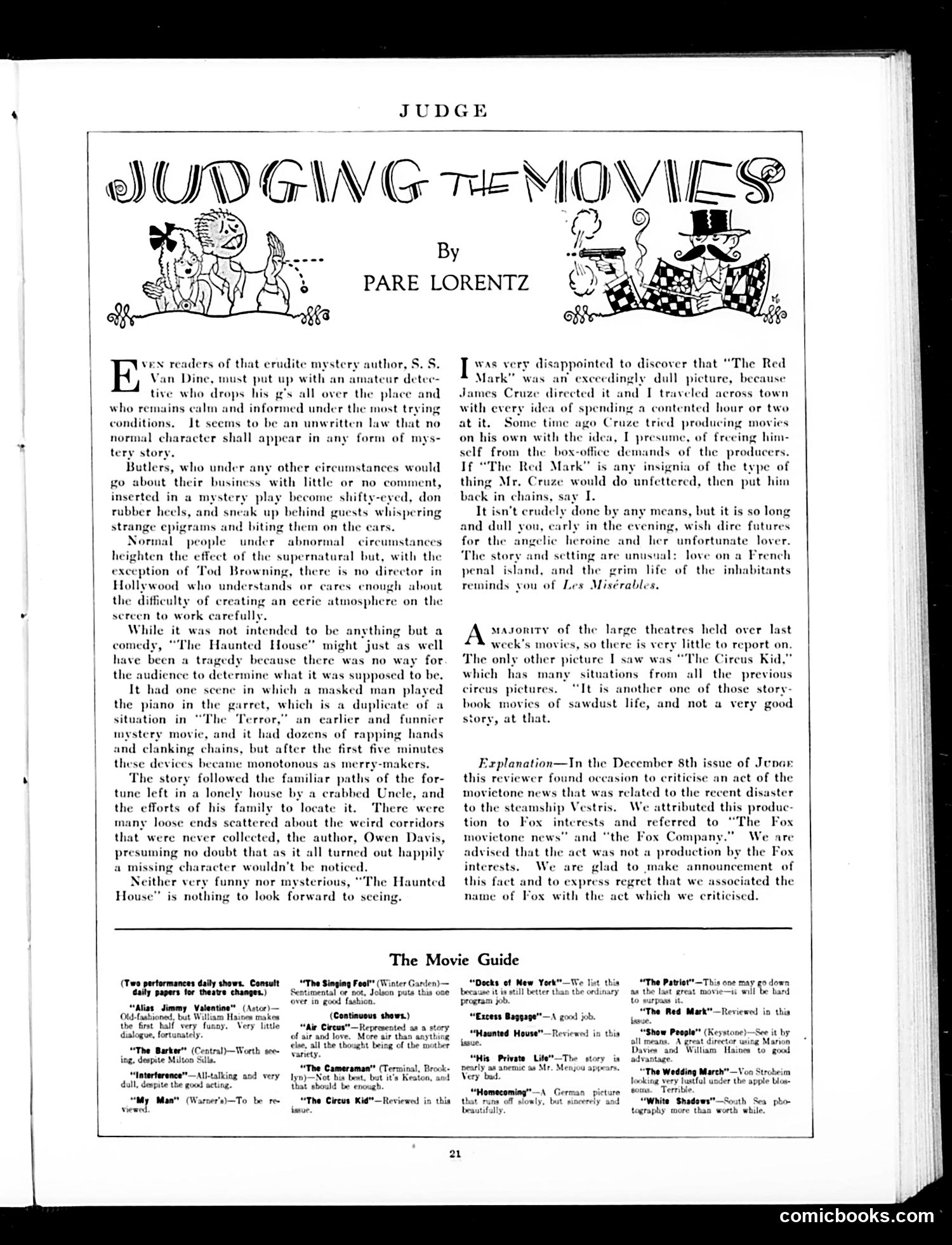
This is a film criticism column from Judge magazine. The critic reviews recent movies, primarily discussing "The Haunted House" (a mystery film based on Owen Davis's play) and "The Red Mark" (directed by James Cruze). **The satire**: Lorentz mocks the absurd conventions of 1920s mystery movies—mysterious butlers with shifty eyes, rapping hands, clanking chains, and contrived plots with loose ends. He critiques "The Haunted House" as neither funny nor mysterious, despite its horror devices becoming monotonous. **Social context**: This reflects contemporary frustration with formulaic Hollywood mystery pictures that proliferated after detective fiction's popularity (referencing S.S. Van Dine's mysteries). The column also includes a retraction acknowledging an earlier error about Fox newsreels covering the Vestris disaster. The page concludes with "The Movie Guide"—a listing of current theatrical releases with brief descriptions.
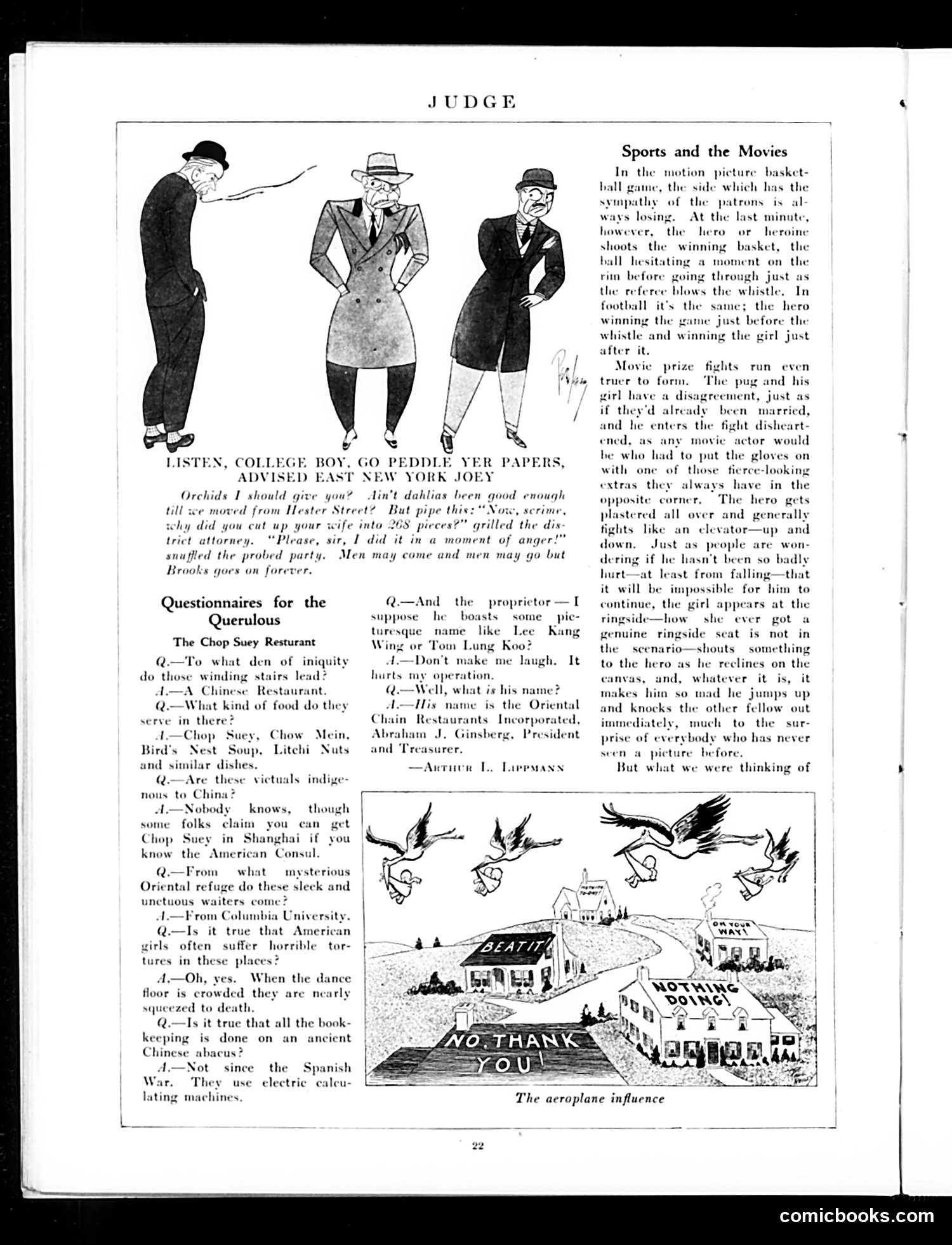
This page contains two satirical pieces typical of Judge magazine's humor: **"Listen, College Boy"** (top): A dialogue-driven joke where a college boy is advised to "go peddle yer papers" by an East New York character named "Joey." The setup appears to mock both pretentious college types and street-smart urban dialect speakers—a class-based humor common to the era. **"Questionnaires for the Querulous"** (middle): A Q&A section mocking Chinese restaurants in America. The satire targets American ignorance about Chinese cuisine and culture—the "authentic" foods mentioned (chop suey, bird's nest soup) are presented as possibly invented for American consumption. The punchline: the restaurant's owner isn't exotically named but is "Abraham J. Ginsberg," a Jewish name, suggesting ethnic entrepreneurship rather than authentic Chinese ownership. **"Sports and the Movies"** (right): Commentary on how Hollywood sports films follow predictable formulas—the hero loses sympathy, nearly loses, then is motivated by his girlfriend's appearance to win, defying realistic physics. **The cartoon** (bottom) depicts airplanes dropping "no thank you" and "nothing doing" messages on buildings below, satirizing aviation's growing cultural influence on American life.
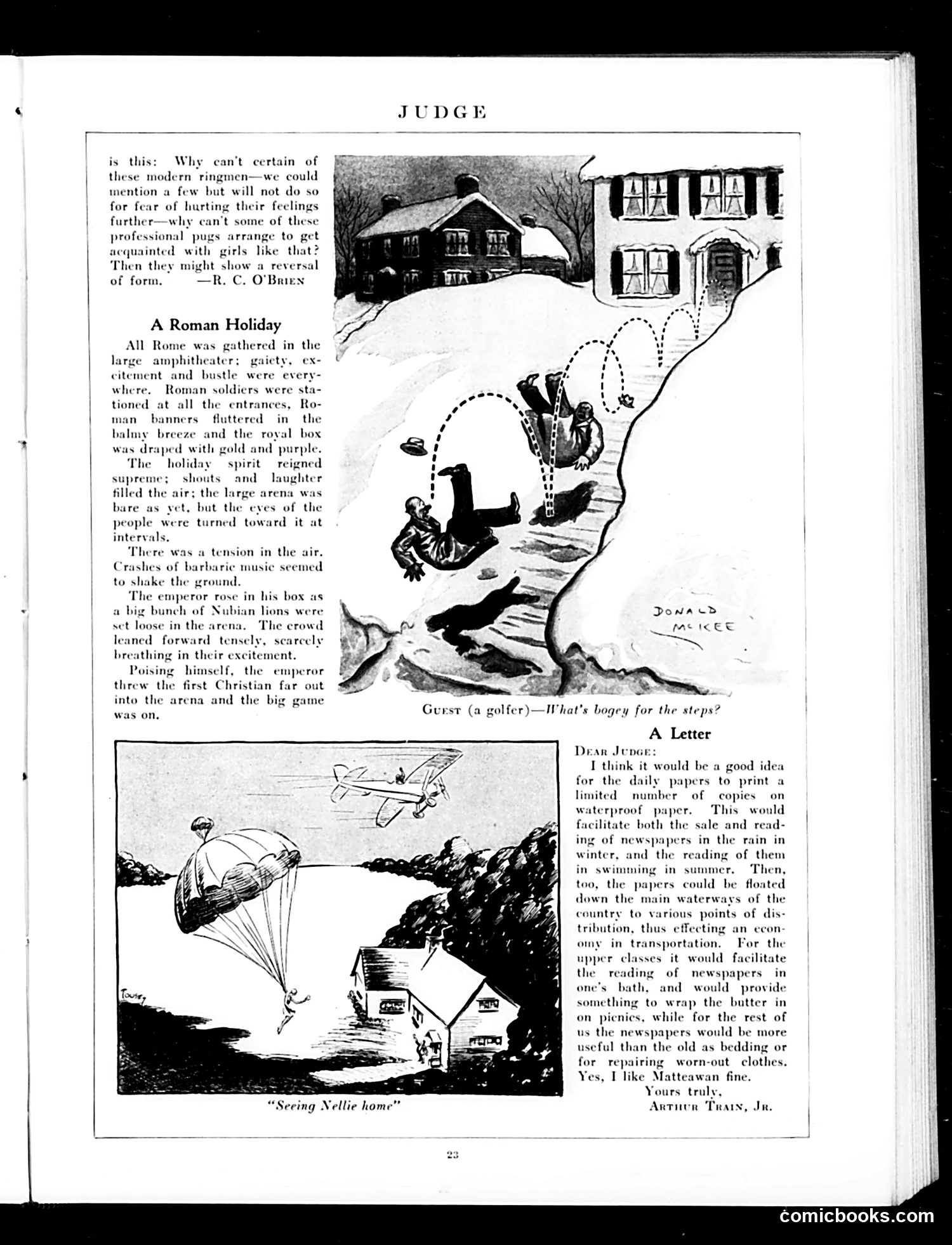
This page contains three separate pieces of satirical content: **"A Roman Holiday"** (top right cartoon by Donald McIlvee): A darkly satirical illustration depicting Christian martyrs being fed to lions in ancient Rome's amphitheater. The accompanying text describes the spectacle in vivid detail, using historical Roman entertainment as an implicit critique of contemporary violence or sensationalism—likely boxing matches, given the O'Brien quote above about professional fighters ("pugs") who should "arrange to get acquainted with girls" instead of fighting. **"Seeing Nellie Home"** (bottom left cartoon): Shows a man in an airplane spotting his girlfriend's house. It's a lighthearted visual gag about modern aviation enabling romantic gestures. **"A Letter"** (right): Arthur Twain Jr. satirically proposes waterproof newspapers for reading in rain, swimming, or baths—absurd practical suggestions that mock both newspaper utility and upper-class leisure habits. The common thread: humorous social commentary on modern life, boxing culture, and class distinctions, typical of Judge's satirical approach.
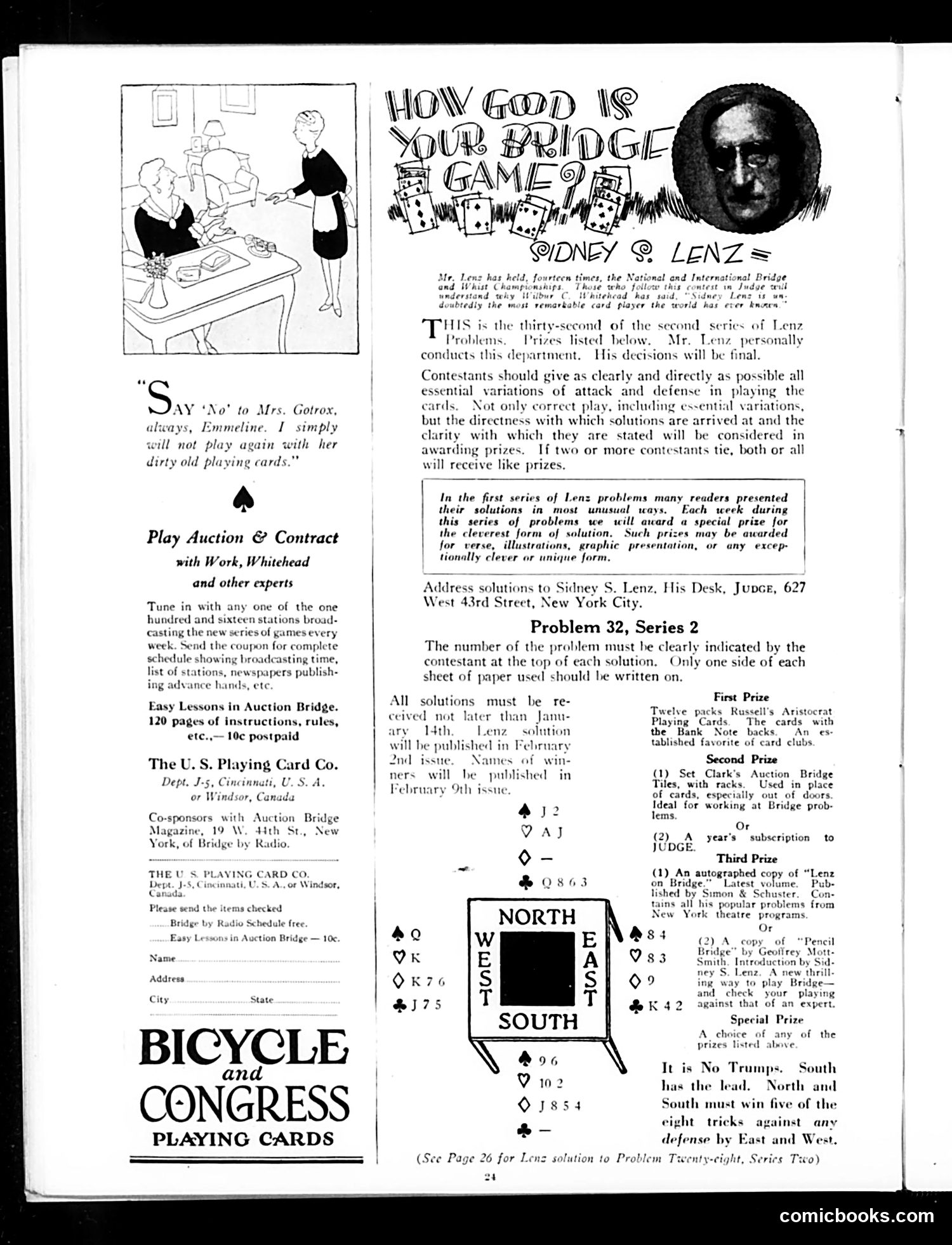
This page is primarily **advertising and a bridge card game puzzle**, not political satire. The cartoon at top-left shows a domestic scene where a woman (Emmeline) refuses to play cards with "Mrs. Gotrox" again because of her "dirty old playing cards"—a lighthearted joke about worn-out decks. The bulk of the page promotes **Bicycle playing cards and bridge instruction materials** through radio broadcasts and mail-order lessons. "Bridge" was a hugely popular card game in the 1920s-30s, and companies capitalized on this craze through media tie-ins. The main content is **Problem 32 from the Lenz bridge series**—a competitive puzzle where readers submit solutions to win prizes (playing card decks, magazine subscriptions, bridge instruction books). Sidney S. Lenz was apparently a prominent bridge expert who judged entries. This reflects the era's enthusiasm for accessible entertainment and instruction distributed via radio, print advertising, and mail—early mass-media marketing targeting middle-class leisure activities.
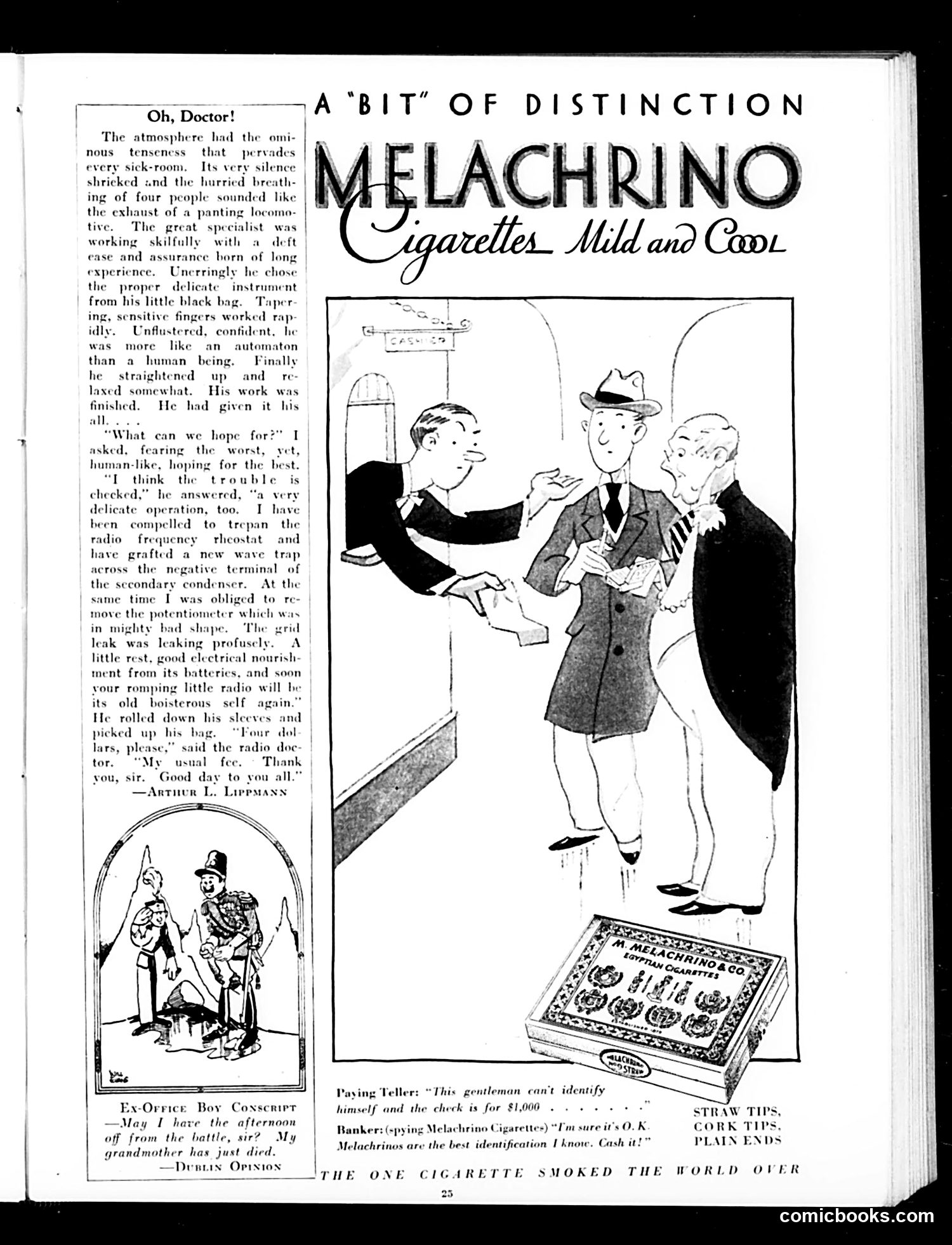
This page combines two satirical pieces from *Judge* magazine: **Main Cartoon (top):** A humorous story about a "radio doctor" treating a broken radio like a surgeon treats a patient. The specialist uses medical terminology while actually performing radio repairs (adjusting rheostats, condensers, etc.). The joke mocks both the pretentious language doctors used and the growing mystique around new radio technology in the early 20th century—treating a mechanical device with the gravitas of life-or-death medicine. **Bottom Cartoon (bank scene):** A banker won't cash a check for someone without proper ID, but accepts Melachrino cigarettes as identification instead. This is an advertisement disguised as satire, humorously suggesting these cigarettes are so distinctive and well-known they serve as reliable proof of identity—thus positioning them as a marker of respectability and recognition. Both pieces are essentially advertorials promoting Melachrino cigarettes as a status symbol.
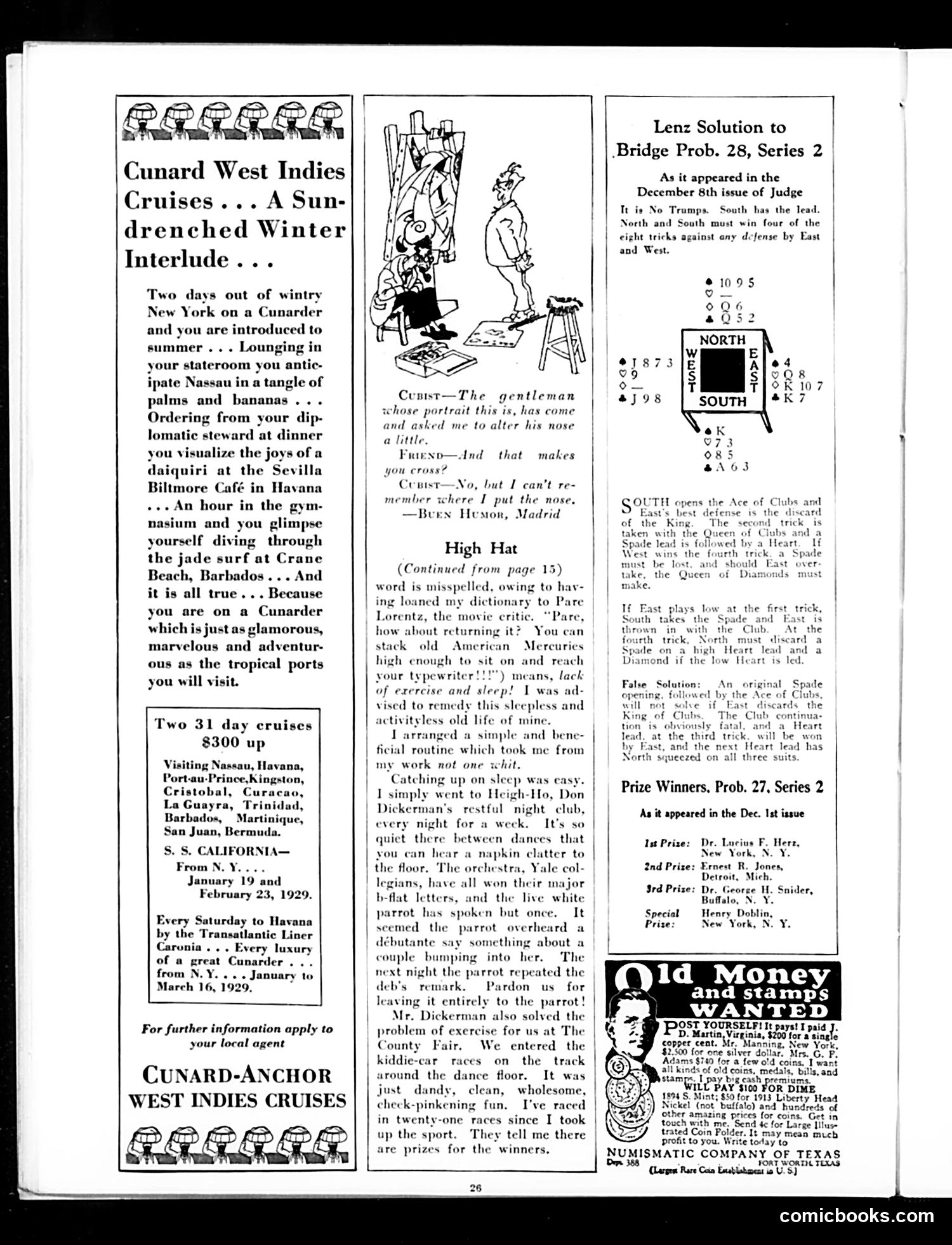
This page is primarily **advertising and puzzle solutions**, not satirical content. The main features are: 1. **Cunard cruise advertisements** (left and bottom) promoting Caribbean luxury travel from New York—typical 1920s aspirational marketing emphasizing tropical glamour and leisure. 2. **"High Hat" column** (center)—a humorous personal essay about adopting a sleep-remedy routine involving nightclubs and children's races. It includes a anecdote about a parrot at a nightclub repeating an overheard remark, presented as amusing. 3. **Bridge puzzle solutions** and **prize winners** for Judge's regular contests. 4. **"Old Money and Stamps Wanted"** (bottom right)—a classified ad seeking vintage currency and collectibles. There is **no political satire** on this page. It reflects typical magazine content: leisure advertising, light humor columns, games/puzzles, and classifieds—aimed at affluent 1920s readers.
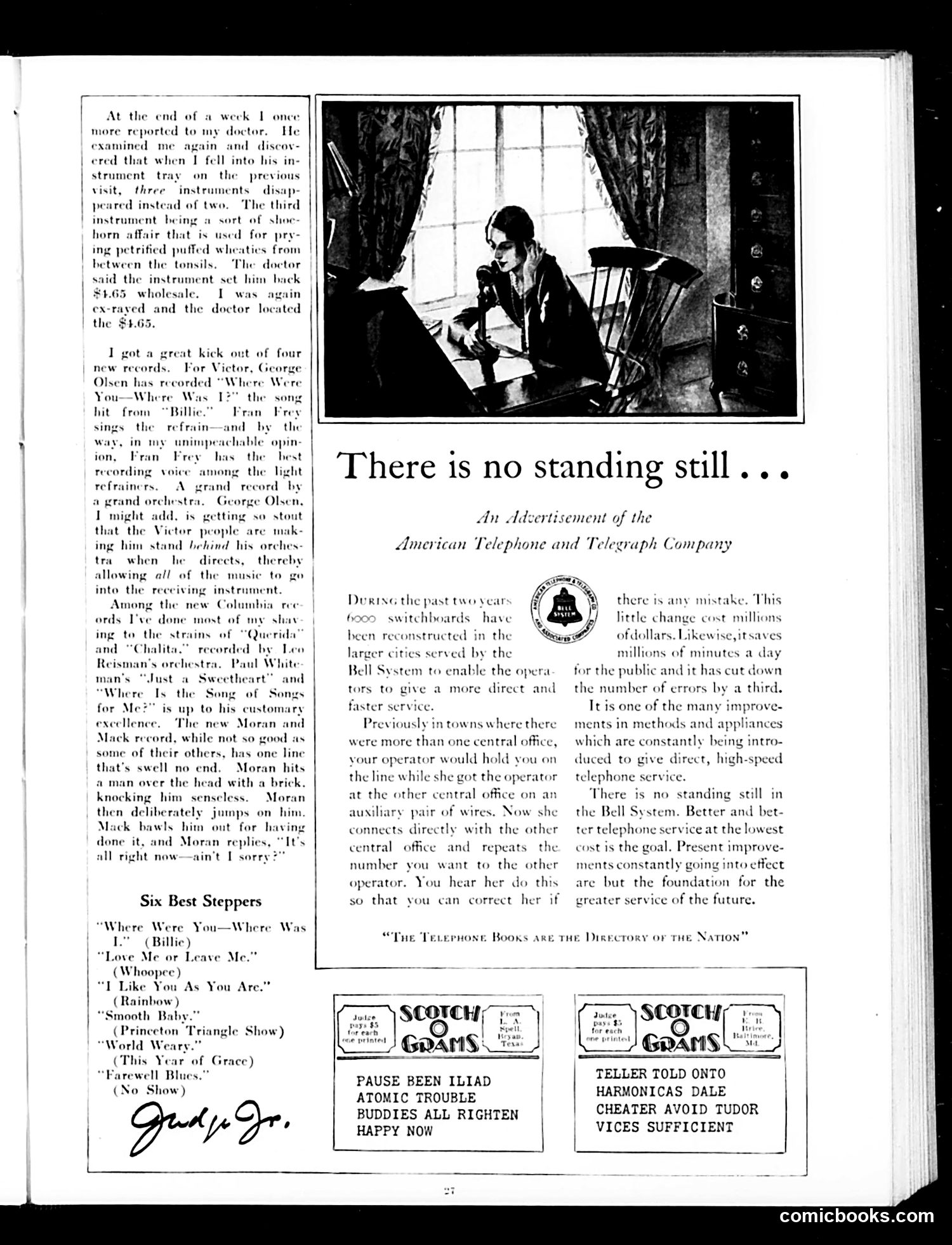
This page is primarily **advertising and entertainment content** rather than political satire. The main content includes: 1. **A personal essay** (left column) discussing the author's medical visit and his opinions on new phonograph records by artists like George Olsen and Fran Frey—typical light entertainment commentary for the era. 2. **A major Bell Telephone advertisement** (center/right) titled "There is no standing still," promoting improvements to telephone switchboard technology. It explains how Bell has reconstructed switchboards in major cities to enable faster, more direct service between central offices, saving time and reducing errors. 3. **"Six Best Steppers"** (bottom left)—a list of popular song/dance recordings of the period, signed by what appears to be the author's signature. 4. **Two "Scotch Grams"** (bottom right)—humorous advertisements playing on phonetic puns related to song titles or phrases. The page reflects 1920s consumer culture and technological progress messaging rather than political commentary.
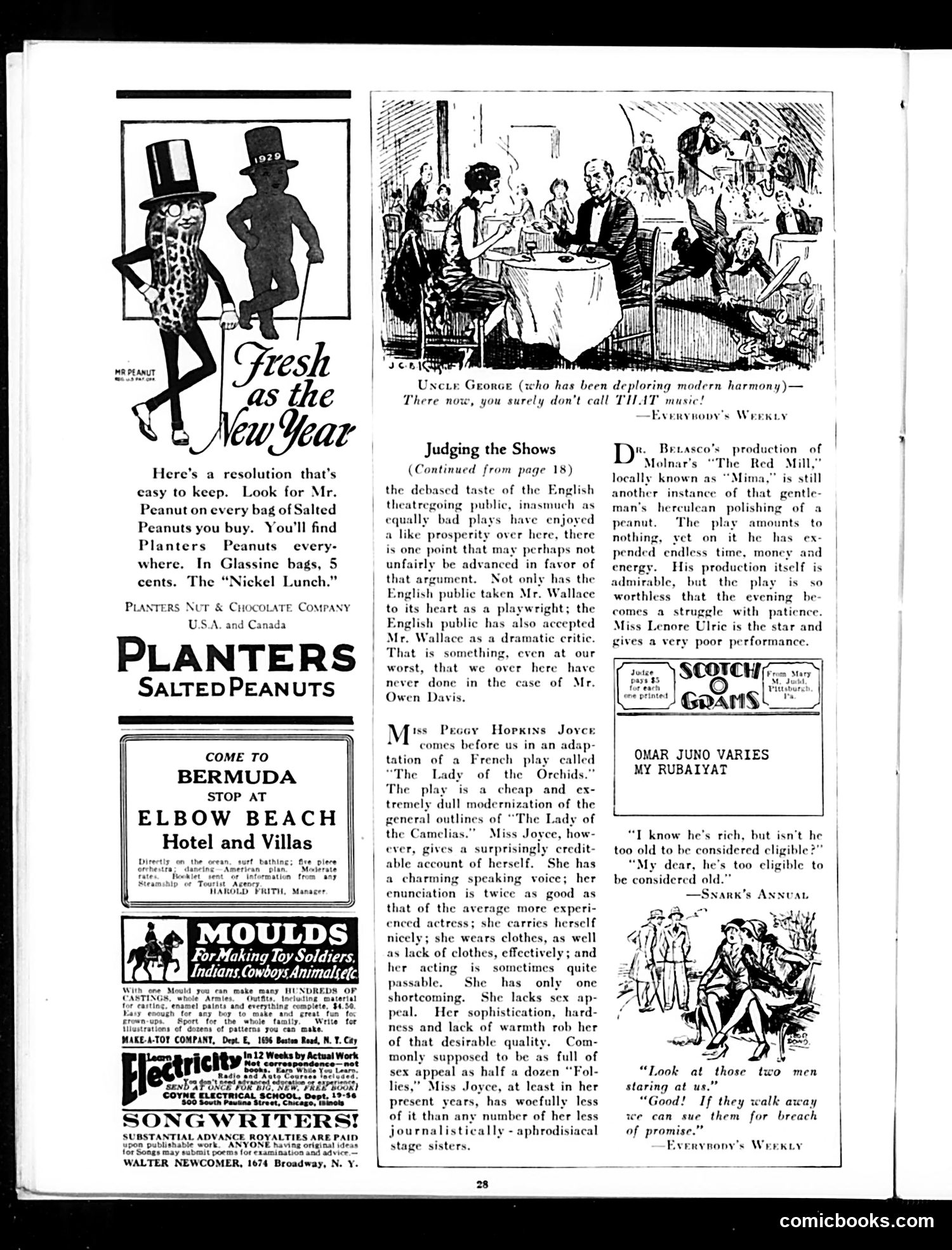
This page is primarily **advertising and theater criticism** rather than political satire. **The cartoon** (top right) shows Uncle George, an older man with old-fashioned tastes, complaining about modern jazz music at what appears to be a party. The joke reflects generational tension: Uncle George represents the elderly who rejected "modern harmony" (jazz), which was scandalous and considered immoral by older Americans in the 1920s. The satire mocks his outdated sensibilities. **Theater reviews** occupy most of the page, critiquing contemporary Broadway productions. The text discusses English playwright Mr. Wallace's success, actress Peggy Hopkins Joyce (noted for lacking "sex appeal"), and David Belasco's lavish but artistically hollow production of "The Red Mill." The remaining content is **advertisements**: Planters Peanuts, Bermuda vacation travel, toy soldier molds, and a songwriting service—typical magazine filler. The page captures 1920s generational conflict and theater world gossip rather than substantive political commentary.
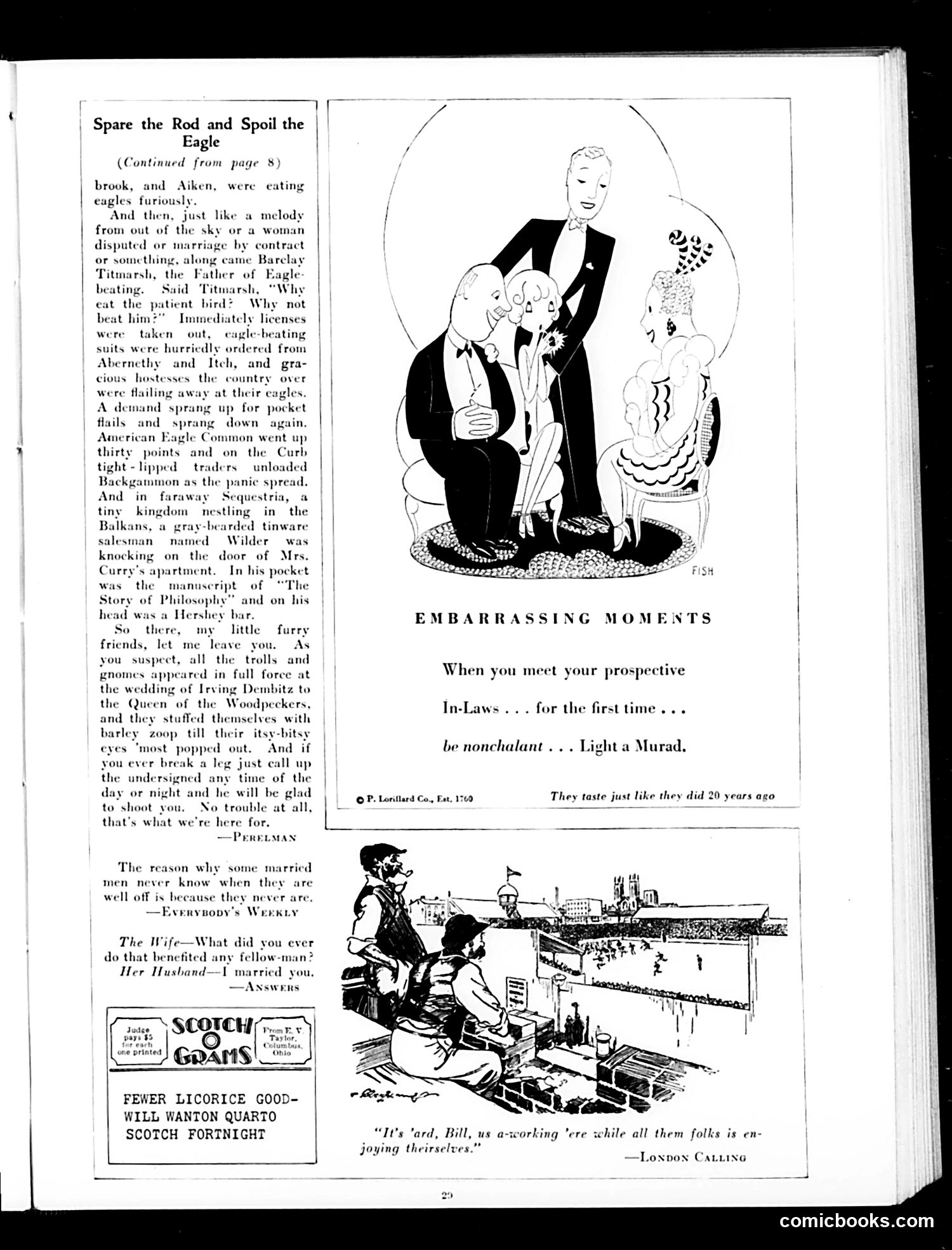
This Judge magazine page combines satirical fiction with advertising. "Spare the Rod and Spoil the Eagle" is a fantastical continuation story mocking American excess and absurdity—eagle-beating becomes a stock-market panic, random characters appear in nonsensical situations (a tinware salesman with Philosophy manuscripts and Hershey bars), and the narrative dissolves into surreal wedding hijinks. The humor relies on escalating absurdity rather than coherent satire. The "Embarrassing Moments" cartoon depicts wealthy people meeting in-laws, with a caption suggesting pretending nonchalance by smoking—an advertisement disguised as humor. The bottom cartoon shows working-class laborers watching the leisure class enjoy themselves, critiquing class inequality. The marriage jokes mock wives and husbands stereotypically. The Scotch Goats advertisement is indecipherable without context. Overall, the page reflects 1920s-30s humor: surreal wordplay, class commentary, gender stereotypes, and product placement disguised as editorial content.
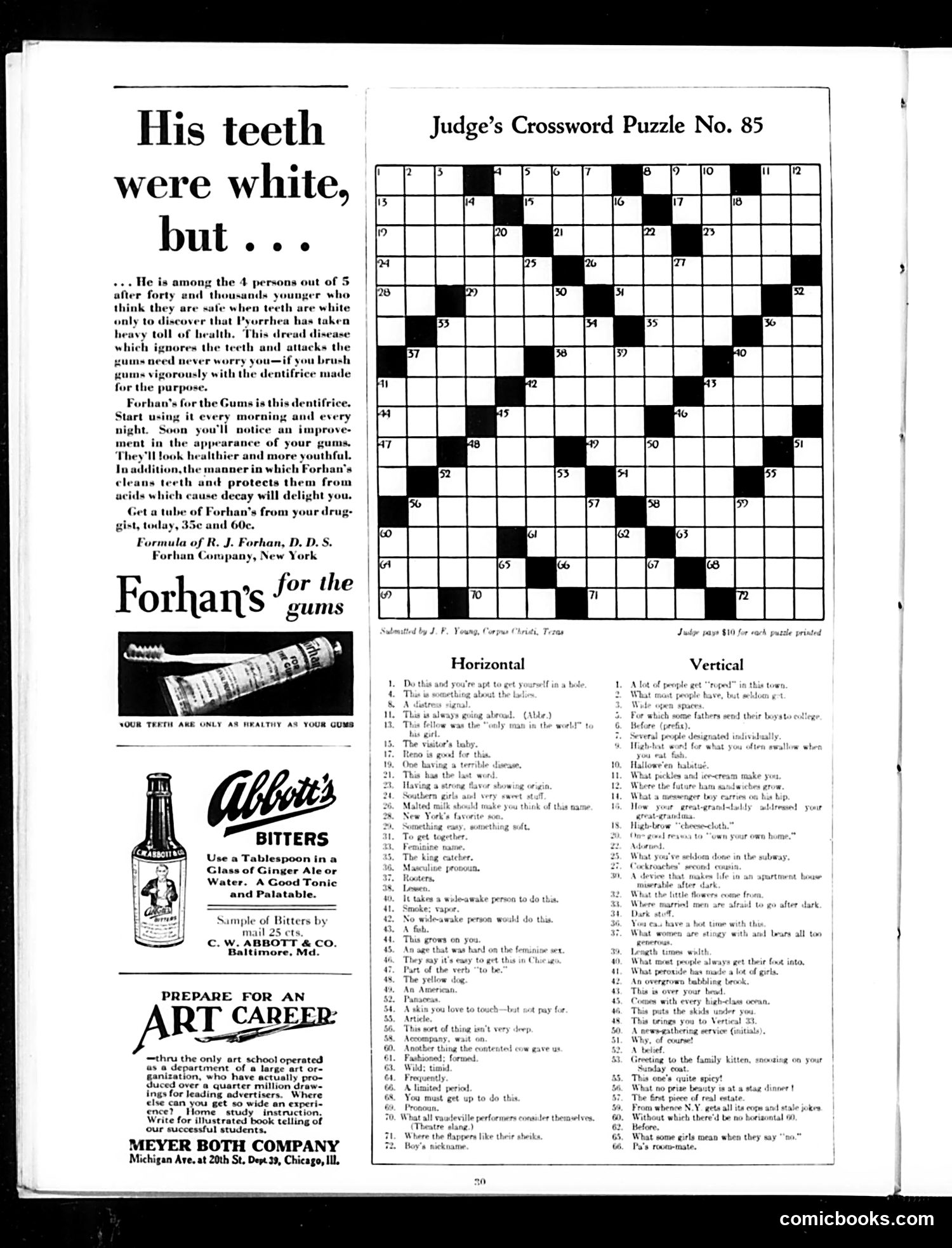
This page is primarily **advertising and a crossword puzzle**, not political satire. The dominant content features a **Forhan's toothpaste advertisement** addressing dental health concerns of the 1920s-30s era. The ad warns that white teeth can mask pyorrhea (gum disease), a serious health threat, and promotes Forhan's as a dentifrice that protects gums specifically. This reflects genuine public health anxiety of the period about gum disease. Below are period advertisements for **Abbott's Bitters** (a medicinal tonic) and the **Meyer Both Company** art school—typical commercial content of Judge magazine. The main visual element is **Judge's Crossword Puzzle No. 85**, a popular entertainment feature. The clues reference contemporary 1920s-30s slang and cultural references ("flappers," "subway," etc.). **No political cartoon or satirical commentary is present on this page.** It represents Judge's mixed content model: advertising revenue subsidized the publication's satirical humor found elsewhere.
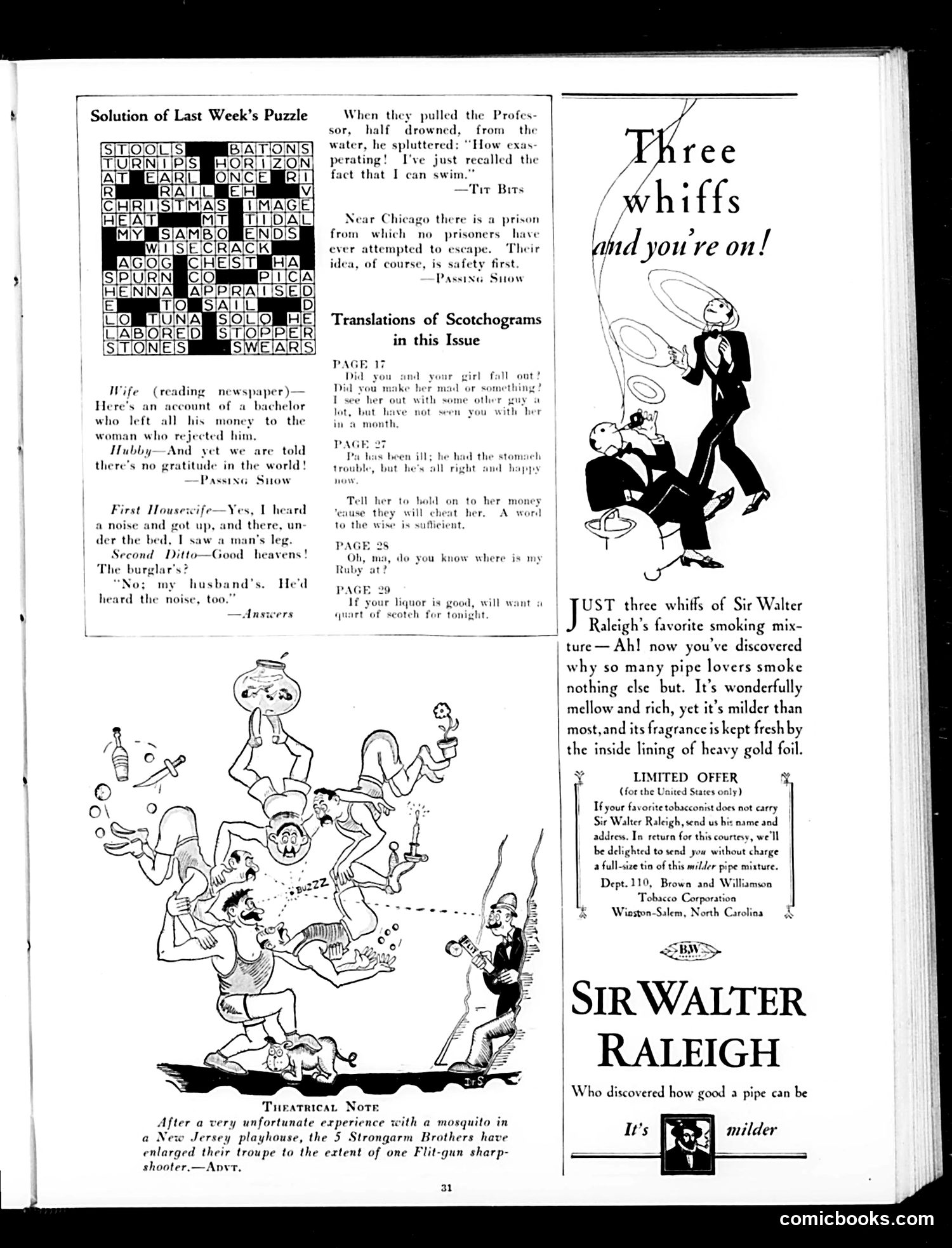
This page from Judge contains three elements: **The Puzzle Solution & Jokes:** The top left shows the previous week's crossword answer and brief humorous one-liners on everyday topics (a bachelor's bequest, domestic surprises, a drowning professor). These are short gag jokes typical of the era's humor magazines. **The Theatrical Note:** A brief comedic item about the "Strongarm Brothers" expanding their troupe after a mosquito incident at a New Jersey playhouse, now including someone with a "Flit-gun"—referencing the popular insecticide brand Flit, which used aggressive advertising. This is essentially a tongue-in-cheek advertisement disguised as news. **Sir Walter Raleigh Advertisement:** The majority of the page is a full cigarette/pipe tobacco advertisement featuring illustrated men smoking, promoting Sir Walter Raleigh tobacco as "milder" with a limited offer for a free sample. The ad plays on historical associations with the explorer Sir Walter Raleigh and tobacco. The page demonstrates how Judge monetized content through advertising while maintaining satirical entertainment—typical of early-20th-century magazine publishing.
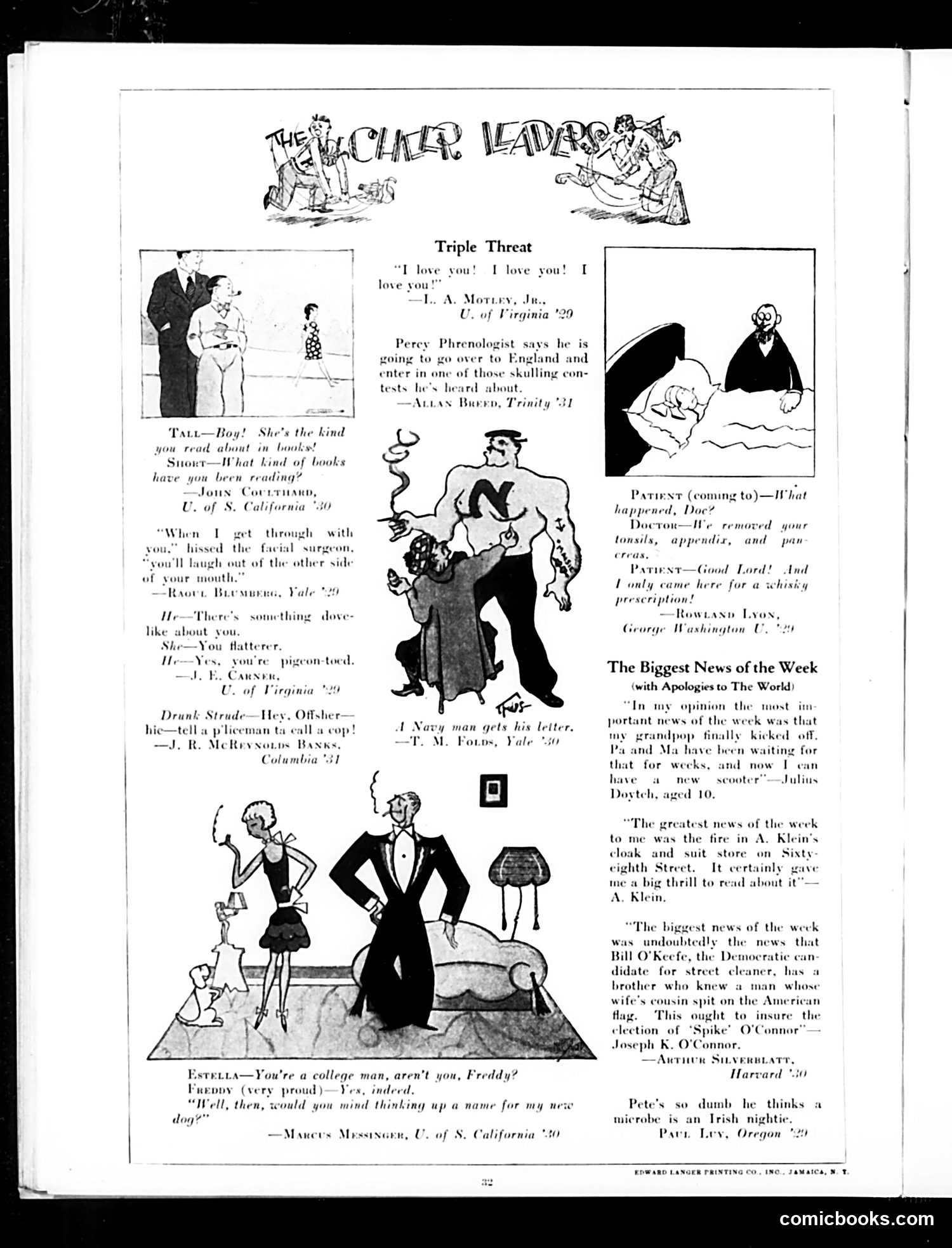
This is a humor page from *Judge* magazine featuring college-era jokes and cartoons, likely from the late 1920s based on the attributed dates ('29, '30, '31). **Content Overview:** The page collects brief comedic vignettes submitted by college students from various universities. The humor is genteel, era-appropriate comedy: a man trying too hard to impress a woman ("I love you!"), collegiate wordplay, and self-deprecating jokes about student life. **Key Cartoons:** - A central image shows a man surrounded by attractive women, illustrating the "triple threat" concept (presumably a man attractive to multiple women) - A lower cartoon depicts a sophisticated scene with elegantly dressed figures and furniture, accompanies the "college man" bit **The Satire:** The page's framing ("The Biggest News of the Week") gently mocks student priorities—a grandfather's death ("kicked off"), petty campus gossip, and trivial concerns treated as major events. It's affectionate rather than biting satire about youthful perspectives. The humor reflects 1920s college culture, prohibition-era references ("whisky prescription"), and genteel campus wit rather than sharp political commentary.
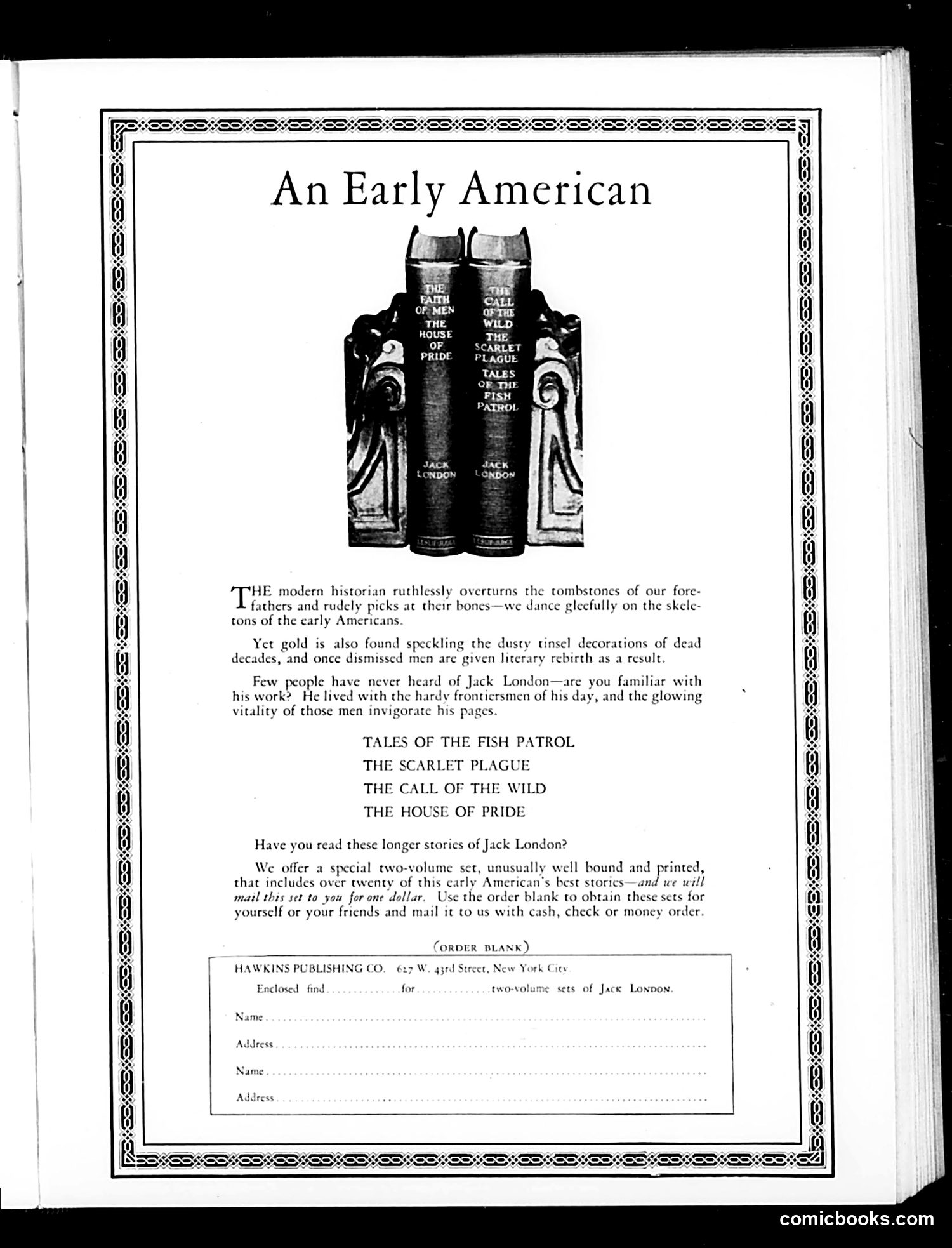
This is a **book advertisement**, not a political cartoon. It promotes a two-volume Jack London collection published by Hawkins Publishing Co. The ad's humor lies in its framing: it mockingly describes how modern historians "ruthlessly overturn the tombstones of our forefathers and rudely pick at their bones," then ironically applies this to Jack London—positioning him as a rediscovered "early American" worthy of literary resurrection. The joke appears to be that London (who was alive and contemporary when this ran) is being treated as a historical figure from a distant past, elevating pulp adventure stories into the canon of serious American literature. The four titles listed—*Tales of the Fish Patrol*, *The Scarlet Plague*, *The Call of the Wild*, and *The House of Pride*—are genuine London works. The ad offers this collection for one dollar with an order blank below. This represents early American mail-order publishing marketing, using tongue-in-cheek language to sell adventure fiction.
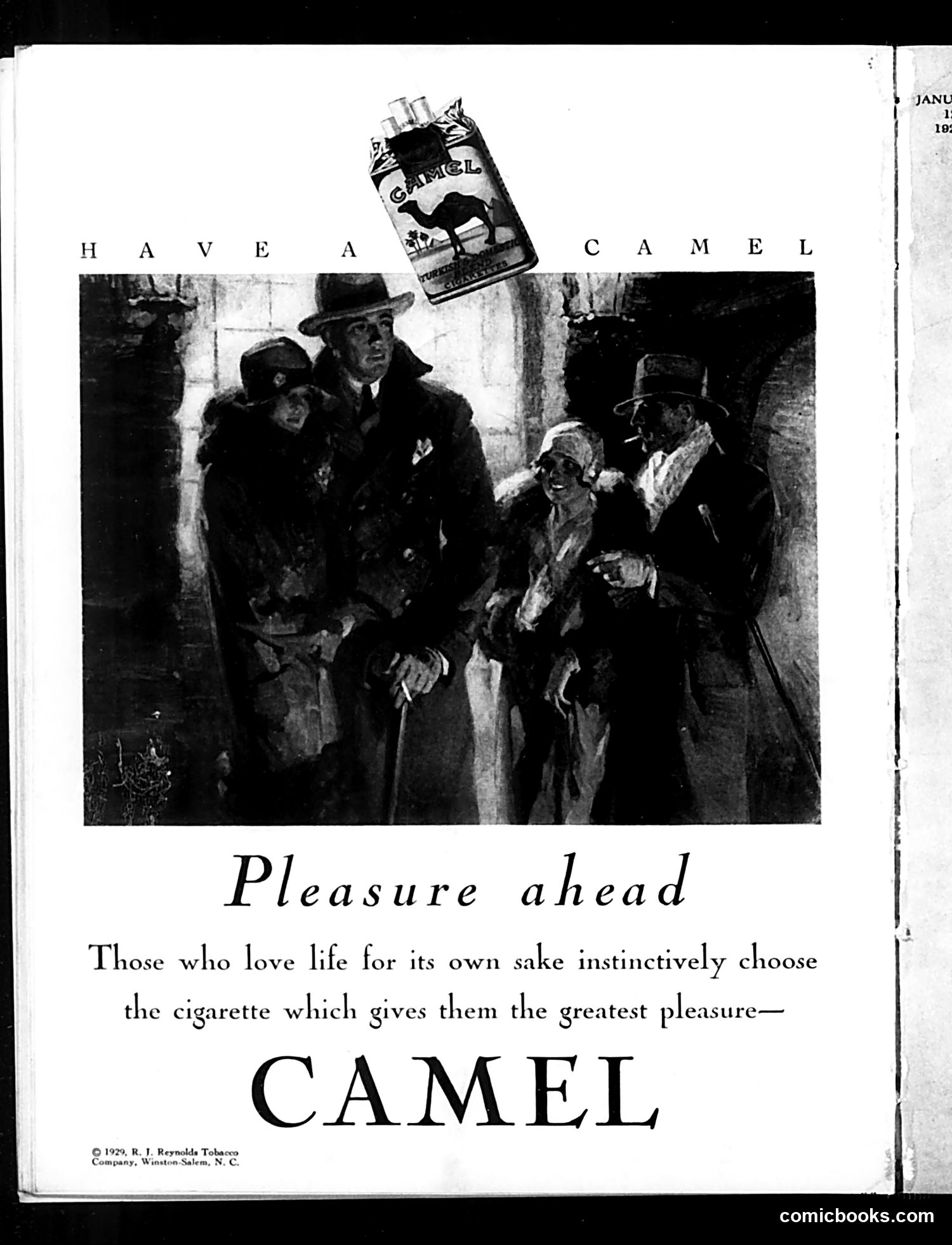
This is a **Camel cigarette advertisement**, not satirical content. Dating to 1929, it uses a scene showing well-dressed men encountering street children or poor youths to convey aspirational messaging. The ad's slogan—"Those who love life for its own sake instinctively choose the cigarette which gives them the greatest pleasure"—attempts to associate smoking with refined living and sophisticated choice. The image appears designed to suggest that Camel appeals to people of taste and discernment. By modern standards, the ad is notable for: (1) marketing cigarettes without health warnings, and (2) the rather cynical juxtaposition of wealth and poverty to sell pleasure-seeking to affluent readers. This reflects 1920s advertising practices before tobacco regulation and the normalization of cigarette marketing in mainstream publications.