
A complete issue · 36 pages · 1929
Judge — March 23, 1929
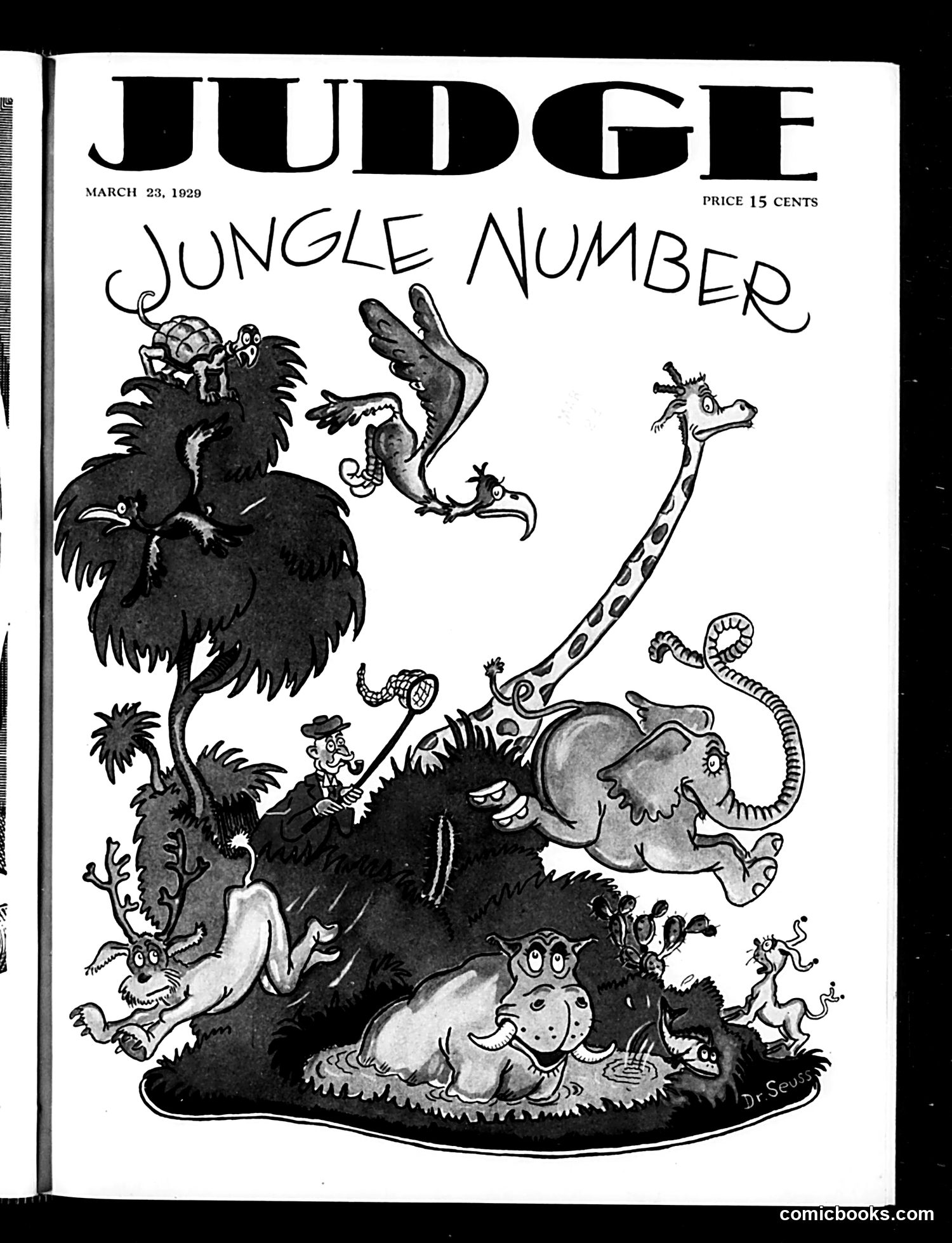
This is the cover illustration for a special "Jungle Number" issue, signed by Dr. Seuss (Theodor Geisel). The cover depicts an exuberant jungle scene populated by various animals and human figures in a chaotic, whimsical composition. The cartoon appears to be primarily **decorative rather than overtly political**—a playful assemblage of jungle creatures (ostrich, giraffe, elephant, hippo, monkeys, snakes) alongside small human figures, creating visual comedy through scale and absurdity. The style is characteristic of early Seuss work, emphasizing imaginative creature design and dynamic composition. Without additional article context from this issue, the specific satirical targets remain unclear, though the "Jungle Number" theming likely referenced contemporary interest in exotic adventure narratives popular during this era.
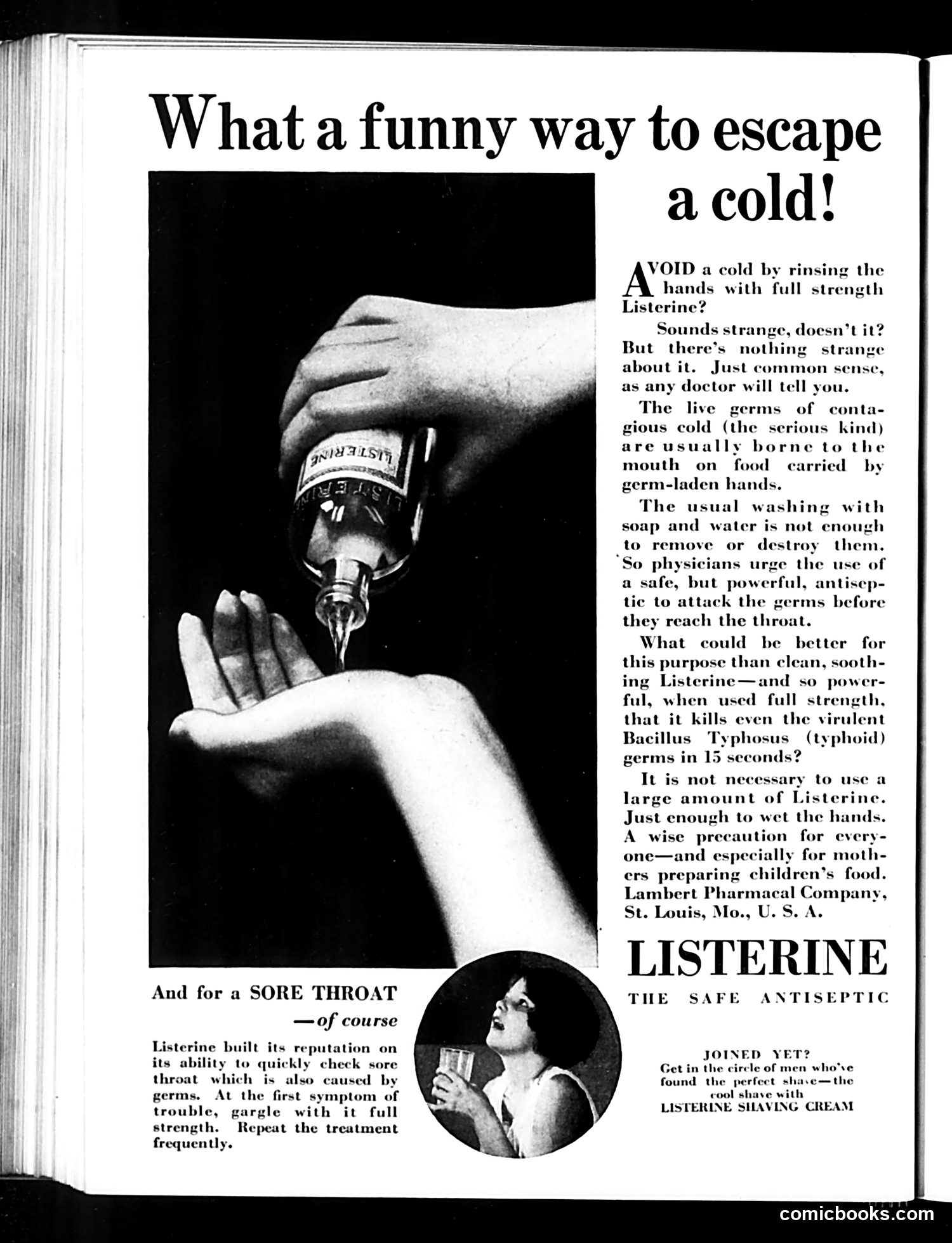
This page is **primarily an advertisement**, not a satirical cartoon. It promotes Listerine antiseptic mouthwash and shaving cream. The ad uses persuasive marketing rather than satire. The large image shows hands applying Listerine, while text claims the product kills cold germs on hands in 15 seconds. A smaller circular photo shows a man using Listerine for sore throat treatment. The "joke" in the headline—"What a funny way to escape a cold!"—is marketing wordplay, not political satire. The copy positions Listerine as medically superior to ordinary soap and water, appealing to early 20th-century anxieties about germs and hygiene. The shaving cream mention at bottom suggests this was a diversified product line. This represents Judge magazine's reliance on commercial advertising revenue alongside editorial content.
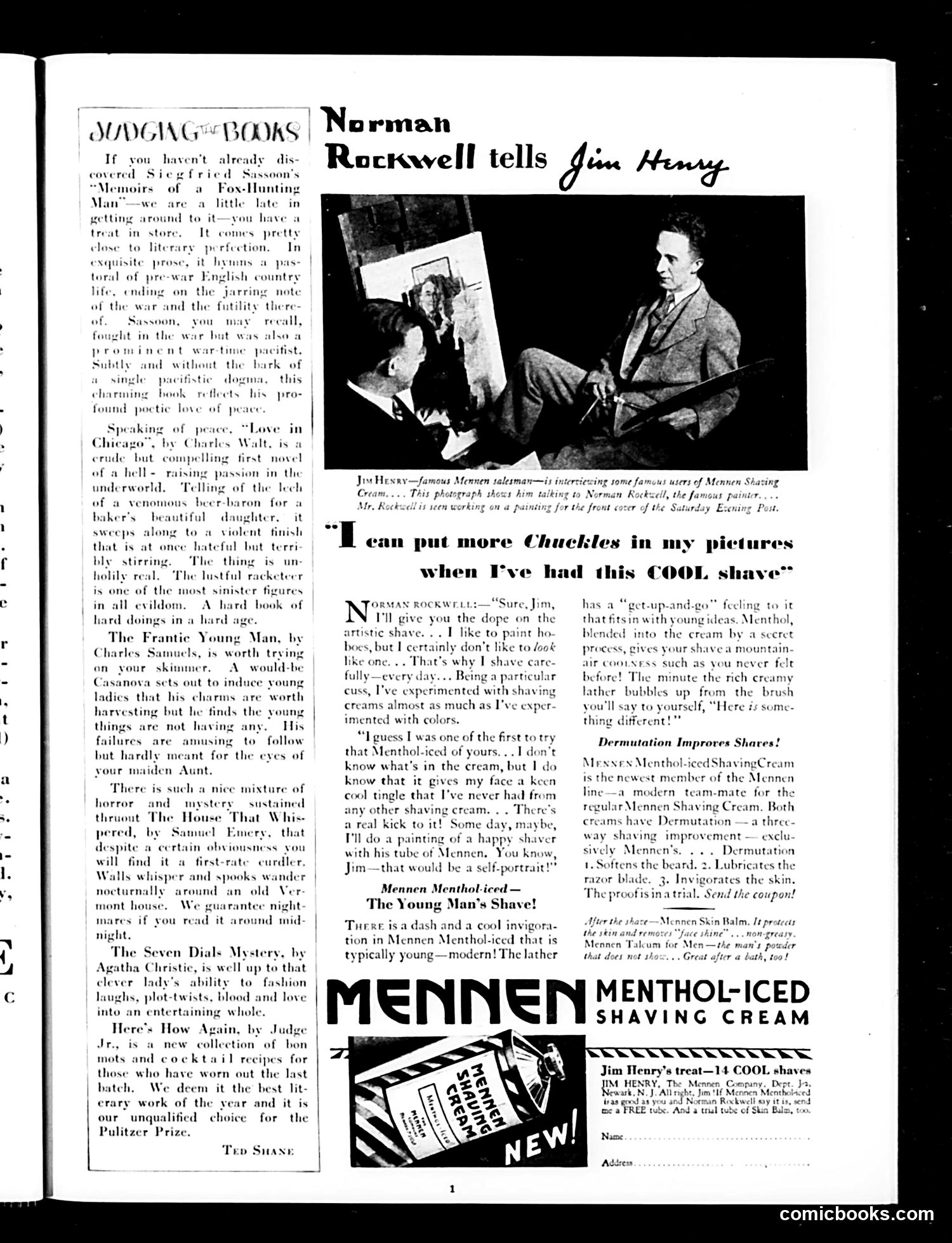
This page is **primarily an advertisement** for Mennen Menthol-Iced Shaving Cream, not political satire. The top portion features a celebrity endorsement format common to 1920s-30s magazines. The photograph shows Norman Rockwell (the famous illustrator) with Jim Henry (identified as "famous Musson salesman"), discussing the shaving cream. Rockwell endorses the product, claiming it allows him to "put more Chuckles in my pictures" when he's had "this cool shave." The advertisement emphasizes the cream's modern menthol ingredient, marketed as refreshing and improving one's appearance and mood—typical consumer marketing of the era. The "Dermatation Improves Shaves!" section promotes the cream's skin benefits. The page includes a coupon offer at bottom. This is commercial content, not political commentary.
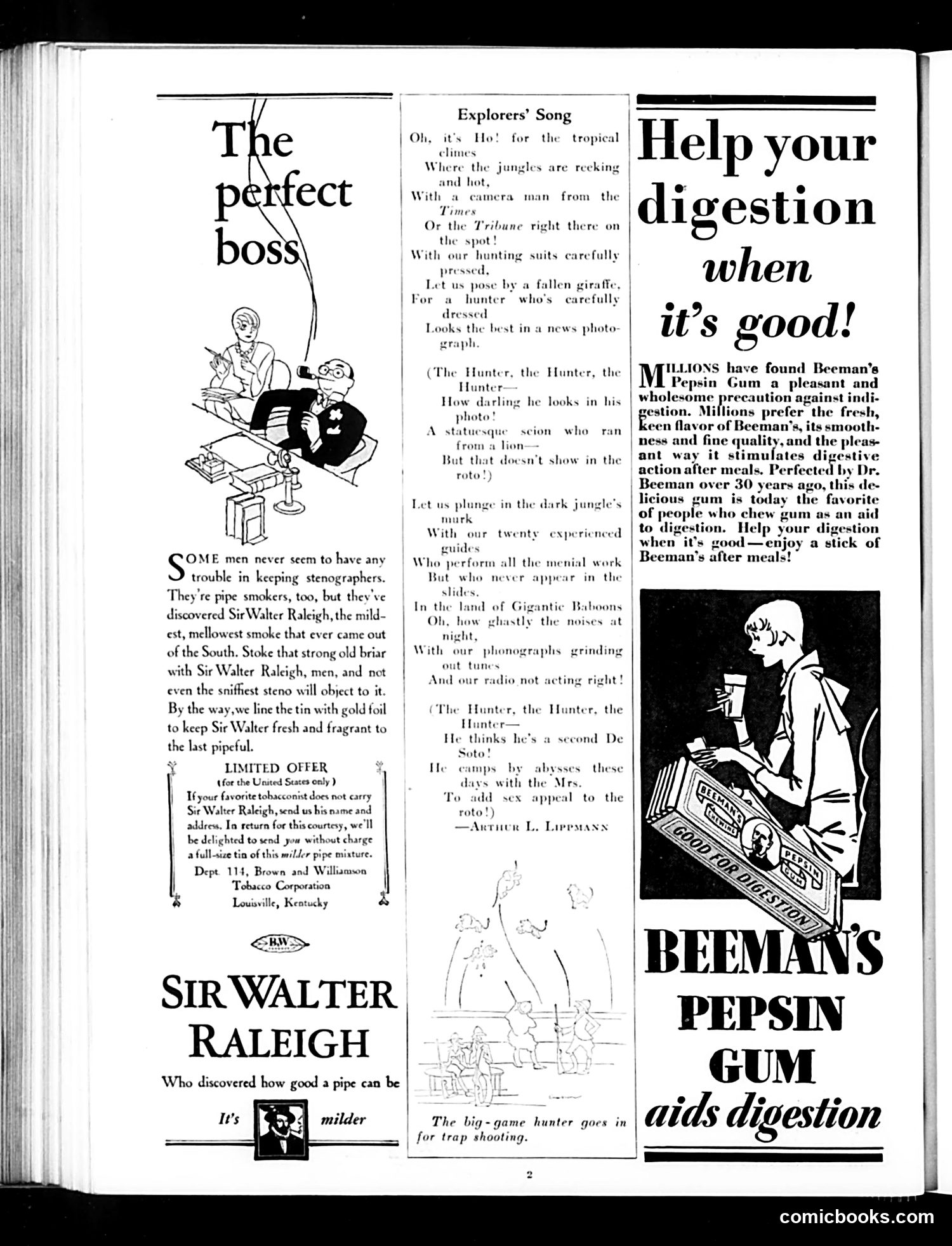
This page contains three separate pieces: an advertisement for Sir Walter Raleigh pipe tobacco, a humorous poem titled "Explorers' Song," and an advertisement for Beeman's Pepsin Gum. **"The Perfect Boss"** cartoon (left) satirizes workplace dynamics, showing a stenographer at a typewriter with a boss figure. The joke appears to target office hierarchies and the relationship between management and clerical workers. **"Explorers' Song"** (center) is a lighthearted poem mocking adventurers and journalists covering exotic expeditions in Africa, with references to hunting, photography, and radio broadcasts—seemingly satirizing the glamorization of colonial exploration and adventure journalism. The remaining content is primarily **commercial advertising** for tobacco and gum products, which dominated magazine pages of this era. These ads use health claims typical of pre-regulation advertising.
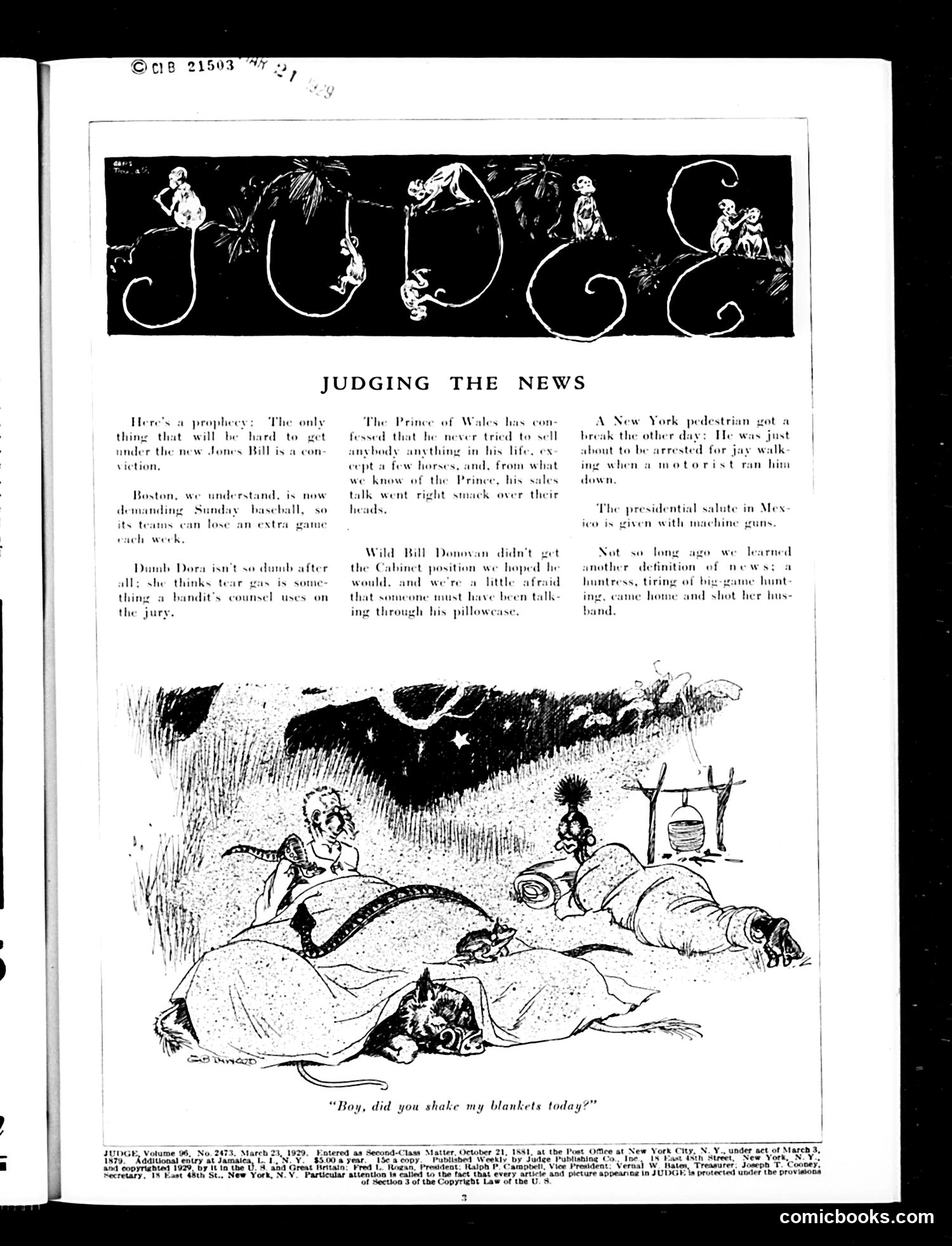
This satirical page comments on contemporary events through short humorous items and an illustration. The text references: - **Jones Bill**: A proposed law requiring Sunday baseball games - **Prince of Wales**: A joke about his sales talks being "too effective" - **Wild Bill Donovan**: A political figure who didn't secure a Cabinet position - **New York pedestrian/motorist incident**: Commentary on traffic safety - **Mexican presidential salute**: A joke about gun customs The bottom illustration appears to depict campers or hikers in an outdoor scene with a humorous caption about blankets. The overall page uses satirical observations about politics, sports, and social customs typical of 1929 American society. The decorative header features small monkey illustrations integrated into ornamental letters.
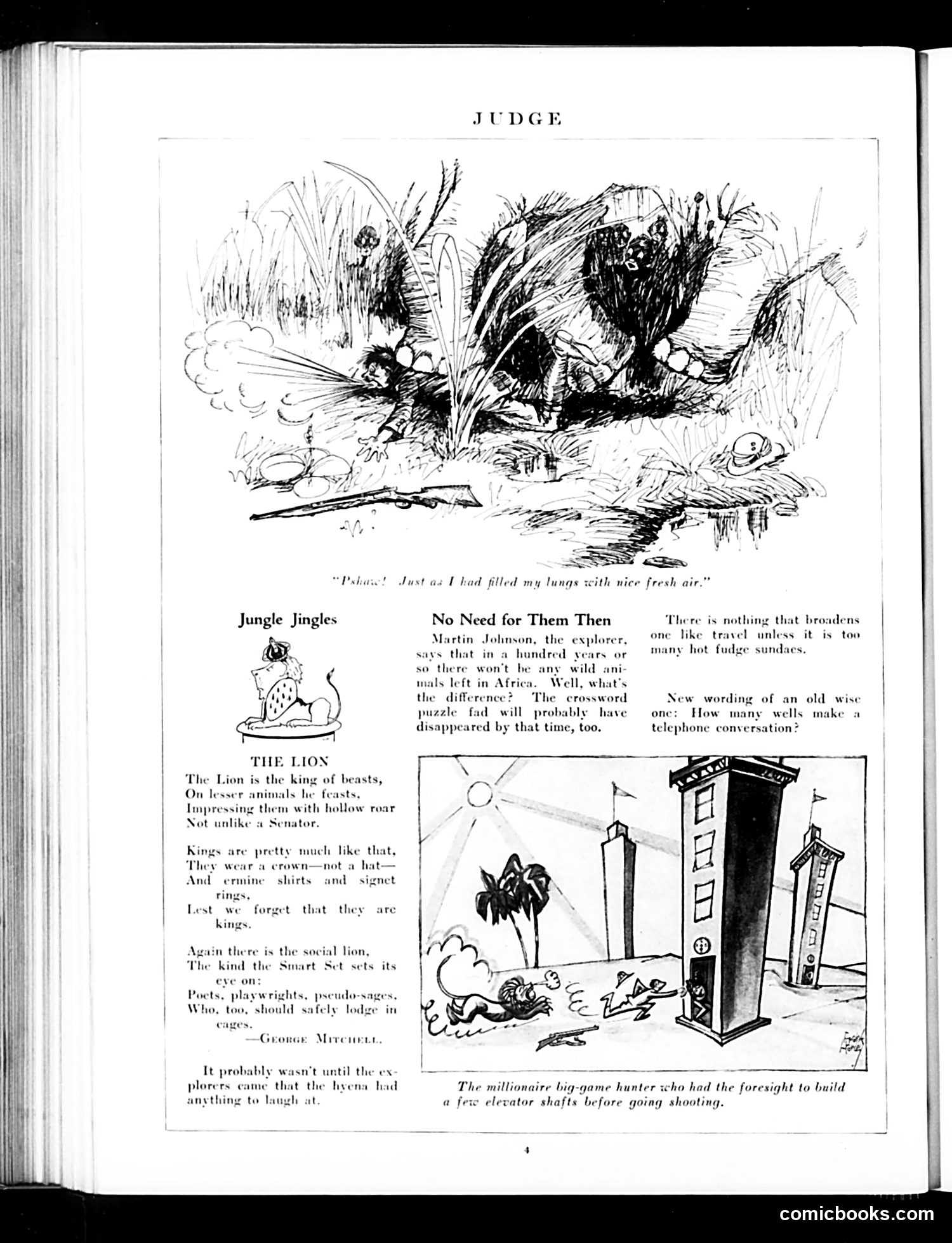
This page contains humorous commentary and cartoons typical of early-to-mid 20th century satire. **Top cartoon**: Shows a character claiming to have "filled my lungs with nice fresh air" — likely mocking romanticized notions of nature or colonial exploration. **"Jungle Jingles" and "The Lion"**: A poem by George Mitchell uses the lion as metaphor for kings and nobility, comparing their authority to natural hierarchy. The satire suggests kings are merely powerful predators, not inherently superior beings — a subtle critique of monarchy. **Bottom cartoon**: Depicts a "millionaire big-game hunter" who built elevator shafts before hunting — apparently satirizing wealthy trophy hunters' disconnect from practical reality or their assumption that technology will solve any problem. The overall theme appears to critique class pretension, colonial attitudes, and the wealthy's detachment from consequences.
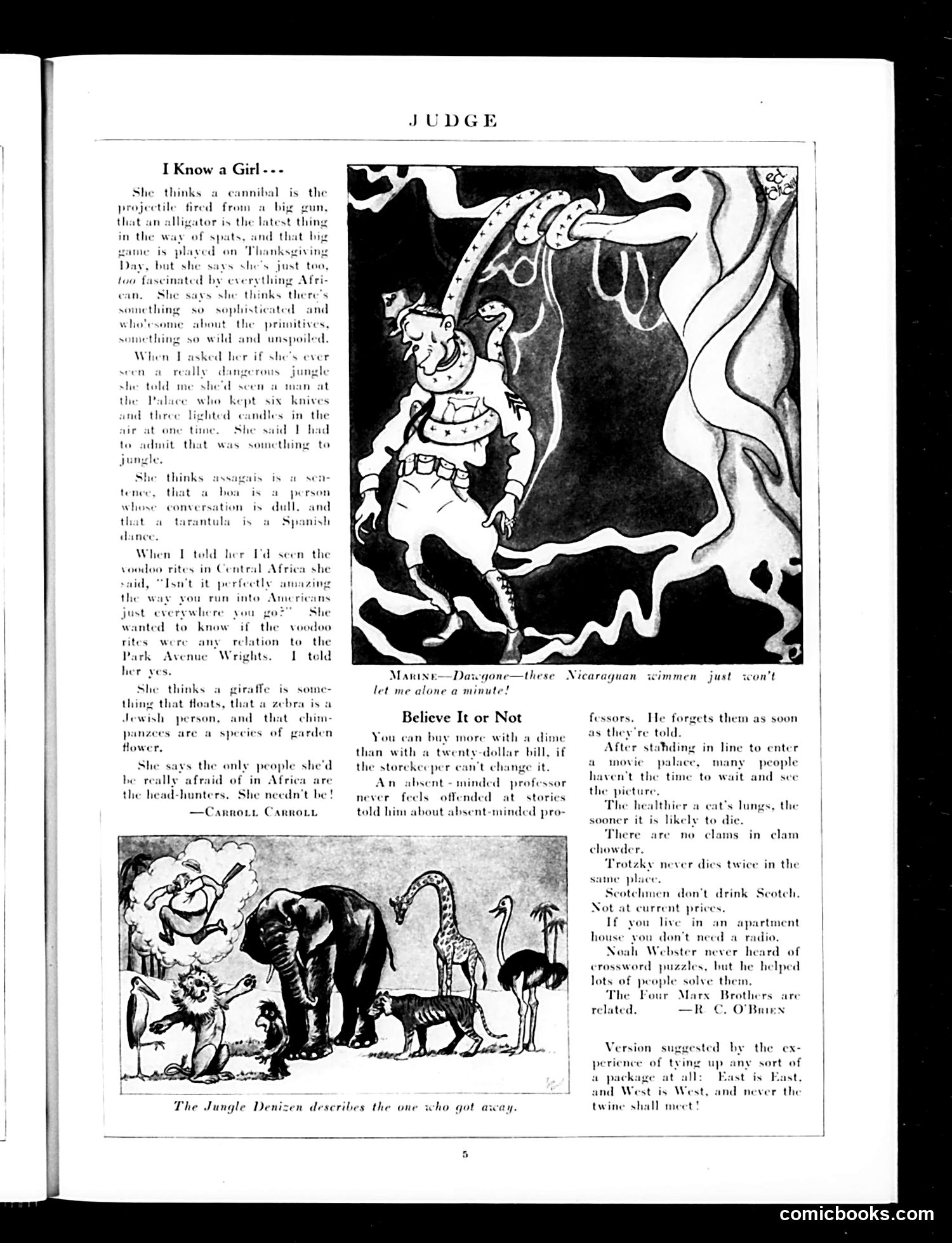
This page contains two separate humor pieces. The top section, "I Know a Girl," features a column by Carroll Carroll describing an eccentric woman fascinated by exotic and "primitive" subjects—jungle animals, voodoo rites, African culture, and "head-hunters." The accompanying cartoon shows her surrounded by decorative animal imagery, satirizing the early 20th-century trend among wealthy Americans of romanticizing non-Western cultures as exotic curiosities. The lower "Believe It or Not" section presents miscellaneous factoids and oddities, with a cartoon captioned "The Jungle Denizen describes the one who got away"—showing various jungle animals, likely mocking exaggerated hunting stories. Both pieces reflect period attitudes treating non-Western cultures as entertainment and spectacle for American audiences.
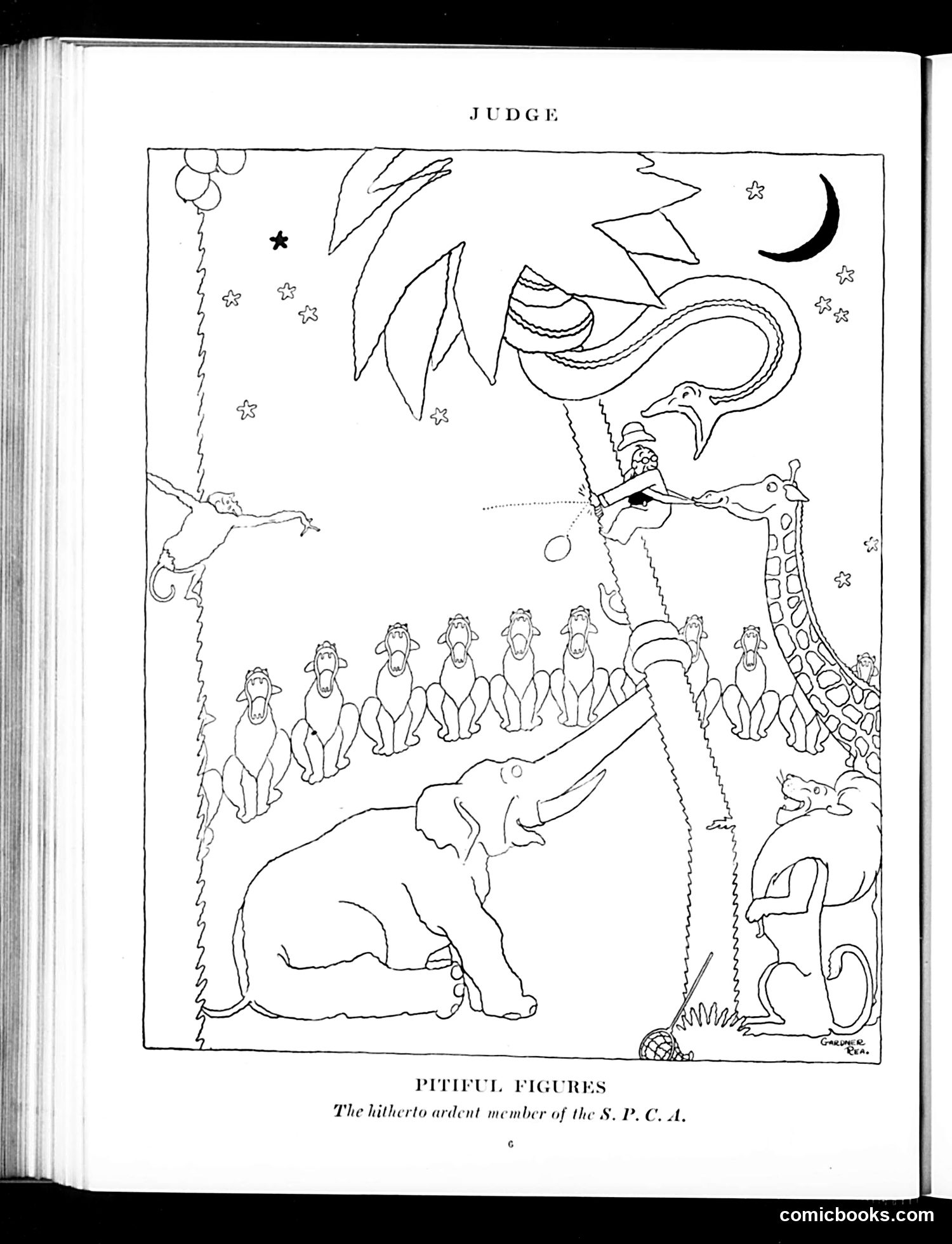
This cartoon satirizes the S.P.C.A. (Society for the Prevention of Cruelty to Animals). The image shows a nighttime scene where a figure holds judicial scales while managing various animals—monkeys, dogs, an elephant, and a giraffe—arranged as if on trial or in judgment. The satire appears to mock the S.P.C.A.'s enforcement activities, possibly suggesting the organization was overzealous, ineffective, or absurdly focused on judging animal welfare cases. The title "Pitiful Figures" implies the animals (or perhaps those responsible for them) are pitiable subjects of the organization's scrutiny. Without additional context about specific S.P.C.A. controversies of Judge's publication period, the exact target remains somewhat unclear, though the cartoon evidently critiques the organization's authority or methods.
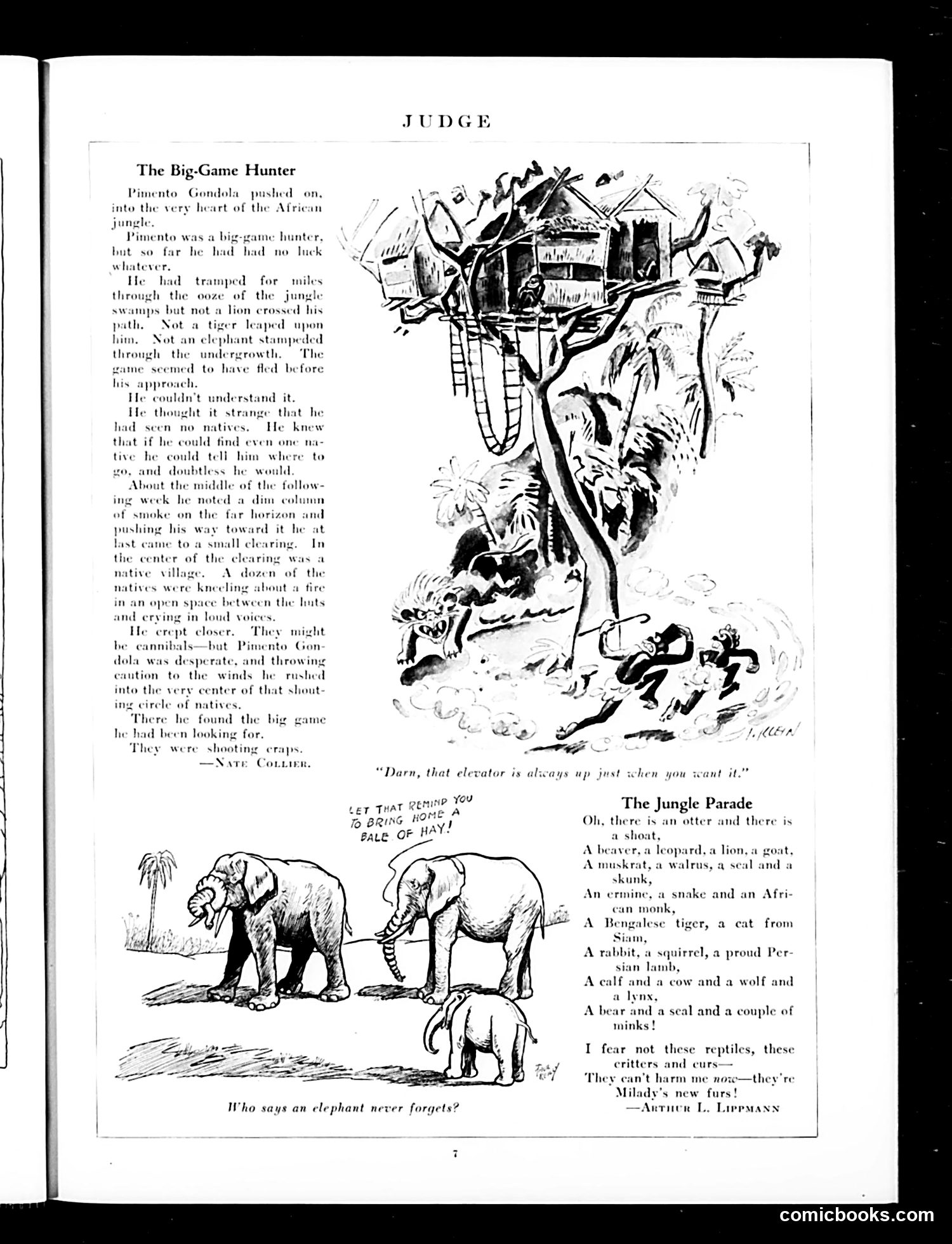
This page contains two satirical pieces from *Judge* magazine: **"The Big-Game Hunter"**: A humorous story illustrated with a dramatic drawing of a treehouse village. The joke is ironic: Pimento Gondola, a big-game hunter seeking dangerous African wildlife, finds the "big game" he's been looking for—natives engaged in craps (dice gambling). The satire mocks both the hunter's expectations and contemporary stereotypes about African villages. **"The Jungle Parade"**: A poem-cartoon pairing elephants with a list of animals, ending with the punchline that these creatures are now "Milady's new furs!" The satire criticizes wealthy women's fashion industry practices, specifically the killing of wild animals for fur coats. The reference to elephants "never forgetting" adds ironic commentary on this exploitation. Both pieces reflect early 20th-century attitudes: colonial adventure stereotypes and critiques of conspicuous consumption among the wealthy.
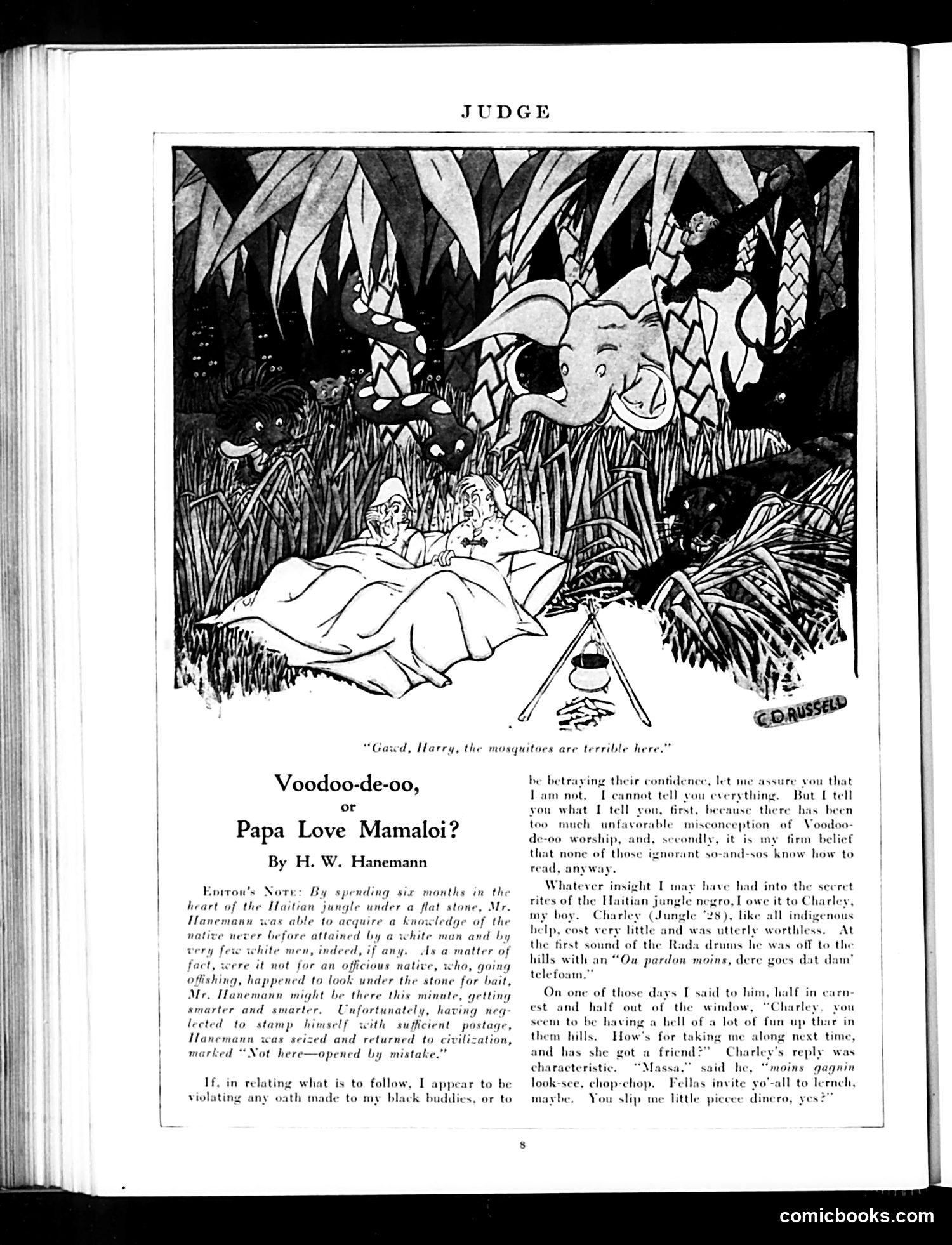
This is a satirical short story illustrated for *Judge* magazine, not primarily a political cartoon. The piece mocks Western fascination with Haitian voodoo and perpetuates racial stereotypes common to early 20th-century American humor. **The Setup:** Author "Hanemann" claims to have studied Haitian voodoo firsthand, supposedly acquiring secret knowledge about native practices. The editor's note satirizes his credibility—he was literally buried under a stone for six months and had to be "returned to civilization." **The Satire:** The story ridicules both the author's pretensions to expertise and contemporary American attitudes toward Haiti and Black people. The stereotyped dialect ("Ou pardon moins," "Massa," "chop-chop") and the characterization of Charley as simultaneously worthless yet mysteriously connected to secret rituals epitomize the casual racism of the era. **The Joke:** The humor relies on readers finding voodoo exotic and comical, and on mocking both the author's gullibility and Haitian culture itself. The illustration shows a jungle scene with exaggerated mystical elements.
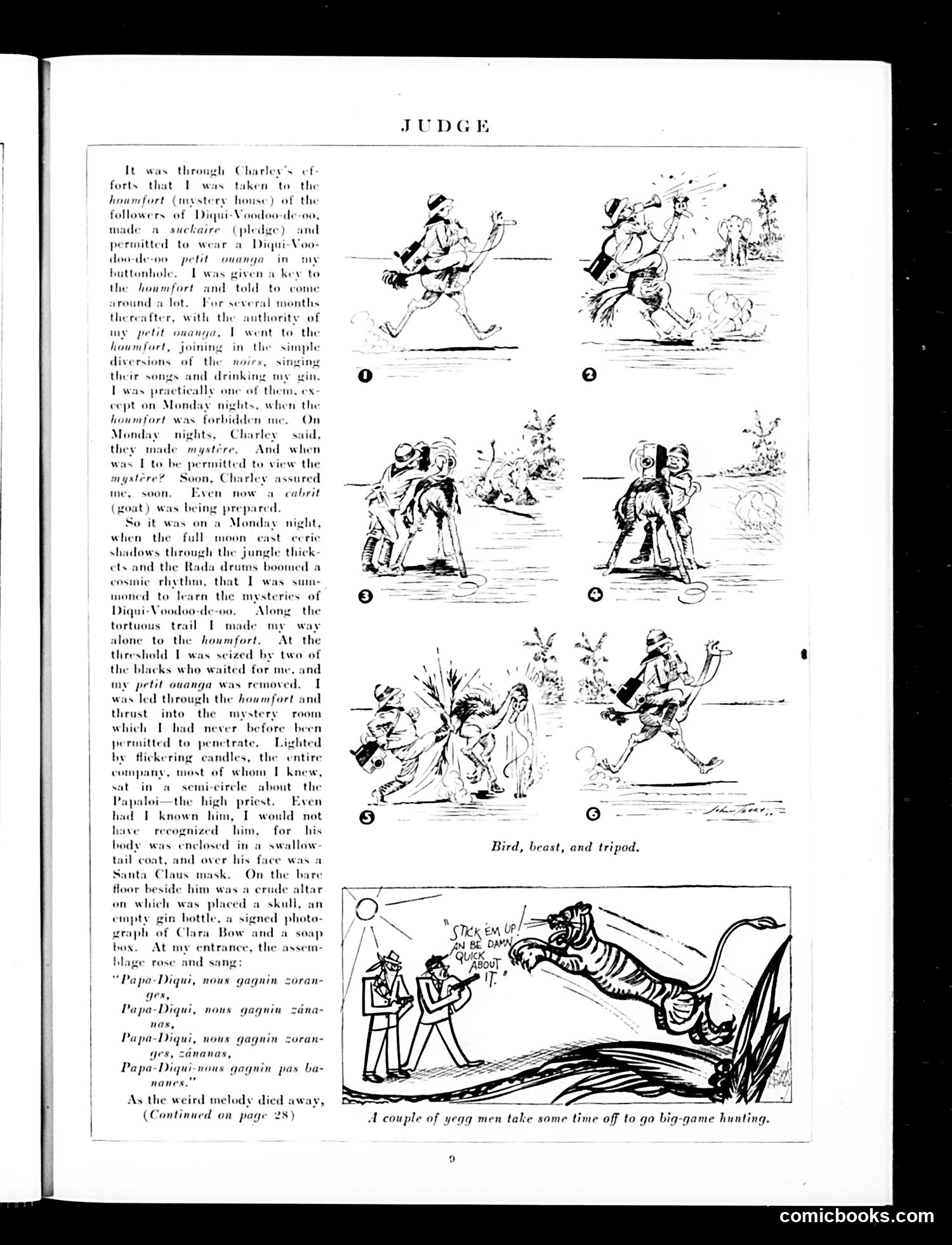
This page satirizes contemporary American fascination with Haitian Voodoo religion, presented as exotic "mystery" for titillation. The narrator describes infiltrating a Voodoo ceremony (houmfort) through a guide named Charley, depicting the ritual as theatrical and absurd—featuring a high priest in a Santa Claus mask presiding over an altar with a skull, empty gin bottle, Clara Bow photograph, and soap box. The satire mocks both the sensationalized Western perception of Voodoo as occult danger and the performative aspects of religious practice itself. The crude altar objects (especially the Hollywood starlet photo) underscore Judge's message: the "mystery" is partly fabricated entertainment. The six small cartoon vignettes above appear unrelated, showing physical comedy. The bottom cartoon captioned "A couple of yegg men take some time off to go big-game hunting" features what appear to be criminals (yegg = safecracker/burglar) confronting a large creature, likely satirizing criminal leisure or masculine posturing.
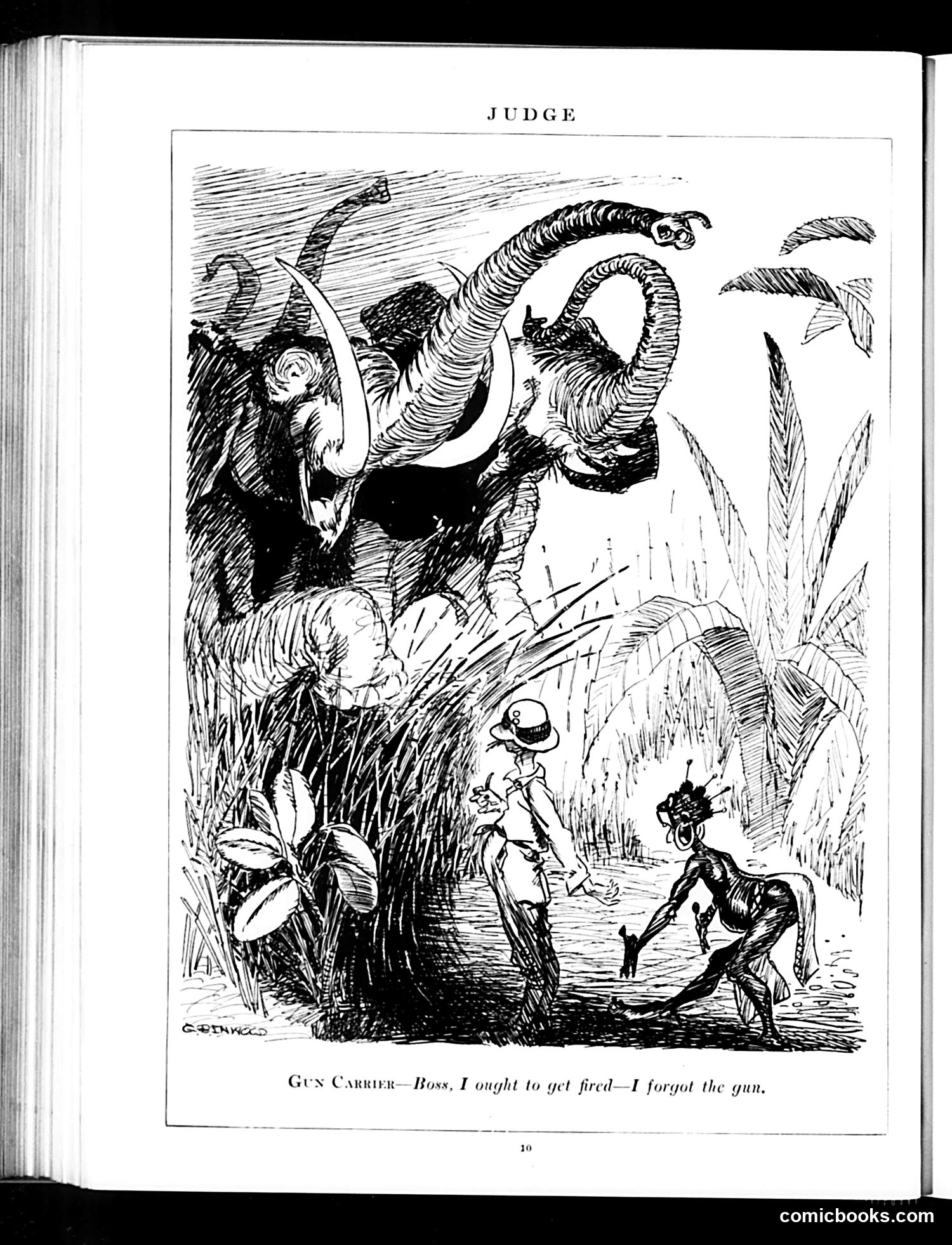
This Judge cartoon depicts a workplace scene where a "Gun Carrier" (likely a factory or industrial worker) confesses to his boss that he forgot to bring his gun to work. The cartoon appears to satirize labor tensions of the early 20th century, when industrial disputes sometimes turned violent. The humor lies in the absurdity that a worker would be *expected* to carry a weapon to his job—suggesting either that workplace confrontations were so normalized that forgetting one's gun was a fireable offense, or that management anticipated violent labor unrest. The exotic jungle setting with the two armed figures below the aggressive elephant-like creature may add commentary about dangerous, "uncivilized" working conditions. This reflects anxieties about class conflict and industrial violence during a period of significant labor strife in America.
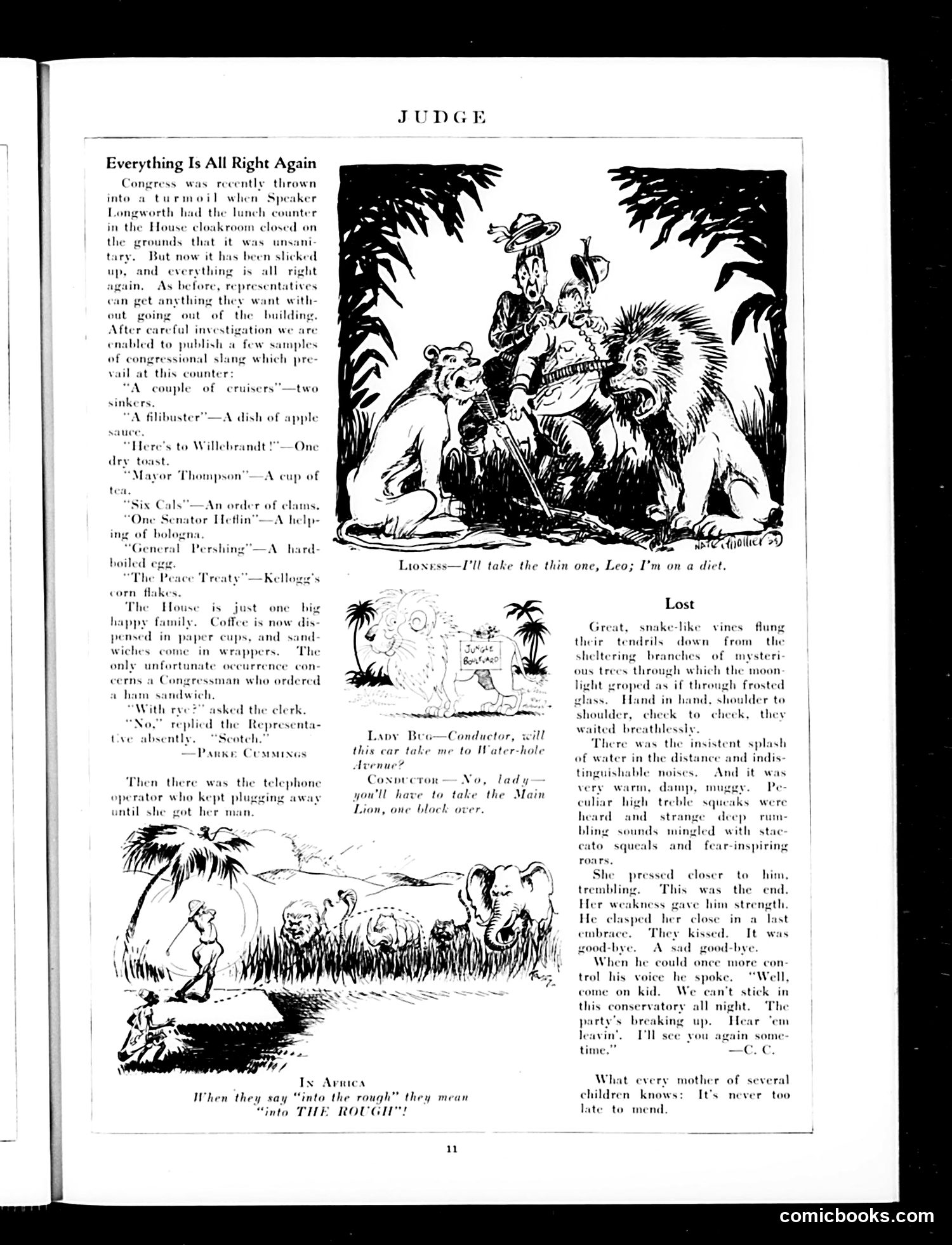
This page from *Judge* satirizes Congress through humorous anecdotes about the House lunch counter. After Speaker Longworth closed it for sanitation violations, it reopened—prompting the magazine to mock congressional slang used there. Dishes are given names referencing politicians and events: "Willebrandt" (dry toast, likely referencing Prohibition enforcer Mabel Willebrandt), "Mayor Thompson" (cup of coffee), "Senator Heflin" (clams), and "Peace Treaty" (corn flakes, referencing post-WWI diplomacy). The cartoons include domestic humor: lions on a diet, a lost couple in a romantic jungle setting, and an Africa joke about "the rough." The page mixes political commentary with light social satire—poking fun at both congressional figures and everyday American life, typical of *Judge's* satirical approach to 1920s culture.
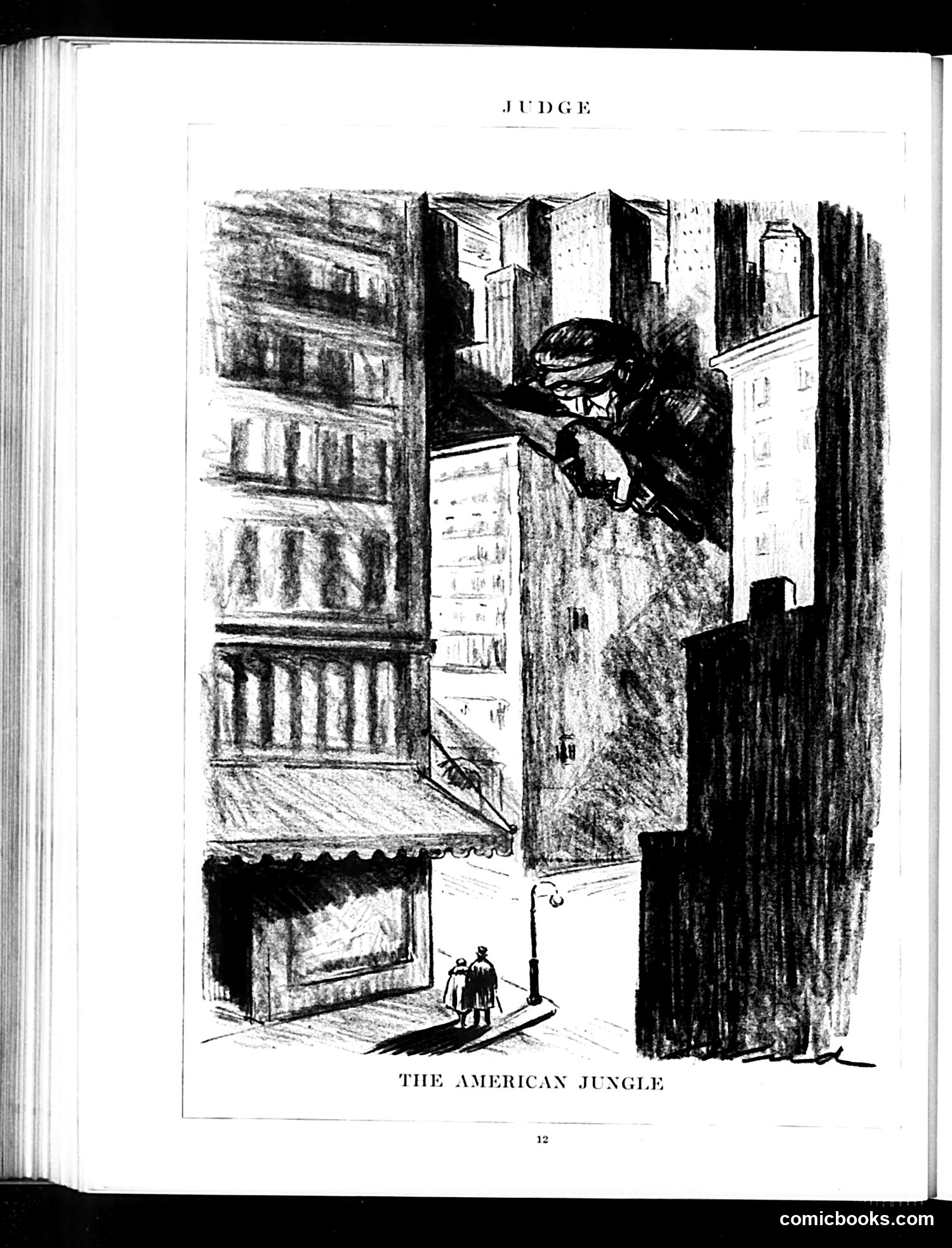
This page from *Judge* magazine features a political cartoon titled "The American Jungle." The image depicts a figure perched atop a tall urban building, appearing to aim a rifle or gun downward at tiny figures on the street below. The "jungle" metaphor suggests American cities are portrayed as dangerous, lawless environments where violence erupts from above. The cartoon likely critiques urban violence, class conflict, or reckless behavior by wealthy/powerful individuals toward ordinary citizens below. The architectural detail—a grand building with a balcony—suggests critique of those in elevated social or economic positions. Without additional context about the publication date, the specific reference remains unclear, but the satire appears to condemn either indiscriminate violence or the callous disregard of the powerful for those beneath them in society's hierarchy.
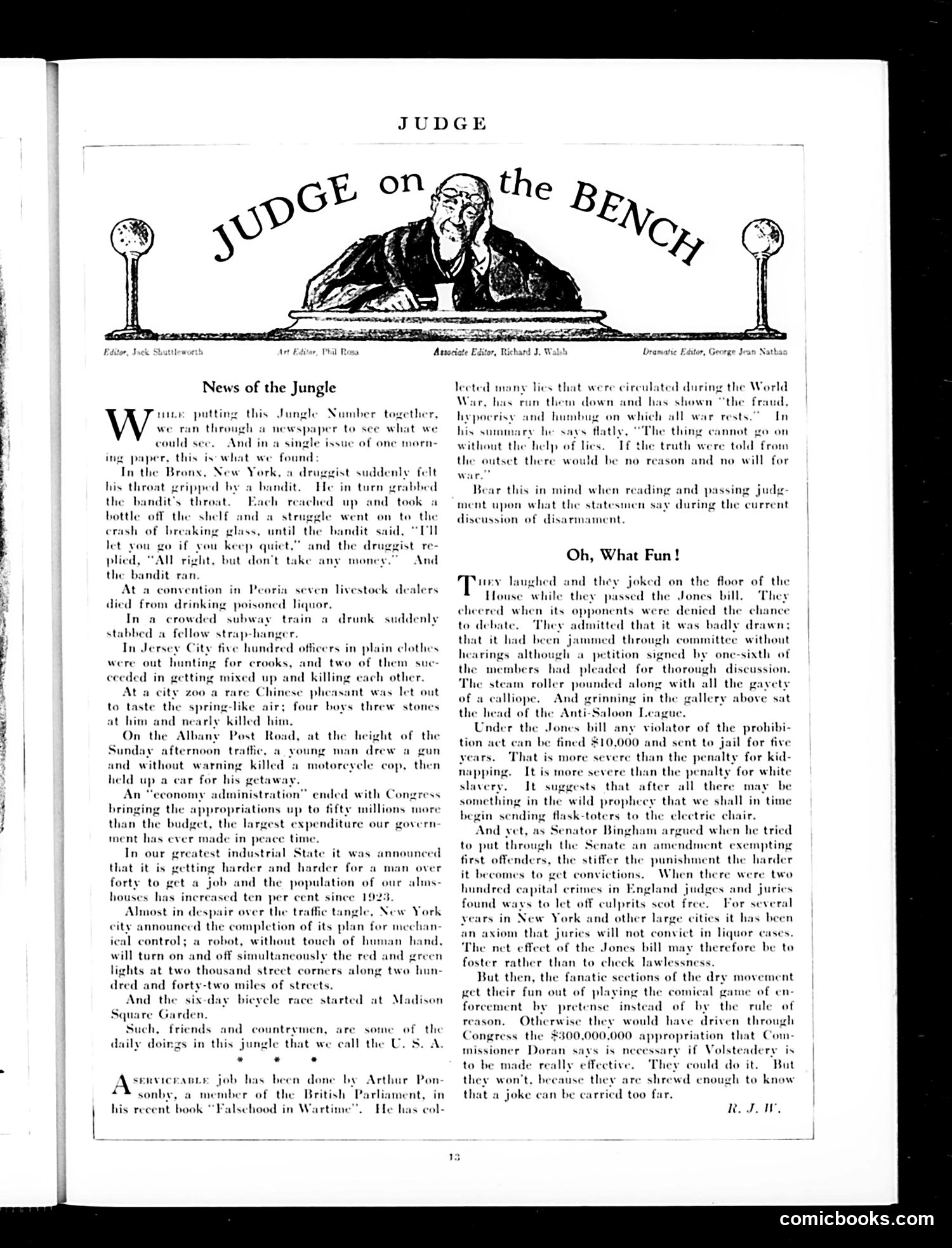
This page satirizes American lawlessness and governmental incompetence through two sections: **"News of the Jungle"** compiles violent, chaotic crimes from a single morning newspaper—druggist-bandit standoffs, poisonings, subway stabbings, police killing each other, random shootings. The "jungle" metaphor suggests civilization is collapsing into barbarism. The section culminates sarcastically: despite this chaos, New York announces a mechanical traffic-control robot as its solution. **"Oh, What Fun!"** criticizes Congress's passage of the Jones bill (Prohibition enforcement legislation). Representatives laughed and joked while denying debate to opponents, jamming through poorly-drafted legislation without hearings. The satire mocks this frivolity given the bill's extreme penalties—$10,000 fines and jail terms for prohibition violations that exceed penalties for kidnapping and white slavery. The Anti-Saloon League (visible in gallery) celebrates this overreach. The page's message: American society faces genuine crisis (crime, lawlessness), yet elected officials respond with either technological band-aids or draconian, hastily-passed laws passed as entertainment rather than serious governance.
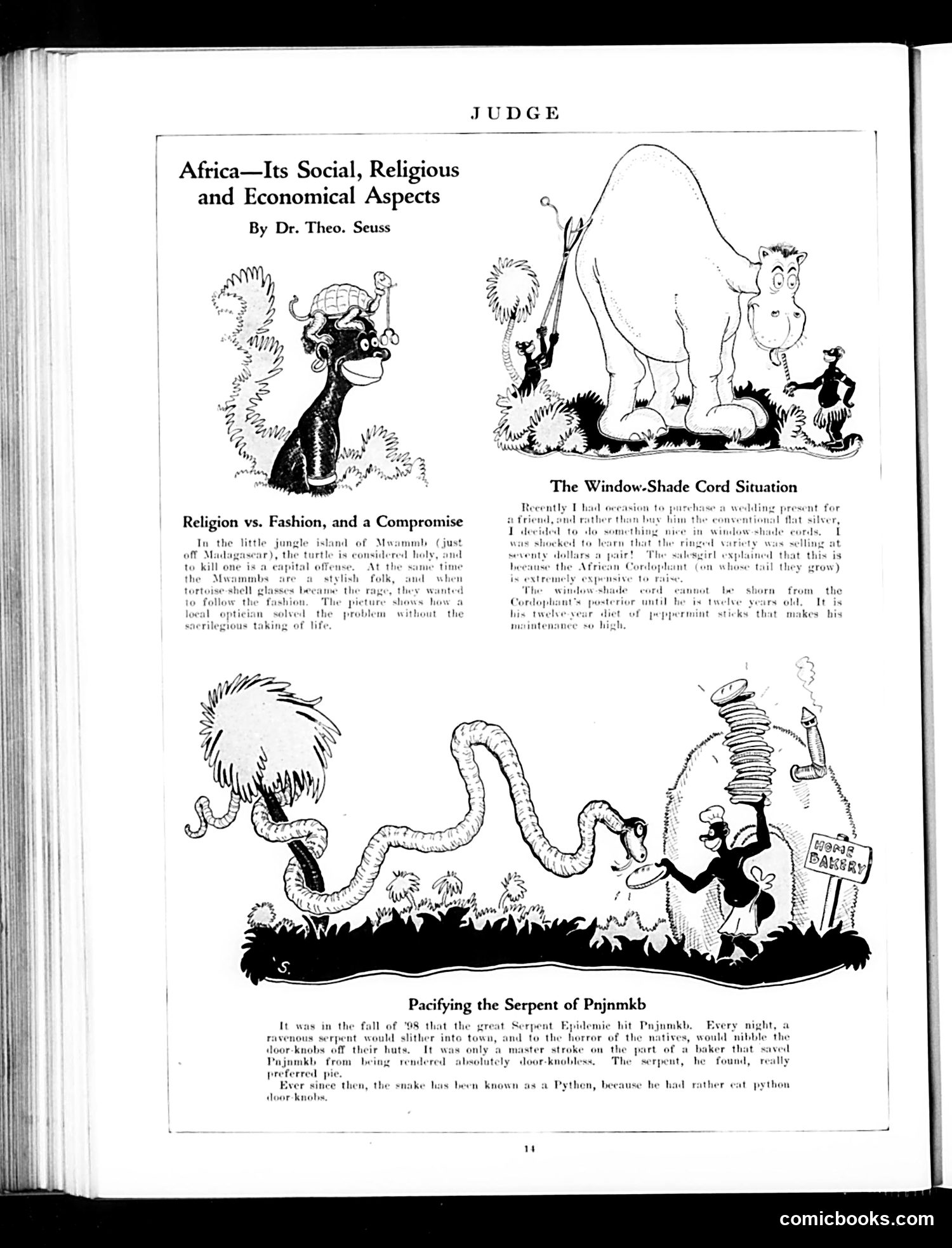
This is a satirical piece by Dr. Seuss (Theodor Geisel) mocking Western attitudes toward Africa through absurdist humor. The cartoons depict fictional African scenarios with exaggerated, dehumanizing imagery typical of early 20th-century American satire. The three vignettes ridicule: 1. **"Religion vs. Fashion"**: Depicts African religious practices as primitive contradictions (sacred turtles vs. fashion demands) 2. **"Window-Shade Cord Situation"**: Mocks an African problem using a camel, suggesting African concerns are trivial or laughable 3. **"Pacifying the Serpent of Pnjnmkb"**: Features a figure battling a giant snake, portraying Africa as a dangerous wilderness requiring Western intervention The satire targets Western colonial attitudes, but does so through racist caricatures and stereotypes rather than genuine critique. This reflects Judge magazine's approach: satirizing colonial pretensions while perpetuating the racist assumptions underlying imperialism itself.
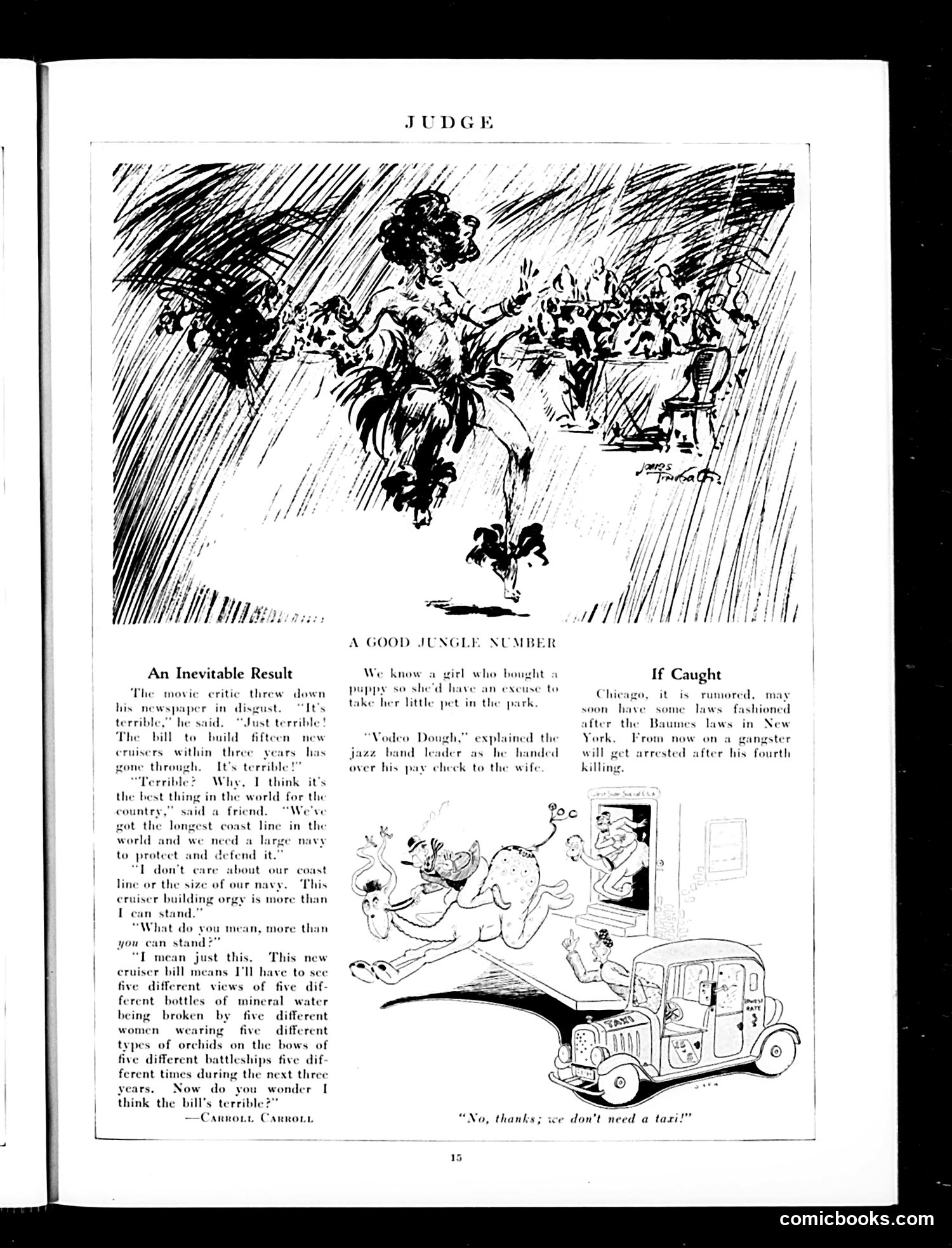
This page contains three satirical pieces typical of 1920s Judge magazine: **"An Inevitable Result"** mocks a movie critic complaining about a naval cruiser-building bill. The joke: the critic isn't concerned with military readiness but dreads attending five separate ship-launching ceremonies where society women in orchids ceremonially break bottles on hulls—a repetitive ritual he must cover professionally. **"A Good Jungle Number"** presents a brief anecdote about a girl using a puppy as an excuse to visit the park, likely implying romantic or social opportunity. **"If Caught"** references the Baumes Laws, New York's actual repeat-offender legislation (enacted 1926), sardonically suggesting Chicago gangsters will soon face similar laws. It jokes that a gangster will be arrested after his "fourth killing"—dark humor about organized crime's prevalence and legal consequences. The accompanying cartoon shows characters fleeing a taxi, with the caption playing on taxi-related crime or evasion themes typical of Prohibition-era satire.
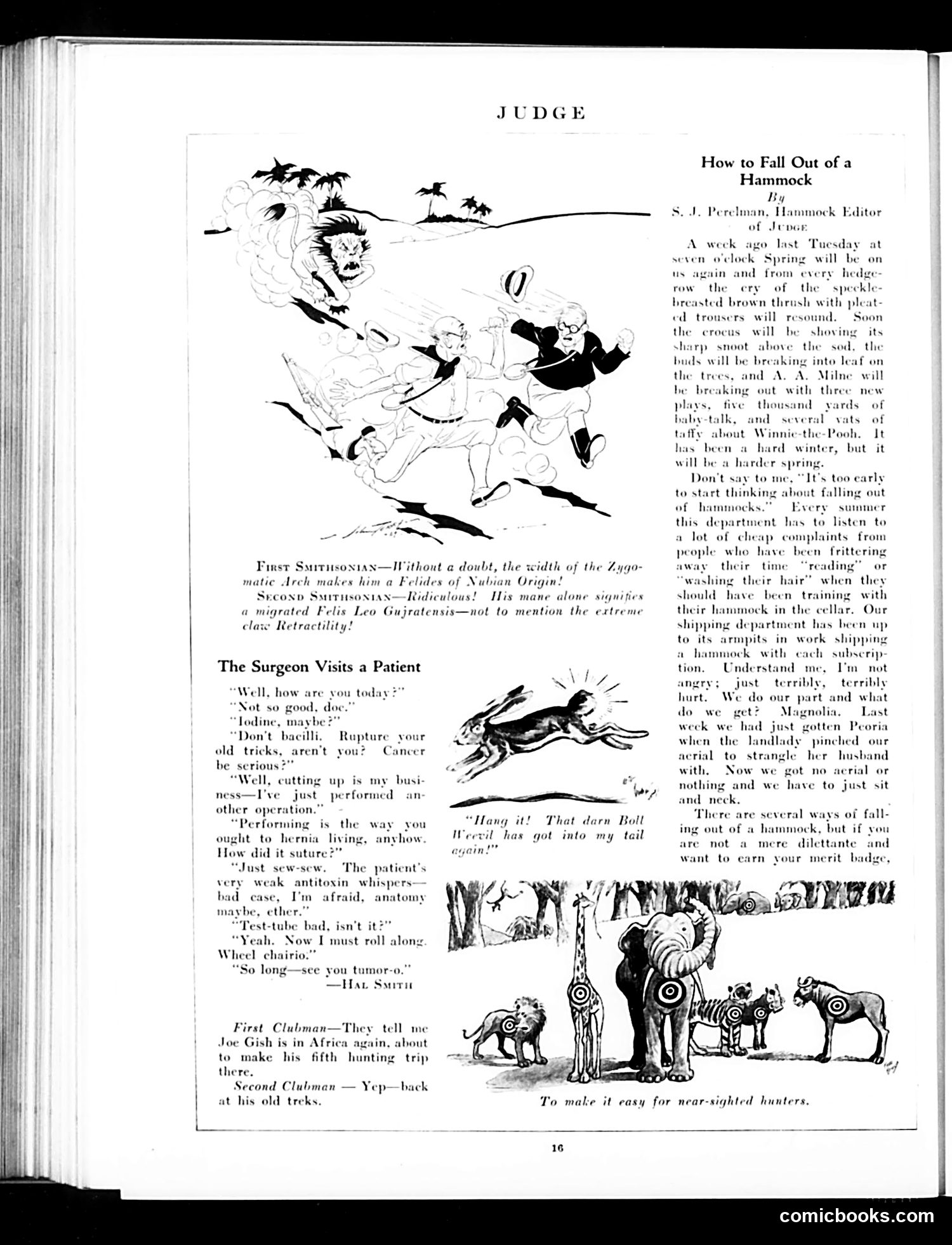
This page contains three distinct satirical pieces: 1. **"The Surgeon Visits a Patient"** — A doctor-patient dialogue full of medical puns ("don't bacilli," "hernia living," "sew-sew," "tumor-o"). The satire mocks both physicians' pretension and patients' hypochondria through rapid-fire wordplay rather than visual caricature. 2. **Smithsonian debate** — Two museum experts argue absurdly about whether an animal is a "Felides of Nubian Origin" versus a "Felis Leo Gujratensis," mocking scholarly pedantry over taxonomic classification. 3. **"How to Fall Out of a Hammock"** by S.J. Perelman — An absurdist humor column promising practical advice but instead delivering whimsical non-sequiturs about spring, A.A. Milne, and shipping department complaints. The title promises utility; the content is deliberately useless. The lower cartoon shows hunting dogs with targets painted on them—satire about making hunting easier for poor marksmen. All pieces use wordplay and incongruity as their comedic mechanism, typical of Judge's sophisticated humor style.
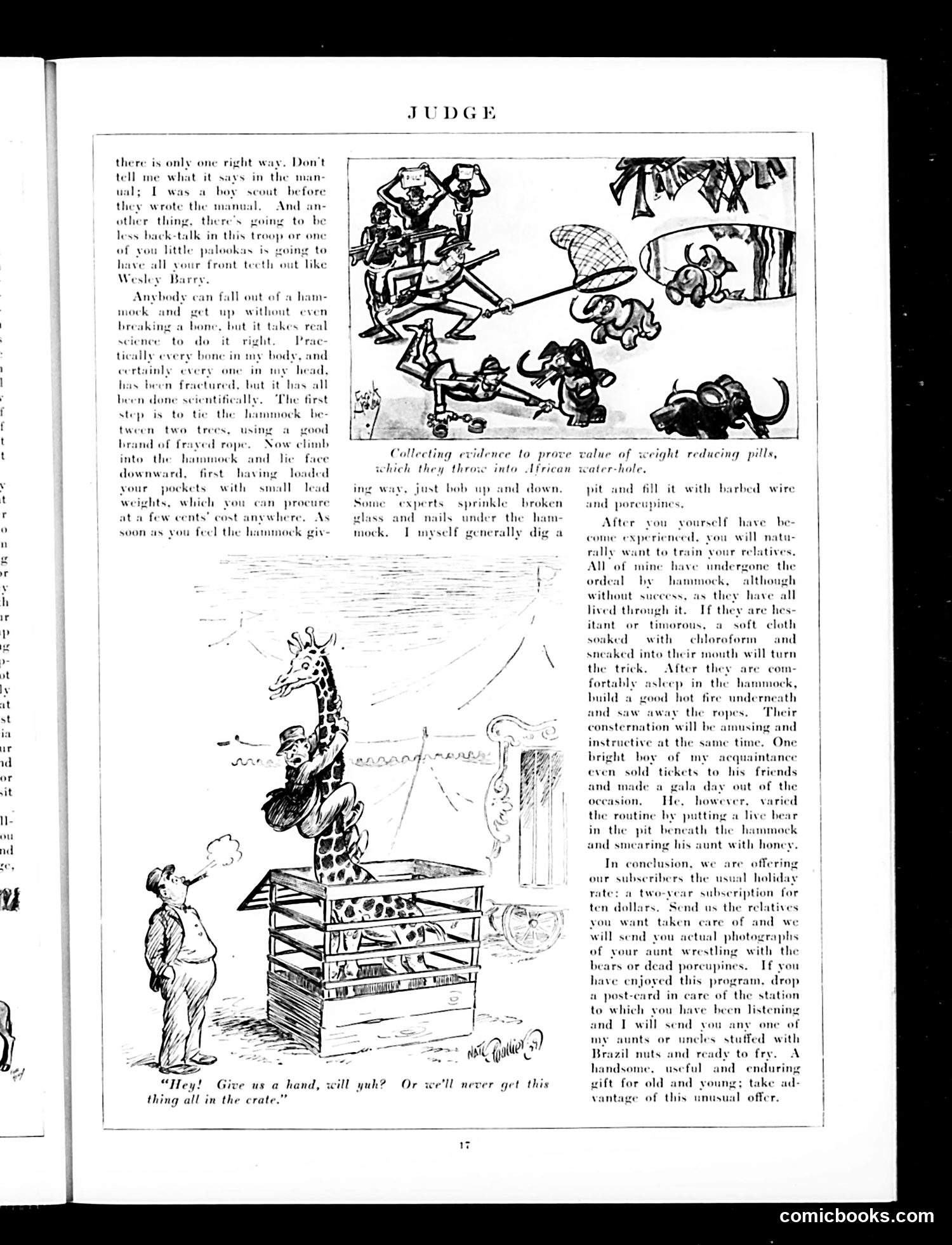
This page satirizes two things: authoritarian "tough guy" leadership and dubious weight-loss products. **Top cartoons**: Mock African safaris and "weight-reducing pills" advertised to colonial audiences. The absurd "evidence"—animals allegedly thrown into water holes by pill-takers—parodies the pseudoscientific claims manufacturers made for diet products. The visual humor comes from the ridiculous notion that pills could cause such effects. **Main text/bottom cartoon**: A scathing parody of a scoutmaster or military-type instructor bragging about "scientific" hammock-falling techniques. The narrator comically describes intentionally injuring himself and his relatives through increasingly dangerous methods (weights, broken glass, chloroform, fire, bears, porcupines). The satire targets: domineering male authority figures who mask recklessness as expertise; the cult of "practical experience" over manuals; and exploitation disguised as teaching. The darkly comedic conclusion—selling tickets to watch relatives suffer, stuffing them with nuts as gifts—escalates the absurdity to expose the cruelty underlying such "character-building" schemes.
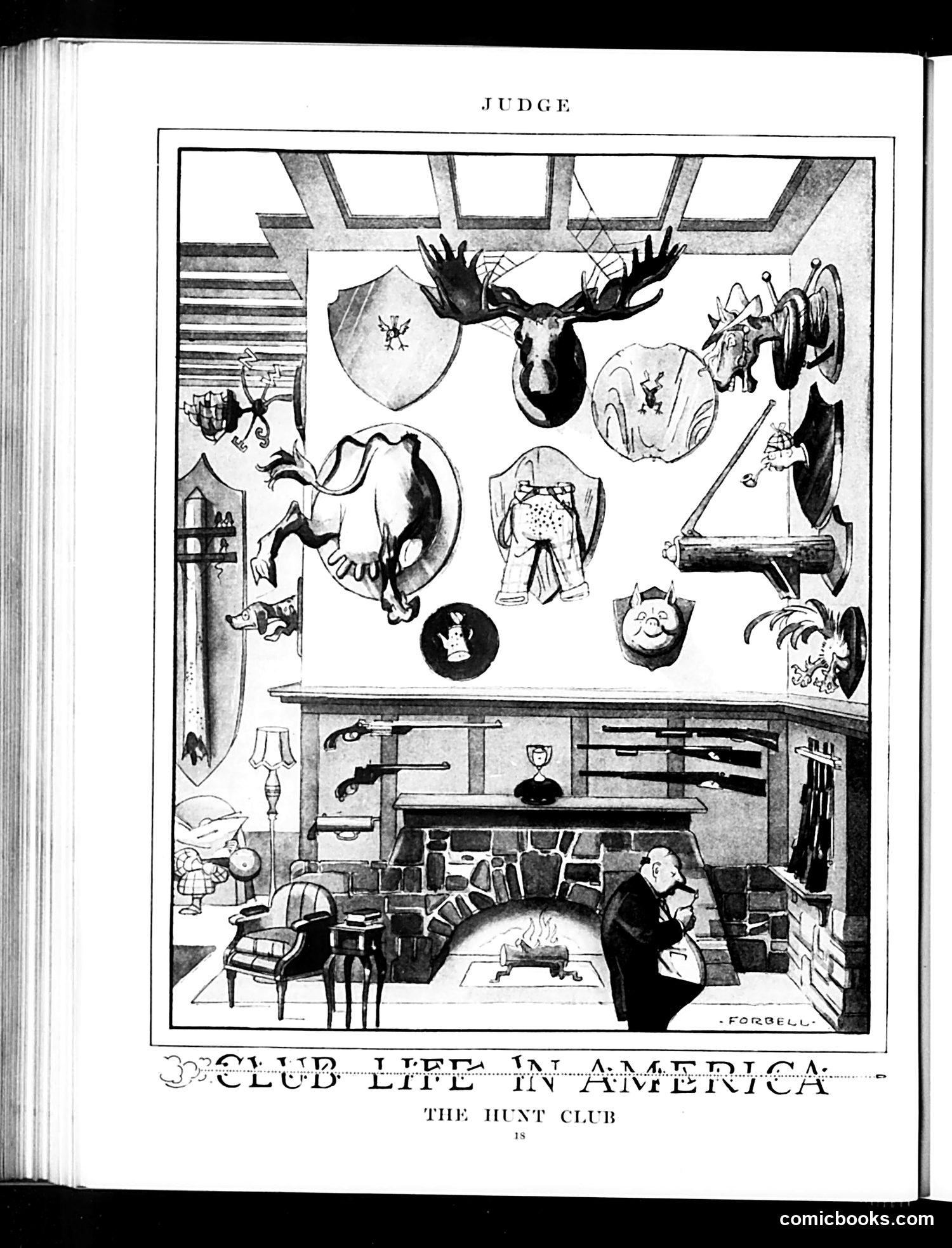
This satirical illustration depicts an American gentlemen's hunt club, shown as a room decorated with hunting trophies. The upper half displays mounted animal heads (moose, elk, and various game) alongside hunting shields and implements. The lower half shows wealthy club members relaxing by a fireplace in a wood-paneled interior. The satire appears to mock the pretensions and excess of American upper-class sporting culture—the ostentatious display of trophies, the idle leisure of wealthy club members, and the aristocratic affectations of hunt clubs that mimicked European traditions. The exaggerated, cartoonish style typical of Judge magazine emphasizes the absurdity and vanity of this lifestyle, poking fun at American wealthy enthusiasts who adopted European hunting traditions as status symbols during the Gilded Age or early 20th century.
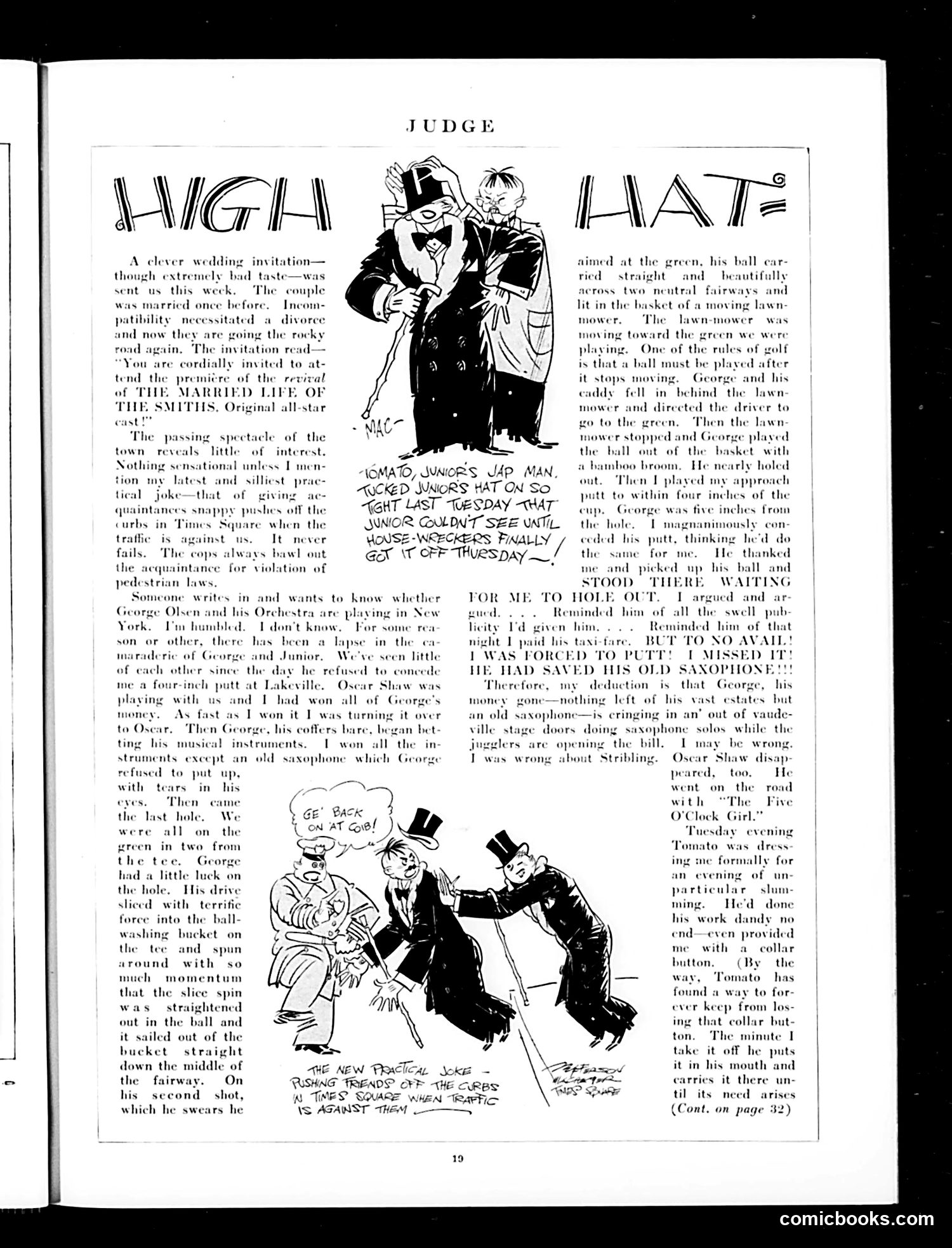
This page contains two separate pieces of satirical commentary typical of Judge magazine: **"High Hat" (upper section):** A humorous anecdote about divorce and remarriage. The satire targets a couple divorcing and remarrying, with their wedding invitation styled as a theater playbill for "The Married Life of the Smiths"—mocking the repetitive nature of their failed marriage attempts. **"For Me to Hole Out" (lower section):** A lengthy golf anecdote satirizing vanity and pride among acquaintances. The narrator describes an absurd incident where his friend George refuses to concede a putt, forcing the narrator to miss his own shot. The piece mocks excessive pride in trivial matters and suggests George has since fallen into vaudeville poverty, reduced to playing saxophone in cheap theaters—a fate presented as deserved humiliation for his unsportsmanlike behavior. Both pieces target upper-middle-class social hypocrisy: remarriage as entertainment, and petty egotism among the leisured classes. The cartoons humorously illustrate these social embarrassments.
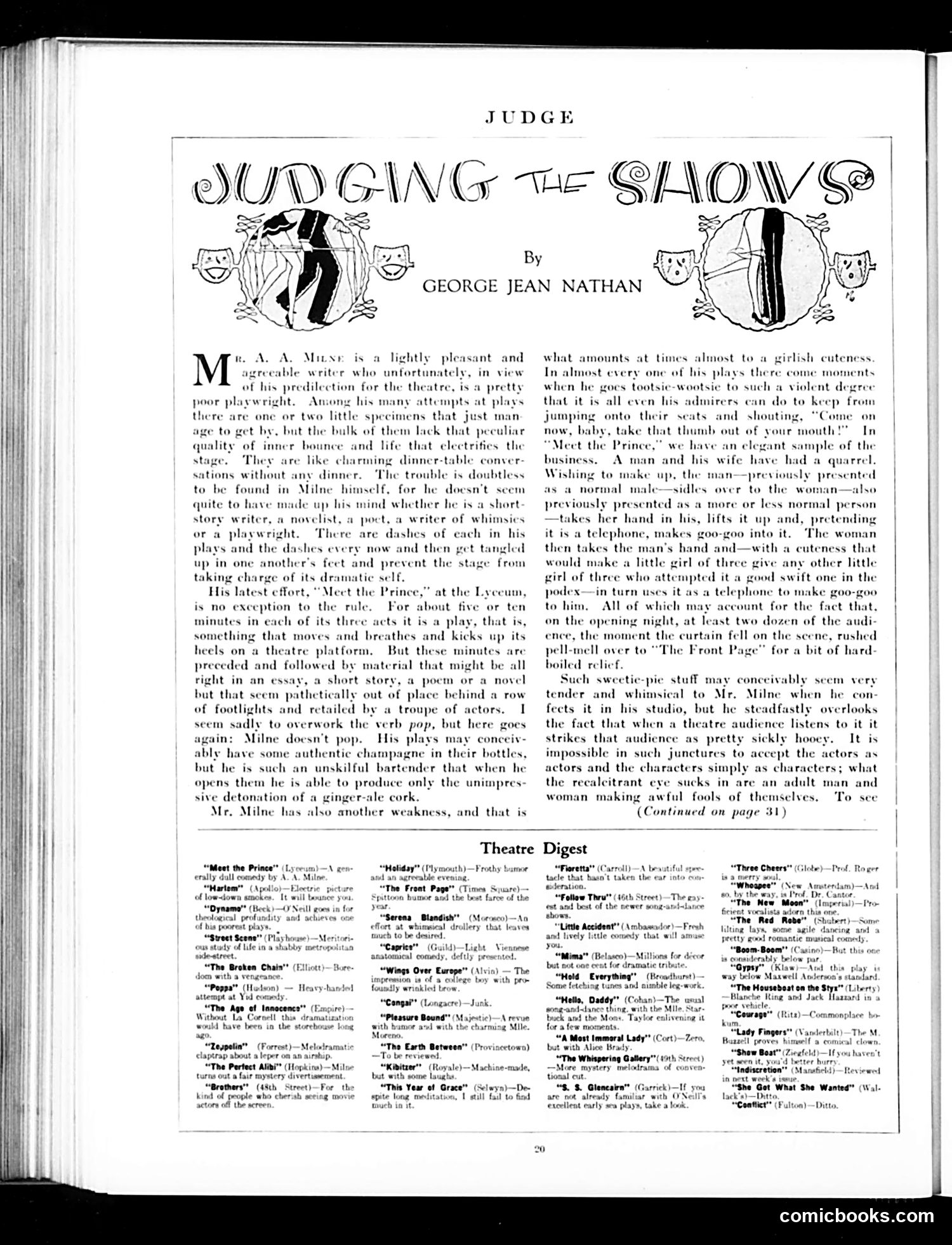
This page reviews playwright A.A. Milne's latest work, "Meet the Prince," at the Lyceum Theatre. Critic George Jean Nathan argues that while Milne is a pleasant writer, he struggles as a playwright because he lacks theatrical instinct—his plays read like "charming dinner-table conversations without any dinner." Nathan's primary complaint: Milne's work contains excessive cuteness and sentimentality inappropriate for the stage. He ridicules a scene where a husband and wife pretend a hand is a telephone and make "goo-goo" sounds at each other—behavior Nathan finds embarrassingly childish when performed by adults before an audience. The satire targets Milne's inability to distinguish between different literary forms. What works in essays or novels becomes "pathetically out of place" on stage. Nathan suggests audiences so disliked this saccharine scene that they fled to see "The Front Page" for "hard boiled relief"—implying sophisticated theater audiences rejected such sentimentality.
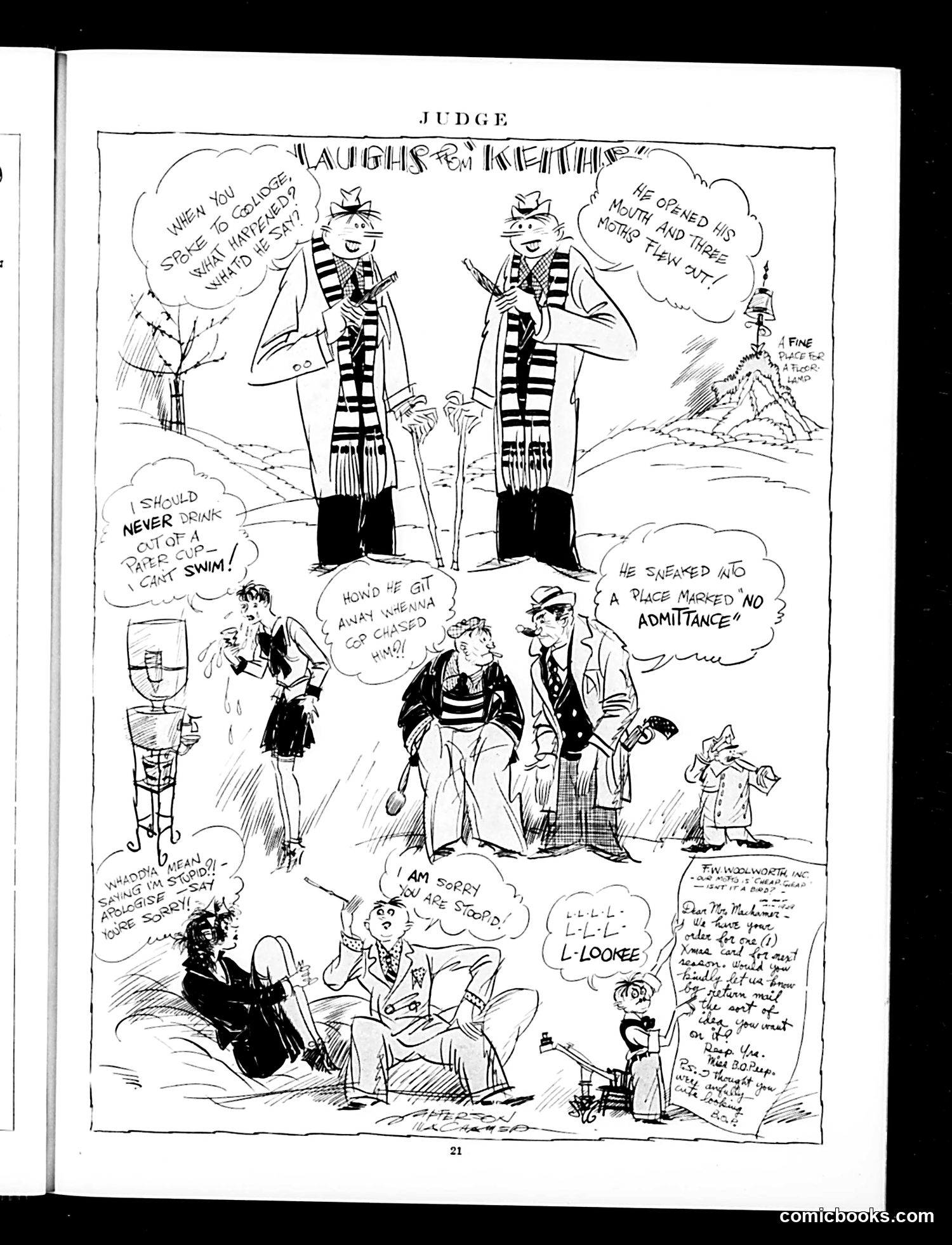
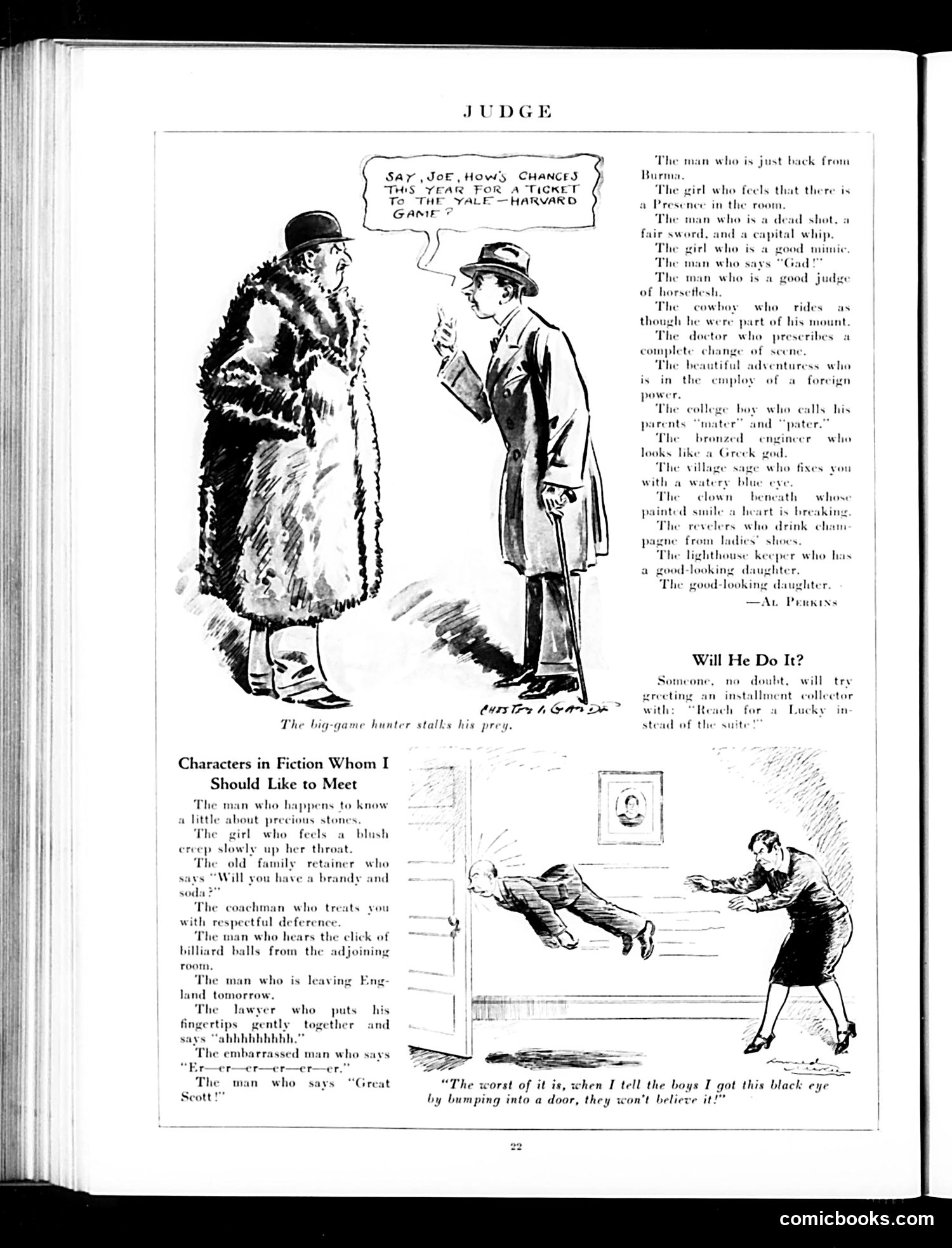
This page contains satirical humor typical of Judge magazine's style. The main cartoon shows two men discussing Yale-Harvard football tickets—a topical reference to the era's obsession with this prestigious college rivalry. The "Characters in Fiction Whom I Should Like to Meet" section is a humorous list of stock character types and social archetypes common in literature and daily life—the mysterious gem expert, the blushing girl, the loyal family servant, the embarrassed man who stammers "Er-er-er." These poke gentle fun at predictable literary conventions and social types. The lower cartoon depicts a woman with a black eye, explaining unconvincingly that she got it "bumping into a door"—the joke being that her male friends won't believe this obvious lie, suggesting domestic violence was a recognizable (if darkly joked-about) social reality. The page reflects early 20th-century upper-class humor and preoccupations: college sports, literary clichés, and social awkwardness.
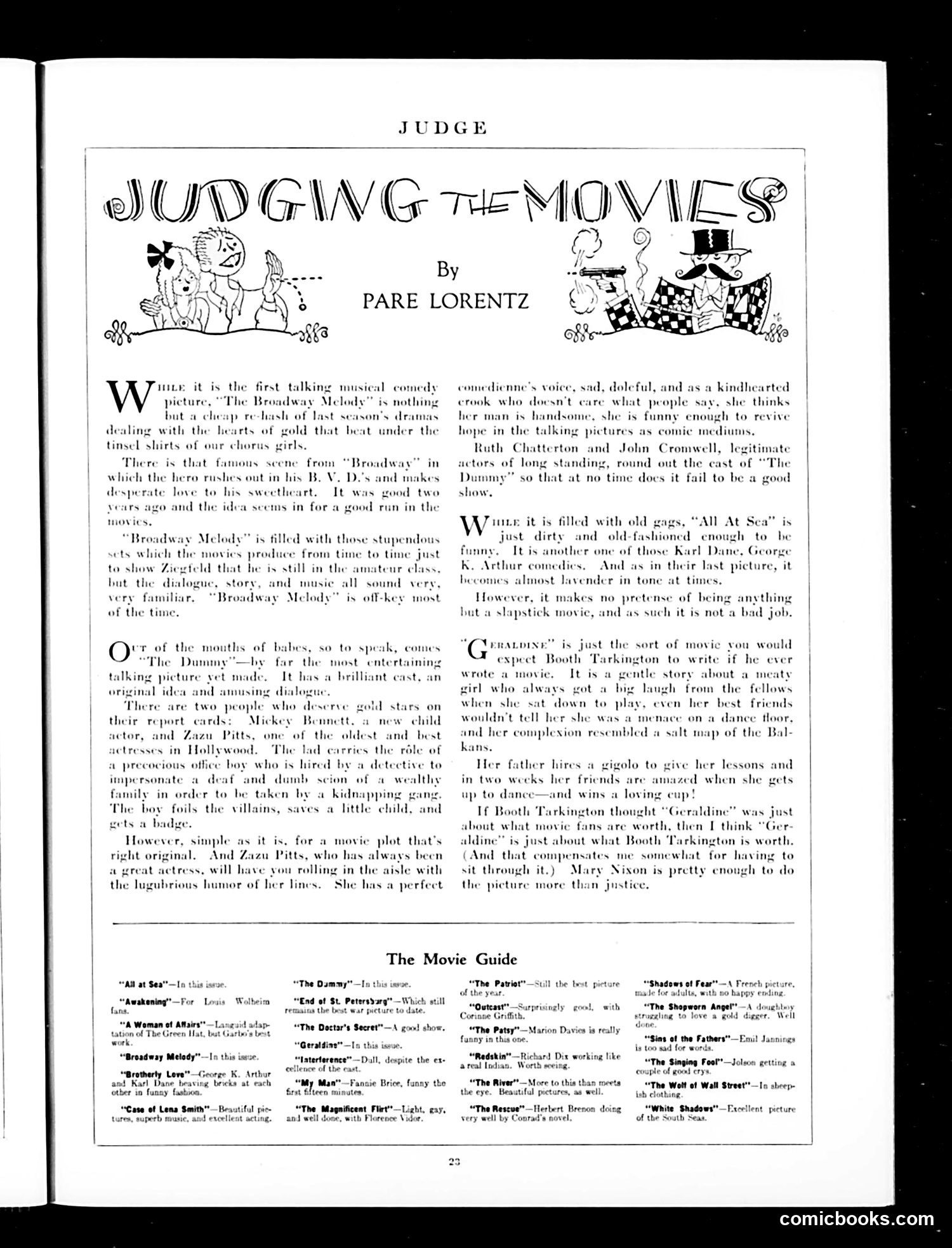
This is a film review column by Pare Lorentz, a prominent cinema critic. The page evaluates recent talking pictures (early "talkies"), a nascent technology around 1929. The reviews praise *The Broadway Melody* as the first talking musical comedy but criticize it as derivative drama. *The Dummy* receives high marks for its original plot and performances by child actor Mickey Bennett and veteran Zazu Pitts, whose "lugubrious humor" provides comic relief. *Geraldine*, adapted from Booth Tarkington's work, is dismissed as sentimental but acceptable, with Mary Nixon providing adequate beauty if not talent. The tone is that of a knowledgeable, somewhat acerbic critic assessing whether these experimental sound films represent genuine artistic progress or merely repackaged stage material. The decorative header shows vaudeville-style figures, emphasizing cinema's theatrical origins—a key tension Lorentz examines throughout.
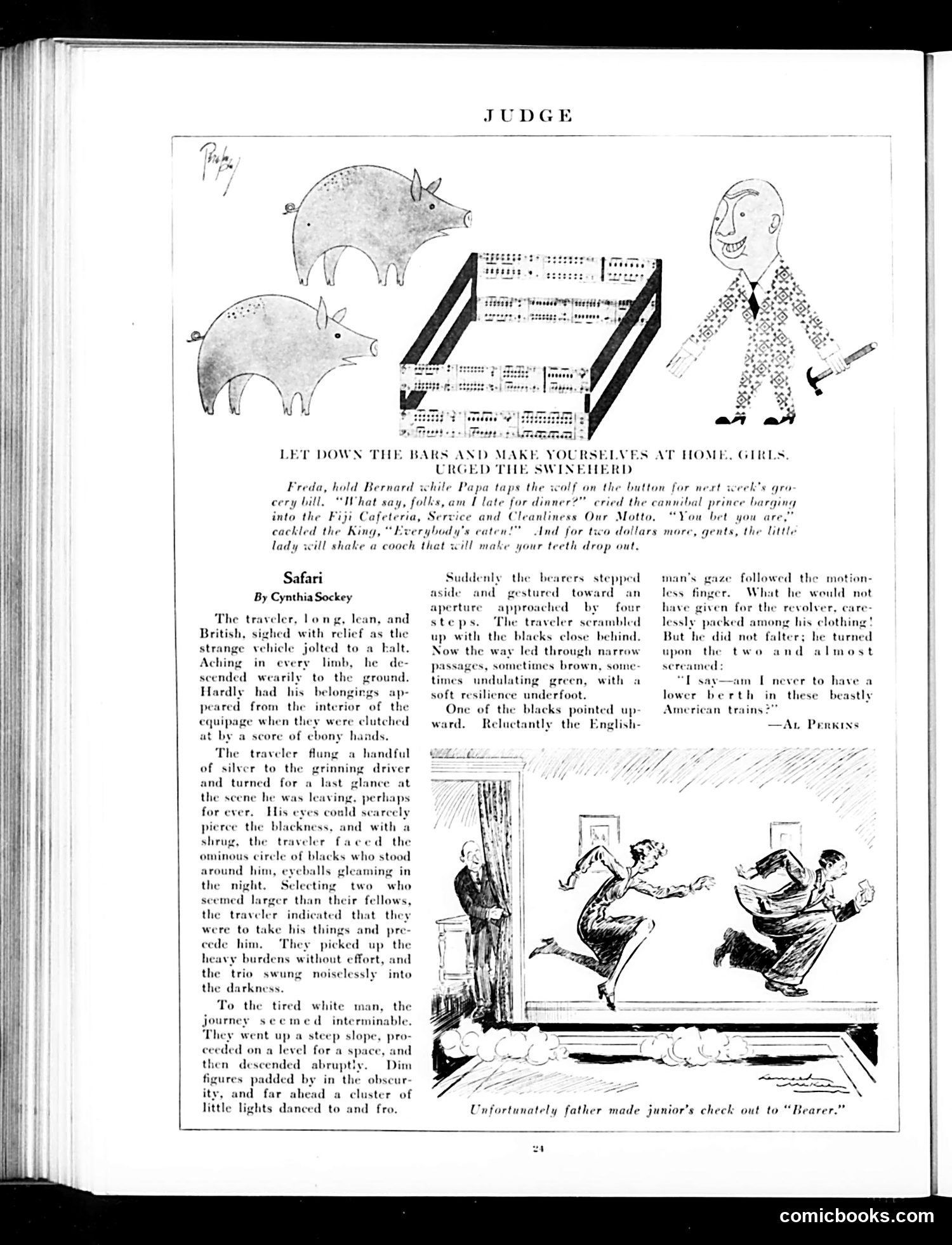
**Top Section ("Judge"):** A satirical cartoon about domestic finances. A man labeled "Papa" uses an abacus while his wife "Freda" holds a baby "Bernard." The joke mocks working-class financial struggle—the father is calculating the grocery bill while his wife wants him to take her out. The caption references a lowbrow cabaret ("Fiji Cafe") and crude entertainment, satirizing both marital discord and lower-class leisure activities of the era. **"Safari" Story:** A short fiction piece by Cynthia Sockey depicting a British traveler in Africa. The narrative employs period-typical racist language and stereotypes ("ebony hands," "grinning driver," "blacks"). The story treats African porters as exotic/threatening figures. The accompanying illustration shows people fleeing or reacting in exaggerated panic. **Bottom Cartoon:** Depicts a father writing a check to "Bearer"—likely a servant or porter—while his son runs away in the background. The caption suggests the father mistakenly made the check payable to the wrong person, a joke about parental incompetence or confusion with servants' names. Overall, the page reflects early 20th-century Judge magazine's casual racism and class-based humor typical of American satire of that period.
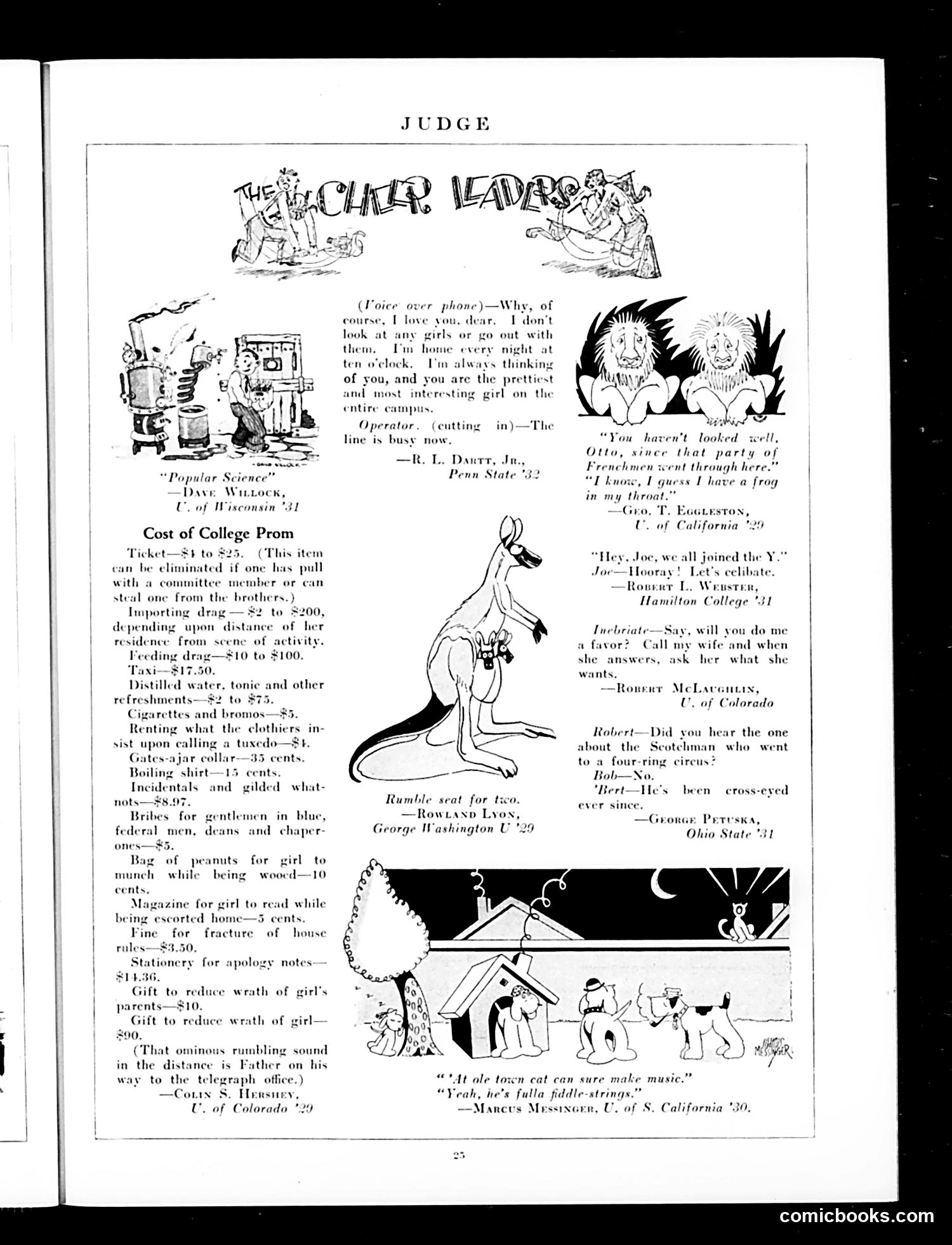
This page from *Judge* collects college-oriented jokes and cartoons typical of early 1930s satirical humor. The main content includes: **"Cost of College Prom"**: A satirical breakdown listing expenses for attending a formal dance, including bribes for police ("gentlemen in blue") and deans—suggesting students expected to encounter law enforcement during parties, likely referencing Prohibition-era drinking. **Phone conversation joke**: A student lies to his girlfriend about staying home, while the operator interrupts to note the line is busy—poking fun at male students' dating duplicity. **Various one-liners** mock college social life: joining the YMCA ("Y"), drunken behavior ("inebriate"), and Scottish frugality at circuses. **Illustrations** include a kangaroo (unclear reference), people in a rumble seat (convertible car seating for necking), and cats making noise—all supporting themes of youthful romance, automobile culture, and mischief. The humor targets college students' hypocrisy, rule-breaking during Prohibition, and dating games common to the era.
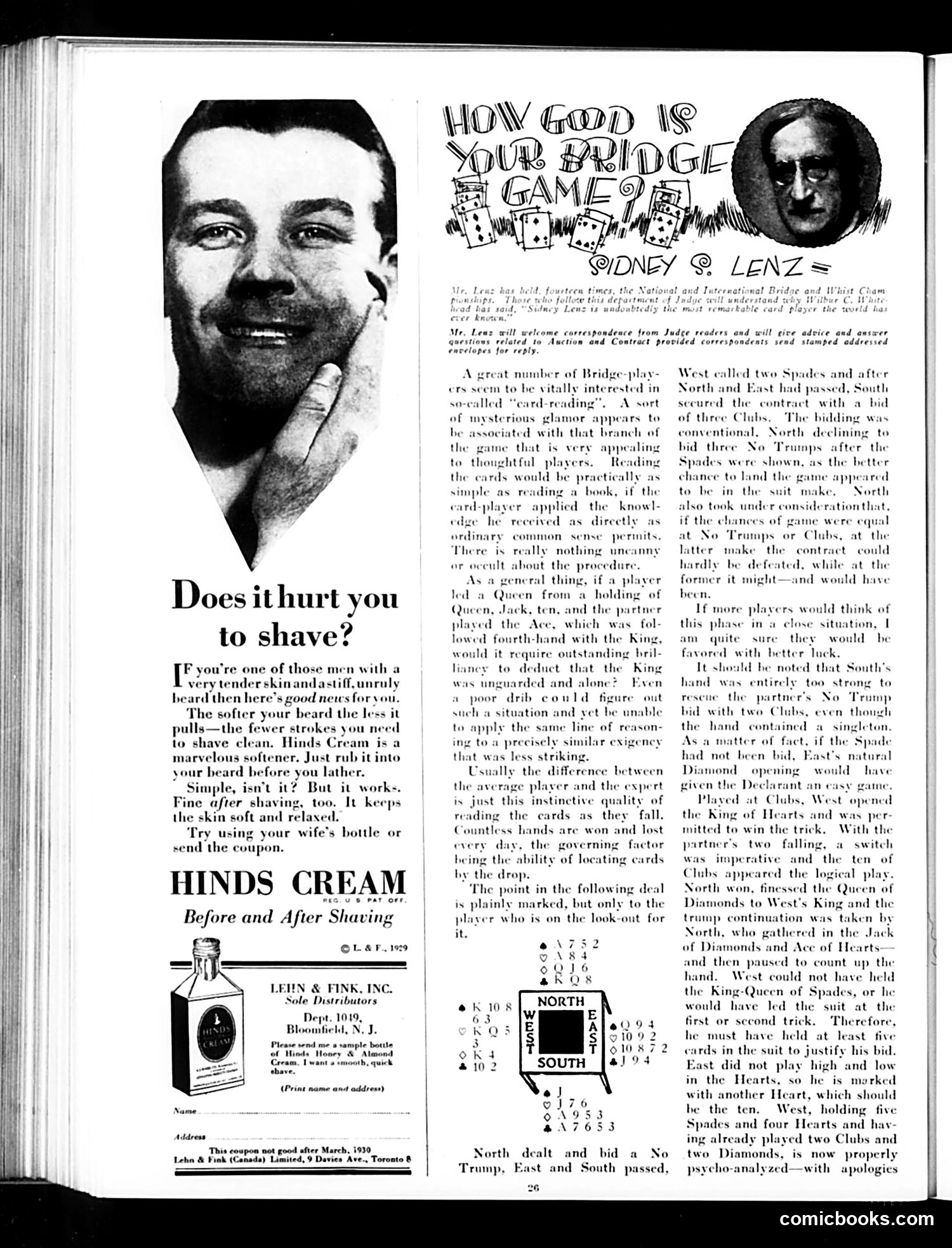
This page mixes advertising with bridge instruction. The main content is **"How Good Is Your Bridge Game?"** by Sidney Q. Lenz, a renowned bridge expert of the era. Lenz analyzes a contract bridge hand, explaining strategy to readers—specifically, how experienced players "read" cards by observing which ones fall during play, rather than relying on intuition or guesswork. The article emphasizes that card-reading is logical deduction, not occult knowledge, and illustrates this with a detailed deal analysis. Lenz was apparently a regular columnist answering readers' bridge questions. The page also includes a **Hinds Cream shaving cream advertisement** featuring a "before and after" photo, using the common early-20th-century sales pitch: "Does it hurt you to shave?" The ad promises their cream softens beards to reduce irritation. The content reflects 1920s-30s American leisure culture: bridge was a fashionable social game, and men's grooming products were actively marketed.
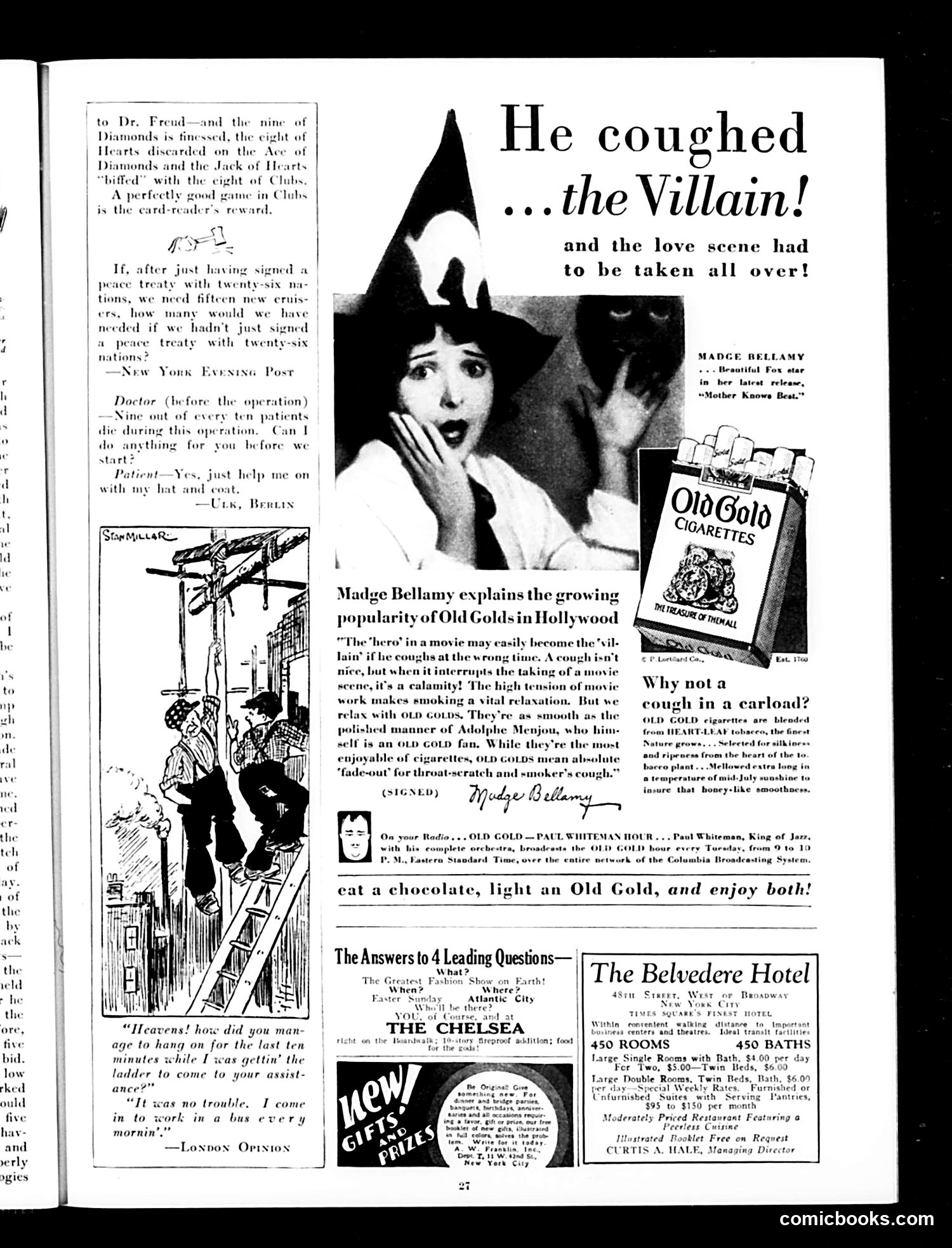
This page is primarily **advertising mixed with light humor** rather than political satire. The main cartoon (left side) depicts a film production mishap: an actor coughing during a romantic scene, forcing the crew to restart filming. The caption "He coughed...the Villain!" and subtitle "and the love scene had to be taken all over!" suggests irony—the "villain" interrupts the hero's moment, creating Hollywood production chaos. The accompanying humor pieces are domestic jokes: a doctor's gallows humor about surgical mortality, and a London anecdote about a worker commuting by bus who casually clung to a ladder for ten minutes without distress. **The page's real content is advertising**: Old Gold cigarettes (featuring actress Madge Bellamy endorsing them as a "smoker's cough" remedy), The Belvedere Hotel, and The Chelsea. These ads dominate the layout. The page reflects 1920s-era concerns (pre-health warnings about smoking) and Hollywood's early film industry, but contains no substantive political commentary—it's primarily commercial content dressed up with entertainment-industry humor.
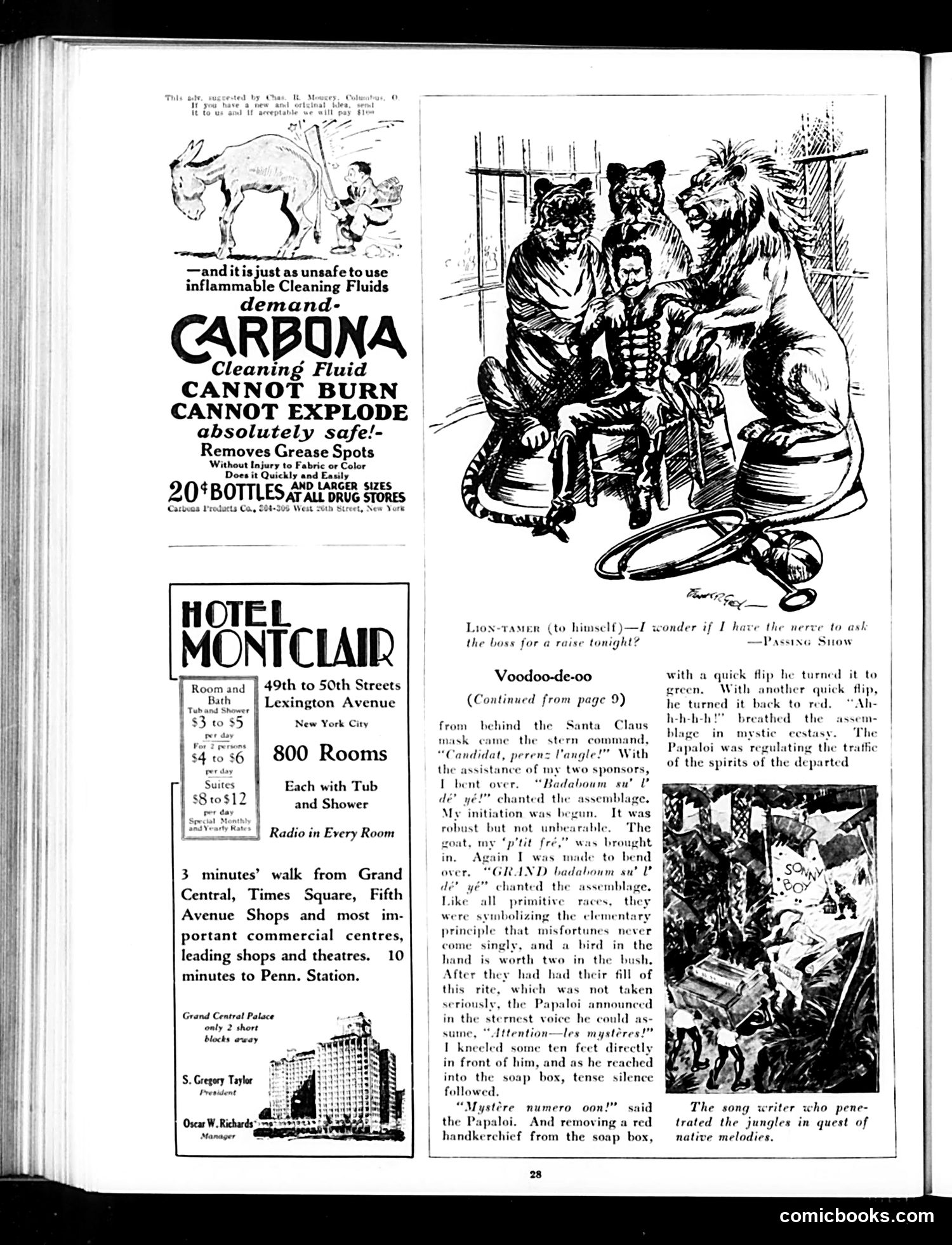
This page is primarily **advertisements and serialized fiction**, not political satire. The layout contains: **Left column:** Commercial ads for Carbona cleaning fluid (emphasizing safety—"cannot burn, cannot explode") and Hotel Montclair. **Right column:** A continuation of a story titled "Voodoo-de-oo" depicting a fictional initiation ritual involving Haitian Vodou practices. The narrative includes stereotypical elements: a goat sacrifice, mysterious Creole chanting ("Badaboum su' l'dé yé"), and a Papaloi (Vodou priest) performing color-changing handkerchief tricks. A small cartoon showing wild animal figures surrounds a seated man, captioned about requesting a raise from "the boss." **Context for modern readers:** This reflects early 20th-century American fascination with sensationalized, exoticized depictions of Haitian religion and culture—presenting Vodou as mysterious, primitive, and theatrical rather than as a legitimate spiritual practice. The content reflects period attitudes toward Caribbean cultures and religion as exotic spectacle.
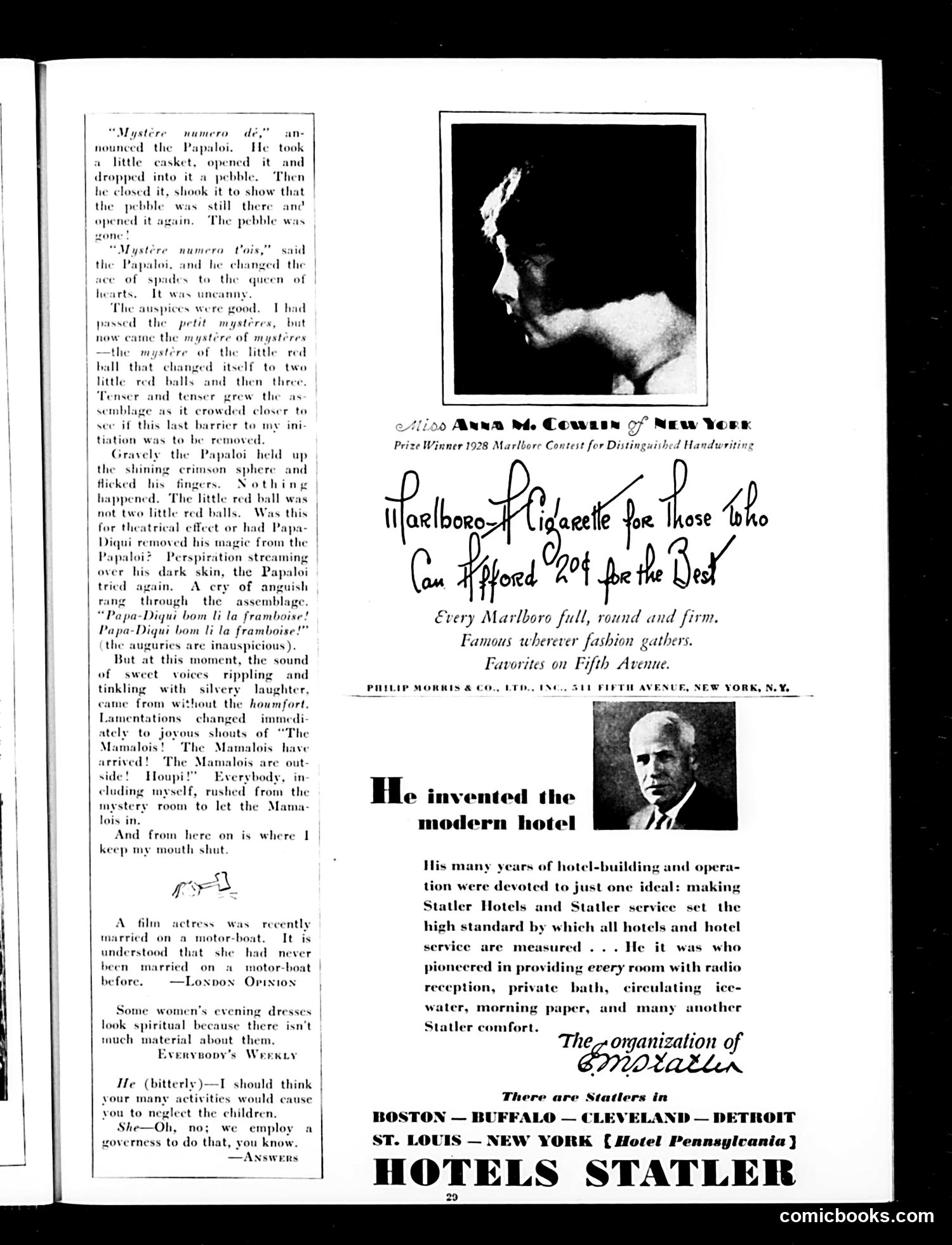
This page mixes literary content with period advertising. The main text appears to be a serialized story involving Haitian Vodou practices—describing a "Papaloi" (priest) performing magic tricks involving cards and a red ball during an initiation ritual, culminating in the arrival of "Mamalois" (priestesses). The narrative trades in exoticized, sensationalist depictions of Vodou common to early 20th-century American popular culture. The advertisements include a Marlboro cigarette ad featuring "Miss Anna de Cowan of New York" (a handwriting contest winner) and a substantial Hotel Statler ad promoting their chain's modern amenities. There are also brief humor items: a comment on film actresses marrying on motorboats, a quip about spiritual-looking evening dresses, and a domestic dialogue joke about employing a governess. The page reflects 1920s-era attitudes toward Caribbean religious practices as exotic spectacle and toward leisure/consumer goods as markers of modernity.
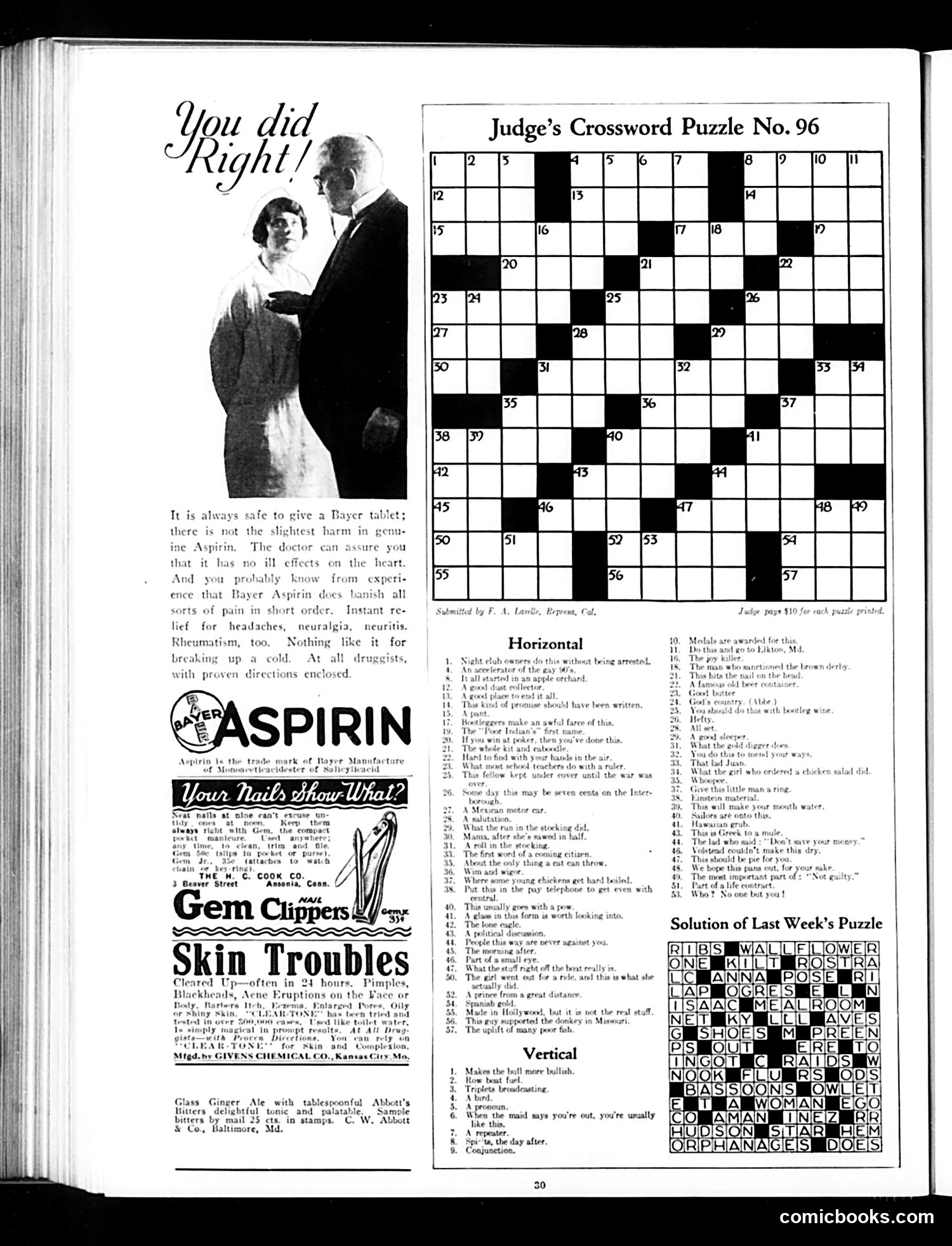
This page is primarily **advertising content** rather than political satire. It features three advertisements: 1. **Bayer Aspirin** (top right): A vintage pharmaceutical ad promoting aspirin as a cure-all for headaches, neuralgia, neuritis, and rheumatism. The accompanying image shows a gentleman and woman, likely meant to convey respectability and medical authority. 2. **Gem Clippers** (bottom left): A nail care product advertisement. 3. **Skin Troubles** (bottom center): An ad for "Clearstone," a skin treatment claiming to clear pimples and acne in 24 hours. The page also contains **Judge's Crossword Puzzle No. 96** with clues and a solution grid. The only potentially satirical element is a small vertical joke about social pretense—when a maid says "you're out," the implication is you're actually drinking or indisposed ("the day after"). This reflects early 20th-century humor about drinking culture and social facades. The page overall demonstrates how Judge balanced editorial content with substantial advertising revenue.
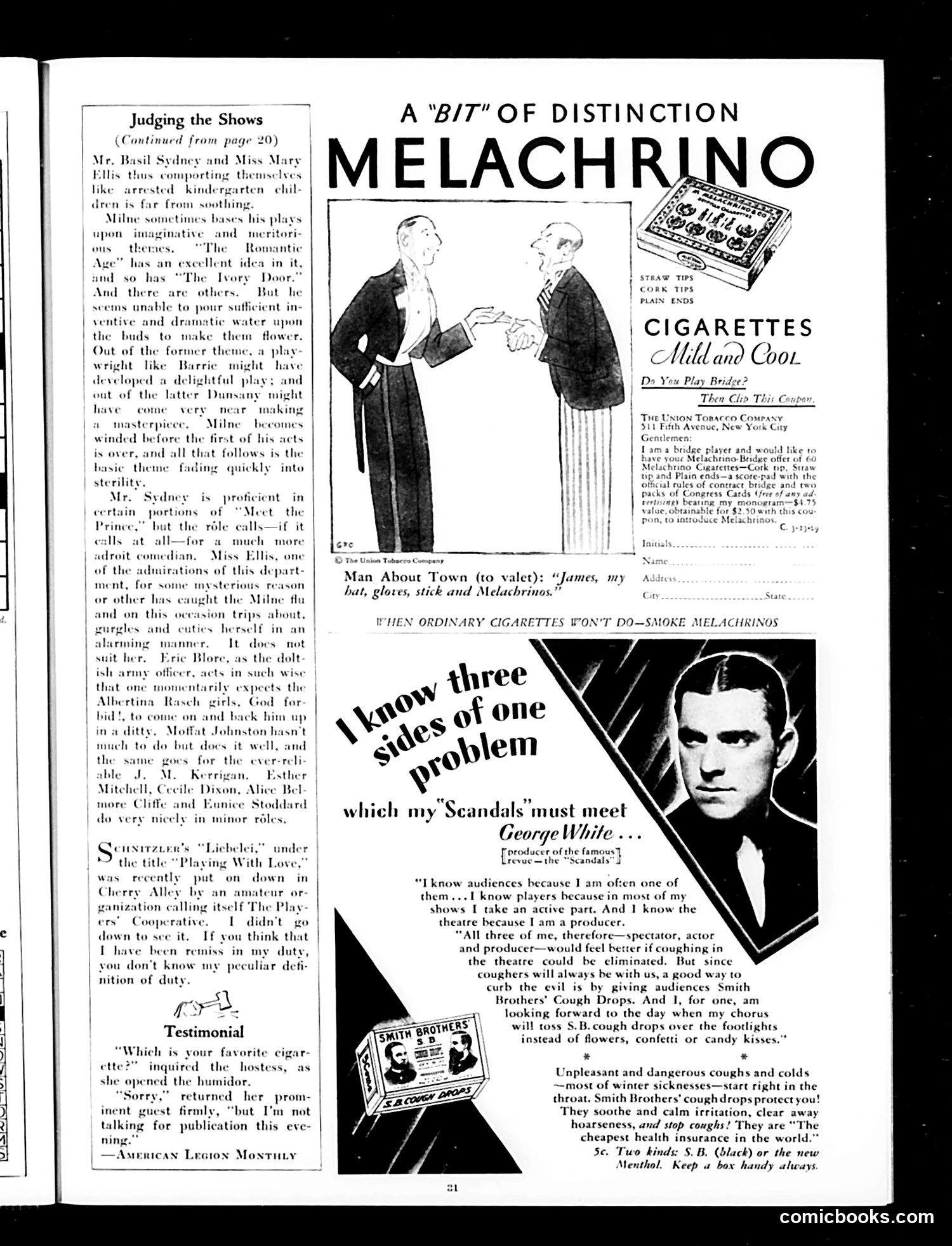
This Judge magazine page combines theater criticism with advertisements. **The Editorial Content** (left column) reviews theatrical productions, critiquing actors Basil Sydney and Mary Ellis for their undisciplined performances in A.A. Milne plays. The critic praises Milne's conceptual ideas but faults his execution, comparing him unfavorably to playwrights Barrie and Dunsany. **The Advertisements** dominate the page: 1. **Melachrino Cigarettes**: Positioned as a luxury product ("a bit of distinction"), targeting bridge players with promotional bridge scorecards and monogrammed items. 2. **Smith Brothers' Cough Drops**: Features testimonial from George White, a Broadway producer of the famous "Scandals" revue. White argues that theater audiences inevitably cough, so cough drops are necessary to prevent disrupting performances—essentially making cough drops essential theater etiquette for the socially conscious. Both ads appeal to aspirational consumers associating products with sophistication and theater culture.
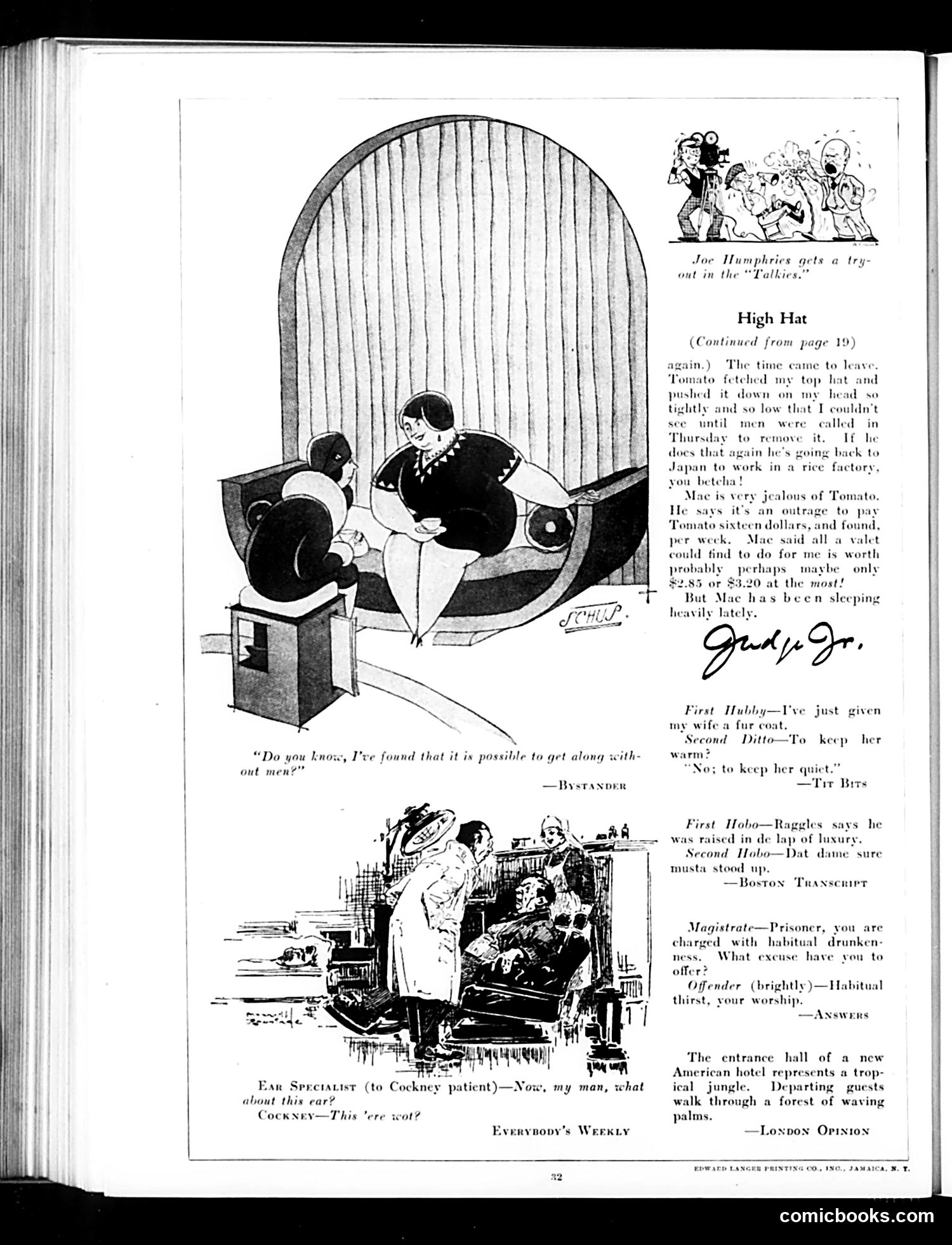
This page from Judge magazine contains several brief satirical jokes typical of the era, plus one substantial illustrated story ("High Hat"). The top cartoon shows a woman in a large chair/pod with mechanical equipment, captioned "Do you know, I've found that it is possible to get along without men?" A Cockney man responds "This 'ere wot?" — satirizing both feminist sentiment and working-class confusion at progressive ideas. The "High Hat" narrative (continued from page 19) describes the author's valet Tomato mistreating him, particularly by forcing his top hat down so tightly he can't see. The humor relies on class reversal—a servant dominating his employer—and suggests the author will send Tomato back to Japan. Other jokes mock domesticity ("keeping her quiet" via fur coat), vagrancy, drunkenness, and nouveau-riche hotel design with fake tropical décor. The page exemplifies Judge's formula: light social satire targeting immigrants, working-class dialect, gender relations, and American consumer culture.
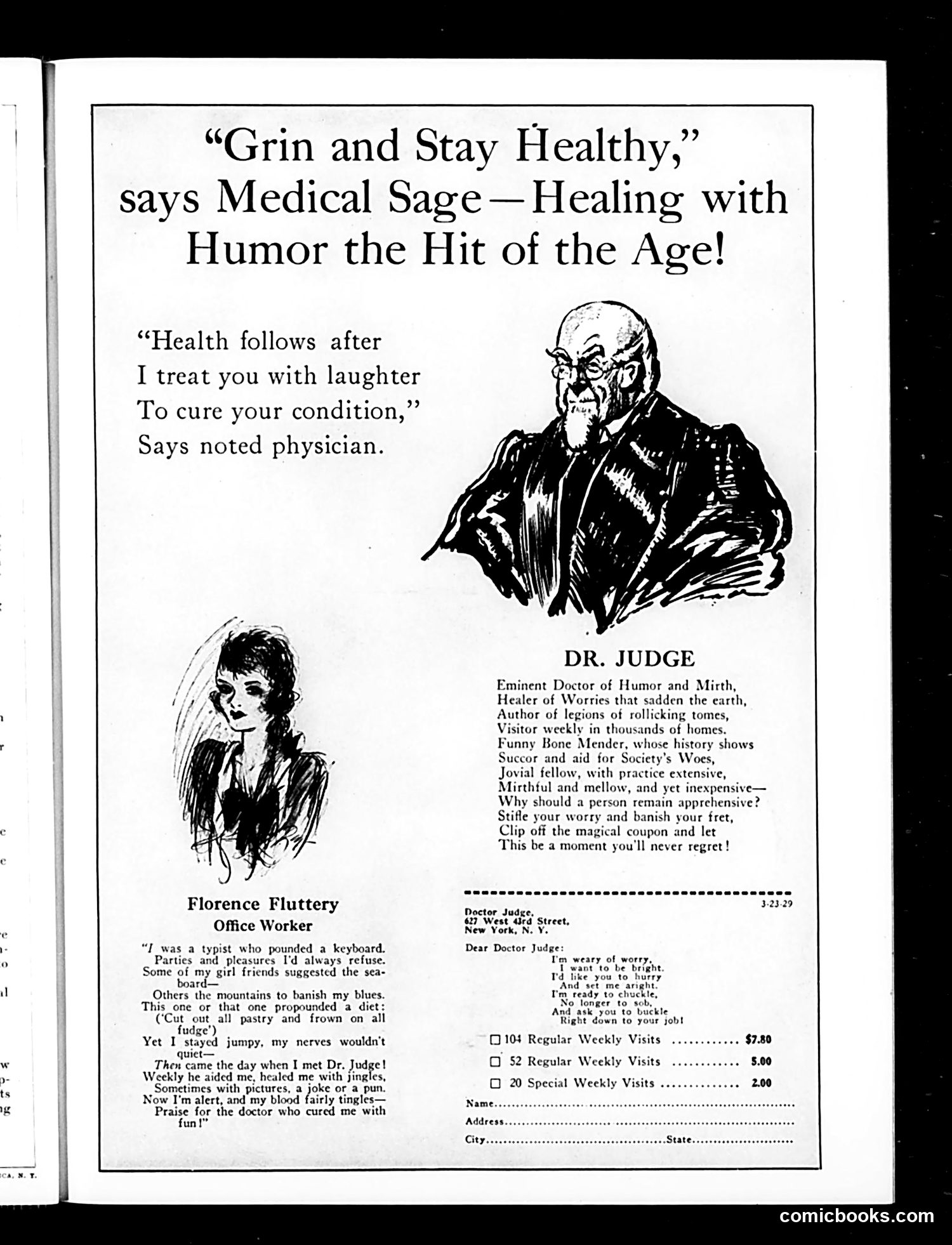
This is primarily an advertisement disguised as editorial content, promoting "Dr. Judge" – a fictional character representing humor as medical treatment. The satire plays on early 20th-century wellness trends where doctors marketed unconventional cures. Two testimonials support the pitch: Florence Fluttery, an office worker, describes depression and anxiety cured by Dr. Judge's jokes and puns rather than conventional remedies. The "doctor" himself is caricatured as a wizened sage, suggesting ancient wisdom repackaged as modern medicine. The coupon offers subscription tiers ("104 Regular Weekly Visits") for this "treatment," mocking both mail-order medicine schemes and the era's growing interest in psychology and mental health. Judge magazine satirizes how Americans eagerly purchased dubious remedies while highlighting genuine stress in modern work life. The implicit joke: laughter *might* actually help, but charging for it via subscription is pure American entrepreneurship.
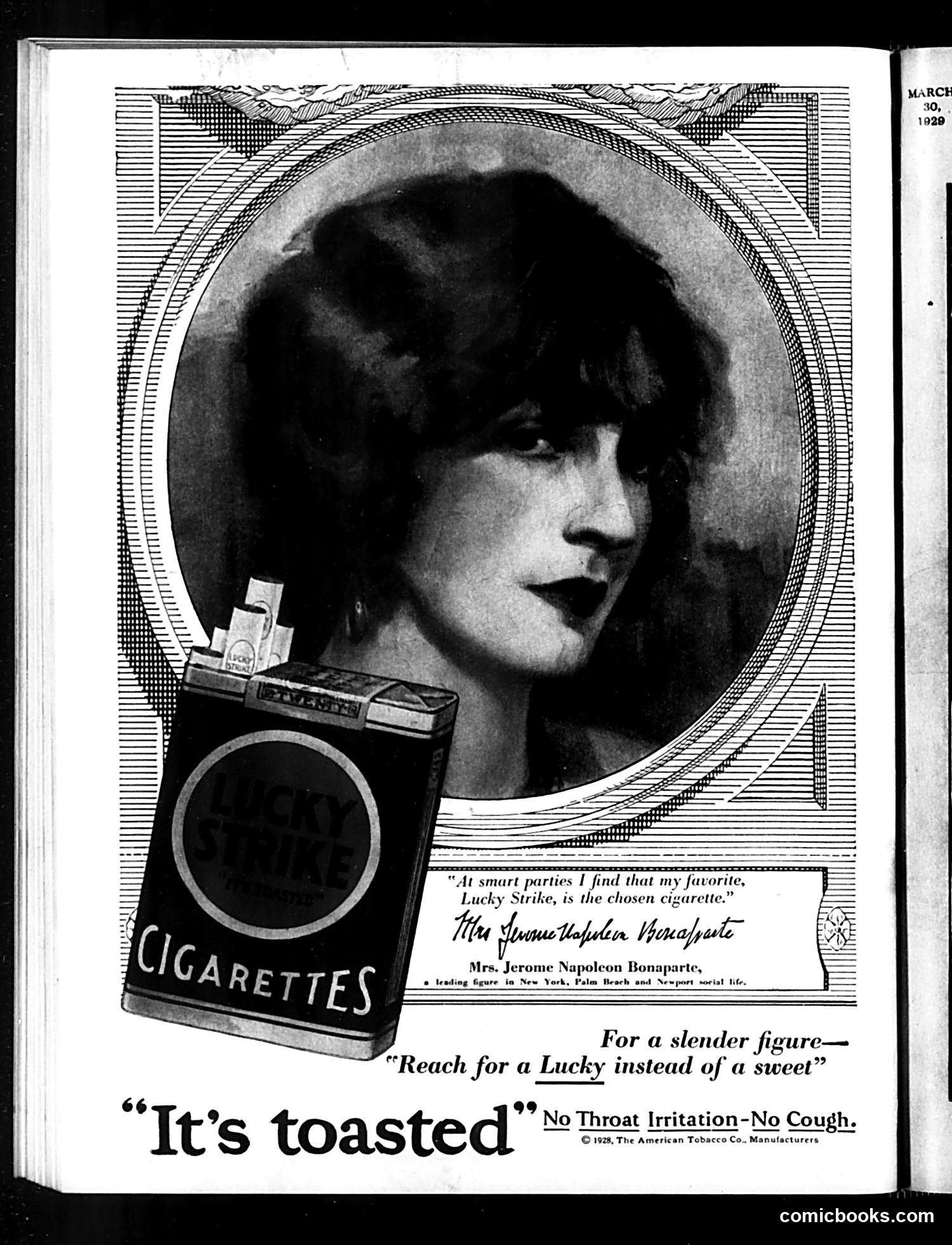
This is a **cigarette advertisement**, not political satire. It features Mrs. Jerome Napoleon Bonaparte, identified as a prominent New York socialite, endorsing Lucky Strike cigarettes. The ad uses a common 1920s marketing strategy targeting women by linking smoking to slenderness—the tagline "Reach for a Lucky instead of a sweet" positioned cigarettes as a weight-control alternative to candy. This advertisement exemplifies how tobacco companies exploited social anxieties about women's appearance and borrowed celebrity endorsements to market their products. The "toasted" claim and "No Throat Irritation" messaging were typical health assertions made before cigarette dangers were widely acknowledged. The copyright date is 1928.