
A complete issue · 36 pages · 1929
Judge — April 6, 1929
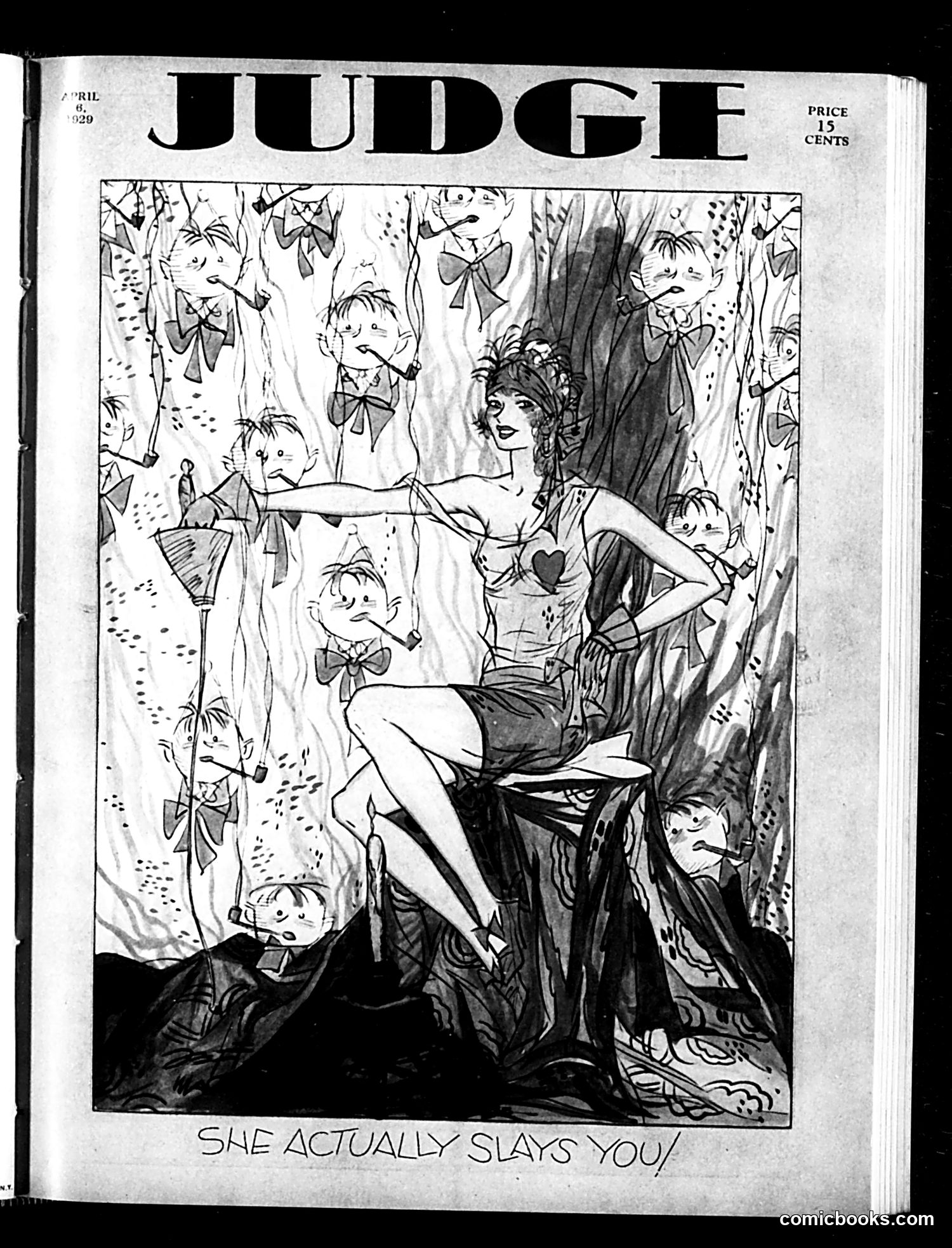
This satirical illustration depicts a glamorous woman surrounded by cherubs or cupids, with the caption "She Actually Slays You!" The artwork appears to be commenting on 1920s dating culture and the appeal of attractive women. The woman is styled in the flapper aesthetic popular during that era—with bobbed hair, headpiece, and fashionable dress—embodying the "modern woman" that fascinated and sometimes scandalized American society. The multiple cherubs suggest themes of romance and attraction. "Slays" was contemporary slang meaning to charm or impress someone thoroughly. This cover likely satirizes the power of feminine allure and perhaps critiques either male susceptibility to female charm or evolving gender dynamics of the Jazz Age. The tone appears humorous rather than moralistic.
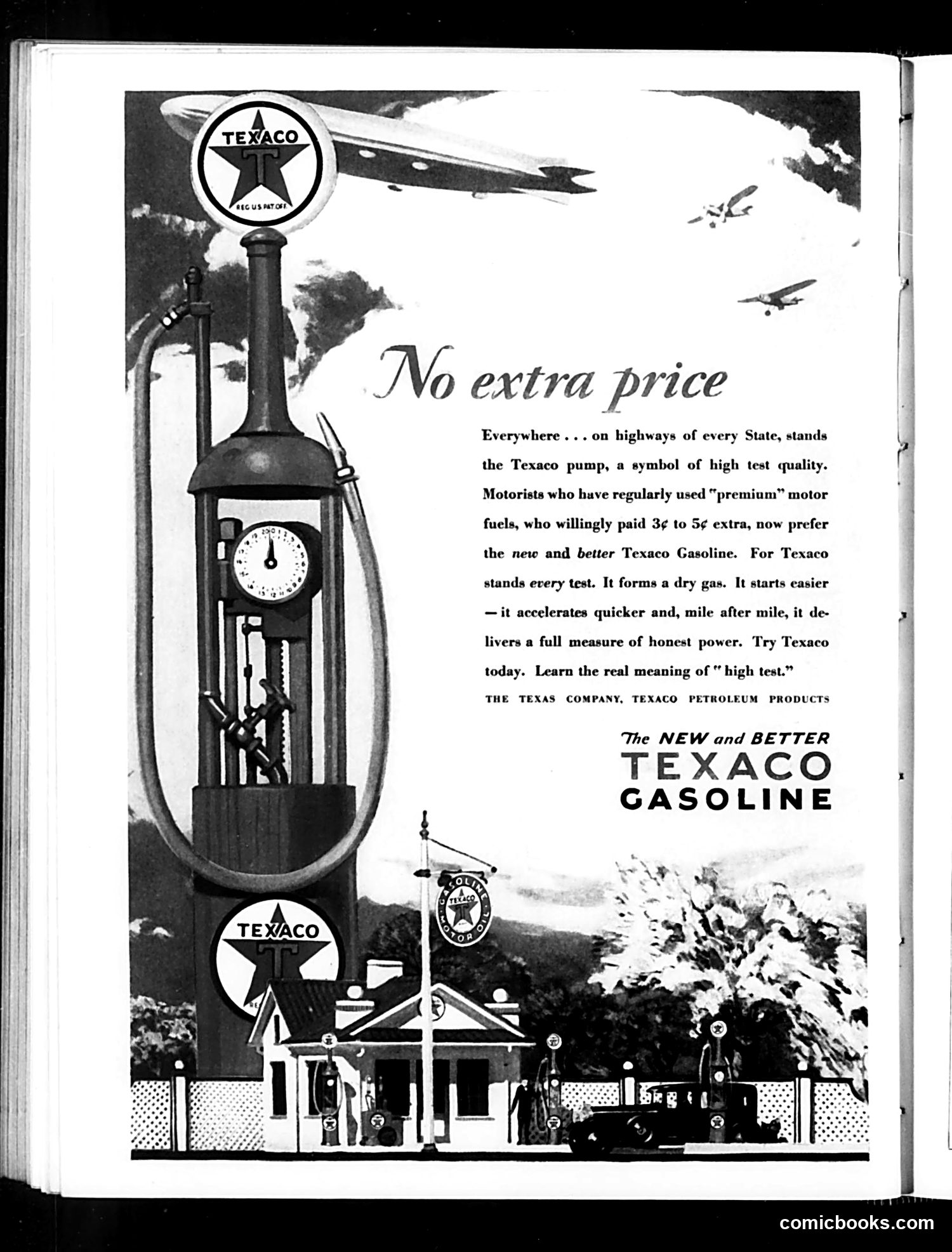
This is a **Texaco gasoline advertisement, not political satire**. The page promotes "The New and Better Texaco Gasoline" with the headline "No extra price." The ad's pitch targets motorists who previously paid 3-5¢ premiums for "premium" fuel. Texaco claims their new regular gasoline now matches that performance—forming "a dry gas," starting easier, accelerating quicker—without the markup. The visual emphasizes this through an iconic tall pump at a roadside station, flanked by aircraft and a scenic landscape, suggesting progress and modernity. This reflects 1920s-30s gasoline marketing competition, where brands competed partly on octane ratings and additives. The "high test" phrase referenced fuel quality standards of that era.
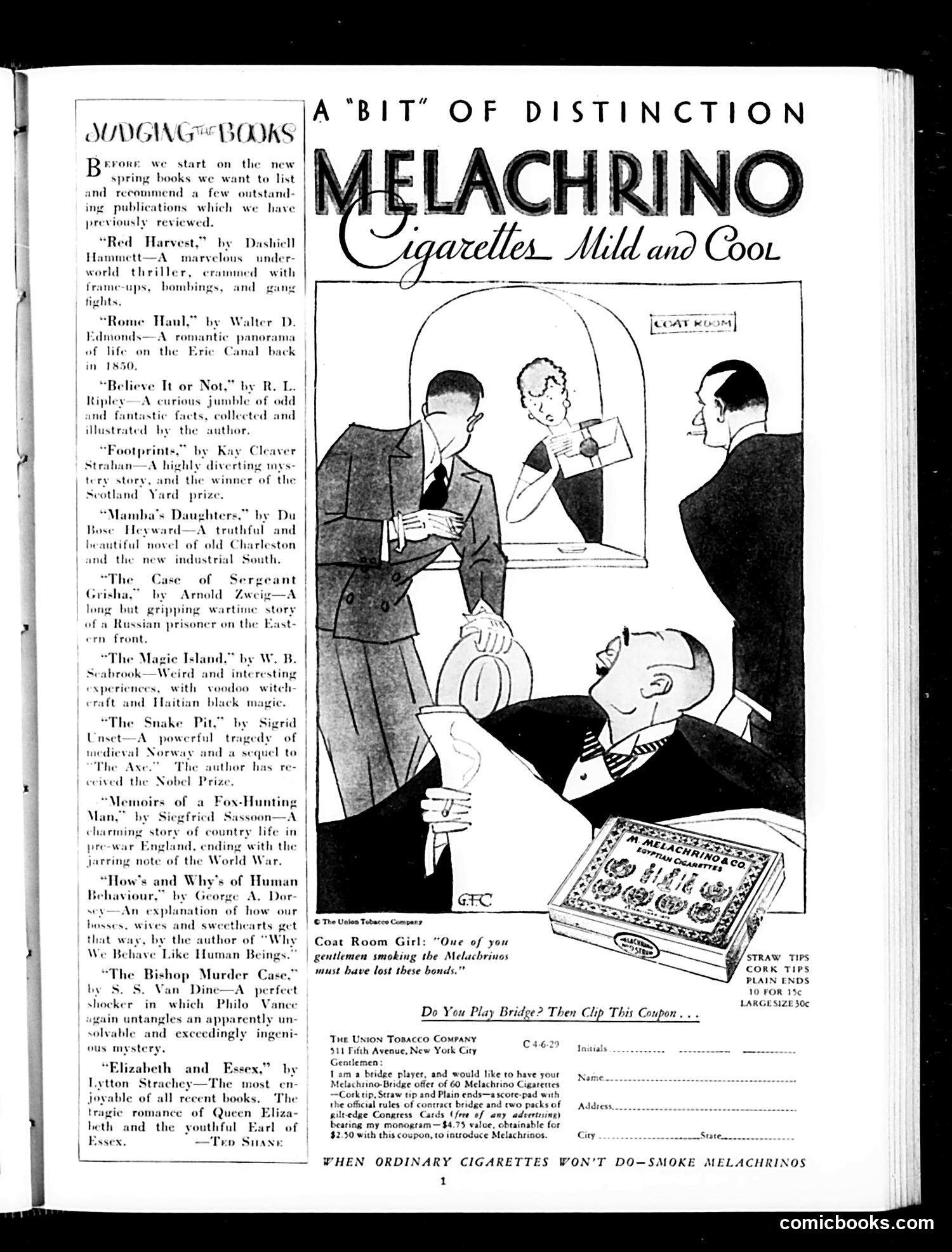
This page is primarily a **cigarette advertisement** for Melachrino brand, not political satire. The illustration shows a social scene where a woman in a mirror and two men are examining a package of Melachrino cigarettes, with the tagline "One of you gentlemen smoking the Melachrinos must have lost their heads." The left side contains book reviews under "Judging the Books," listing contemporary novels like works by Dashiell Hammett and W.B. Seabrook. **The satire is minimal**: the ad's humor relies on the playful suggestion that Melachrinos are so desirable that smokers are losing their minds over them. This represents typical 1920s-30s advertising rhetoric, before cigarette health warnings. The "bridge player" coupon offers cigarettes as a premium product for the educated, leisured class.
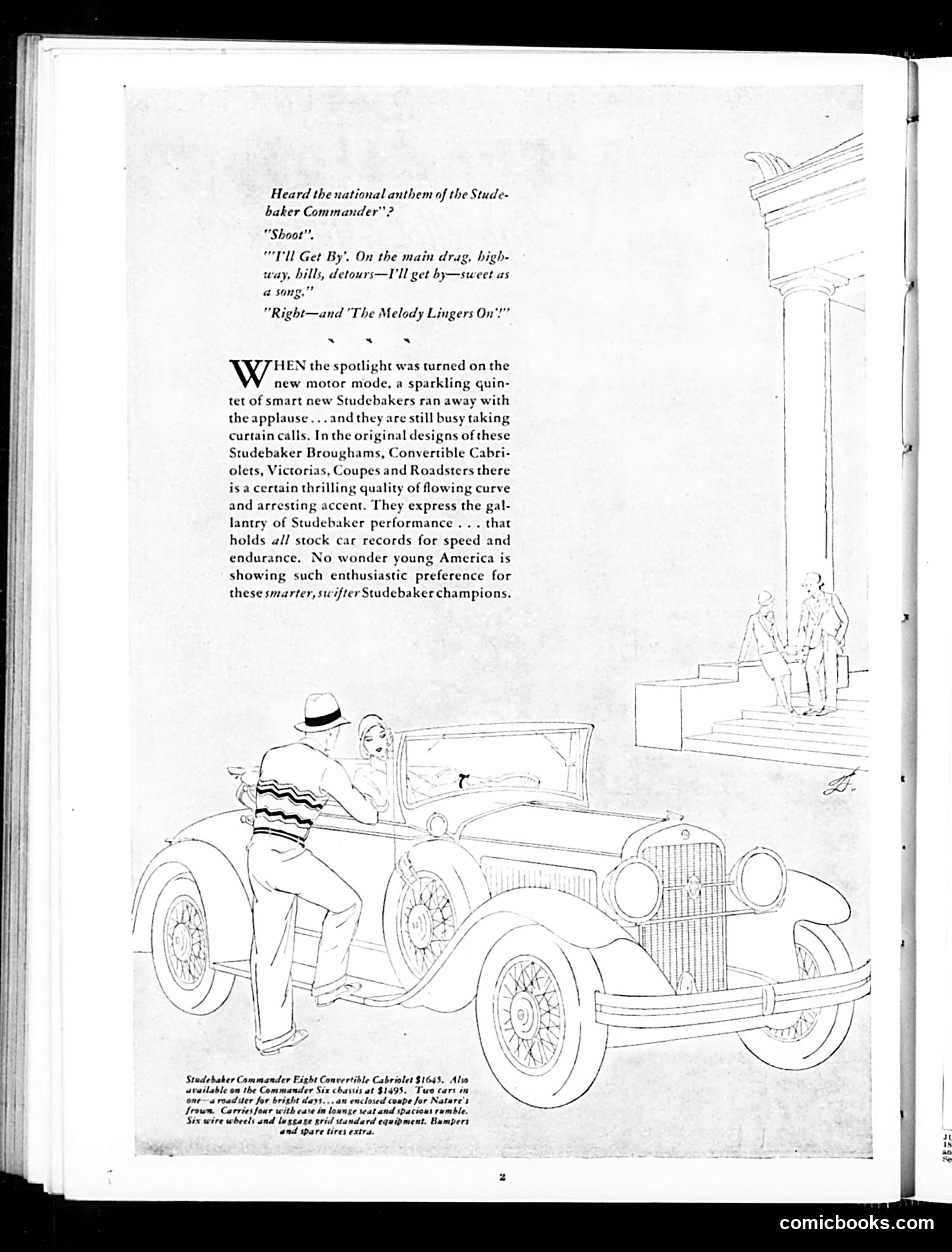
This page is primarily **advertising for Studebaker automobiles**, not political satire. The illustration depicts a well-dressed man and woman in a Studebaker Commander Eight Convertible Cabriolet, positioned outside what appears to be a theater or formal venue. The satirical framing is subtle: the opening dialogue humorously references the "Studebaker Commander" as if it were a military or political figure ("Heard the national anthem of the Studebaker Commander?"), treating the car brand with mock-reverence. The text emphasizes Studebaker's performance records and appeals to affluent, status-conscious buyers—"young America" preferring these "smarter, swifter Studebaker champions." The satire targets consumer culture and advertising itself rather than specific politics.
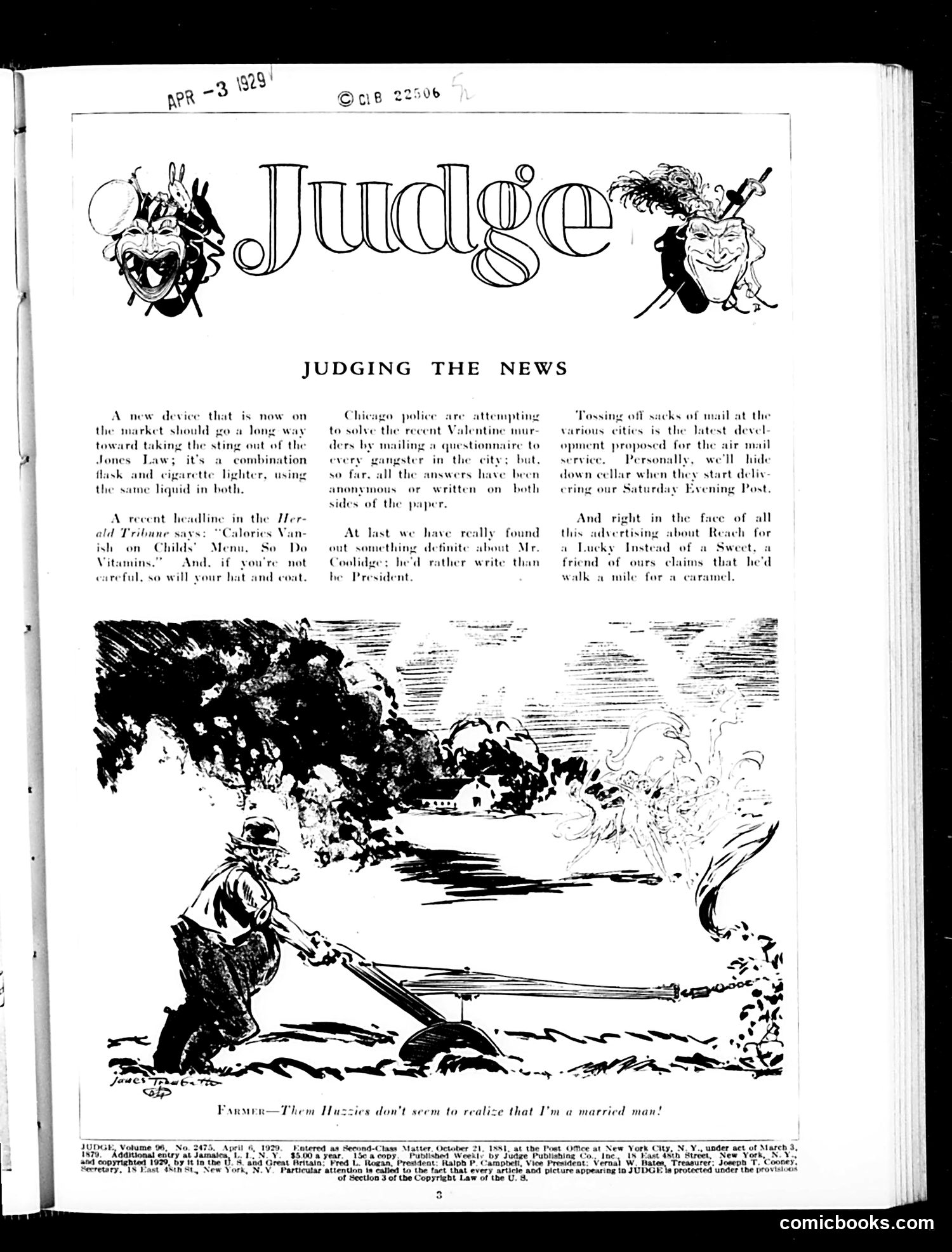
This page presents editorial commentary titled "Judging the News," offering satirical takes on contemporary topics: 1. **A new combination lighter/cigarette device** — Judge mocks this gadget as unnecessary complexity. 2. **Chicago police and Valentine murders** — References the recent St. Valentine's Day Massacre (February 1929), where police attempted solving gang violence through questionnaires sent to gangsters—an absurdly ineffective approach Judge ridicules. 3. **Mail delivery innovation** — Proposes tossing mail sacks between cities as a humorous alternative to standard postal service. The bottom cartoon depicts a **farmer with a plow**, with the caption "Them Hazzies don't seem to realize that I'm a married man!"—likely a rural/domestic humor gag, though the specific reference is unclear.
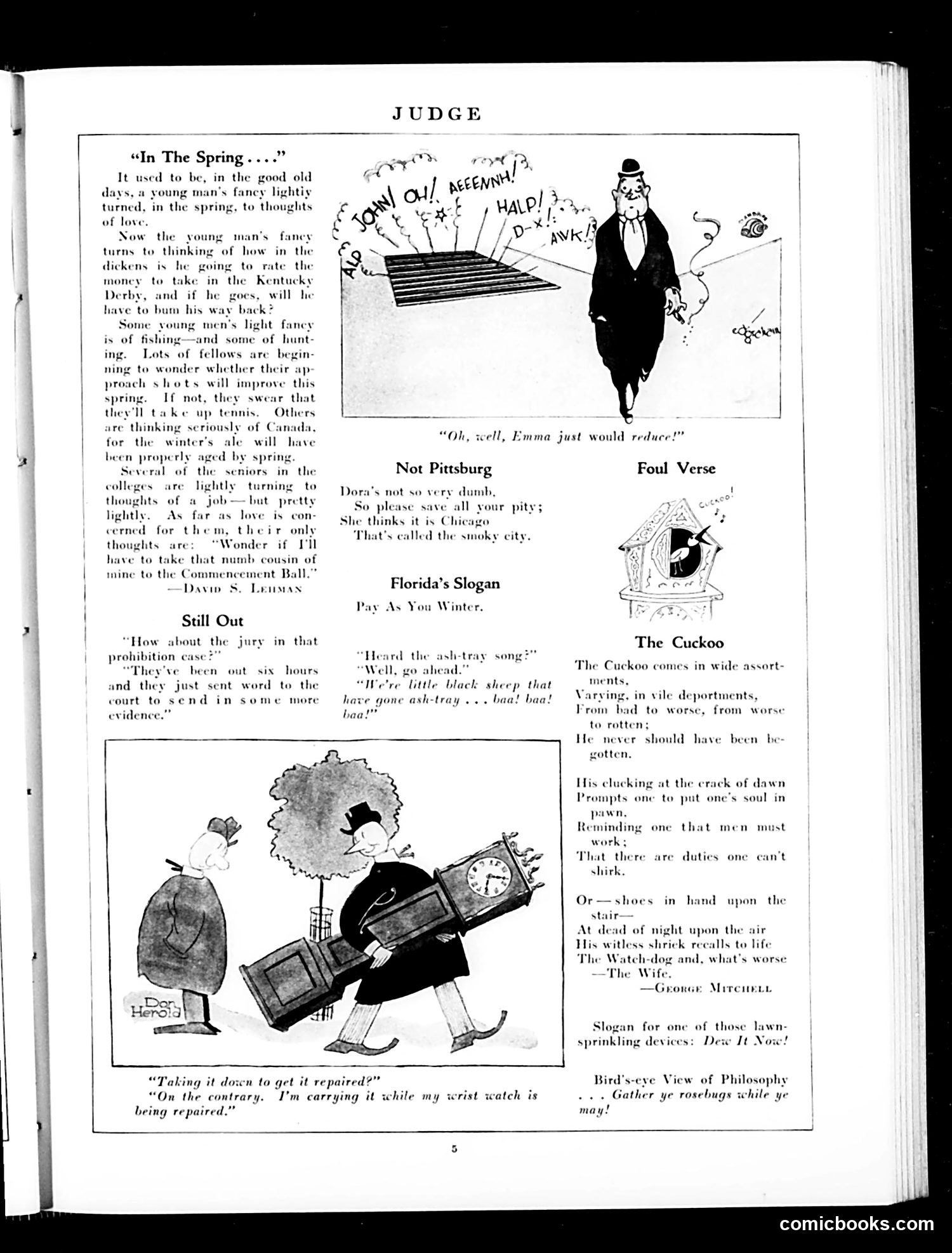
This page contains **spring-themed humor and light verse** rather than political cartoons. The main cartoon shows a man carrying a large clock and other items, captioned "Taking it down to get it repaired?" His response jokes about carrying the clock while his wrist watch is being repaired—simple domestic humor. Other sections include: - **"Not Pittsburg"**: A joke mocking Chicago as a "smoky city" - **"Florida's Slogan"**: "Pay As You Winter" - **"The Cuckoo"**: Verse about an annoying bird, touching on themes of duty and masculine responsibility - Various short jokes and verse fragments The top cartoon depicts a gentleman in formal dress amid spring noise (marked "SCREECH," "AEEEOWW," "HALD"), with the caption "Oh, well, Emma just would *relace!*"—a pun on "re-lace" shoes. The content reflects **early 20th-century domestic and seasonal humor** with no significant political content.
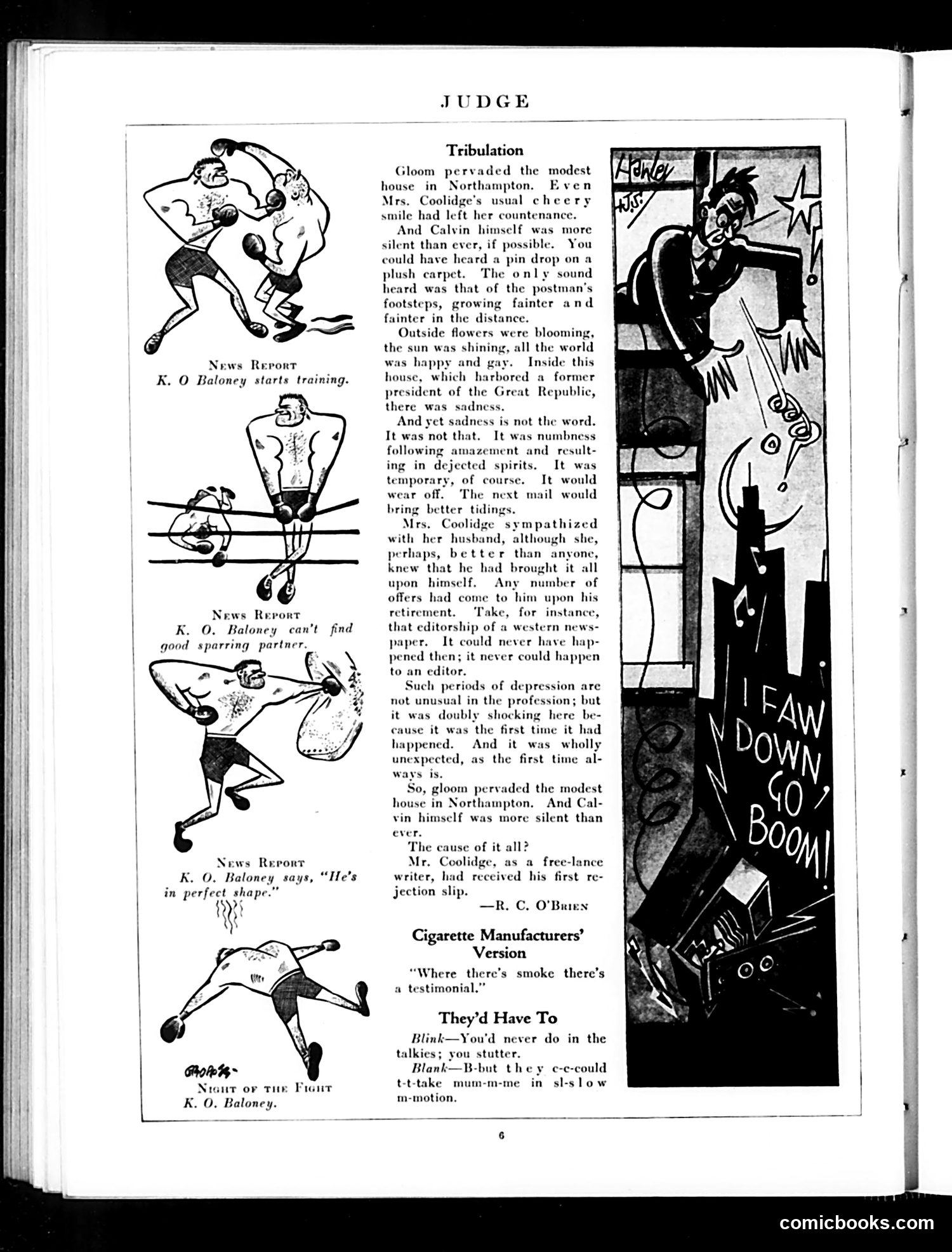
This page from *Judge* magazine features satirical commentary on a writer's professional crisis. The main story, "Tribulation," describes gloom in a Northampton household following the rejection of a manuscript by a free-lance writer named Mr. Coolidge. The narrative emphasizes the unexpected nature of this first rejection and its demoralizing effect on both him and his wife. The left side contains humorous cartoon sketches labeled "News Report" credited to "K. O. Baloney," depicting physical comedy—a man struggling with various activities, illustrating the phrase "He's in perfect shape." The satire mocks the precarious financial instability of literary freelancers and the emotional toll of professional rejection. The cigarette manufacturers' quip and "They'd Have To" section provide additional light humor about speech impediments.
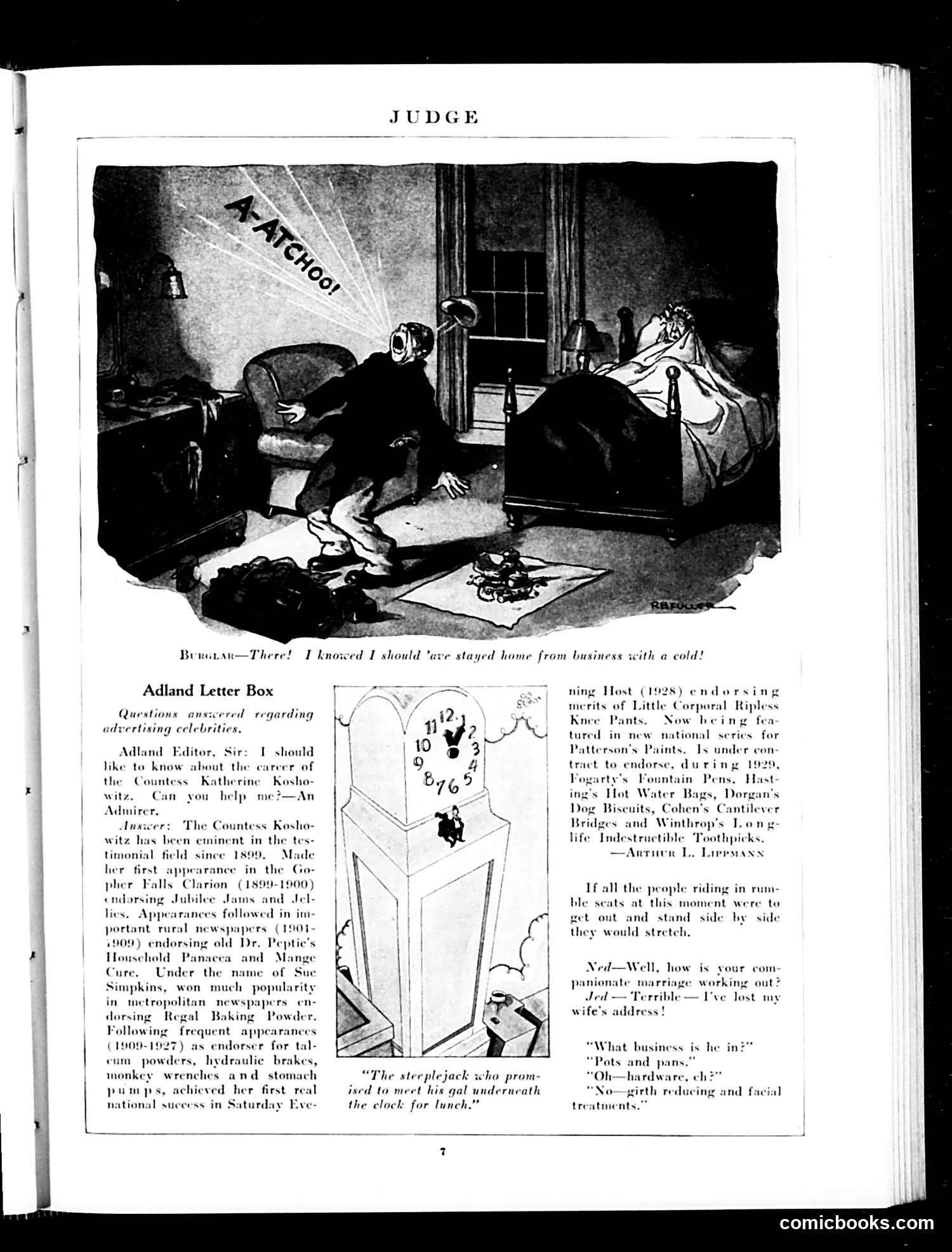
This page from Judge satirizes **celebrity product endorsements**, a growing advertising practice in the 1920s. The main content is the "Adland Letter Box," which mocks the "Countess Katherine Koshowitz"—an apparently fictional celebrity endorser who has promoted countless products since 1899, from patent medicines to baking powder to dog biscuits. The satire targets how manufacturers hired celebrities to lend credibility to dubious products, often obscure ones (hydraulic brakes, "girth reducing treatments"). The top cartoon shows a burglar caught with "ARTCHOO!"—a visual pun suggesting he's stealing from someone with a cold, referencing the business excuse in the caption below. The page also includes brief humorous items: a joke about a steeplejack meeting his girlfriend under a clock, and exchanges about marriage trouble and beauty product sales. The underlying satire critiques both consumer gullibility and the commercialization of celebrity culture during the Jazz Age.
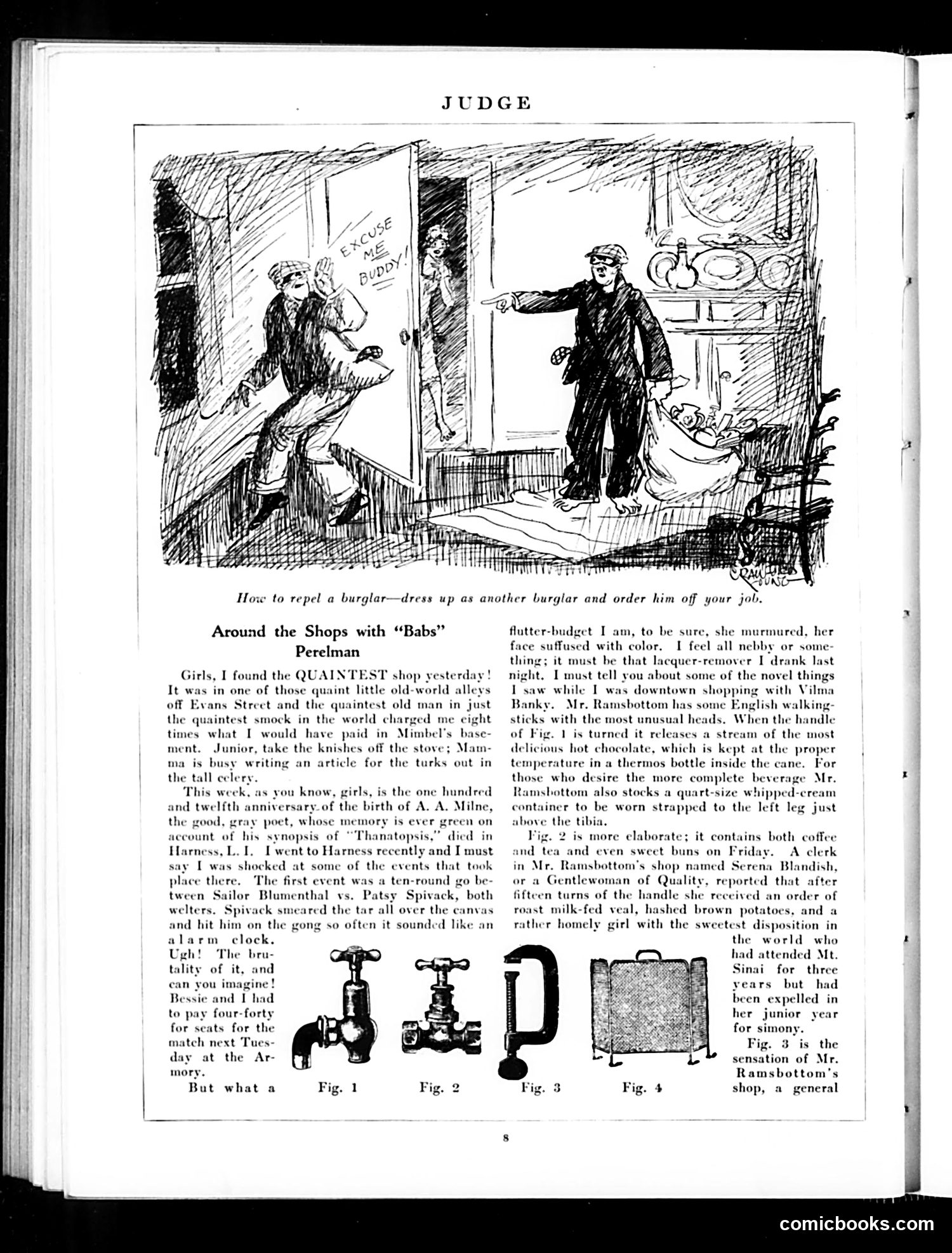
This is a humor column by S.J. Perelman titled "Around the Shops with 'Babs,'" satirizing pretentious consumer culture and absurdist product design. The main joke involves fictional "novelty" walking canes sold by a shopkeeper named Ramsbottom. The canes contain increasingly elaborate hidden features: Fig. 1 dispenses hot chocolate via thermos; Fig. 2 adds whipped cream dispensing; Fig. 3 supposedly serves full meals. The satire mocks both consumers' gullibility for pointless luxury goods and manufacturers' escalating product "innovations." The cartoon at the top depicts a burglar-deterrent method: dressing as a burglar yourself to confuse an actual burglar—absurdist humor typical of Perelman's style. The column uses exaggerated details (A.A. Milne's "112th birthday," lacquer-remover intoxication) and malapropisms to mock consumer culture's superficiality. The reference to an expelled student dismissed for "simony" (selling religious offices) is an incongruous joke.
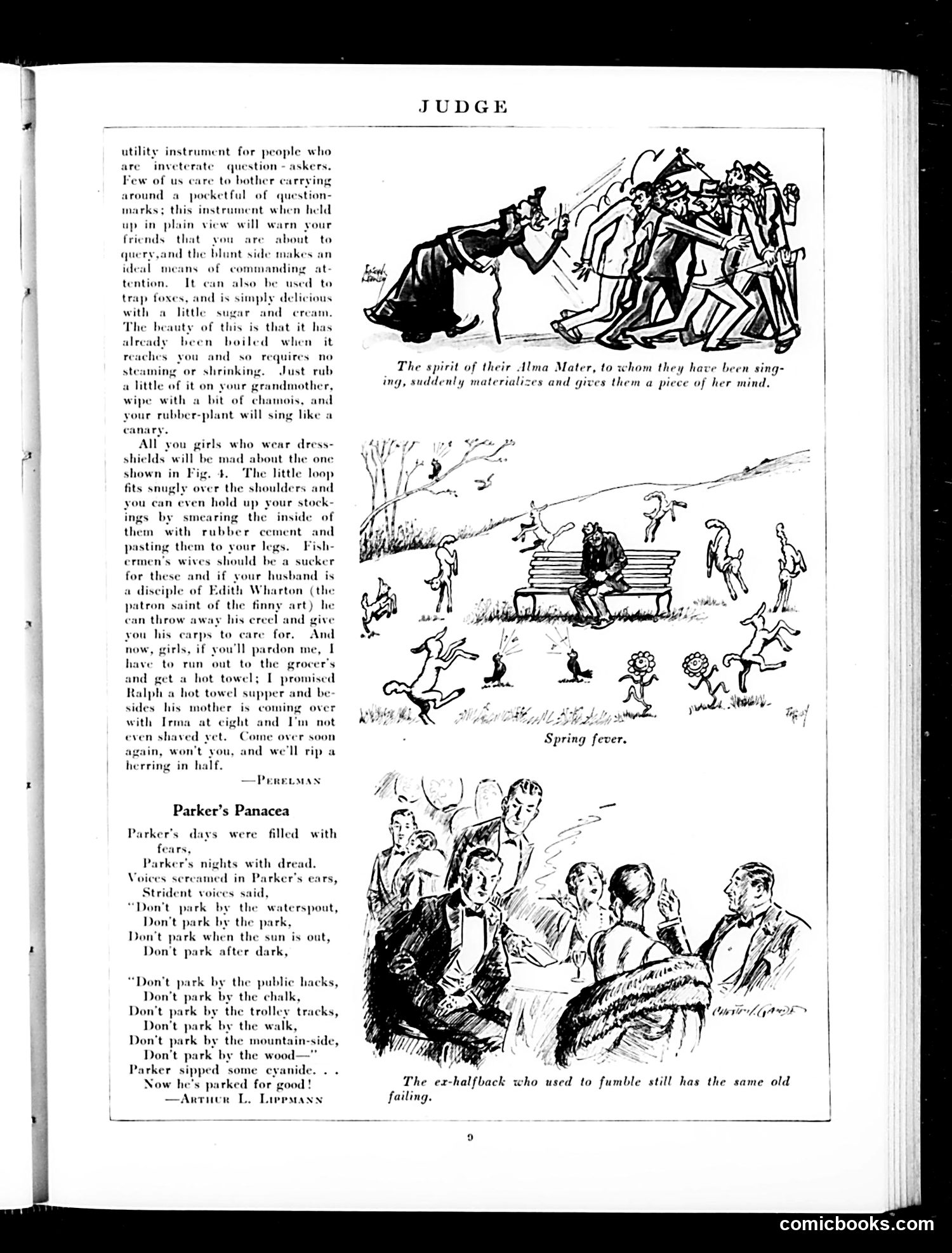
This page contains three satirical pieces: **Top cartoon**: Shows a ghostly "Alma Mater" (university spirit) materializing to scold students who've been singing about her. The satire mocks college nostalgia and the gap between idealized university memories and reality. **"Spring Fever" illustration**: A park scene depicting young people lounging and playing, satirizing springtime behavior and youthful leisure. **"Parker's Panacea"**: A dark comic poem by Arthur L. Liverance about a man named Parker driven to suicide by relentless parking restrictions. The joke is grimly ironic: conflicting "don't park" rules—by waterspouts, parks, during day/night, near various urban features—create such anxiety that Parker poisons himself. The final line "Now he's parked for good" is a pun on death/permanent parking. This satirizes early automobile-era urban regulation chaos and bureaucratic absurdity, rendered as tragicomedy.
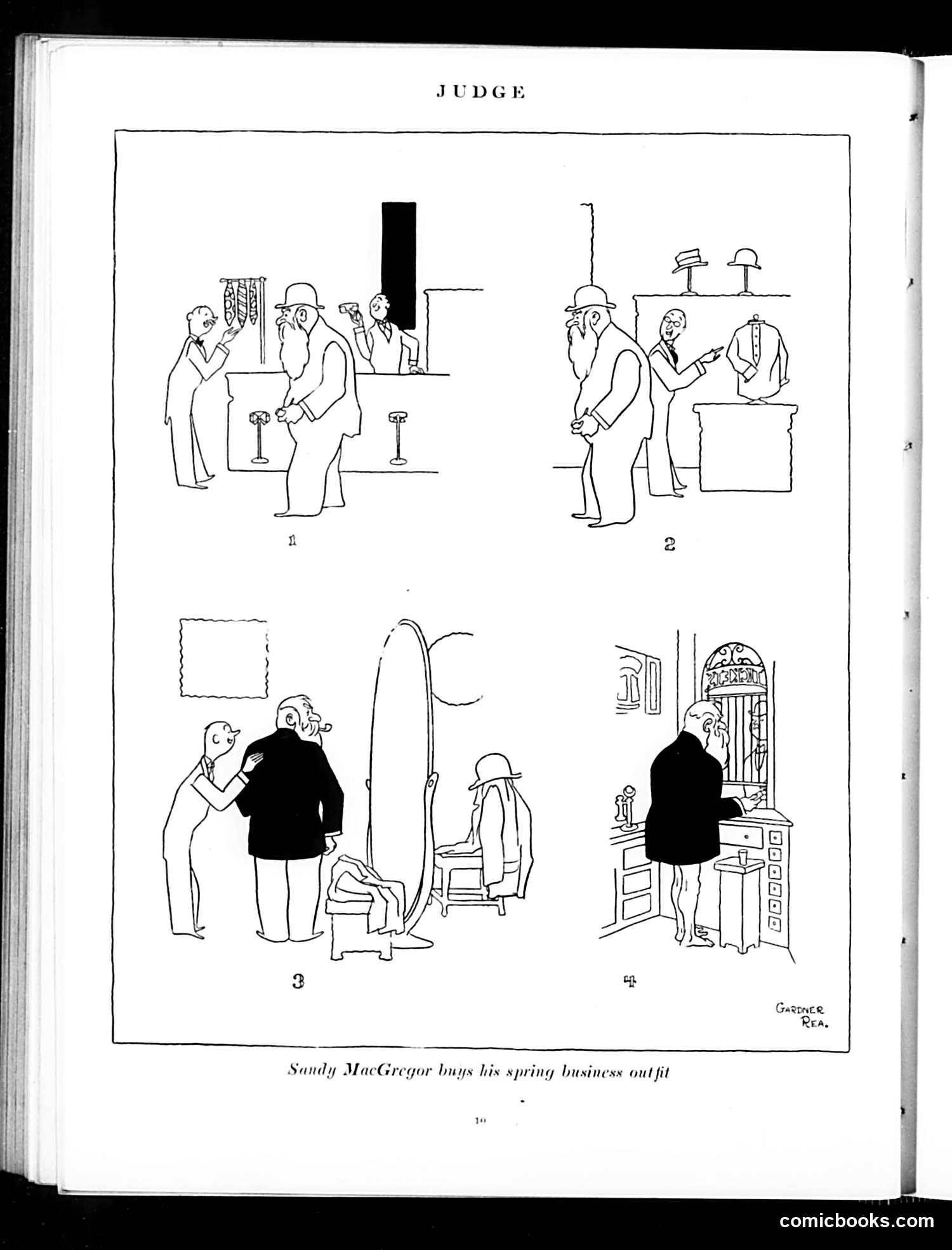
This four-panel cartoon by Gassner depicts a man named Sandy MacGregor shopping for spring clothing. The humor appears to derive from the contrast between his expectations and reality at various establishments. In panels 1-2, he visits what seems to be a tailor or formal clothier, where he interacts with salesmen. Panels 3-4 show him at home, seemingly disappointed or struggling with his purchases—possibly ill-fitting garments or poor quality goods. The satire likely mocks either the clothing industry's poor service to working-class customers, or MacGregor's own misguided shopping choices. The "spring business outfit" suggests he's attempting to dress professionally for the season, only to encounter problems. Without more contextual information about Sandy MacGregor (possibly a recurring character), the specific target of ridicule remains somewhat unclear.
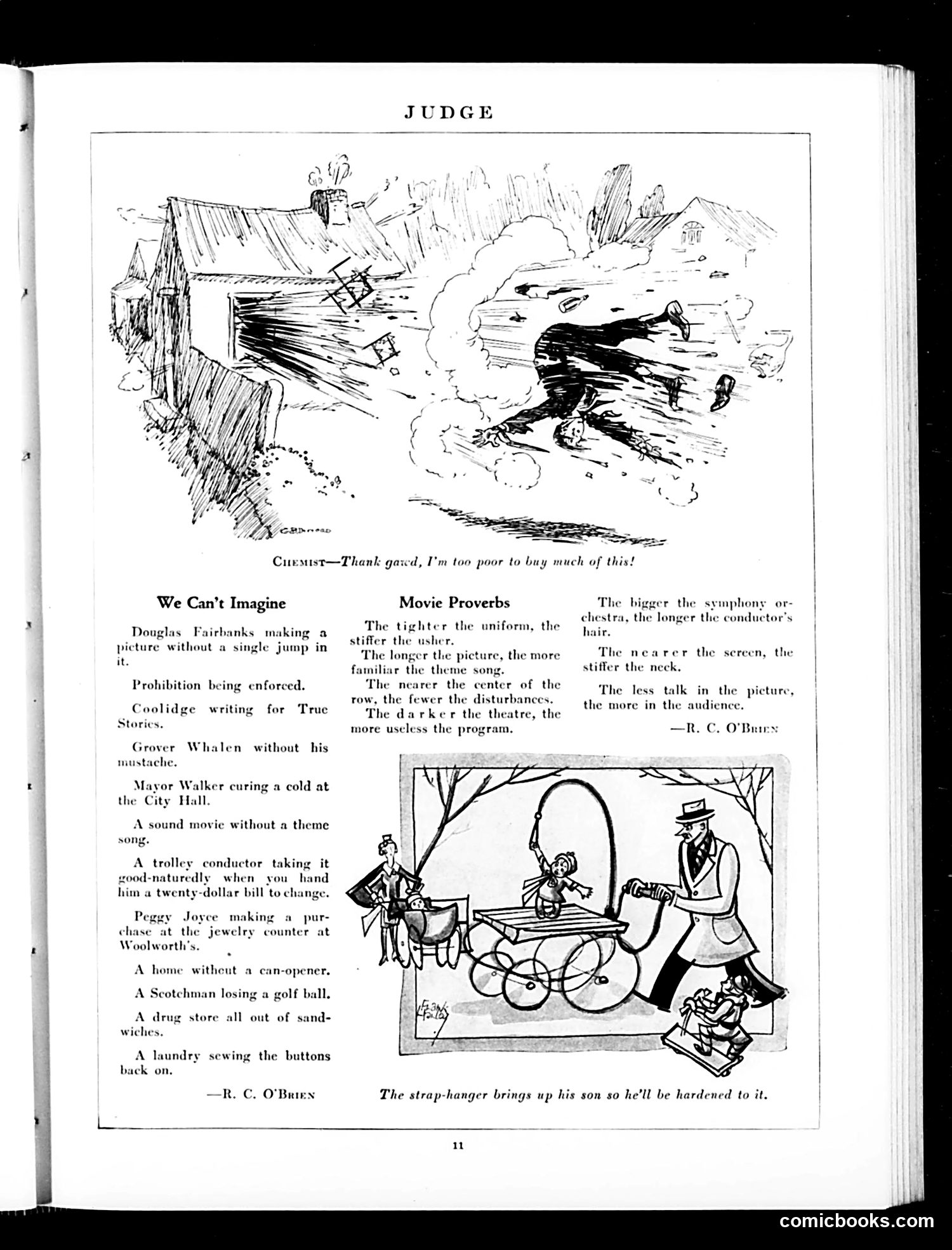
This page from *Judge* magazine contains satirical humor from the 1920s Prohibition era. **"We Can't Imagine"** lists absurdities—things contemporary readers would find impossible: - Douglas Fairbanks (silent film star) making a movie without stunts - Prohibition actually being enforced (it wasn't effectively) - President Coolidge writing for pulp magazines - NYC Police Commissioner Grover Whalen without his distinctive mustache - Mayor Jimmy Walker actually resting during illness **"Movie Proverbs"** mocks cinema conventions: theme songs, usher uniforms, theater darkness enabling audience chatter, and symphony orchestras' theatrical pretension. **The cartoon** shows a "strap-hanger" (subway commuter) deliberately exposing his son to crowded public transit to "harden" him—satirizing tough parenting and urban life's discomforts. The overall tone is humorous complaint about modern life's inconveniences and the entertainment industry's excesses during the Jazz Age.
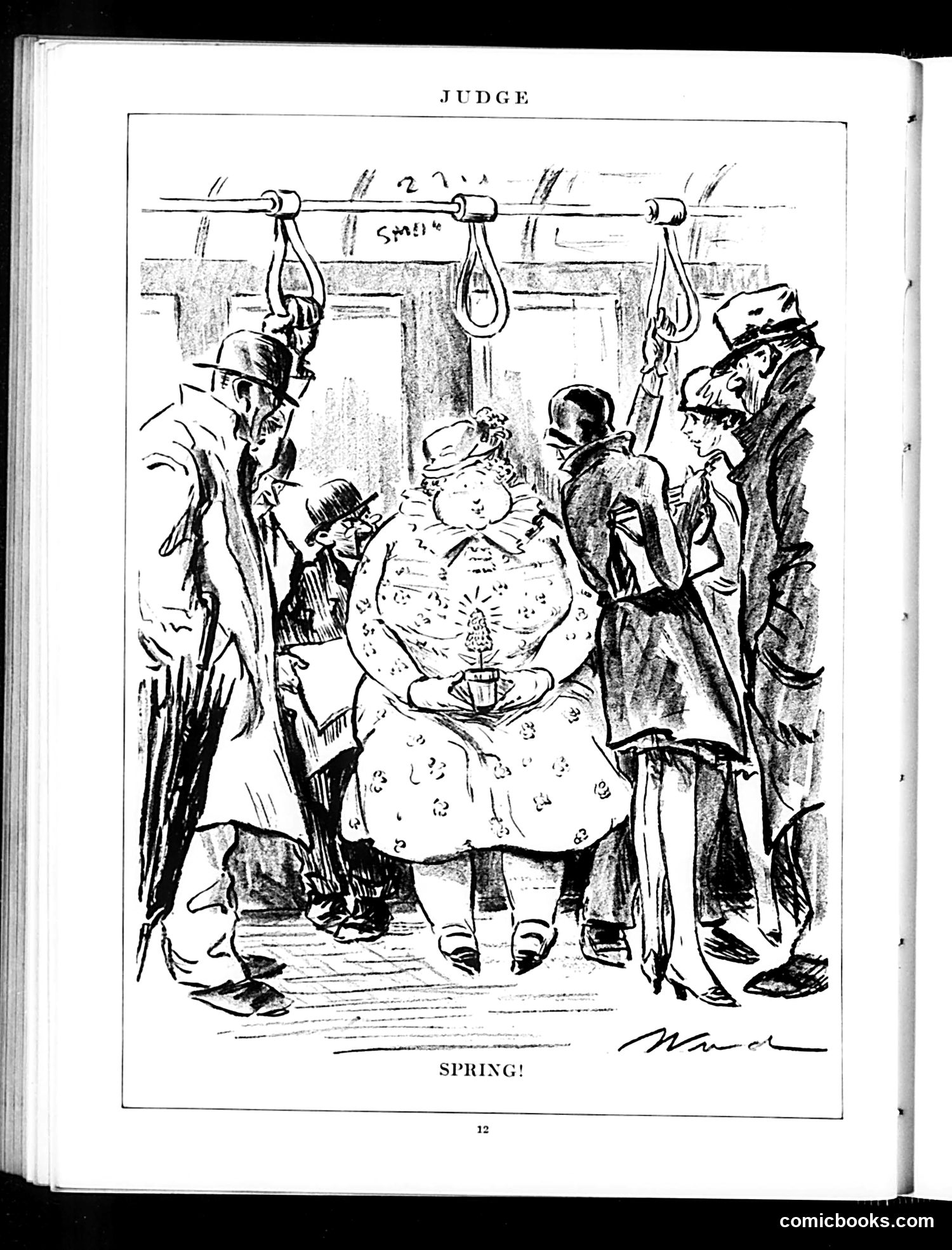
This single-panel cartoon titled "SPRING!" appears to depict a satirical commentary on seasonal change and social behavior. The central figure is an extremely rotund woman in a patterned dress, surrounded by well-dressed men in hats who appear to be observing or reacting to her. The nooses hanging above suggest darkly comic consequences. The satire likely critiques how spring traditionally prompted social activities and courtship rituals—here exaggerated grotesquely. The woman's size and the men's varied reactions suggest commentary on attractiveness standards, desperation, or the absurdity of seasonal social conventions. The artist's signature is visible (appears to be "Marcl" or similar). Without additional context about Judge's publication date, the specific social commentary remains somewhat unclear, though the overall tone is one of mocking social pretension.
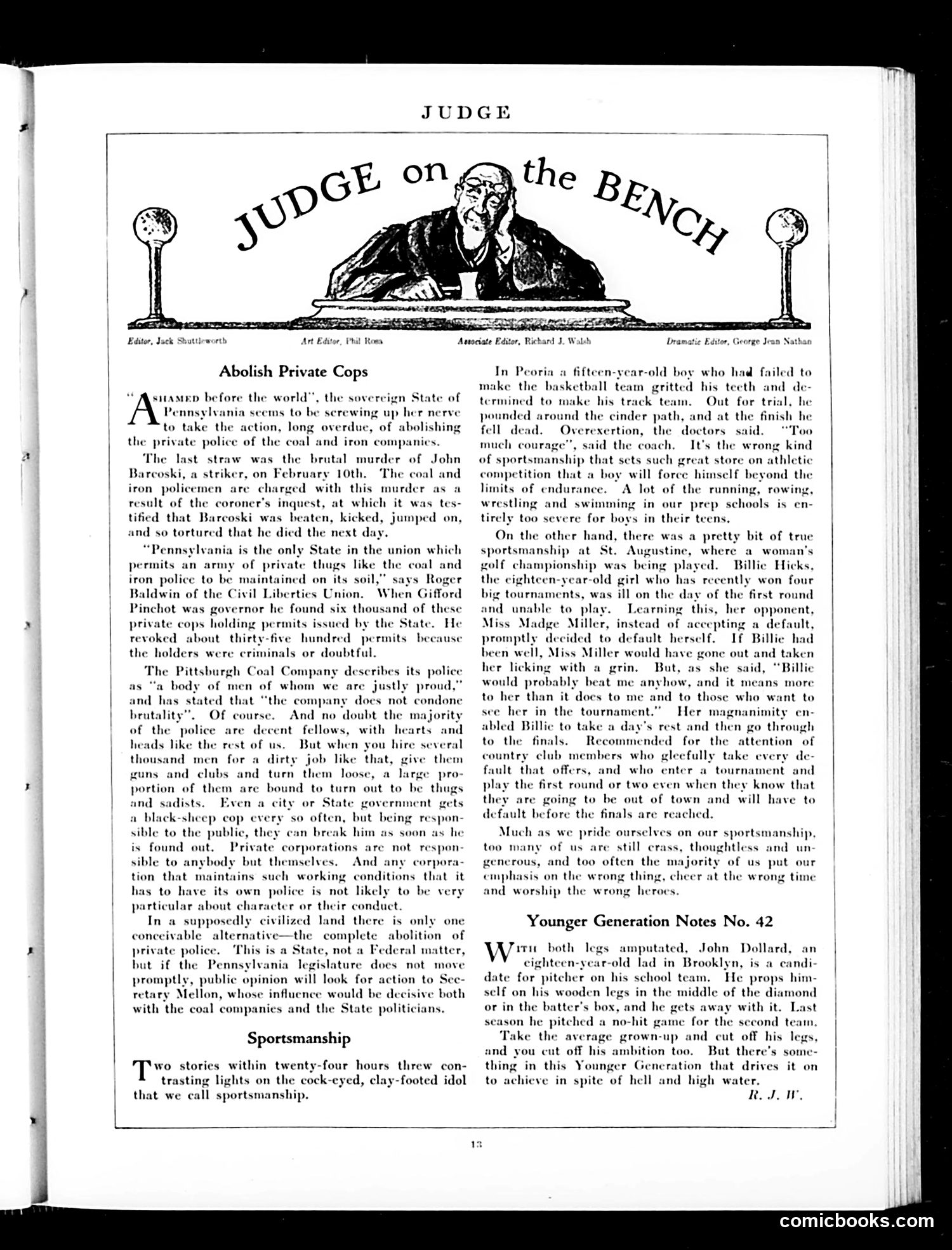
This page contains two editorial arguments about American character and conduct: **"Abolish Private Cops"** criticizes Pennsylvania's practice of allowing coal and iron companies to maintain private police forces. The piece references the murder of striker John Barcoski (February 10th) allegedly by company police, arguing that private corporations cannot be trusted with law enforcement. It calls on Pennsylvania's legislature—or Secretary of Treasury Andrew Mellon, who reportedly influences state politicians—to abolish these forces entirely. **"Sportsmanship"** presents contrasting moral tales: a fifteen-year-old boy in Peoria dies from overexertion pursuing track team tryouts (condemned as misplaced competitive values), while golfer Billie Hicks's opponent Madge Miller honorably defaults rather than compete against her injured rival. The editorial praises Miller's generosity while criticizing excessive athletic pressure on youth. Both pieces critique American excess—whether in corporate power or competitive obsession—as threats to human welfare.
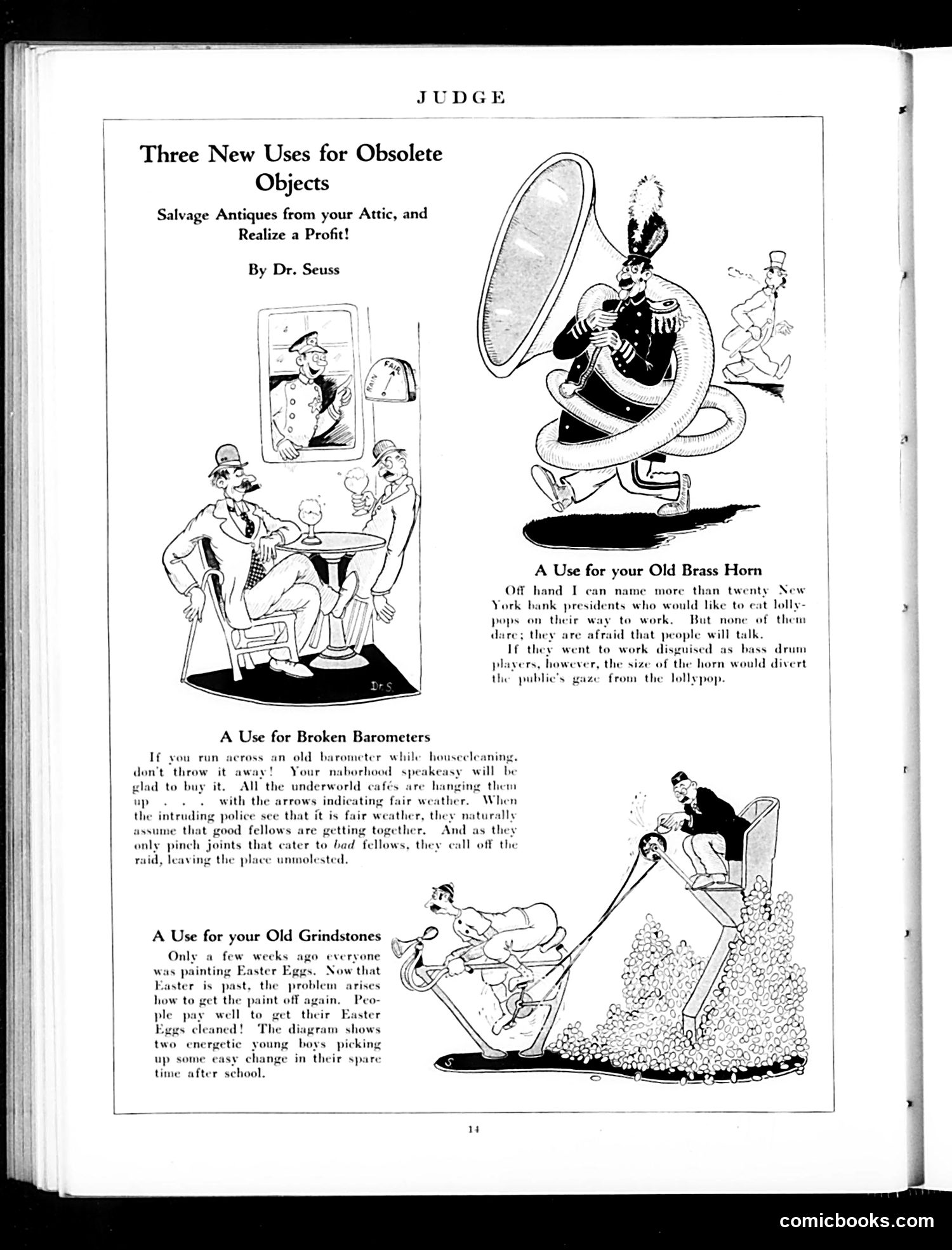
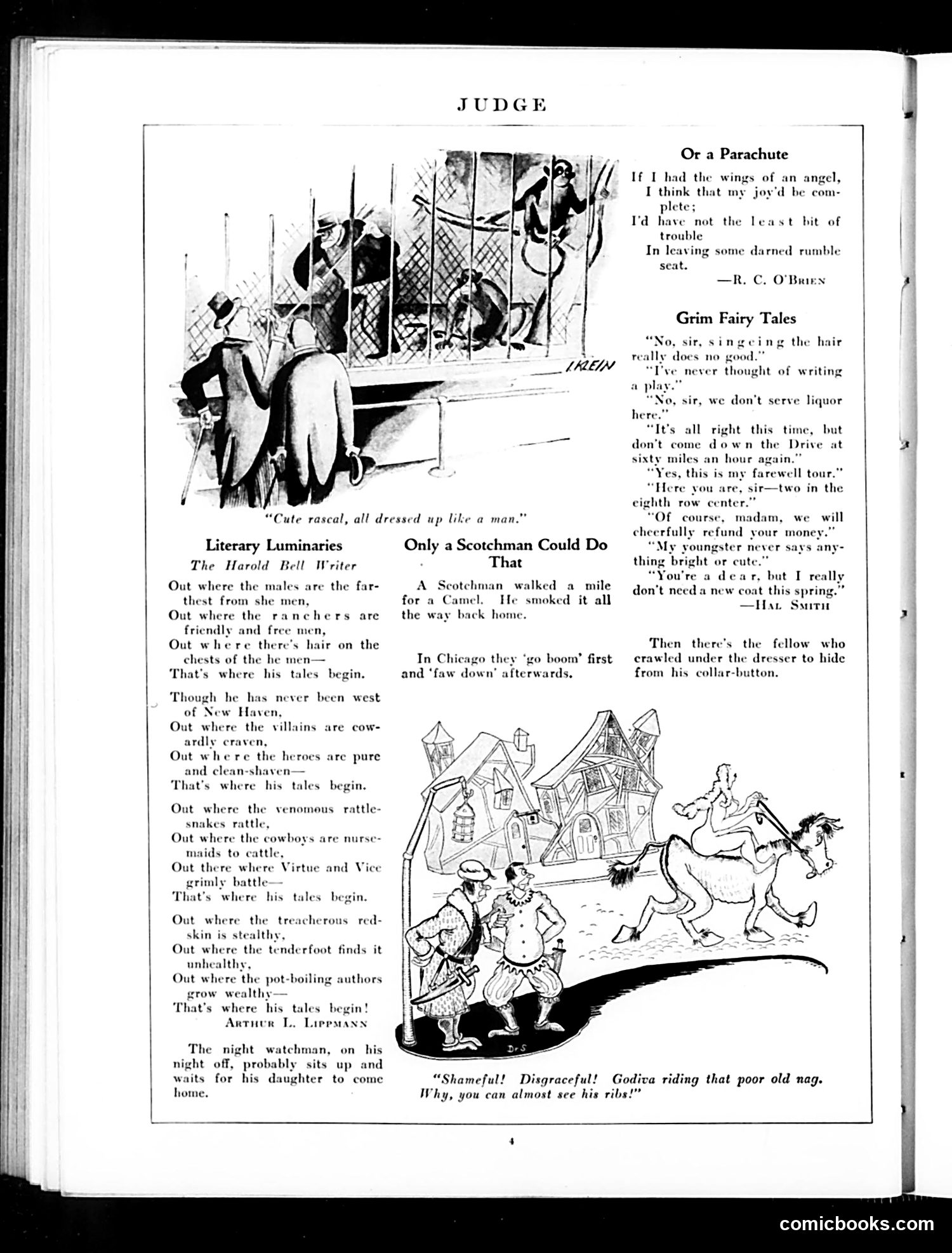
This 1920s-era Dr. Seuss satire mocks Prohibition-era social hypocrisy through absurdist humor. **The three "uses" mock:** 1. **Bank presidents eating lollipops disguised as bass drum players** — satirizes how wealthy, respectable men feared social judgment for minor indulgences, suggesting absurd disguises to avoid scrutiny. 2. **Broken barometers in speakeasies** — directly references Prohibition (1920-1933). Illegal bars ("underworld cafés") supposedly displayed barometers showing "fair weather" to signal police that "good fellows" were present, deterring raids on establishments serving alcohol illegally. 3. **Easter egg paint cleaning** — straightforward child labor joke about boys earning money after school. The core satire: during Prohibition, seemingly respectable institutions (banks, police) participated in or enabled lawbreaking while maintaining appearances of propriety. The absurd "solutions" highlight how ridiculous this moral hypocrisy had become.
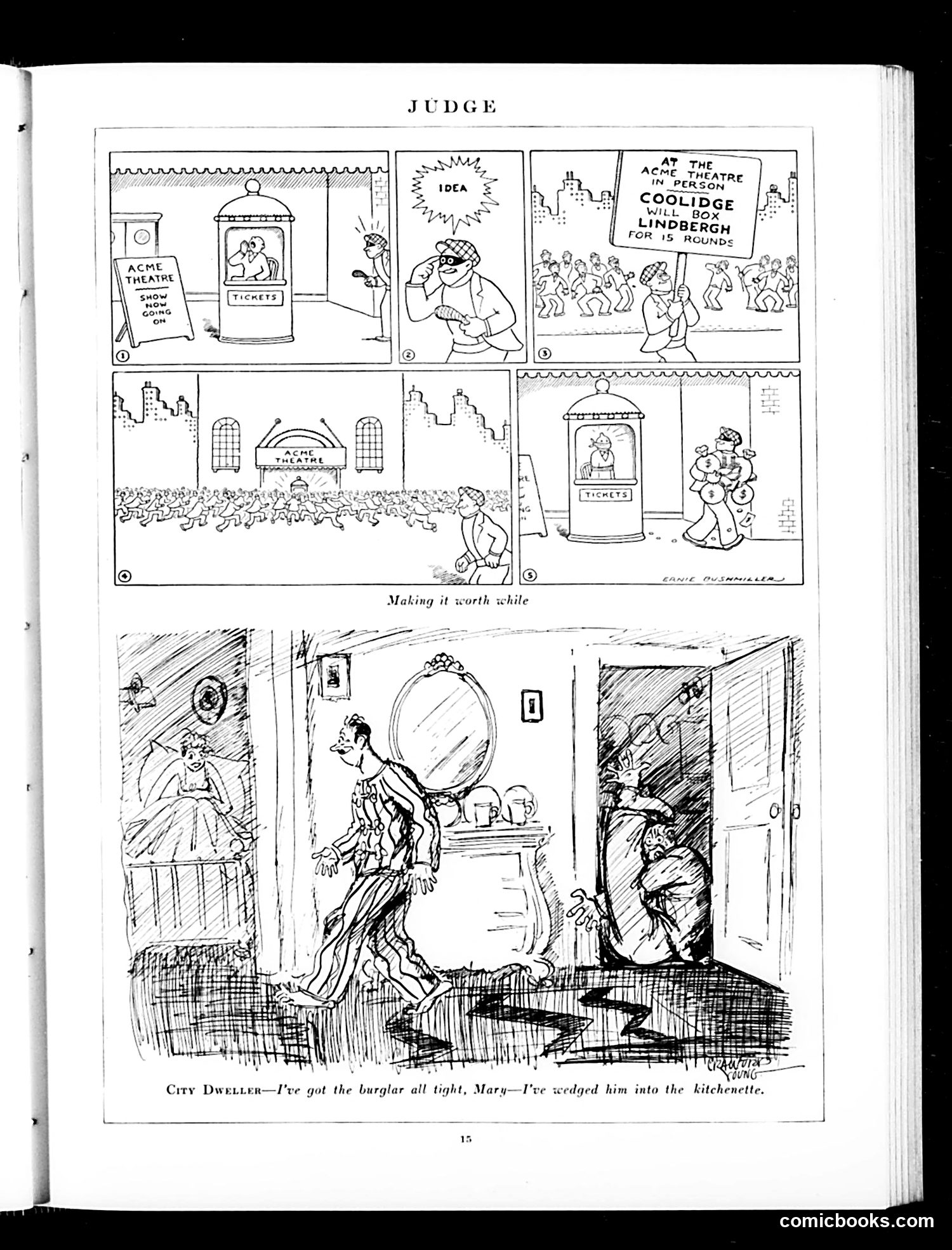
The page contains two distinct cartoon sections: **Top section** ("Making it worth while"): A four-panel comic strip satirizing theater marketing. It shows the Acme Theatre promoting a performance by Coolidge and Lindbergh "in person." The joke appears to mock the theater's exaggerated advertising claims and crowd enthusiasm—likely a commentary on celebrity culture and theatrical hype of the 1920s-30s era. **Bottom section** ("City Dweller"): A single-panel cartoon depicting a domestic scene where a woman has caught a burglar and "wedged him into the kitchenette" (a small kitchen). The humor contrasts urban apartment living's cramped spaces with a homeowner's resourcefulness—satirizing city apartment life as claustrophobic and comedically inadequate for handling emergencies. Both cartoons employ situational humor typical of Judge's satirical approach to American social customs.
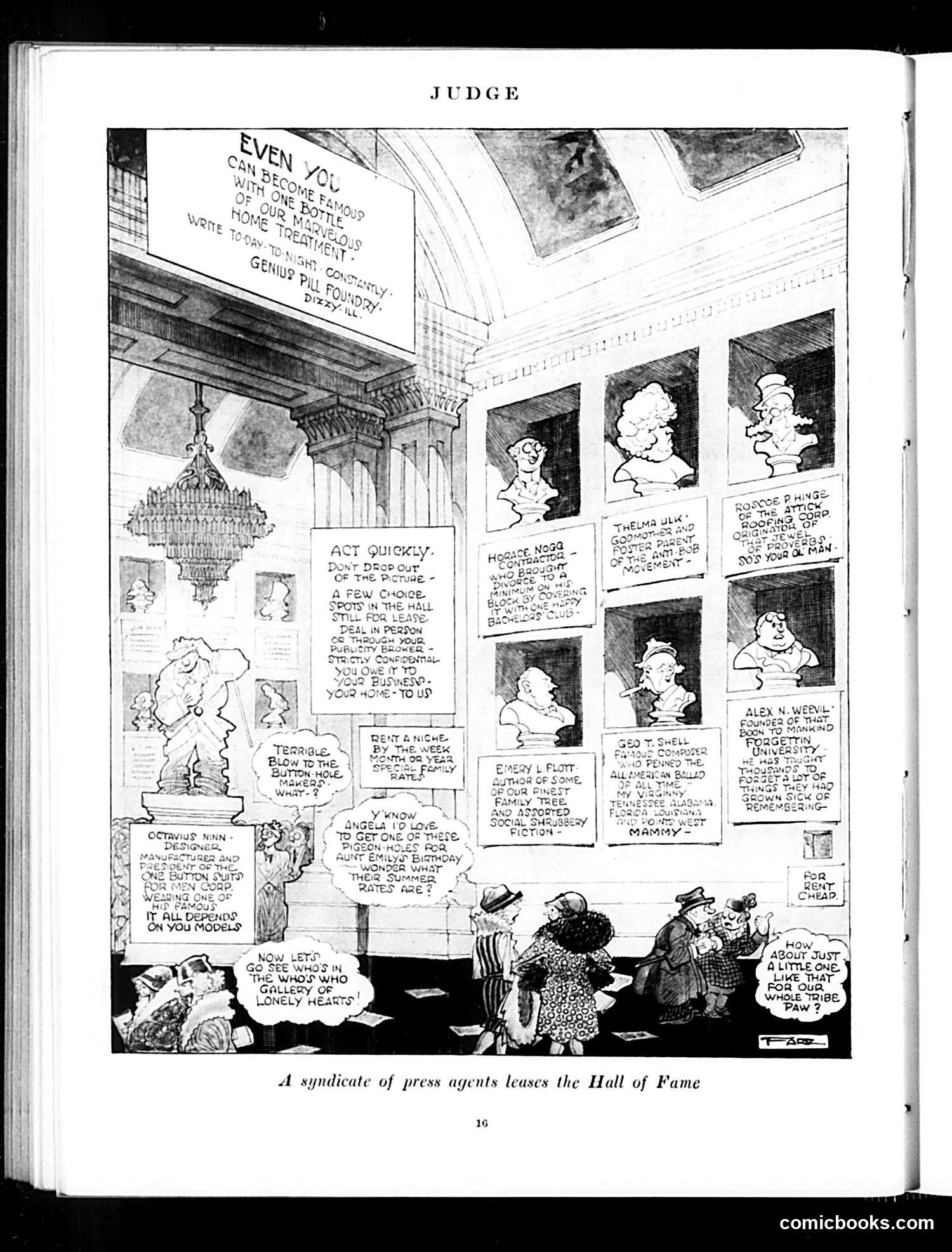
This cartoon mocks the commercialization of celebrity and fame through "press agents"—publicists who manufacture reputations. The "Hall of Fame" is depicted as a gallery of busts with accompanying promotional text, suggesting these figures' legacies are artificially constructed marketing products rather than genuine achievements. The press agents (bottom) are literally "leasing" fame to clients, treating reputation as a commodity. Characters in the gallery appear to be minor or questionable celebrities whose accomplishments are inflated by their agents' promotional copy. The satire targets early 20th-century celebrity culture: how publicity machines could elevate unknowns to fame through hype rather than merit. The "Lonely Hearts" gallery reference suggests even personal relationships are being commodified and sold. The joke emphasizes that fame itself has become a purchasable product, disconnected from actual distinction or worth—a commentary on the growing power of public relations in American society.
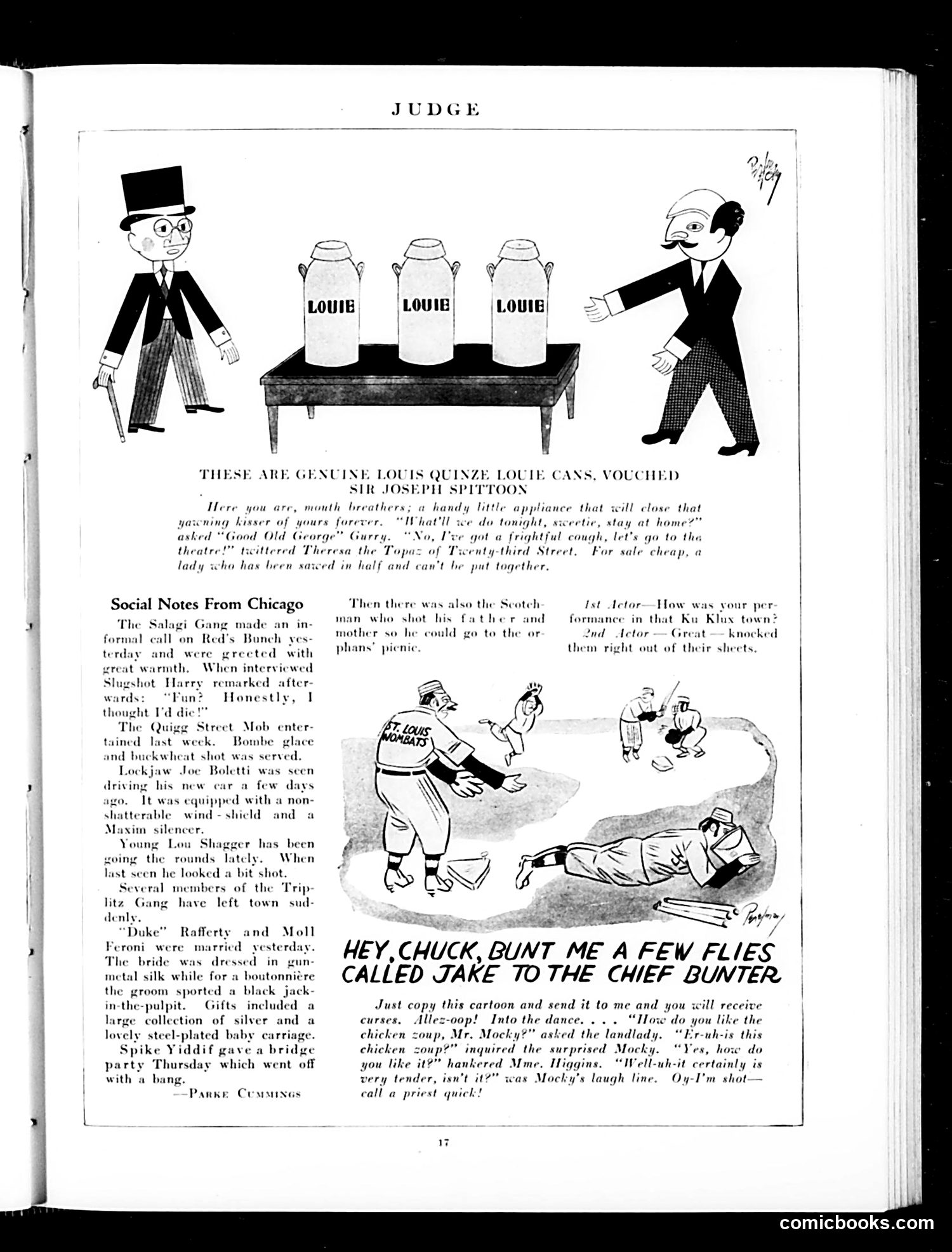
This page from *Judge* contains satirical humor typical of early 20th-century American comedy magazines. **Top Cartoon**: Mocks Prohibition-era bootlegging. Two men flank three bottles labeled "LOUIE" (likely referring to cheap whiskey). The text jokes about closing "that gawning kisser of yours forever"—satirizing both the appeal of alcohol and the absurdity of Prohibition enforcement. **"Social Notes from Chicago"**: A recurring humor column parodying high-society gossip by applying it to Chicago's criminal underworld. References to "Slugshot Harry," "Lockjaw Joe Boletti," and various "gangs" mock both organized crime and society pages. The dark jokes (the Scotsman murdering his parents to attend an orphans' picnic) exemplify *Judge's* cynical humor. **Bottom Cartoon**: Baseball humor involving a character named "Jake" and crude double-entendre about "chicken soup," typical of vaudeville-influenced comedy. The page satirizes Prohibition, organized crime glamorization, and working-class entertainment conventions of the era.
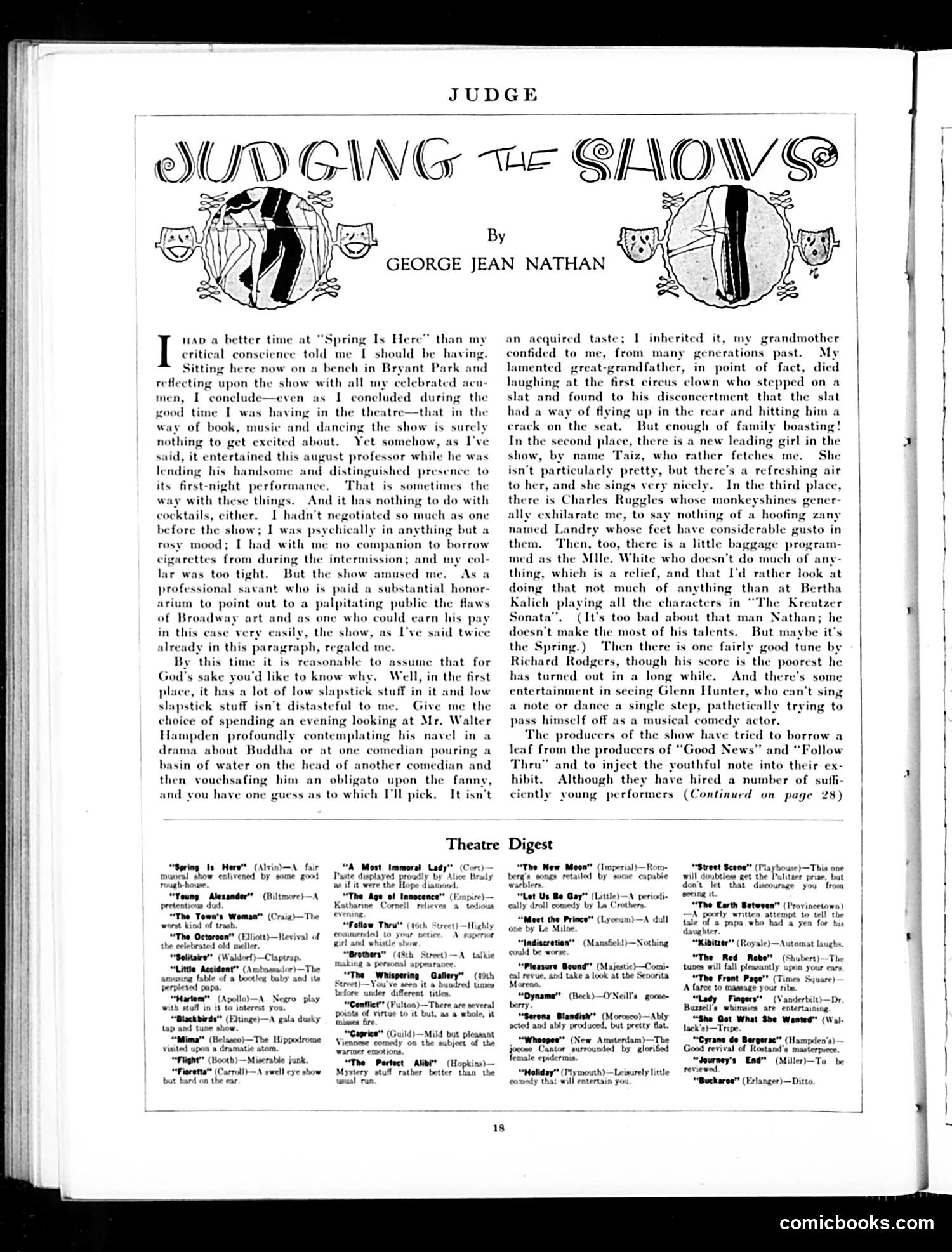
This is a theater review column, not a political cartoon. Nathan, a prominent drama critic, reviews the Broadway musical "Spring Is Here," admitting he enjoyed it despite his critical standards. He defends his enjoyment by explaining three things: first, he appreciates lowbrow slapstick comedy (he humorously prefers "one comedian pouring a basin of water on the head of another" to pretentious drama); second, he's charmed by a new leading actress named Taiz; and third, he appreciates various comic performers in the show, particularly a dancer named Landry. The piece satirizes the tension between a critic's professional duty to judge art seriously and the human tendency to simply enjoy entertainment. The "Theatre Digest" section lists other current Broadway productions with brief dismissive or approving comments.
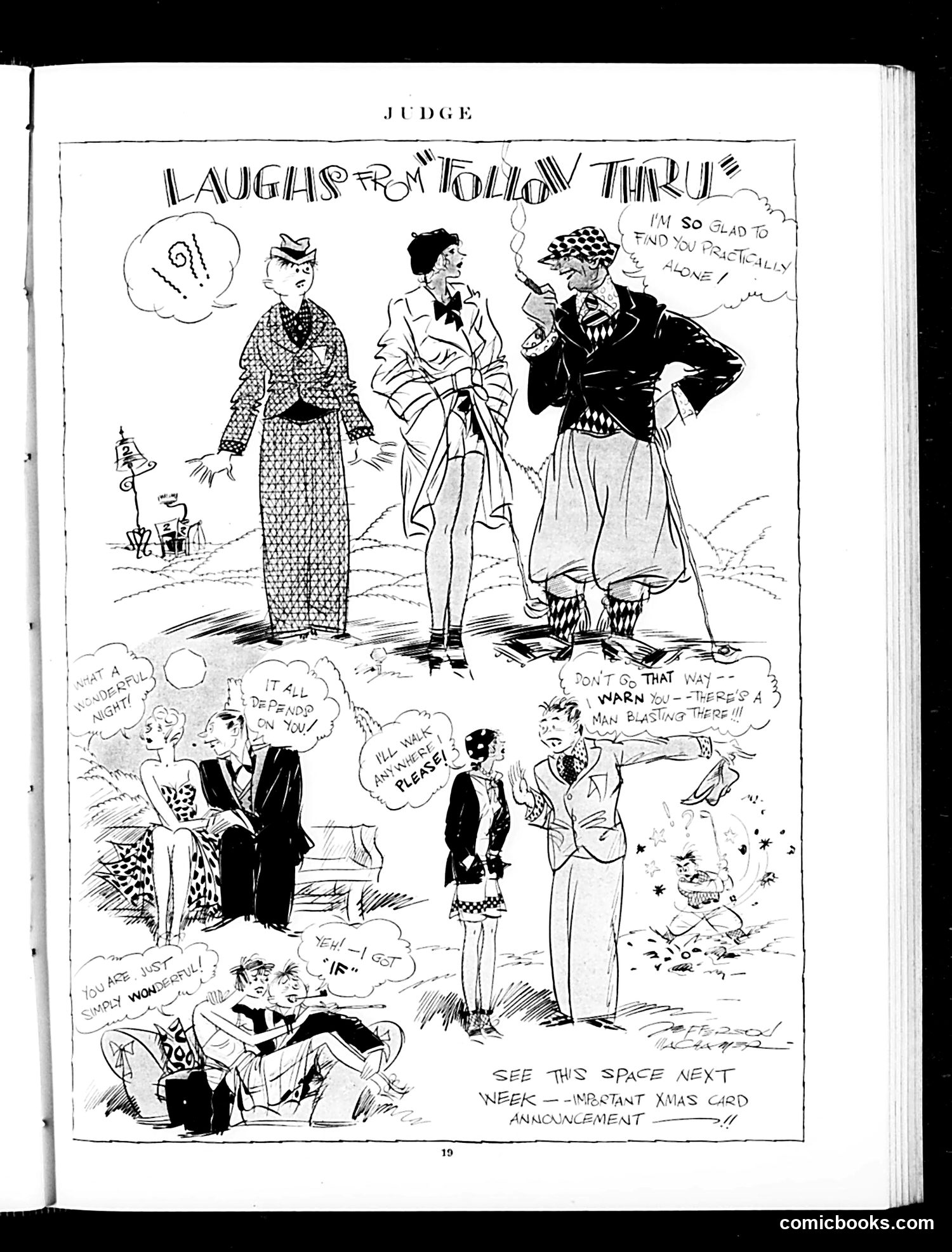
This is a comic strip showing romantic and social misunderstandings during what appears to be a courtship or dating scenario. The title suggests humor emerges from situations that develop across multiple panels. The strip depicts several couples in various states of confusion and miscommunication—people talking past each other, misinterpreting intentions, and getting tangled in social awkwardness. One character warns "Don't go that way—warn you—there's a man blasting there!!!" suggesting physical danger or chaos interrupting romantic moments. The humor relies on the visual gags of people dodging around each other, the escalating confusion in dialogue bubbles, and the physical comedy of romantic entanglements gone wrong. At bottom, an announcement promises Christmas card content next week, suggesting this was seasonal magazine content.
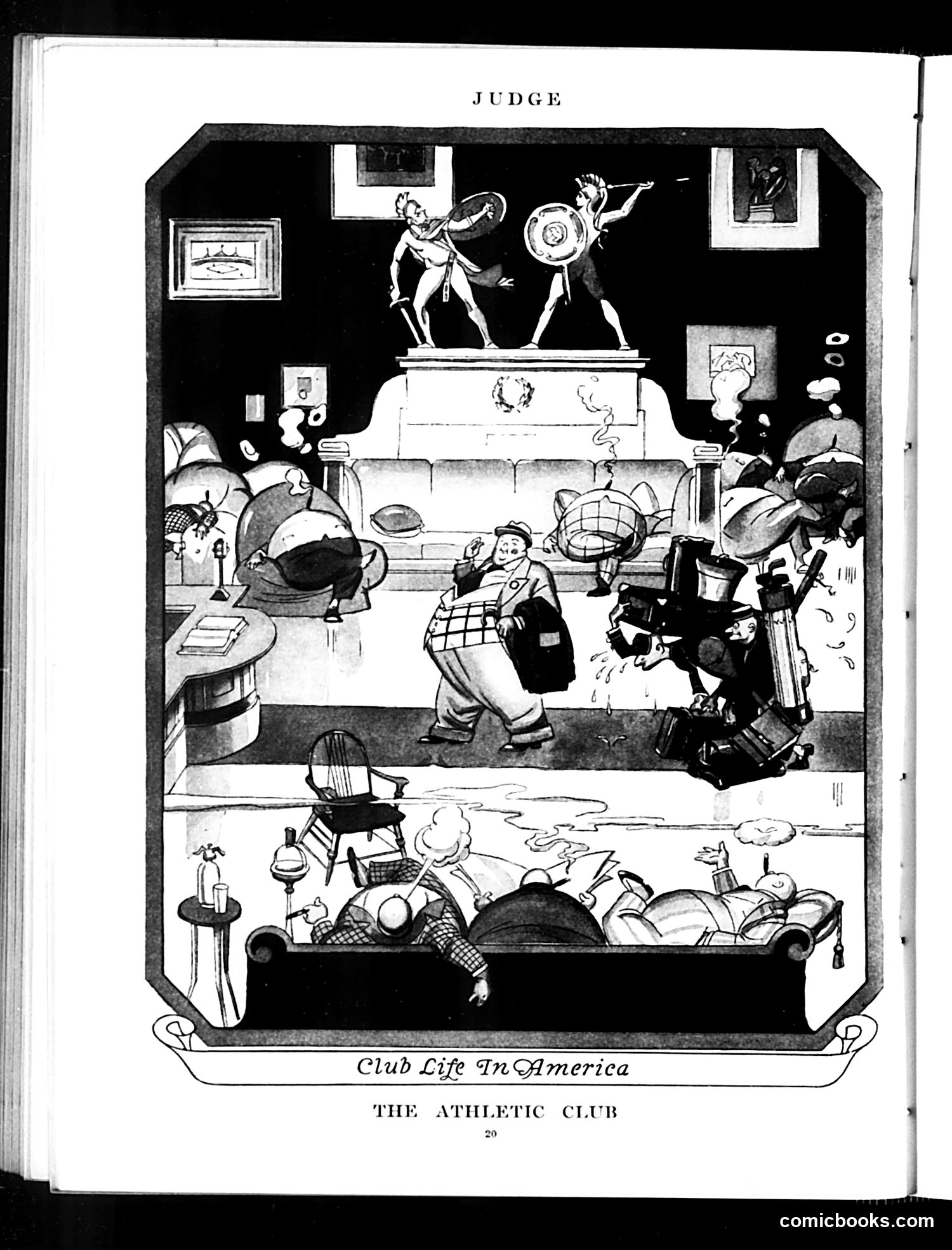
This cartoon satirizes American athletic clubs of the era through exaggerated caricature. The image depicts a fancy club where wealthy members engage in leisure activities—exercising, socializing, and lounging—while servants and staff attend to them. The figures are drawn with comedic proportions and theatrical poses. The satire likely critiques the self-indulgent excess of exclusive clubs: members performing athletic displays for each other's admiration (note the figures posturing atop the central platform), the class disparities (well-dressed patrons versus laborers), and the performative nature of "gentlemen's" athletic pursuits. The elaborate setting and ornate furnishings mock the pretensions of such establishments. The title "Club Life in America" suggests Judge is using this particular club as a microcosm to comment on American wealth, leisure culture, and social hierarchy among the upper classes during Judge's publication period.
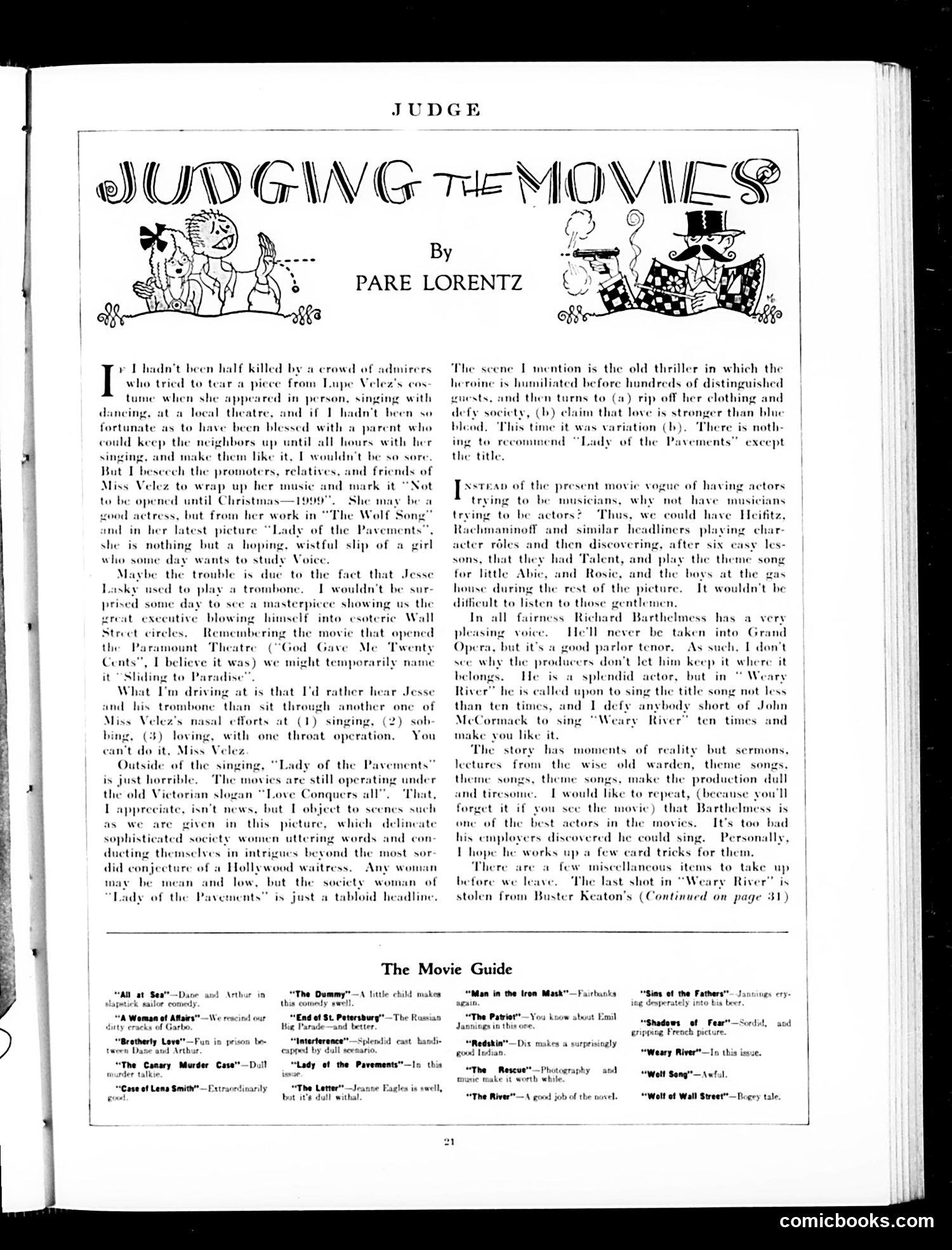
This is a film review column, not a political cartoon. Lorentz critiques contemporary 1920s movies, particularly attacking actress Lupe Vélez's singing performances and the trend of casting non-musicians as singers. **Main targets:** - **Lupe Vélez**: A popular silent film actress whose personal appearances caused fan riots. Lorentz mocks her singing voice in "The Wolf Song" and "Lady of the Pavements," calling her merely "a hoping, wistful slip of a girl." - **Hollywood's miscast singers**: The broader complaint is that studios force actors to sing when they lack talent, naming Richard Barthelmess in "Weary River" as an example. - **Jesse Lasky** (Paramount executive): A joking aside suggesting his trombone-playing background influences terrible executive decisions. **The satire's point**: Hollywood's commercial desperation during the transition to sound film led producers to exploit actors' popularity rather than hire actual singers, creating unwatchable performances.
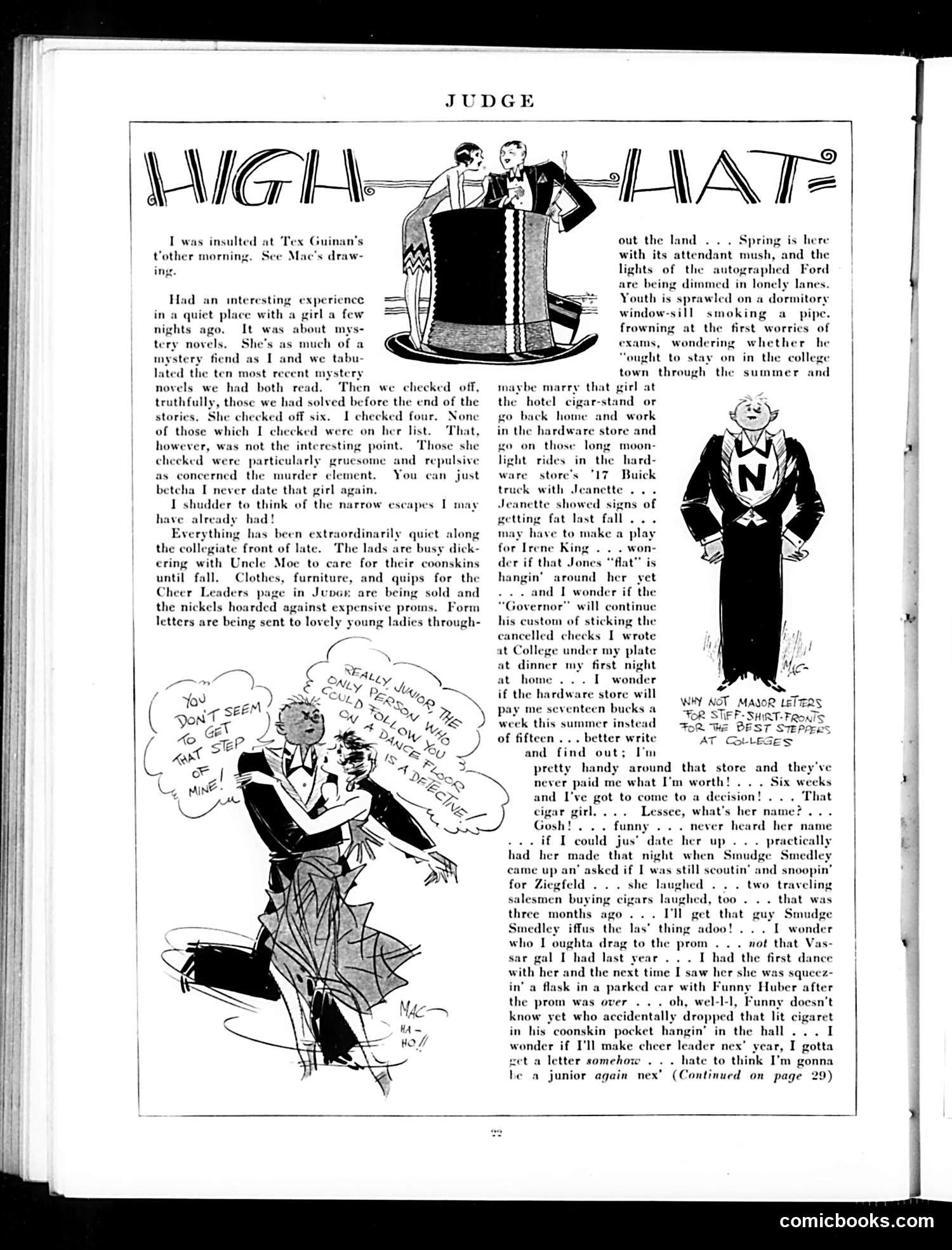
This page features a satirical column mocking college life and social pretensions of the era. The main text is a rambling, self-absorbed monologue from a college student dwelling on trivial concerns: dating mishaps, summer employment prospects, and social status anxieties. Key references include **Tex Guinan's** (a famous speakeasy), **Uncle Moe** (likely a relative or authority figure), and casual mentions of **Ziegfeld** (theatrical productions). The illustrations caricature the confused, anxious student mentality. The satire targets the superficiality of collegiate social life—obsession with appearance, romantic conquests, and economic concerns (haggling over summer wages). The rambling, stream-of-consciousness style emphasizes youthful self-absorption and indecision. The humor relies on readers recognizing these as universal college stereotypes and vanities worth mocking.
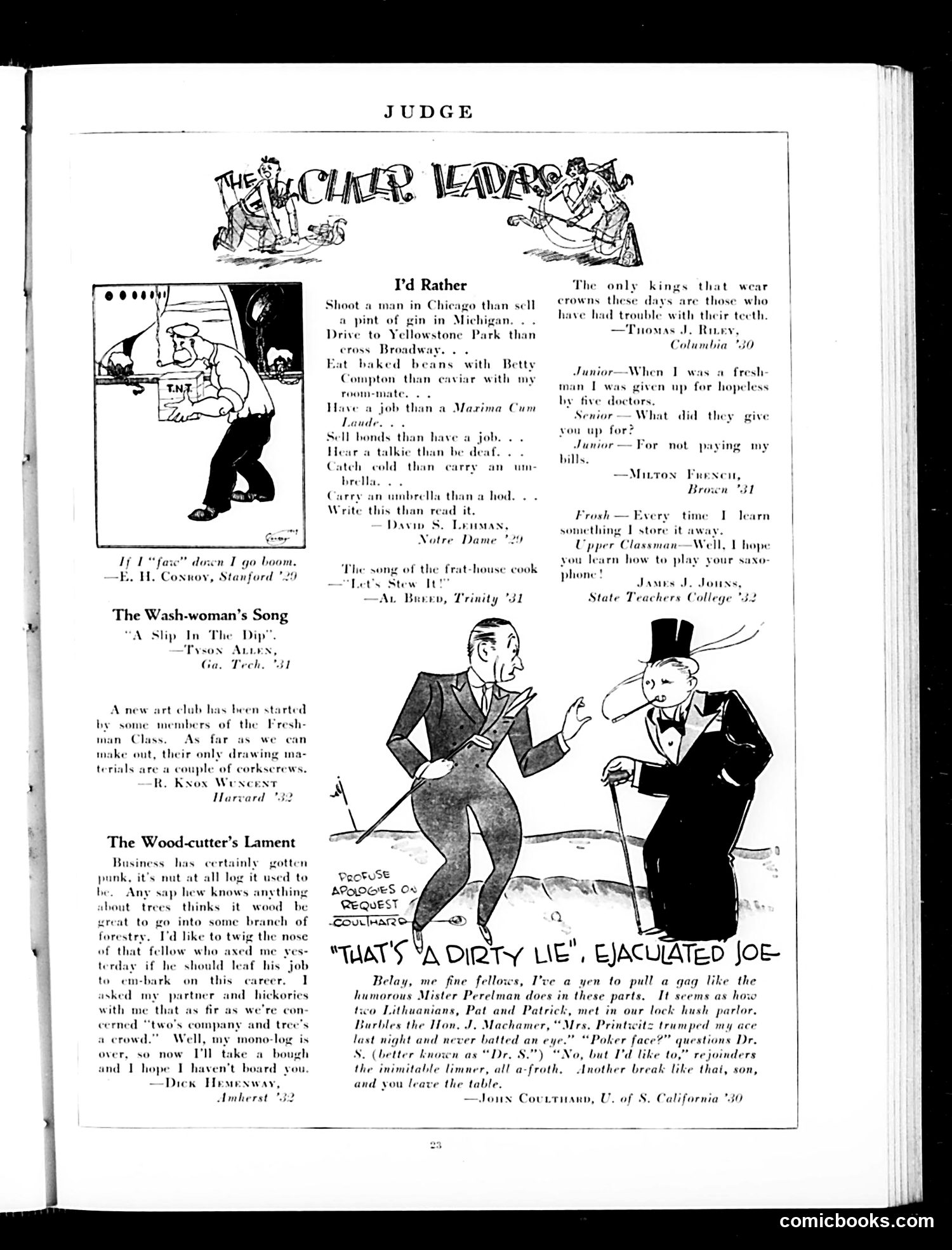
This page from Judge magazine contains several student humor submissions, primarily jokes and comic vignettes from college contributors (dated late 1920s-early 1930s). The main cartoon depicts two men in formal attire arguing outdoors, with one ejaculating "That's a dirty lie!" The accompanying text by John Coulthard (U. of S. California '30) is a humorous anecdote about two Lithuanians named Pat and Patrick meeting in a barbershop. The joke plays on ethnic stereotypes and involves wordplay about a woman's "poker face" during a card game—the punchline being that she silently left rather than responding to the men's behavior. The page also includes brief humorous quotes submitted by students, mostly comparing preferences ("I'd Rather..."), and commentary on campus life. The tone is lighthearted college humor typical of the era, relying on ethnic jokes and genteel satire rather than sharp political commentary.
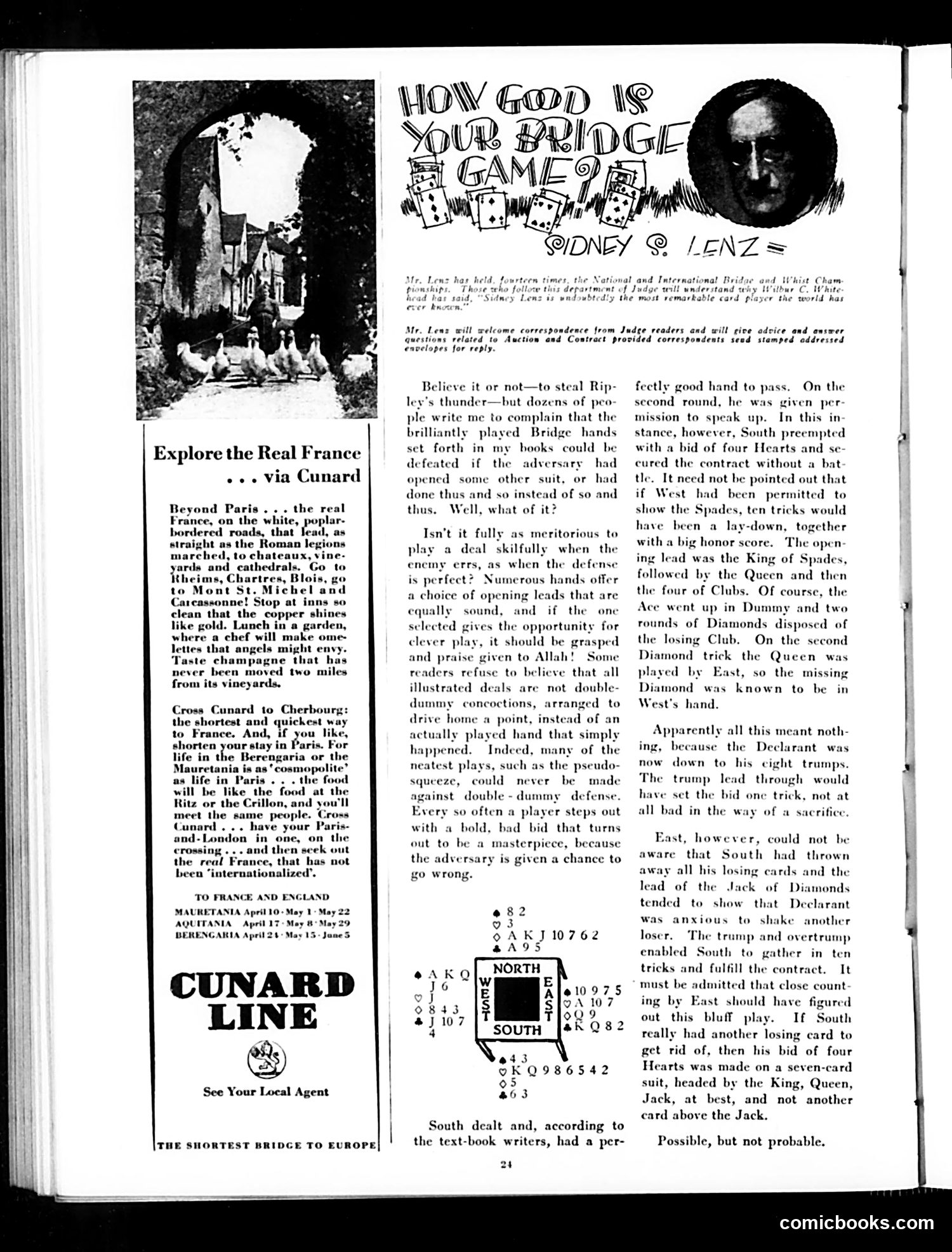
This page contains a **bridge card game column** by Sidney S. Lenz (whose portrait appears at top right), a famous bridge expert of the era. The column's title "How Good Is Your Bridge Game?" is a playful reference to Robert Ripley's "Believe It or Not" feature. Lenz addresses reader complaints that his published bridge hands could be defeated with different plays—suggesting the deals are artificially constructed. He argues this misses the point: skilled play *against actual errors* is equally meritorious as perfect defense. He then analyzes a specific hand where South made a bold preemptive bid that succeeded because East couldn't deduce South's true card distribution. The surrounding content includes a **Cunard Line advertisement** promoting transatlantic travel to France, emphasizing luxury ship amenities alongside tourism. The **satire is implicit**: Lenz gently mocks readers who don't understand bridge strategy while defending his pedagogical approach. The page reflects 1920s-30s leisure culture for affluent audiences—bridge enthusiasts who could afford ocean voyages.
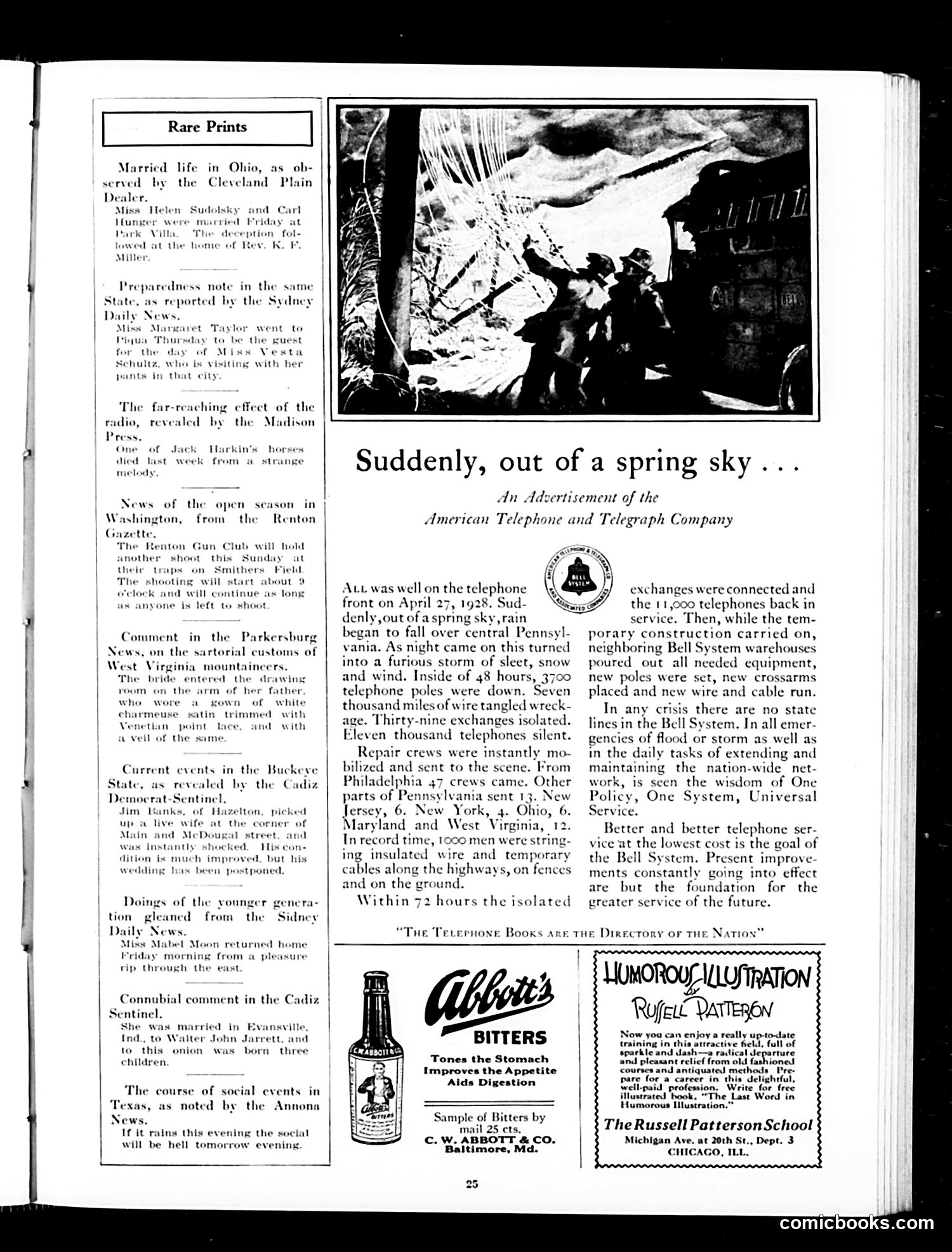
This page is primarily **advertisements and filler content** rather than political satire. The main feature is a **full-page advertisement for the American Telephone and Telegraph Company** celebrating the Bell System's disaster response capabilities. The ad describes a real 1928 Pennsylvania storm that downed 3,700 telephone poles and 7,000 miles of wire. It portrays Bell's coordinated interstate response—crews from multiple states restoring service within 72 hours—as evidence of American industrial competence and the wisdom of a unified "One Policy, One System, Universal Service" approach. The page's left column contains humorous newspaper clippings from various regional papers (Ohio, Texas, West Virginia) highlighting quirky local news items—marriages, hunting reports, social events. This "Rare Prints" section appears to mock small-town journalism clichés. The remaining advertisements promote Abbott's Bitters (a medicinal tonic) and the Russell Patterson School of illustration. **The satire is minimal here**; this reads as a typical 1920s magazine layout mixing editorial humor with corporate and patent-medicine advertising.
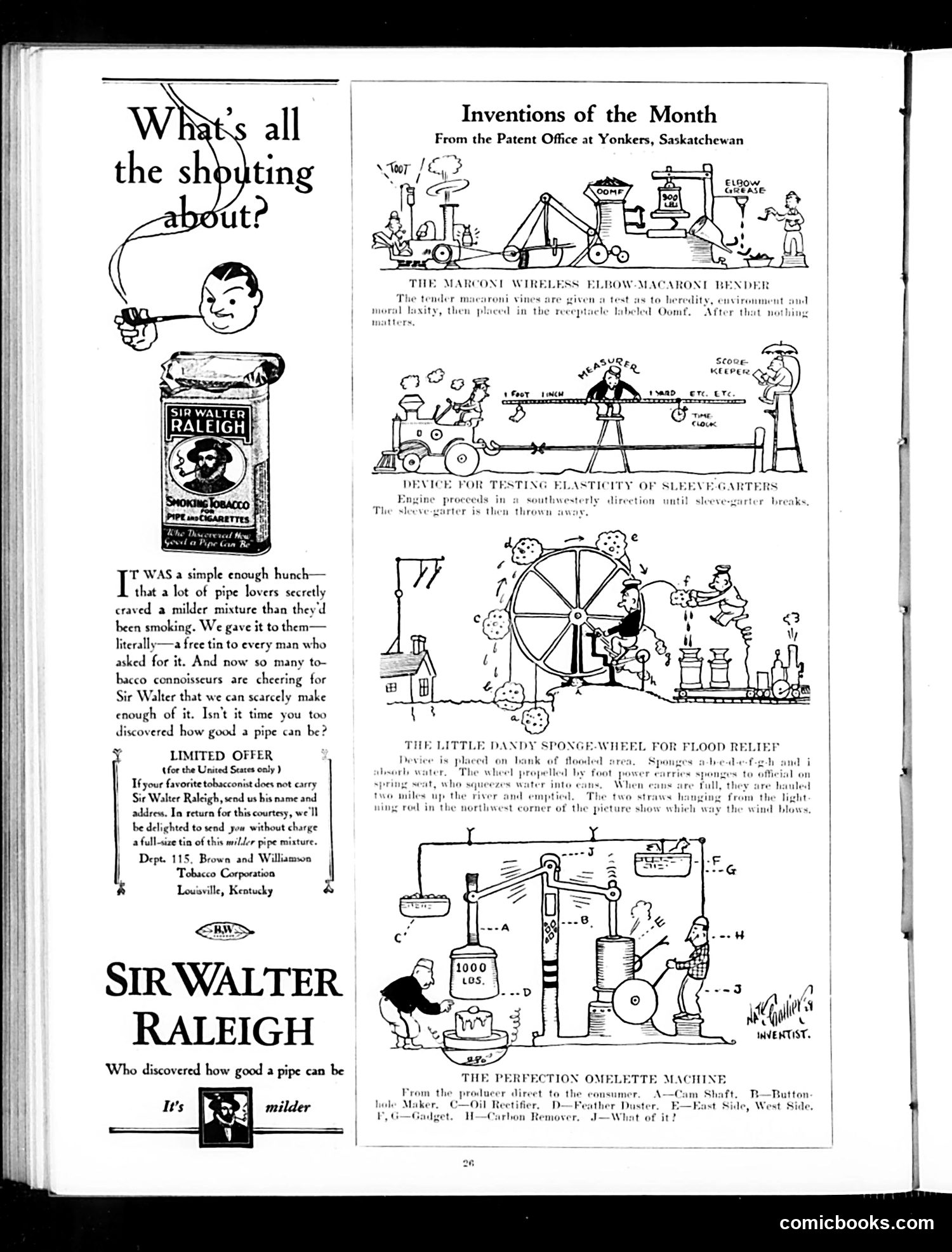
This page mixes advertising with satirical content typical of Judge magazine. The left side is a **Sir Walter Raleigh pipe tobacco advertisement** using historical association (Raleigh "discovered" good pipes, the ad claims) to sell a "milder" smoking mixture—appealing to smokers seeking a less harsh product. The right side shows "**Inventions of the Month**" from a fictional "Patent Office at Yonkers, Saskatchewan"—a humorous setup. These are absurd contraptions with whimsical names like "The Little Dandy Sponge-Wheel for Flood Relief" and "The Perfection Omelette Machine." The crude drawings and elaborate, impractical designs satirize both the era's genuine patent-filing culture and the tendency to over-engineer simple problems. The satire works because early 20th-century America experienced a "patent craze"—anyone could file patents for dubious inventions. Judge mocks this by presenting deliberately useless, overcomplicated devices as serious innovations, poking fun at both inventors and readers' fascination with novelty gadgets.
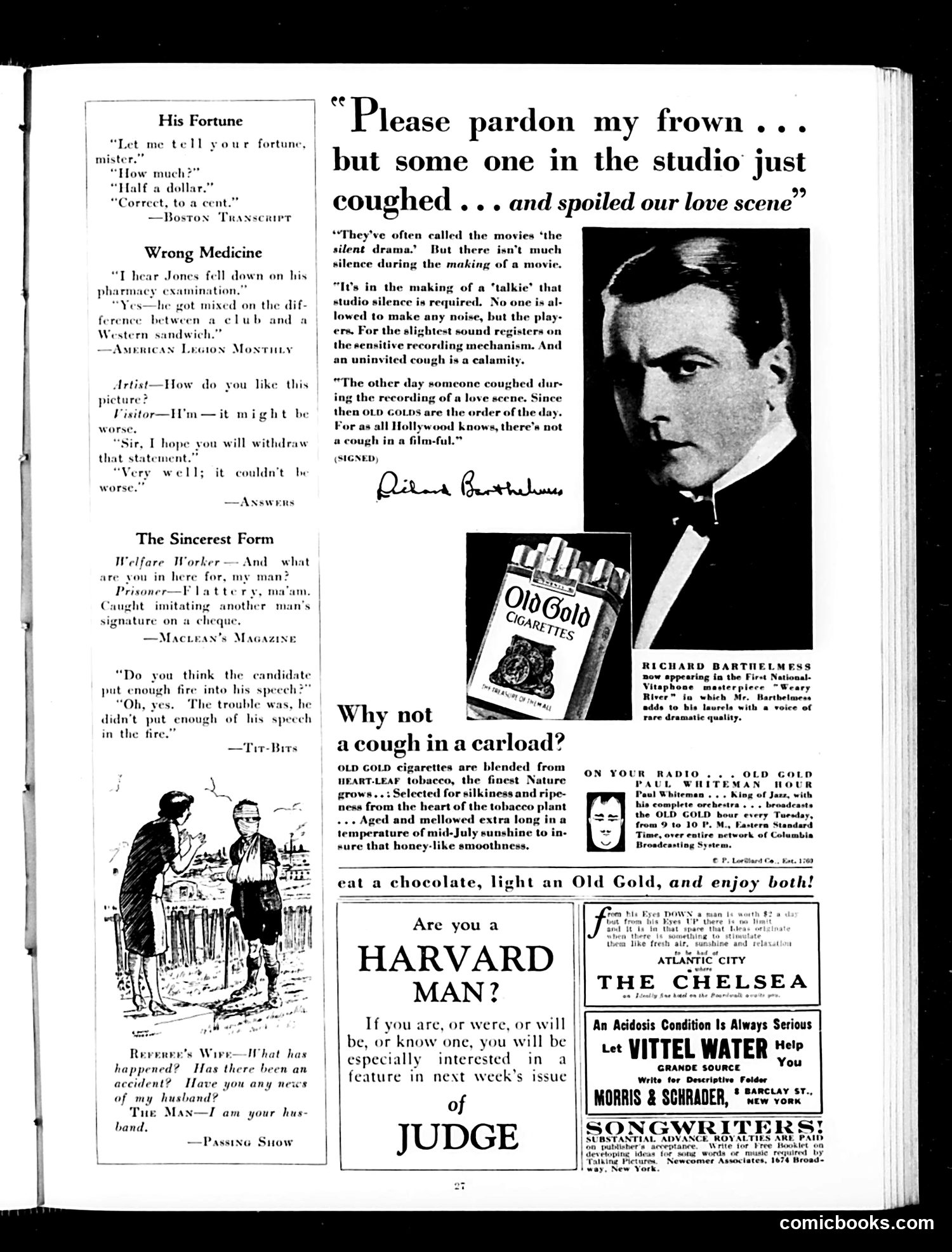
This page mixes satirical humor with advertisements, primarily focused on early "talkie" (sound) film production challenges. **Main Content:** The large feature mocks Hollywood's difficulty maintaining studio silence during sound recording. Actor Richard Barthelmess (identified in caption) complains that someone coughed during a love scene, ruining the take. The satire targets the film industry's transition from silent to sound pictures—a revolutionary but technically demanding shift requiring absolute quiet during recording. **Context:** By the late 1920s, synchronized sound was still novel and fragile. Any ambient noise—coughs, footsteps, machinery—would be captured on the sensitive recording equipment, destroying takes. The piece humorously emphasizes this absurd constraint. **Advertising:** The page is dominated by Old Gold cigarettes, ironically promoting their "smoothness" while the feature complains about coughs—a clever (if cynical) juxtaposition that audiences would have recognized. The page reflects genuine 1920s-era anxieties about Hollywood's technological transition and the film industry's growing pains.
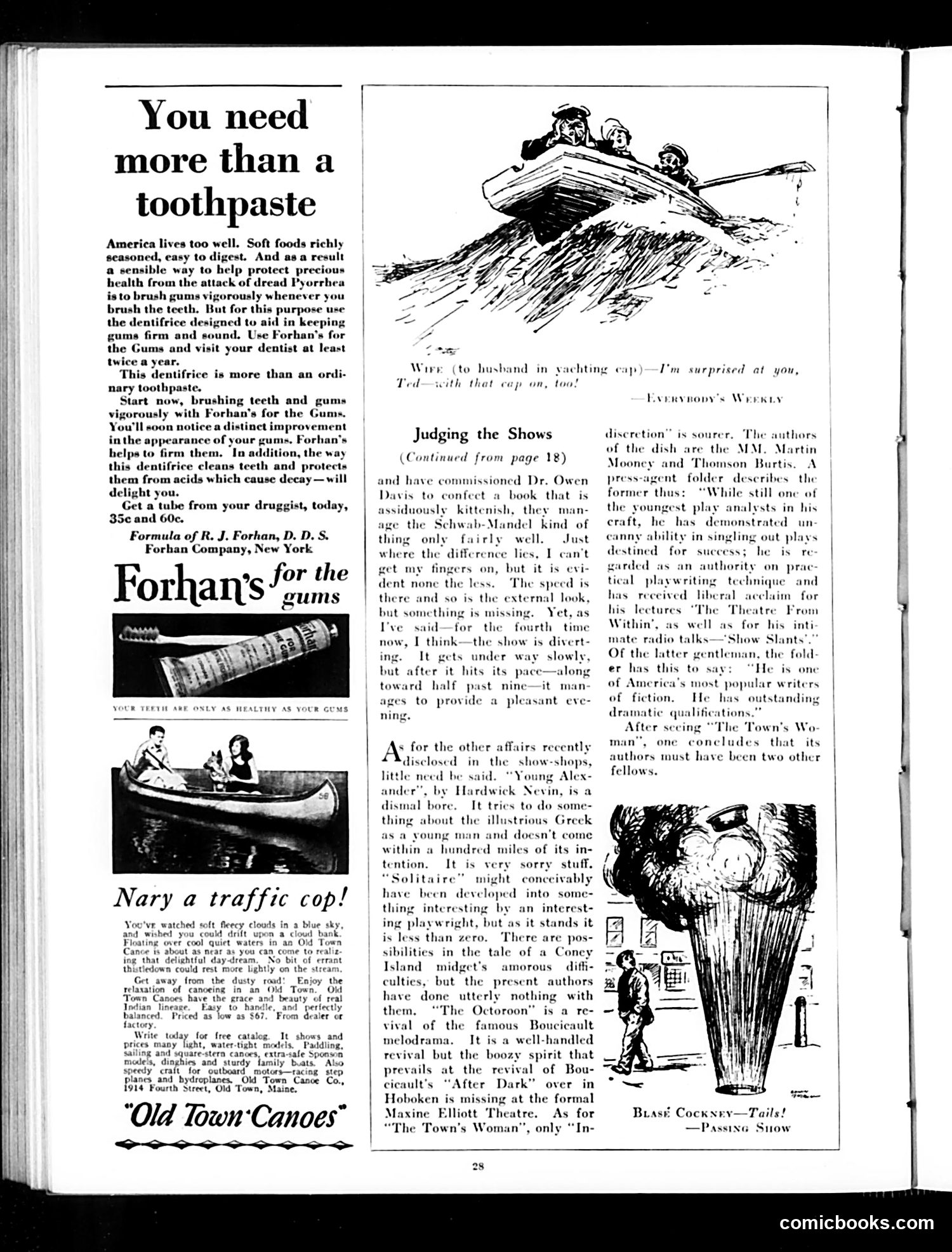
This page mixes advertisements with theater criticism. The **cartoons** are minimal—just humorous vignettes accompanying ads. The top cartoon (Forhan's toothpaste) shows a couple in a canoe; the joke appears to be about oral hygiene enabling romance or confidence. The middle cartoon ("Nary a traffic cop!") depicts a peaceful canoe scene, using idyllic imagery to sell Old Town Canoes as an escape from urban life. The bottom cartoon shows a woman addressing a man in a yachting cap ("Wire to husband"), likely satirizing wealthy leisure activities or marital dynamics among the affluent. The page's primary content is **theater criticism** evaluating recent Broadway plays, assessing works by various playwrights. The critic discusses "The Town's Woman" and other productions with dismissive language ("dismal bore," "less than zero"). These are straightforward period advertisements and reviews—the satire is genteel rather than sharp, reflecting Judge magazine's audience of middle-to-upper-class readers interested in consumer goods and cultural commentary.
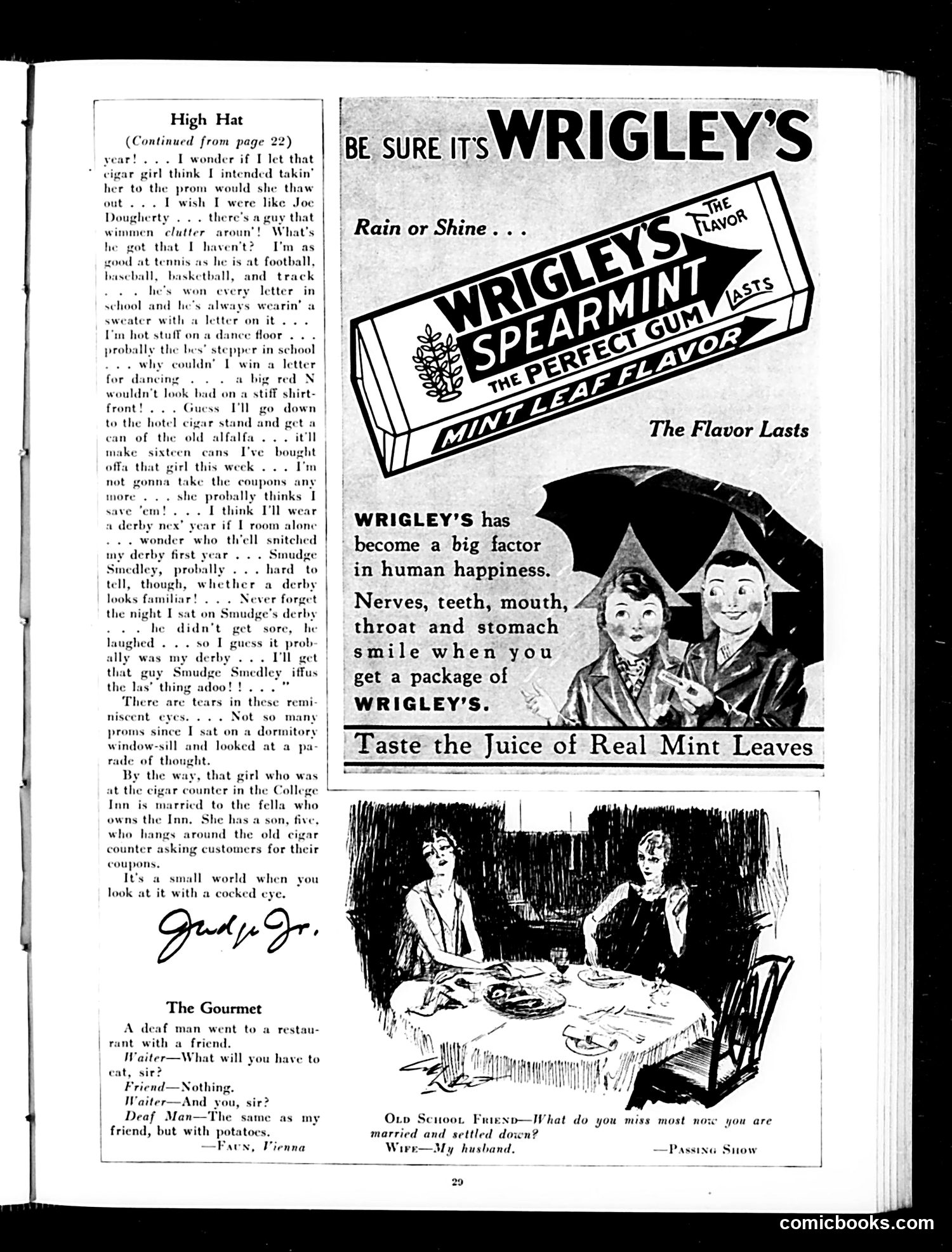
This page contains multiple unrelated satirical pieces typical of Judge magazine's format. **"High Hat"** (left column) is a comedic monologue from a young man, likely a college student, obsessing over social status—comparing himself unfavorably to a more accomplished peer named Joe Dougherty, worrying about impressing a "cigar girl," and fantasizing about wearing a letterman sweater or derby hat. The humor derives from his insecurity and shallow preoccupations. **"The Gourmet"** is a brief joke playing on a deaf man's misunderstanding at a restaurant—he repeats "the same as my friend, but with potatoes," creating absurdist humor. **The Wrigley's advertisement** dominates the right side, promoting Spearmint gum with claims it affects "nerves, teeth, mouth, throat and stomach." Below is a cartoon captioned "Old School Friend" showing two women at dinner; the joke suggests a married woman misses her freedom more than her husband. The page reflects 1920s social preoccupations: college life, dating anxieties, and consumer products marketed with exaggerated health claims.
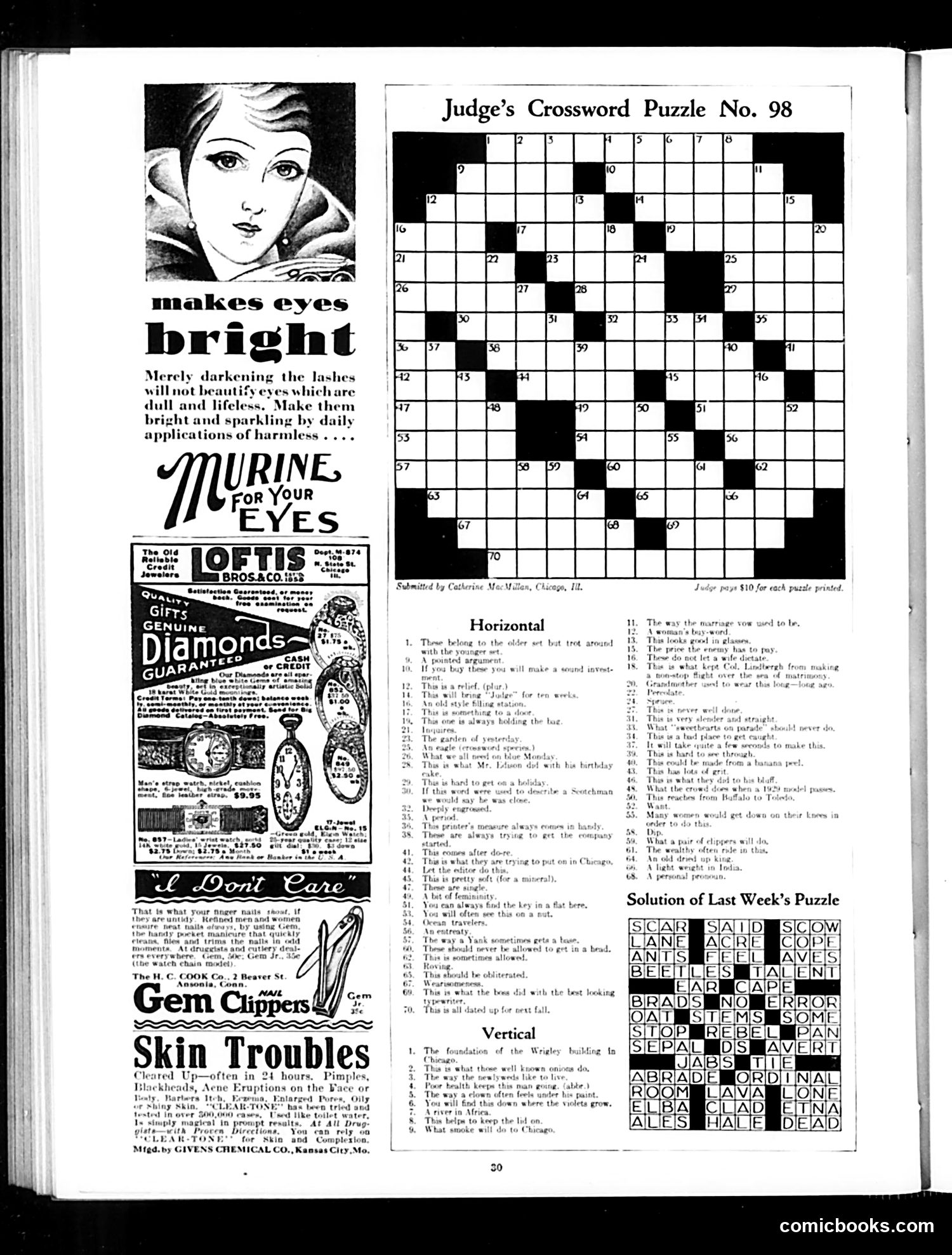
This page is primarily a **crossword puzzle** (No. 98) with accompanying advertisements—not a political cartoon. The visible ads include: - **Murine for Eyes**: A beauty/cosmetic product claiming to brighten eyes through daily application - **Diamonds with Cash Guarantee**: A jewelry advertisement - **Gem Clippers**: A nail care tool - **"Clear-Tone"**: An unspecified product - **Skin Troubles remedy**: Advertising treatment for dermatological conditions The page represents typical early 20th-century Judge magazine content: entertainment (crossword) mixed with period advertisements targeting readers—particularly women—with beauty and personal care products. The ads reflect contemporary beauty standards emphasizing bright eyes and clear skin, common sales pitches of that era. There is no discernible political satire visible on this particular page.
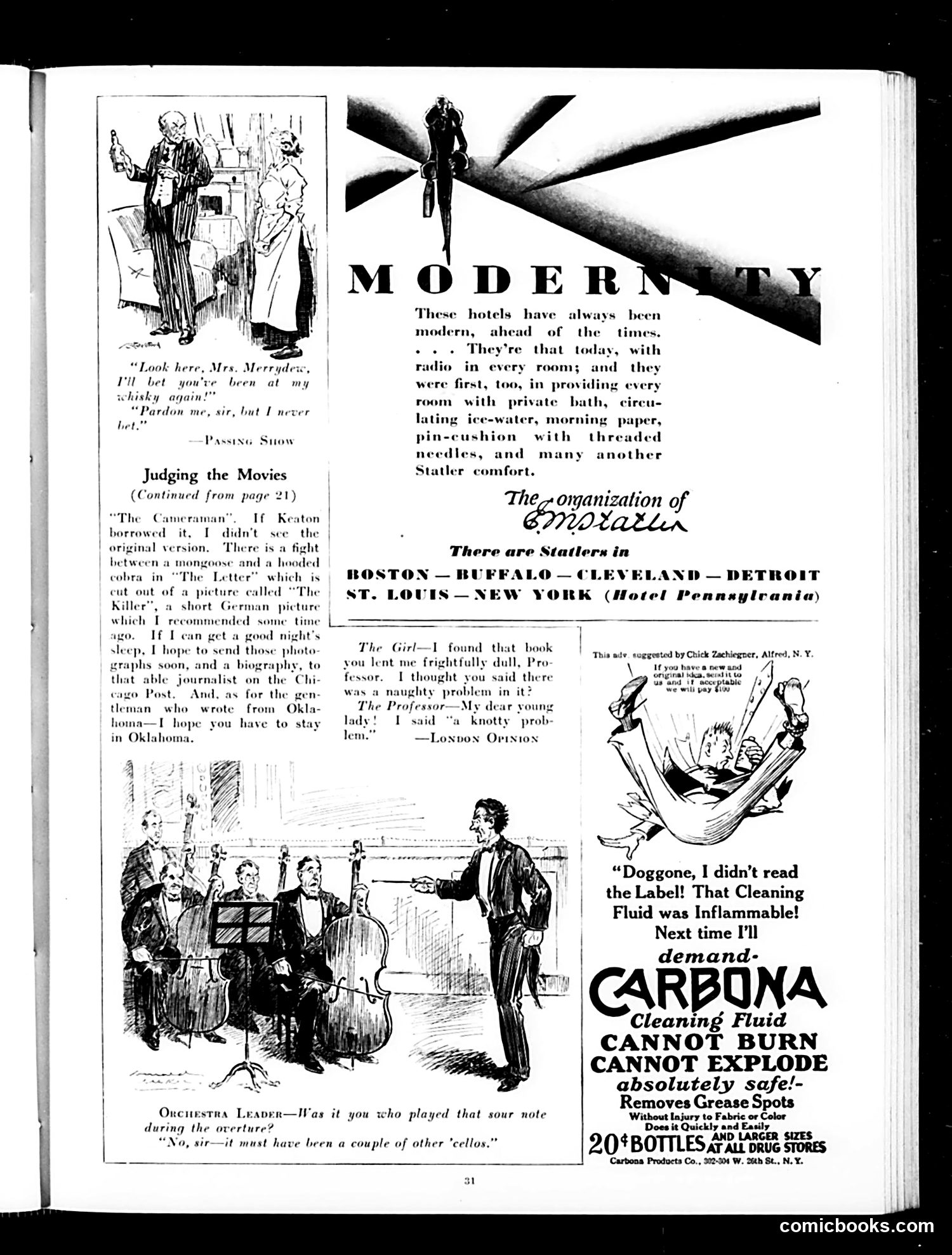
This page mixes humor, advertising, and social commentary typical of 1920s Judge magazine. **Top cartoon ("Passing Show")**: A comic dialogue about whisky—likely referencing Prohibition-era hypocrisy, where wealthy people like "Mrs. Merryview" continued drinking illegally while publicly condemning it. **"Judging the Movies" section**: Film criticism commentary, including a reference to Buster Keaton's *The Cameraman*. The writer makes jokes about silent film quality and editorial standards. **Statler Hotels advertisement**: Promotes these hotels as modern and ahead of their time, highlighting contemporary luxuries (radio in rooms, private baths, circulating ice water). This reflects 1920s enthusiasm for technological progress. **Bottom cartoons**: Include mild humor about orchestra musicians and a mishap with cleaning fluid—the latter being an advertisement for Carbona brand, emphasizing its safety (non-flammable). The page overall reflects Jazz Age consumer culture and light satire, with advertising integrated throughout.
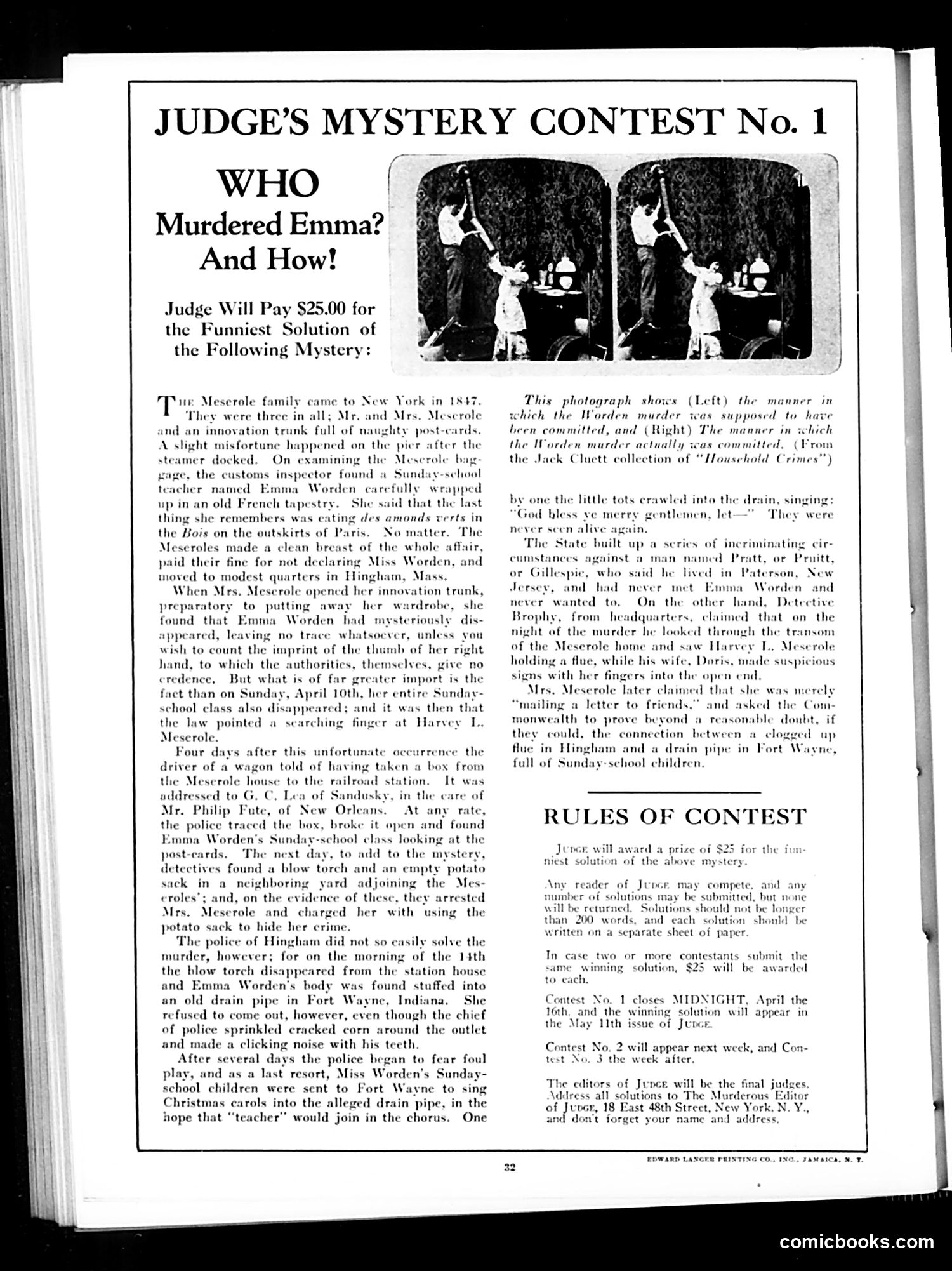
This is a **humor contest page**, not a political cartoon. Judge magazine published a mock-mystery puzzle offering $25 for the "funniest solution." The setup is absurdist satire: A Sunday-school teacher named Emma Worden mysteriously disappears after being smuggled into America in a trunk. Evidence accumulates absurdly—her thumbprint, missing students, a blow torch, a potato sack, her body in a drain pipe in Indiana. Police suspect various suspects (Harvey L. Meserole, a woman named Pratt/Pruitt), with Detective Brophy making ridiculous deductions about suspicious finger signals at a flue. The joke targets **detective fiction conventions** of the era—overwrought mystery plots with illogical clues and improbable solutions. By piling on contradictory, nonsensical evidence, Judge mocks how contrived popular mysteries had become. Readers were invited to submit their own humorous "solutions" explaining the murder, with winners published later.
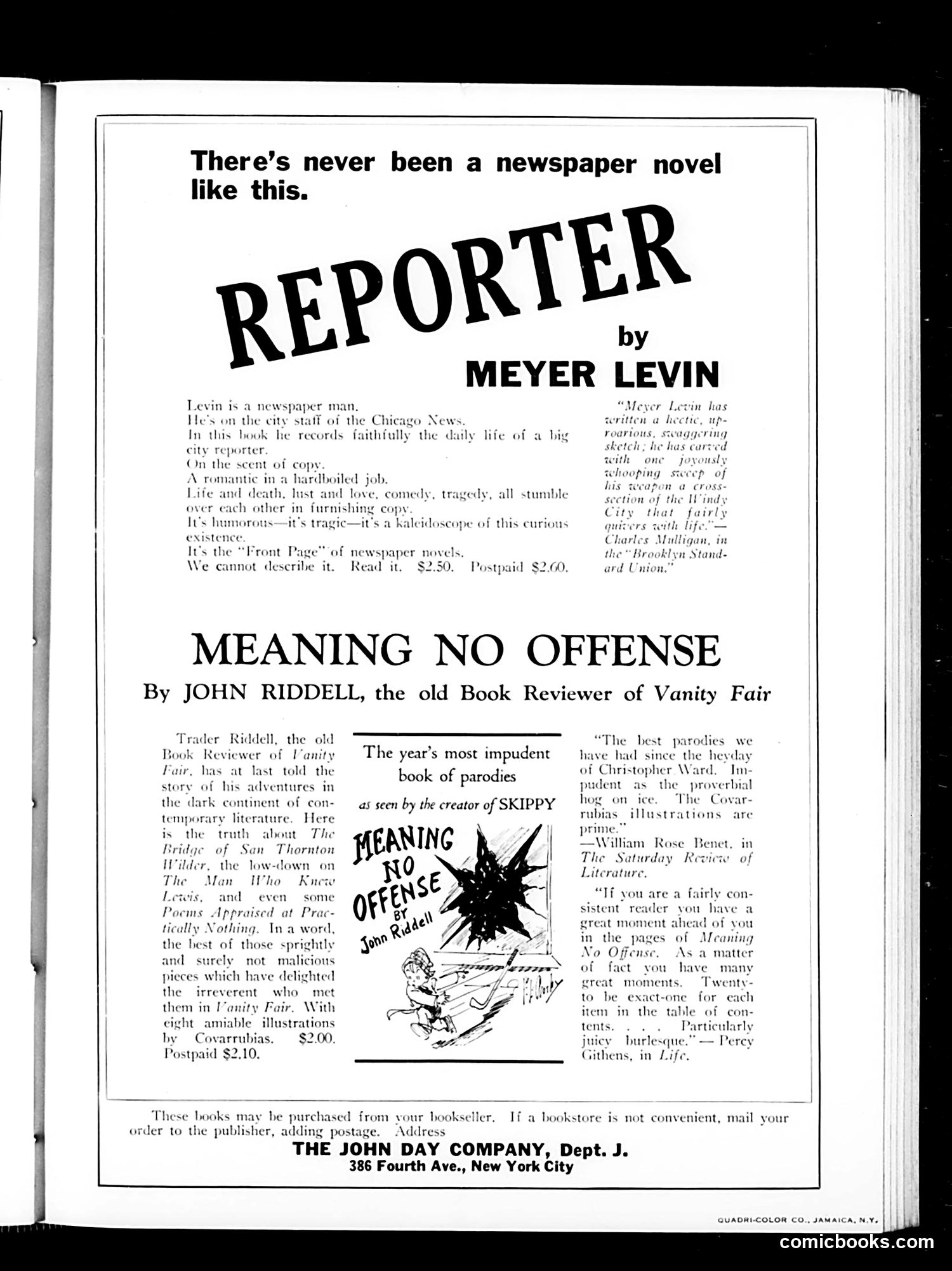
This is primarily a **book advertisement page** rather than a political cartoon. It promotes two literary works through the magazine's advertising section: 1. **"Reporter" by Meyer Levin** — A novel about a Chicago newspaper reporter's daily life, positioned as unprecedented in the newspaper fiction genre. The ad emphasizes its realistic portrayal of urban journalism's dramatic mix of "life and death, lust and love, comedy, tragedy." 2. **"Meaning No Offense" by John Riddell** — A collection of literary parodies reviewed by the fictional "old Book Reviewer of Vanity Fair." The satire targets contemporary literary works like Thornton Wilder's *The Bridge of San Luis Rey* and Christopher Ward's writings, presented as humorous takedowns of popular books. The page includes endorsements from contemporary critics (William Rose Benet, Percy Githens) and features an illustration by the cartoonist associated with *Skippy*. Rather than social commentary, this represents Judge's role as a literary marketplace, targeting educated readers interested in modern fiction and satirical humor.
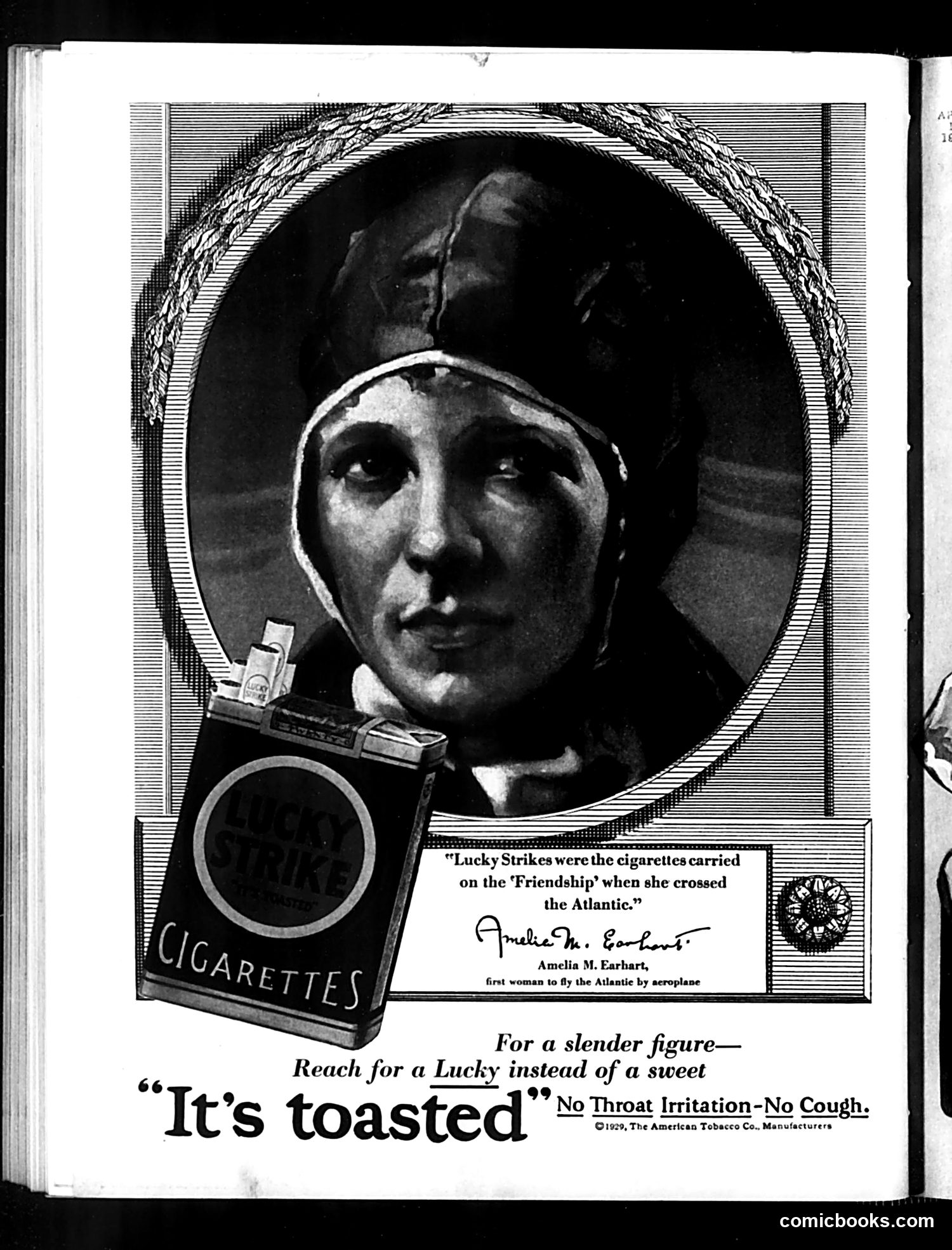
This is a Lucky Strike cigarette advertisement featuring Amelia Earhart, the pioneering aviator who made a transatlantic flight. The ad claims Lucky Strikes were carried aboard the "Friendship" during her crossing, using her achievement to endorse the product. The advertisement plays on early 20th-century marketing tactics linking cigarettes to health and slenderness ("for a slender figure"), while the "It's toasted" slogan was Lucky's actual advertising claim about their manufacturing process. This represents the era before tobacco's health dangers were widely acknowledged or regulated—companies freely used celebrity endorsements and health-adjacent claims to market cigarettes. Earhart's fame and association with modernity and achievement made her an appealing (if ironic) spokesperson for a product now recognized as highly dangerous.