
A complete issue · 36 pages · 1929
Judge — May 11, 1929
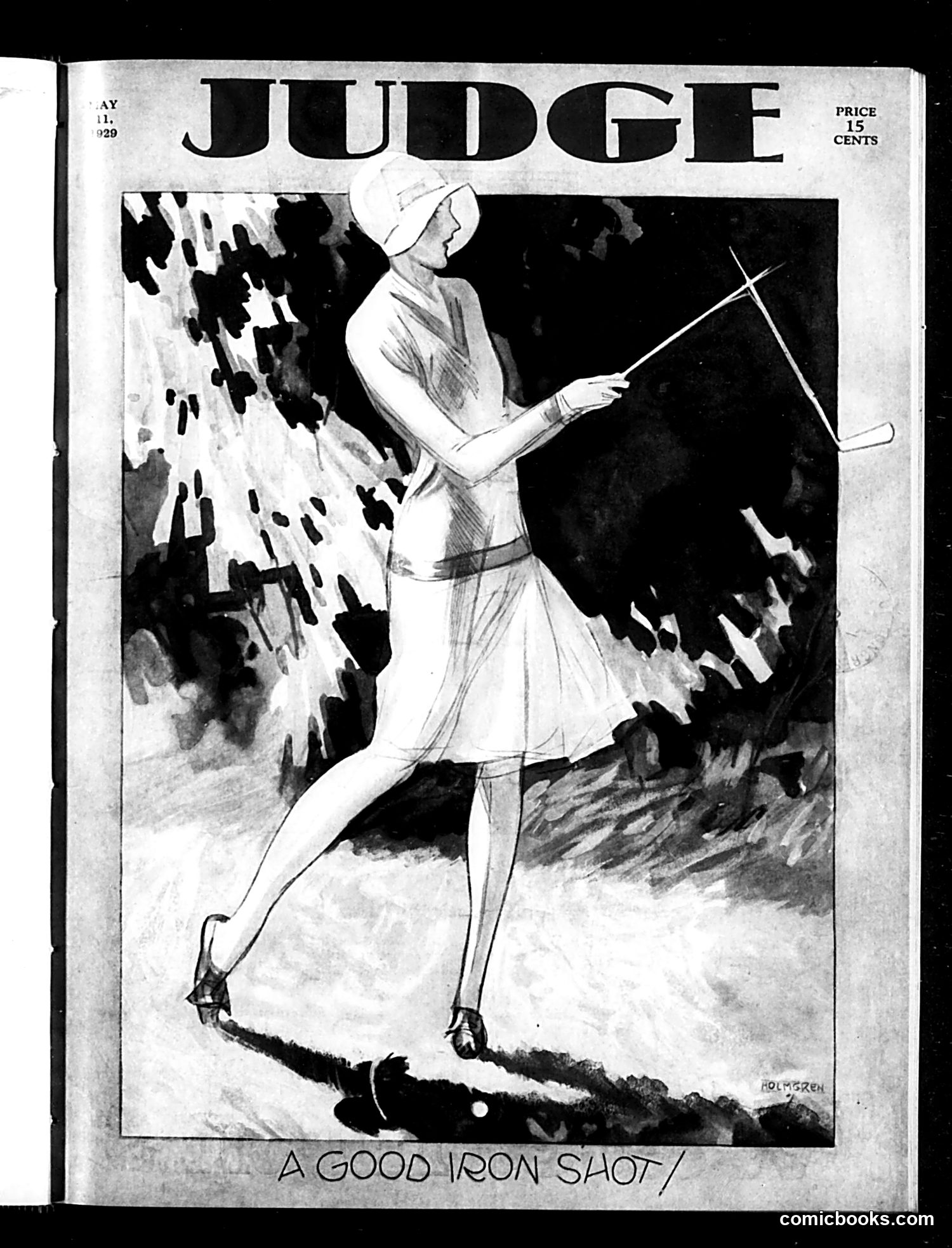
This Judge magazine cover depicts a woman golfer mid-swing, hitting what appears to be an iron club on a golf course. The caption "A Good Iron Shot" is a straightforward sports reference with no apparent political commentary. The illustration dates from an era (likely 1920s-1930s based on the style and price) when women's golf participation was gaining social acceptance, though still considered relatively novel. The figure's athletic pose and confident stance reflect this period's gradual shift in attitudes toward female athleticism and participation in traditionally male-dominated sports. The satirical element likely lies in gentle social commentary about changing gender roles and women's expanding recreational opportunities, rather than direct political critique. The artist's signature appears to be "Holmgren."
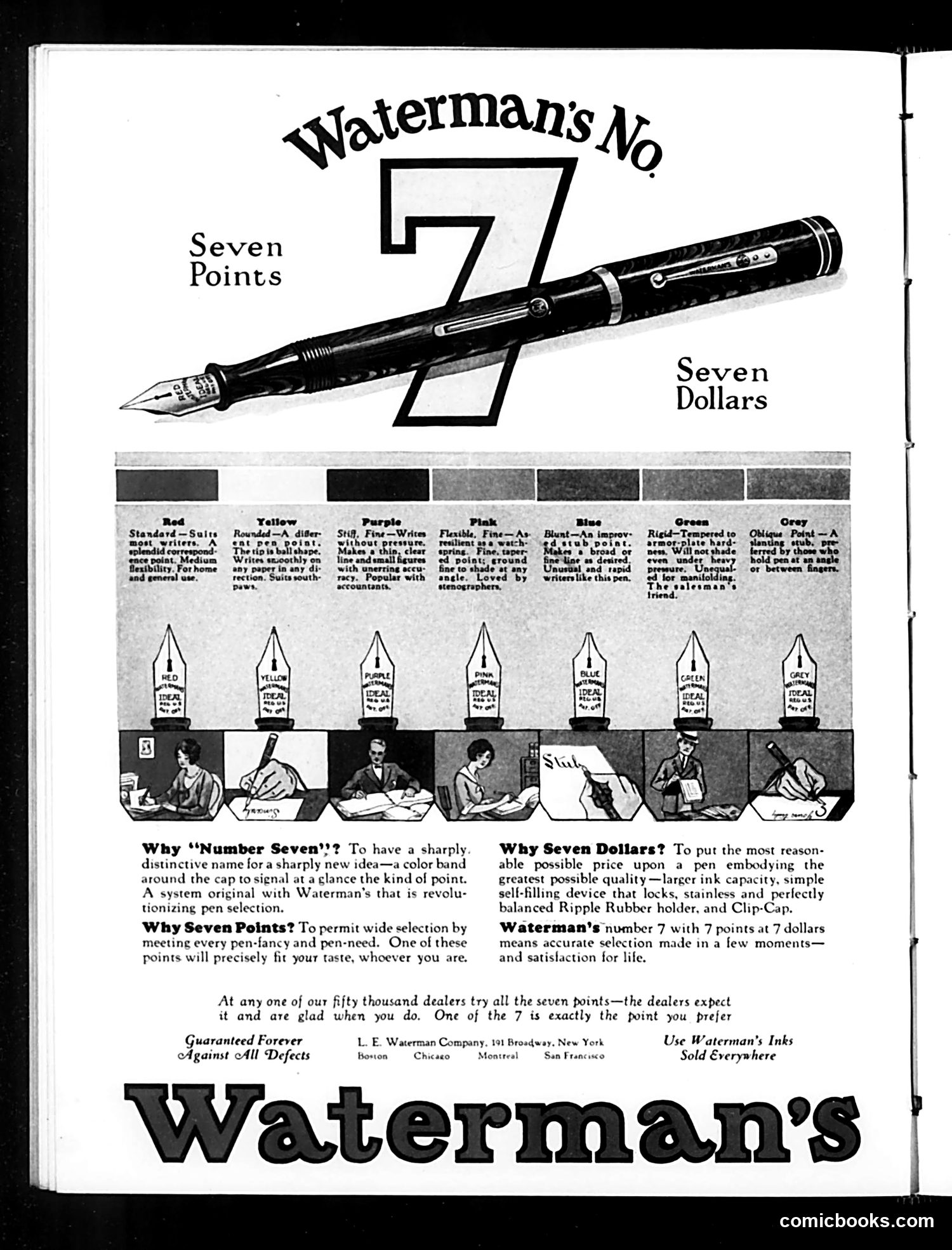
This is **not a political cartoon** but rather a **product advertisement** for Waterman's fountain pens, specifically promoting their "Number 7" model priced at seven dollars. The page uses visual satire humorously: the large "7" and repeated "seven" emphasize the product number and price point. Below, seven different pen nib styles are shown with illustrations of various professionals using them (a writer, businessman, accountant, etc.), suggesting each point serves different occupational needs. The humor lies in the tongue-in-cheek explanations of why "Number Seven" and why the price point—essentially marketing copy dressed in comedic language about selection and quality. The "seven points" refers to different nib sizes available to customers. This is straightforward advertising rather than social commentary.
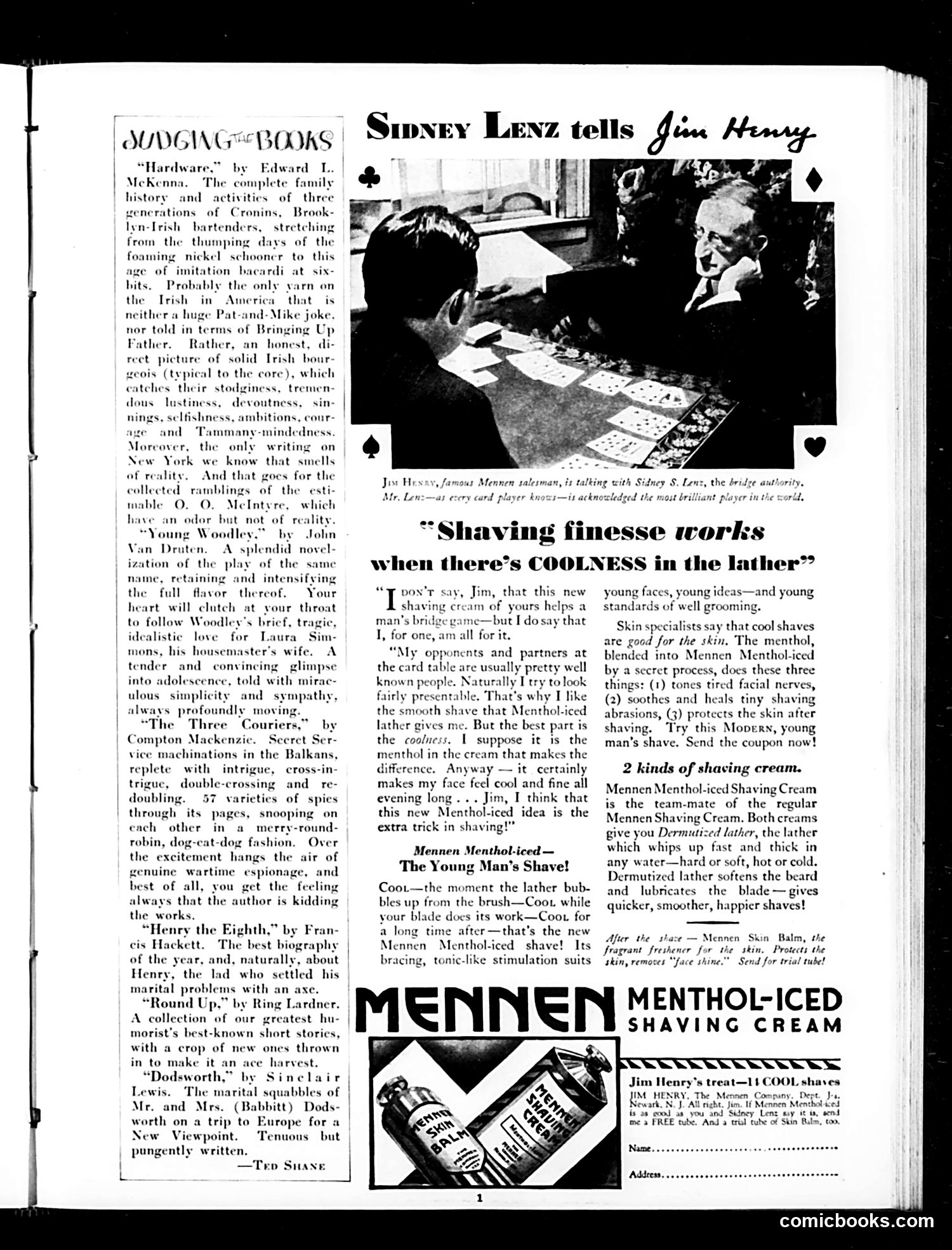
This page is **primarily advertising**, not political satire. The dominant content is a Mennen Menthol-iced Shaving Cream advertisement, with the left column containing "Judging the Books"—book reviews, not cartoons. The only satirical element is the header "Sidney Lenz tells Jim Henry," featuring a photograph of what appears to be bridge players (Sidney Lenz was a famous contract bridge authority). The caption references Lenz discussing shaving cream with "Jim Henry, famous Mennen salesman," framing the advertisement as celebrity endorsement. The accompanying text humorously positions shaving cream as essential to card-playing success, claiming menthol provides "coolness" and composure—a playful, non-political pitch merging leisure activities with consumer goods. This reflects 1930s-era advertising's use of celebrity and humor to sell products.
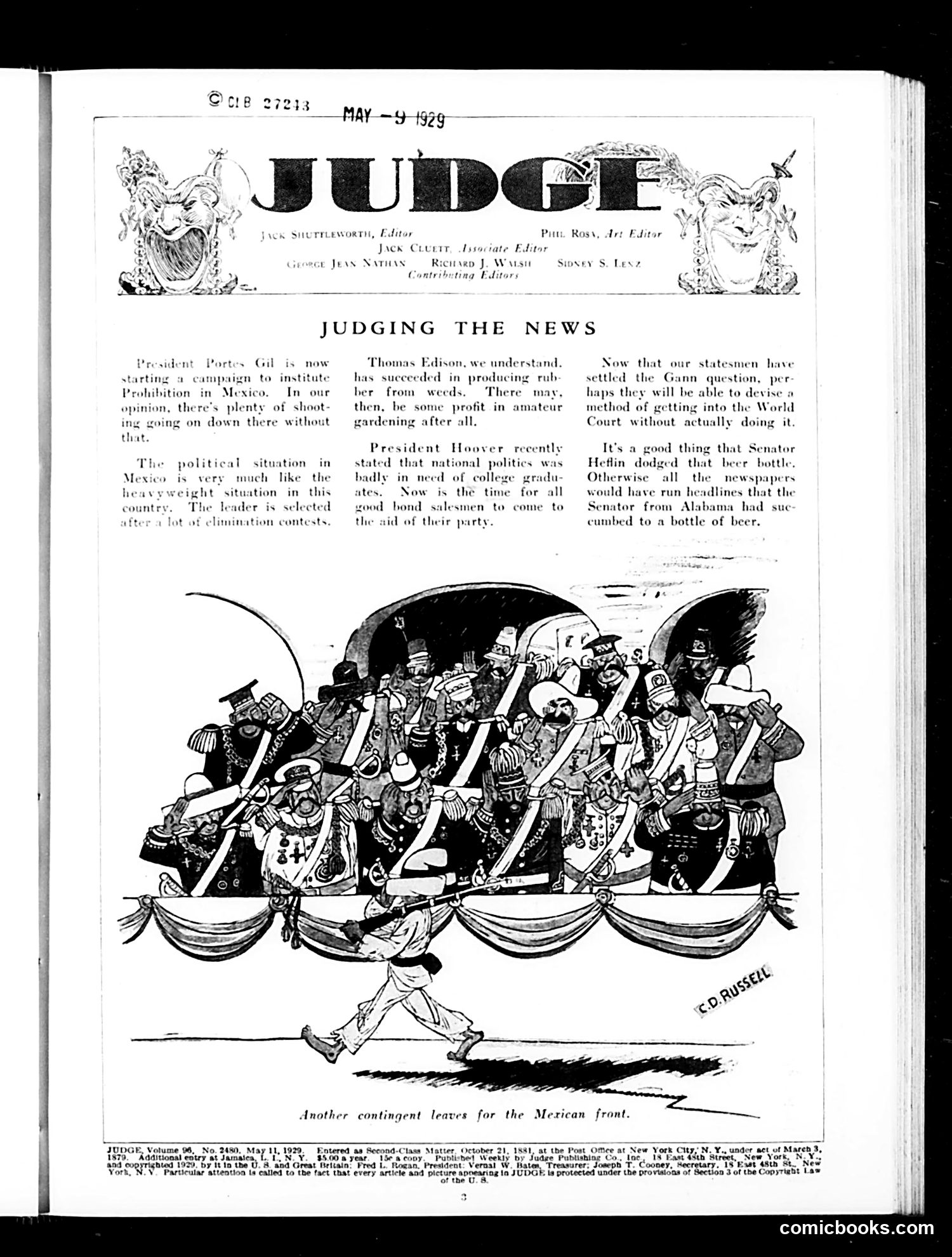
**Main Cartoon:** "Another contingent leaves for the Mexican front" depicts a crowded military procession of elaborately uniformed officers marching toward Mexico, drawn by E.D. Russell. **Context:** This satirizes Mexico's chronic political instability. The accompanying editorial "Judging the News" compares Mexico's leadership struggles to a "heavyweight situation" requiring elimination contests to select leaders. The cartoon mocks the apparent endless parade of military interventions and regime changes in Mexican politics during this period. **Point:** The humor lies in depicting Mexican political leadership as an absurdly ornate yet perpetually unstable military carousel—suggesting Mexico cycles through leaders and conflicts so frequently that sending "another contingent" has become routine and almost comedic.
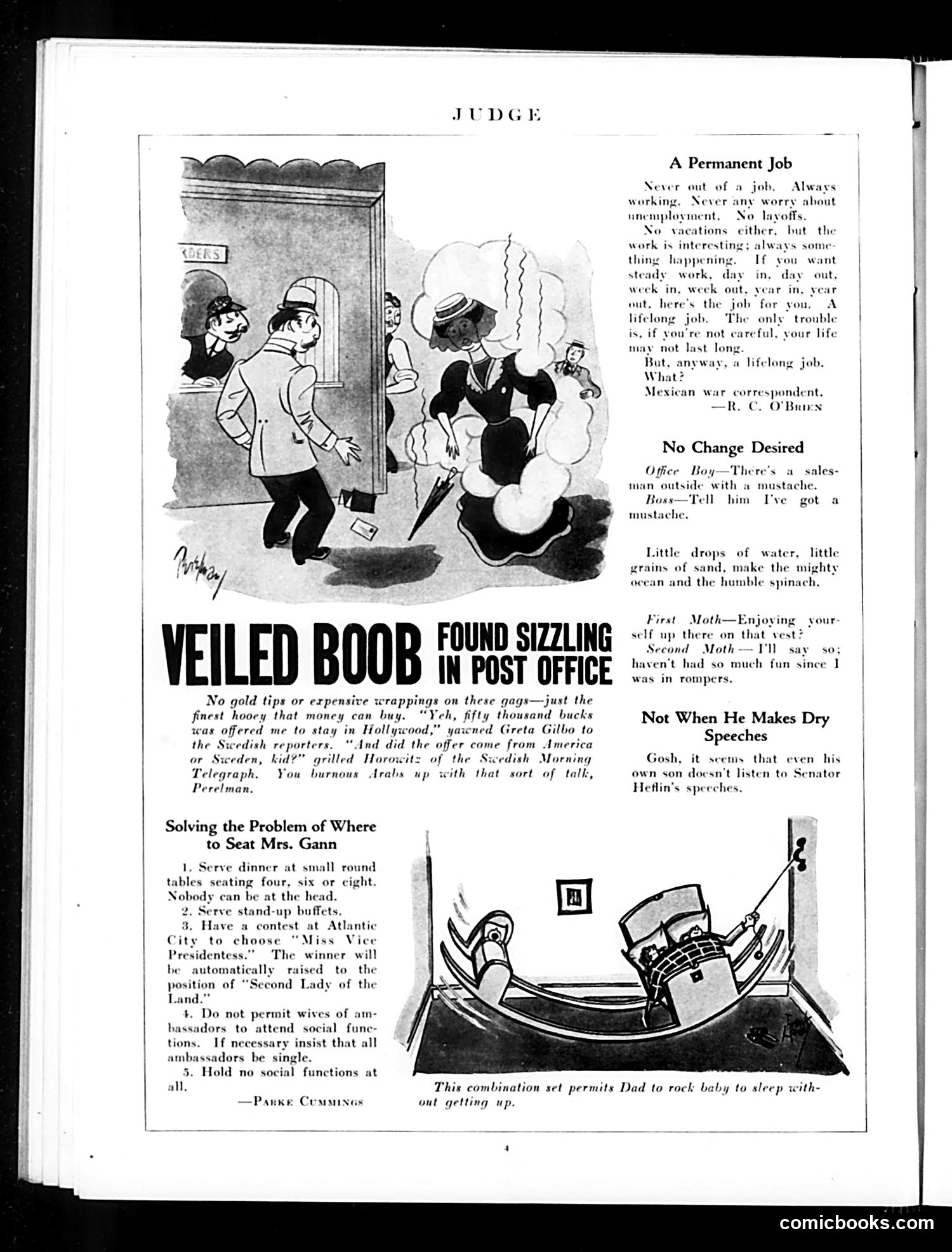
The main cartoon "Veiled Boob Found Sizzling in Post Office" satirizes Hollywood's obsession with publicity stunts. It depicts reporters surrounding a woman at a post office, referencing offers supposedly made to actresses like Greta Garbo and others to remain in Hollywood through manufactured scandals or attention-grabbing schemes. The joke mocks both the desperation of studios to keep stars in America and the absurdity of using the postal system for publicity stunts. The right-side humor columns mock politicians and social situations. "A Permanent Job" (attributed to R.C. O'Brien) jokes about war correspondent work, while other items satirize senatorial speeches and social protocol for seating arrangements. The lower illustration appears to be an advertisement for a baby-rocking device.
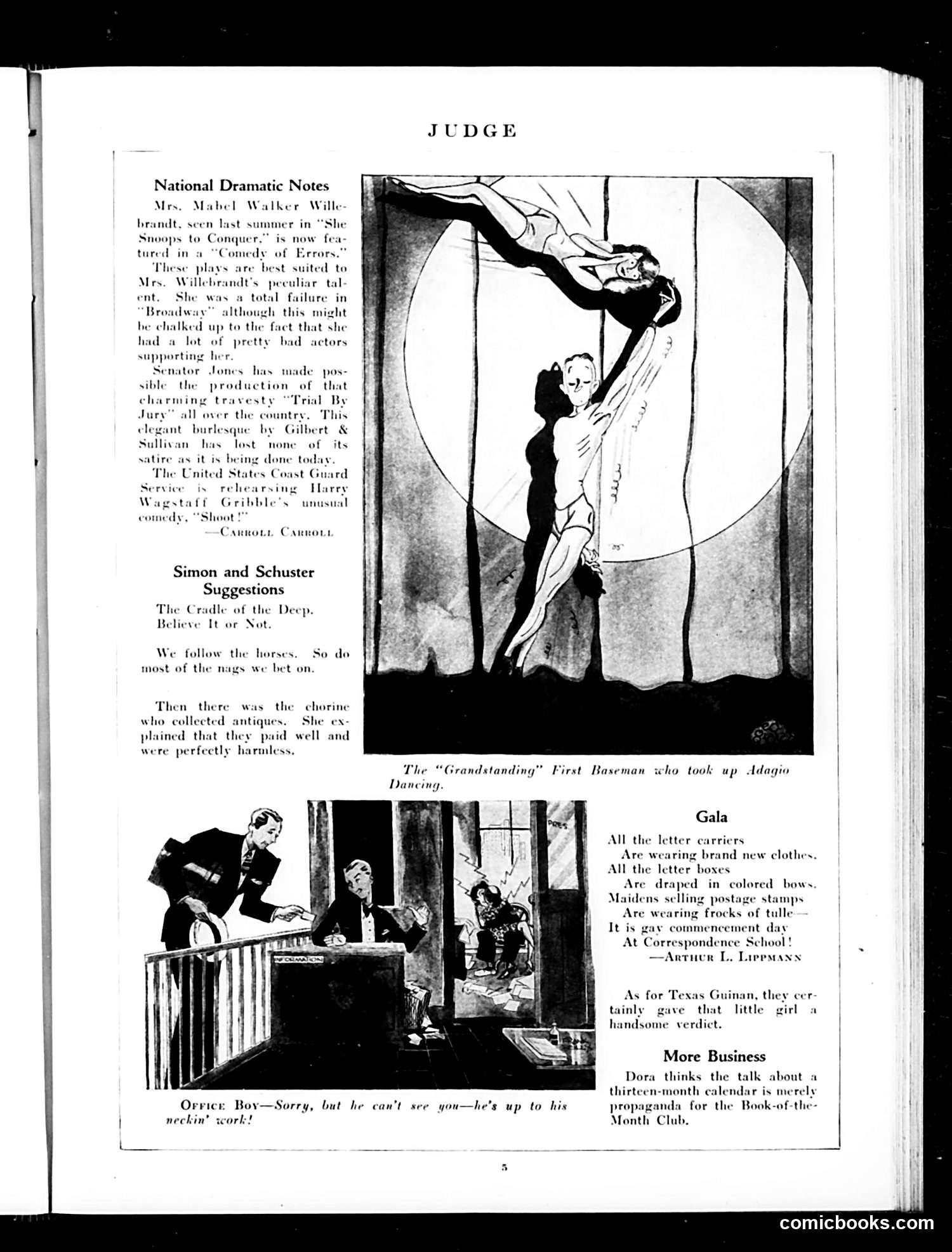
This page contains theatrical and social commentary typical of early 20th-century Judge magazine. The upper illustration, captioned "The 'Grandstanding' First Baseman who took up Adagio Dancing," satirizes a baseball player attempting ballet—likely mocking athletes who pursued multiple careers or those seen as pretentious. The lower cartoon, "Office Boy—Sorry, but he can't see you—he's up to his neckin' work!" depicts a busy office scene, humorously suggesting an overworked employee is literally submerged in his duties. The text sections include commentary on theatrical productions and performances, with mentions of Mrs. Mabel Walker Willebrandt and various productions like "Trial by Jury." The "Gala" and "More Business" sections offer brief satirical observations about social events and contemporary activities, typical of Judge's gossipy, tongue-in-cheek style.
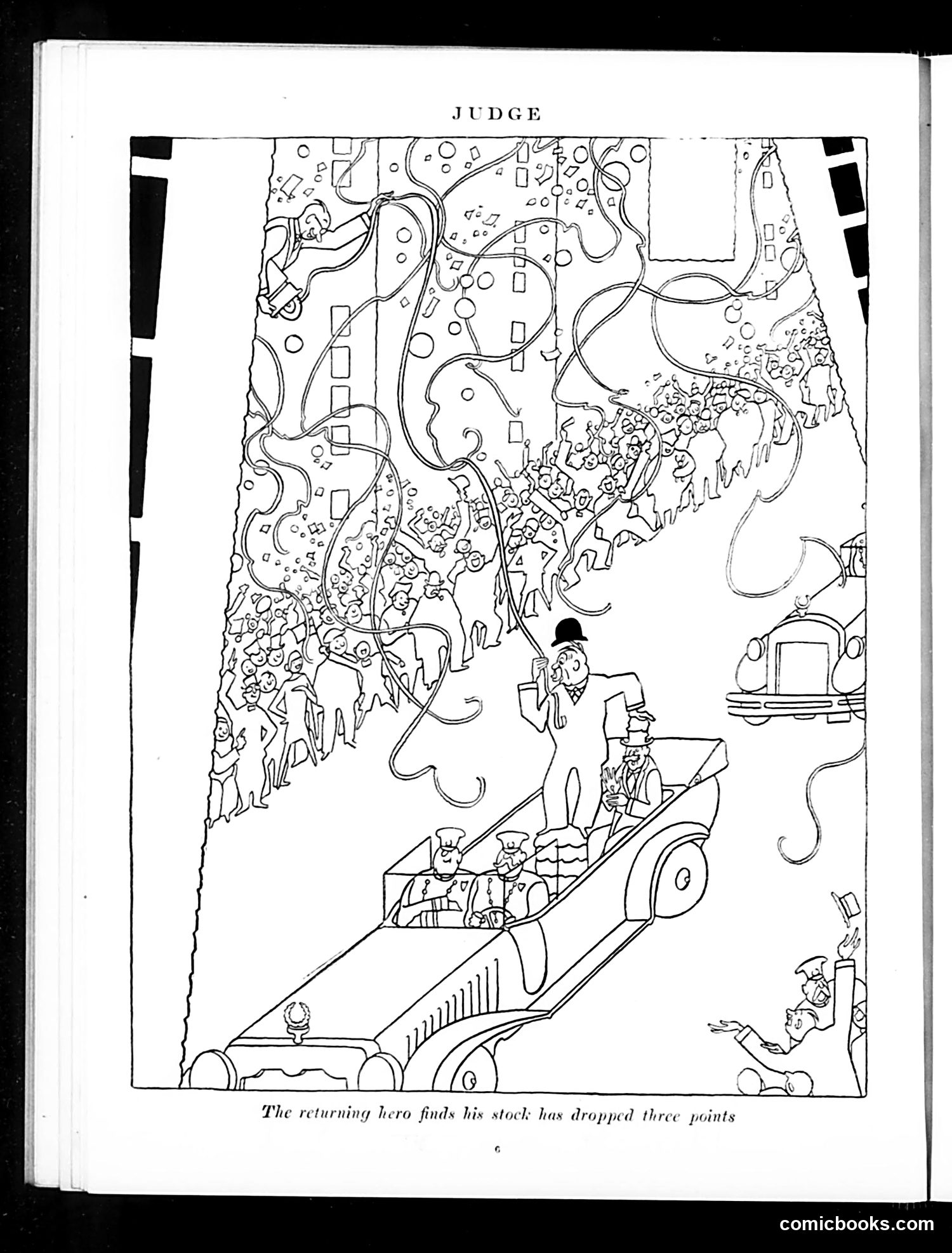
This cartoon satirizes the stock market, specifically the phrase "The returning hero finds his stock has dropped three points." The illustration depicts a returning war hero (likely from World War I, given the vintage style) arriving home to discover his financial investments have declined in value. The satire targets the disconnect between patriotic homecoming celebrations and economic realities—while crowds gather to welcome the soldier, his personal wealth has diminished. The fancy cars and crowds suggest prosperity and celebration, but the caption's dark humor reveals that financial markets show no regard for military service or national sentiment. This reflects 1920s anxieties about economic volatility and the primacy of financial concerns over social values.
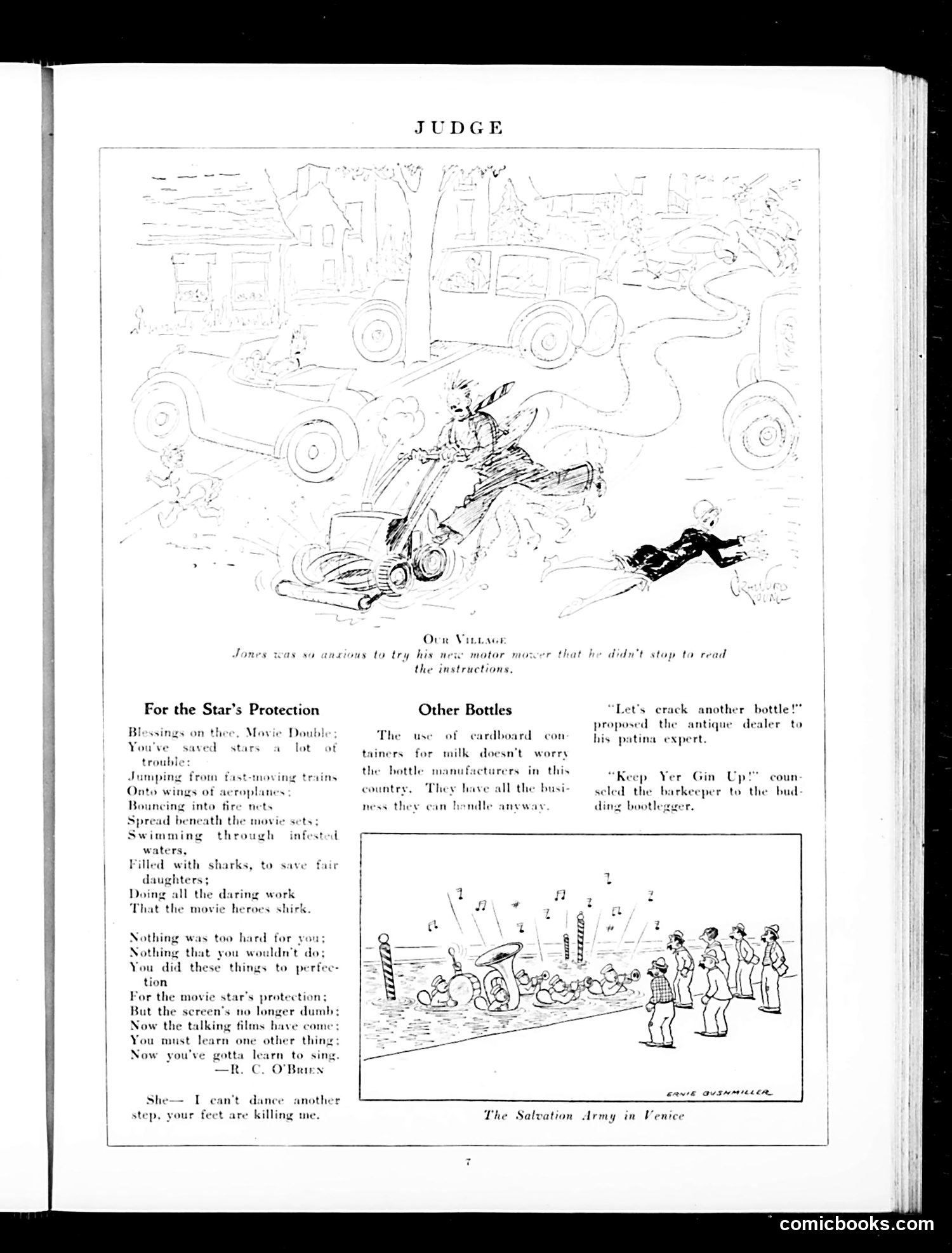
This page contains two main satirical pieces: **Top cartoon ("Our Village"):** Shows a man injured by a runaway motorized lawnmower he didn't stop to read the instructions for—mocking consumer impatience with new technology and instruction manuals. **"For the Star's Protection" (poem by R.C. O'Brien):** Praises movie stunt doubles for dangerous physical work, but warns they now face a new challenge: **talking pictures have arrived**, and they must learn to sing. This references the early 1930s transition from silent to "talkie" films—a major industry disruption that suddenly made vocal ability essential, potentially obsoleting many silent-era performers and doubles. **"The Salvation Army in Venice" cartoon:** Depicts the Salvation Army band in Venice, likely satirizing either their presence abroad or their musical efforts. **Side notes on bottles and gin** are brief jokes about milk packaging and Prohibition-era bootlegging ("Keep Yer Gin Up"), referencing the bootleg liquor trade during alcohol prohibition. The page's humor targets technological change, entertainment industry disruption, and contemporary social issues.
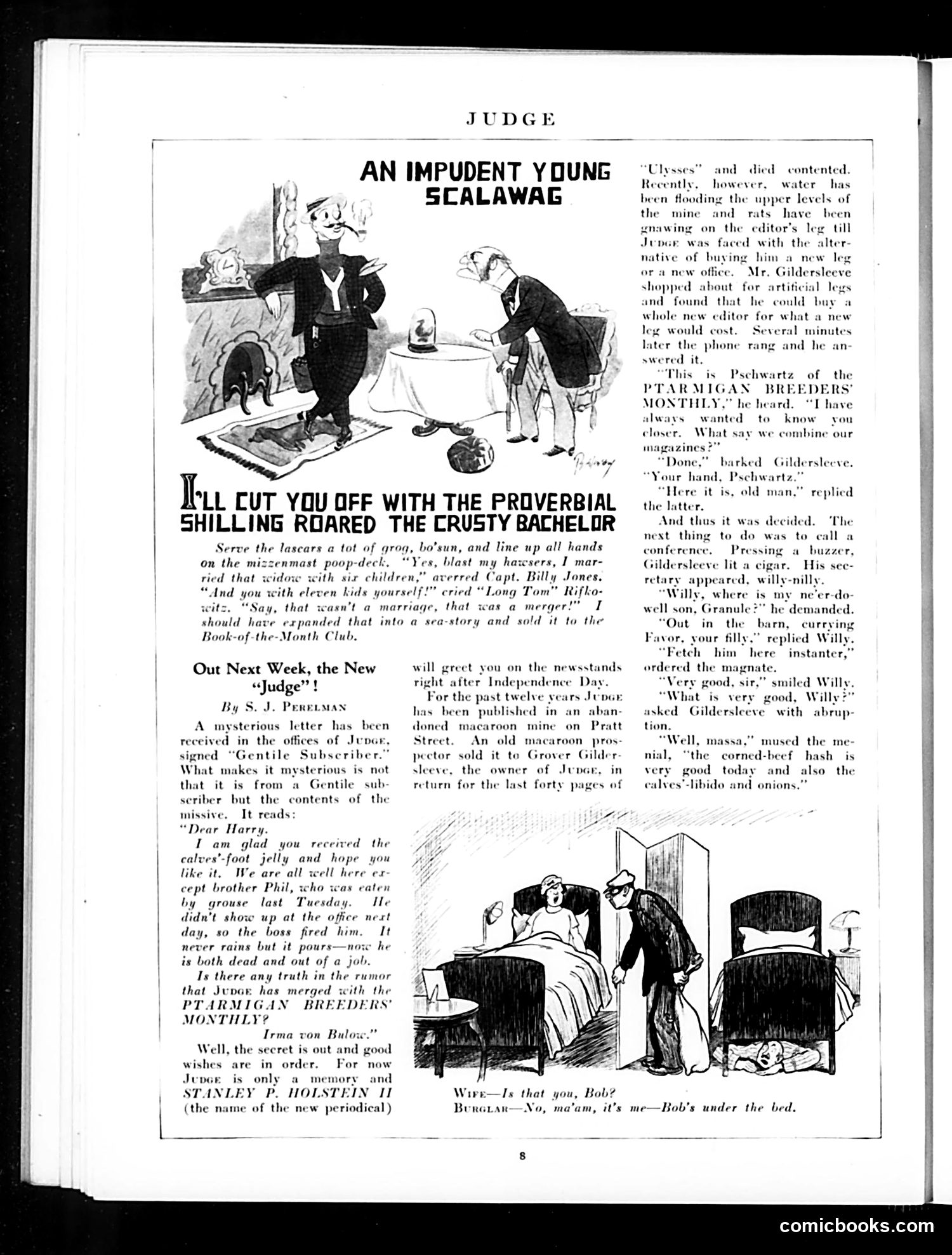
This page contains two satirical pieces typical of Judge's humor: **"An Impudent Young Scalawag"** (top cartoon) depicts a maritime scene where a crusty sea captain complains about his large family to fellow sailors, comparing marriage to a corporate "merger"—satirizing how marriage combines two households like a business deal. **"Out Next Week, the New 'Judge'"** (main story) is absurdist satire about Judge magazine itself "merging" with *Ptarmigan Breeders' Monthly*. The joke hinges on the ridiculous collision: a sophisticated urban satirical magazine combining with an obscure agricultural periodical. A mysterious letter signed "Gentile Subscriber" announces this fictional merger, playing on anxieties about magazine consolidation and changing editorial identity. The accompanying illustration shows a domestic scene where a servant admits the master's rival is hiding "under the bed"—a slapstick joke about infidelity or cowardice. The satire targets early-20th-century American magazine culture and corporate consolidation, presented through increasingly absurd scenarios.
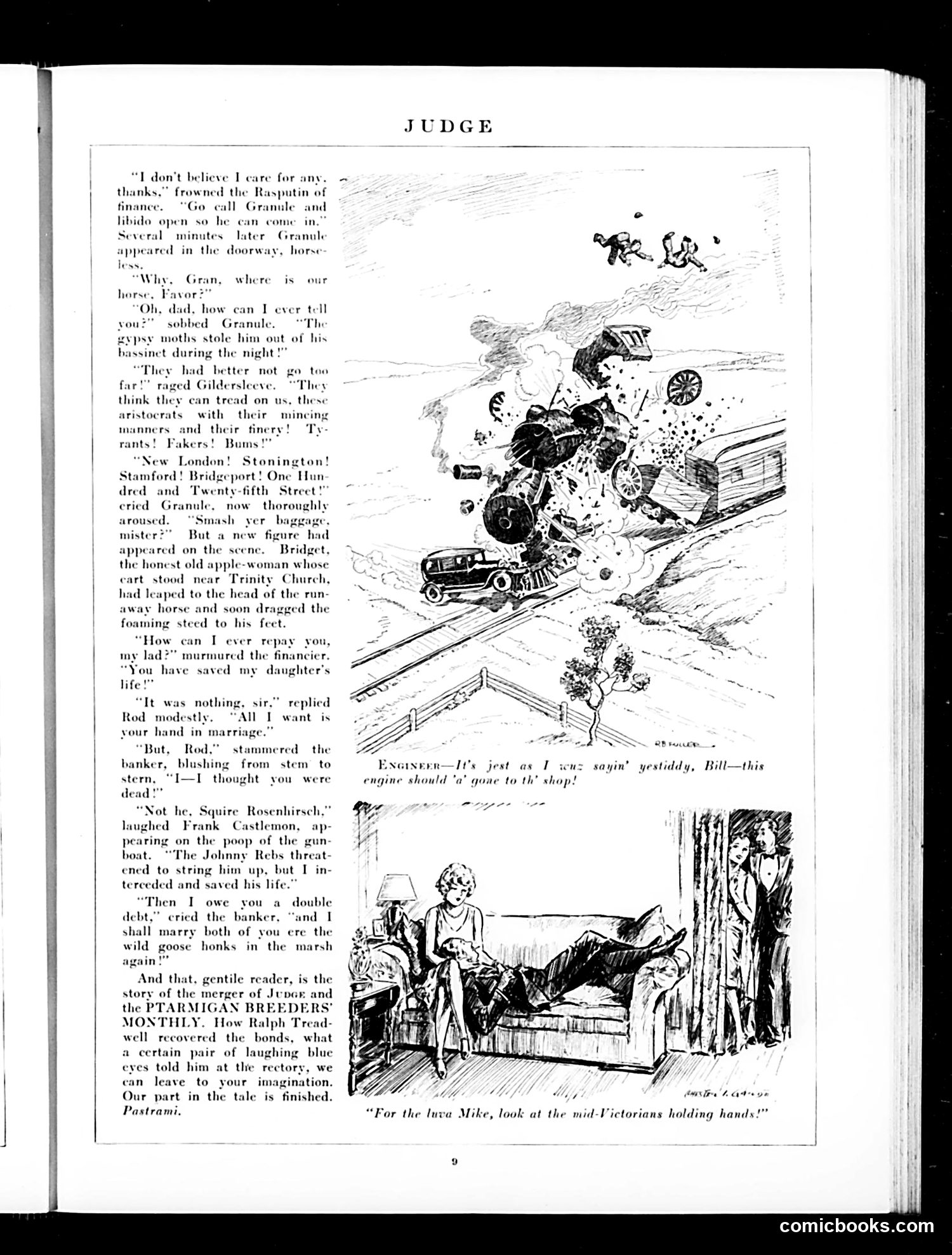
This page contains a satirical serialized story mocking melodramatic Victorian fiction conventions. The narrative follows a banker ("Rasputin of finance") whose daughter's horse is stolen by "gypsy moths," leading to a runaway-horse rescue by an apple-woman named Bridget (or possibly "Rod"). Multiple characters—a financier, various rescuers—each claim credit for saving the banker's daughter, resulting in promises of marriage to multiple people. The satire targets the overwrought plot devices and emotional excess of mid-Victorian literature: runaway horses, last-minute rescues, working-class heroines, grateful wealthy suitors, and improbable coincidences stacked upon each other. The editorial voice dismisses these clichés as ridiculous ("Pastrami"). The lower cartoon appears to show an engineer commenting on mechanical failure, continuing the comedic tone. This is literary satire aimed at contemporary popular fiction's absurd conventions and class-based romantic narratives.
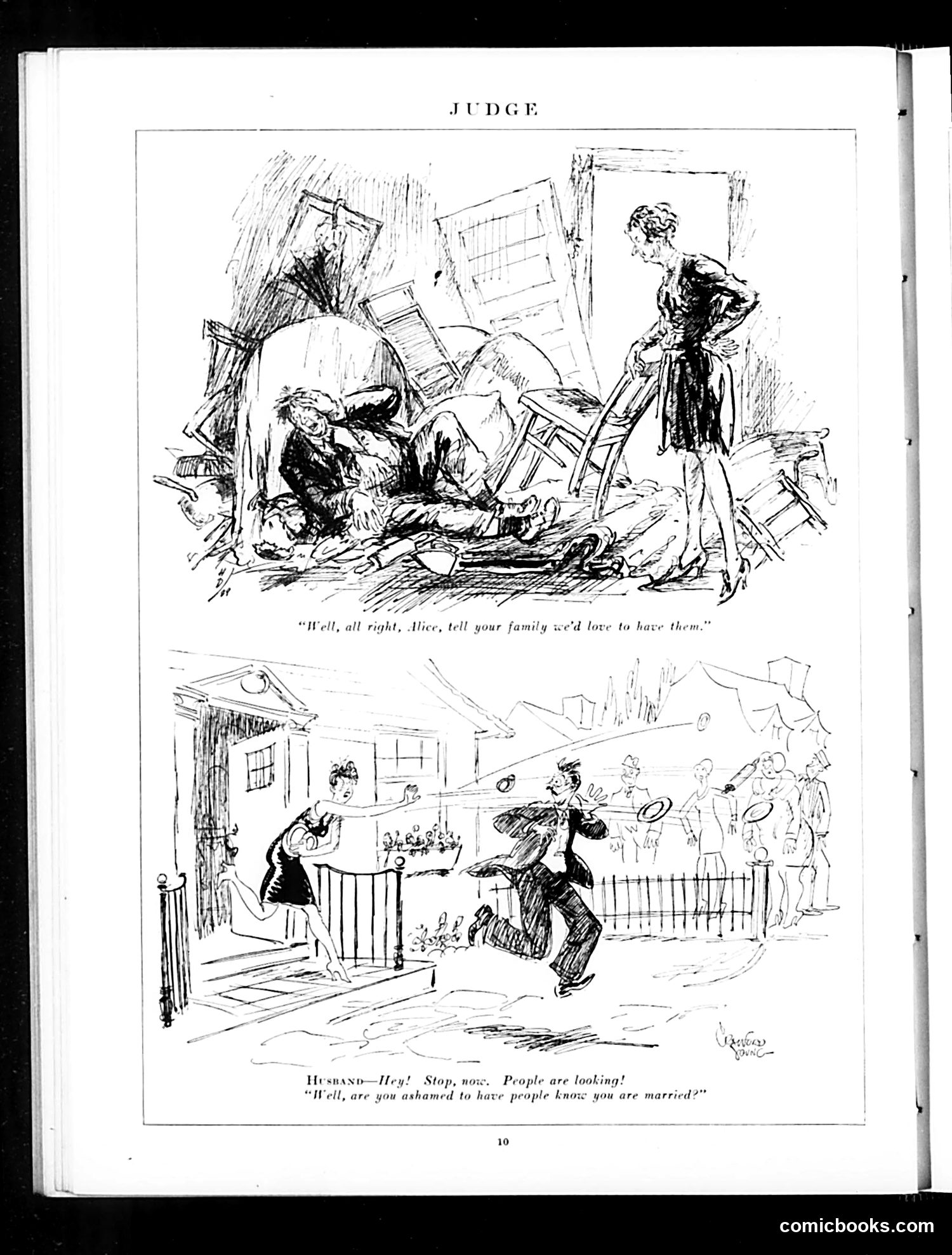
This page contains two separate satirical cartoons about marriage and social propriety. **Top cartoon**: A messy domestic scene where a woman addresses "Alice," telling her family would "love to have them"—likely discussing houseguests or relatives, while the home appears chaotic with overturned furniture. **Bottom cartoon**: A husband and wife are caught playing frisbee (or a similar game) outdoors in public. When onlookers appear, the husband panics, telling his wife to stop. She sarcastically responds by questioning whether he's *ashamed* to be seen with his own wife in public. The satire targets male embarrassment about displaying affection or domestic life publicly—a social anxiety common to the era. The joke suggests married men paradoxically hide their wives in public despite commitment to them privately, reflecting period attitudes about masculine dignity and public decorum.
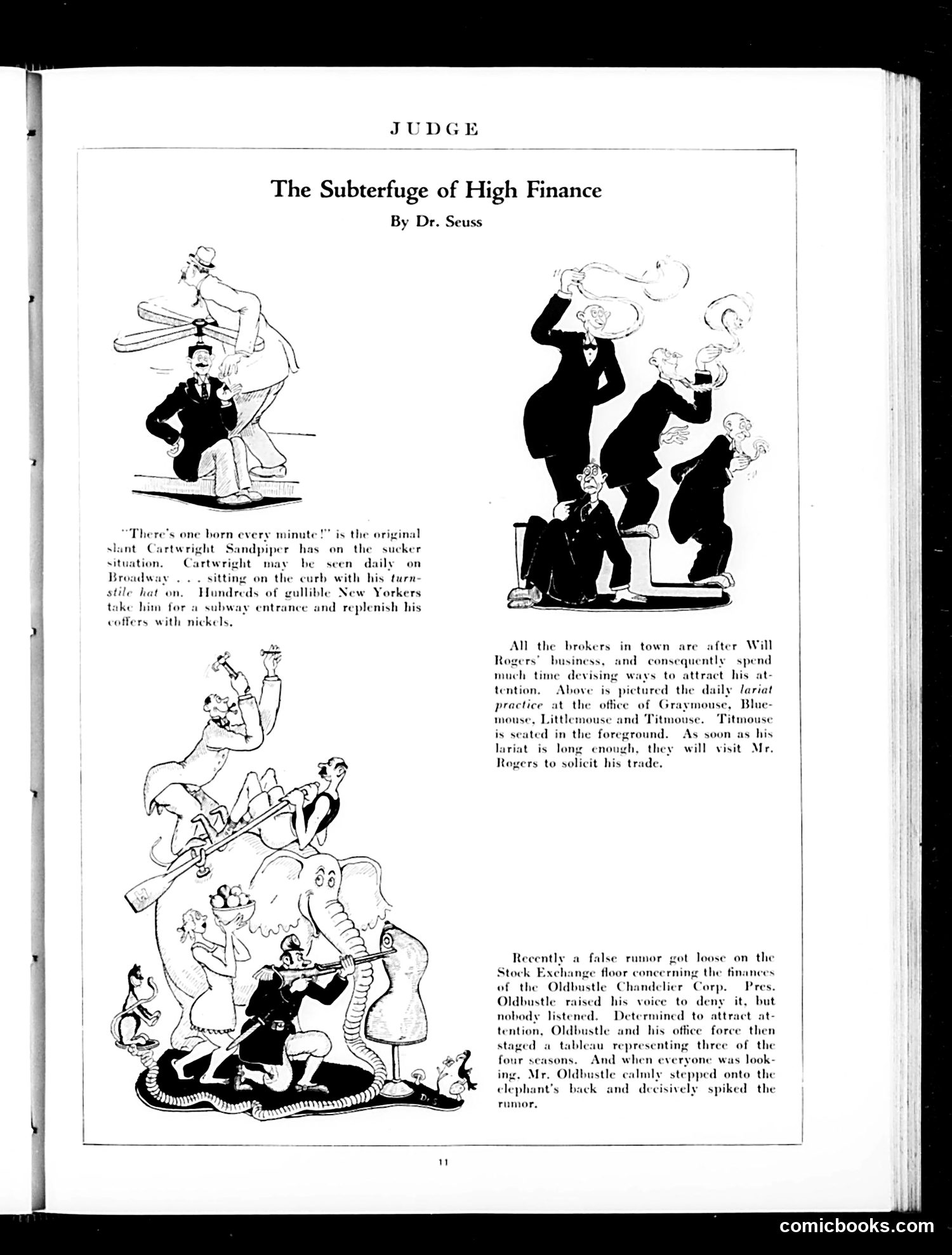
This Dr. Seuss satirical cartoon mocks financial scheming and con artistry in 1920s New York. The top left depicts "Cartwright Sandpiper," a con man posing as a subway entrance on Broadway, tricking gullible New Yorkers into giving him nickels—playing on the then-common phrase "there's a sucker born every minute." The middle section ridicules stock brokers competing for Will Rogers' (the famous humorist/investor) business through absurd stunts—practicing lasso tricks in their office to impress him. The bottom scene lampoons PR desperation: when President Oldbustle of Oldbustle Chandelier Corp. can't get stock exchange attention denying rumors about his company's finances, he stages an outrageous theatrical performance (riding an elephant and "spiking" the rumor) purely for shock value to grab attention. The satire targets how financial operators used spectacle and trickery—not substance—to manipulate markets and public perception.
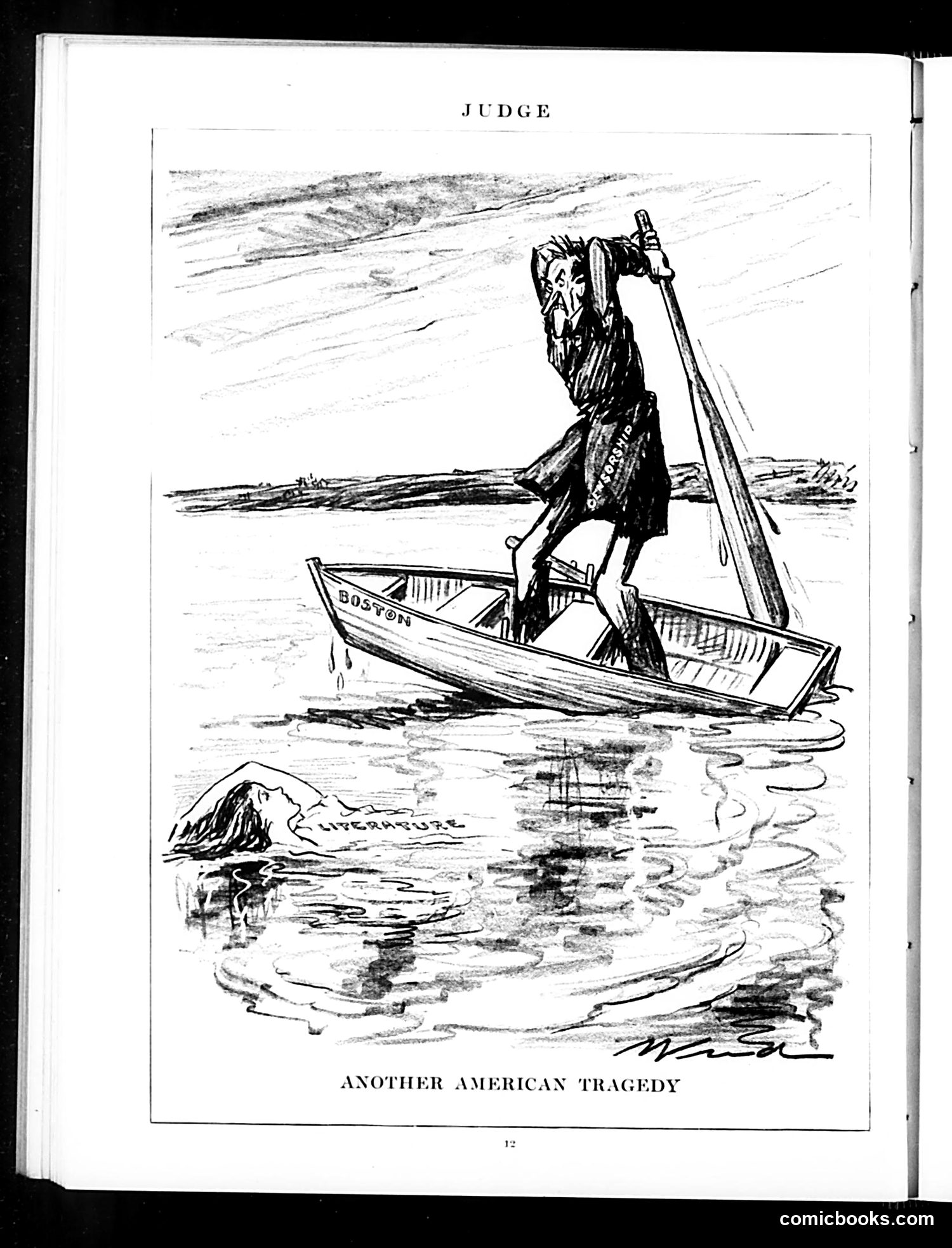
This political cartoon from *Judge* magazine depicts a skeletal, grim-reaper-like figure standing in a boat labeled "BOSTON," pointing accusingly downward at a drowning figure in the water below. The title "Another American Tragedy" suggests this references a specific disaster or scandal connected to Boston. The skeletal figure likely represents Death or Justice itself, while the drowning victim in the water appears to be the actual subject of criticism. The cartoon likely comments on a Boston-based tragedy involving negligence, corruption, or injustice—possibly industrial, maritime, or political in nature. Without knowing the specific publication date, the exact event remains unclear, but the imagery emphasizes moral accountability and suggests systemic failure in Boston. The stark visual metaphor equates the situation with death and tragedy.
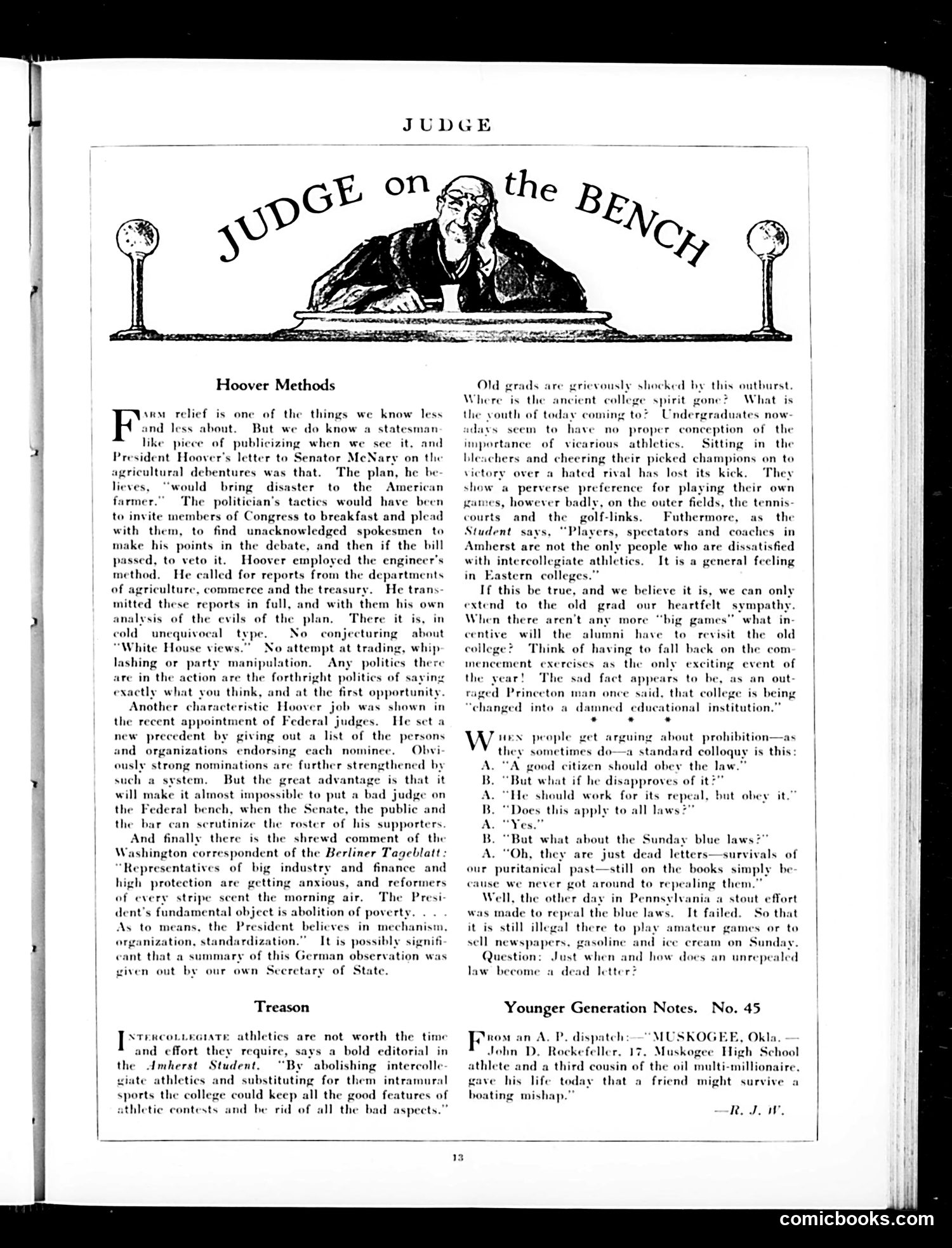
**"Hoover Methods"** praises President Herbert Hoover's administrative approach to farm relief policy. The article contrasts Hoover's transparent, data-driven method—publishing departmental reports and his analysis openly—with typical politician tactics of backroom dealing and manipulation. It particularly applauds his appointment of federal judges, noting he publicly lists endorsing organizations, making Senate scrutiny easier and preventing "bad judges" on the bench. The piece frames Hoover as an engineer-administrator who believes in "mechanism, organization, standardization" to abolish poverty, citing approval from a German newspaper correspondent. **"Treason"** mocks collegiate athletics' decline. An Amherst Student editorial advocates replacing intercollegiate sports with intramural ones. The satirist notes alumni are "grievously shocked," lamenting lost school spirit and the demise of "big games"—once alumni's reason to revisit campus. The piece ironically suggests colleges risk becoming merely "damned educational institutions" without competitive athletics. Both pieces employ satirical commentary on contemporary 1920s-era debates about government efficiency and university culture.
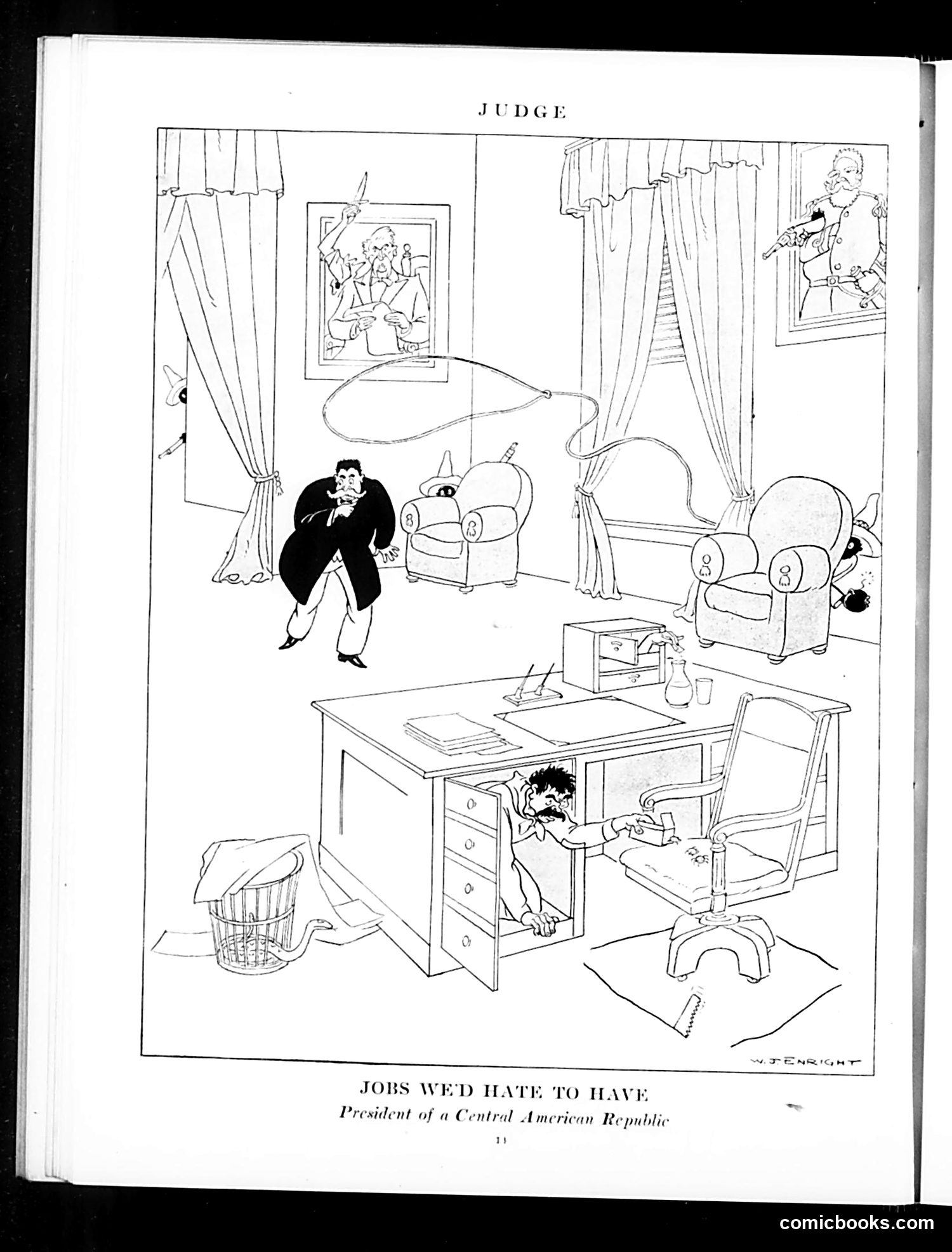
This Judge magazine cartoon satirizes the unstable presidency of Central American republics during the early 20th century. The title "Jobs We'd Hate to Have" frames the position as undesirable. The cartoon depicts a judge's chambers in chaos: a nervous man in formal dress (the president) sits at a desk while a child hides underneath it, and armed figures occupy the room—likely representing military coups, revolts, or political violence. The comfortable furnishings and portraits contrast sharply with the disorder, suggesting the office's prestige cannot protect against constant instability. The satire criticizes the frequent political upheaval in Central America, where presidential transitions were often violent rather than democratic. The American audience would recognize this as commentary on regional instability that made the position genuinely dangerous and precarious.
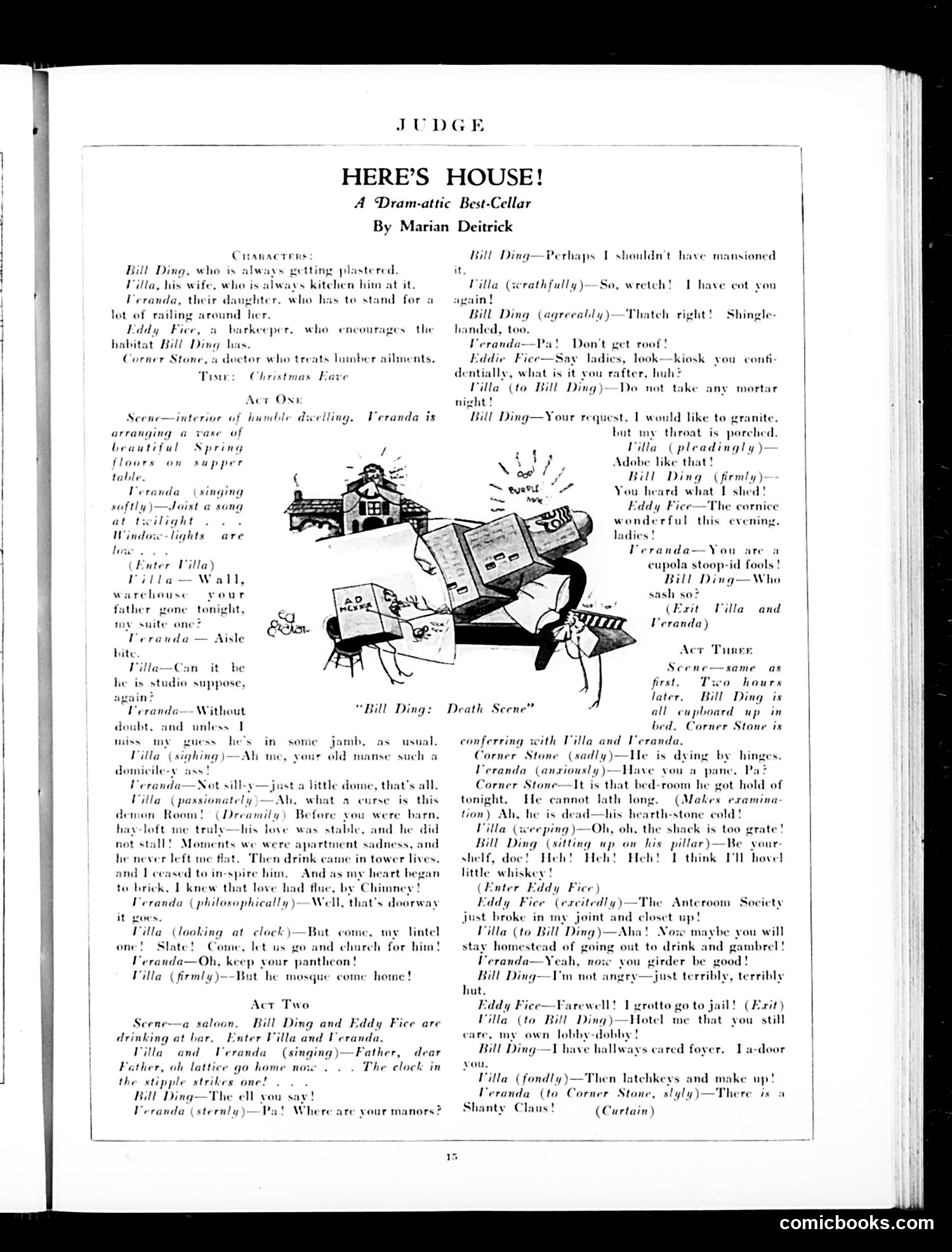
This is a comedic play script from *Judge* magazine featuring an extended architectural pun. The characters' names are all building/construction terminology: **Bill Ding** (the drunk protagonist), his wife **Villa**, daughter **Veranda**, bartender **Eddy Fice**, and doctor **Corner Stone**. The plot dramatizes the dangers of alcoholism: Bill Ding drinks excessively at the saloon, neglects his family, and ultimately dies. The satire works through constant building-related wordplay (references to "loft," "mansion," "shingle," "mortar," "lath," "hearth-stone," etc.) applied to domestic tragedy. This reflects early 20th-century American temperance sentiment—the belief that alcohol destroys families and homes. The elaborate pun scheme (the subtitle calls it "A Dram-attic Best-Cellar") suggests *Judge's* lighter approach to the serious social issue, using humor to deliver a cautionary message about drinking's domestic consequences.
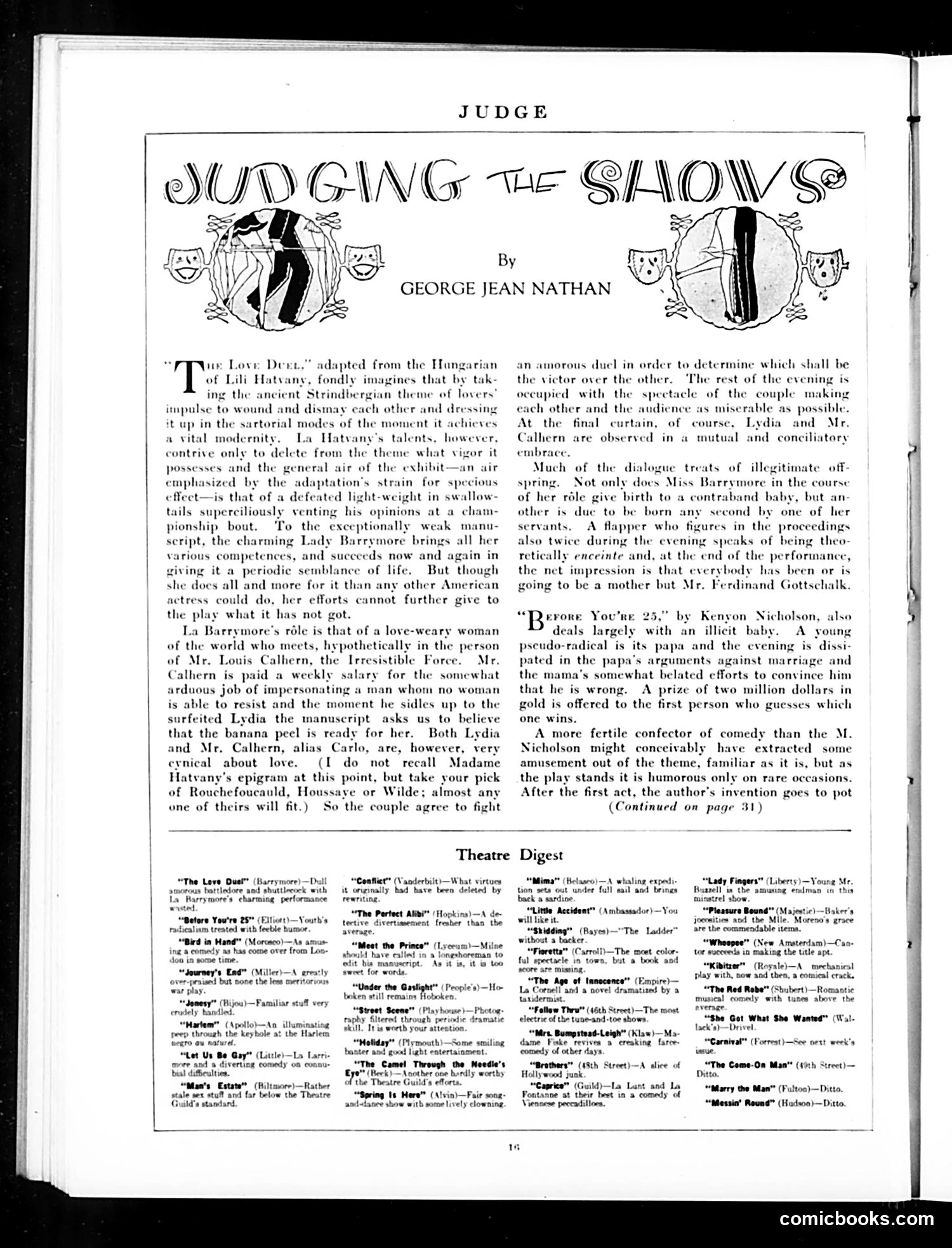
This page contains theater reviews by critic George Jean Nathan. The main review discusses "The Love Duel," a Hungarian-themed play adapted by Lili Hatvany, starring actress La Barrymore opposite actor Louis Calhern. Nathan criticizes the play as tedious despite Barrymore's skilled performance. The plot involves two world-weary lovers engaging in an "amorous duel" to determine who can resist the other—essentially a cynical romantic contest. Nathan finds the theme tired and notes the play's preoccupation with illegitimate children is handled poorly. A secondary review covers "Before You're 25" by Kenyon Nicholson, another play centered on an illicit baby, which Nathan finds similarly uninspired, describing it as humorous only occasionally. The "Theatre Digest" section at bottom provides brief capsule reviews of other Broadway productions, using rating-style descriptions of their merits or faults.
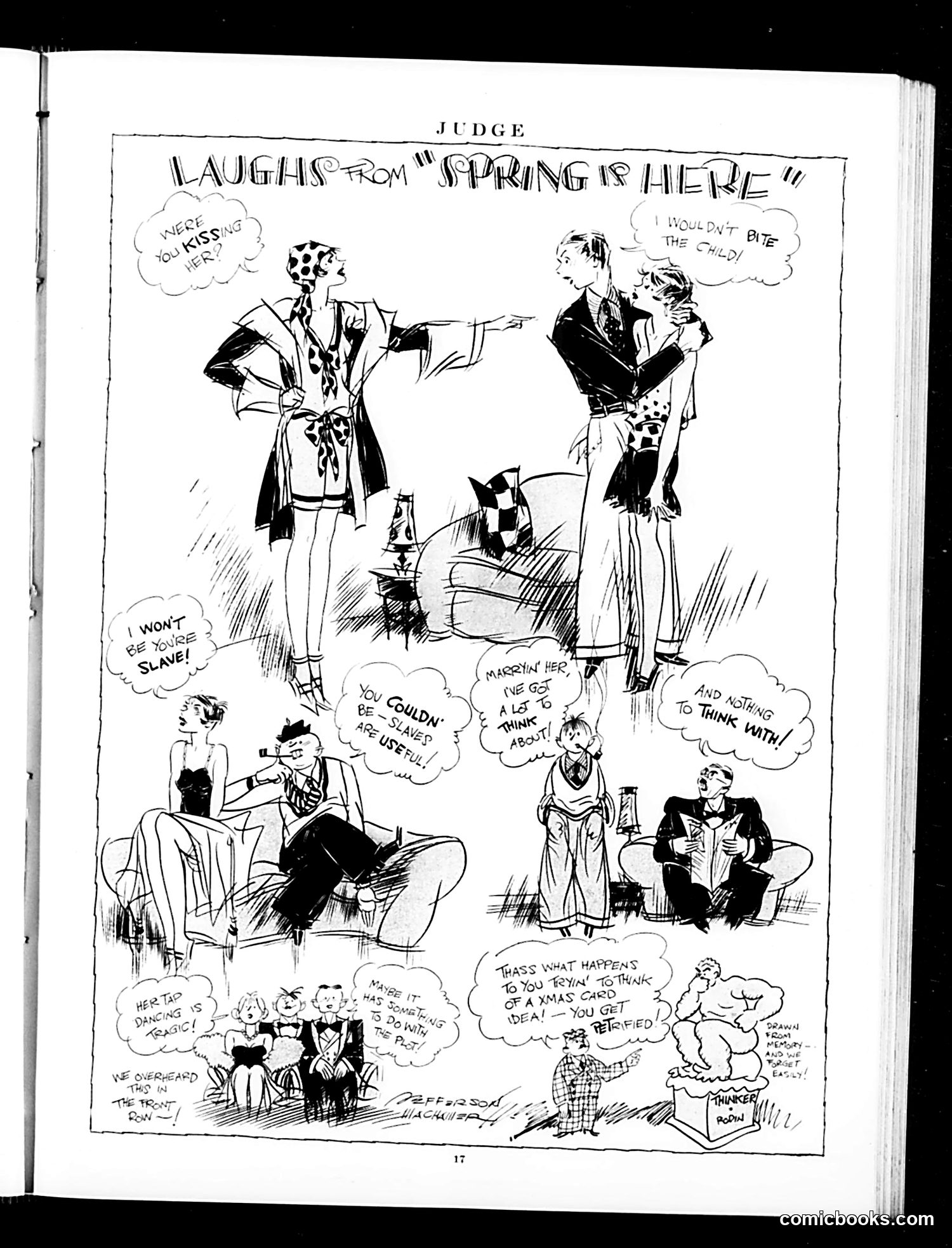
This multi-panel comic satirizes various romantic and social scenarios. The title references the seasonal optimism of spring, which traditionally inspires courtship. The cartoon depicts couples in different situations—some flirting, others married or engaged—exchanging dialogue about kissing, dancing, marriage, and gift-giving. The humor appears to mock the predictable social rituals and romantic clichés of the era: men's attempts at seduction ("we're kissing here!"), women's resistance or complications ("I wouldn't bite the child!"), and the inevitable outcomes of romantic pursuits leading to marriage and domesticity. The final panel suggests that attempting to think of Christmas card ideas results in chaos—humorously implying that sustained romance becomes difficult in married life. The satire targets conventional courtship expectations and their frequently disappointing realities.
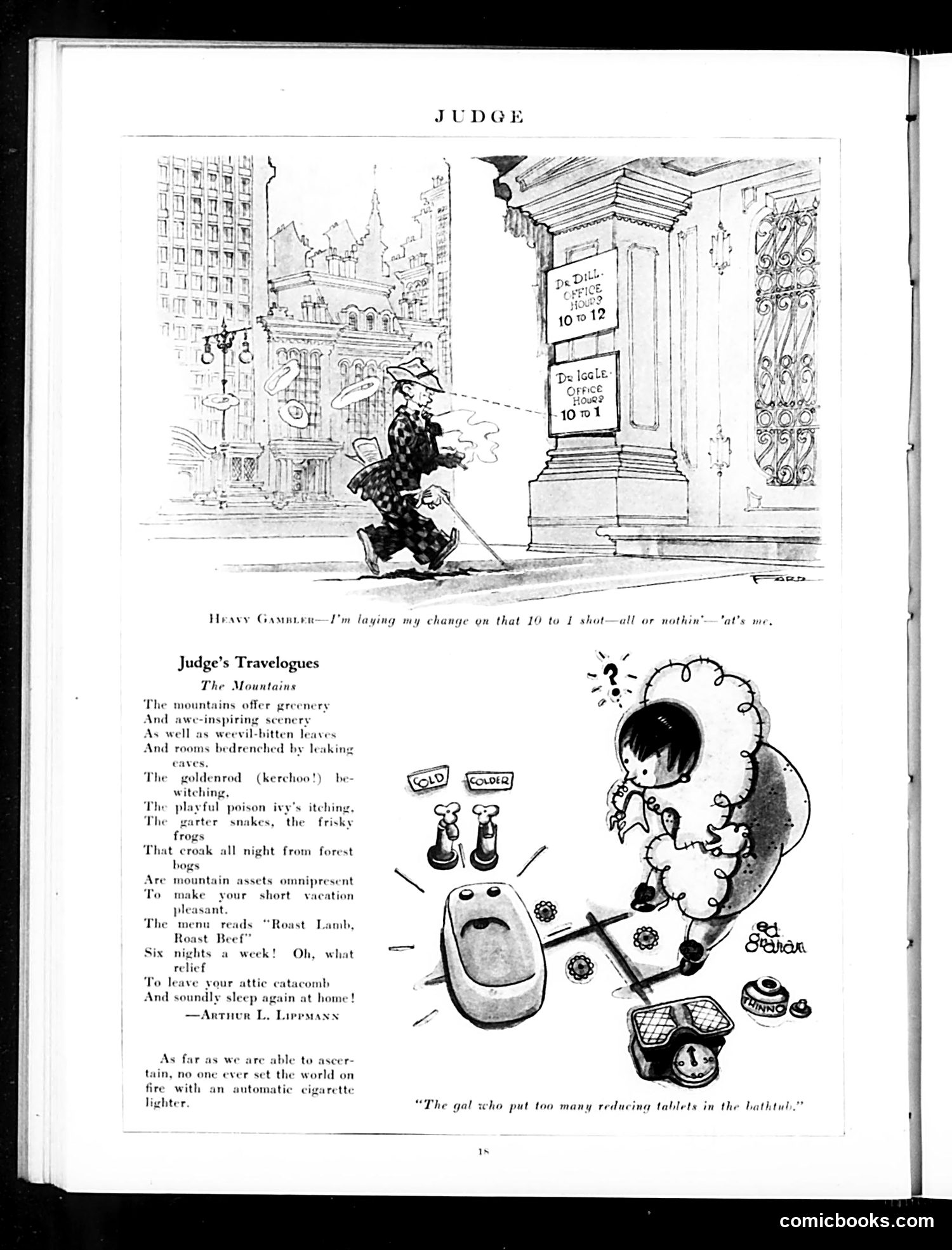
The top cartoon depicts a "Heavy Gambler" at what appears to be a courthouse (marked "Judge's Offices"), placing a bet on "10 to 1 odds"—suggesting he's wagering on a legal outcome. The satire critiques gambling culture and the desperation of those betting on uncertain results, even in serious legal matters. "Judge's Travelogues: The Mountains" is a humorous poem mocking vacation marketing. It sarcastically describes mountain vacations as afflicted by allergies (goldenrod causing sneezes), insects (poison ivy, snakes), leaky accommodations, and monotonous meals—the opposite of advertised "awe-inspiring scenery." The satire targets false tourist advertising and the gap between promotional promises and disappointing reality. The bottom cartoon, captioned "The gal who put too many reducing tablets in the bathtub," shows a woman who has apparently dissolved or shrunk from using too many diet/weight-loss tablets in bathwater—a dark joke about dangerous fad weight-loss products. It satirizes the era's unregulated, potentially toxic diet aids and women's desperation to lose weight.
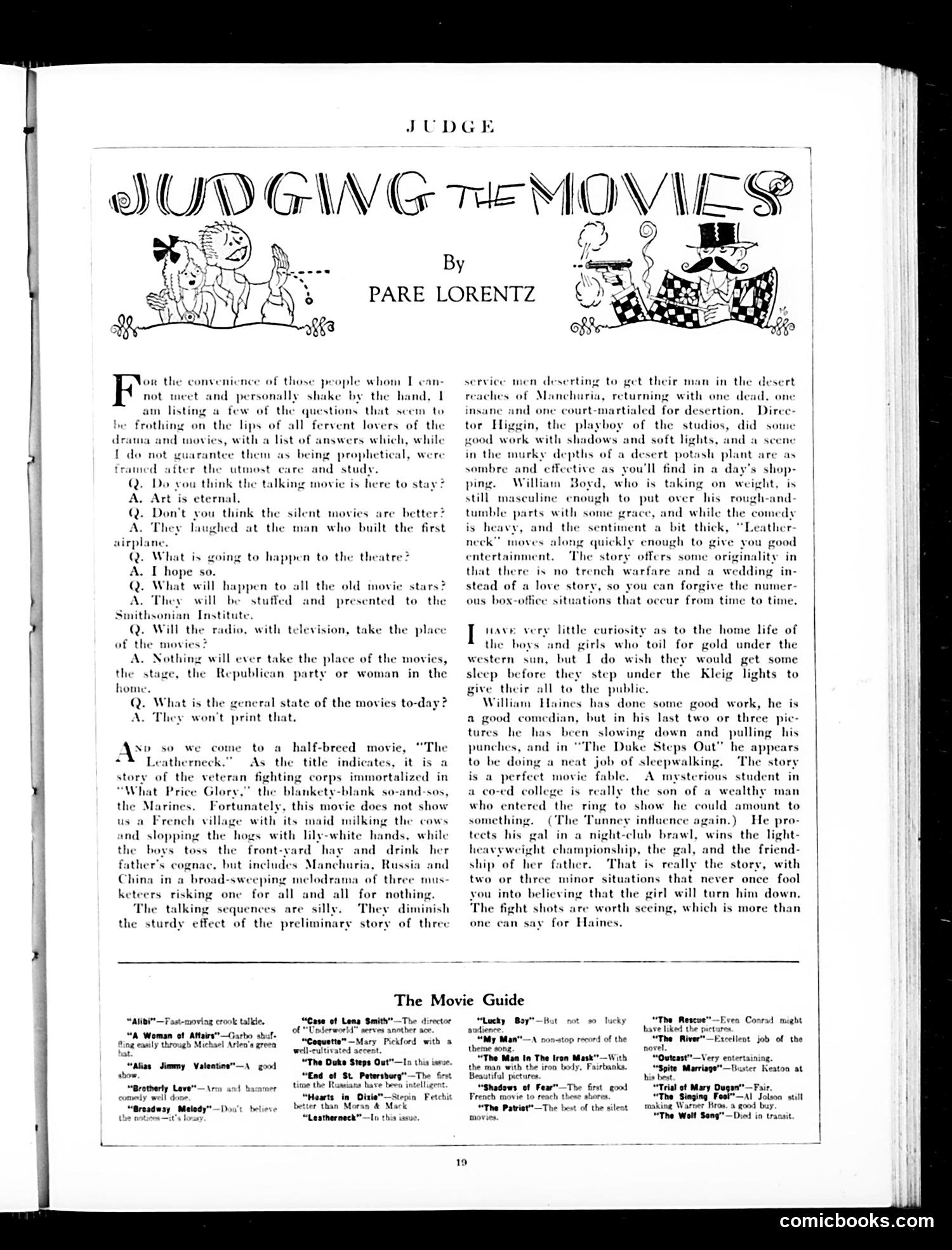
This page features film criticism by Pare Lorentz, structured as a Q&A column about movies' future amid the rise of "talking pictures" (sound film). The satire targets contemporary anxieties: will talkies replace silent films? Will radio and television kill cinema? Will old movie stars become obsolete? The humor is dated but clear—Lorentz suggests the Republican Party is as permanent as movies, mocks radio's threat as overblown, and reassures readers that cinema is immortal. He then reviews "The Leatherneck," a military drama, criticizing its melodrama while praising actor William Haines's comedic work despite his recent decline in quality. References to "What Price Glory" (a famous WWI film) and boxer Gene Tunney ground the discussion in 1920s popular culture. The overall tone is protective of cinema against emerging technologies, reflecting Depression-era anxiety about entertainment's evolution.
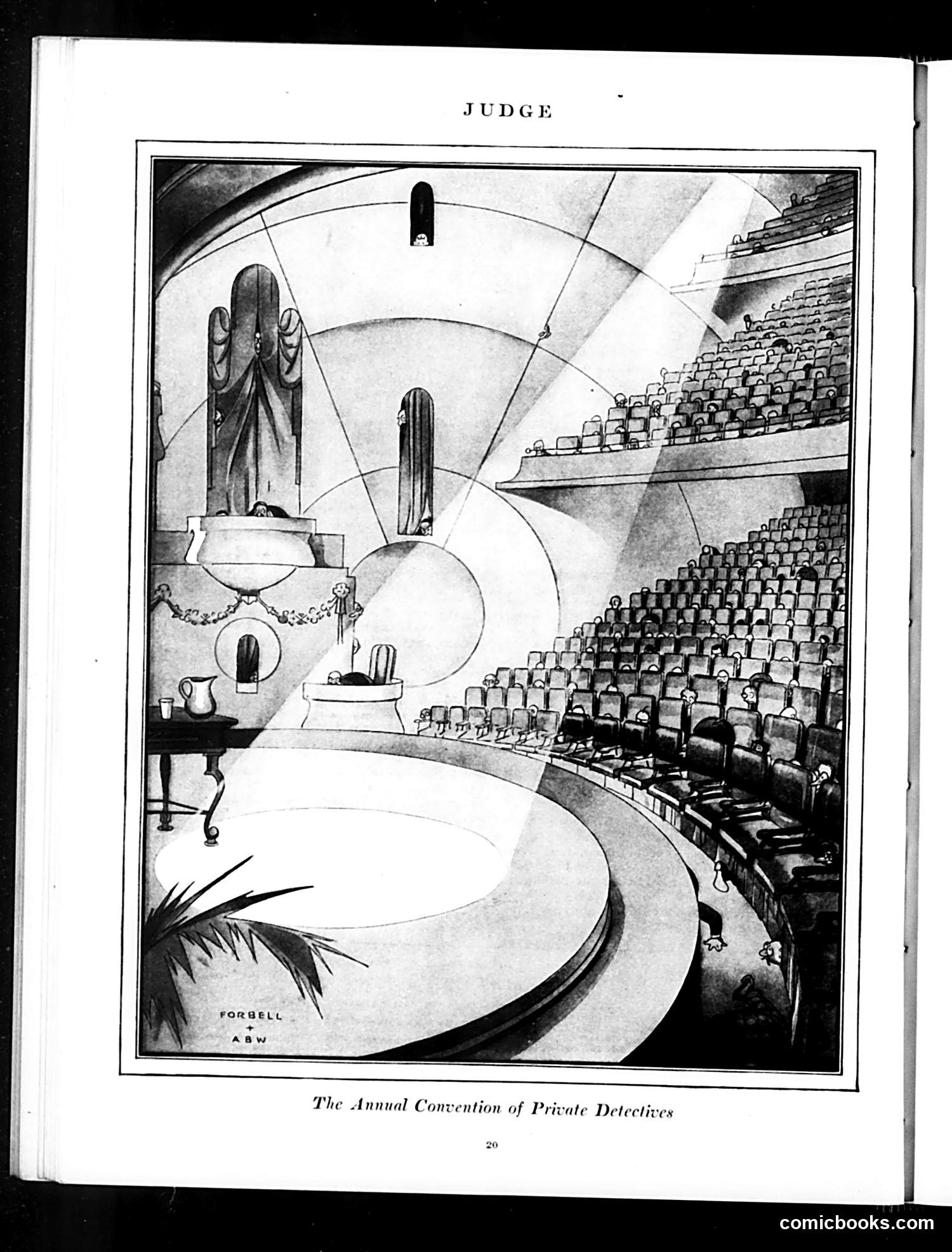
This satirical illustration depicts a grand, Art Deco-style auditorium filled with seated attendees facing a stage with statues and ceremonial objects. The joke appears to mock private detectives as a profession—suggesting they gather in impressive, formal settings despite their typically unglamorous work. The elaborate architecture, draped statuary, and serious ceremony contrast sharply with the mundane reality of detective work, creating ironic humor. The illustration implies private detectives fancy themselves important and professional, when in fact they may be regarded as less respectable than official law enforcement. The artist's signature reads "FORBELL + ABW" (lower left). This reflects early 20th-century American attitudes toward private investigators as a somewhat dubious profession.
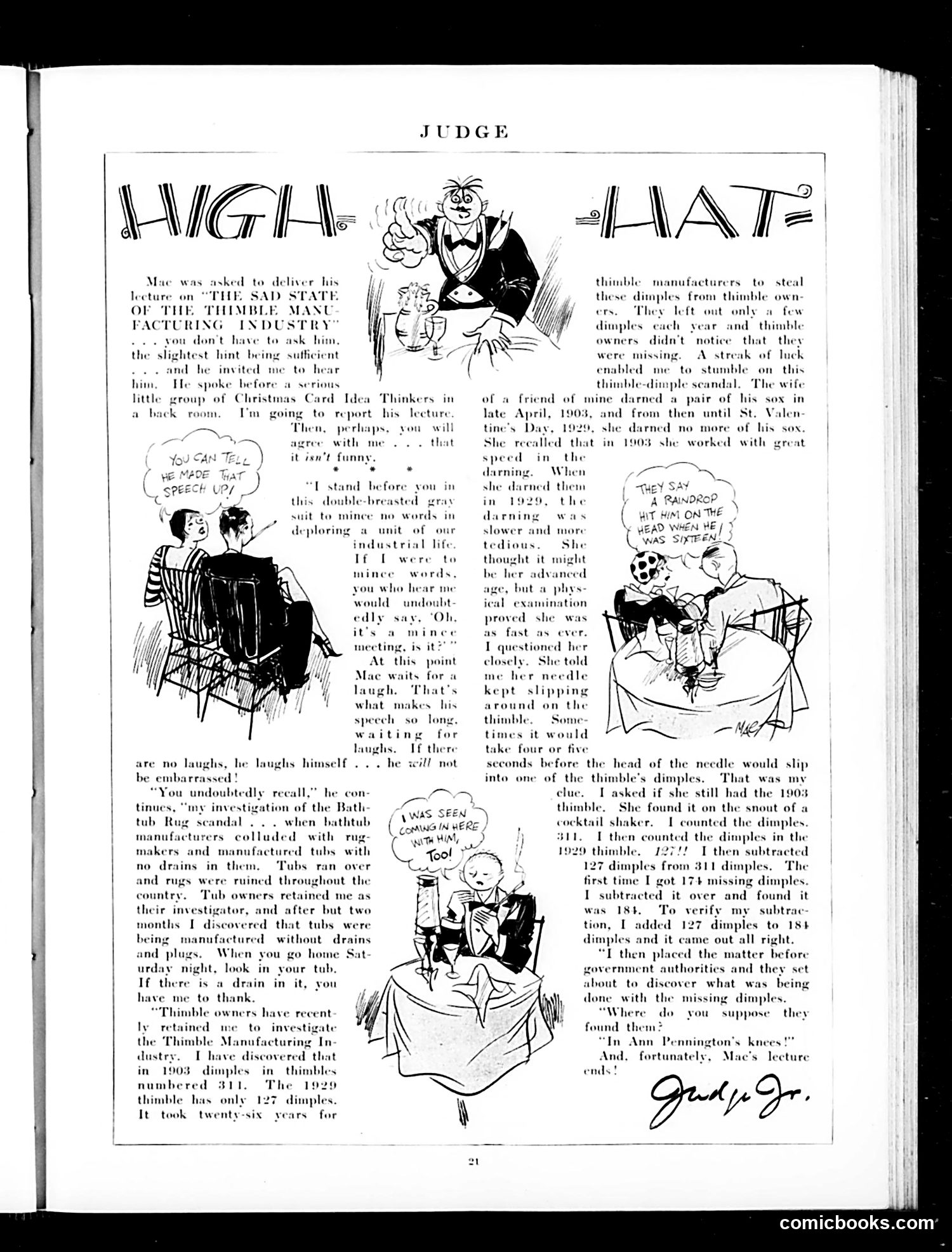
This page satirizes a lecture by "Mac," a supposedly serious investigator presenting to "Christmas Card Idea Thinkers." The joke is that Mac delivers an absurdly elaborate, pseudo-scientific investigation into a completely trivial problem: thimble manufacturers allegedly stealing dimples from thimbles between 1903-1929. The satire mocks: - **Overly formal business investigations** into non-existent scandals - **Ridiculous logic**: Mac traces "missing dimples" to dancer Ann Pennington's knees (a contemporary reference to her famous legs) - **Pompous speech-making** that wastes time with bad puns ("mince no words in this double-breasted suit") - **Corporate absurdity**: The entire investigation hinges on a woman's darning needle slipping The cartoons show Mac delivering this nonsense while his audience reacts. The punchline—that the dimples ended up in a dancer's knees—is pure vaudeville-style humor, typical of Judge's irreverent approach to American business culture and pretension.
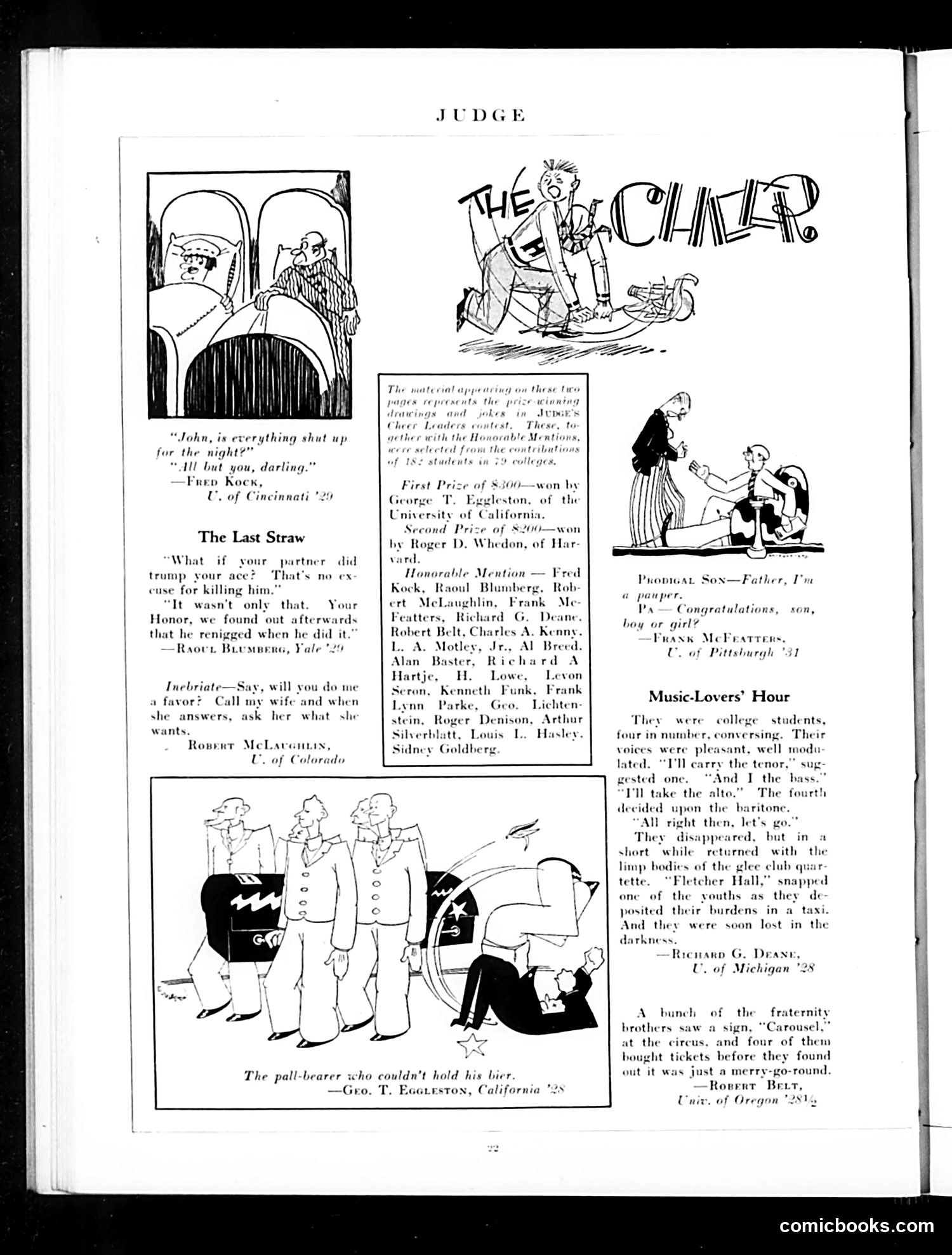
This page collects student humor submissions to Judge magazine, featuring jokes and cartoon gags typical of 1920s college humor. **"The Last Straw"** jokes about bridge card game disputes escalating to murder—the punchline being that "renegging" (breaking card game rules) was the final insult justifying homicide. **The pall-bearer cartoon** is a visual pun: a man "couldn't hold his bier" (beer), showing him drunk at a funeral, unable to carry the coffin steadily. **"Music-Lovers' Hour"** presents dark gallows humor: four students discussing singing parts, then returning with unconscious glee club members' bodies to dump in a taxi—suggesting they kidnapped or attacked rival singers. This reflects competitive college spirit taken to violent extremes. **"Carousel" joke**: fraternity members misread a circus sign, expecting a mechanical ride but finding an actual carousel (horse ride), playing on the dual meaning. These are student-written submissions showcasing the era's casual acceptance of violence as comedy fodder.
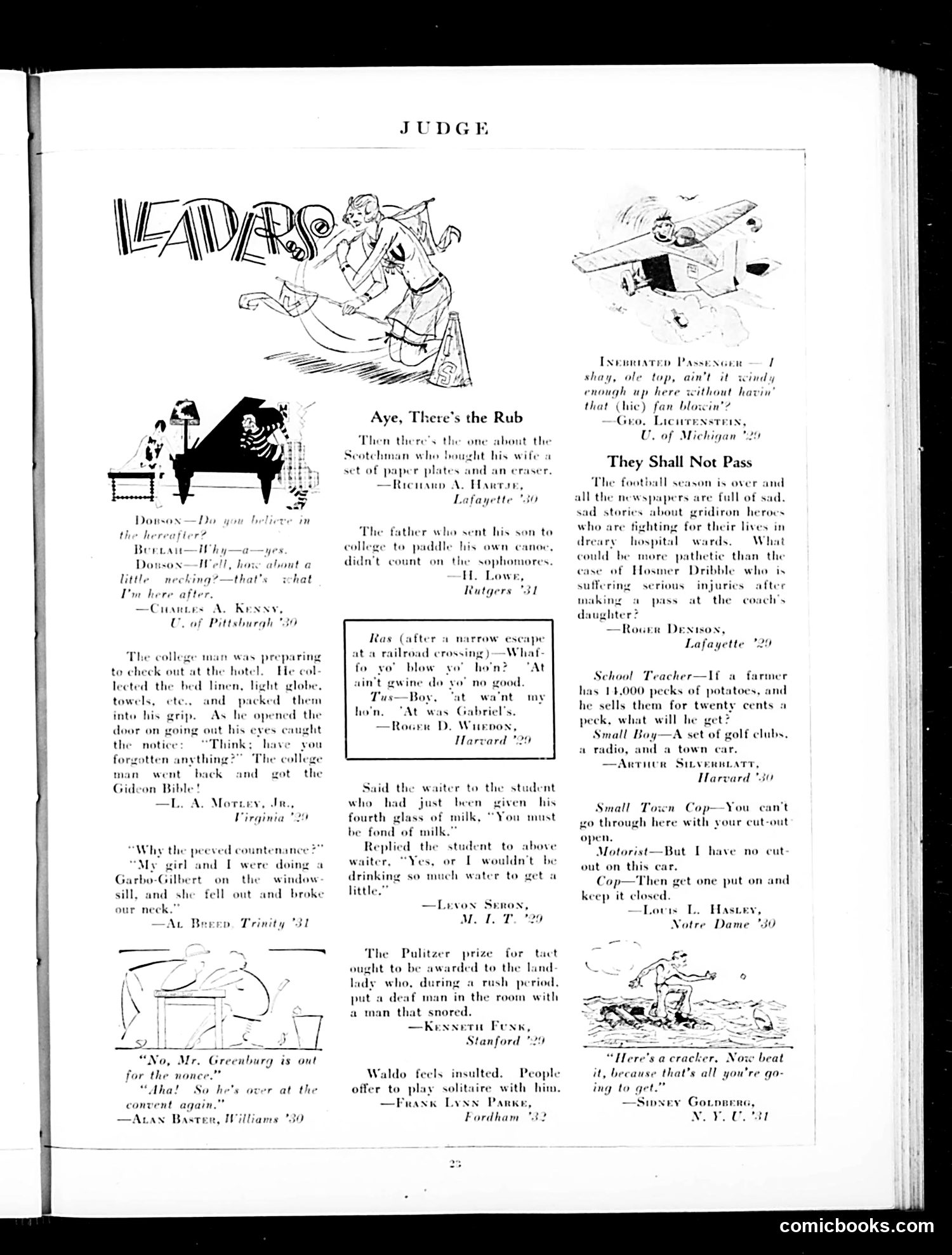
This page from *Judge* collects humor pieces—primarily jokes and brief comic scenarios—submitted by college students from various universities (noted by class years like '29, '30, '31). The cartoons and jokes satirize **college life and social conventions** of the era. Examples include: - A college man stealing hotel linens (petty theft as campus humor) - A Scotsman's wife receiving practical paper plates as a gift (ethnic stereotype humor) - A father's son struggling with college independence (generational comedy) - A "Small Town Cop" hassling a motorist about a "cut-out" exhaust (rural authority figures) - A football player injured after making advances at the coach (sexual innuendo) The humor relies heavily on **period-specific references**: ethnic caricatures, class anxieties, automotive culture, and romantic mishaps. The dialect humor ("Ras" and Gabriel) reflects dated racial stereotyping common to the era. Overall, this represents **collegiate humor magazines' typical content**—light satire of student life, relationships, and social pretension, rather than political commentary.
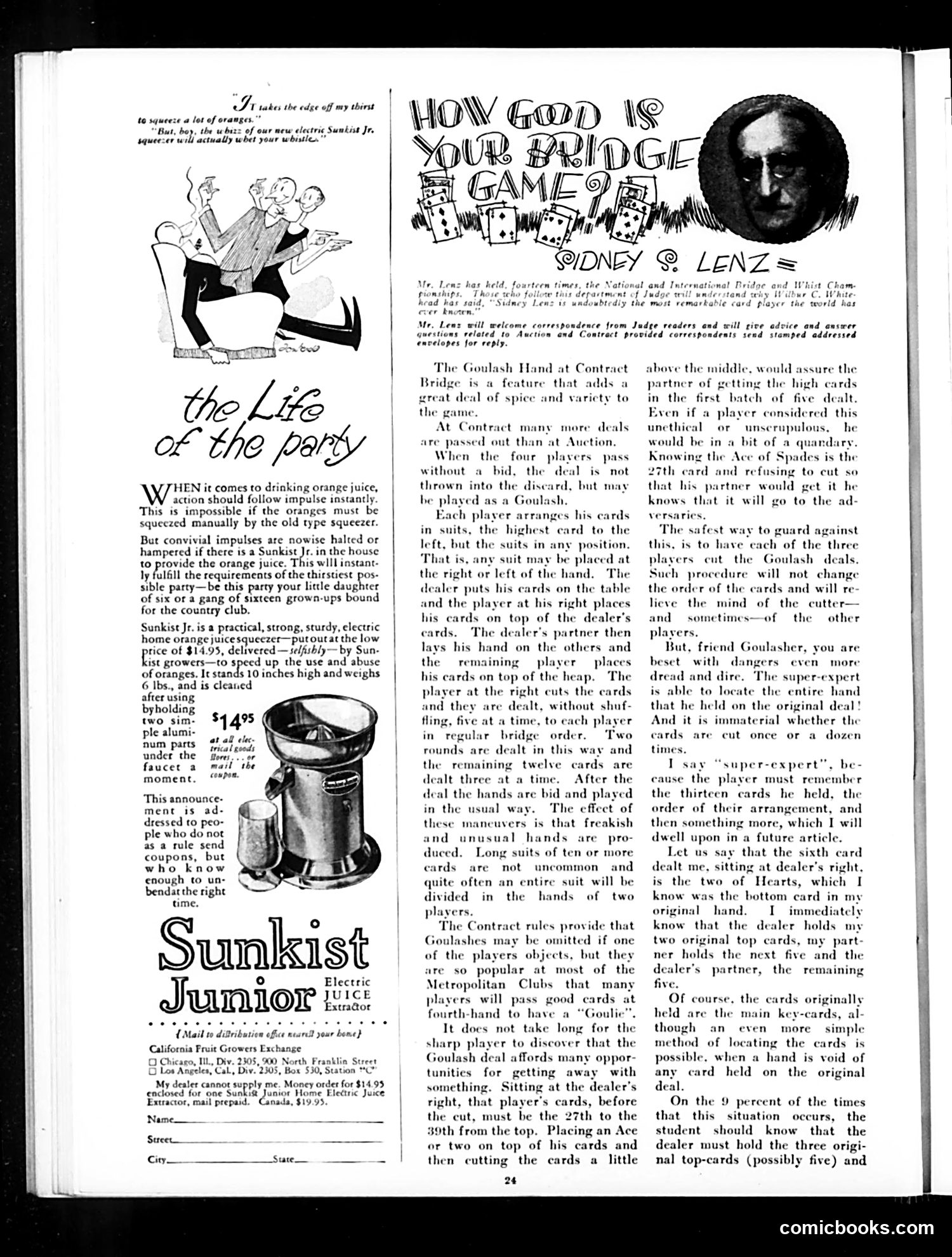
This is primarily an **advertisement page** for the Sunkist Junior electric orange juice squeezer ($14.95), pitched as a practical convenience for hosting parties—from children to "sixteen grown-ups bound for the country club." The upper left contains a cartoon about "the life of the party," showing social drinking culture of the era, where serving fresh orange juice signals hospitality and sophistication. The main content is a **bridge card game instructional article** by Sidney Q. Lenz (identifiable from the portrait), explaining the "Goulash Hand"—an unusual Contract Bridge dealing method where cards aren't shuffled normally. The article warns players about the strategic advantages and disadvantages this creates, particularly for detecting which cards were in the original deal. The satire is subtle: the ad juxtaposes modern electrical convenience with the leisured, sophisticated pastimes (bridge clubs, country clubs) of affluent 1920s-30s society. The page reflects Judge magazine's typical audience: educated, upper-middle-class readers who played bridge and hosted social gatherings.
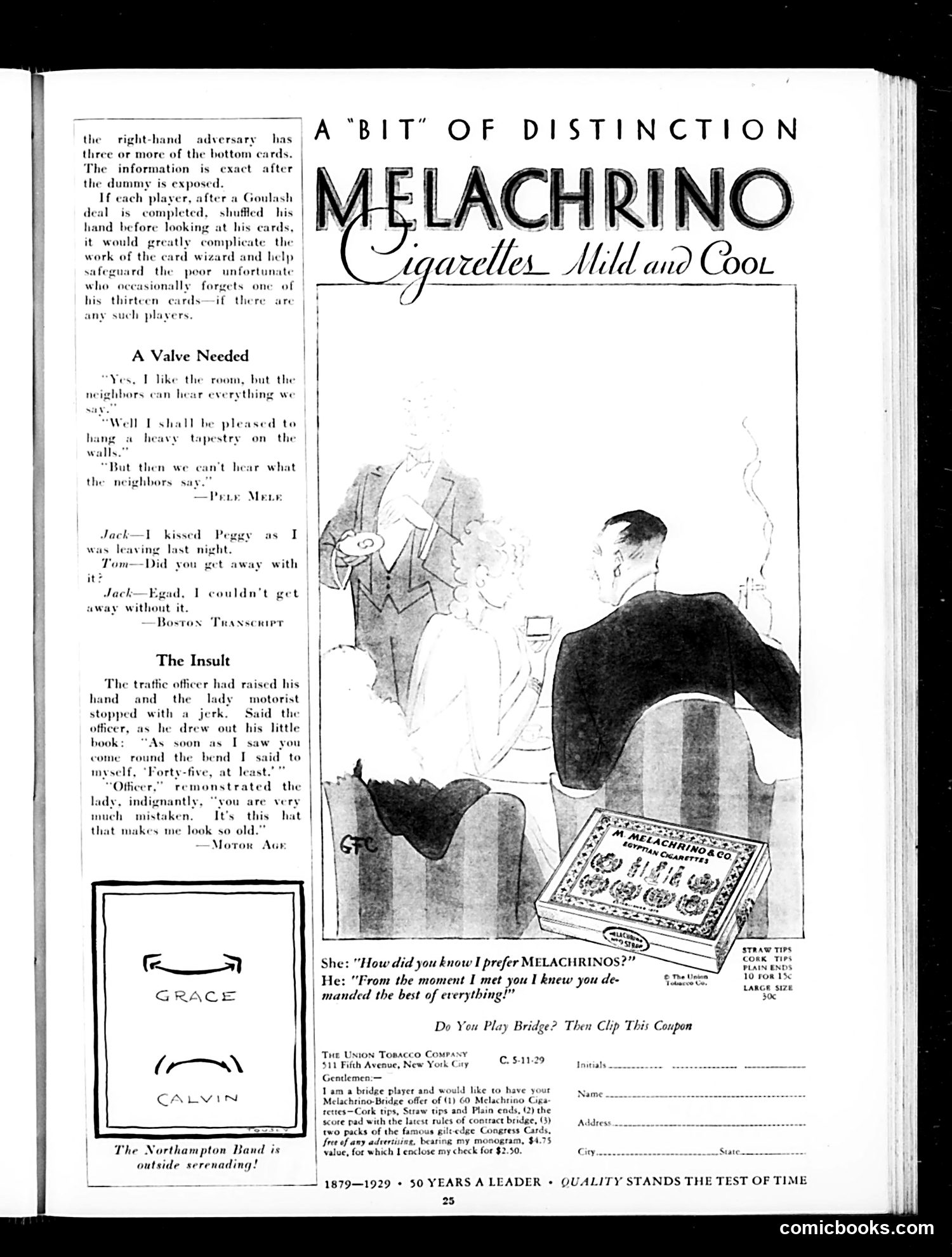
This page is primarily **advertising for Melachrino cigarettes**, disguised as editorial content with humorous anecdotes. The main illustration shows a man examining a Melachrino cigarette box while a woman looks on admiringly. The accompanying dialogue presents a romantic scenario where the man demonstrates his superior taste by preferring Melachrino cigarettes, and the woman approves because "from the moment I met you I knew you demanded the best of everything." The left column contains three brief, unrelated humorous anecdotes about card games, soundproofing, and a traffic officer—typical filler content for Judge magazine. **The satire's point**: The advertisement cleverly positions Melachrino cigarettes as a marker of refined taste and sophistication. By framing it as a romantic preference rather than a commercial pitch, the ad suggests that smoking these particular cigarettes signals social distinction and good judgment to potential romantic partners. This reflects 1920s advertising strategy that conflated consumer products with personal character and desirability.
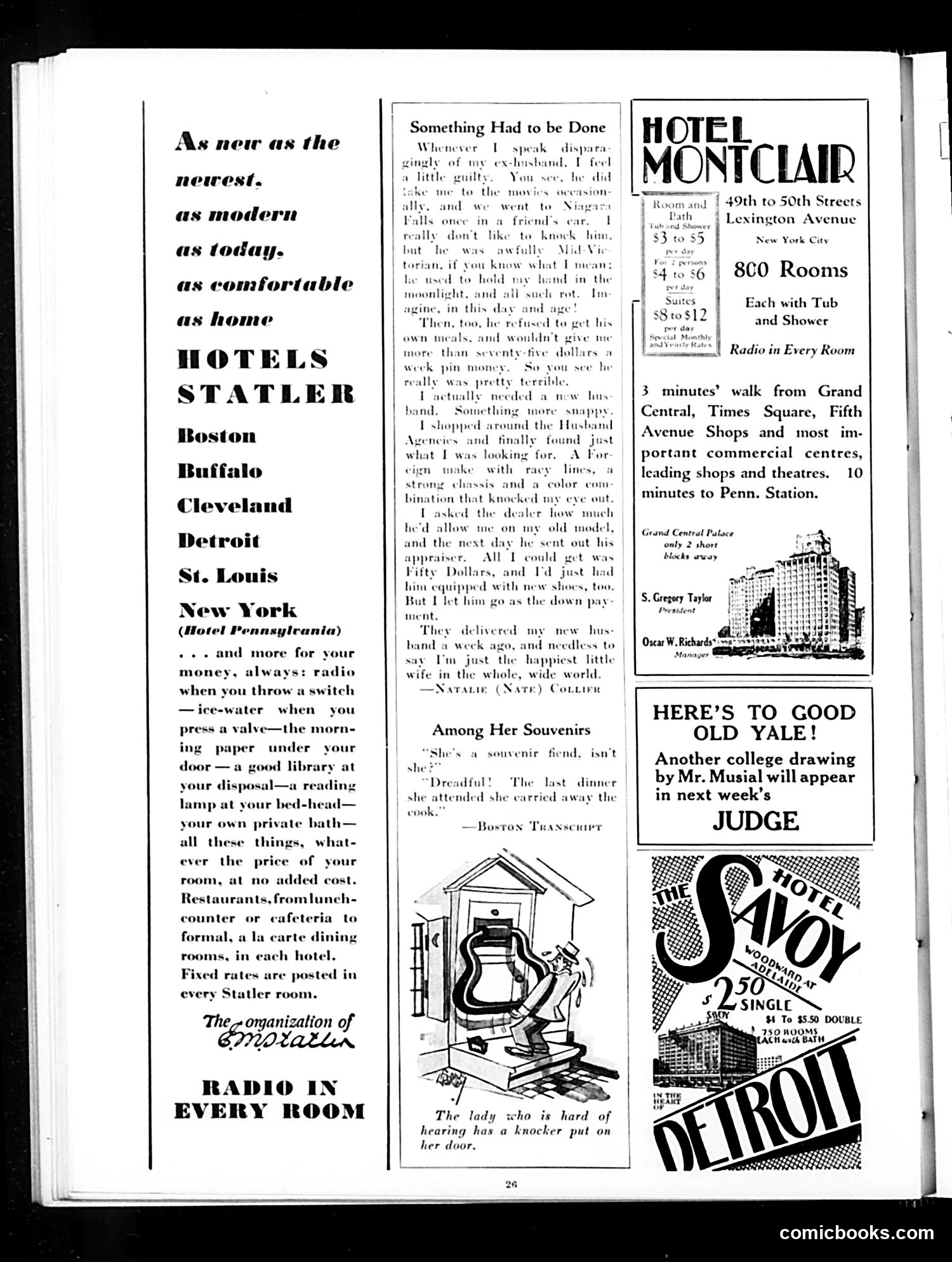
This page is primarily **advertising** for luxury hotels (Statler chain and Hotel Montclair), with two satirical humor pieces interspersed. **"Something Had to be Done"** is a divorce satire mocking modern marital attitudes. A woman complains her ex-husband was "Mid-Victorian"—too romantic (holding hands in moonlight)—and stingy with her allowance. She trades him in like a used car at "Husband Agencies," shopping for a newer model with better features. The joke targets 1920s-era cynicism about marriage as a consumer transaction and criticizes both women's materialism and men's obsolescence in modern relationships. **"Among Her Souvenirs"** is a brief gag: a woman is a "souvenir fiend" who steals items from dinner parties—specifically, she absconded with the cook after the last event. The humor relies on the double meaning of "carry away." Both pieces reflect Jazz Age social commentary on changing gender relations and consumer culture, though the satire is relatively light.
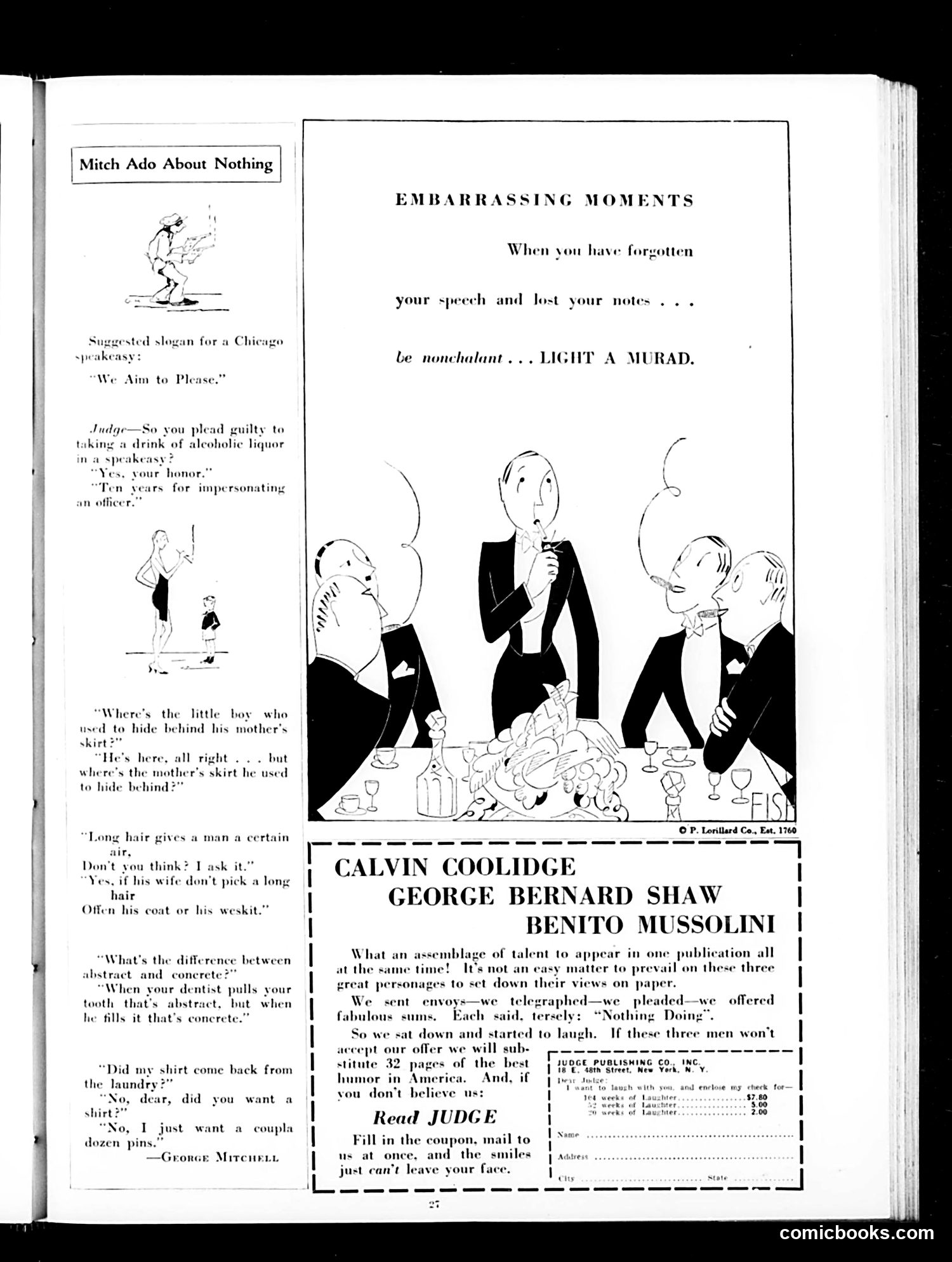
This page contains two distinct sections: **Left side ("Mitch Ado About Nothing"):** A collection of brief jokes and quips on everyday topics—laundry mishaps, hair, dental work, domestic disputes. These are simple one-liners typical of early 20th-century humor magazines, relying on wordplay and domestic situations. **Right side ("Embarrassing Moments"):** A cartoon showing men at a formal dinner awkwardly lighting cigars, with text suggesting that when you've forgotten your speech notes, staying calm and smoking a Murad cigarette solves embarrassment. This is **direct product advertising disguised as humor**—a common magazine practice then. **Bottom section:** Judge magazine advertises that it will feature writings by Calvin Coolidge (U.S. President), George Bernard Shaw (famous Irish playwright), and Benito Mussolini (Italian dictator) in a single issue. The copy humorously claims they offered "fabulous sums" to secure these prominent figures' contributions, suggesting exclusivity and prestige. This appears to be a promotional gimmick—likely exaggerated or entirely fictional—to boost magazine sales.
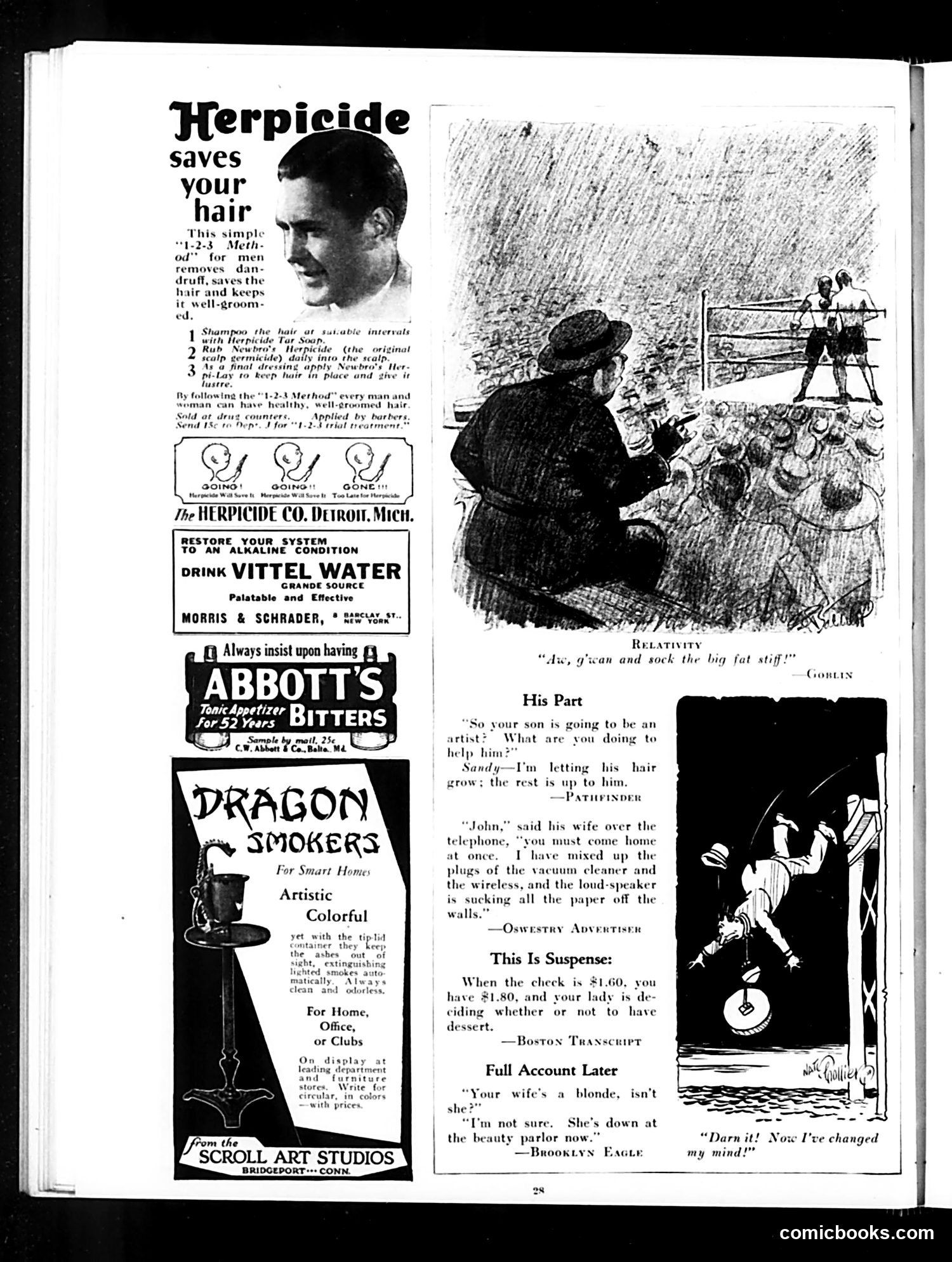
This page is primarily **advertisements** with humorous filler content typical of early 20th-century magazines. The main cartoon shows a man watching a boxing match, captioning it as "Relativity" with a Goblin quote about "can and sock the big fat stiff"—likely satirizing Einstein's then-recent theory of relativity by reducing it to prizefighting vernacular. The short jokes below mock domestic life: a wife's complaint about mixing vacuum and wireless plugs destroying wallpaper; marital uncertainty about a wife's hair color (she's at the beauty parlor); and dining anxiety about whether to order dessert based on check totals. **The ads** promote now-obsolete products: Herpicide (hair loss treatment), Vittel Water (mineral water), Abbott's Bitters, and Dragon Smokers (decorative ashtrays). This reflects early 1900s consumer culture, domestic anxieties, and attempts to sell solutions to invented problems—marriage tensions and personal grooming concerns being primary targets.
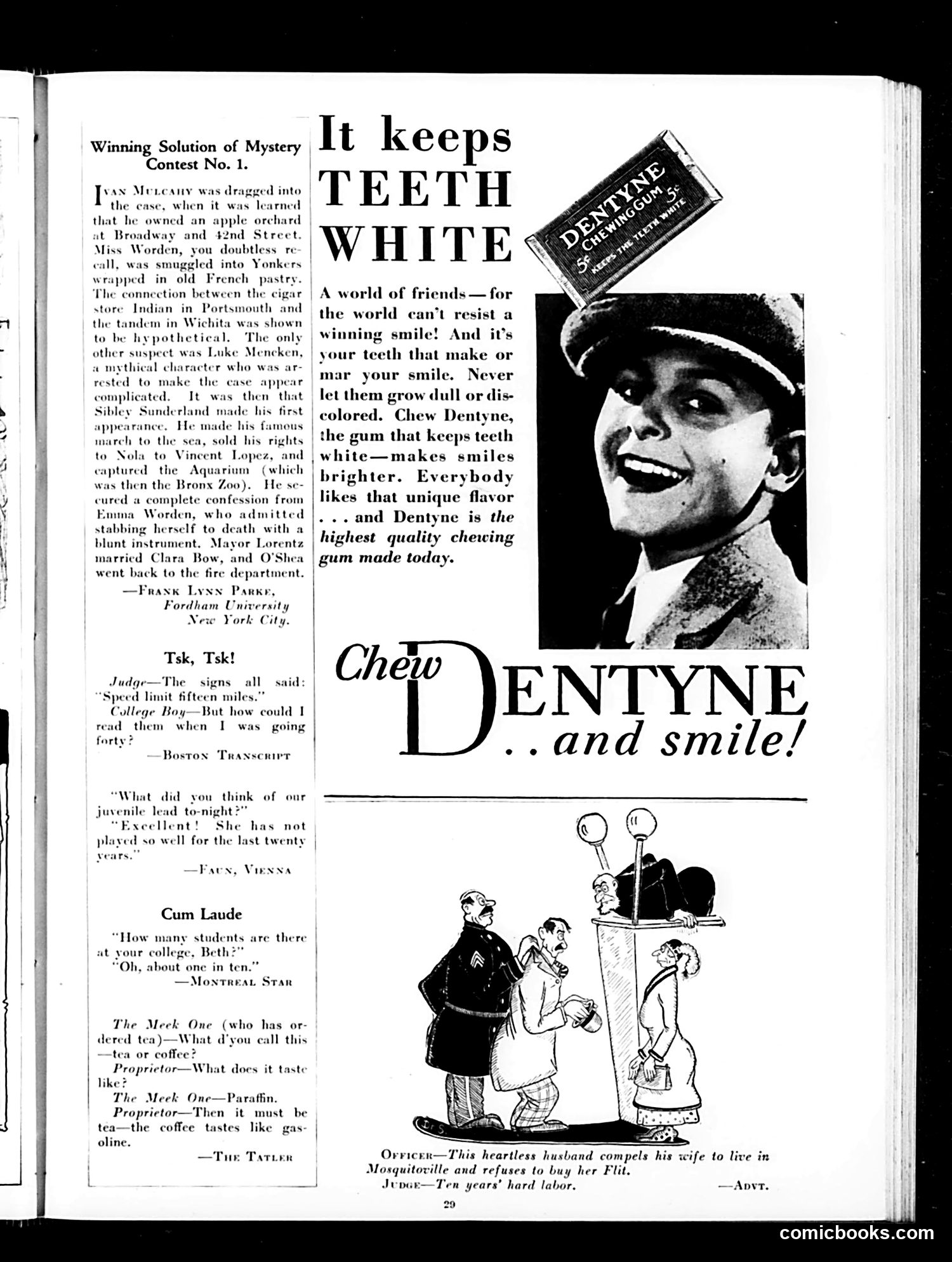
This page from *Judge* magazine contains a mix of content: a contest solution, brief humorous jokes, and advertising. The **main cartoon** (bottom) satirizes domestic justice: a judge sentences a "heartless husband" to hard labor for forcing his wife to live in "Mosquitoville" and refusing to buy her Flit (an insecticide brand). The joke mocks how trivial domestic disputes might be treated with mock-seriousness by courts—the punchline treats a husband's stinginess about pest control as criminal negligence worthy of imprisonment. The **short jokes** above employ wordplay: a speeding college boy couldn't read speed-limit signs while driving 40 mph; a meek customer mistakes his tea for gasoline based on taste. The **Dentyne advertisement** occupies significant space, featuring a smiling man encouraging readers to chew the gum to maintain white teeth and attractive smiles—typical early 20th-century advertising that linked product use to social success and personal appeal. The **contest solution** announces winners of a mystery contest, though the cryptic details are difficult to parse without the original contest materials.
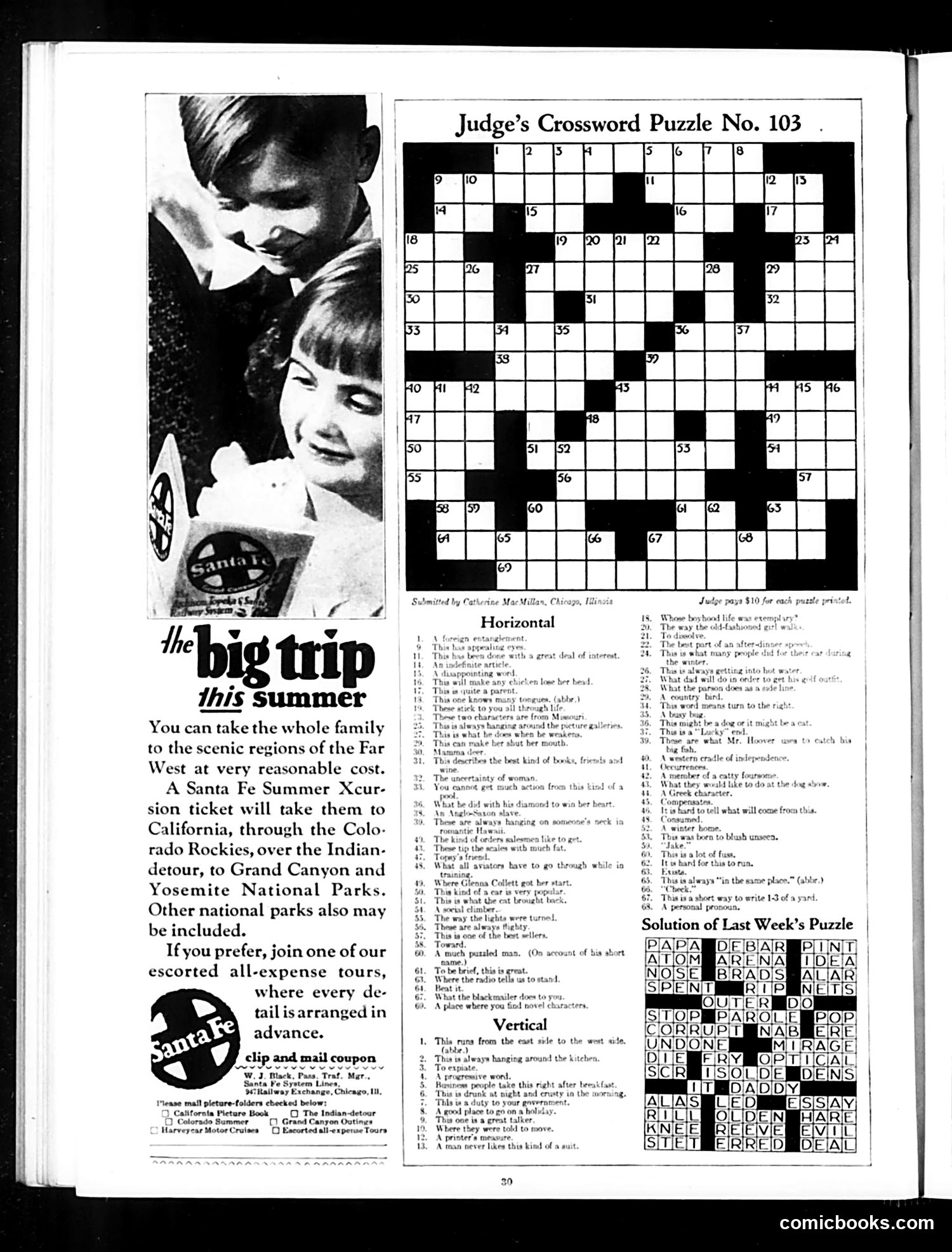
This page is primarily a **travel advertisement**, not political satire. The main content is a Santa Fe Railway promotion for summer vacations to Western destinations—California, Colorado Rockies, Grand Canyon, and Yosemite National Parks. The photograph shows a family (likely a parent and child) looking at promotional materials, advertising the appeal of taking "the whole family" on affordable cross-country trips. The "Indian-detour" reference indicates tours that included Native American cultural attractions—a common marketing angle of the era, though the term reflects period attitudes. The crossword puzzle and its solution below are filler content typical of Judge magazine's format. There is no visible political cartoon or satire on this page—it's essentially an advertorial section demonstrating how magazines of this era integrated promotional content with standard puzzle features.
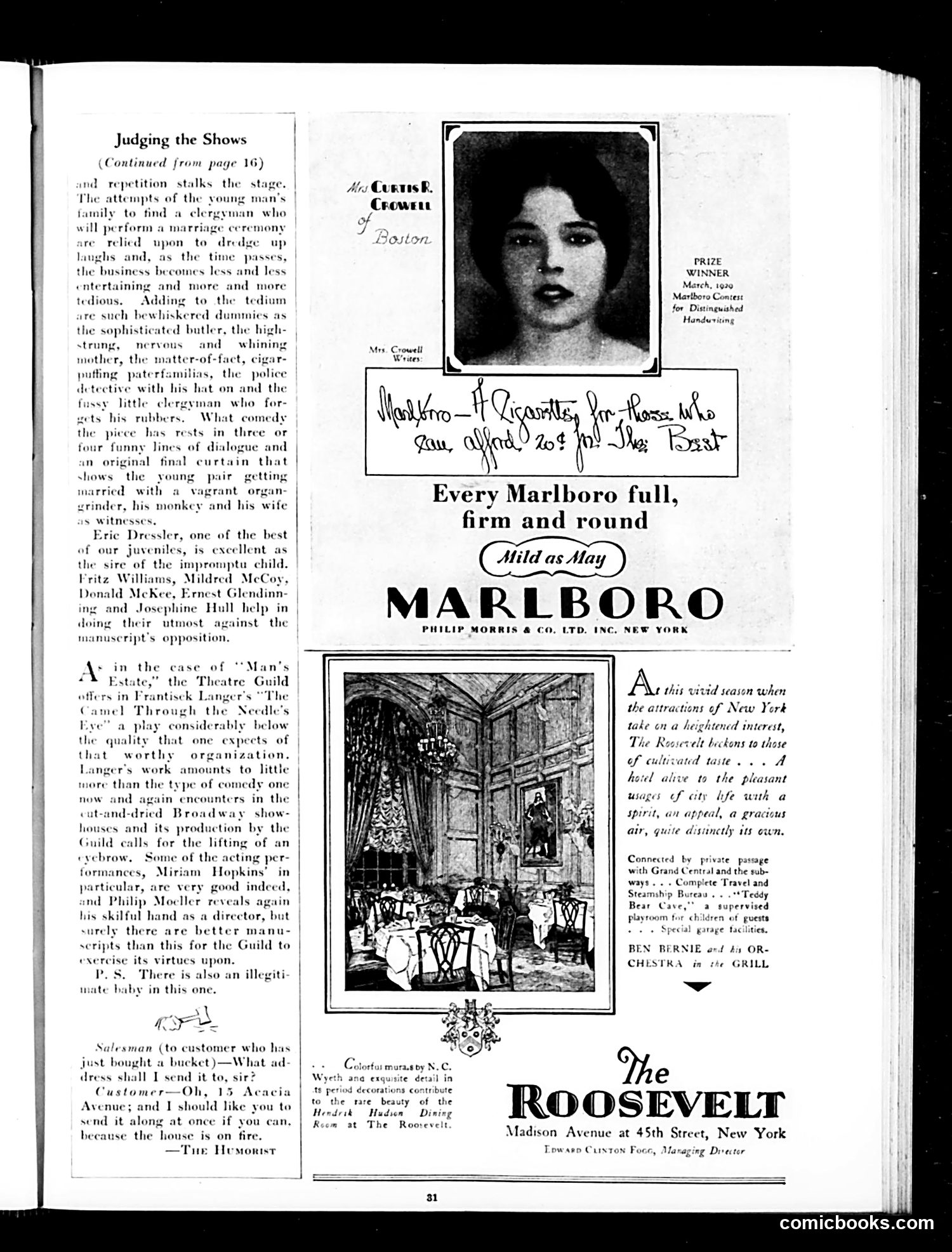
This page is primarily **advertisements and theater reviews** rather than editorial cartoons. The main content includes a theater review ("Judging the Shows") critiquing recent Broadway productions, with complaints about formulaic plots and repetitive comedies. There's a brief humorous "Humorist" anecdote about a salesman and a customer with a burning house. The advertisements feature: - A **Marlboro cigarette ad** with a handwriting contest winner (Mrs. Crowell of Boston) and endorsement - A **Roosevelt Hotel advertisement** emphasizing its Manhattan location, amenities, and connections to Grand Central No political satire or caricatures are evident. This appears to be a standard magazine page from 1920 mixing theater criticism with commercial advertising—typical of *Judge* magazine's format during this period.
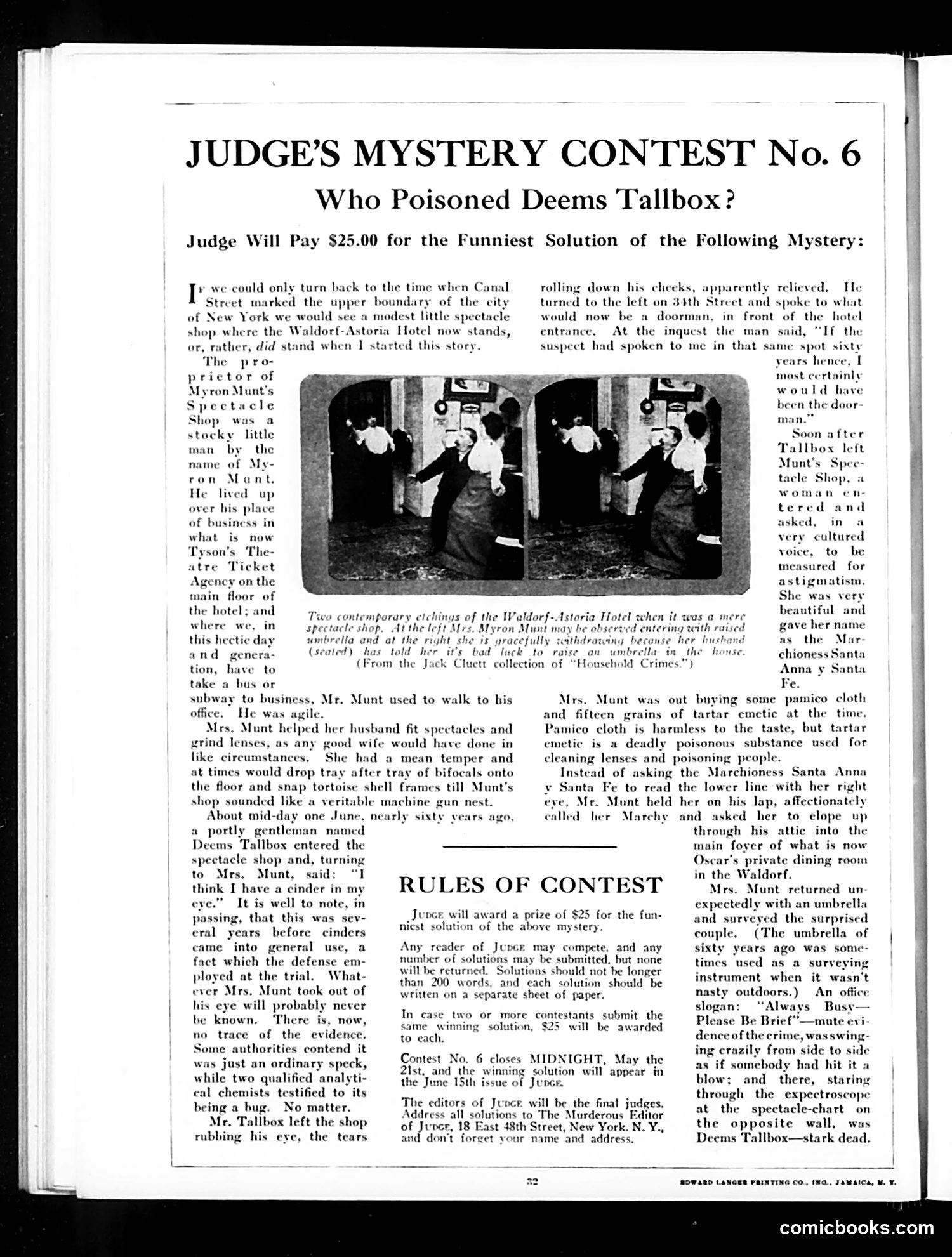
This page presents a participatory mystery contest from *Judge*, a satirical magazine. Rather than political satire, it's a entertainment feature inviting readers to solve "Who Poisoned Deems Tallbox?" The setup is a farcical murder plot: A portly gentleman visits Myron Munt's spectacle shop (where the Waldorf-Astoria Hotel now stands) with a cinder in his eye. After leaving, he dies—apparently poisoned. The story hints at suspicious circumstances involving Mrs. Munt's access to tartar emetic (a poison used to clean lenses), a beautiful "Marchioness," and an umbrella. The contest offers $25 for the "funniest solution"—emphasizing humor over mystery-solving. Readers could submit solutions under 300 words by May 21st. This represents *Judge*'s lighter entertainment content, blending nostalgia (old New York) with absurdist humor and reader participation.
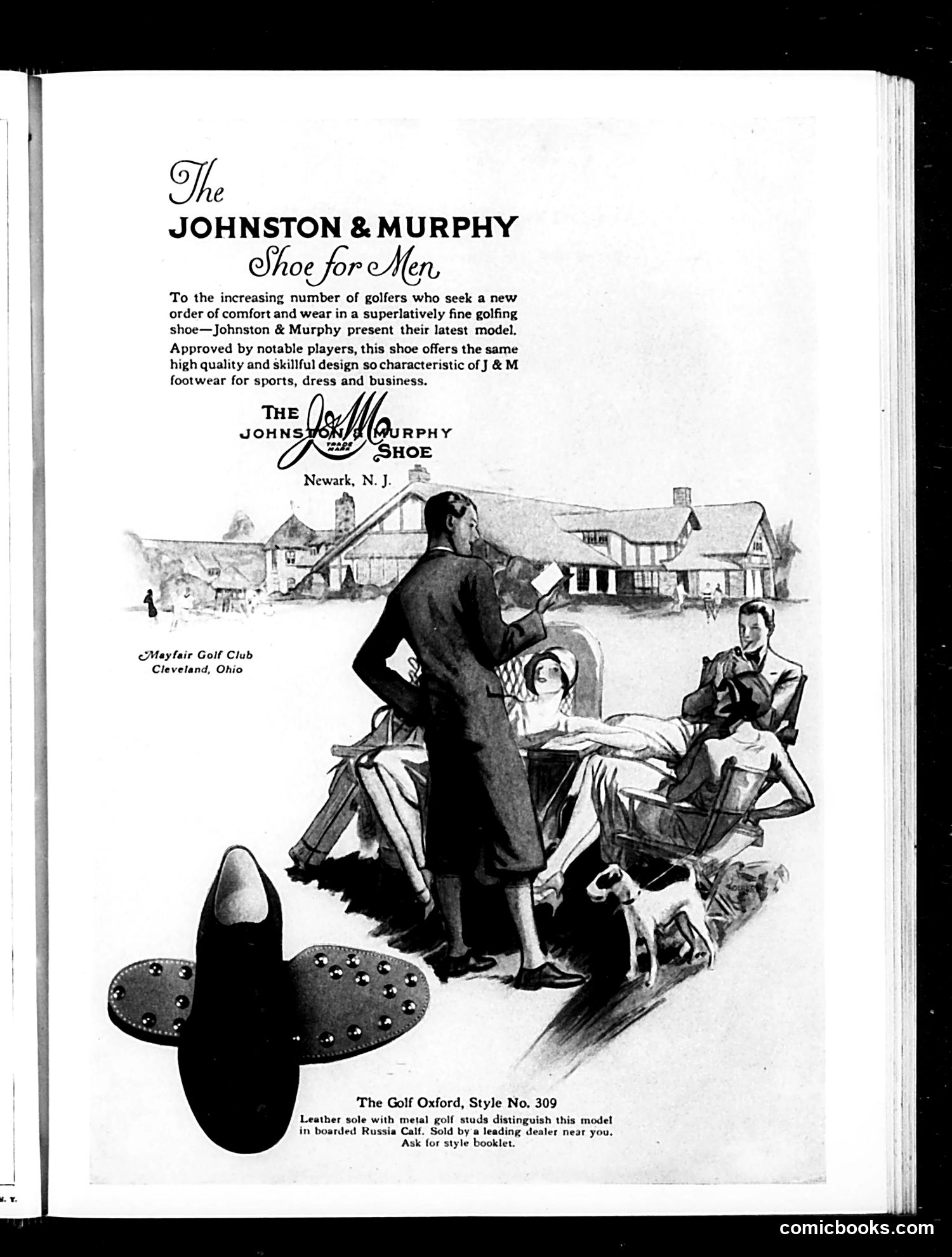
This is **not a political cartoon or satire—it's a straightforward advertisement** for Johnston & Murphy shoes, positioned as a full-page ad in *Judge* magazine. The page promotes "The Golf Oxford, Style No. 309," a specialized golfing shoe with metal studs on the sole. The illustration depicts an idealized country club scene at Mayfair Golf Club (Cleveland, Ohio), showing well-dressed golfers and spectators in a leisure setting with clubhouse architecture visible. The ad's messaging targets affluent golfers seeking quality footwear, emphasizing that the shoes are "approved by notable players" and offer superior comfort and design. The shoe image at bottom-left shows the metal-studded leather sole that distinguished the product. This represents early 20th-century marketing to the upper-class golf demographic—a lifestyle aspirational advertisement rather than satirical content.
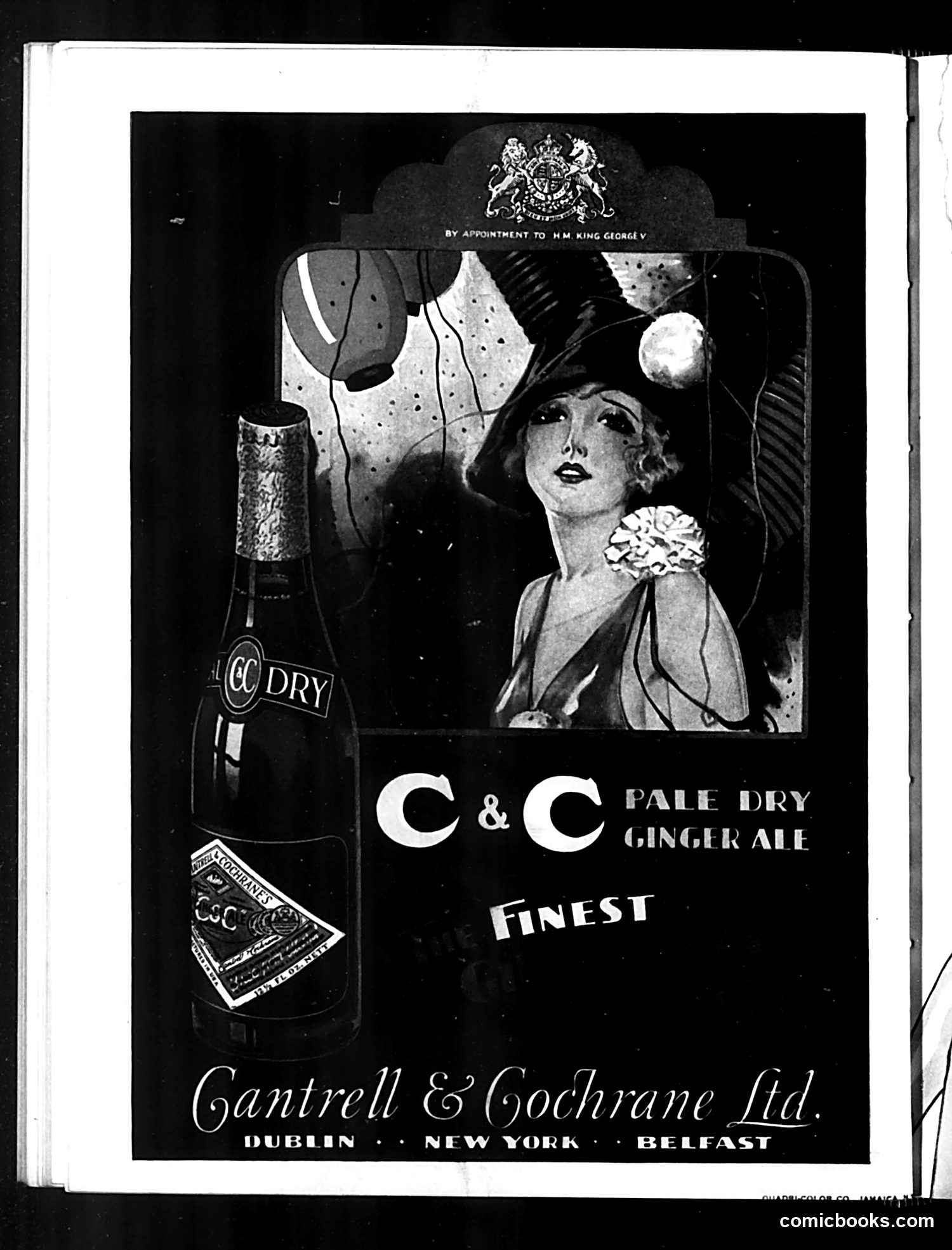
This is a **full-page advertisement**, not political satire. It promotes C&C Pale Dry Ginger Ale, made by Cantrell & Cochrane Ltd., a Dublin-based beverage company with operations in New York and Belfast. The ad features a glamorous 1920s-era woman gazing upward, surrounded by decorative Art Deco elements and a champagne bottle. The "By Appointment to H.M. King George V" royal warrant at the top suggests this was a premium product with official prestige. The imagery associates the ginger ale with sophistication and elegance—typical luxury marketing of the era. There is no satire or political commentary visible; this is straightforward commercial advertising from what appears to be a 1920s publication.