
A complete issue · 36 pages · 1929
Judge — July 6, 1929
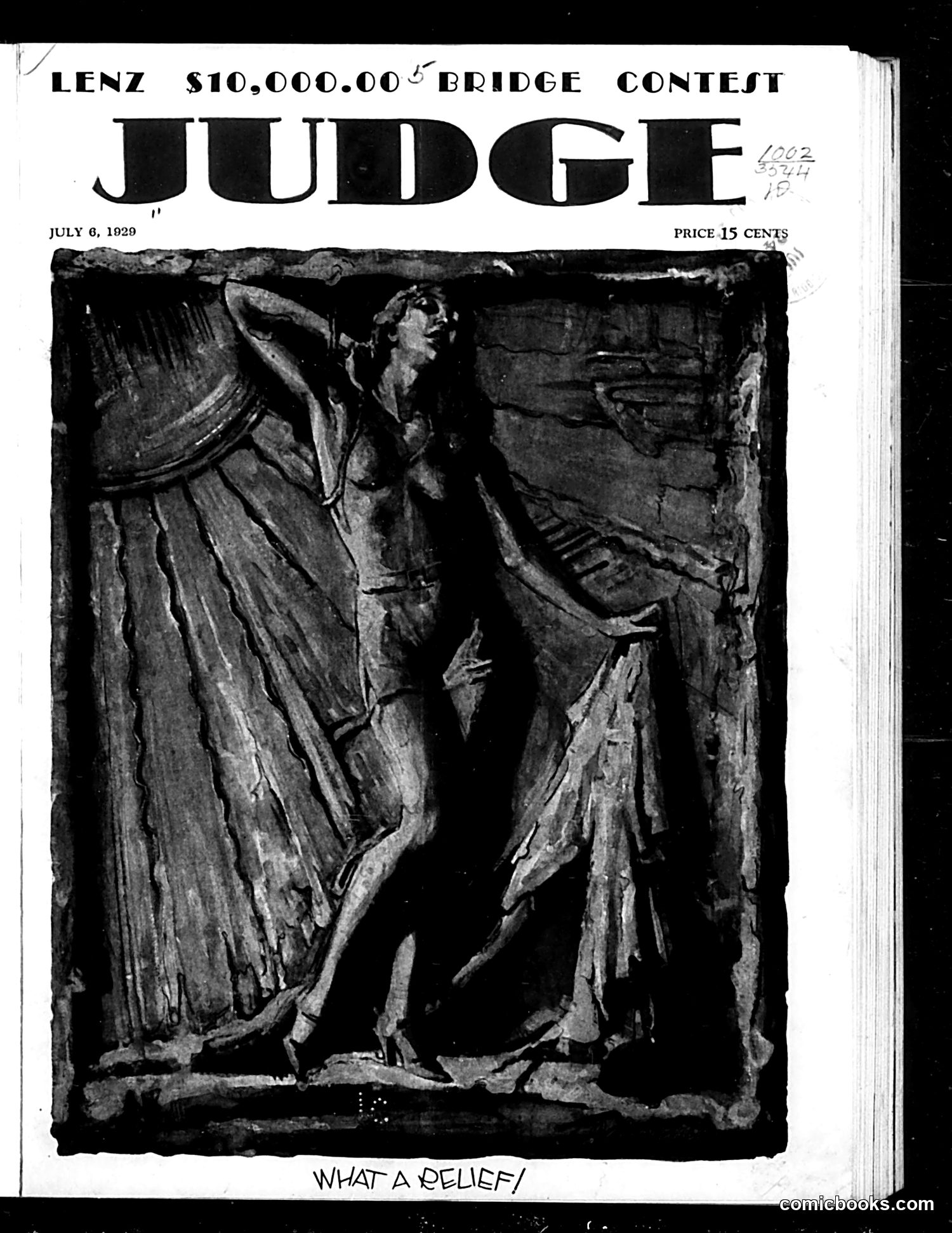
This cover depicts two figures in classical or religious robes appearing to provide relief or support to each other. The caption "WHAT A RELIEF!" suggests commentary on economic or social circumstances. The publication date—July 1929—places this just months before the October stock market crash. The image likely comments on contemporary financial or economic pressures affecting Americans, with the figures potentially representing different social classes or institutions offering mutual aid. The "$10,000.00 Bridge Contest" header references a separate competition Judge was running, unrelated to the main cover illustration. Without clearer identification of the specific figures or context, the precise satirical target remains uncertain, though the timing suggests concern about economic conditions or relief efforts during this pre-Depression period.
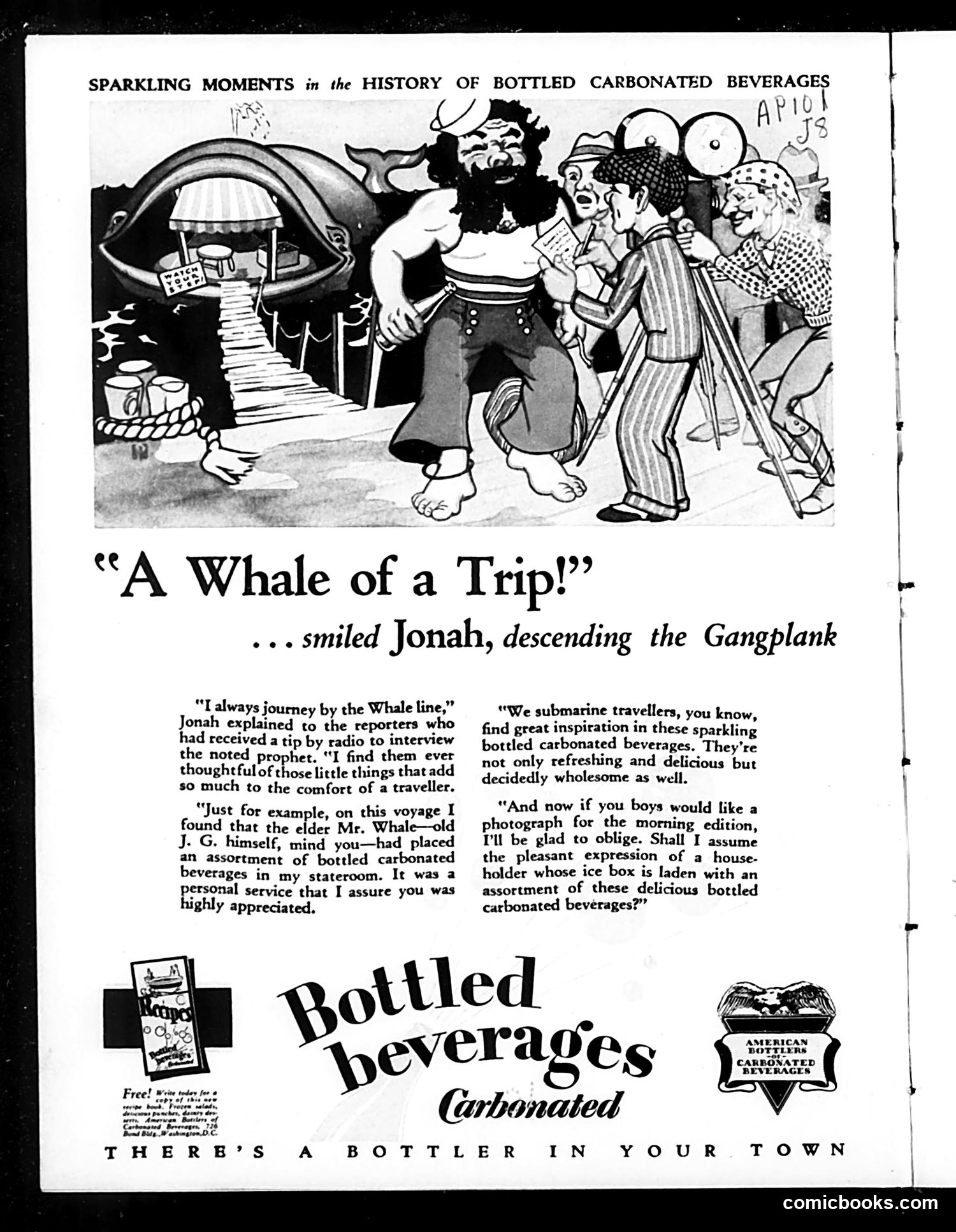
This is primarily a **commercial advertisement for bottled carbonated beverages**, not political satire. The page uses a humorous fictional narrative framing rather than genuine commentary. The illustrated scene depicts a character named "Jonah" descending a gangplank from what appears to be a submarine ("the Whale-line"), speaking to reporters about his travels. The absurdist humor derives from the unlikely scenario of submarine travel and the character's endorsement of bottled carbonated drinks as essential travel provisions. The text quotes Jonah praising these beverages as "refreshing and delicious but decidedly wholesome" and offering to pose for photographers with an ice box of the products. This is pure marketing wrapped in playful storytelling—using the Biblical reference to Jonah and the whale as a humorous anchor for product promotion aimed at mid-20th century consumers.
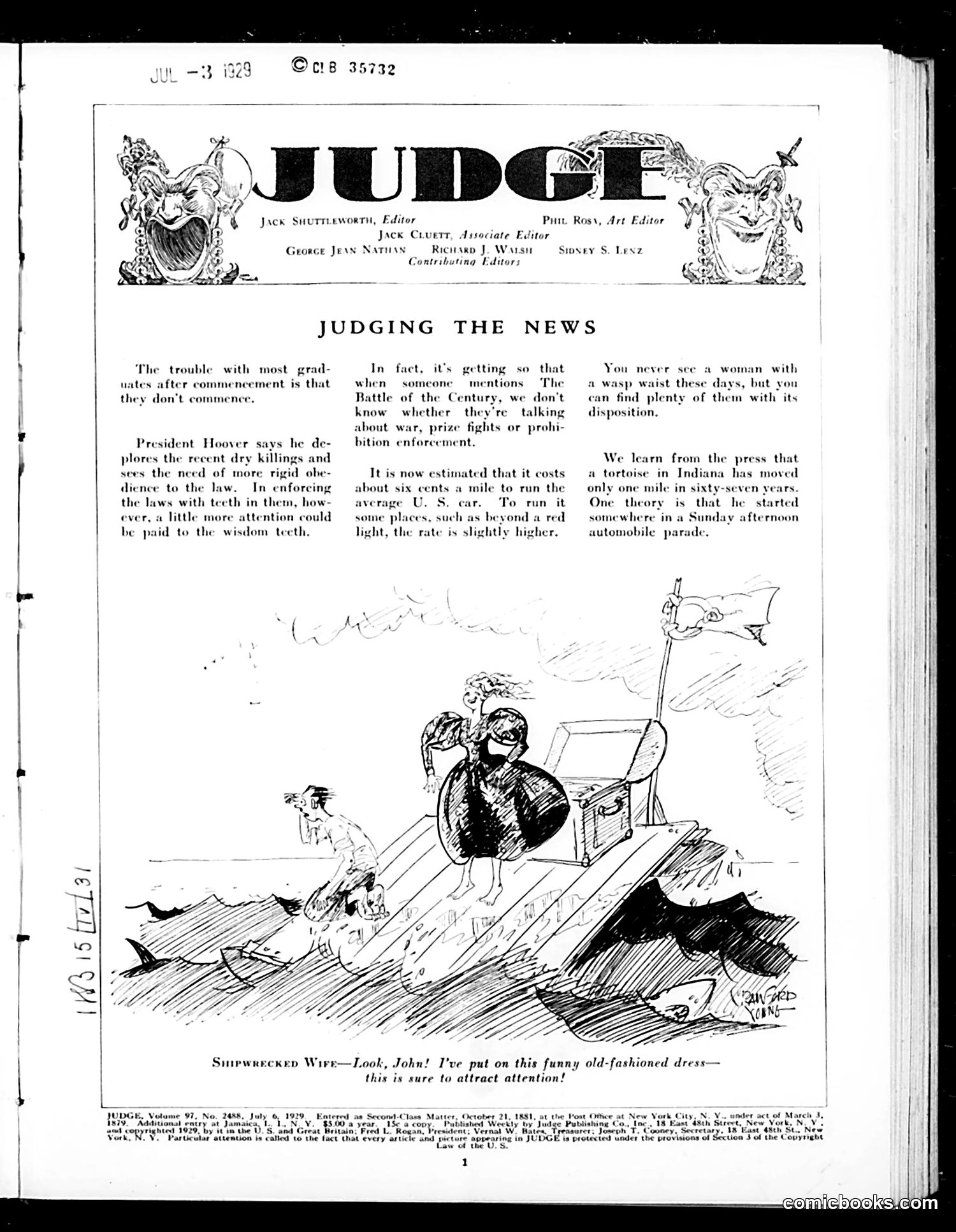
The main cartoon, titled "Shipwrecked Wife," depicts a woman in an old-fashioned dress on a boat during rough seas, trying to attract attention. The joke appears to be about female fashion—the caption suggests wearing an outdated, attention-grabbing outfit will help get rescued, playing on the idea that ridiculous or conspicuous clothing draws notice. The surrounding text under "Judging the News" comments on contemporary issues: President Hoover's stance on crime, automobile running costs (six cents per mile), and a tortoise in Indiana that moved only one mile in sixty-seven years—used to mock slow news coverage. The humor relies on 1929-era references to fashion, crime policy, and automotive economics now largely obscure to modern readers.
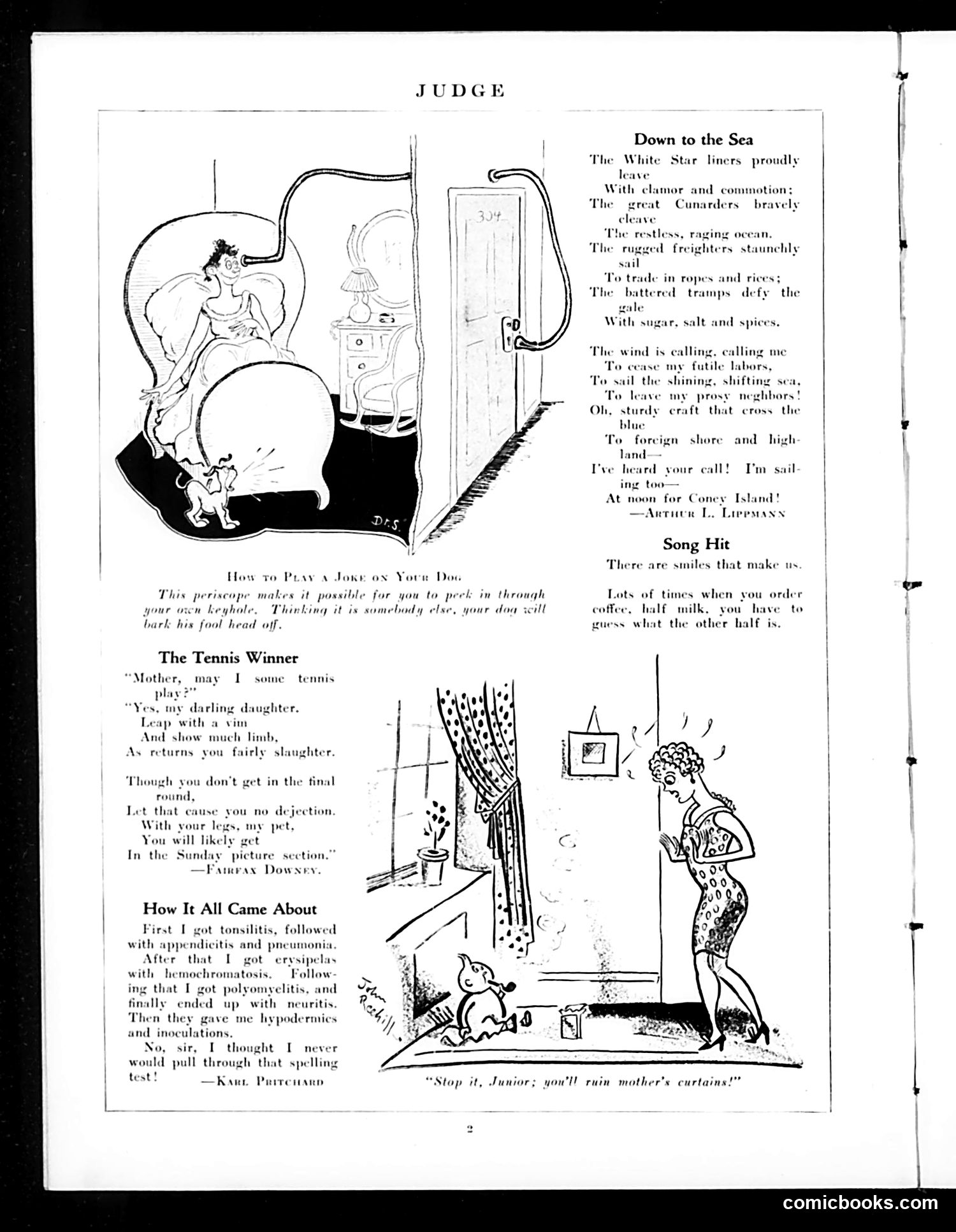
This page contains four separate humor pieces rather than political cartoons: 1. **"How to Play a Joke on Your Dog"** — A practical joke illustration showing a periscope device to peek through a keyhole at a dog, making its head appear to bark off. 2. **"The Tennis Winner"** — A humorous poem by Fairfax Downey about a mother encouraging her daughter to play tennis, with the joke being she'll likely end up in the "Sunday sports section" rather than winning. 3. **"Down to the Sea"** — A romantic poem by Arthur L. Lipmann about sailing and leaving one's life behind for adventure. 4. **"Song Hit"** — A brief joke about the ambiguity of coffee orders (half coffee, half milk). The bottom cartoon shows a child making a mess indoors while mother scolds him. These are general humor and light satire typical of Judge magazine's entertainment content, not political commentary.
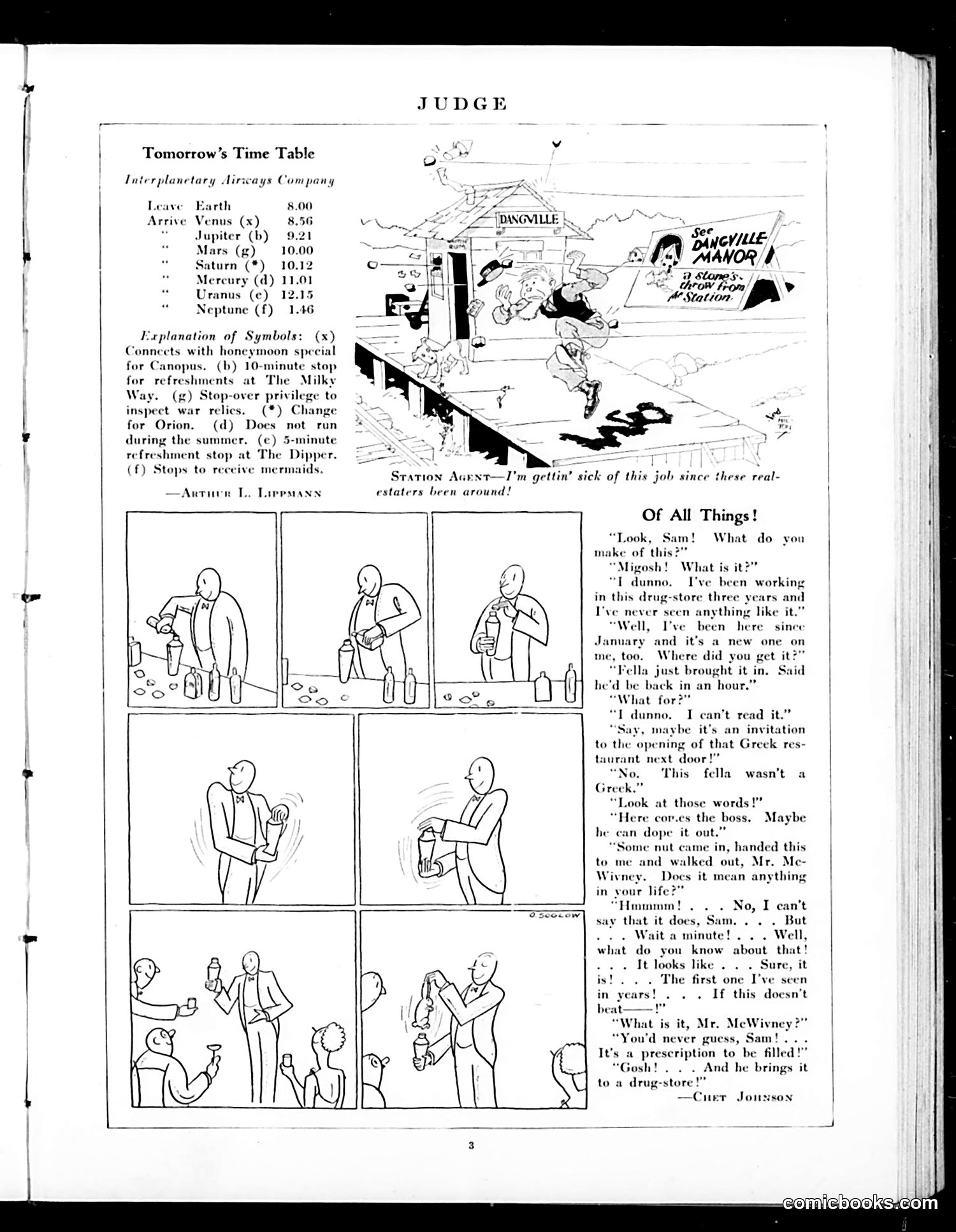
This page contains two distinct pieces: **Top Section:** A space-travel timetable by Arthur L. Lippmann showing fictional interplanetary schedules to Venus, Jupiter, Mars, Saturn, Uranus, and Neptune, with arrival times and symbolic notations. This is light satirical sci-fi humor about future space travel—then purely fantastical. **Bottom Section:** A six-panel comic strip titled "Of All Things!" by Chet Johnson depicting a drugstore interaction. A customer brings an unidentifiable object to a pharmacist/druggist asking what it is. The item mystifies everyone—the boss, other customers, even the original seller. The joke's punchline hinges on the object's inscrutability and the absurdist humor of a mysterious item ending up in a drugstore, typical of early 20th-century observational comedy about everyday confusion. Both pieces represent Judge's mix of speculative humor and relatable domestic comedy.
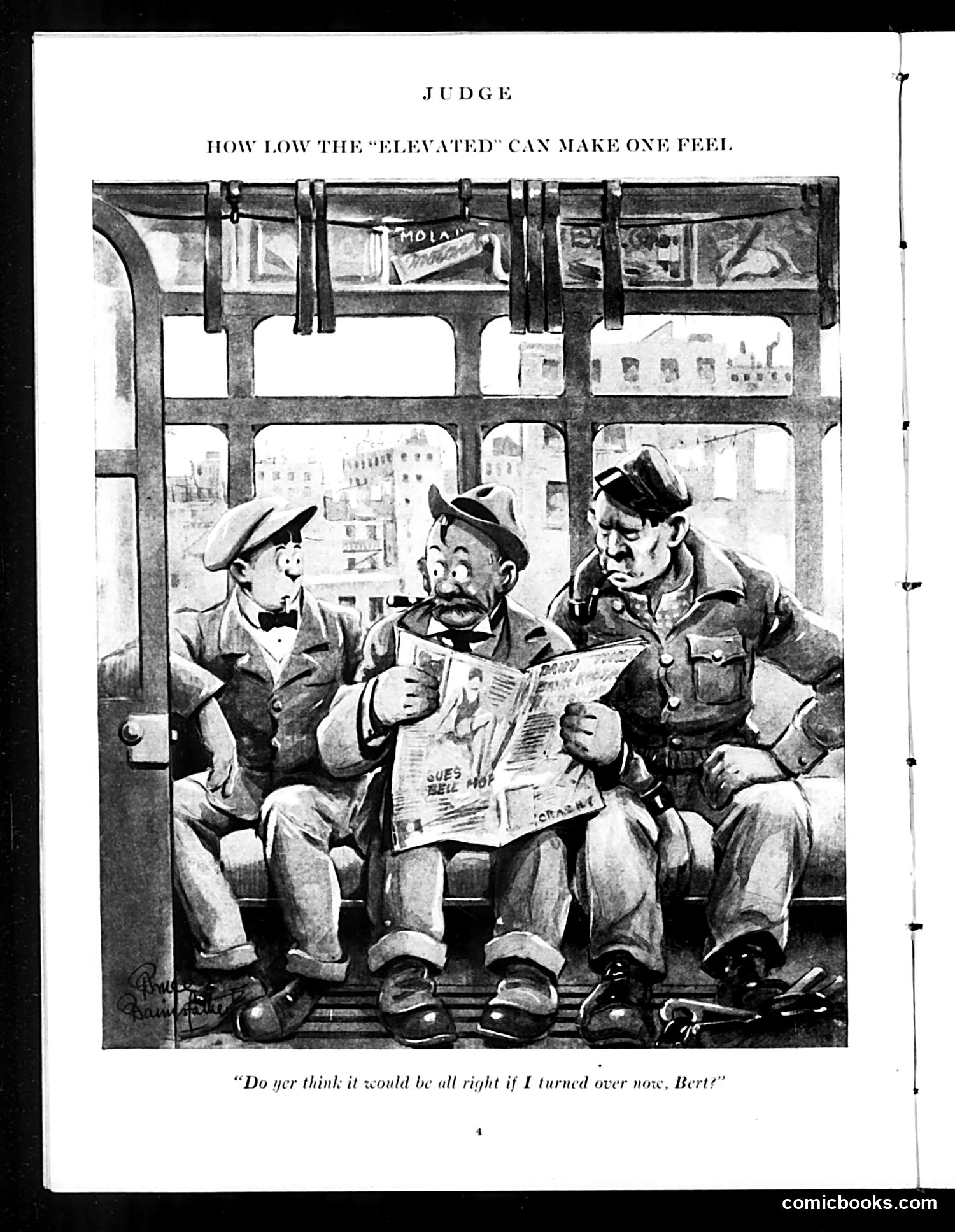
This cartoon satirizes class consciousness and social anxiety among working-class men. Three working-class laborers sit together on what appears to be public transit, reading a newspaper. The middle figure asks, "Do yer think it would be all right if I turned over nose, Bert?"—a humorous reference to "turning up one's nose," an expression meaning to show disdain or superiority. The joke plays on the irony of people with limited social standing worrying about appearing "elevated" or snobbish. The title, "How Low the 'Elevated' Can Make One Feel," references the elevated train system while suggesting that even riding on modern infrastructure makes ordinary workers anxious about maintaining proper social dignity. It's gentle satire about class self-consciousness.
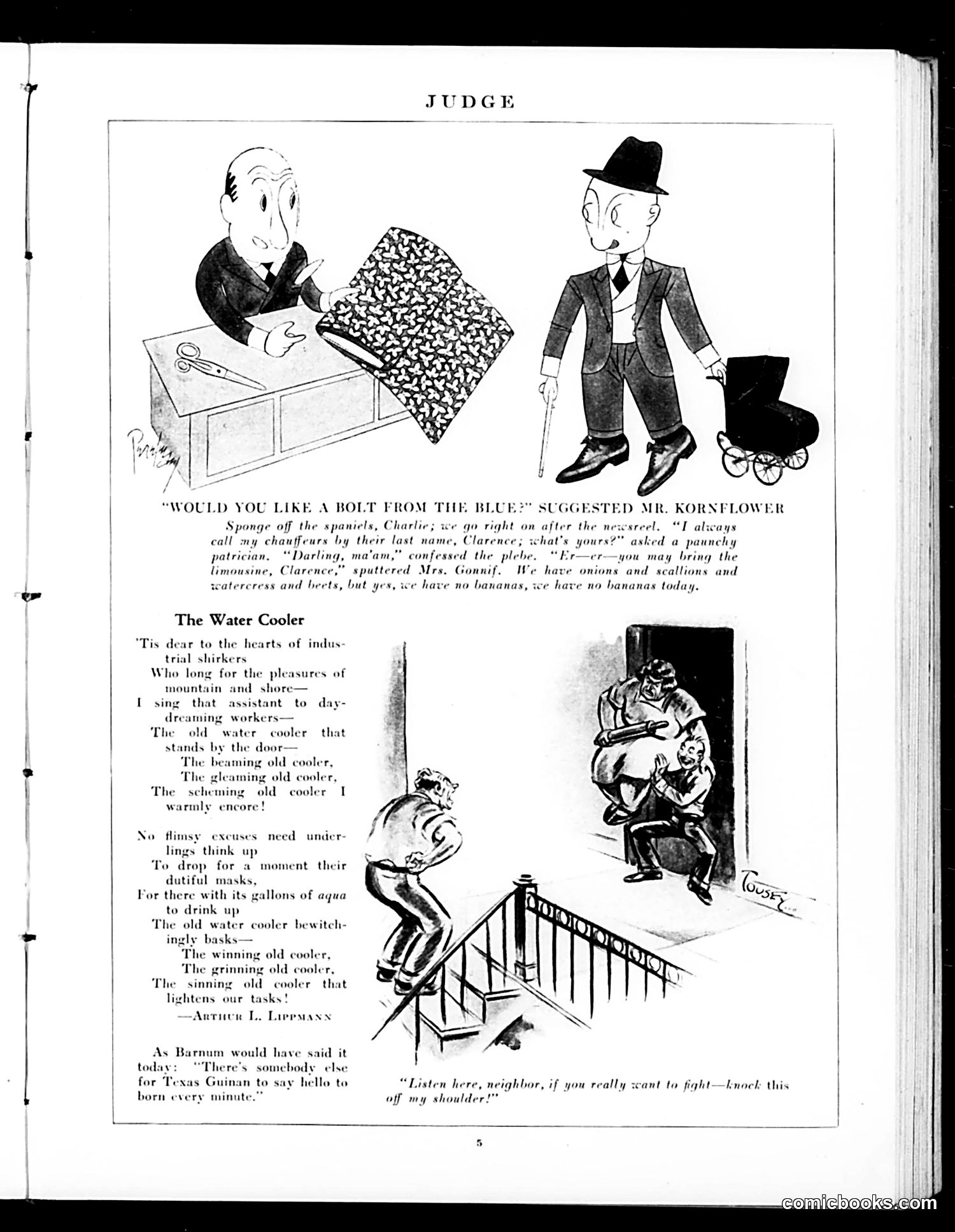
**Top Cartoon**: A judge examines fabric while a man with a baby carriage waits. The caption references Mr. Kornflower suggesting a "bolt from the blue," then humorously detailing a domestic dispute where a woman demands her husband call neighbors by first names. The punchline mocks bourgeois social pretension—the wife insists on informality while the couple lacks basic resources ("no bananas today"). This satirizes middle-class affectations and economic hardship. **"The Water Cooler" Section**: A poem celebrating the office water cooler as relief for overworked industrial workers. Two illustrations show workers at a water cooler and entering a building. The satire gently mocks workplace culture, portraying the water cooler as workers' only comfort during grueling labor. This reflects early 20th-century industrial working conditions and the modest pleasures available to laborers.
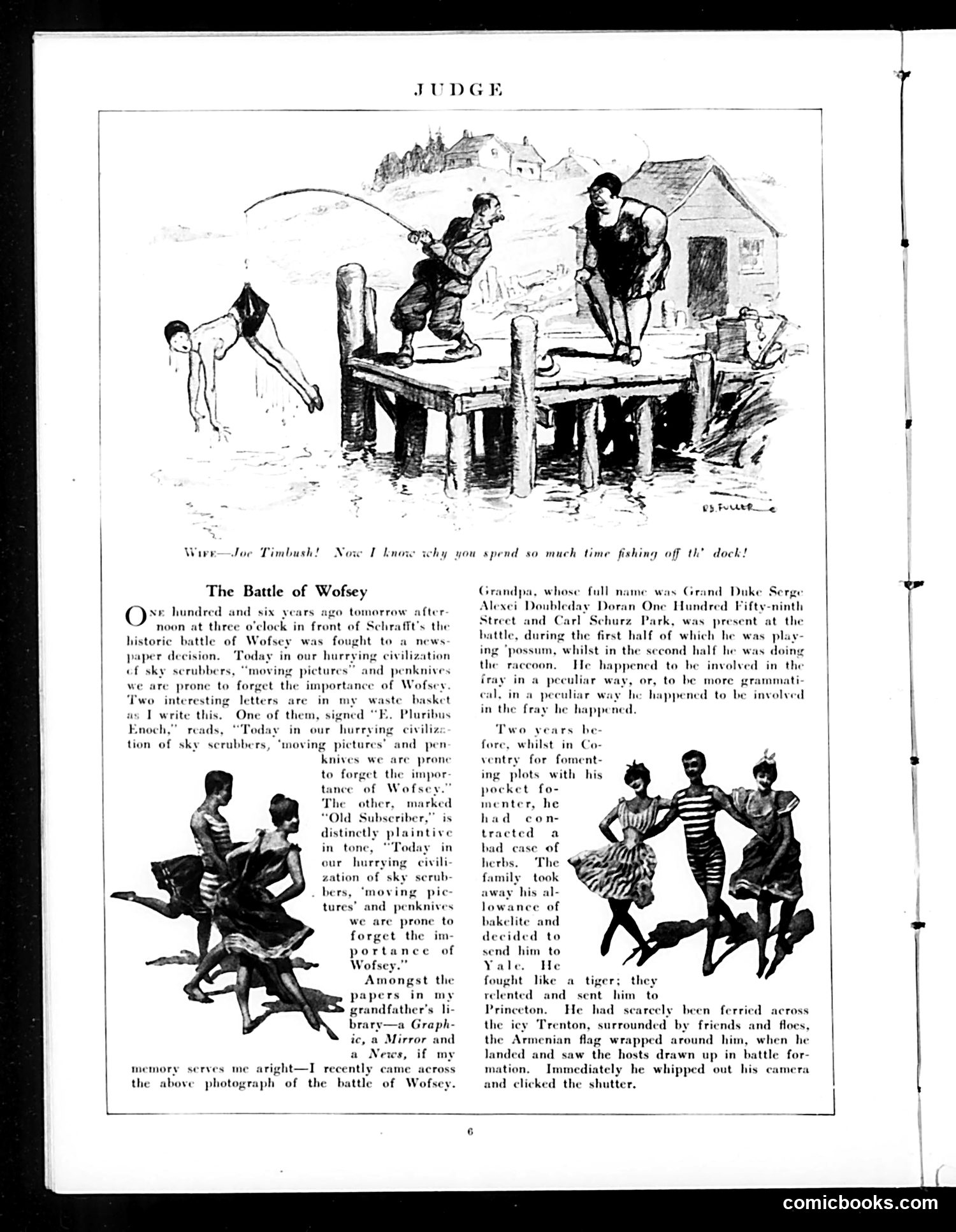
The top cartoon satirizes **fishing as an excuse for idleness**. A wife confronts her husband ("Joe Timbush") about spending excessive time fishing off the dock, suggesting he's avoiding responsibility under the pretense of leisure. The article below, "The Battle of Wofsey," is a humorous anecdote about a man named **Grand Duke Serge Alexei Doubieday** (likely a satirical name play) and his involvement in some kind of local dispute or "battle." The text references his pocket-forming adventures and a camera incident involving the Trenton River and American flag—details suggesting either a tall tale or mockery of pretentious behavior. The cartoons and text together mock **gentlemen's excuses for frivolous behavior** and exaggerated personal narratives.
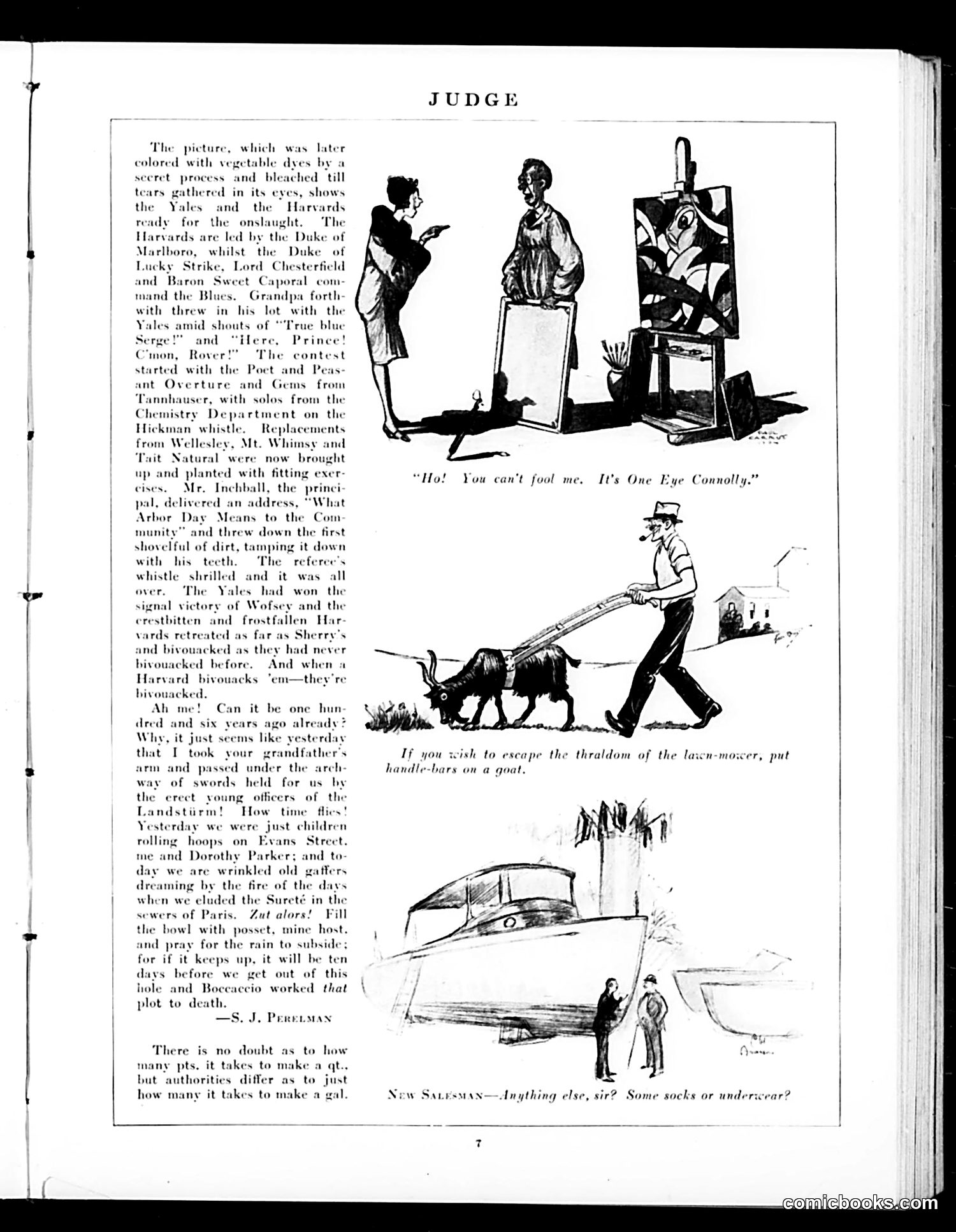
This page satirizes the Yale-Harvard football rivalry through absurdist humor. The main cartoon depicts a contest between these universities with deliberately ridiculous elements: the "Harvards" are supposedly led by personified cigarette brands (Duke of Marlboro, Lucky Strike, Lord Chesterfield, Baron Sweet Caporal)—a jab at tobacco advertising's pervasiveness and corporate influence on American institutions. The narrative mocks college traditions, classical music performances, and nostalgic reminiscence. The text references "Landsturm" (German militia), Paris sewers, and Dorothy Parker, creating a chaotic, historically jumbled backdrop that amplifies the absurdity. Secondary cartoons offer unrelated sight gags: identifying "One Eye Connolly" in a painting; escaping lawnmower obligations by putting handlebars on a goat. The final text fragment jokes about measurements (quarts to gallons)—likely a drinking reference. Overall, this is satirical nonsense humor targeting college elitism, corporate sponsorship, and nostalgic pretension typical of Judge's style.
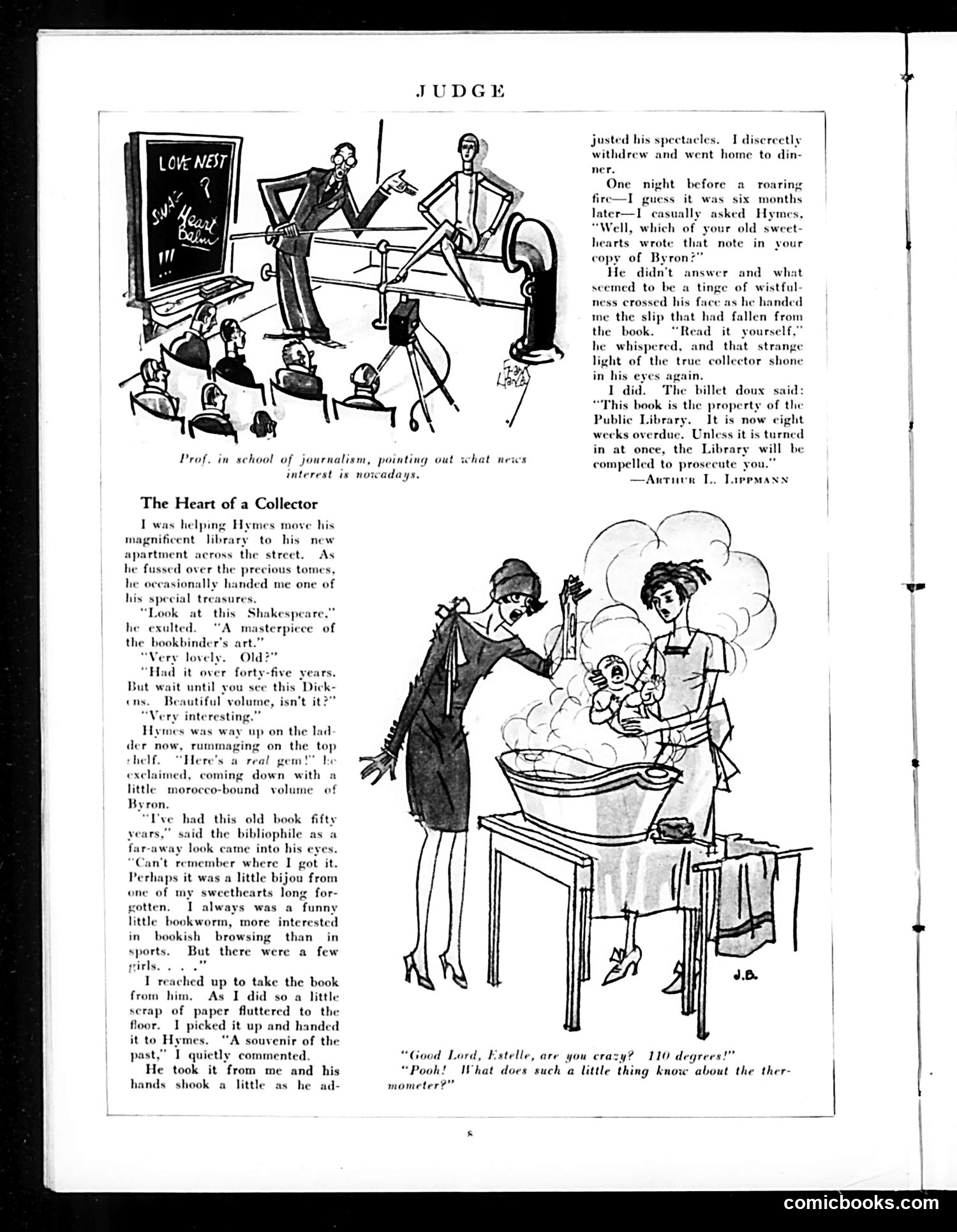
This story satirizes obsessive book collecting by contrasting a collector's romantic reverence for rare books with mundane reality. Professor Hymes cherishes his library—a Shakespeare, Dickens, and Byron—treating them as precious treasures from his romantic past. He fondles a morocco-bound Byron volume with mysterious nostalgia, imagining it a gift from a forgotten sweetheart. The punchline reveals the deflating truth: a library overdue notice falls from the book. The library threatens prosecution for an eight-week overdue item. The joke mocks Hymes's pretentious collector's mentality—his treasured, carefully-preserved "gem" is simply a book he negligently failed to return, transforming his sentimental fantasy into embarrassing reality. The accompanying cartoon above jokes about journalism professors overlooking actual news.
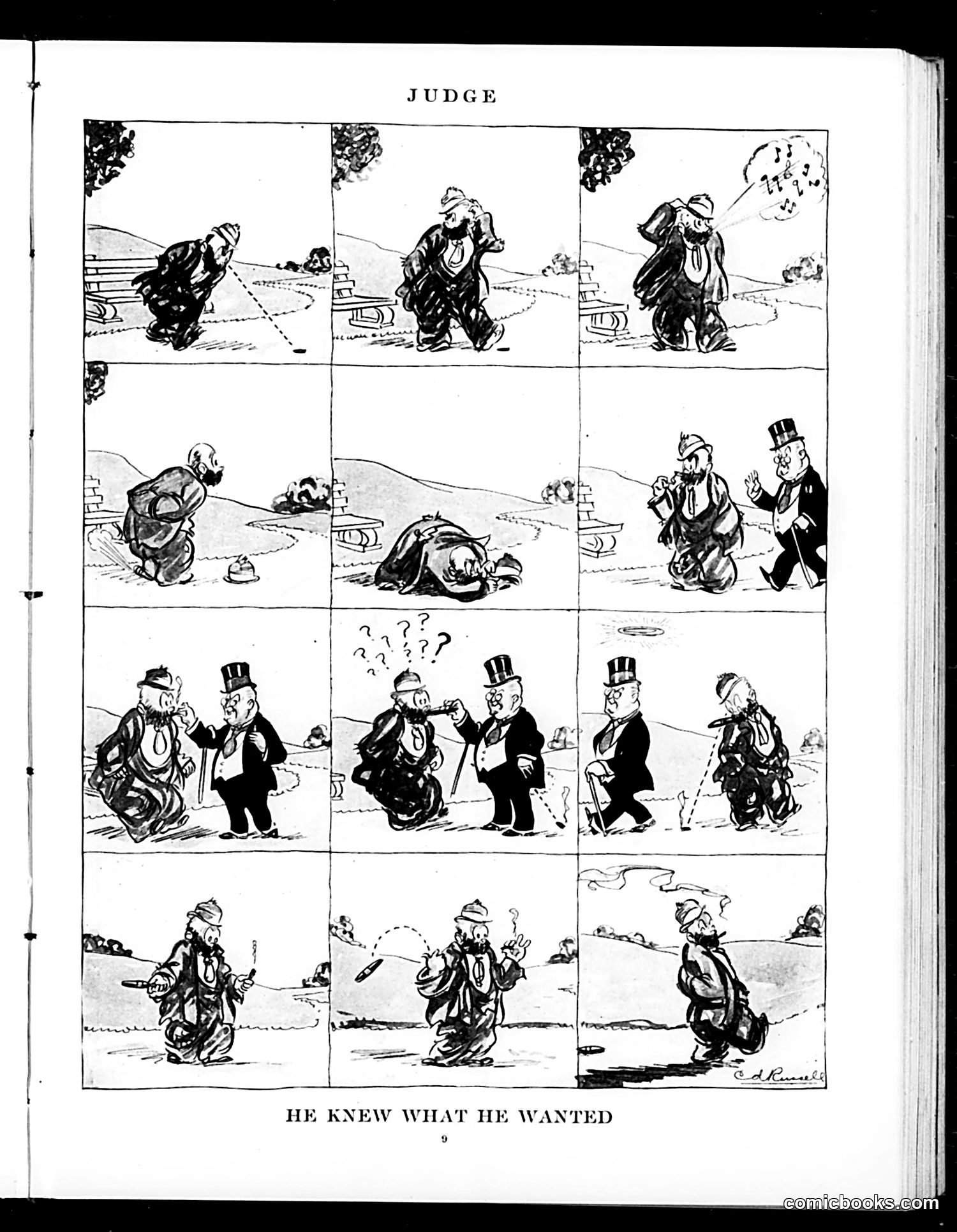
This twelve-panel comic strip depicts a figure in judicial robes (the "Judge") engaged in fishing. The narrative shows him progressively catching larger fish, becoming increasingly animated and excited. In the middle panels, he consults with a gentleman in a top hat, appearing to discuss or celebrate his catches. The title "He Knew What He Wanted" suggests the Judge had a specific goal or outcome in mind from the start. The cartoon likely satirizes judicial corruption or predetermined verdicts—the judge "fishing" for a particular result rather than impartially weighing evidence. The wealthy-looking man in the top hat may represent a wealthy defendant or special interest influencing judicial decisions. This reflects Progressive Era concerns about corrupt judges serving powerful interests rather than justice.
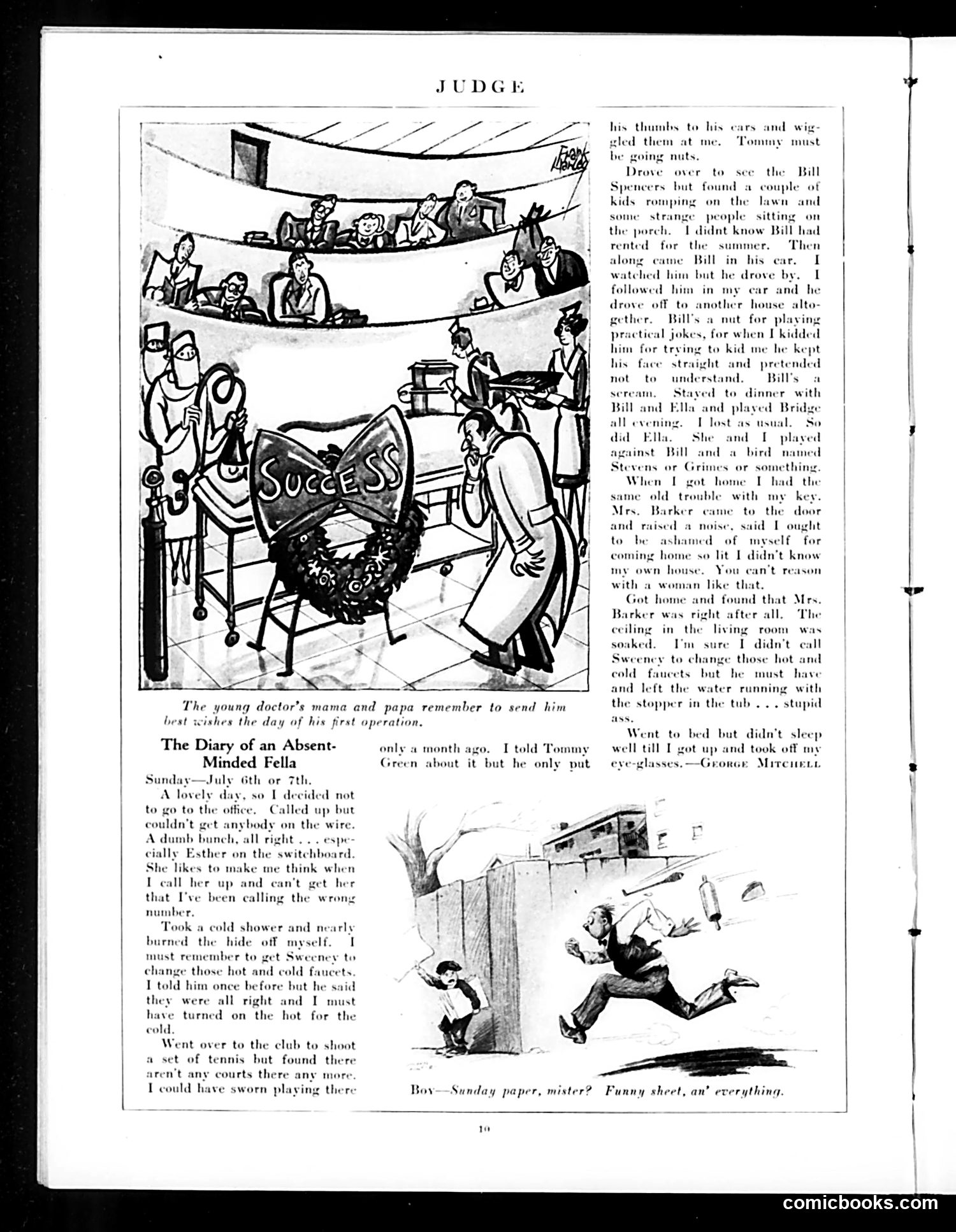
This is a humorous domestic narrative about a befuddled narrator's Sunday, illustrated with two cartoons. The main joke concerns the narrator's scatterbrainedness and marital friction. **Key elements:** - The protagonist repeatedly forgets practical details (calling wrong numbers, confusing hot/cold faucets, losing his house key) - He's caught coming home drunk ("lit") and confronted by his neighbor Mrs. Barker about the disturbance - His wife Ella plays bridge with him while he loses money - A subplot involves his friend Bill Spencer playing pranks, renting out his house without telling anyone - The lower cartoon shows a man being ejected from a wall, captioned about a "Sunday paper"—likely mocking the absurdity of the narrator's situation **The satire:** This gently mocks the scatter-brained businessman of the era—a fixture of comic literature—who cannot manage basic household tasks, gets drunk socially, and creates domestic chaos through simple incompetence. It's a domestic comedy premised on masculine bumbling.
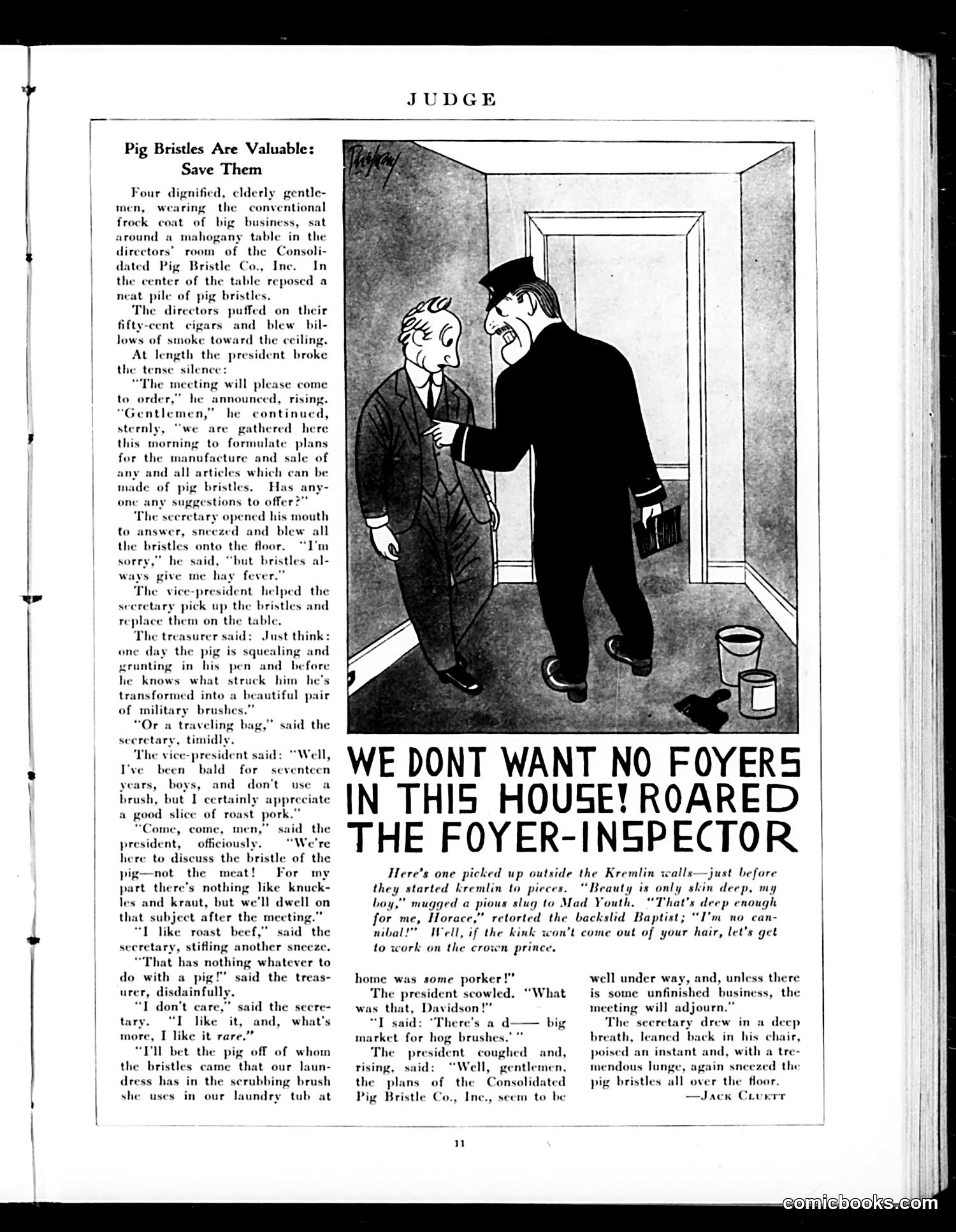
This Judge page contains two separate satirical pieces: **"Pig Bristles Are Valuable"** (left): A humorous story mocking pompous businessmen holding a board meeting about pig bristle manufacturing. The joke satirizes their pretentious formality—they discuss the "bristle of the pig" solemnly while repeatedly getting distracted by actual pork dishes. The secretary's sneezing repeatedly scatters bristles, undercutting their dignity. The satire targets self-important corporate culture and the gap between business posturing and reality. **"We Don't Want No Foyers in This House"** (right): A cartoon about a "foyer-inspector" confronting someone at the Kremlin. This references Soviet Russia (implied by "Kremlin walls" and "kremlin to pieces"—a pun). The satire appears to mock anti-communist sentiment and paranoid American fears of Soviet infiltration, or possibly ridicules Soviet bureaucratic inspectors. The accompanying caption about beauty being "only skin deep" suggests commentary on superficial appearances versus substance. Both pieces represent typical Judge satire: mocking institutional pomposity and contemporary political anxieties.
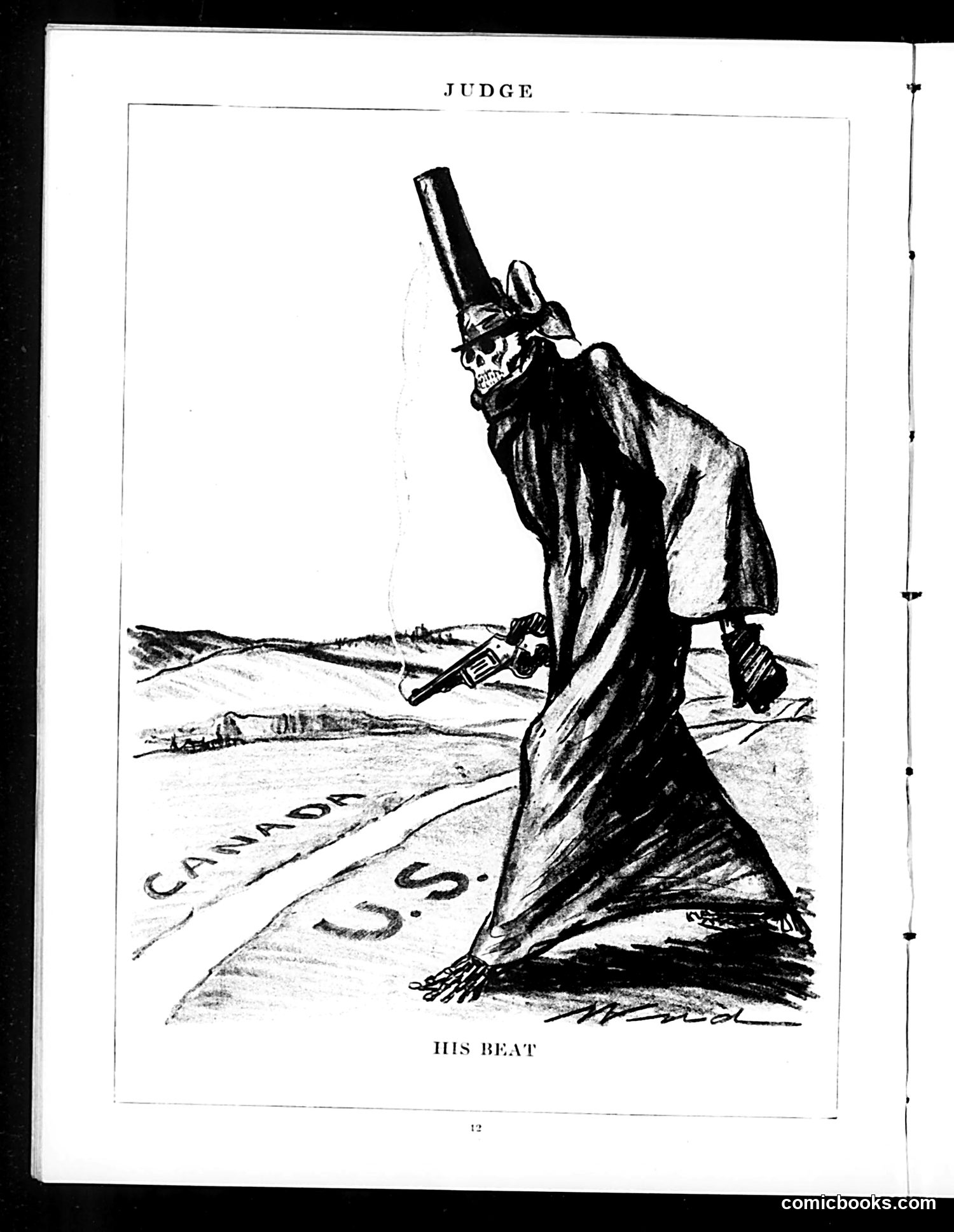
This political cartoon depicts Death (a skeletal figure in a coat and top hat, carrying a revolver) walking a patrol route marked "CANNON'S U.S." The imagery suggests Death is "beating" or regularly traversing American territory—likely a commentary on gun violence, particularly from cannons or military weapons. The title "His Beat" implies Death has claimed this area as his regular patrol ground, where violence is so commonplace it's become routine. The desolate landscape with scattered buildings reinforces the devastation. Without the specific publication date visible, the exact historical context is unclear—this could reference Civil War aftermath, industrial accidents, or contemporary gun violence of Judge's era. The cartoon critiques how normalized or accepted such lethal violence had become in American society.
This page from *Judge* contains three satirical pieces examining American society circa the 1920s. **"The Home of the Brave"** critiques American post-WWI anxiety. The essay ironically notes that while Americans proved their bravery in the Revolutionary War, they haven't yet demonstrated "justice and generosity." It references a foreign official's concern that America—having defeated imperialism—now threatens to become a tyrannical "Colossus" itself, using economic power to dominate weaker nations unable to compete in world markets. **"Kiss and Make Up"** sarcastically celebrates recent reconciliation between Harvard and Yale after an athletic dispute, mocking that no one remembers what caused the quarrel or cares to learn. **"No More Chivalry"** describes a courtroom scene where a judge endorses a young man striking a woman who warned another girl about him, endorsing rough equality over protective courtesy—presented as darkly humorous progress.
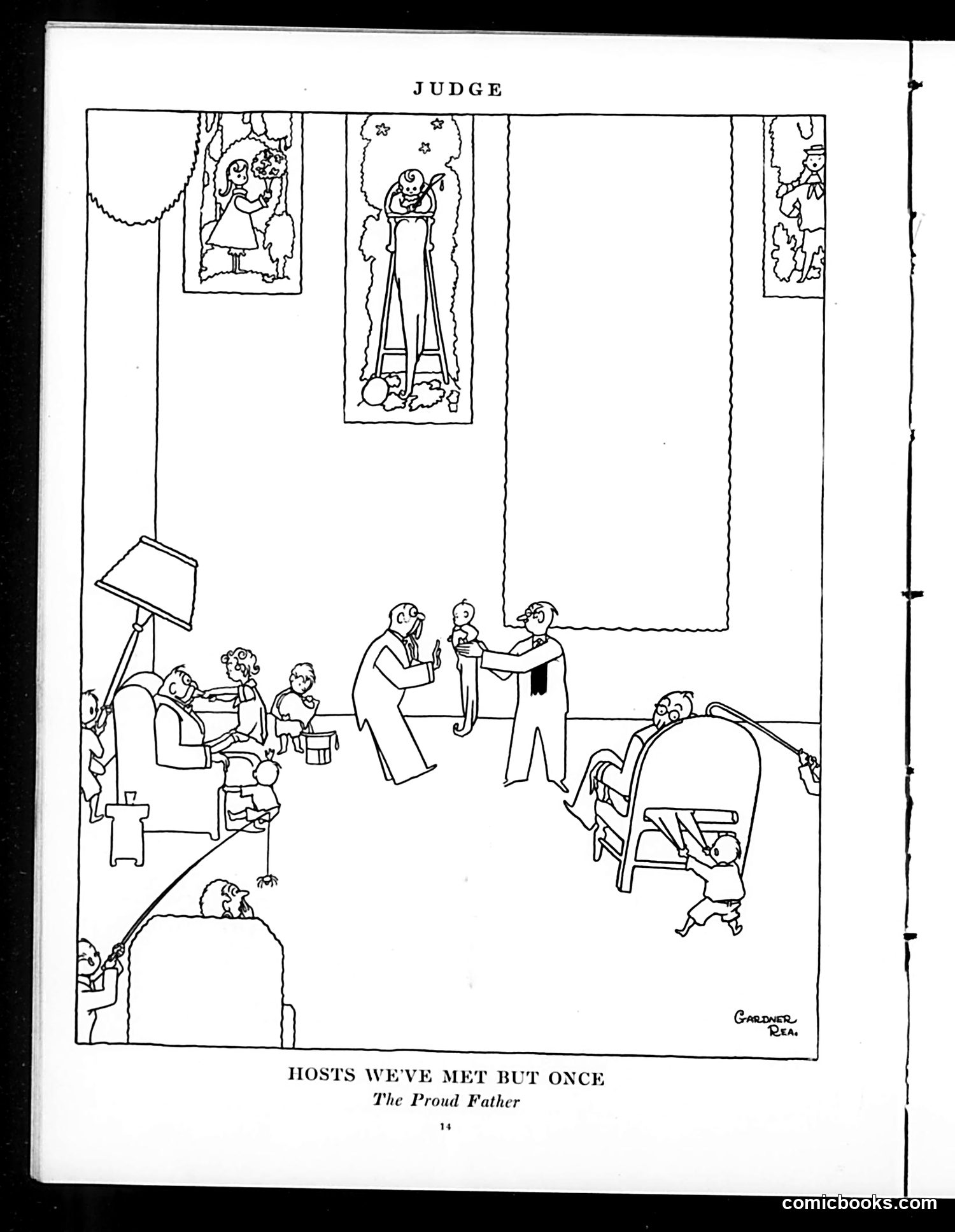
This cartoon from *Judge* satirizes parental pride and social awkwardness. The scene depicts a courtroom or formal gathering where a man (the "proud father") is enthusiastically displaying what appears to be a small child or infant to other adults, holding it up for inspection. The caption "Hosts We've Met But Once" suggests these are acquaintances or near-strangers, making the father's enthusiastic baby-showing socially inappropriate or comedically presumptuous. The joke targets the common social phenomenon of new parents imposing their children on people who barely know them, treating casual acquaintances as if they share in their parental enthusiasm. The other figures' body language suggests mild discomfort or indifference to this unsolicited presentation.
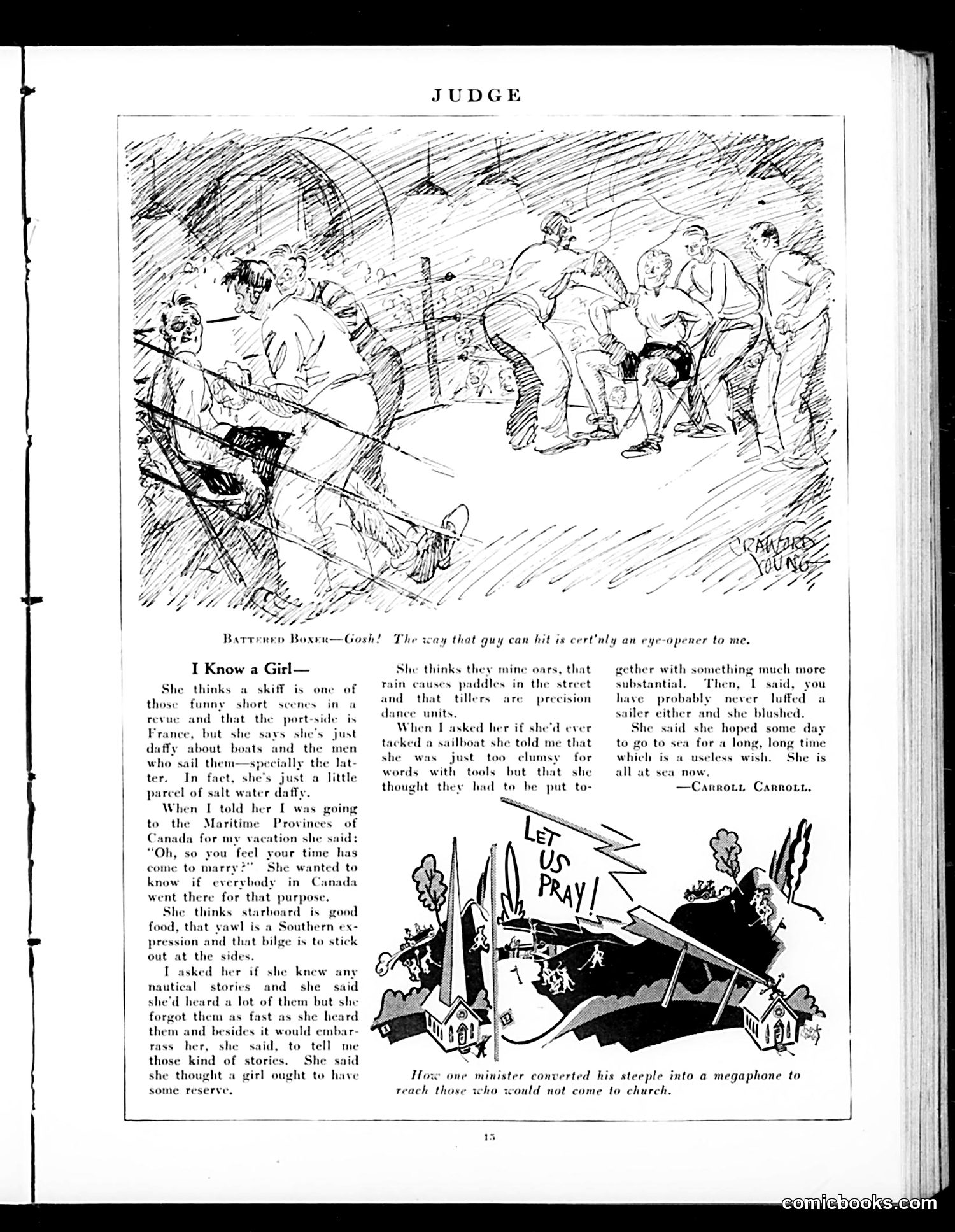
This is humor based on early 20th-century gender stereotypes. The unnamed narrator describes a young woman who is comically ignorant of sailing and maritime vocabulary—confusing "skiff" with theatrical sketches, "starboard" with food, "tillers" with dance units, and "luffing" with an embarrassing activity. The satire targets both the woman's lack of knowledge and the narrator's condescending attitude toward her. The punchline emphasizes she's "all at sea"—a double meaning implying both nautical confusion and general bewilderment. The lower cartoon about a minister converting a church steeple into a megaphone is separate, commenting on religious outreach methods. The humor reflects period assumptions about women's unsuitability for traditionally masculine pursuits like sailing, though presented in the gossipy, anecdotal style typical of *Judge* magazine's social satire.
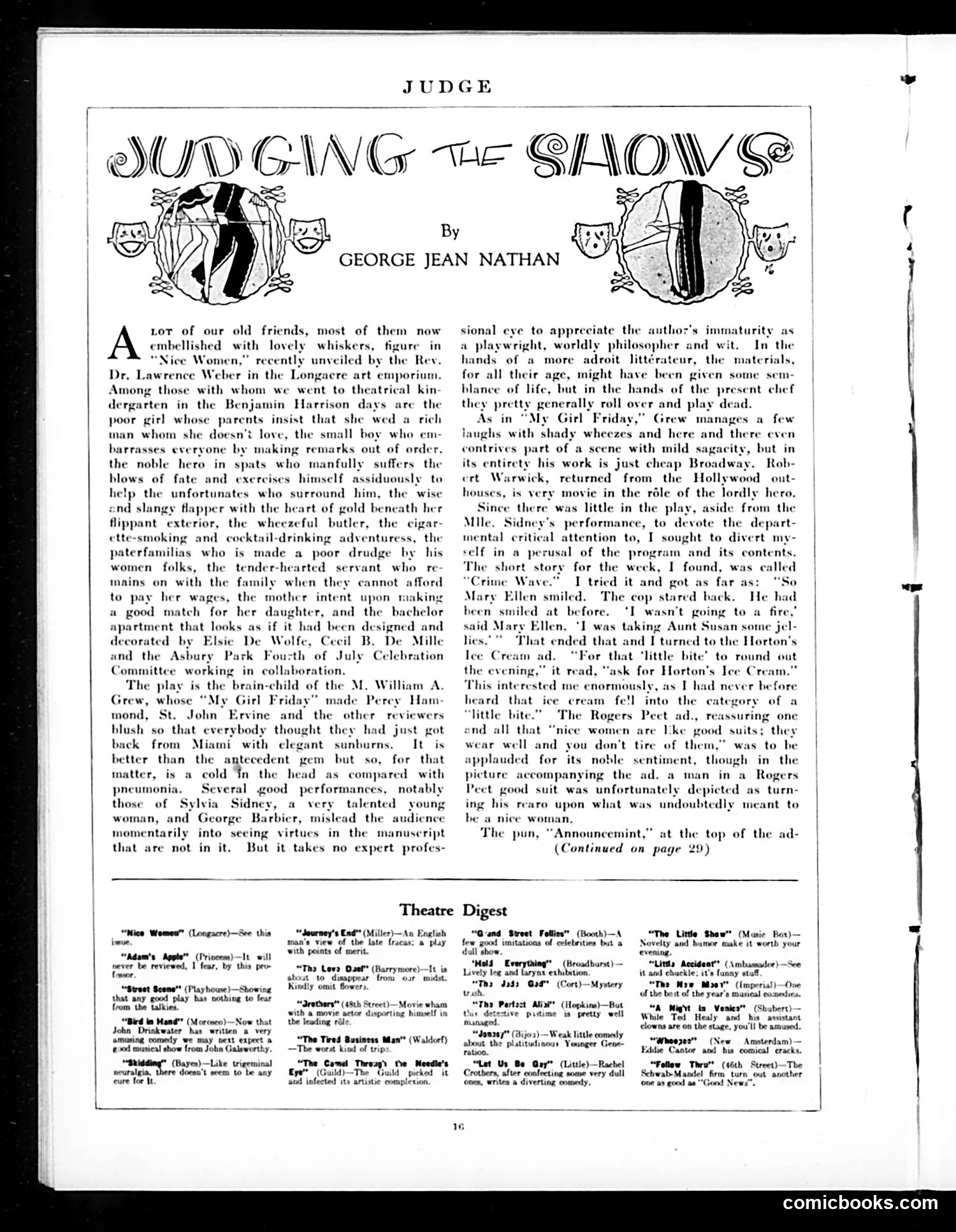
This is a theater review column, not a political cartoon. Nathan critiques M. William Grew's play "Nice Women," dismissing it as "cheap Broadway" despite solid performances by Sylvia Sidney and Robert Warwick. The satire lies in Nathan's digression: frustrated by the play's weakness, he analyzes the program's advertisements and short stories instead. He mocks the *Crime Wave* story ("Mary Ellen smiled..."), the Horton's Ice Cream ad's awkward phrasing about "little bites," and—most pointedly—a Rogers Peet clothing ad claiming "nice women are like good suits" while depicting a man literally turning his rear toward a woman, undermining its own message. Nathan uses these absurdities to illustrate how even the *advertising* surrounding mediocre theater reveals cultural pretension and contradictions. The column exemplifies Judge's satirical commentary on American entertainment and commercialism circa the 1920s-30s.
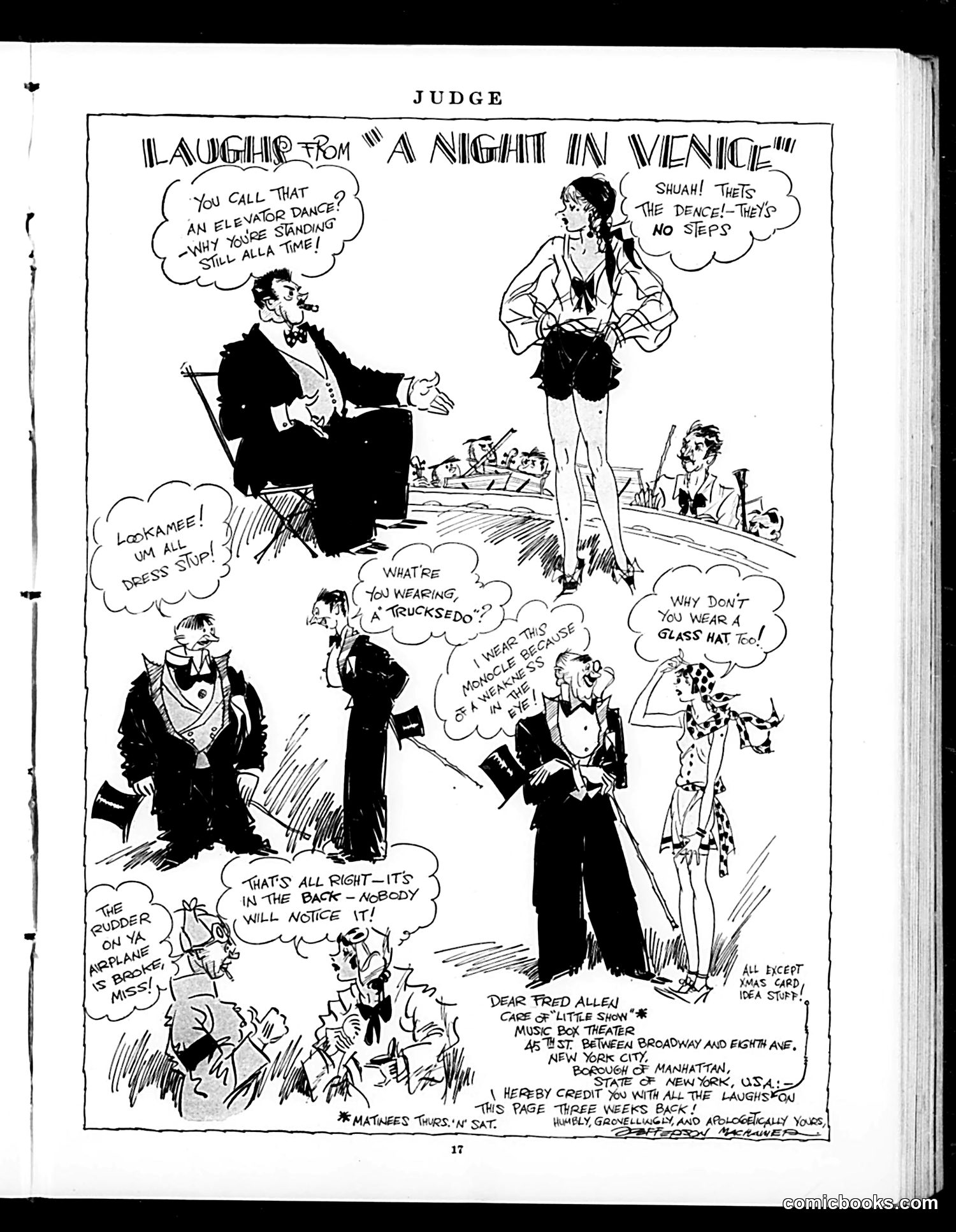
This is a satirical cartoon mocking the theatrical production "A Night in Venice," likely a musical or operetta staged at the Music Box Theater in Manhattan. The humor centers on **costume and fashion absurdities** in theatrical productions. The characters—appearing to be theater-goers and performers—exchange jokes about the show's impractical staging choices. One figure questions an "elevator dance" performed while standing still; another criticizes revealing costumes ("tuxedo" worn as a dress); a third suggests a grass hat would be more appropriate. The final character, presumably the show's director or producer, dismisses all complaints by claiming the questionable elements are "in the back—nobody will notice it." The satire targets **theatrical excess and illogical costume/choreography choices** that audiences tolerated in early 20th-century entertainment. The cartoon credits Fred Allen's "Little Show" as the source material, suggesting this parodies real theatrical conventions of the era.
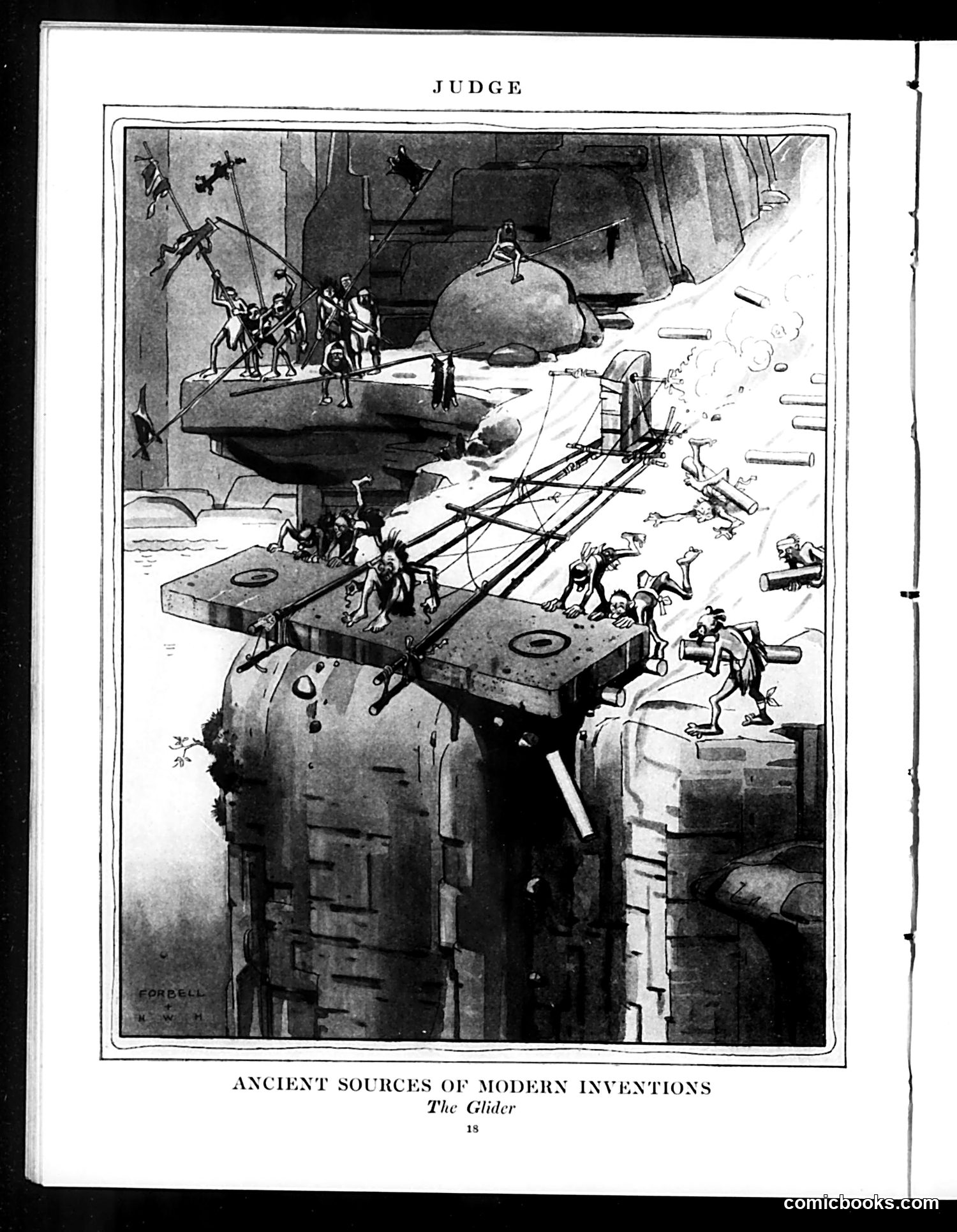
This satirical cartoon from *Judge* magazine presents a humorous "ancient sources" concept, claiming that the modern glider invention has historical precedent. The illustration depicts what appears to be ancient Roman or Greek figures operating a primitive flying apparatus constructed from large wooden barrels, planks, and rope—all precariously balanced on what looks like architectural ruins or fortifications. The joke operates on visual absurdity: tiny human figures frantically manning this obviously impractical contraption, which bears no functional resemblance to actual gliders. The satire mocks both the recent enthusiasm for early aviation experiments and the tendency to claim ancient civilizations possessed advanced knowledge. The artist (signed "Forsell") creates humor through the contrast between the magazine's grandiose title promising "ancient sources" and the ridiculous, clearly non-functional apparatus shown. This likely reflects early-1900s skepticism toward nascent aircraft technology.
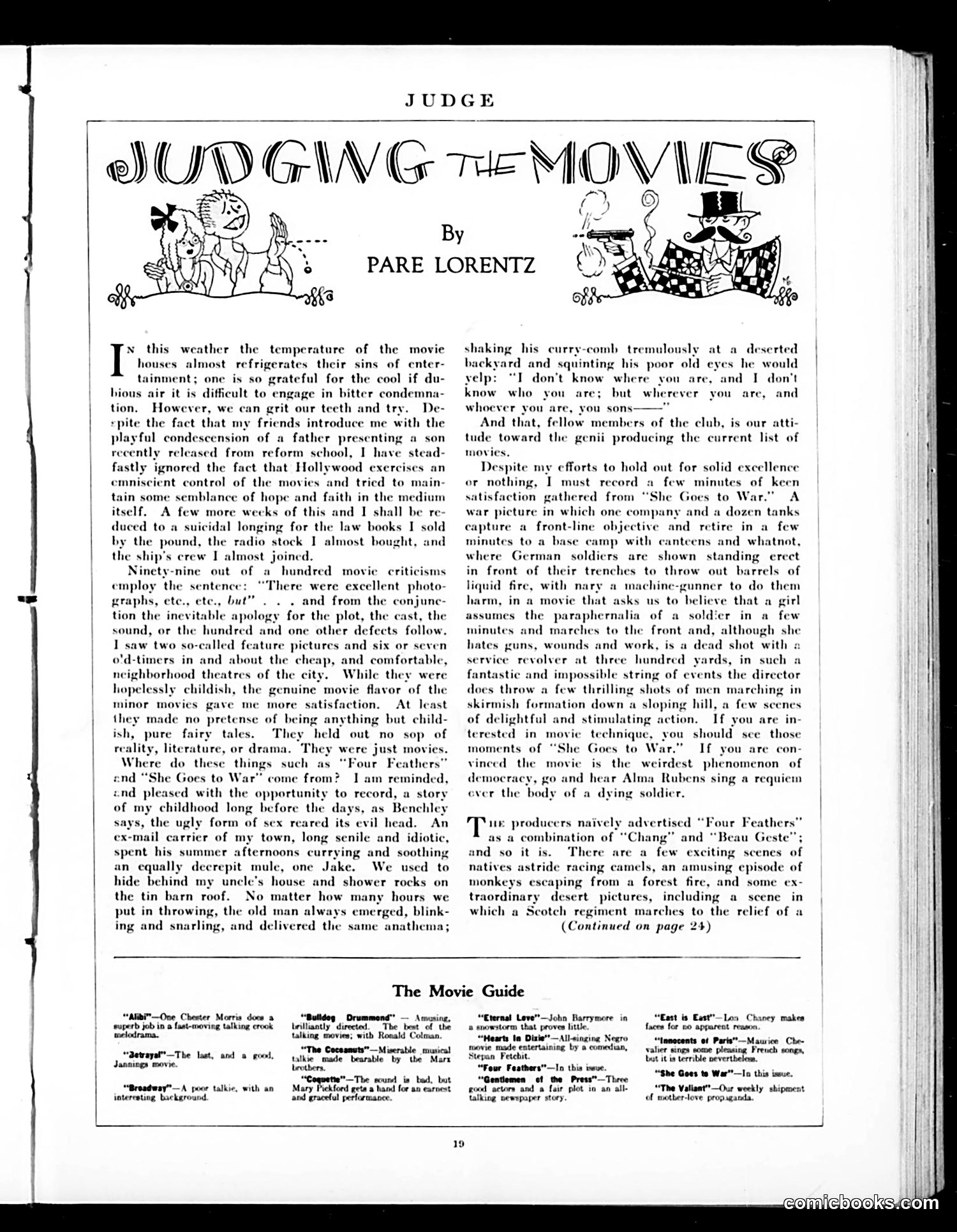
This is a film criticism essay by Pare Lorentz published in *Judge* magazine. Rather than a political cartoon, it's satire delivered through written commentary on 1920s Hollywood movies. Lorentz adopts a persona of mock-curmudgeonly superiority, claiming to evaluate films with "unmiscent control" while admitting he's surrendered to entertainment's mediocrity. He critiques contemporary war pictures like "She Goes to War" and "Four Feathers" for their absurd depictions—soldiers standing upright in trenches, women soldiers becoming sharpshooters in minutes despite hating violence. The satire targets both Hollywood's nonsensical storytelling and audiences' willingness to accept propaganda disguised as entertainment. His complaint that 99 of 100 film reviews contain "there were excellent photographs, etc., etc., but" mocks critics' inability to acknowledge a movie's complete failure. The humor relies on exaggerated complaint and the contrast between his pretended sophistication and his actual grudging enjoyment of pure escapism.
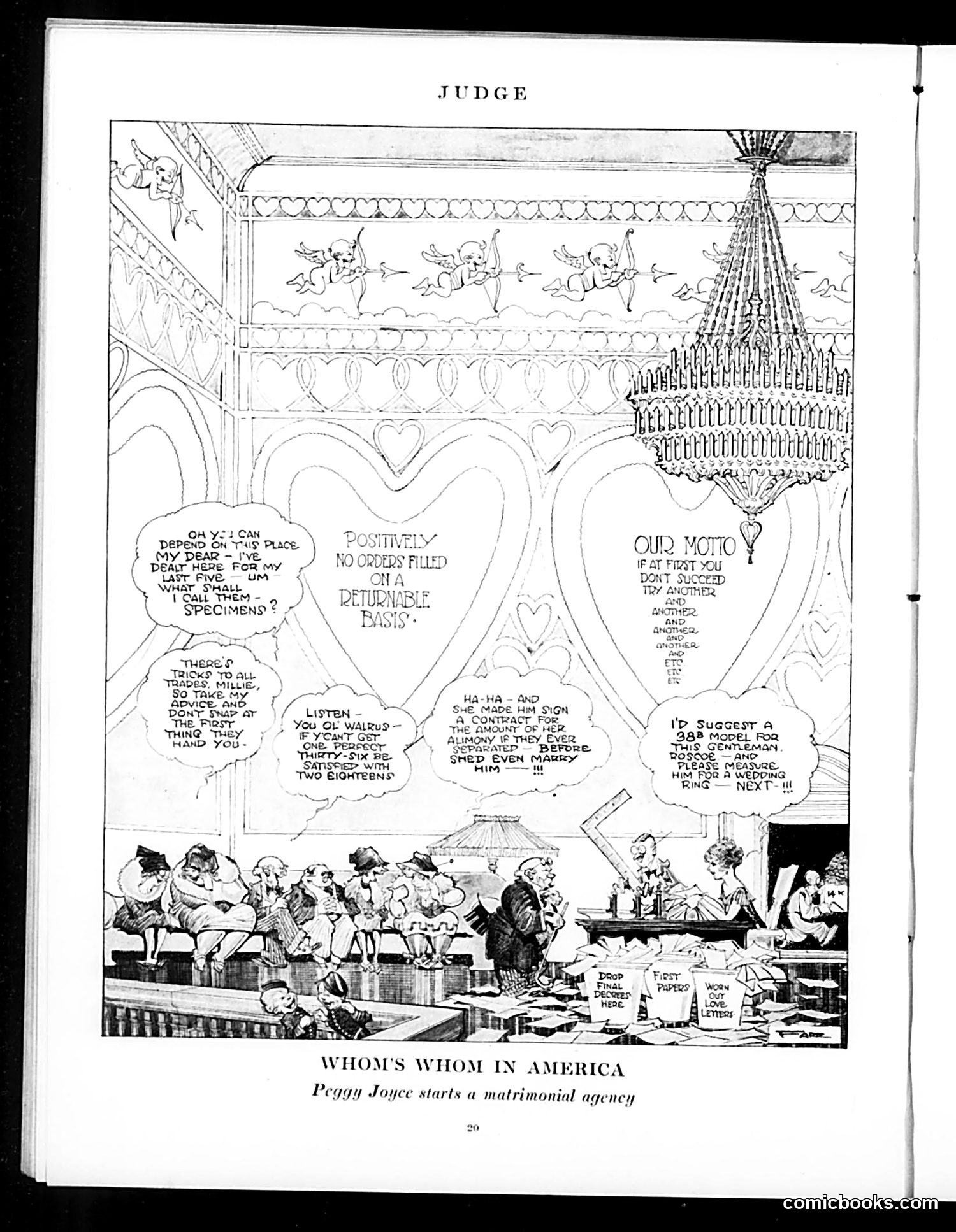
This cartoon satirizes **Peggy Joyce**, a famous 1920s socialite and serial bride known for multiple high-profile marriages. The caption indicates she's starting a "matrimonial agency." The scene depicts a courtroom-like setting where various men discuss marriage prospects while holding contracts and documents. The dialogue reveals the satire's targets: - Men haggling over marriage terms as business transactions - References to prenuptial agreements and financial settlements ("she made him sign a contract") - The absurdity of commodifying matrimony ("388 model for the gentleman") - Repeated failed marriages treated as routine business The humor mocks both Joyce's notorious marital history and the broader 1920s phenomenon of wealthy socialites treating marriage as transactional rather than romantic. The elaborate courtroom setting with hearts (ironic decoration) underscores how love has been replaced by contractual obligation and financial calculation. This reflects Jazz Age anxieties about changing marriage customs and the rise of divorce among the wealthy.
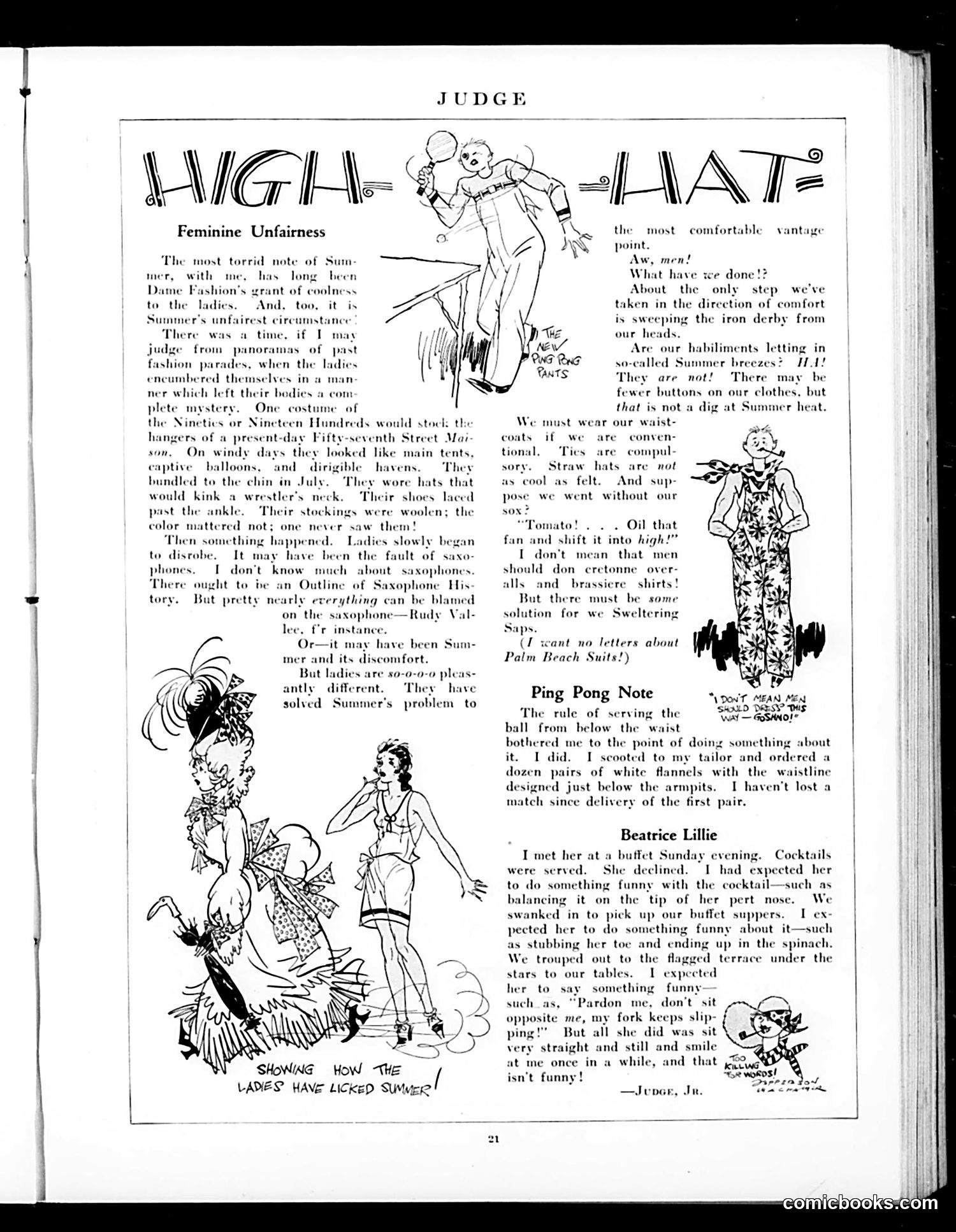
This 1920s-era satirical page mocks gender double standards in summer fashion. **"Feminine Unfairness"** contrasts how women have progressively abandoned restrictive clothing (bundled in past decades, now scantily clad) with men's unchanging formal constraints. The author blames saxophones and jazz culture (associated with Rudy Vallee) for women's liberation. The irony: women solved summer discomfort by undressing, while men remain trapped in ties, waistcoats, and wool—yet society permits only women this freedom. Men sweltering in formal dress cannot simply remove layers without scandal. **"Ping Pong Note"** is a brief humor anecdote about ordering custom high-waisted tennis flannels to comply with serve rules. **"Beatrice Lillie"** profiles the famous Irish-British entertainer (a real 1920s star), mocking her refusal to perform comedic antics at a dinner party—she simply sat "straight and still and smile[d]," disappointing expectations that celebrities must constantly entertain. The cartoons show fashionable women in minimal clothing alongside formally-dressed men, visually reinforcing the satire.
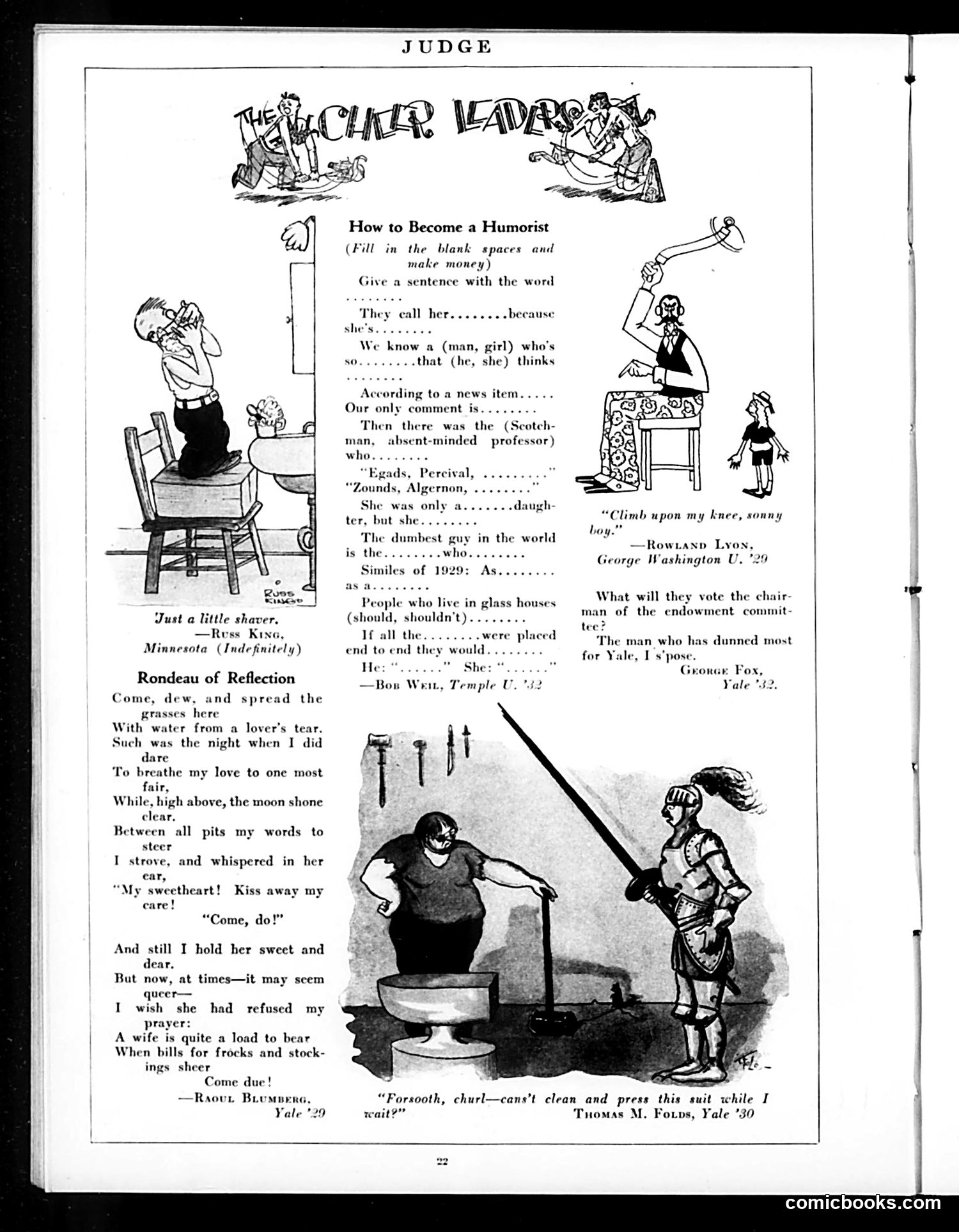
This page from Judge combines humor writing exercises with satirical cartoons typical of 1920s-30s college humor. **"How to Become a Humorist"** is a fill-in-the-blank joke template mocking predictable comedy formulas of the era—stock characters (absent-minded professors, daughters), tired phrases ("Zounds, Algernon"), and repetitive joke structures. **"Rondeau of Reflection"** is sentimental romantic poetry that ironically subverts itself: the speaker romanticizes courting his lover under moonlight, but concludes he regrets marrying her because of her expensive clothing bills—a common joke about wives' extravagance. **The bottom cartoon** depicts a Roman or medieval warrior confronting a servant/valet, demanding the soldier's suit be cleaned and pressed immediately while he waits. The humor lies in the absurdity of demanding instant garment service in ancient times, likely satirizing modern impatience and consumerism. All content reflects 1920s college-audience humor: romantic disillusionment, gender stereotypes about female spending, and anachronistic jokes.
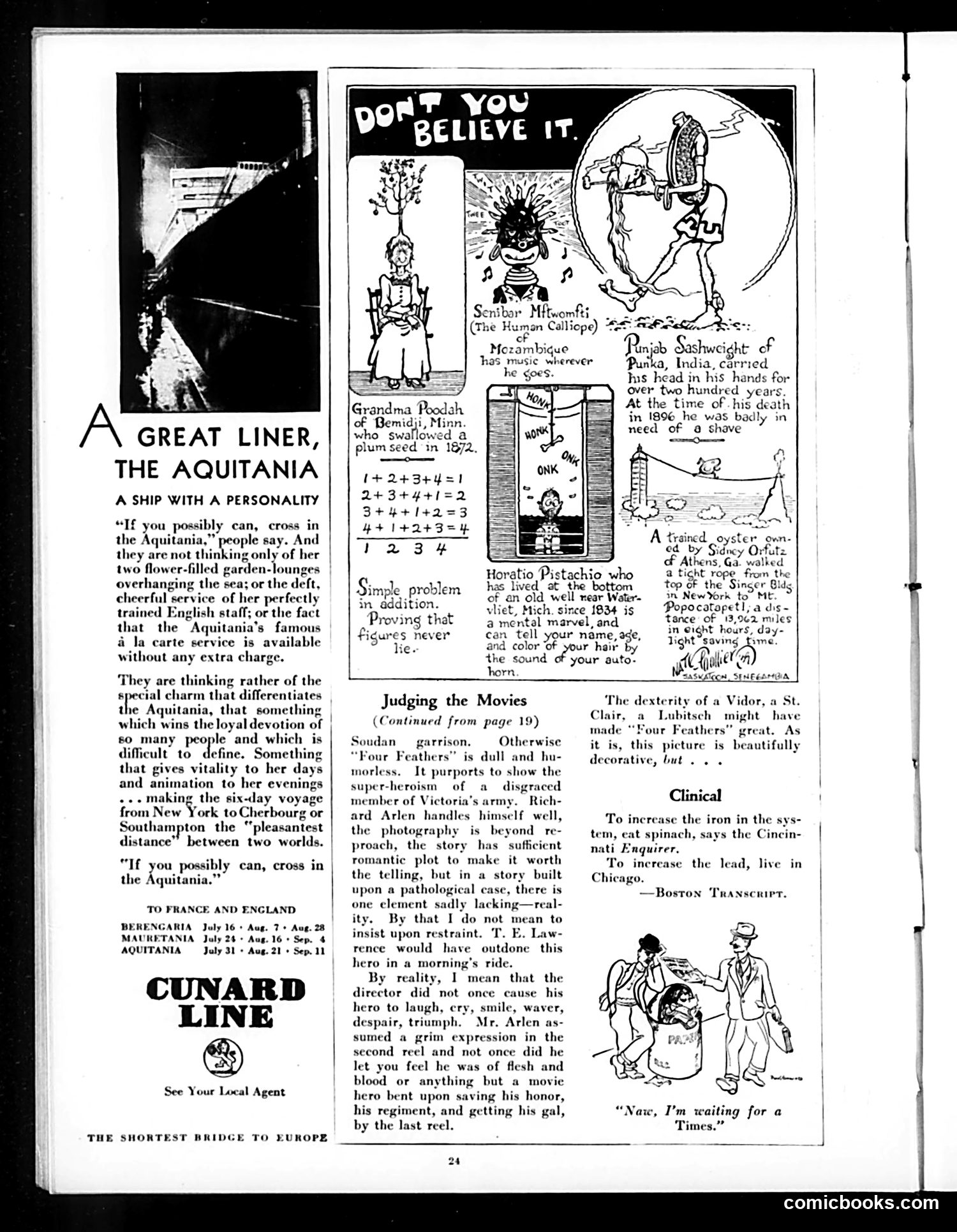
This page features a "believe it or not" style feature mocking tall tales and dubious claims. The cartoons present absurd, impossible scenarios presented as fact: - **Grandma Poodah** allegedly swallowed a plum seed in 1872 and still carries it - **Horatio Pistachio** has lived in a well since 1834 and can identify people by their car horn sounds - **Punjab Sashweight** carried his own head for 200 years - **A trained oyster** walked a tightrope across New York The satire targets the public's gullibility for sensational, unverifiable stories—a common entertainment format of the 1920s era. By presenting increasingly ridiculous claims with pseudo-serious illustrations and pseudo-scientific "proof" (like the addition problem), Judge ridicules both credulous readers and the publications that profited from publishing such nonsense. The page also contains ship advertising for Cunard Line's luxury transatlantic service, representing the magazine's commercial content.
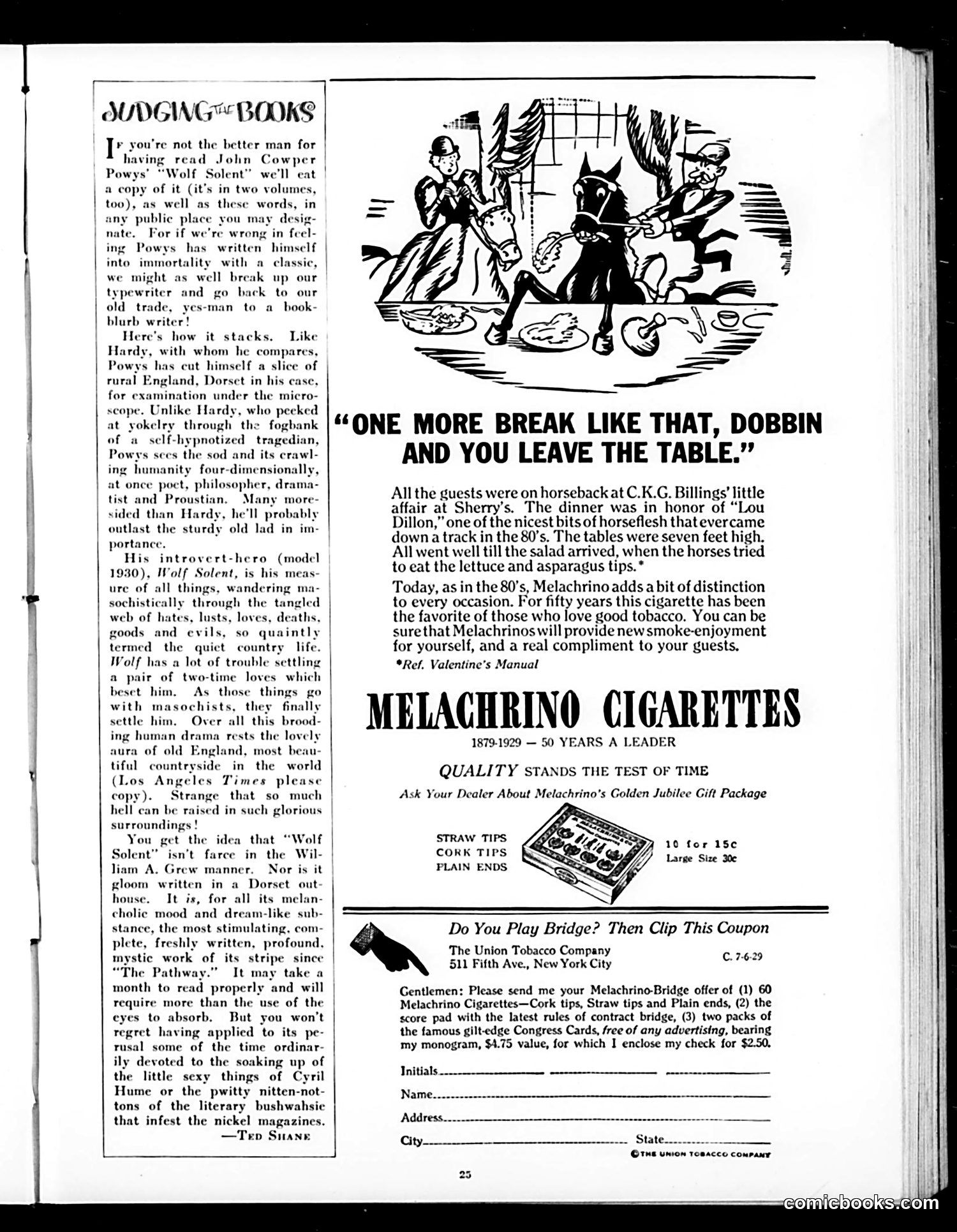
This page contains two distinct elements: **Left side:** A book review by Ted Shane of John Cowper Powys's novel "Wolf Solent" (1930). Shane praises it as a profound, complex work comparing Powys favorably to Thomas Hardy—sophisticated literary criticism from the era. **Right side:** A cartoon and advertisement. The cartoon depicts C.K.G. Billings's famous 1903 horseback dinner at Sherry's restaurant in New York, a notorious wealthy eccentricity where guests dined mounted on horses at elevated tables. The joke: when salad arrived, the horses tried to eat it. The advertisement uses this historical anecdote to sell Melachrino cigarettes, claiming the brand has distinguished elegant occasions for fifty years. A coupon offers bridge-playing accessories. **The satire:** The cartoon mocks Gilded Age excess—wealthy New Yorkers staging an absurd spectacle. By 1929 (publication date), this 1903 event was nostalgic, allowing Judge to simultaneously mock that extravagance while the cigarette ad exploits the amusing memory for marketing.
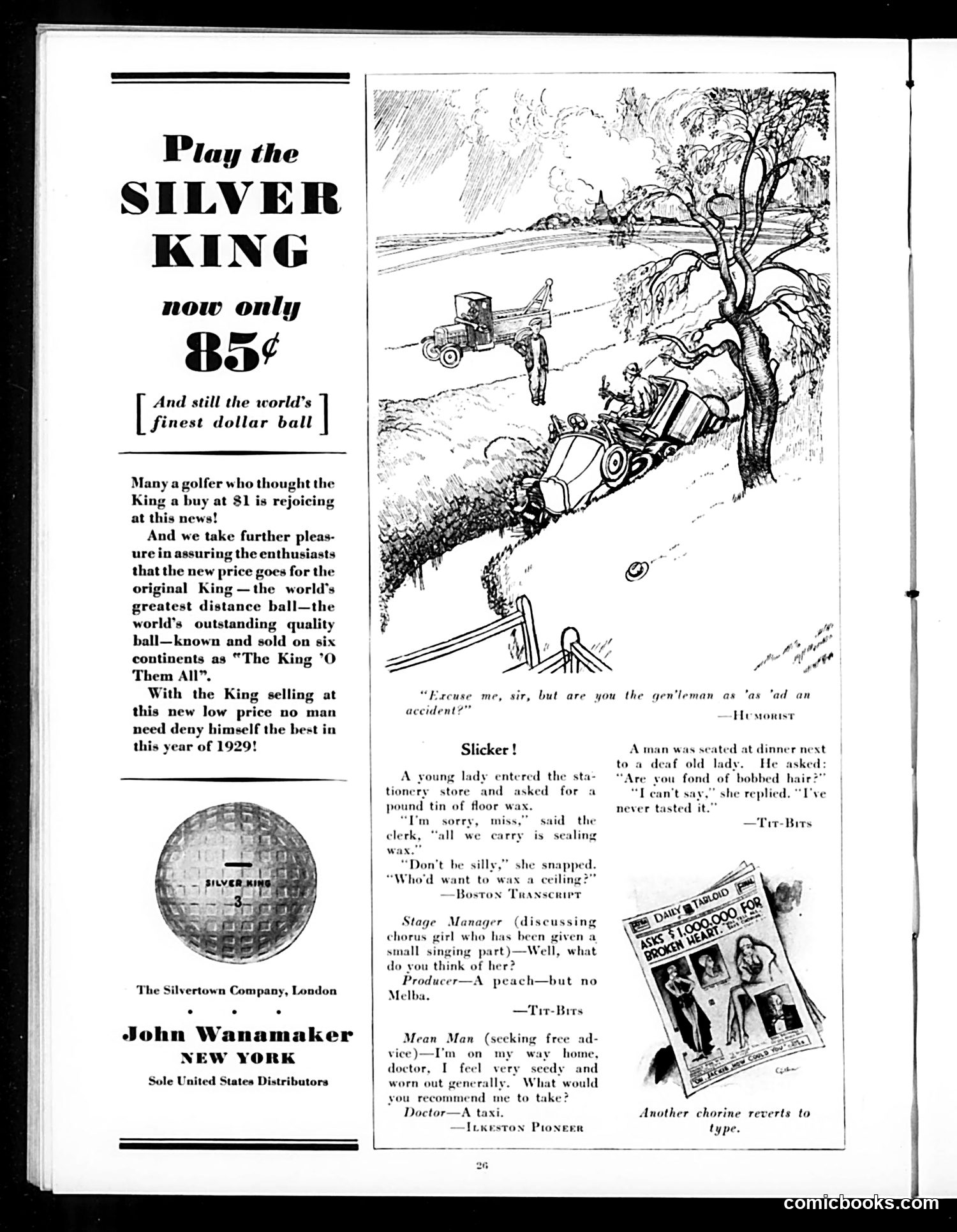
This page is primarily **advertising** for the Silver King golf ball, with the price reduced from $1 to 85¢. The ad emphasizes this is still "the world's finest dollar ball," appealing to 1929 golfers seeking quality at a lower cost—relevant given the stock market crash occurred that October. The right side contains several brief **humorous anecdotes** typical of Judge's satirical humor: - A stationery clerk's confusion about "floor wax" vs. ceiling wax (wordplay on the young woman's request) - A stage manager's backhanded compliment about a chorus girl ("A peach—but no Melba," implying she lacks the greatness of opera singer Nellie Melba) - A "mean man" seeking free medical advice - A dinner conversation joke about "bobbed hair" (the fashionable short hairstyle of the 1920s) These jokes reflect Judge's focus on urban, middle-class humor and social commentary typical of the era. The cartoons mock everyday pretension, gender relations, and modern social changes.
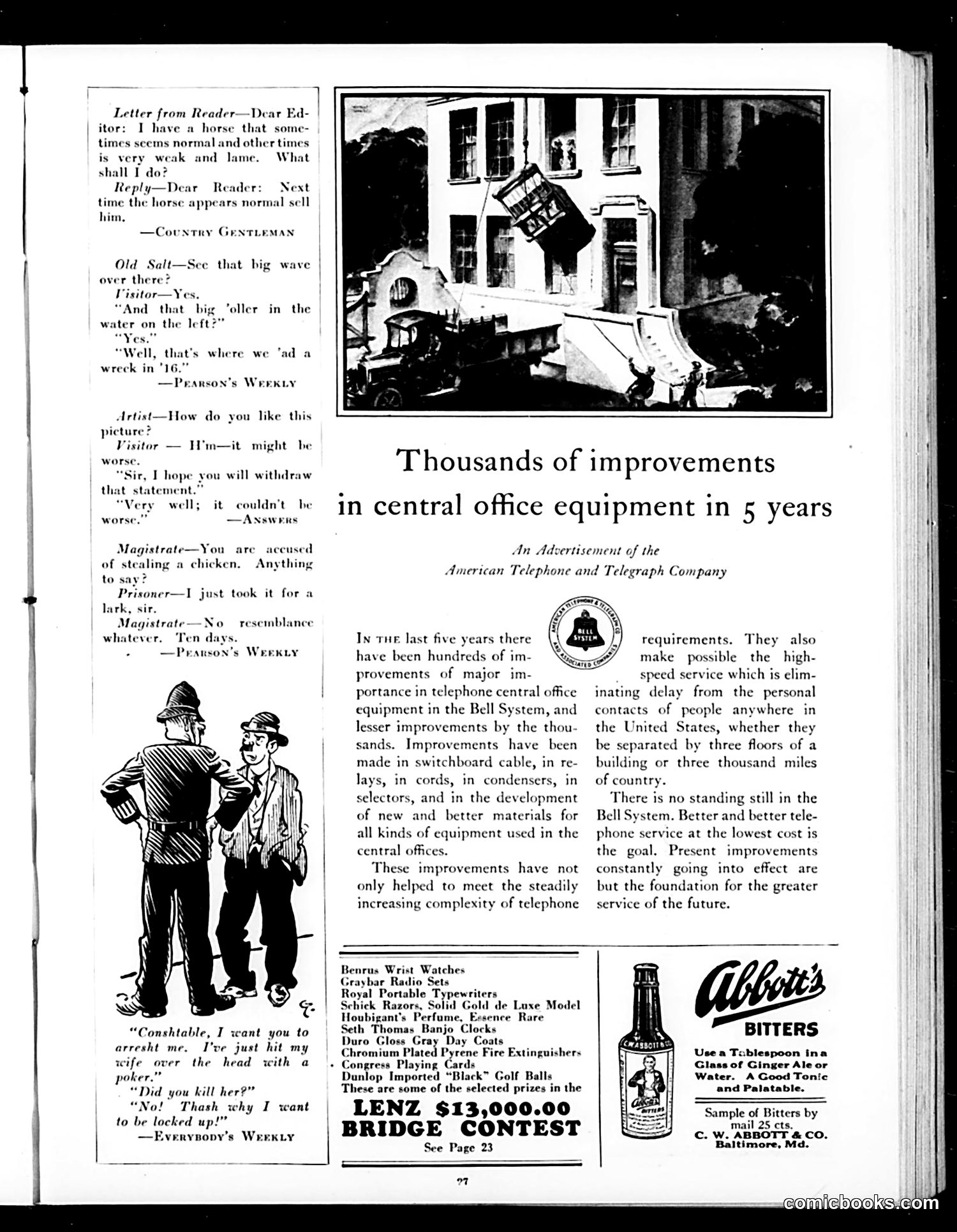
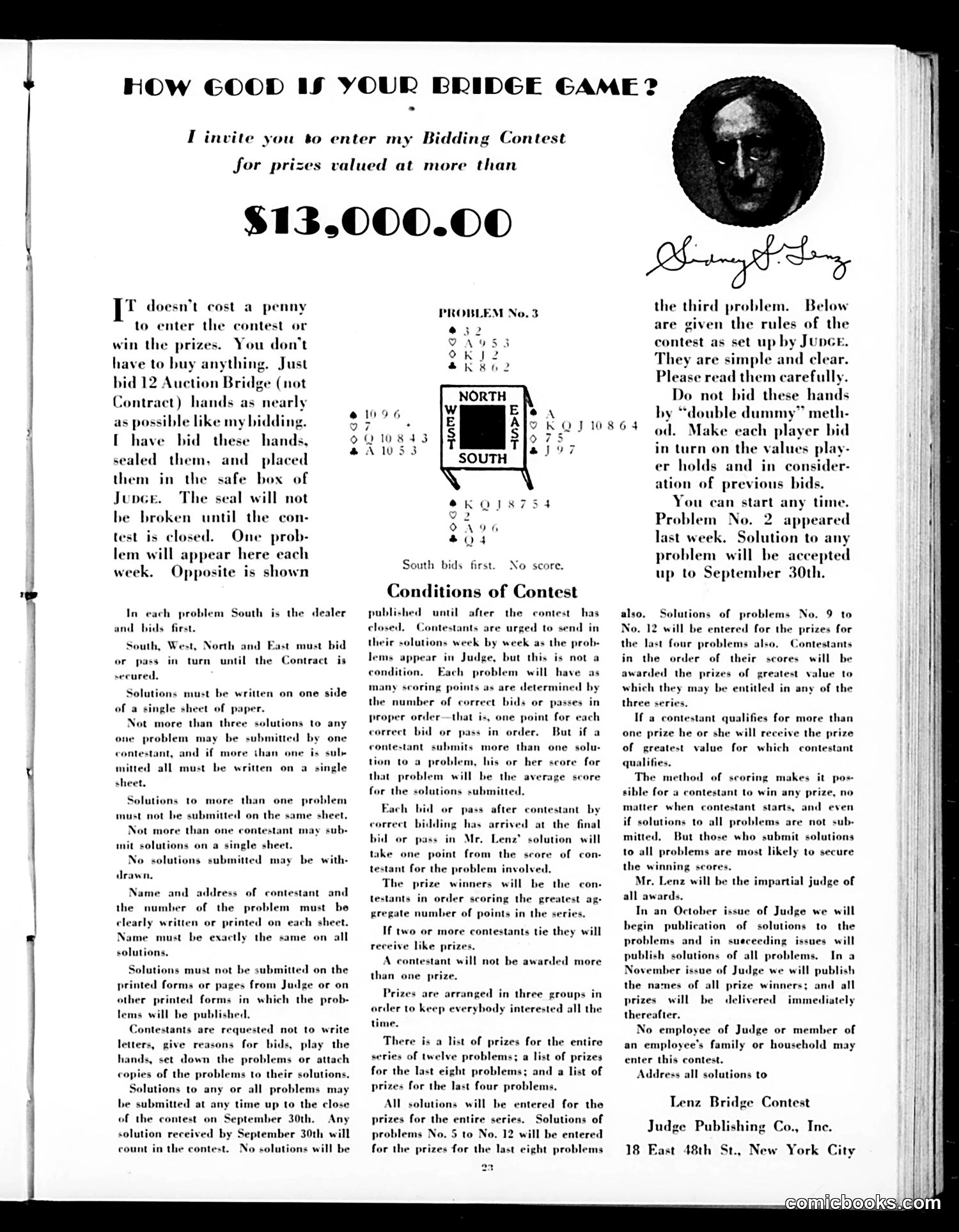
This page is primarily **advertising and jokes** rather than political satire. The **cartoons** are simple humor comics: one about a dishonest horse trader, another about a naval shipwreck survivor, and one about a man arrested for hitting his wife, who welcomes jail. These jokes rely on period attitudes toward animals, war, and domestic violence—elements that would seem crude to modern readers. The **AT&T advertisement** dominates the right side, promoting telephone infrastructure improvements as progress and efficiency. Positioned as an endorsement of modern technology, this was typical marketing for the rapidly expanding Bell System in the 1920s-1930s (the era of Judge's publication). The page also includes a **bridge game contest** and advertisements for consumer goods (watches, typewriters, razors, golf balls, bitters tonic). There is **no discernible political commentary** on this particular page—it reflects Judge's shift toward lighter humor and commercial content rather than sharp satire.
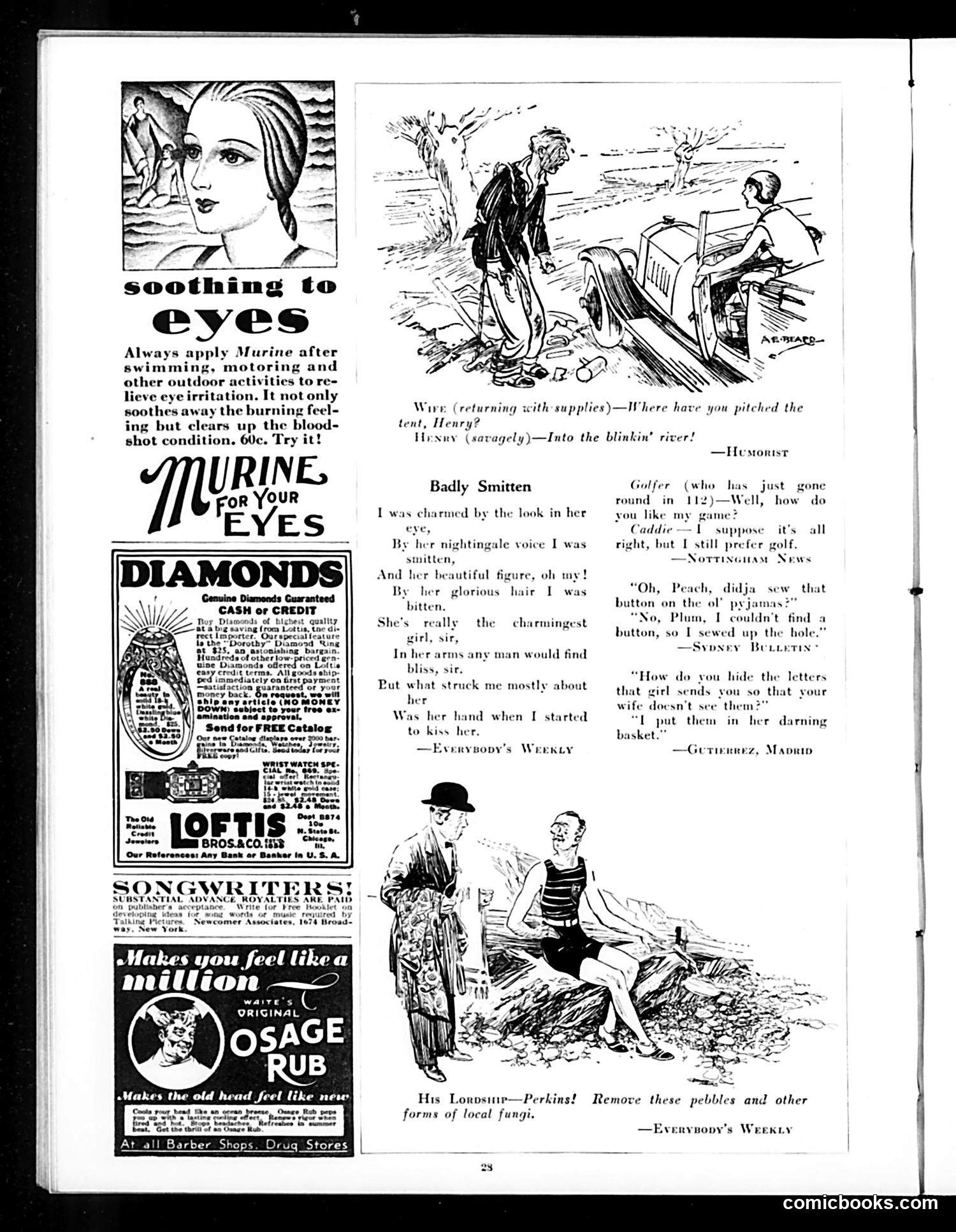
This page contains primarily **advertisements and humor snippets** rather than political cartoons. The main content includes: **"Badly Smitten"** — A poem about a man charmed by a woman's appearance, from *Everybody's Weekly*. The humor is conventional romantic verse. **Golf cartoon** — A golfer who shot 112 (poorly) angrily pitched his tent "into the blinkin' river," a mild sight-gag joke. **"His Lordship"** — A class-humor sketch where a working-class man (Perkins) is told to remove "pebbles and other forms of local fungi," likely referring to foot problems in crude terms. **Miscellaneous short jokes** about hiding love letters and sewing buttons — domestic humor typical of the era. **Large advertisements** for Murine eye drops, diamonds, Loftis jewelry, and Osage Rub dominate the left side. The page lacks significant political satire or caricature. It represents typical early 20th-century magazine filler: light domestic humor, class-based comedy, and commercial advertising rather than pointed social commentary.
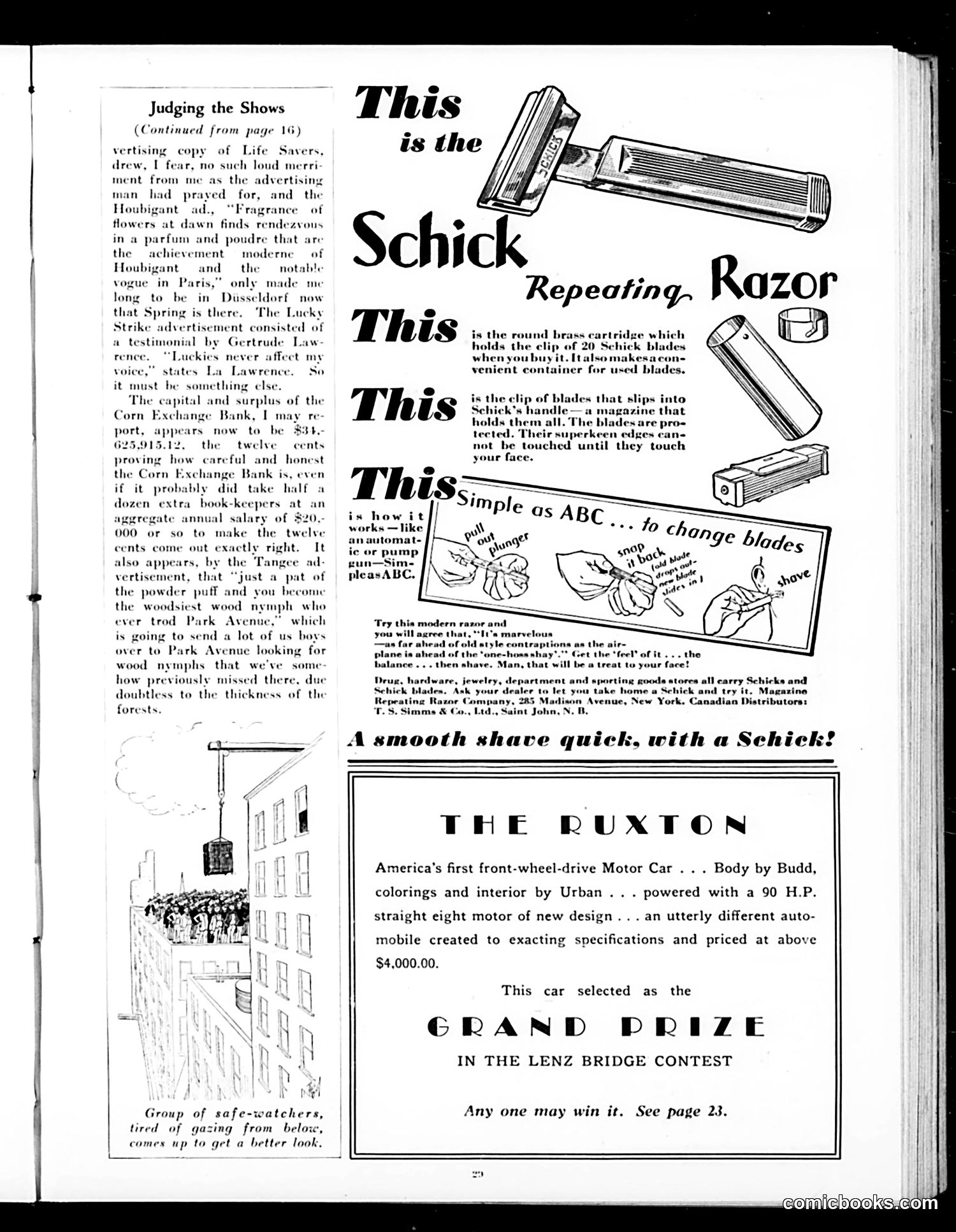
This page is primarily **advertising**, not political satire. It contains: 1. **"Judging the Shows"** (top left): A theater/entertainment review column discussing various advertisements in other publications—Life Savers, Lucky Strike cigarettes, and banking ads. The writer critiques their copywriting quality. 2. **Schick Repeating Razor advertisement** (center/right): A detailed product ad explaining the new Schick razor's innovative features—its clip-loading blade system and automatic operation ("Simple as ABC"). This represents early 20th-century consumer product marketing. 3. **The Buxton automobile advertisement** (bottom): Promoting America's "first front-wheel-drive Motor Car," priced over $4,000, as a grand prize in the "Lenz Bridge Contest." 4. **Street cartoon** (left margin): A small sketch of observers looking upward from below a building—captioned as "safe-watchers" seeking a better view. The page reflects 1920s consumer culture and advertising practices rather than political commentary.
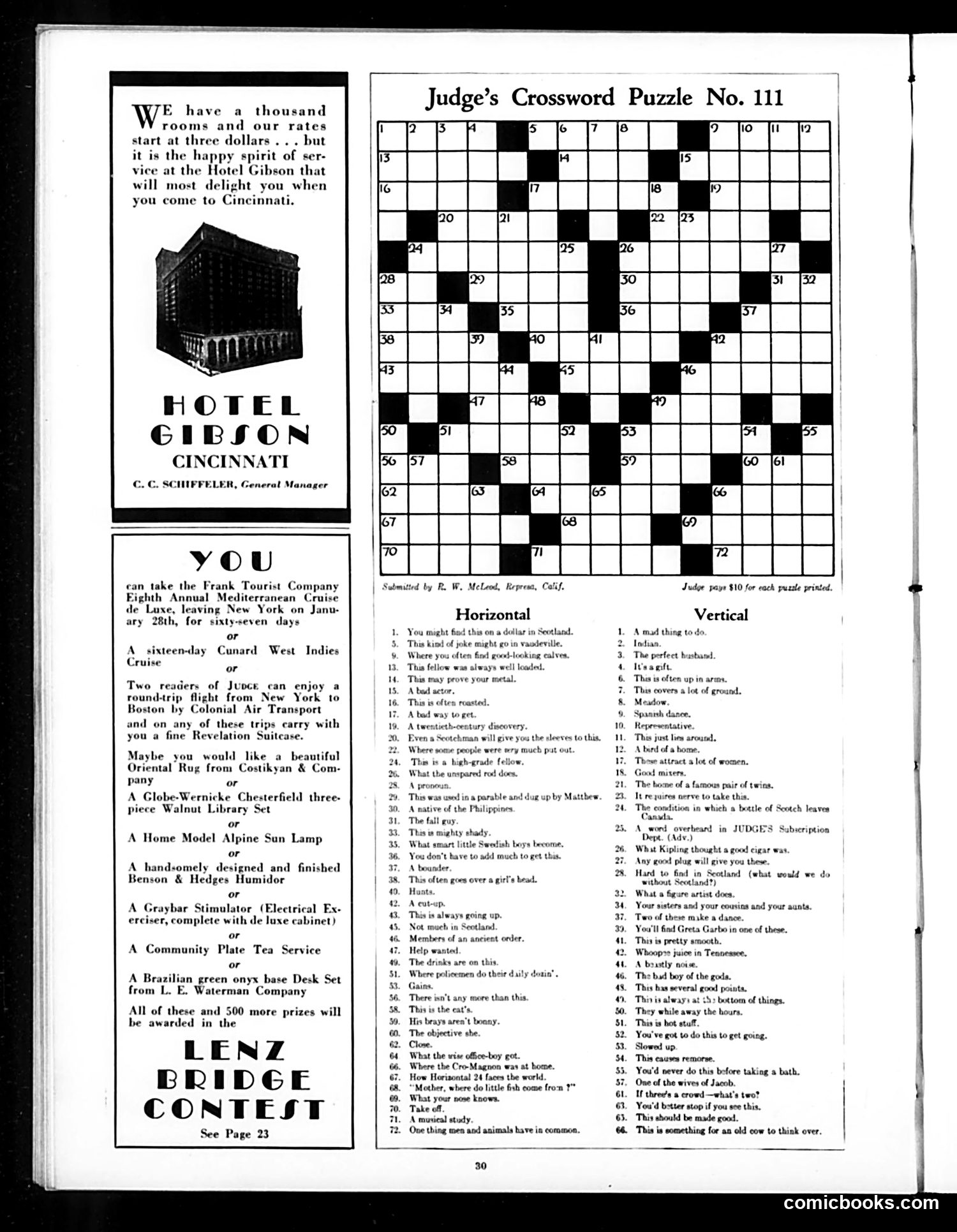
This page is **primarily a crossword puzzle with advertisements**, not a political cartoon. The puzzle itself contains no political satire or caricatures. The content consists of: 1. **Hotel Gibson advertisement** (Cincinnati) - a luxury hotel promoting its service and three-dollar rates 2. **Travel and prize advertisements** - cruises, suitcases, furniture, and appliances available through a "Lenz Bridge Contest" 3. **The crossword puzzle** - a standard word game with clues in horizontal and vertical sections The clues are lighthearted wordplay referencing everyday objects, animals, and concepts ("A bad actor," "Spanish dance," "Indian"), with occasional references to Prohibition-era Scotland (suggesting alcohol smuggling/Scotch whisky as a running joke, typical of 1920s American humor). There is **no political content or social satire** visible on this page—it represents Judge magazine's typical mix of advertising and entertainment puzzles from the period.
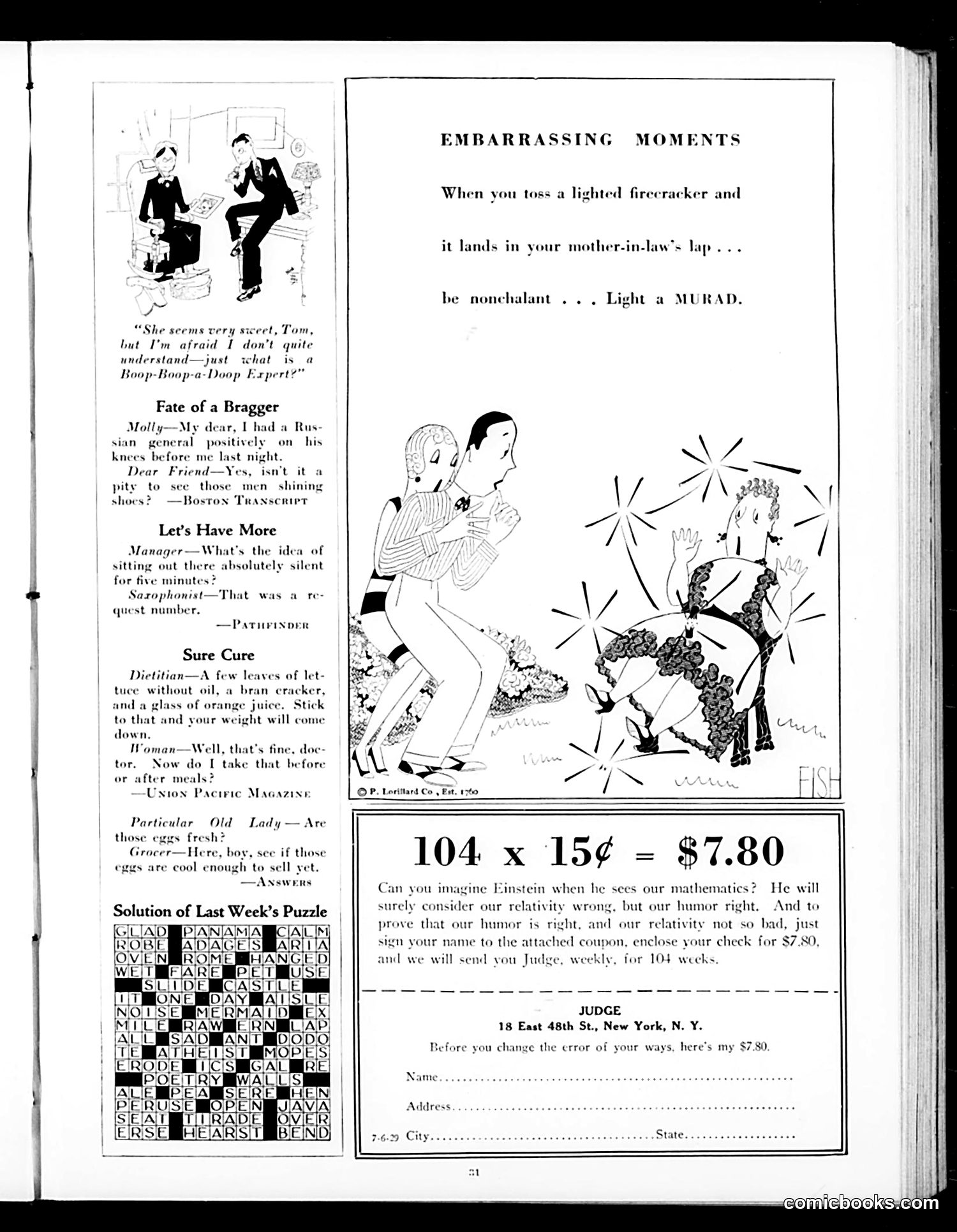
This page contains several humor pieces and an advertisement for Judge magazine subscriptions. The main cartoon depicts an "embarrassing moment": a firecracker lands in a mother-in-law's lap at what appears to be a social gathering. The joke's "solution" is to light a Murad cigarette and act casual—a darkly humorous advertisement suggesting smoking provides social cover for awkward situations. The smaller vignettes mock various social pretensions: a woman exaggerates about a Russian general (revealed to be a shoe-shiner), a saxophonist's silence is called a "request number" (implying incompetence), and a dietician's weight-loss advice is impractical. The subscription pitch references Einstein's relativity theory as a joke about Judge's mathematical error in their puzzle contest (104 weeks × 15¢ ≠ $7.80), playfully admitting the mistake while claiming their humor compensates. The overall tone reflects 1920s-era satire mocking pretension and social awkwardness, with casual product placement alongside the comedy.
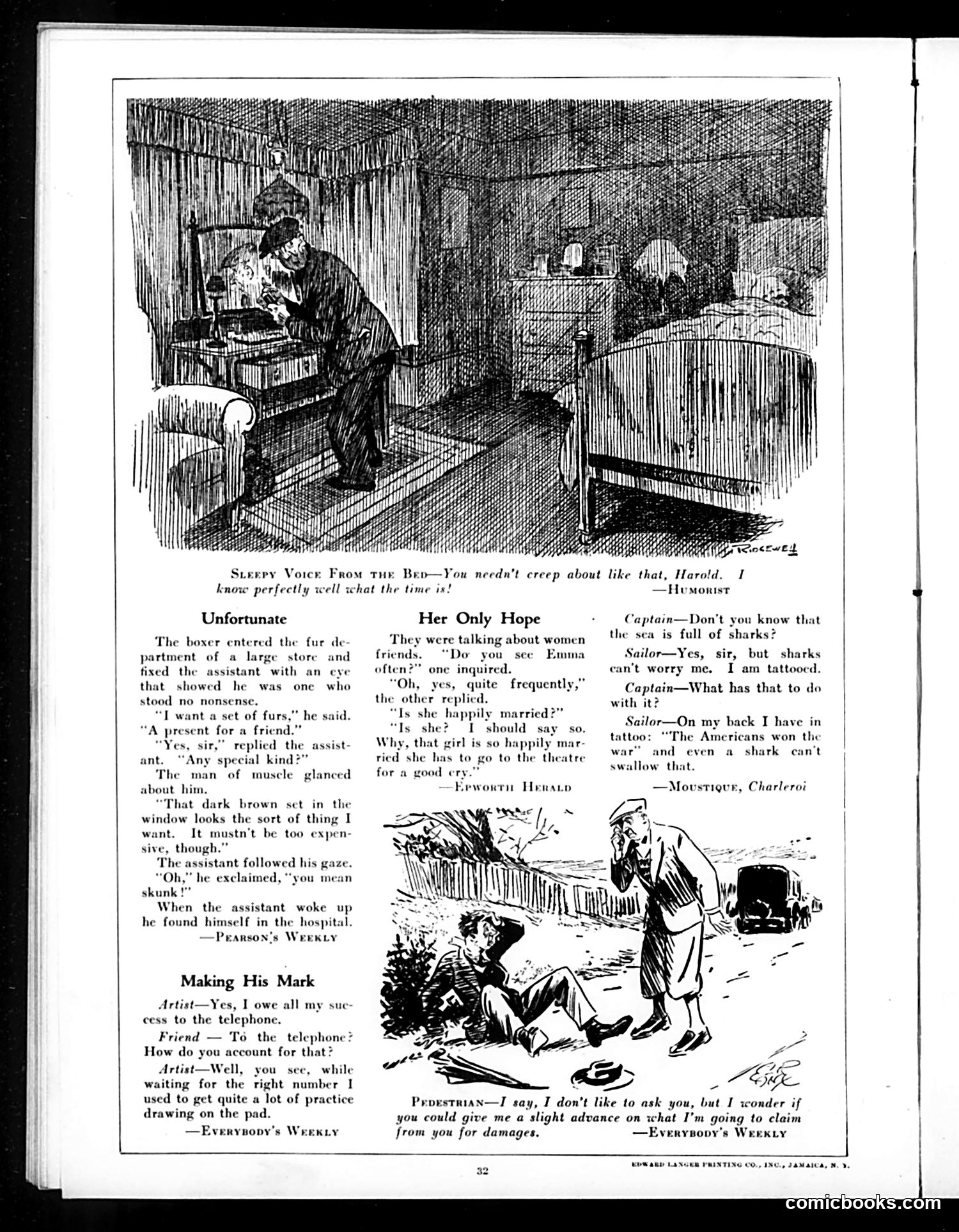
This page contains several brief humorous anecdotes typical of early 20th-century American satirical magazines: **"Unfortunate"**: A boxer enters a fur store seeking a gift. When the assistant suggests a skunk fur, the boxer punches him, landing the assistant in the hospital—a visual pun on the word "skunk" and the boxer's violent profession. **"Making His Mark"**: An artist credits his telephone for success; while waiting for connections, he practiced drawing on notepads—satirizing both artistic mediocrity and the early telephone era's inefficiencies. **"Her Only Hope"** and other brief jokes mock marital unhappiness, naval superstition about tattoos, and social awkwardness. **Top cartoon**: Shows bedroom scene where a wife catches her husband creeping about late at night, suggesting infidelity or secret activity. The page represents Judge's formula: quick, punchy jokes targeting urban middle-class anxieties, marital discord, and the absurdities of modern life—humor relying on wordplay and situational irony rather than political commentary.
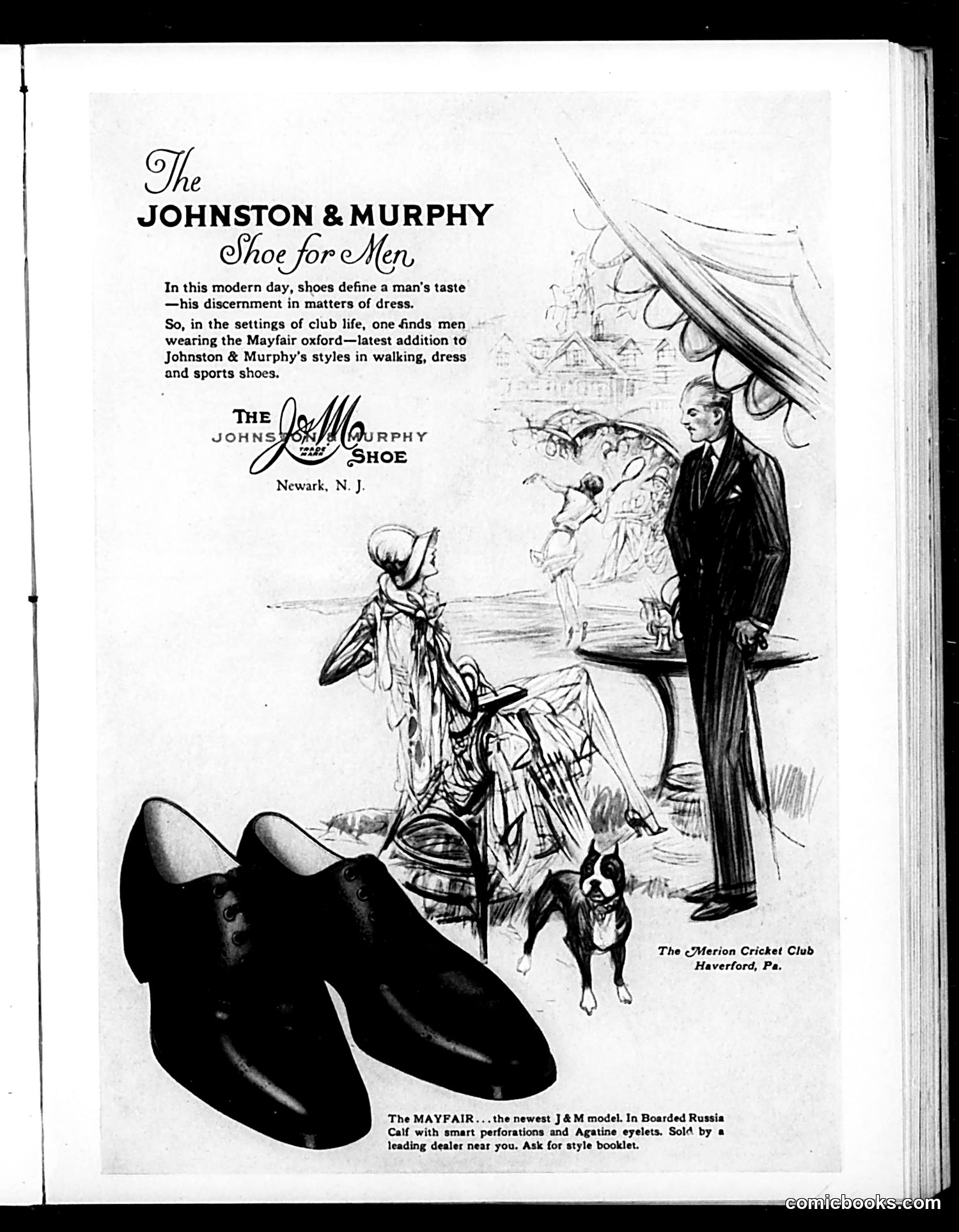
This is primarily a **product advertisement** for Johnston & Murphy shoes, not a political cartoon. It promotes their "Mayfair oxford" model to male consumers of means. The advertisement uses **social aspiration and class positioning** as its marketing strategy. The illustration depicts well-dressed men at what appears to be an exclusive country club (The Merion Cricket Club in Haverford, Pennsylvania is explicitly named), establishing that wearing these shoes signals membership in elite social circles. The text's opening claim—"shoes define a man's taste"—reflects early 20th-century **consumer culture messaging**: that purchasing the right branded products demonstrates refinement and social standing. The shoe is described with technical details ("Boarded Russia Calf," "Agatine eyelets") to emphasize quality and sophistication. This is **aspirational advertising** targeting middle-to-upper-class male readers of *Judge* magazine, using imagery of leisure, club life, and gentlemanly conduct to sell shoes as markers of social identity.
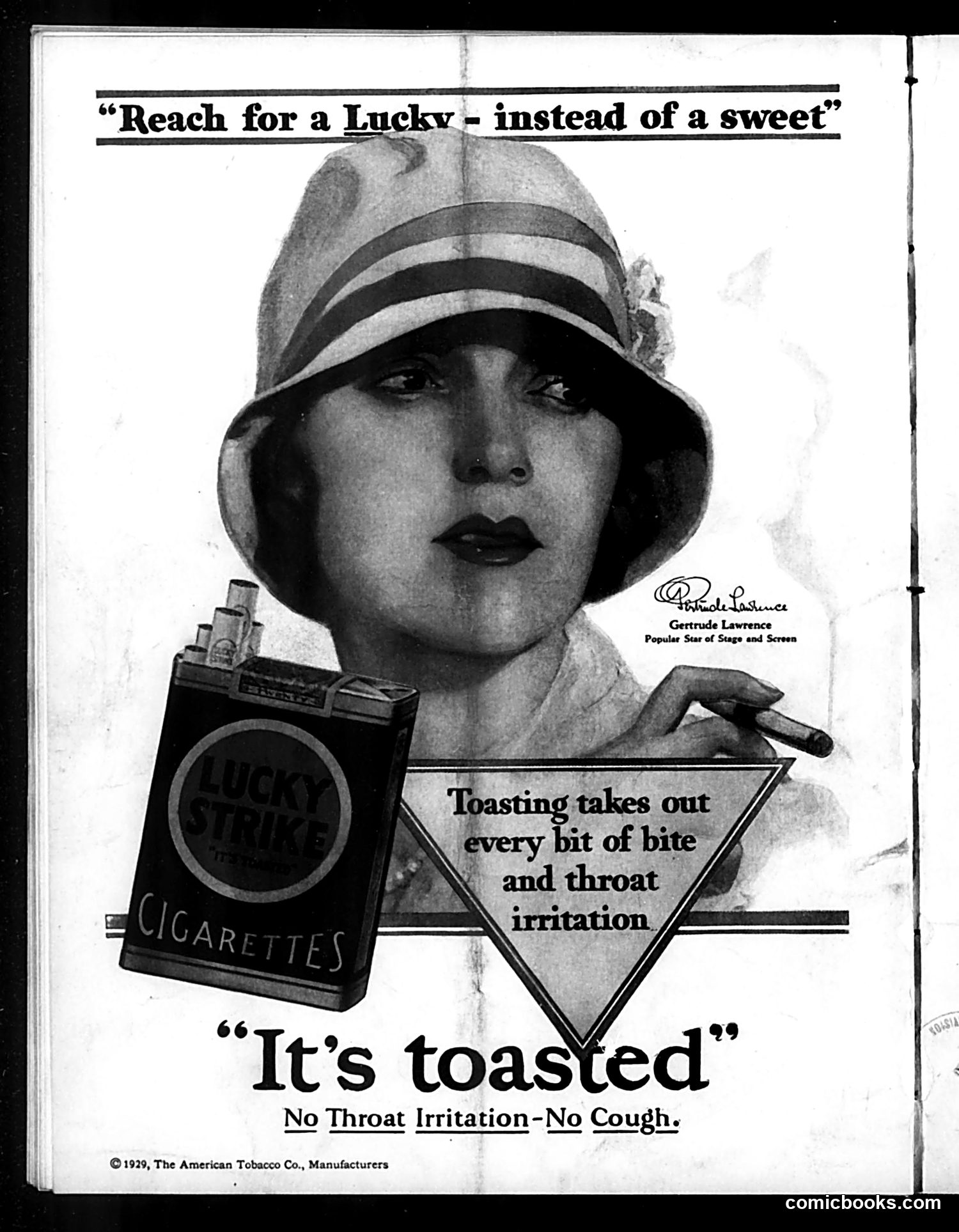
This is a 1929 cigarette advertisement featuring actress Gertrude Lawrence endorsing Lucky Strike cigarettes. The ad's slogan "Reach for a Lucky – instead of a sweet" encourages smoking as an appetite suppressant, promoting cigarettes as a weight-management tool. The main claim—"It's toasted. No Throat Irritation–No Cough"—suggests the toasting process reduces harmful effects, addressing health concerns even as the ad promotes smoking. This exemplifies early 20th-century tobacco marketing tactics: using celebrity endorsements and health-adjacent messaging to normalize cigarette consumption. The ad reveals how companies marketed smoking to women specifically, positioning it as both fashionable and beneficial—claims we now recognize as deceptive.