
A complete issue · 36 pages · 1929
Judge — July 13, 1929
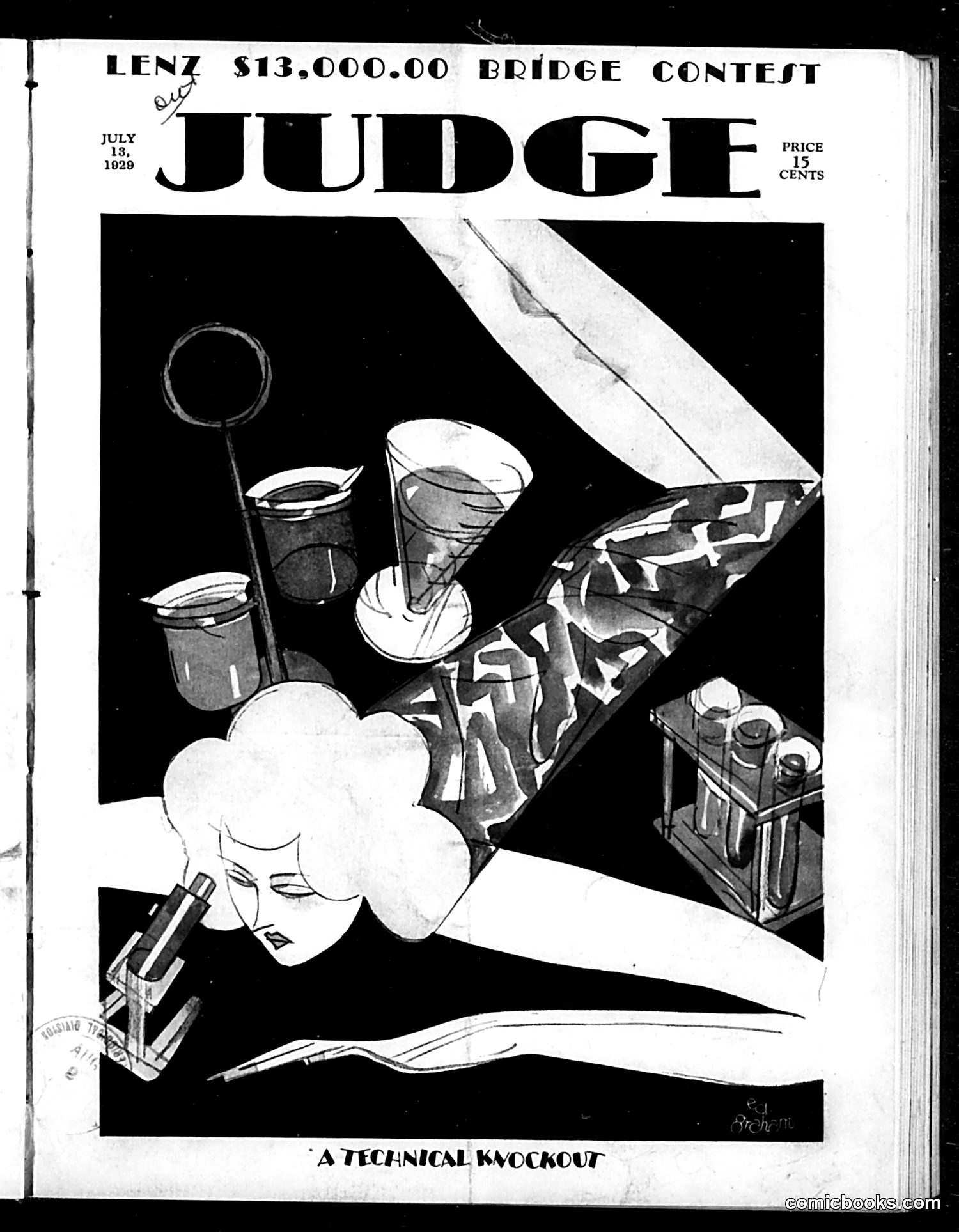
This cartoon depicts a boxer being knocked down, with boxing equipment (gloves, bucket, towel) scattered around. The subtitle "A Technical Knockout" is a boxing term for victory when a fighter cannot continue. Given the July 1929 date—just months before the stock market crash—this likely satirizes the economic situation or financial markets through boxing metaphor. The feminine figure being knocked down may represent a specific financial entity, market, or economic condition of the period. The "$13,000.00 Bridge Contest" header suggests this is part of a larger magazine issue with contests and varied content typical of Judge magazine's format. Without clearer identifying details visible in the image, the specific target of satire remains somewhat unclear, though the boxing metaphor clearly indicates economic or financial defeat.
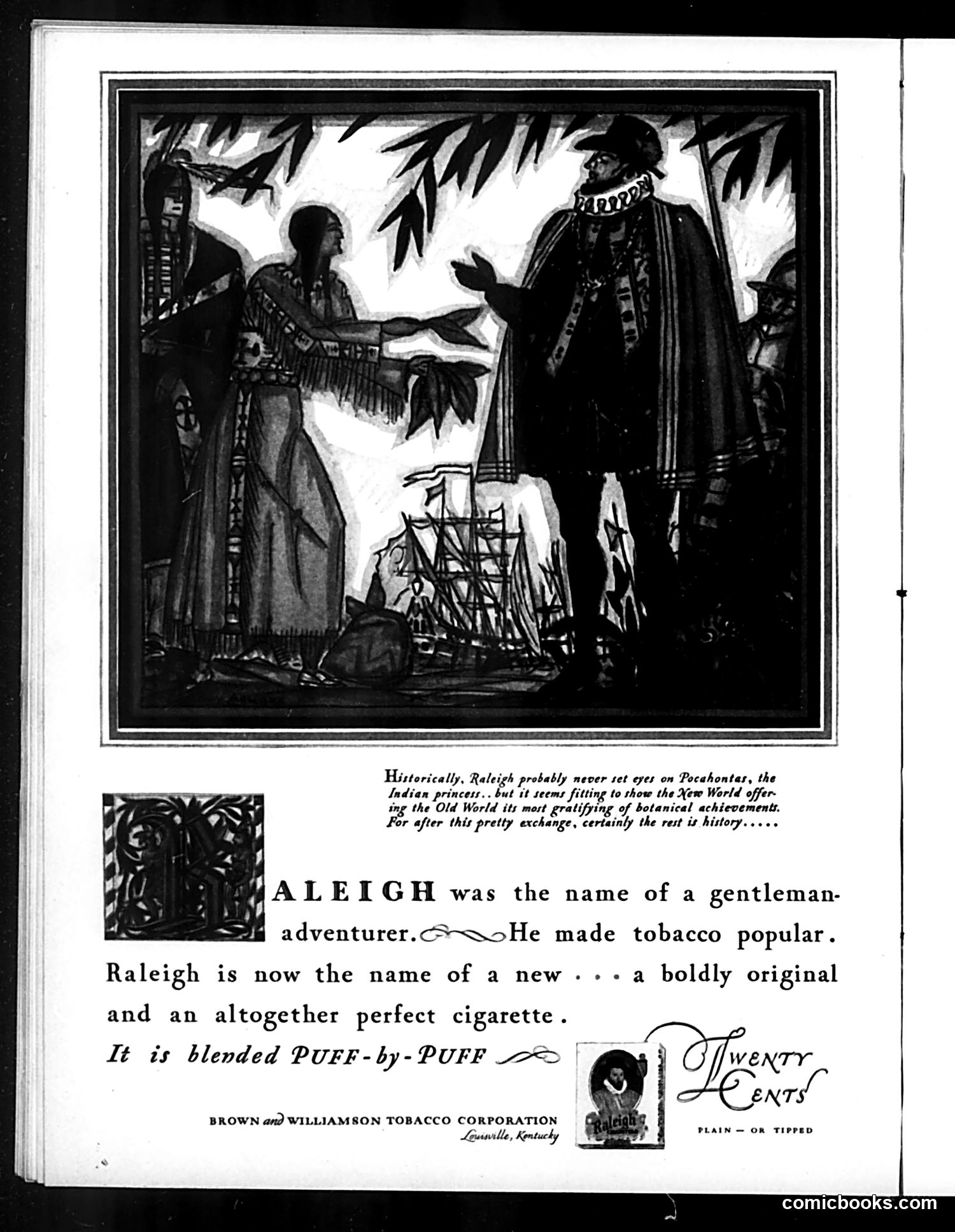
This page is primarily a **cigarette advertisement** for Raleigh brand, published by Brown & Williamson Tobacco Corporation in Louisville, Kentucky. The advertisement uses a historical scene depicting **Sir Walter Raleigh** meeting with a Native American woman, likely representing Pocahontas or a generic "Indian princess." The accompanying text references Raleigh as a "gentleman-adventurer" who "made tobacco popular," attempting to create historical prestige for the product. The ad's tagline—"It is blended PUFF-by-PUFF"—emphasizes the cigarette's quality. At twenty cents, this was positioned as a premium product. Rather than satire, this appears to be a straightforward branded advertisement leveraging colonial-era imagery and Raleigh's historical association with tobacco cultivation in the Americas to sell cigarettes to American consumers.
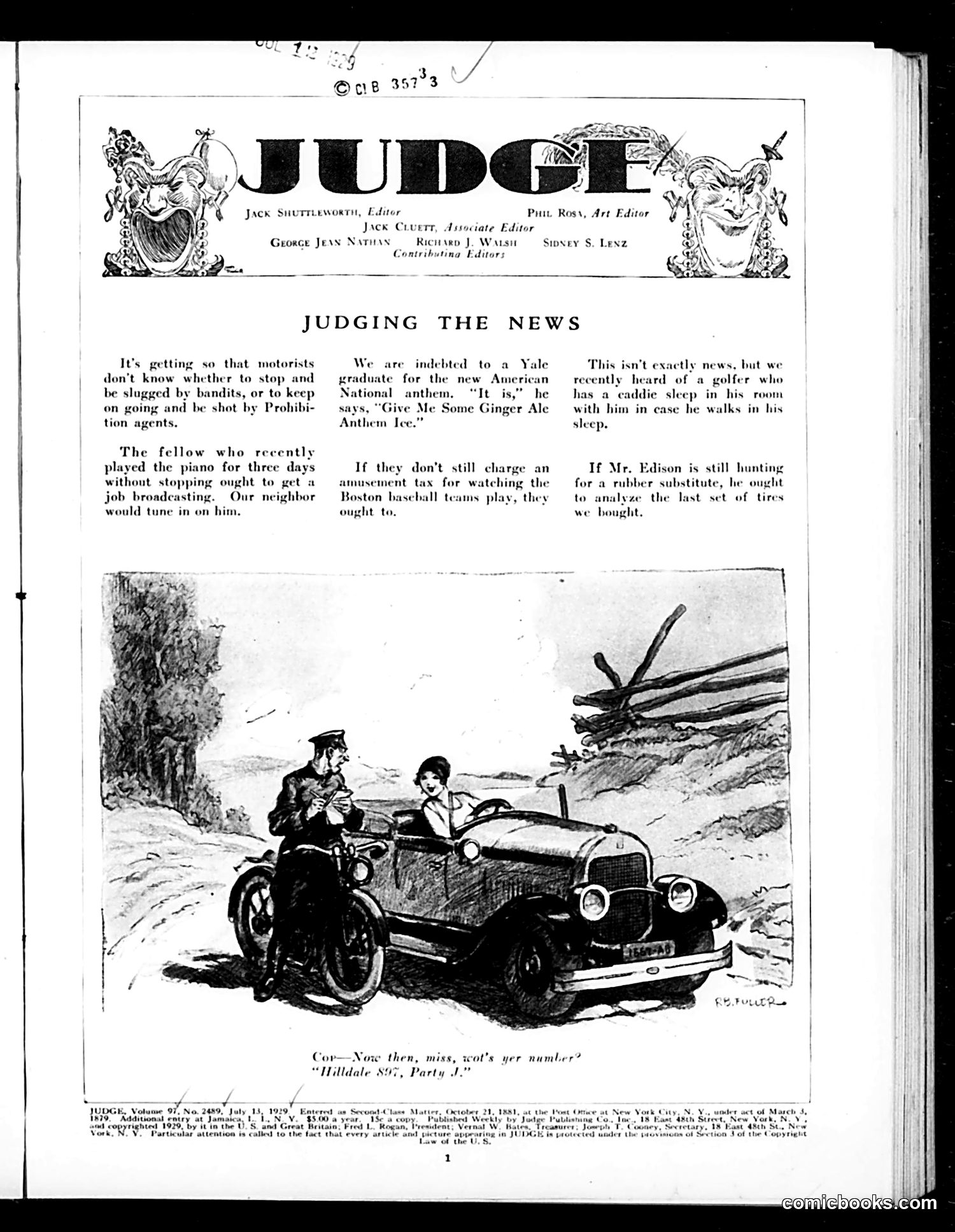
This page contains a satirical humor column titled "Judging the News" with brief commentaries on current events, plus one cartoon illustration. The main cartoon depicts a traffic stop where a police officer on a motorcycle is asking a motorist for their license number, with the caption referencing "Hilldale Street, Parts J." The joke appears to satirize either traffic enforcement practices or dangerous driving conditions of the era (the page is dated July 19, 1928). The text snippets above mock various contemporary issues: prohibition agents, a piano player's marathon performance, baseball taxation, and Edison's search for a rubber substitute. These are light satirical jabs at topical matters of 1928—all presented without requiring specific historical knowledge to function as humor about everyday absurdities.
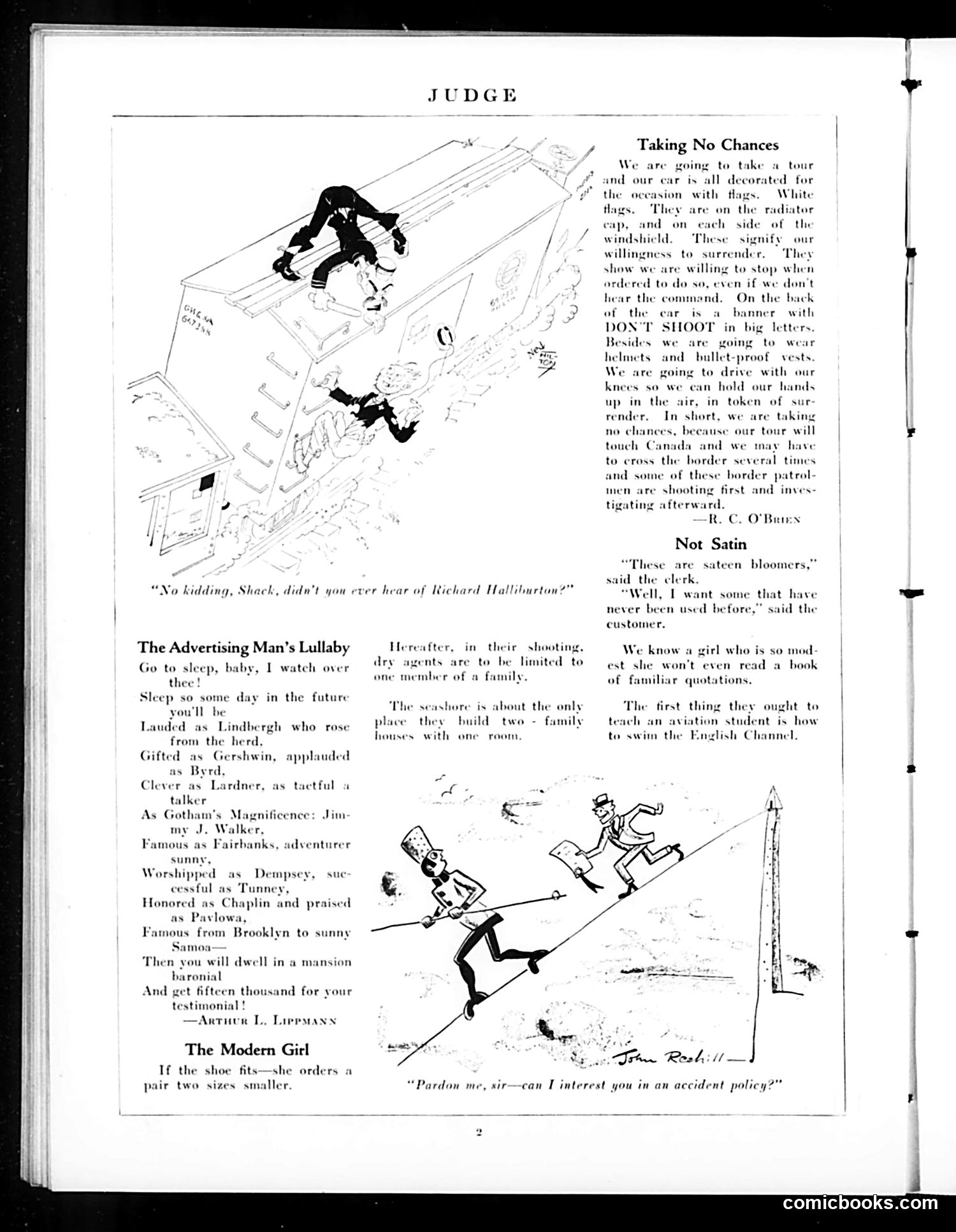
This page contains several humorous short pieces and cartoons typical of Judge magazine's satirical style. **"Taking No Chances"** (top cartoon): Depicts a couple preparing for a border crossing to Canada, decorating their car with white flags and wearing helmets and "bullet-proof vests." The text references border patrol agents "shooting first and asking questions afterward," satirizing American anxieties about Canadian border security during what appears to be Prohibition-era tensions (references to "DO'S SHOOT"). **"Not Satin"** and **"The Modern Girl"**: Brief humorous quips about consumer behavior and women's fashion preferences. **"The Advertising Man's Lullaby"**: A poem mocking advertising industry figures and celebrity endorsements. The bottom cartoon shows figures on a tightrope discussing accident insurance, likely satirizing financial risk and economic uncertainty of the period.
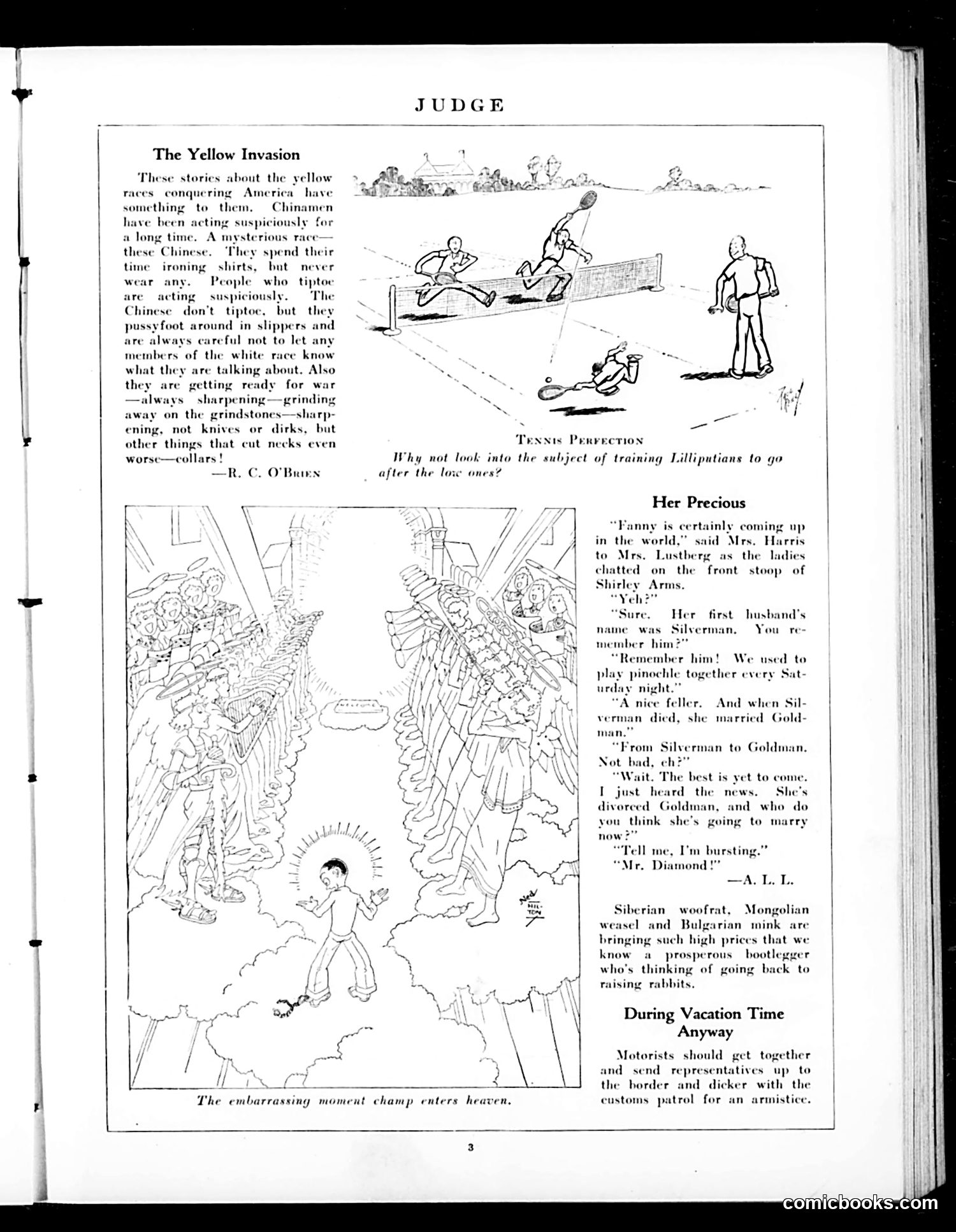
**"The Yellow Invasion"** satirizes anti-Chinese sentiment of the era. The text by R.C. O'Brien mocks xenophobic stereotypes—Chinese people supposedly act suspiciously, wear no tiptoes (racist mockery of footwear), sharpen collars like weapons, and speak mysteriously. The satire targets white Americans' paranoid fears rather than endorsing them, though the racial caricatures are deeply offensive by modern standards. **"Tennis Perfection"** appears to be a humorous cartoon about training Lilliputians (tiny people from Gulliver's Travels) for tennis. **"Her Precious"** is a satirical dialogue about a woman's remarriages—from Silverman to Goldman to Diamond—mocking social climbing through serial marriages to wealthy men with Jewish names, reflecting period antisemitism. The page reflects early 20th-century American prejudices through satirical critique, though the execution relies on harmful stereotypes.
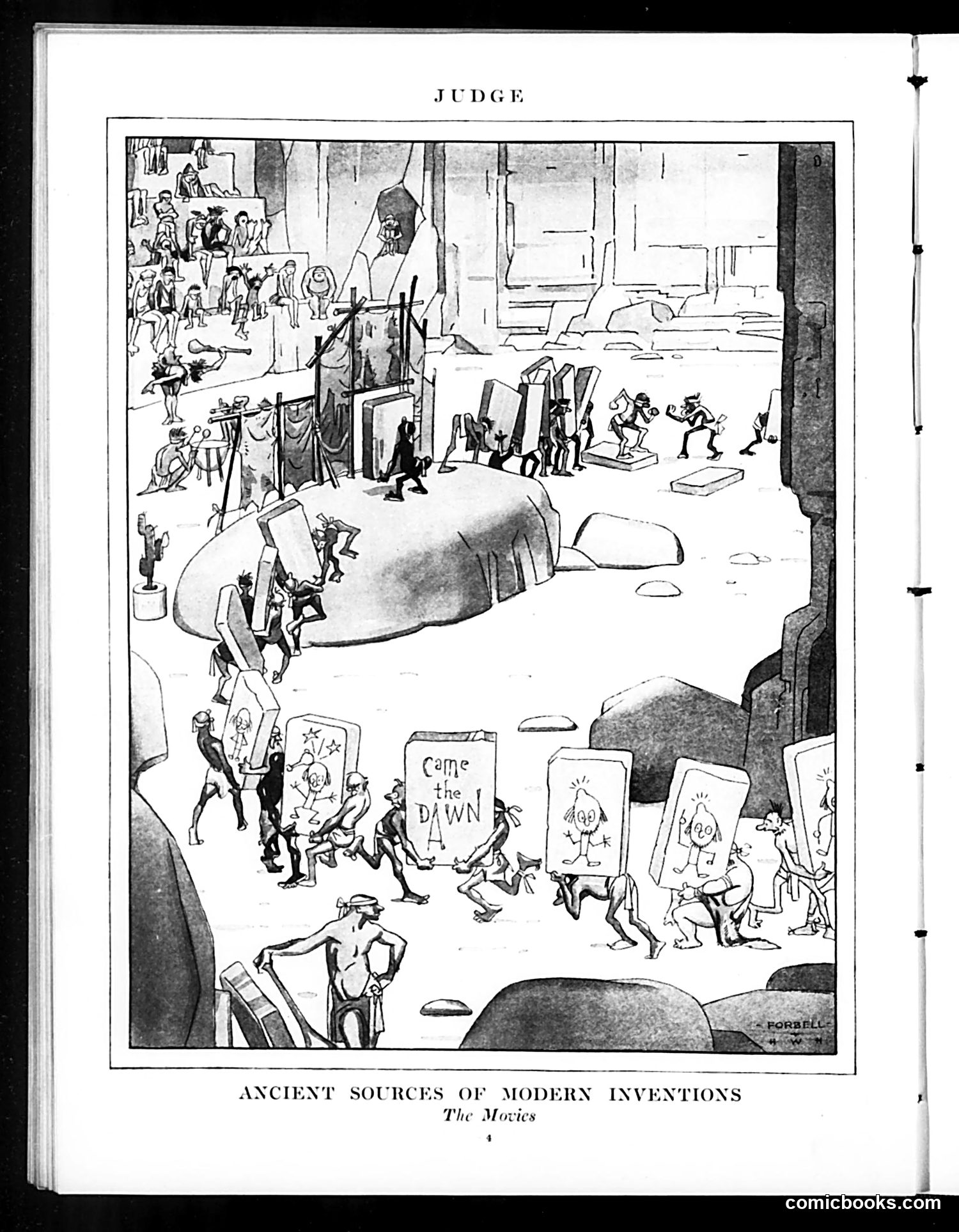
This cartoon satirizes **"The Movies"** as ancient sources of modern inventions, suggesting cinema derived its spectacles from classical antiquity. The scene depicts a massive amphitheater or arena where crowds gather around giant statues and staged performances—evoking Roman gladiatorial games and public entertainment. The satire critiques how Hollywood appropriates grand historical themes and spectacle from ancient civilization rather than creating original art. Protesters carry signs reading "Come the DAWN," suggesting early cinema's dawn or perhaps critiquing its derivative nature. The exaggerated scale of the set pieces and crowds emphasizes cinema's grandiose ambitions. This early 20th-century cartoon likely mocks the film industry's pretensions to artistic legitimacy while recycling ancient tropes for mass entertainment appeal.
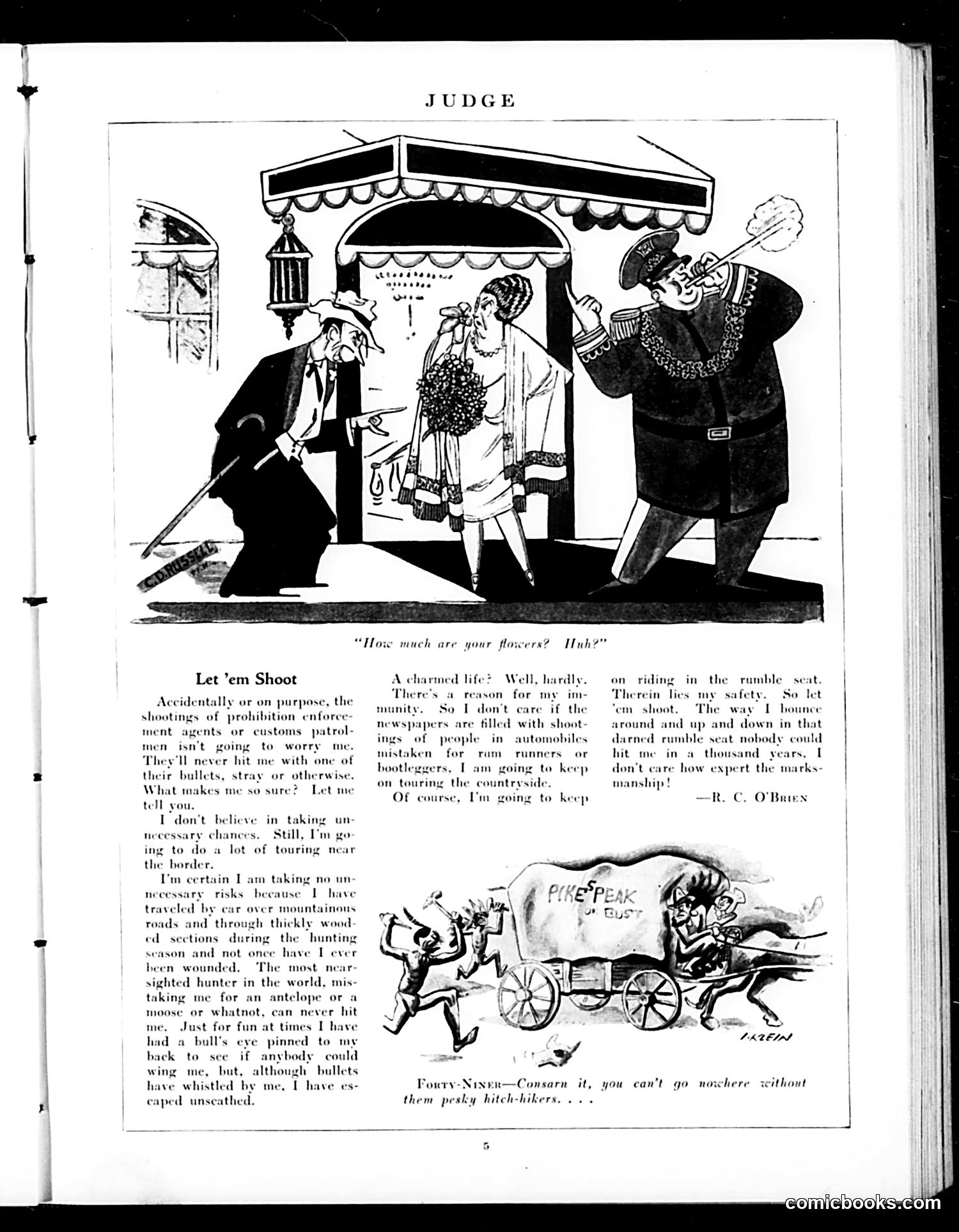
The top cartoon depicts a judge presiding over what appears to be a traffic or legal matter, with the caption "How much are your flowers? Huh?"—suggesting judicial confusion or absurdity. The main article "Let 'em Shoot" discusses a motorist's cavalier attitude toward prohibition enforcement. The author claims shootings by federal agents and customs patrol pose no risk to law-abiding drivers, boasting of extensive mountain driving without incident. The satire mocks this reckless confidence. The bottom cartoon shows "Peakpeak" moonshiners with a cart labeled "PEAKPEAK BUTTER," illustrating the prohibition-era bootlegging problem the article references. Together, the page satirizes both the dangers of prohibition enforcement and the criminals it spawned.
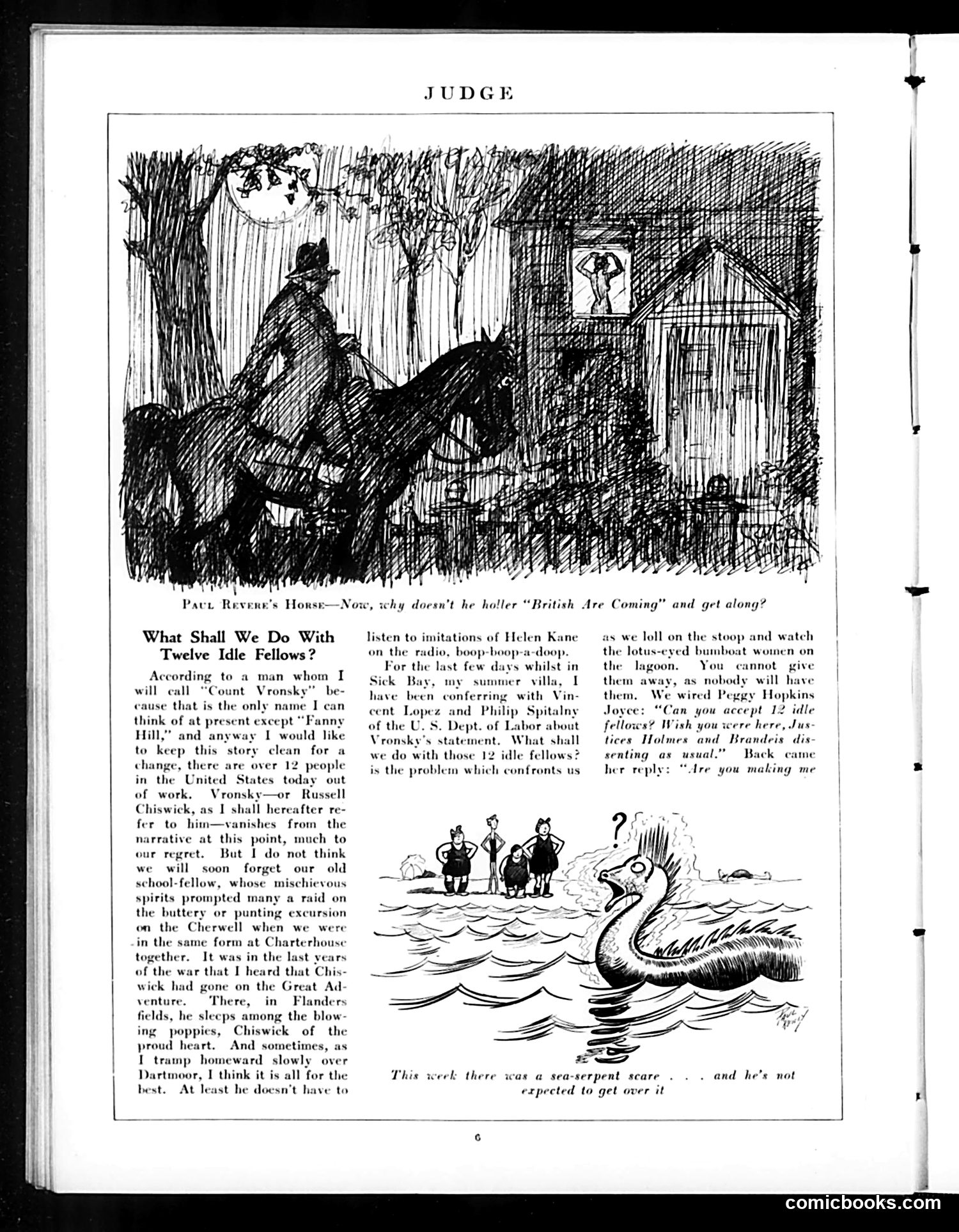
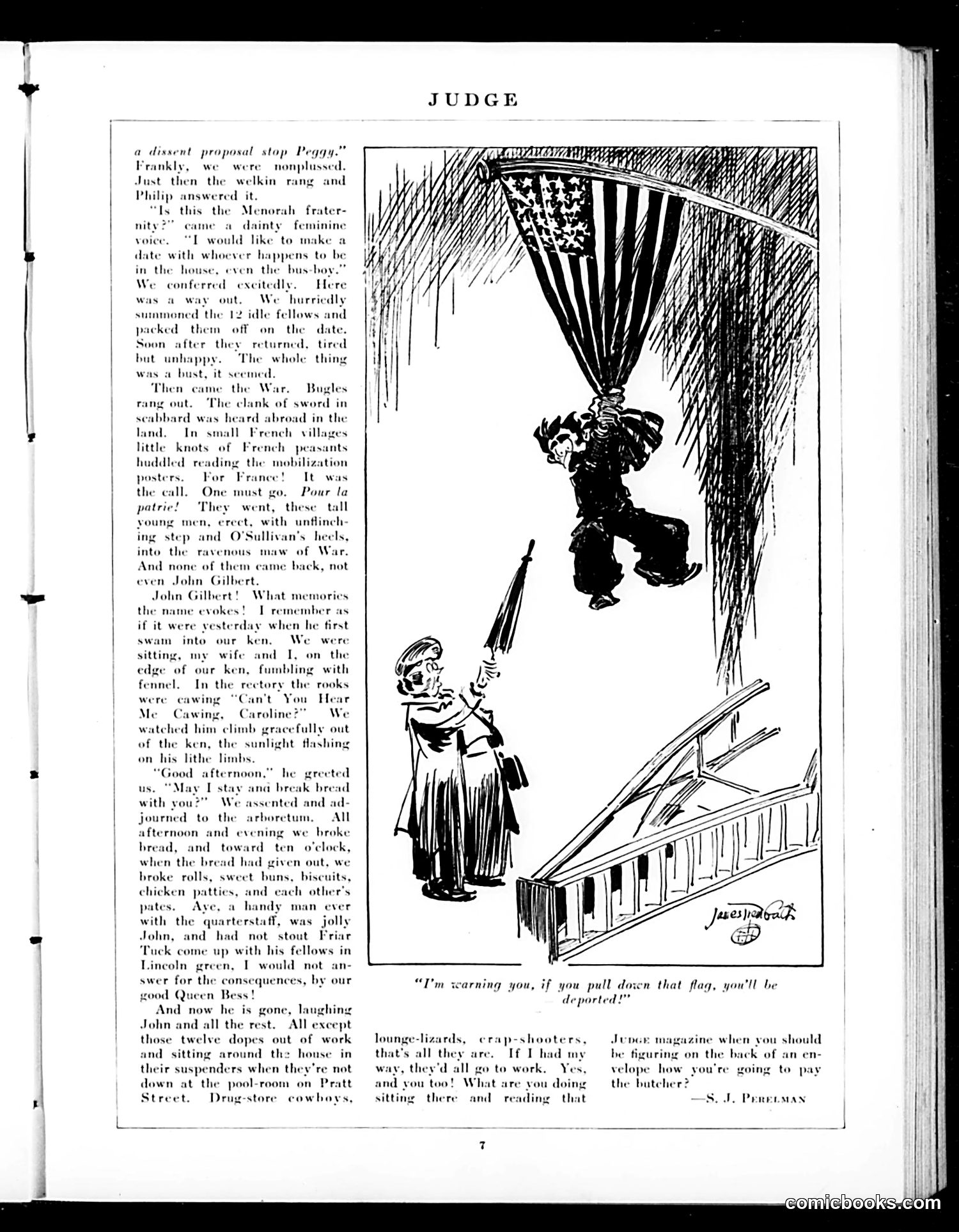
This page from *Judge* contains a cartoon satirizing American attitudes toward immigrant labor during World War I. The illustration shows a woman (likely representing America or patriotic authority) threatening a man pulling down an American flag, warning of deportation. The accompanying text is a rambling narrative about young men—apparently including immigrants or working-class fellows—enlisting for France during WWI while idle workers remain behind. The story contrasts noble sacrifice ("Pour la patrie!") with unemployed men lounging in pool halls and streets. The satire targets **anti-immigrant sentiment** and the perceived hypocrisy of America: foreign-born or working-class men fight and die for France, yet those remaining home face deportation threats for minor infractions while contributing nothing. The cartoon suggests anxiety about loyalty, patriotism, and the status of immigrants during wartime—a pointed commentary on nativist politics of the era. The sarcastic tone mocks both the threat of deportation and the idleness of non-contributing citizens.
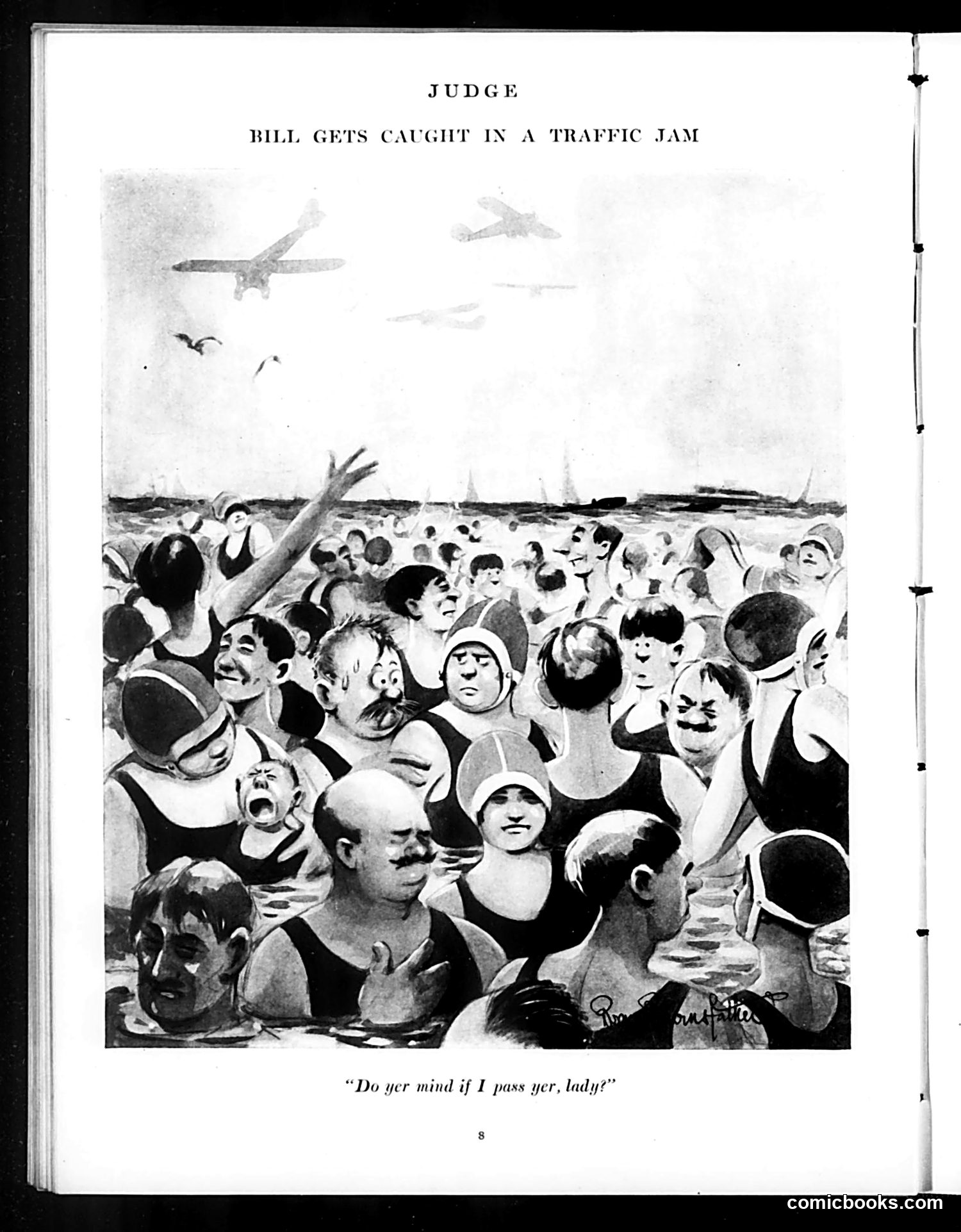
This is a humorous cartoon titled "Bill Gets Caught in a Traffic Jam," depicting a crowded beach scene where numerous swimmers are packed together in the water. A man (presumably "Bill") asks a woman, "Do yer mind if I pass yer, lady?" — a polite question made absurd by the impossibly dense crowd surrounding them. The joke uses "traffic jam" metaphorically: the beach is so overcrowded that swimmers literally cannot move freely, creating gridlock comparable to automobile traffic. The cartoon satirizes either the popularity of public beaches during a specific era or possibly post-war recreation culture when beach-going became a mass leisure activity. The colloquial dialect ("yer") adds comedic working-class flavor to the scene.
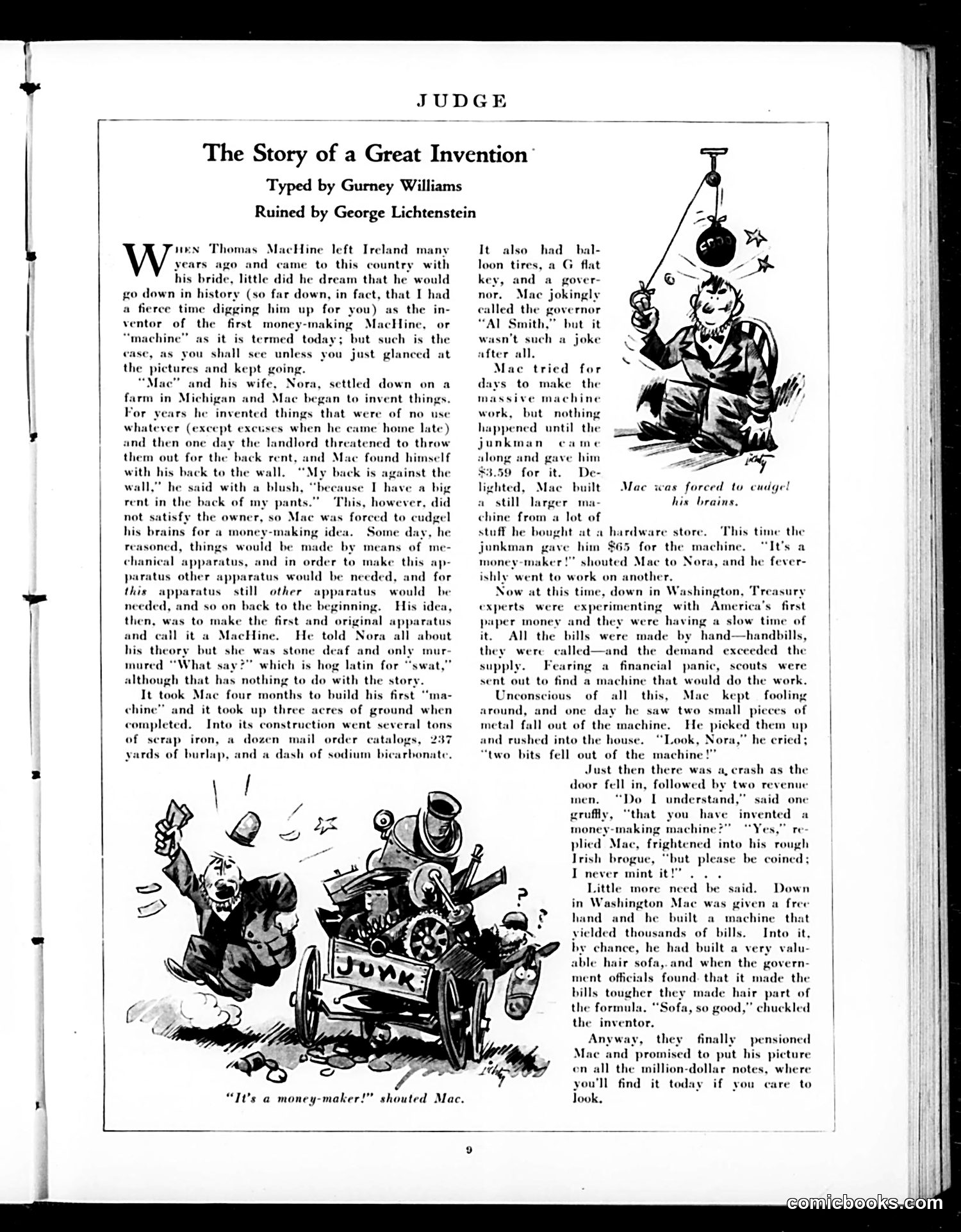
This is a satirical story illustrated with cartoons, lampooning both incompetent inventors and government bureaucracy. The protagonist, Thomas MacHine, an Irish immigrant, builds a useless four-month contraption he names the "MacHine." Through accident rather than design, it produces metal pieces he mistakes for currency. The satire targets multiple subjects: MacHine's bumbling incompetence; a reference to "Al Smith" (likely Governor Al Smith of New York, a contemporary political figure); and the Treasury Department's desperation during America's early paper money experiments. The revenue agents' arrival and MacHine's panicked Irish brogue ("I never mint it!") provide comedic relief. The punchline ridicules government credibility—they accept MacHine's nonsensical invention, reward him with a portrait on million-dollar bills, and somehow a hair sofa accidentally included in the machine supposedly improves bill durability. The entire narrative mocks both inventor-culture enthusiasm and governmental competence.
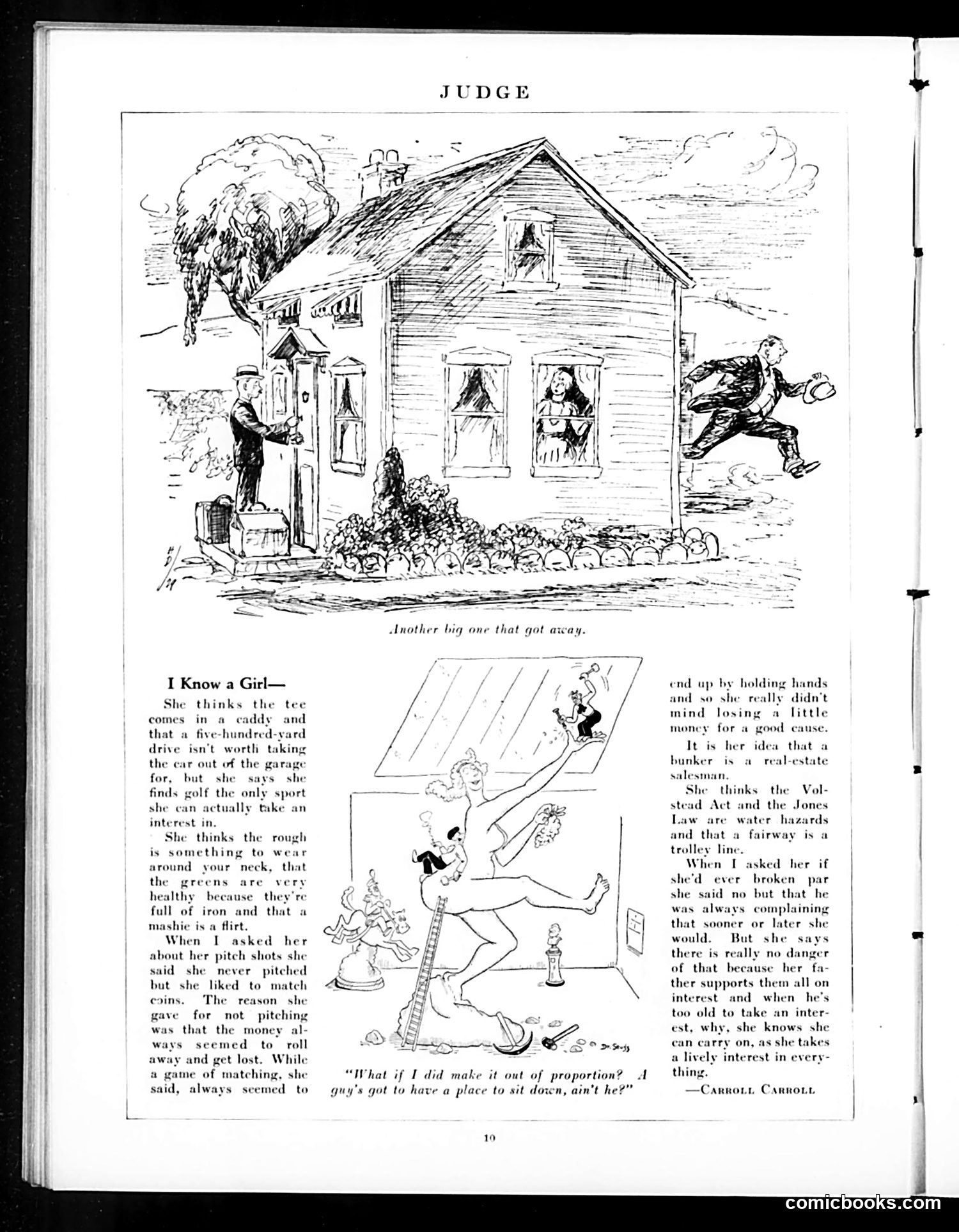
This page contains two separate humor pieces mocking gender stereotypes of the early 20th century. **Top cartoon:** A domestic scene where a man appears to be escaping from his house while a woman watches from windows. The caption "Another big one that got away" suggests she's comparing her husband to a golf fish that escaped—satirizing both marital discord and women's supposed obsession with golf. **"I Know a Girl" (bottom):** A lengthy comic poem by Carroll Carroll ridiculing a woman who claims to love golf but demonstrates complete ignorance of the sport. She confuses golf terminology (mashie = flirt, bunker = real-estate salesman), doesn't understand the rules, and apparently prefers matching coins. The satire targets women's athletic pretensions—she claims interest in golf purely for social reasons (hand-holding, losing money for "good causes"), not genuine sport. The underlying joke: women lack authentic interest in golf; they participate only for social validation and romance.
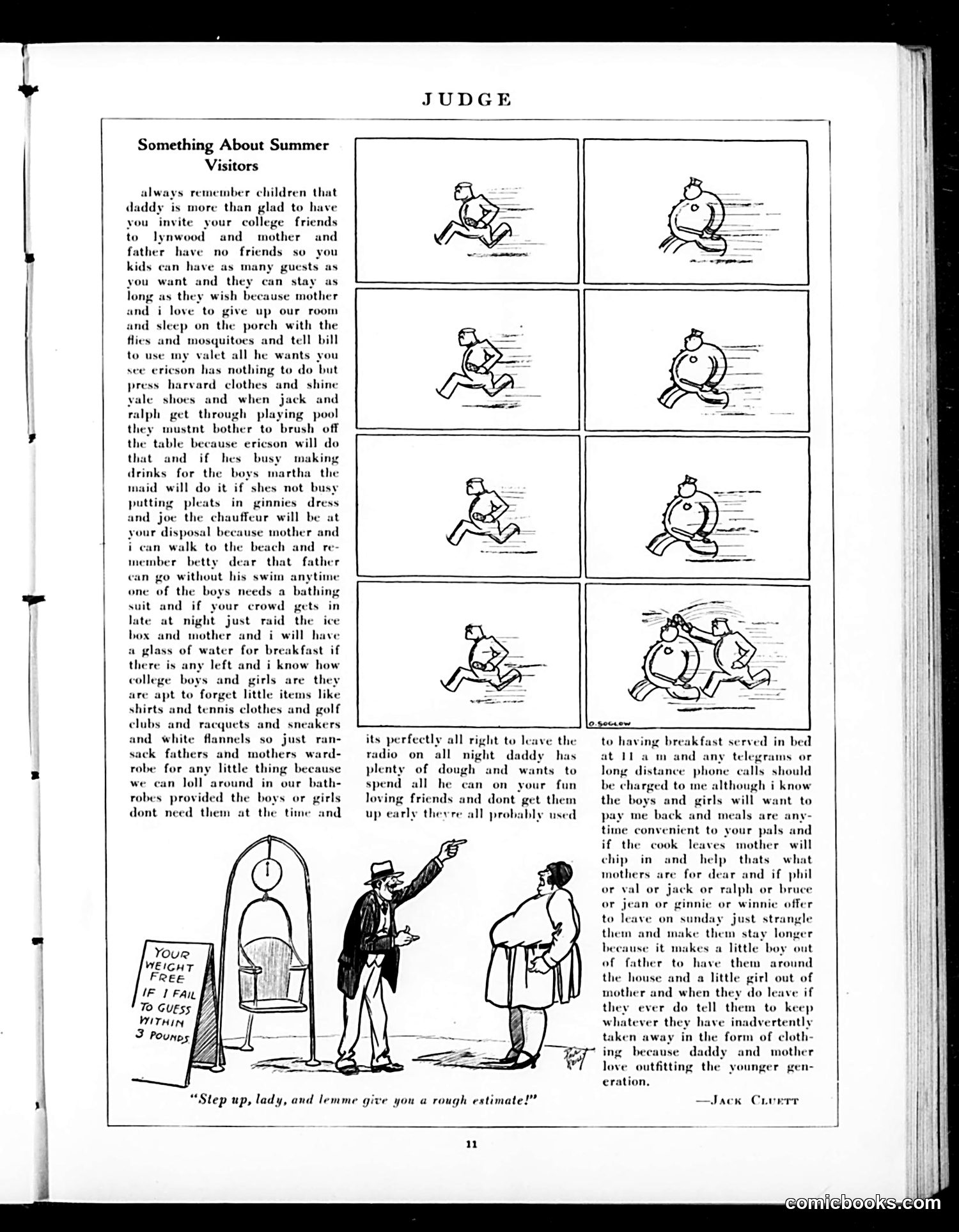
This page from *Judge* contains a satirical piece titled "Something About Summer Visitors" by Jack Cluett, paired with an unrelated cartoon about a weight-guessing carnival game. The main text is a sarcastic monologue from a parent ostensibly welcoming college-age guests for summer, but the exaggerated hospitality reveals parental exhaustion. The joke works through dramatic irony: the parent claims to happily sacrifice their bedroom, meals, servants' labor (referenced: "Ericson," Martha the maid, Joe the chauffeur), and money on the guests' entertainment—staying up late at the ice box, using the radio all night, making long-distance calls. The humor lies in how absurdly self-sacrificing this sounds, satirizing upper-middle-class parents' performative generosity toward their children's friends during the Jazz Age era when college visiting was fashionable. The accompanying cartoon shows a carnival weight-guesser at work, a separate piece of period humor unrelated to the text above. The satire captures early-20th-century anxieties about domestic disruption and class performance among affluent families.
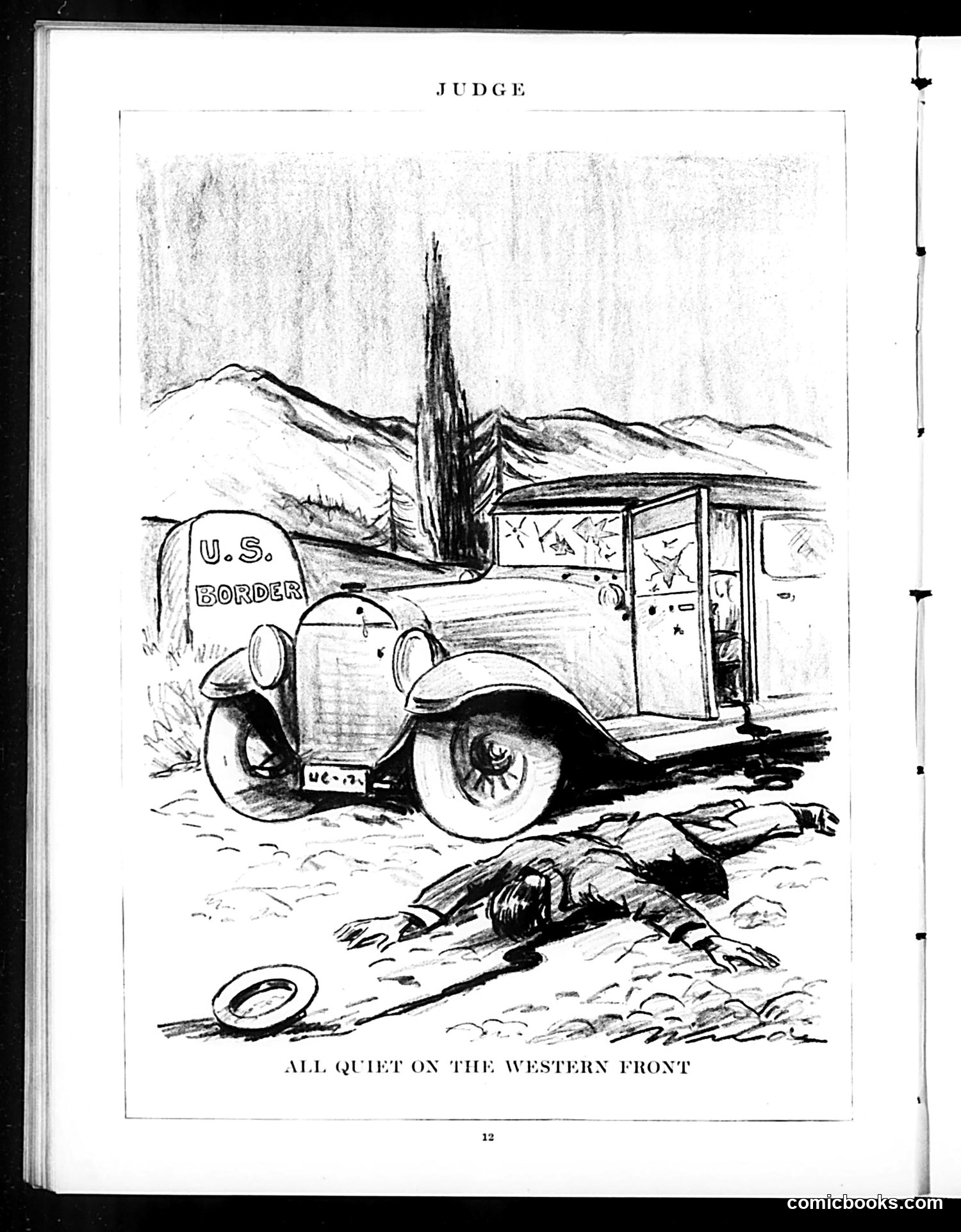
This Judge cartoon uses dark humor to comment on the U.S.-Mexico border conflict. The image shows a dead body lying in the desert near a U.S. Border patrol vehicle and building, with mountains in the background. The title "All Quiet on the Western Front" ironically references the famous WWI novel, suggesting that border violence is being downplayed or ignored by authorities despite evident casualties. The cartoon critiques the disconnect between official claims of border control and the actual human cost of border enforcement or cross-border activity. The dead figure and abandoned tire emphasize the serious violence occurring, contrasting sharply with the euphemistic phrase "all quiet," which typically means no conflict—thereby exposing this as false or propagandistic language.
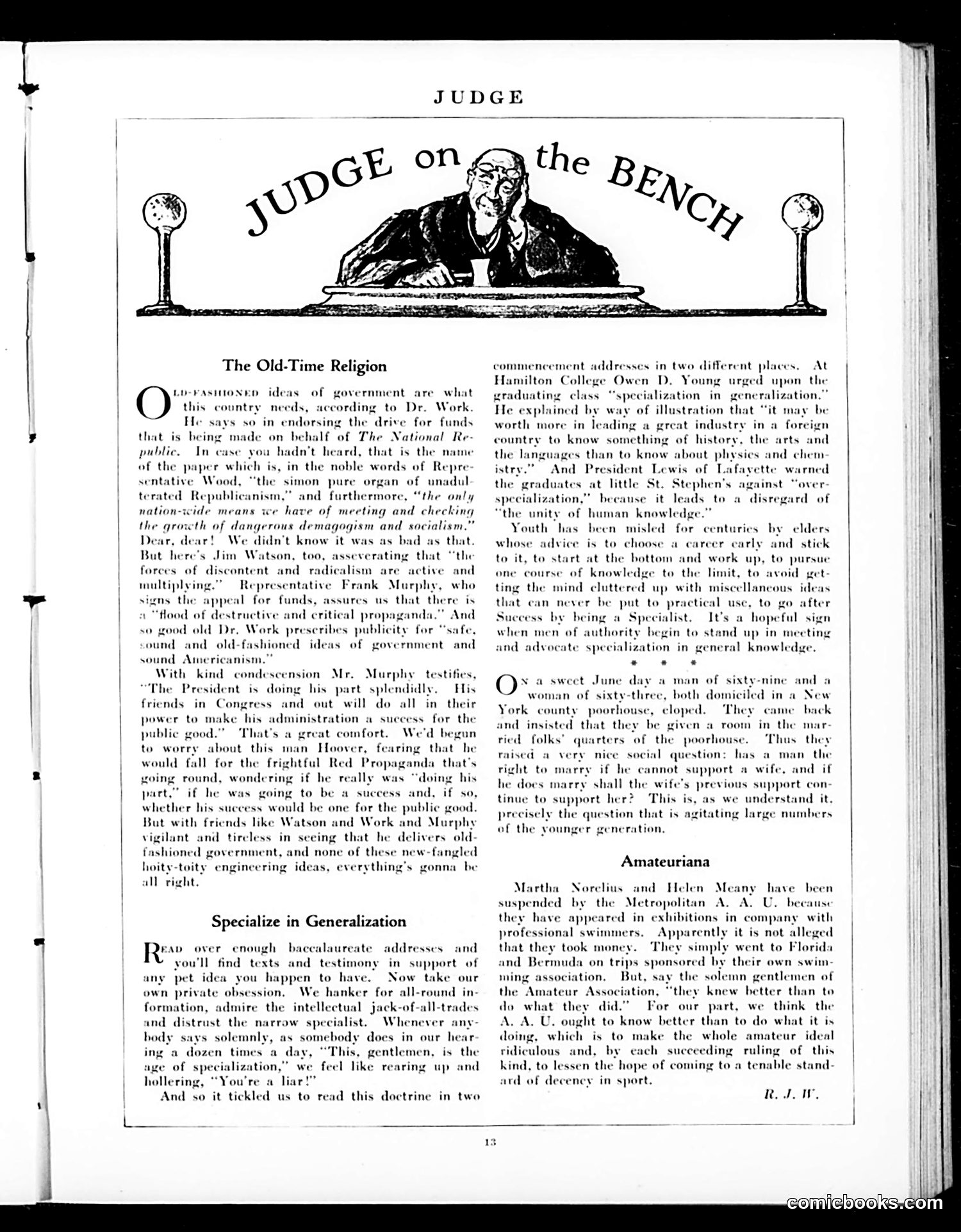
This page from Judge satirizes American conservative politics circa the late 1920s-early 1930s. **"The Old-Time Religion"** mocks Republican establishment figures—Dr. Work, Representative Frank Murphy, and Senator Jim Watson—who are raising funds for *The National Republic* publication. They justify this by claiming the country needs "old-fashioned ideas" to combat "dangerous demagogism and socialism." The satire suggests these politicians are using fear-mongering about radical threats to rally support for their traditionalist agenda, while presenting themselves as protective of America. **"Specialize in Generalization"** critiques contradictory advice given at college commencements. The Judge editor notes that speakers like Owen D. Young and President Lewis of St. Stephen's simultaneously urge students to pursue broad, general knowledge while society actually rewards narrow specialization. The satire highlights this generational hypocrisy and confusion. The **"Amateuriana"** section briefly addresses amateur athletic eligibility disputes, seemingly unrelated to the political content above.
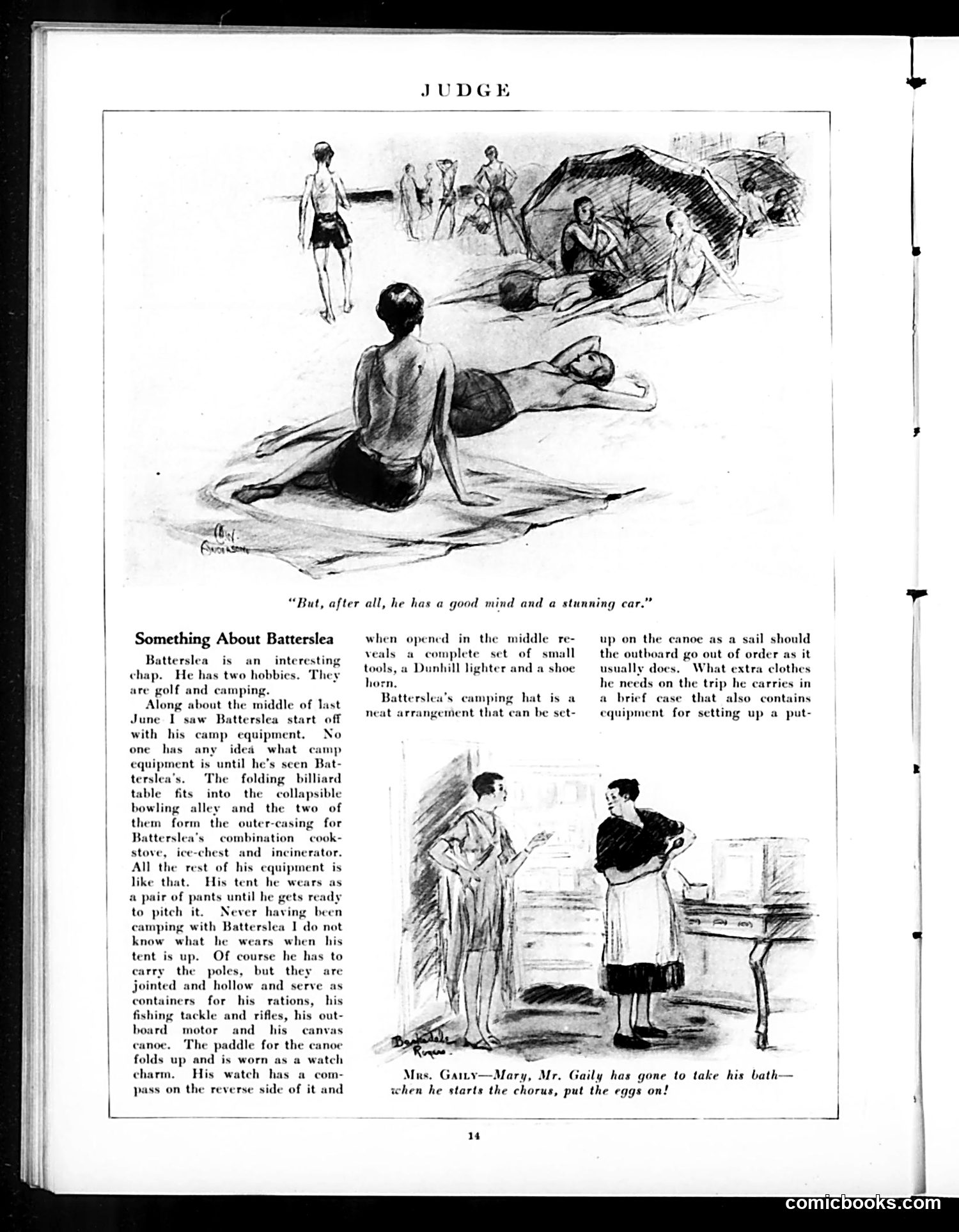
This page contains two separate humor pieces from *Judge* magazine. **Top illustration & caption**: A beach scene showing a shirtless man sitting alone while others enjoy the water. The caption—"But, after all, he has a good mind and a stunning car"—suggests social satire about male attractiveness and desirability. The joke appears to be consoling the unattractive man by noting his non-physical attributes. **"Something About Batterslea" article**: A humorous profile of an obsessively efficient camper who has designed multipurpose camping gear—a folding billiard table that doubles as a bowel-ing alley and tent casing; a watch with a compass; hollow tent poles serving as food containers; a paddle worn as a watch charm. The satire mocks over-engineered gadgetry and the type of person who over-complicates leisure activities with elaborate contraptions. **Bottom cartoon**: A domestic scene where a wife (Mrs. Gaily) instructs her maid Mary to put eggs on when Mr. Gaily starts singing in his bath—implied mockery of his terrible singing voice. All three pieces are light, observational humor typical of early-20th-century American magazines.
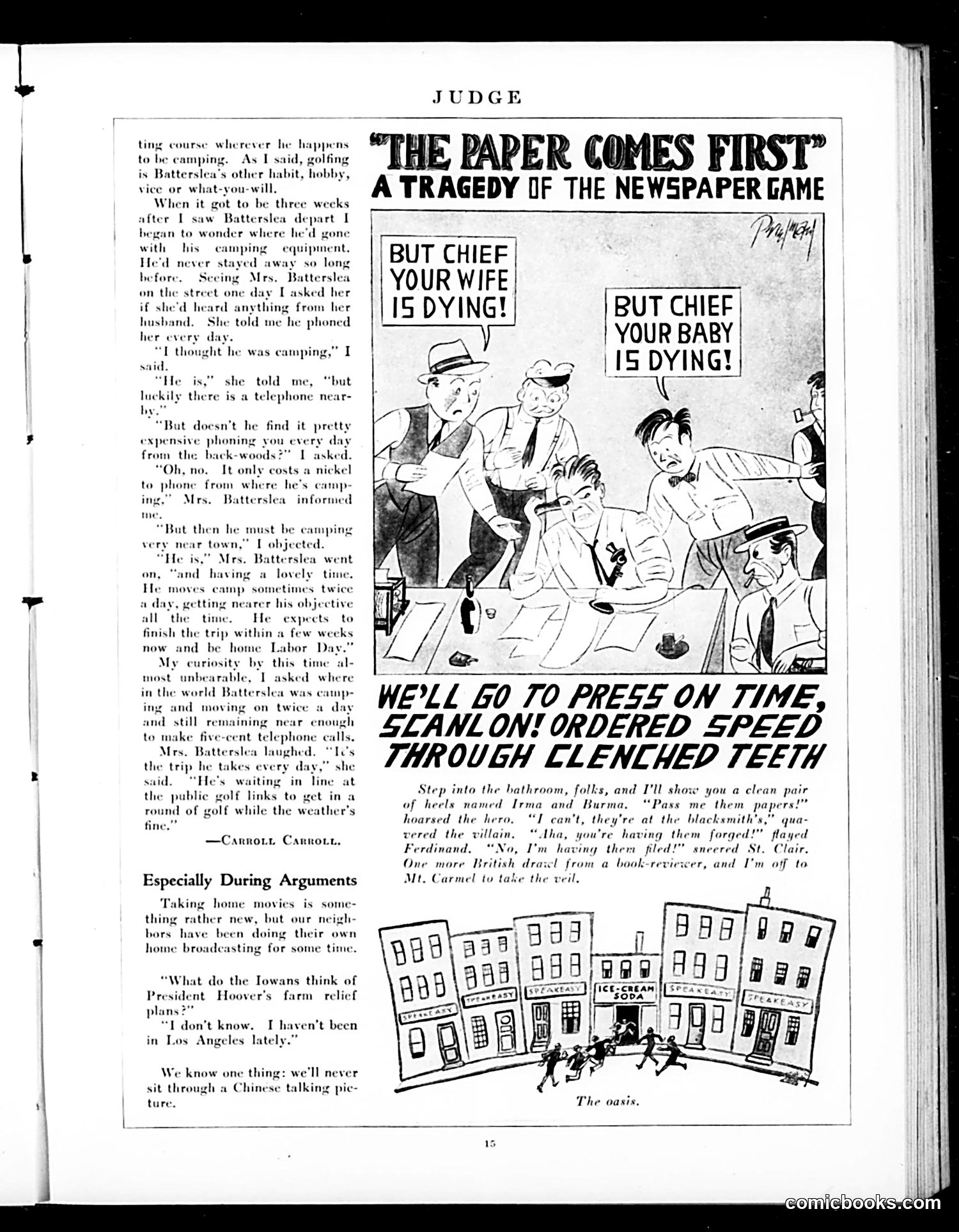
The main cartoon mocks the stereotype of a newspaper editor so obsessed with meeting deadlines that he ignores human tragedy. Two men inform the chief editor of catastrophic personal emergencies—his wife dying, his baby dying—yet he responds with only frustration about printing delays, demanding the paper "go to press on time" with "clenched teeth." The joke satirizes the newspaper industry's legendary ruthlessness and misplaced priorities: getting the story/edition out matters more than basic human compassion. The caption "The Paper Comes First" makes this explicit. Below, a subtitle references melodramatic "newspaper game" stories where characters argue about documents ("Pass me them papers!"), suggesting newspapers themselves promote sensational fiction about their own importance. The satire targets both the industry's actual callousness and popular romanticization of newspaper work as supremely vital. This reflects real tensions in 1920s-30s journalism: competitive, deadline-driven, sometimes ethically questionable.
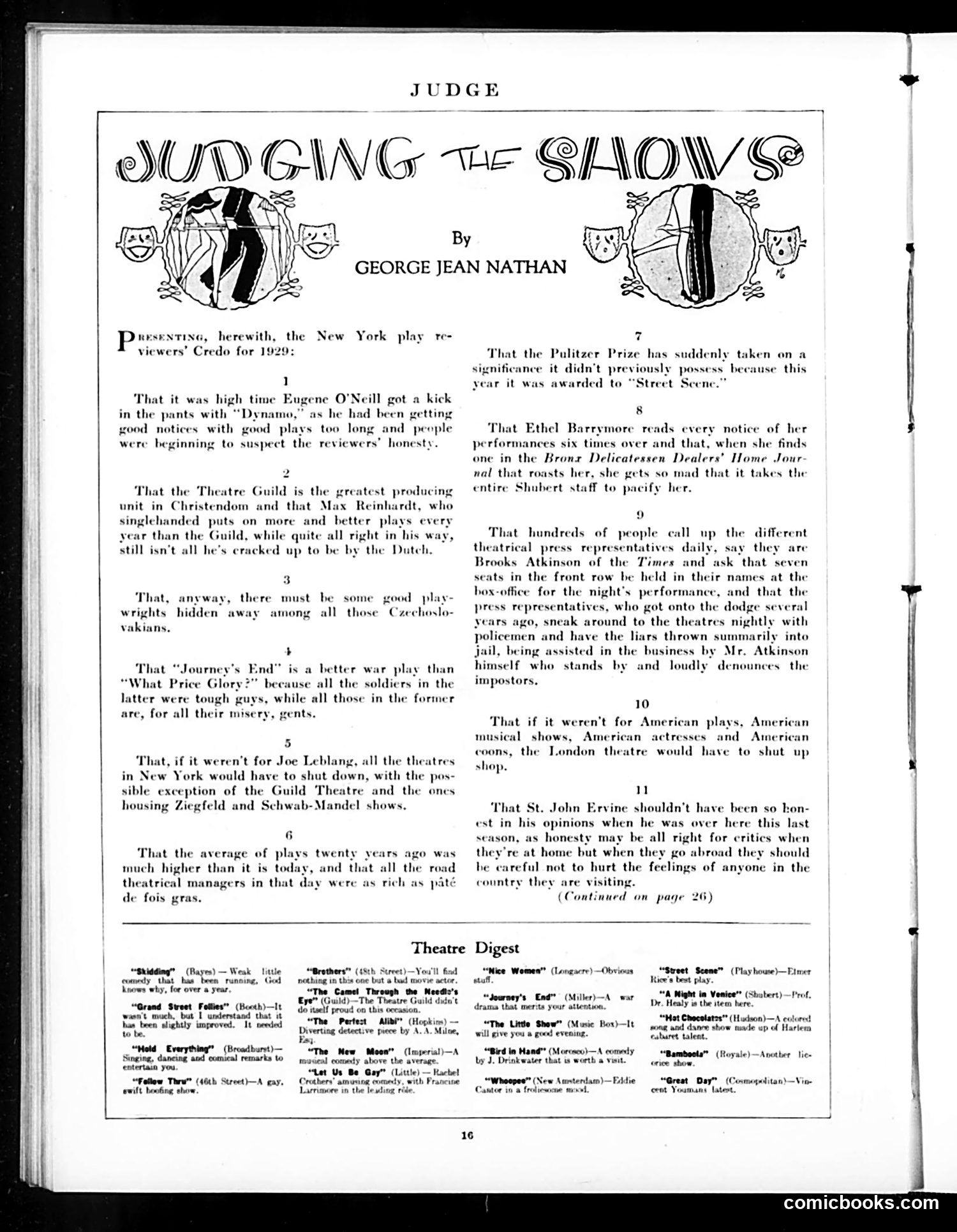
This page satirizes New York theater critics' perceived hypocrisy and inconsistency in 1929. George Jean Nathan presents a mock "credo" of theater reviewers' unstated biases. The satire targets several absurdities: critics damaging successful playwrights like Eugene O'Neill out of jealousy; arbitrarily praising the Theatre Guild while dismissing equally talented Max Reinhardt; favoring obscure foreign plays; and applying double standards (praising "Journey's End" while dismissing "What Price Glory" for identical qualities). Nathan also ridicules the influence of theater gatekeepers—particularly Joe Leblang (a ticket broker) and critic Brooks Atkinson—and mocks the theater world's pretensions, including Ethel Barrymore's vanity and fraudulent ticket requests. The final jabs criticize the Pulitzer Prize's sudden importance and British critic St. John Ervine's candor, suggesting critics should be less honest abroad to protect national pride. The accompanying "Theatre Digest" provides contemporary show reviews.
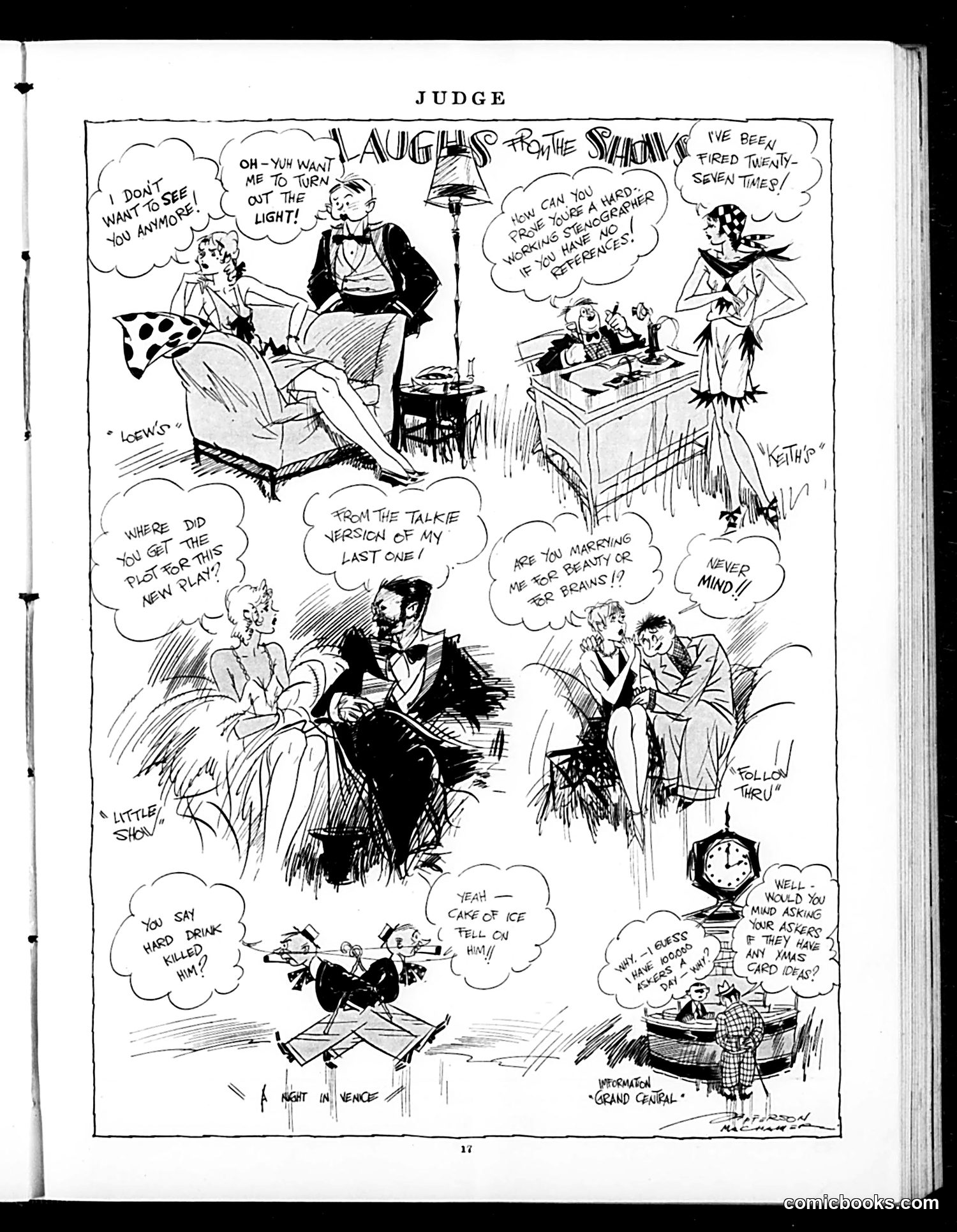
This multi-panel cartoon satirizes the early "talking picture" (sound film) era, likely from the late 1920s. The joke mocks how theater actors and playwrights were scrambling to adapt their work for cinema's new sound technology. The panels show theatrical figures discussing converting stage productions to "talkie" films. References include adapting plays ("from the talkie version of my last one"), concerns about how dialogue translates to screen, and the challenges of casting stage actors for film roles. The satire targets the entertainment industry's chaos during this technological transition—stage performers worried about relevance, playwrights confused about adaptation requirements, and the general upheaval as cinema threatened traditional theater's dominance. The exaggerated character reactions convey the anxiety and absurdity surrounding this major shift in entertainment.
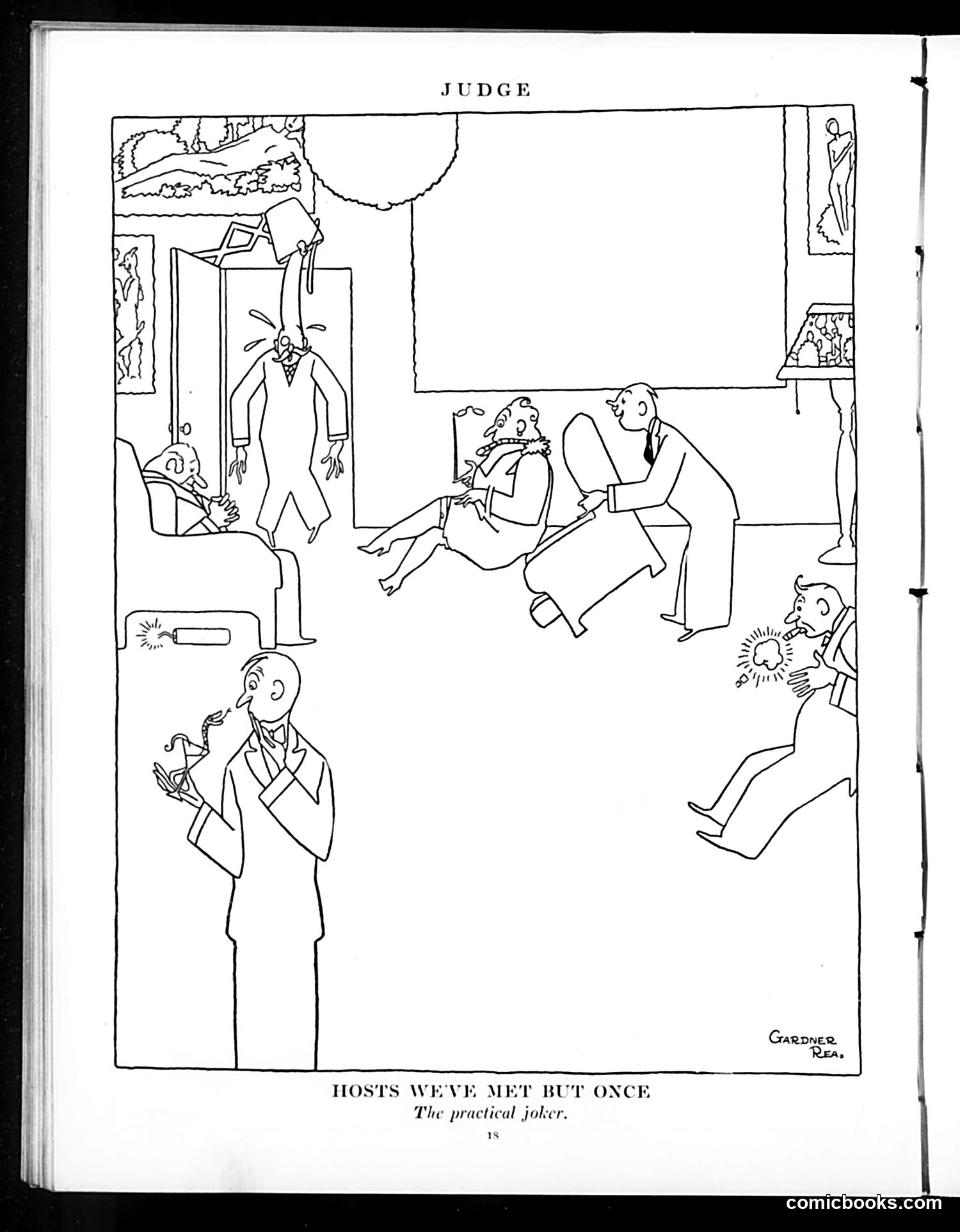
This cartoon satirizes the awkward social dynamics of encountering someone briefly who then subjects you to elaborate pranks. The scene depicts a courtroom or formal setting where a man labeled "the practical joker" (shown at bottom left with a mischievous expression) has apparently staged an absurd situation—possibly a fake legal proceeding or elaborate hoax—to torment people he's met only casually. The other figures appear bewildered and distressed by the chaos unfolding around them. The satire targets a particular social type: someone who uses practical jokes as an excuse to harass acquaintances, exploiting minimal prior relationship to impose unwanted humiliation. The Judge magazine's audience would recognize this as mockery of an annoying social phenomenon—the pest who oversteps boundaries through "humor."
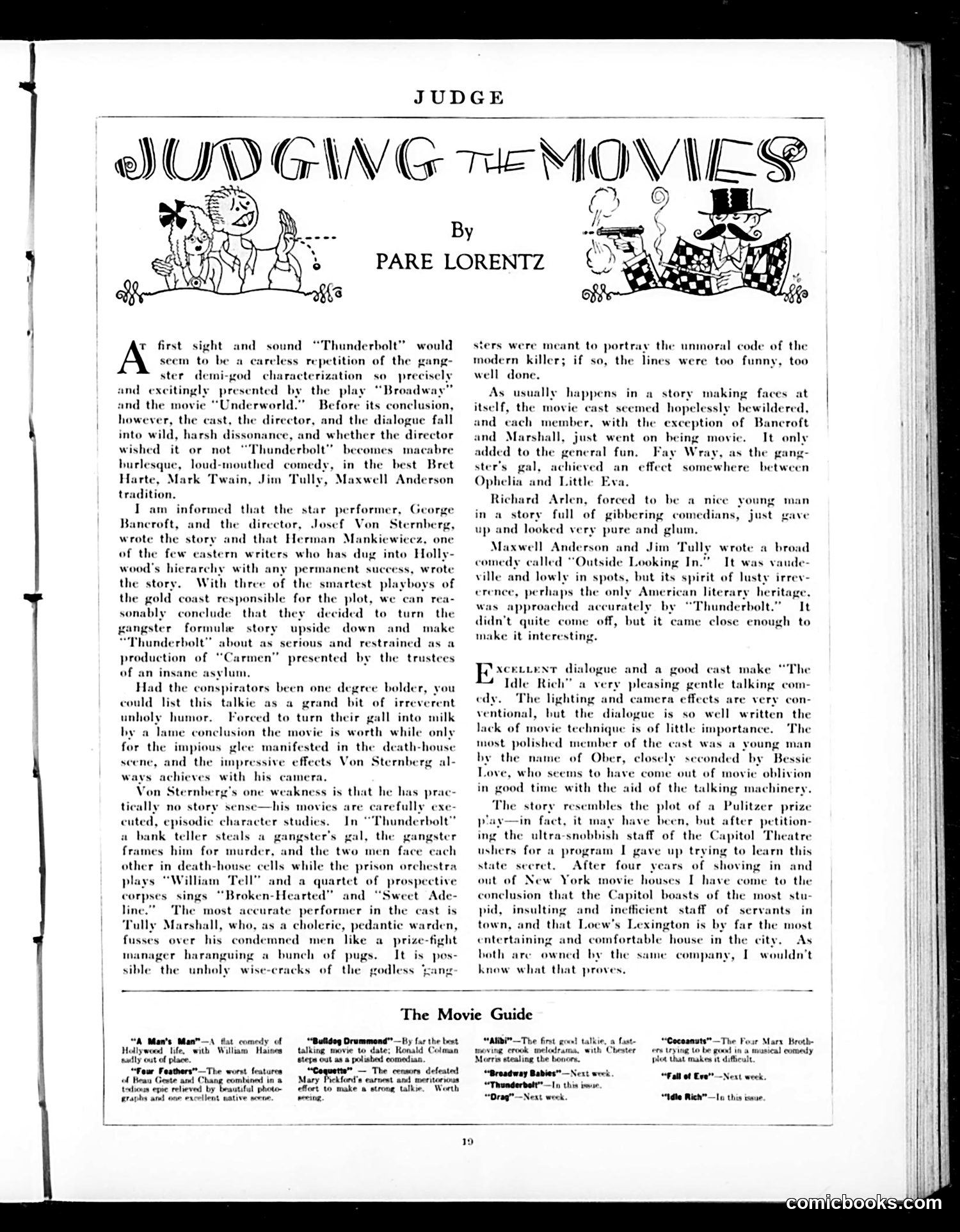
This is a theater review column by Pare Lorentz critiquing contemporary talking pictures, not a political cartoon. The page discusses two films: **"Thunderbolt"** — a gangster movie starring George Bancroft and directed by Josef Von Sternberg. The reviewer criticizes it as an unintentional comedy that tries to seriously adapt the gangster-film formula (referencing earlier hits "Broadway" and "Underworld") but undermines itself with humorous dialogue and absurd plot elements. The reviewer compares its tone to a serious production of Bizet's opera "Carmen" staged by an asylum. **"The Idle Rich"** — praised as a well-written talking comedy with good dialogue compensating for conventional cinematography. The column reflects 1920s film criticism's fascination with the new "talking picture" technology and contemporary literary adaptations. No political satire is present; this is straightforward entertainment journalism.
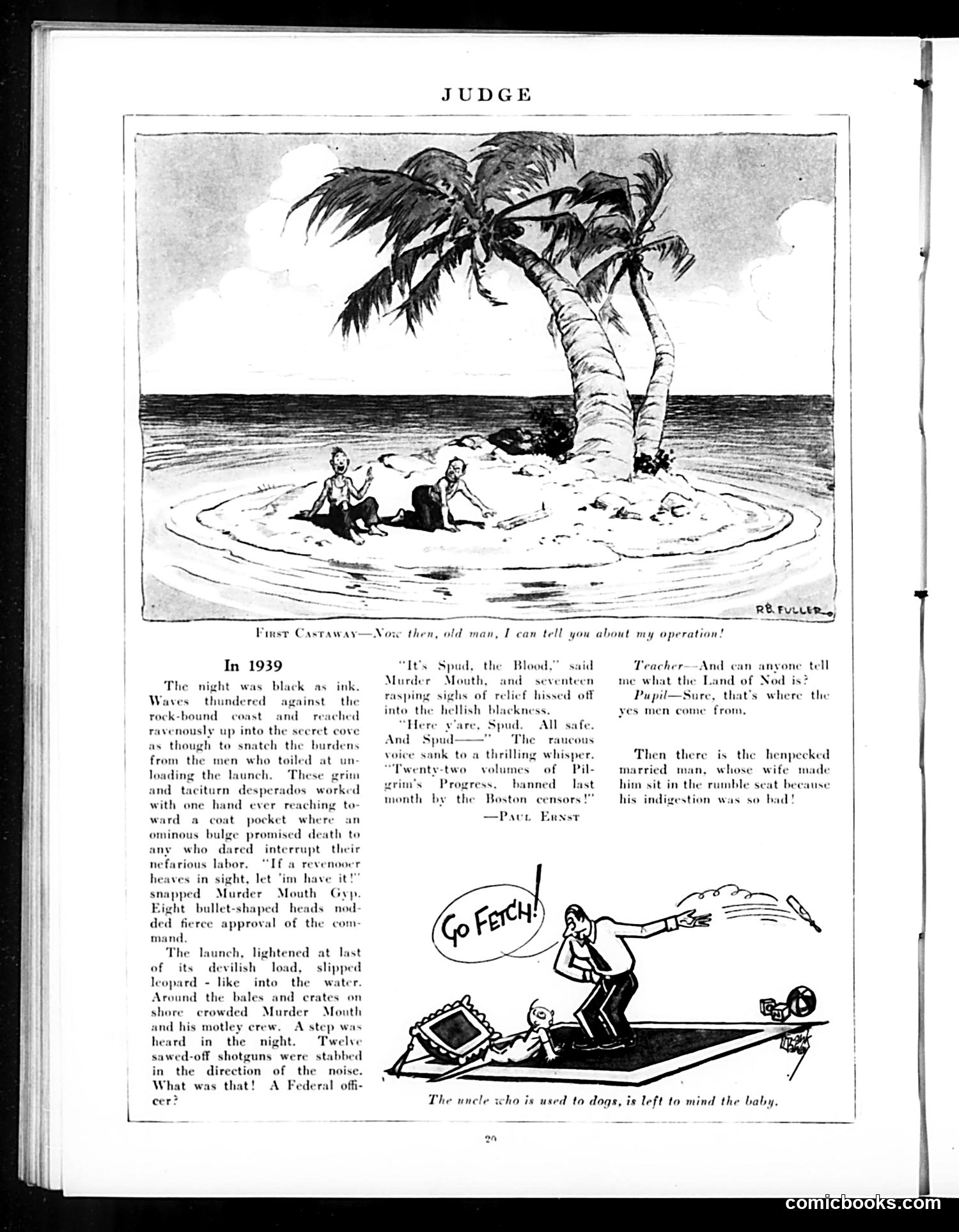
This page contains two separate satirical pieces: **Top cartoon ("First Castaway"):** Depicts Prohibition-era smugglers unloading contraband ("devilish load") at a cove in 1939. The gang leader "Murder Mouth Gyp" and his men nervously expect federal revenue agents ("revenooers"). The joke culminates when a feared interruption turns out to be "Spud," another smuggler—prompting relieved wisecracks about censorship (the Boston censors had banned volumes of Pilgrim's Progress, a curious non-sequitur suggesting wartime anxiety about control). **Bottom cartoons:** Two unrelated classroom jokes—one about the "Land of Nod" (a biblical sleep reference, with the punchline that yes-men come from there), and another about a henpecked husband forced into the rumble seat due to indigestion, concluding with a non-sequitur about an uncle minding a baby. The page mixes Prohibition satire with domestic humor typical of Judge's content. The disconnected nature suggests this is a general humor/joke compilation rather than unified commentary.
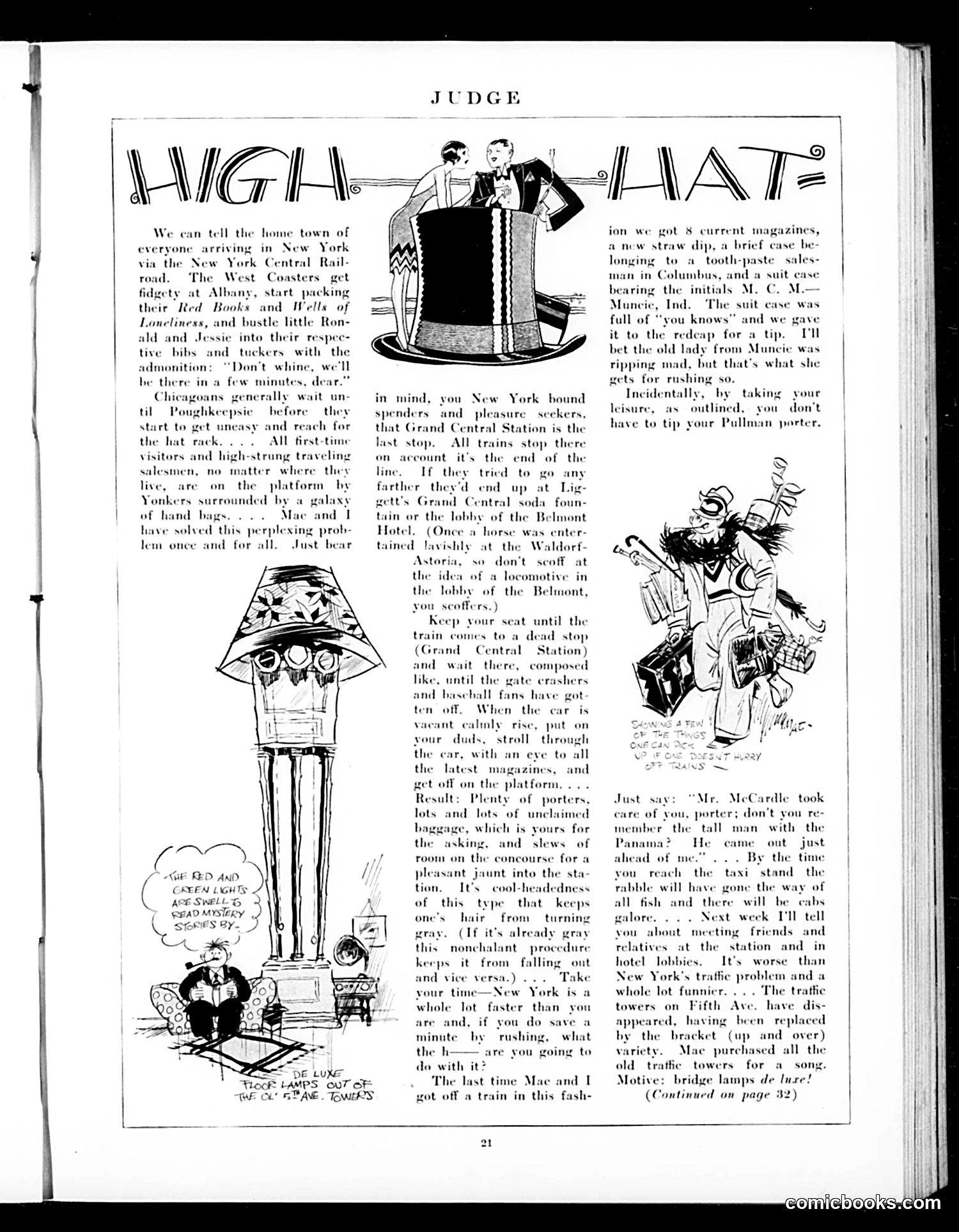
This satirical advice column mocks nouveau-riche American travelers arriving in New York City via the New York Central Railroad. The author (likely "Mae" and an unnamed male writer) ridicules different regions' travelers: West Coasters fussily pack at Albany; Chicagoans panic at Poughkeepsie; first-timers overpack luggage at Grand Central Station. The humor targets travelers' anxious, status-conscious behavior—rushing off trains, tipping excessively, displaying nervous energy. The cartoons illustrate these types: a fashionably dressed woman with excessive luggage; a frantically gesturing porter laden with belongings. The satire's point: sophisticated New Yorkers find leisure and composure superior to frantic rushing. By staying seated calmly, one gains unclaimed luggage and avoids tipping porters unnecessarily. The joke is that "taking your time" in New York—seemingly counterintuitive in a fast-paced city—actually demonstrates superior class and sophistication. The column gently mocks American provincial pretension and travel anxiety.
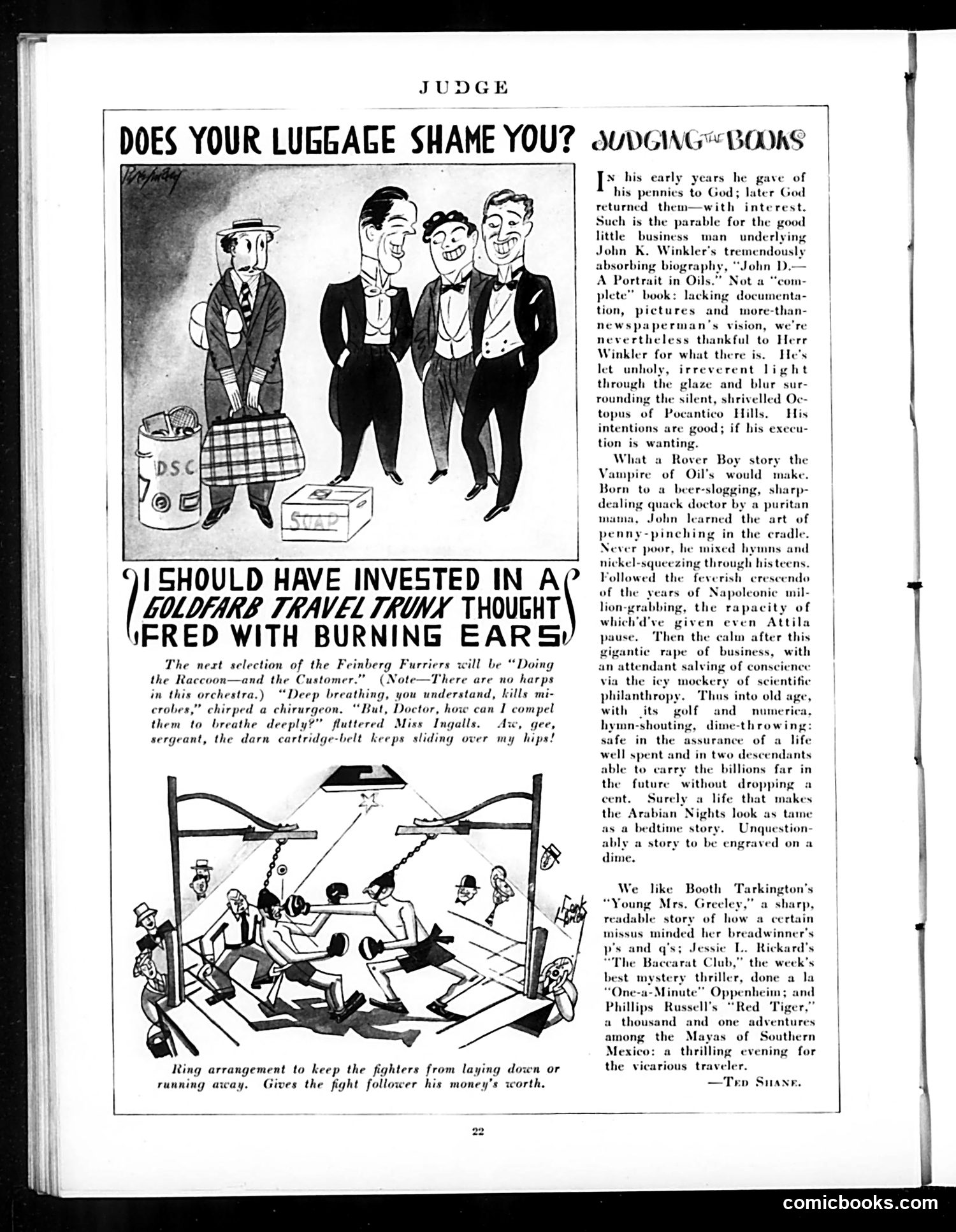
The top cartoon mocks travelers' embarrassment about shabby luggage. A well-dressed man with worn, patched baggage stands apart from three stylish gentlemen—the visual joke being that inferior luggage marks one's social status. The caption "Should Have Invested in a Goldiard Travel Trunk" advertises a solution to this class anxiety, satirizing consumer culture and the materialism of the era. Below are vignette jokes: one about a doctor's illogical breathing advice, another about a sergeant's poorly-fitting cartridge belt, and a boxing-ring setup to prevent fighters from escaping—all absurdist humor typical of Judge's style. The "Judging Books" section reviews John K. Winkler's biography of an oil magnate (appears to reference Rockefeller, termed "Vampire of Oil"), along with other contemporary books. The reviews employ irreverent, flowery prose characteristic of the magazine's literary criticism.
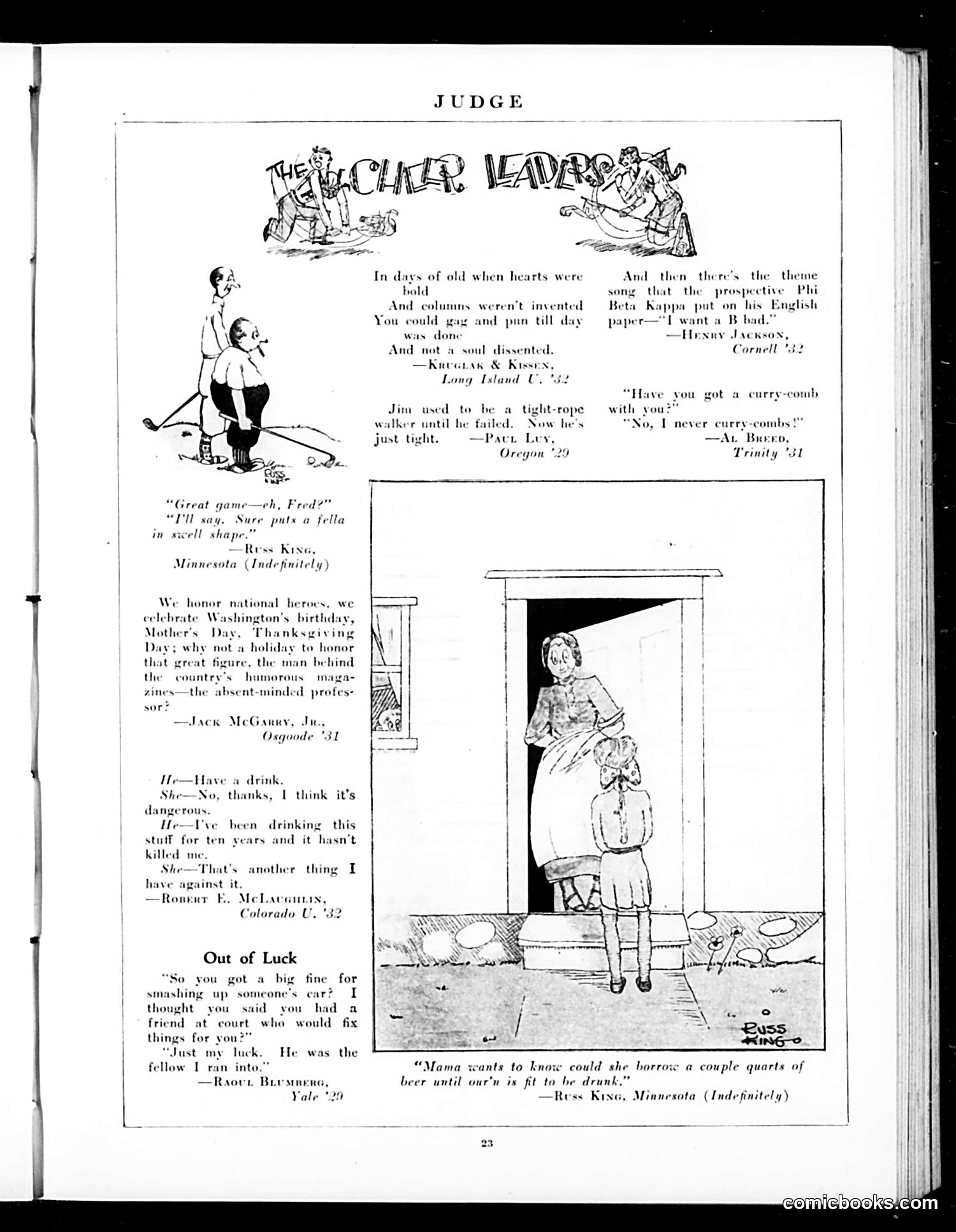
This page collects humorous quotes and quips submitted by college students (identified by school and year), a common Judge feature. The cartoons are light social satire rather than political commentary. **Main cartoon (bottom right)**: A woman and child stand at a neighbor's door requesting to borrow beer until "our'n is fit to be drunk"—satirizing Prohibition-era hypocrisy, when alcohol was illegal but widely consumed anyway. The humor relies on the absurdity of the excuse and the matter-of-fact delivery. **Other content**: Student submissions mock: - Drinking culture ("tight-rope walker until he failed. Now he's just tight") - Academic pretension (Phi Beta Kappa students writing "I want a B bad") - Dating etiquette and casual insults The page reflects 1920s-early 1930s college humor and Prohibition-era drinking culture, where the contradiction between legal prohibition and actual consumption provided regular comedic fodder.
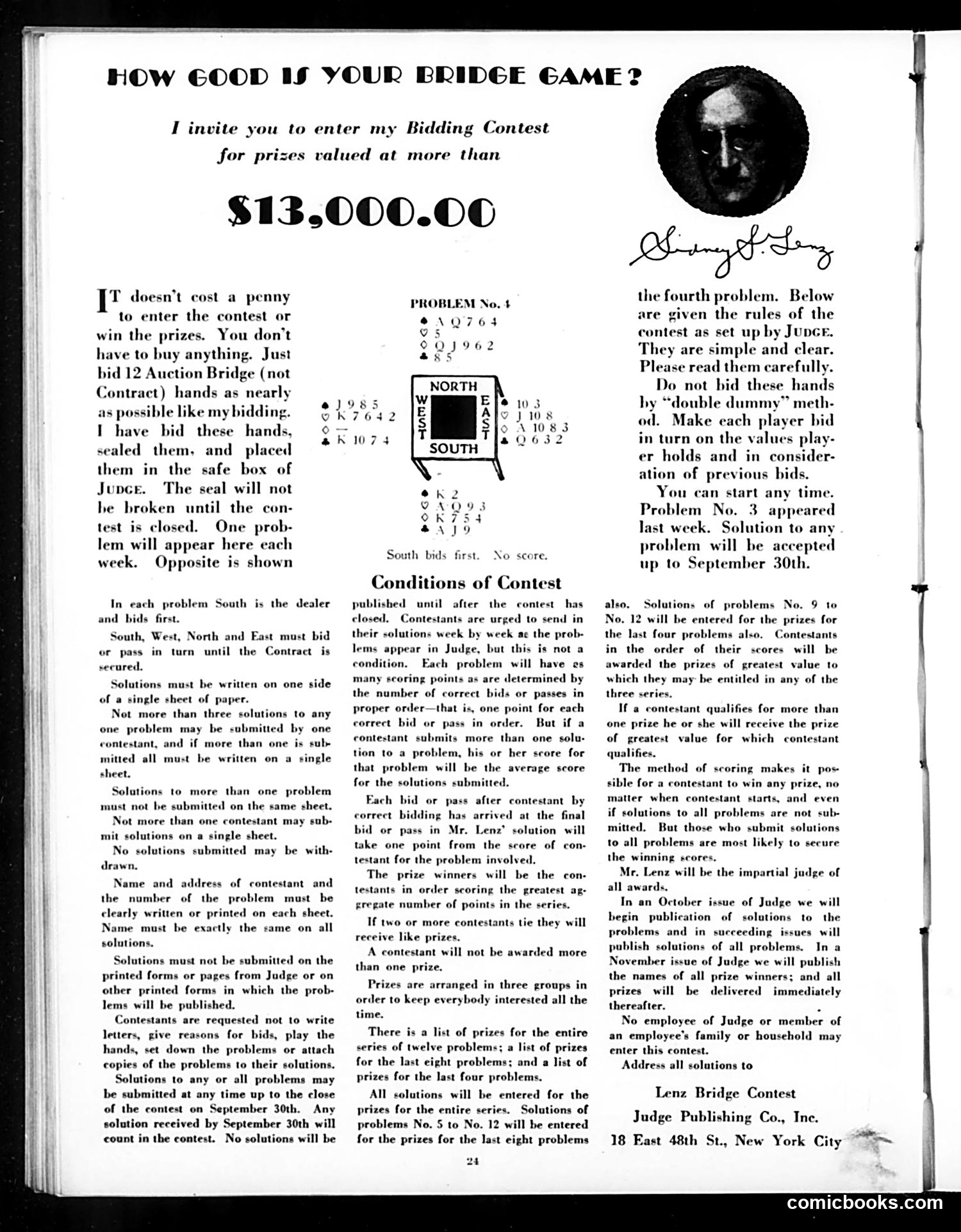
This page is primarily a **contest advertisement**, not a political cartoon. It announces a bridge bidding competition sponsored by Judge magazine, offering $13,000 in prizes. The contest invites readers to bid on twelve Auction Bridge hands "as nearly as possible" like bids sealed by someone identified only as "JUDGE" (shown in a circular photo). Contestants submit solutions weekly as problems appear in the magazine through September 30th. The page includes the first bridge problem with card hands displayed and detailed contest rules. Notably, it references "Mr. Lenz' solution," suggesting the contest is judged against bids by a notable bridge authority of the era—likely **Ely Culbertson** or another prominent bridge expert of the 1920s-30s period. This represents Judge magazine's use of advertising space for reader engagement contests, a common practice in early 20th-century publications.
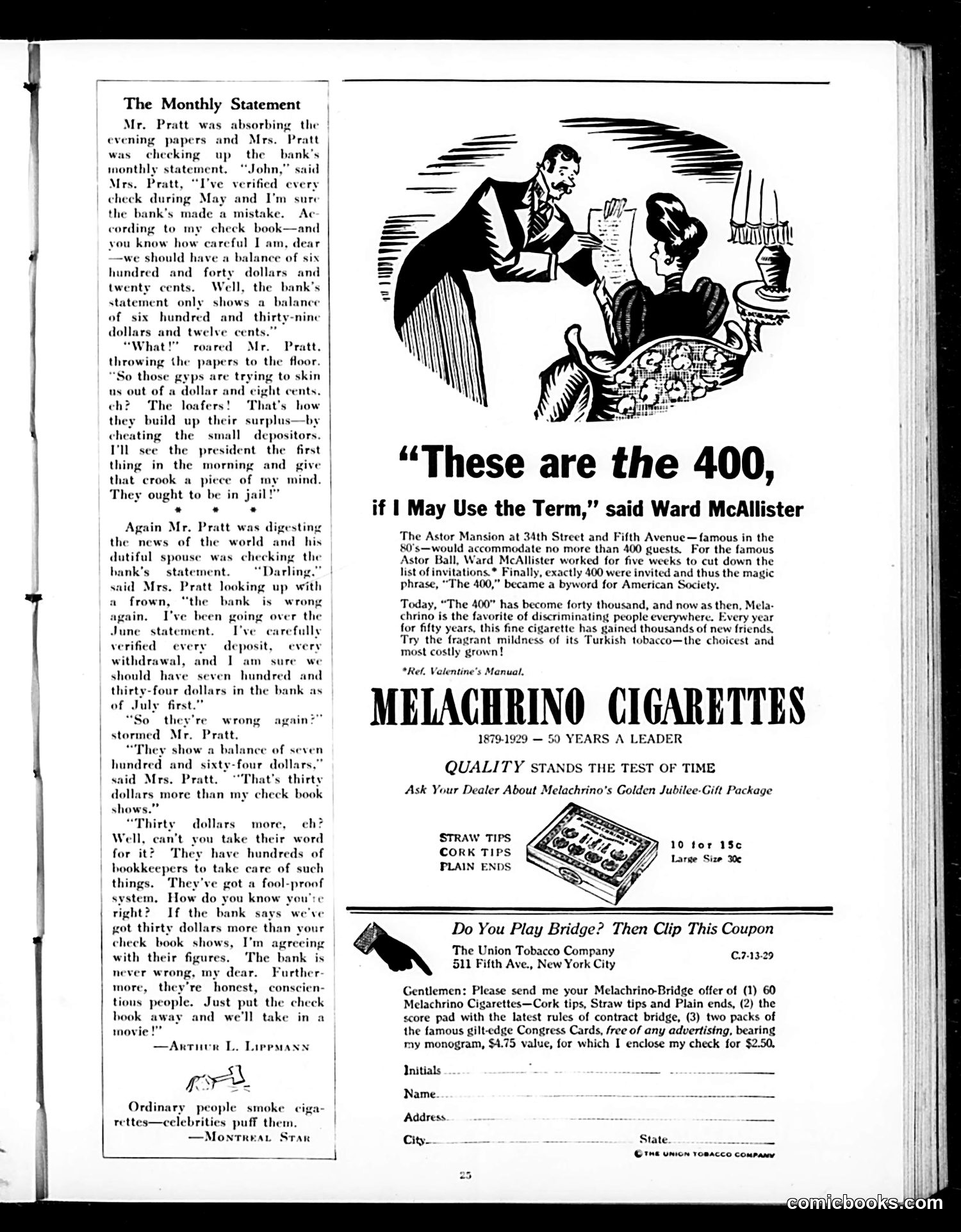
This story satirizes early 20th-century banking practices and marital dynamics. Mr. and Mrs. Pratt discover a $1.08 discrepancy in their bank statement—Mrs. Pratt's careful record-keeping shows *less* money than the bank claims. Mr. Pratt assumes the bank must be right, dismissing his wife's meticulous accounting as irrelevant against institutional authority. The joke mocks male arrogance and blind trust in institutions: he refuses to question "honest, conscientious people" with "a fool-proof system," despite his wife's evidence of error. The accompanying advertisement for Melachrino Cigarettes references Ward McAllister and New York's exclusive "400"—the social elite who could attend Mrs. Astor's famous balls. The ad claims the brand has maintained prestige for fifty years, positioning it as a luxury product for discriminating society.
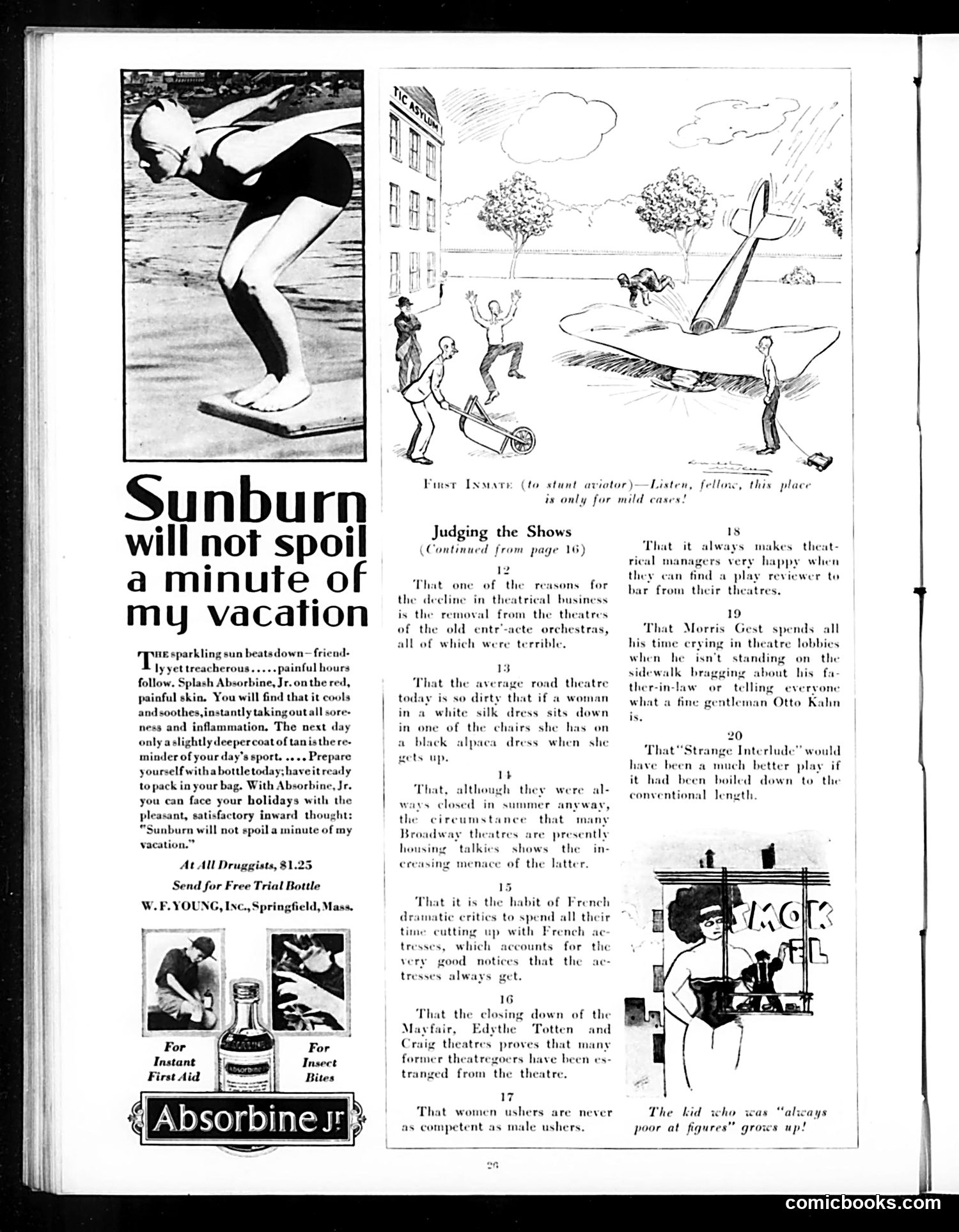
This page combines advertising with theatrical satire. The left side promotes **Absorbine Jr.**, a patent medicine for sunburn relief, featuring a photograph of a swimmer and humorous copy about vacation preparation. The right side continues a column titled "Judging the Shows," offering numbered observations (12-20) mocking Broadway and theater culture. The satire targets: - **Theater conditions**: dirty venues, removal of orchestra entr'acte music, Broadway's financial decline - **French theater critics**: portrayed as spending time with actresses rather than serious criticism - **Specific figures**: Morris Gest (theatrical producer) for excessive emotional displays and name-dropping his father-in-law Otto Kahn - **Theater management**: their happiness when critics are banned - **Gender bias**: women ushers deemed incompetent compared to men - **Eugene O'Neill's "Strange Interlude"**: criticized for being excessively long The small cartoon at bottom right, captioned about a child "always poor at figures" growing up, appears unrelated—likely an advertisement or separate joke.
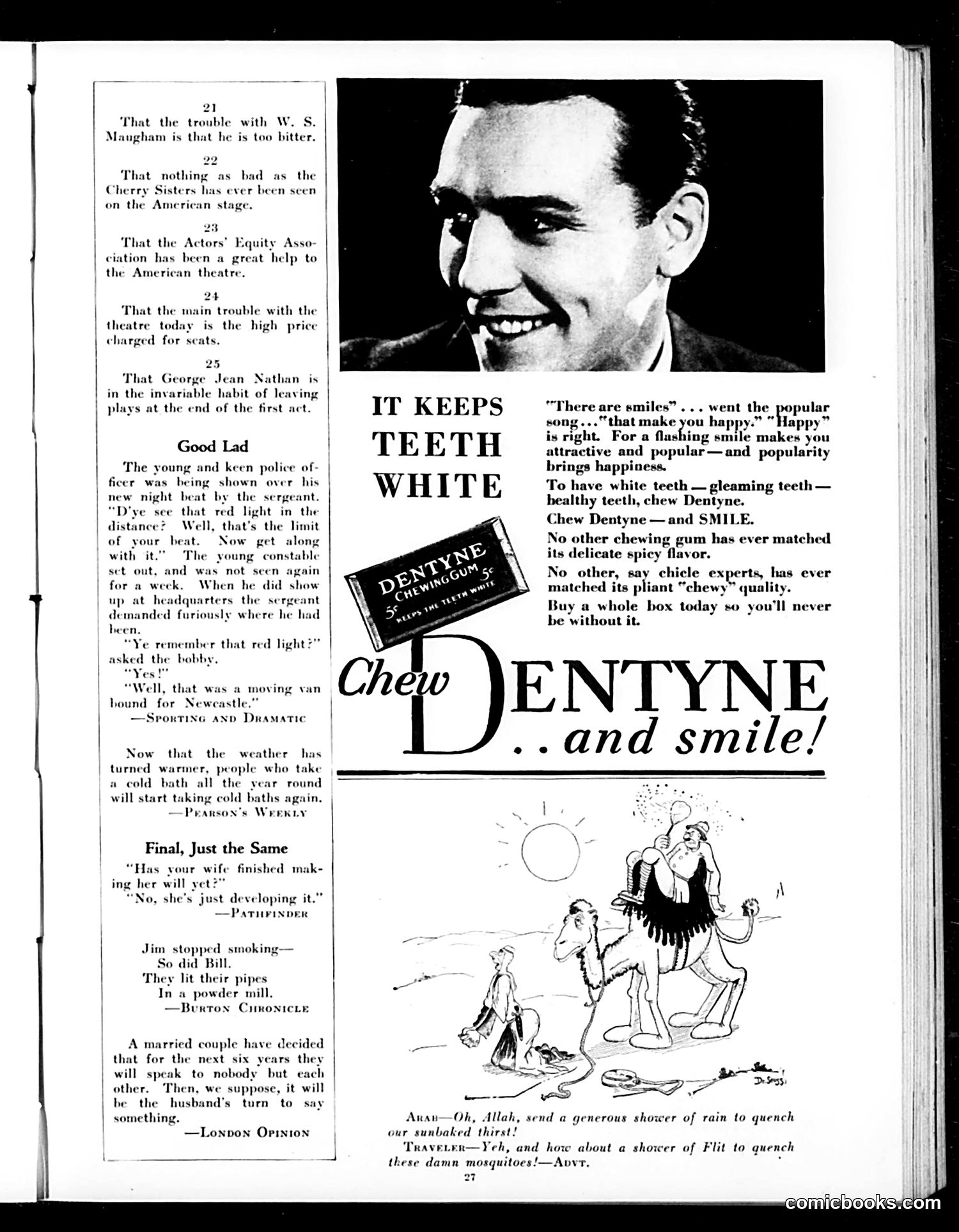
This page mixes short satirical comments with advertising. The left column contains numbered quips about theater—mocking W.S. Maugham's bitterness, praising the Actors' Equity Association, and criticizing high ticket prices. These reflect early 20th-century theatrical debates. The "Good Lad" anecdote jokes about a naive police officer who mistakes a moving van's red light for a permanent traffic signal at Newcastle—mild humor about misunderstanding. The main content, however, is a **Dentyne chewing gum advertisement** featuring a photograph of a smiling man and cartoon imagery of beach vacationers. The ad promises that white teeth and smiling make you "attractive and popular," linking dental hygiene to happiness and social success—typical advertising strategy of the era. The bottom section includes comic snippets and another advertisement for "Flit" insecticide, using a desert traveler joke to promote mosquito spray. This is primarily an **advertising-heavy page** with light satirical humor framing the commercial content.
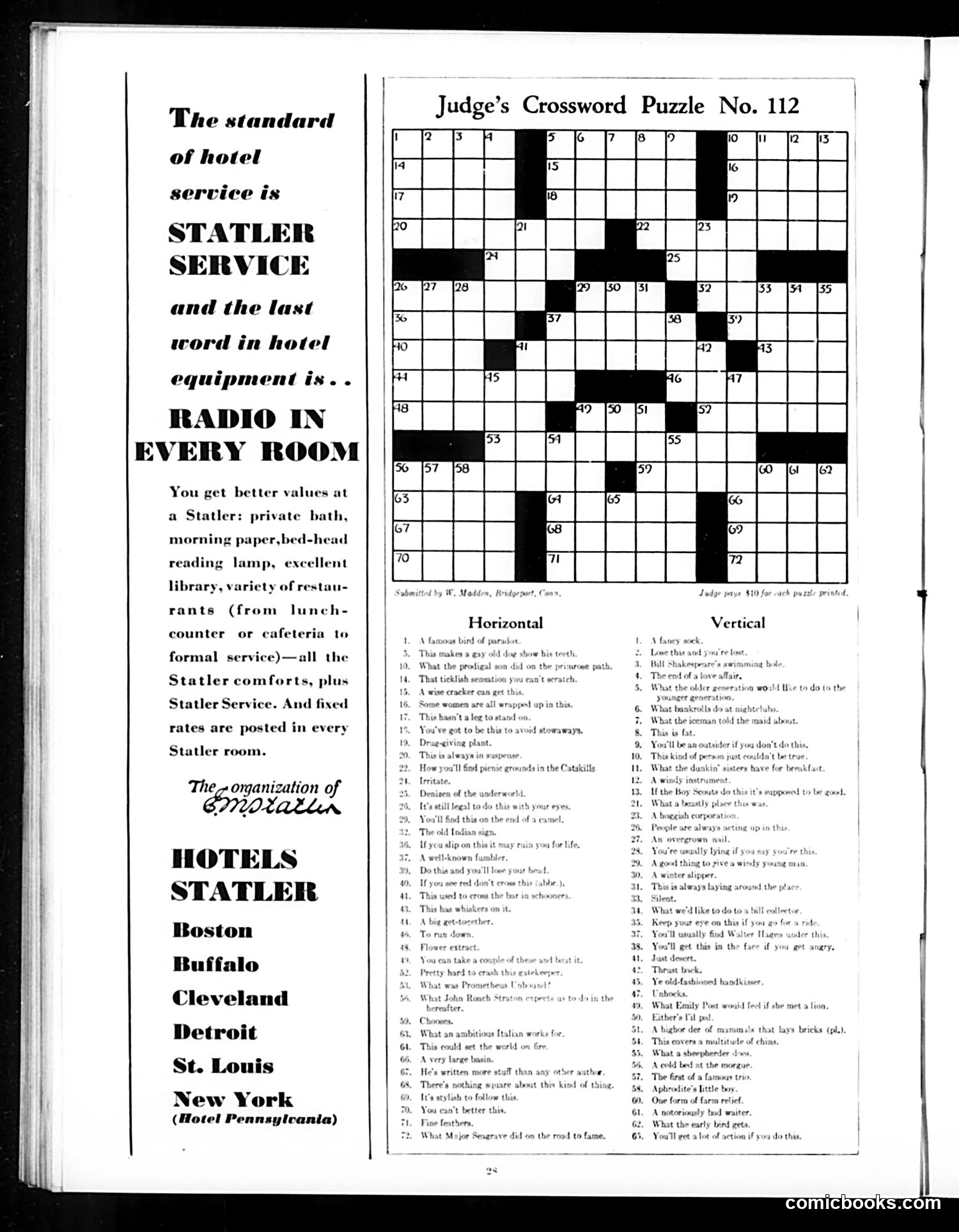
This page is primarily **advertising disguised as entertainment**. The dominant content is a crossword puzzle (#112) that serves as a vehicle for promoting the Statler Hotel chain. The left side contains a full advertisement for Statler Hotels, listing their locations (Boston, Buffalo, Cleveland, Detroit, St. Louis, New York) and emphasizing luxury amenities: private baths, radios in rooms, reading lamps, restaurants, and consistent service standards. This was significant in the 1920s-30s era when such features represented modern hotel luxury. The crossword puzzle itself likely contains hotel- and service-related clues and answers, further embedding the brand messaging into the editorial content—a clever marketing technique that made the ad entertaining rather than overtly promotional. This represents how advertisements were integrated into magazine editorial space during this period, blurring the line between content and commerce for what appears to be an upscale travel/business audience.
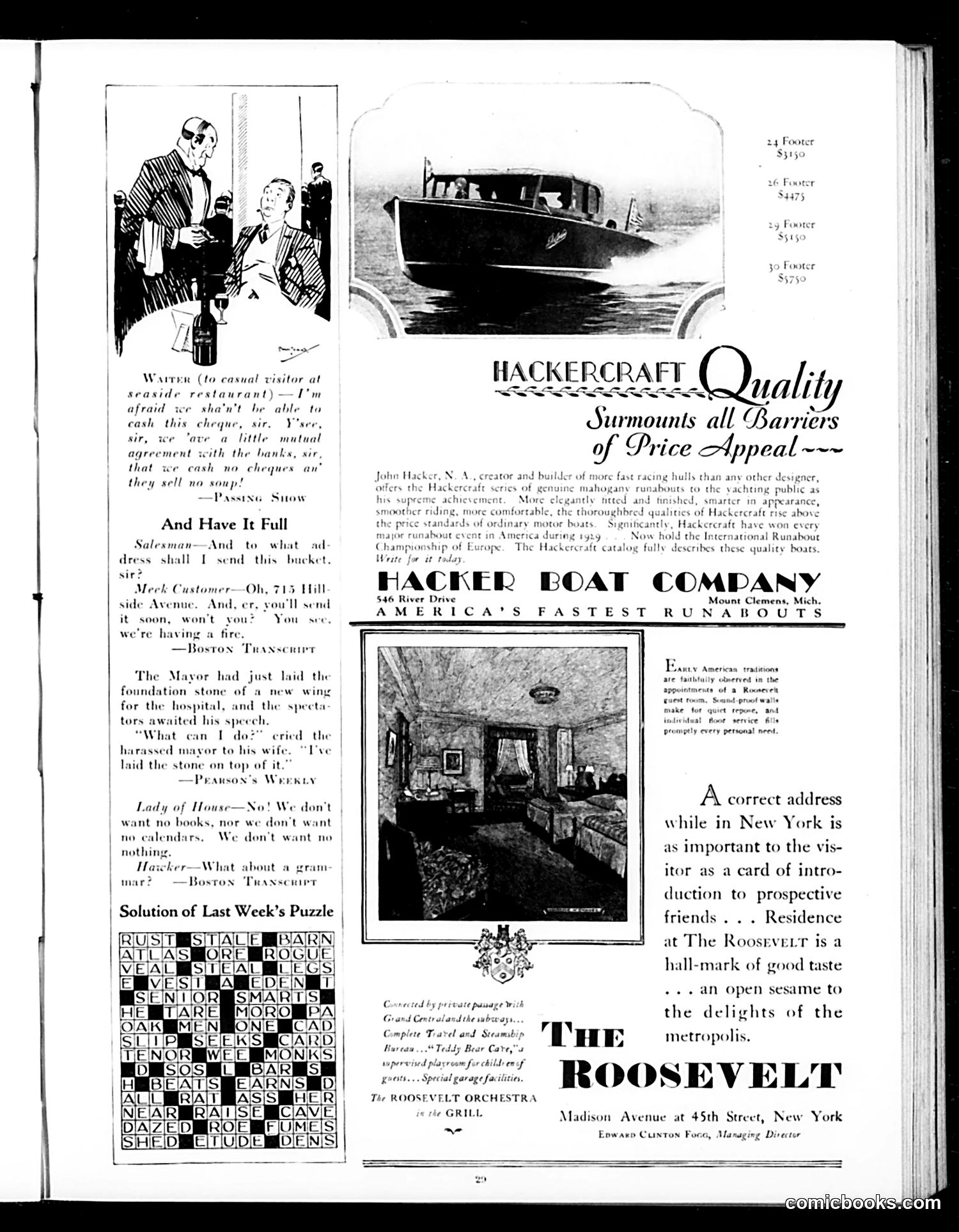
This page contains several brief comic exchanges satirizing economic hardship during what appears to be a recession or depression era (likely 1920s-1930s based on the style). **The cartoons mock:** 1. **Bank-restaurant mutual agreement**: A waiter tells a customer they won't cash checks because banks agreed not to sell soup—satirizing the collapse of credit and commercial trust between institutions. 2. **Dodging payment**: A salesman asks a customer's address; the customer delays, revealing they're moving to avoid paying for a delivery—poking fun at widespread financial defaults. 3. **Hospital foundation stone disaster**: A mayor accidentally laid a ceremonial stone on top of something important, mocking bureaucratic incompetence during public works. 4. **Unwanted goods**: A woman refuses all solicitations (books, calendars, grammar), suggesting poverty and rejection of even free items. The satire reflects widespread economic anxiety and the collapse of normal commercial relationships. The page is otherwise dominated by advertisements for boats and a hotel, typical of Judge's mixed editorial-advertising format.
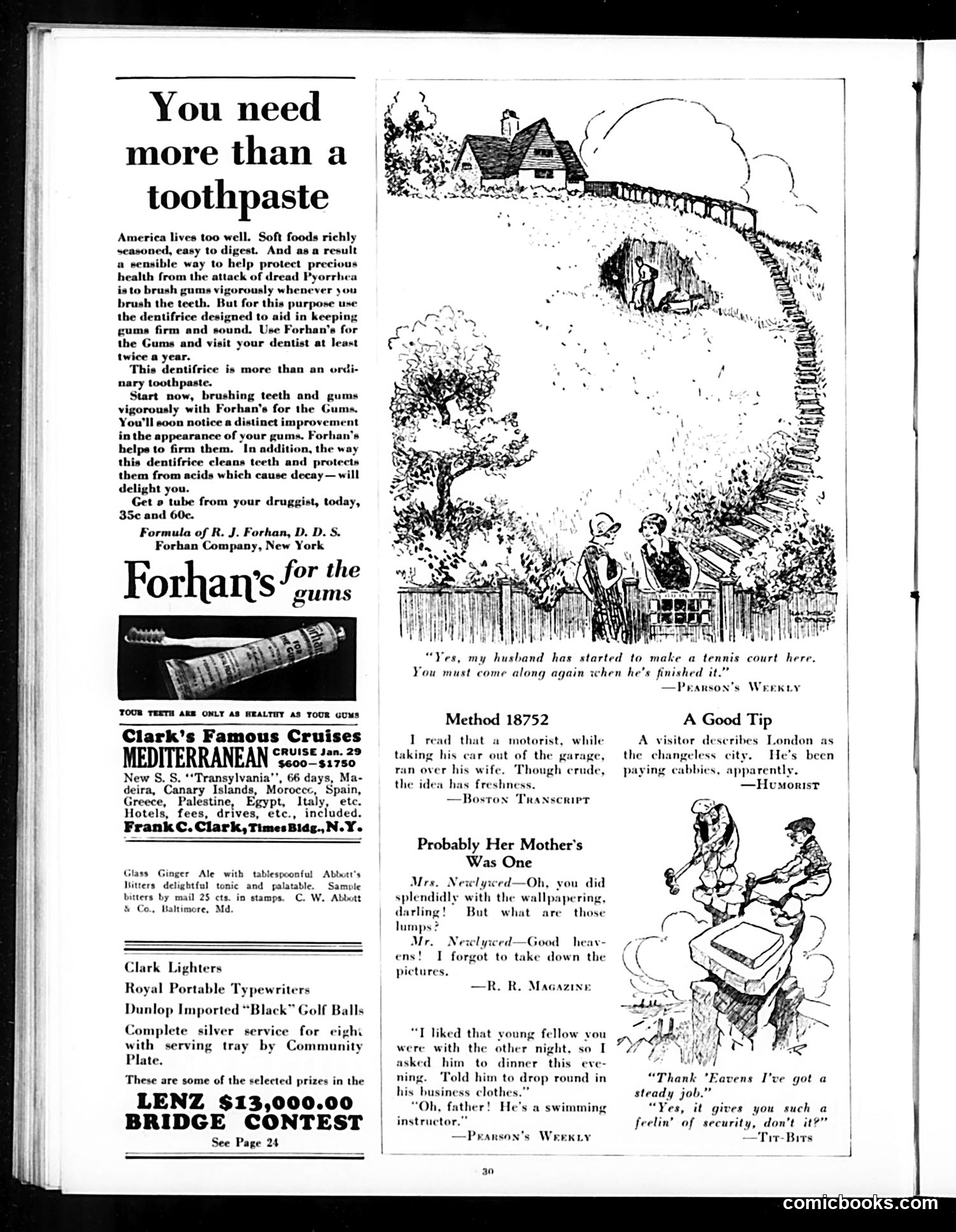
This page is primarily **advertising and humor columns**, not political satire. The main content includes: **Forhan's Dentifrice Advertisement**: A prominent ad warning against "Pyorrhea" (gum disease), reflecting early 20th-century health anxieties about dental hygiene. The copy emphasizes that Americans' soft diet requires specialized gum care—a common sales pitch of the era. **Humor Columns**: The right side contains three separate joke items from *Pearson's Weekly* and other publications: - A cartoon about a husband building a tennis court (domestic humor) - Brief anecdotes mocking newlyweds and social pretension - Working-class humor about job security **Other Ads**: Travel cruises, typewriters, golf balls, silverware, and a bridge contest round out the page. This reflects Judge's mixed content model: satirical cartoons appeared elsewhere, but this particular page emphasizes consumer advertising and light domestic comedy typical of 1920s-era magazines.
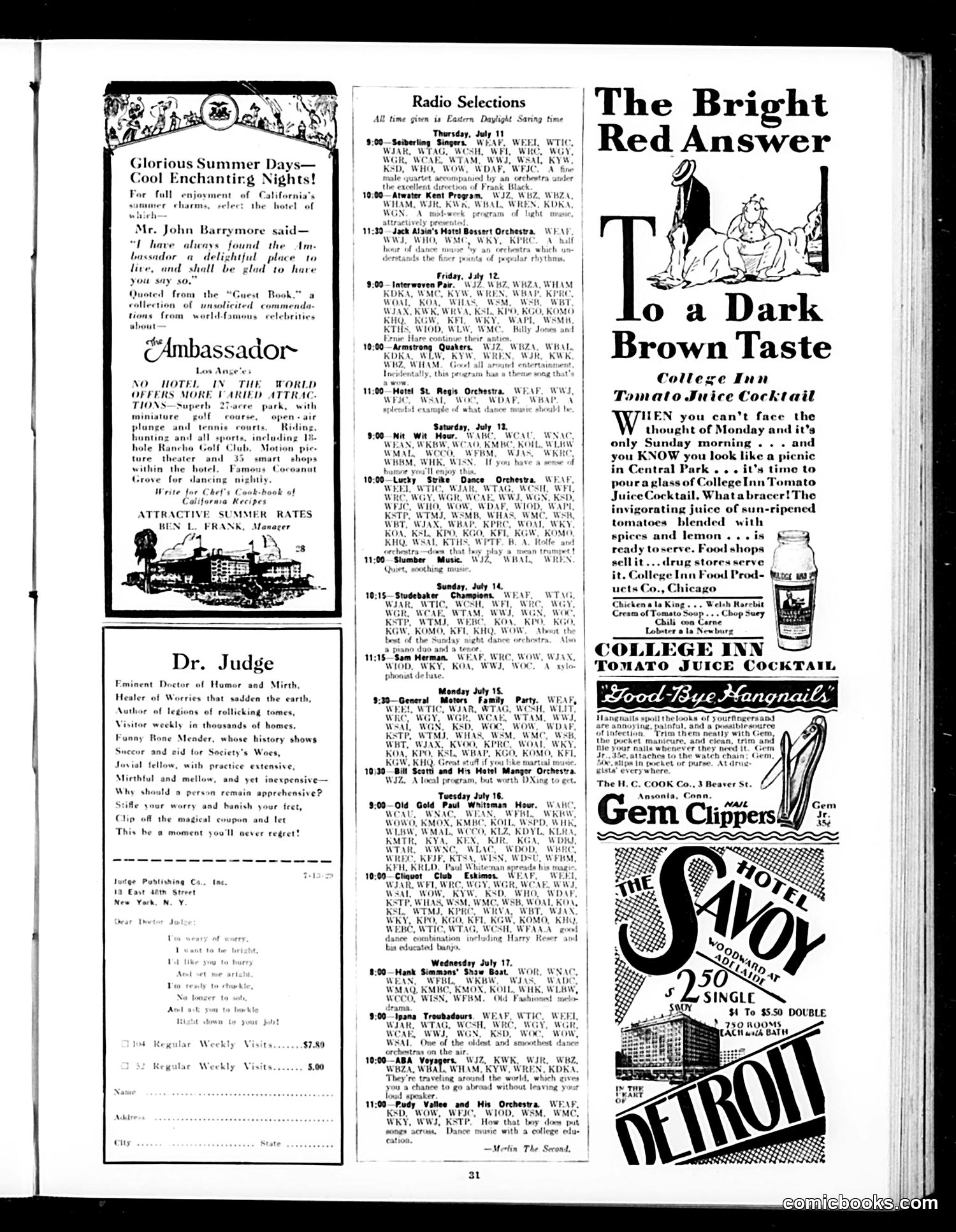
This is primarily an **advertising and radio programming page** from Judge magazine, circa July 1927. The left side features advertisements for the Ambassador Hotel in Los Angeles (endorsed by actor John Barrymore) and promotes Judge magazine itself through a personified "Dr. Judge" character—described as a "Doctor of Humor and Mirth" who heals readers' worries. The center contains **radio station listings** for Eastern Daylight Time, showing what programs aired on various stations throughout the week—including dance orchestras, singers, and variety shows typical of 1920s radio. The right side advertises consumer products: a "College Inn Tomato Juice Cocktail" (marketed to picnickers), "Gem Clippers" (razors), and the Hotel Savoy in Detroit. **For modern readers:** This reflects pre-television entertainment—radio was the dominant mass medium, and print magazines promoted both radio programming and consumer goods to middle-class audiences seeking leisure activities during summer.
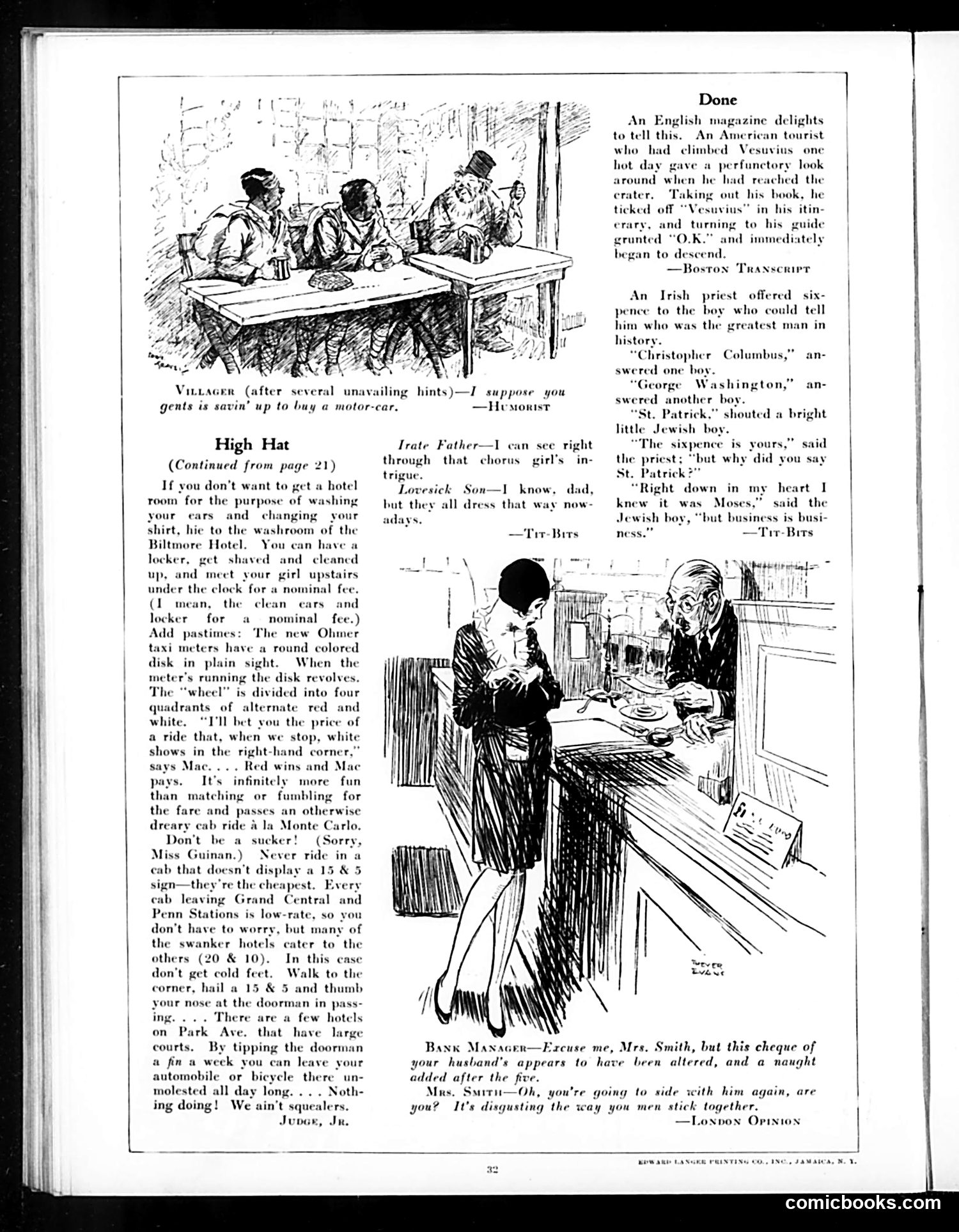
This page contains several brief humorous anecdotes rather than political cartoons: **"High Hat"** offers practical tourist advice about New York hotels and taxi meters—mocking wealthy tourists' pretensions while providing actual tips (like watching taxi meter wheels or tipping doormen). **The smaller jokes** satirize social hypocrisy and gender dynamics: - A father disapproves of chorus girls' revealing dress while his son finds them attractive - An Irish priest offers sixpence for naming history's greatest man; a Jewish boy wins by naming St. Patrick while privately thinking Moses—a joke about religious minorities strategically concealing their true preferences for financial gain - A bank manager discovers an altered check; the wife accuses her husband of dishonesty, then complains when the manager sides with him—satirizing both marital conflict and male solidarity among authority figures **The illustration** shows the bank scene, depicting middle-class domestic and financial anxiety in the early 20th century. The page reflects Judge's typical mix of practical urban humor, ethnic stereotyping common to the era, and mockery of middle-class pretensions and matrimonial discord.
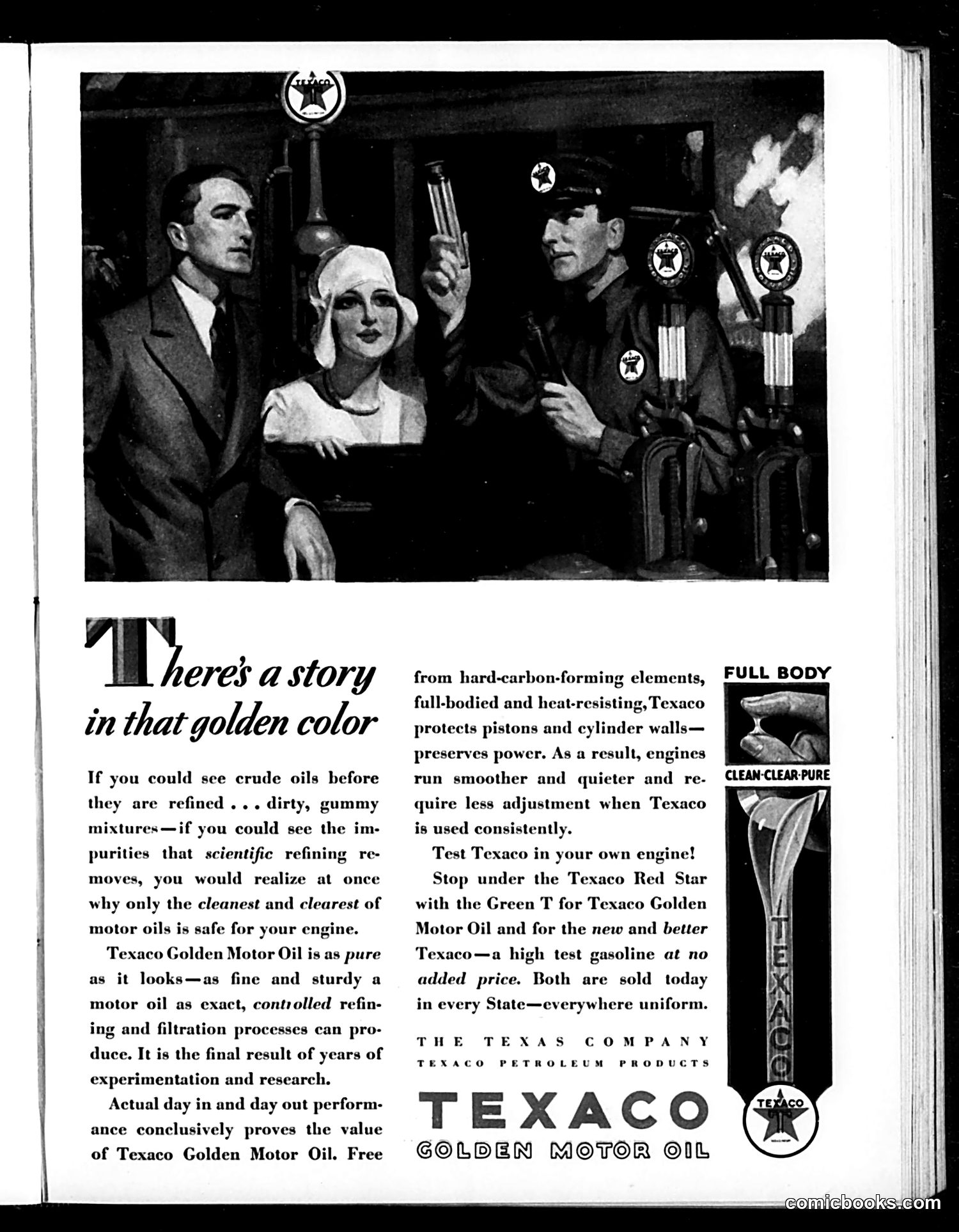
This is primarily a **Texaco motor oil advertisement**, not political satire. The image shows a stylized scene of people at what appears to be a gas station or service establishment, with Texaco branding visible. The ad's appeal targets early-to-mid 20th-century consumer anxieties about product quality. The text emphasizes scientific refinement and purity—contrasting "dirty, gummy" crude oil with Texaco's "cleanest and clearest" product. This marketing strategy addresses widespread concerns about engine maintenance and reliability when automobiles were still relatively novel. The "golden color" referenced in the headline serves as visual proof of quality to consumers who couldn't directly assess motor oil's actual properties. The advertisement promises that rigorous industrial processes produce a superior, uniform product available nationwide—appealing to both technical credibility and standardization. This reflects Depression-era or post-war American consumer culture valuing scientific progress and brand reliability.
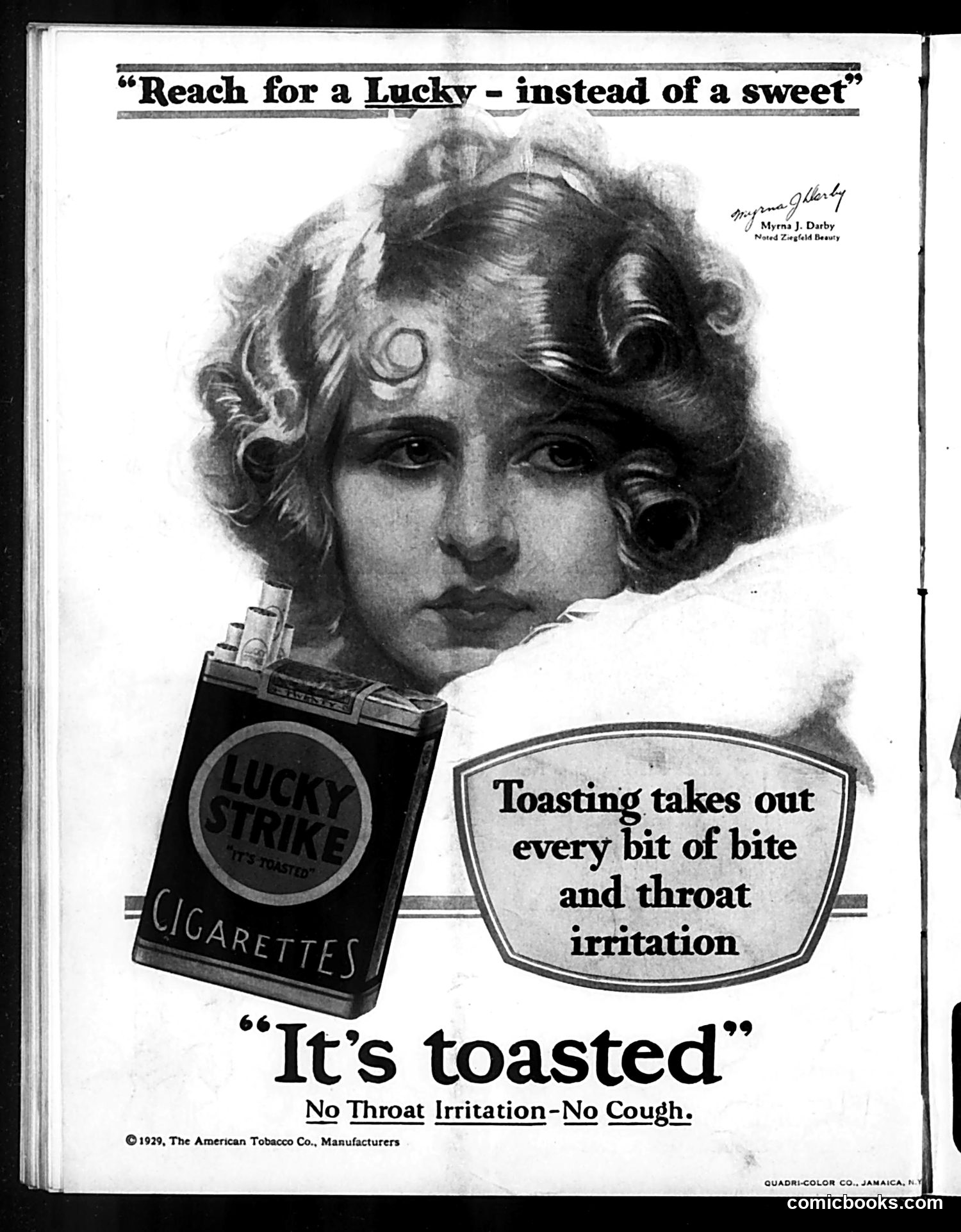
This is a **Lucky Strike cigarette advertisement**, not satire. The 1929 ad features a glamorous woman with styled hair and makeup, positioned to showcase the product alongside a pack of Lucky Strike cigarettes. The ad's central claim—"It's toasted"—was Lucky Strike's actual marketing slogan, asserting that their toasting process eliminated throat irritation and cough. The tagline "Reach for a Lucky instead of a sweet" was a real campaign encouraging cigarettes as appetite suppressants. By modern standards, this is darkly ironic: the ad promises health benefits from a product we now know causes serious harm. The "no throat irritation" claim is particularly laughable given cigarettes' actual effects. This represents pre-regulation tobacco marketing, before health warnings were required.