
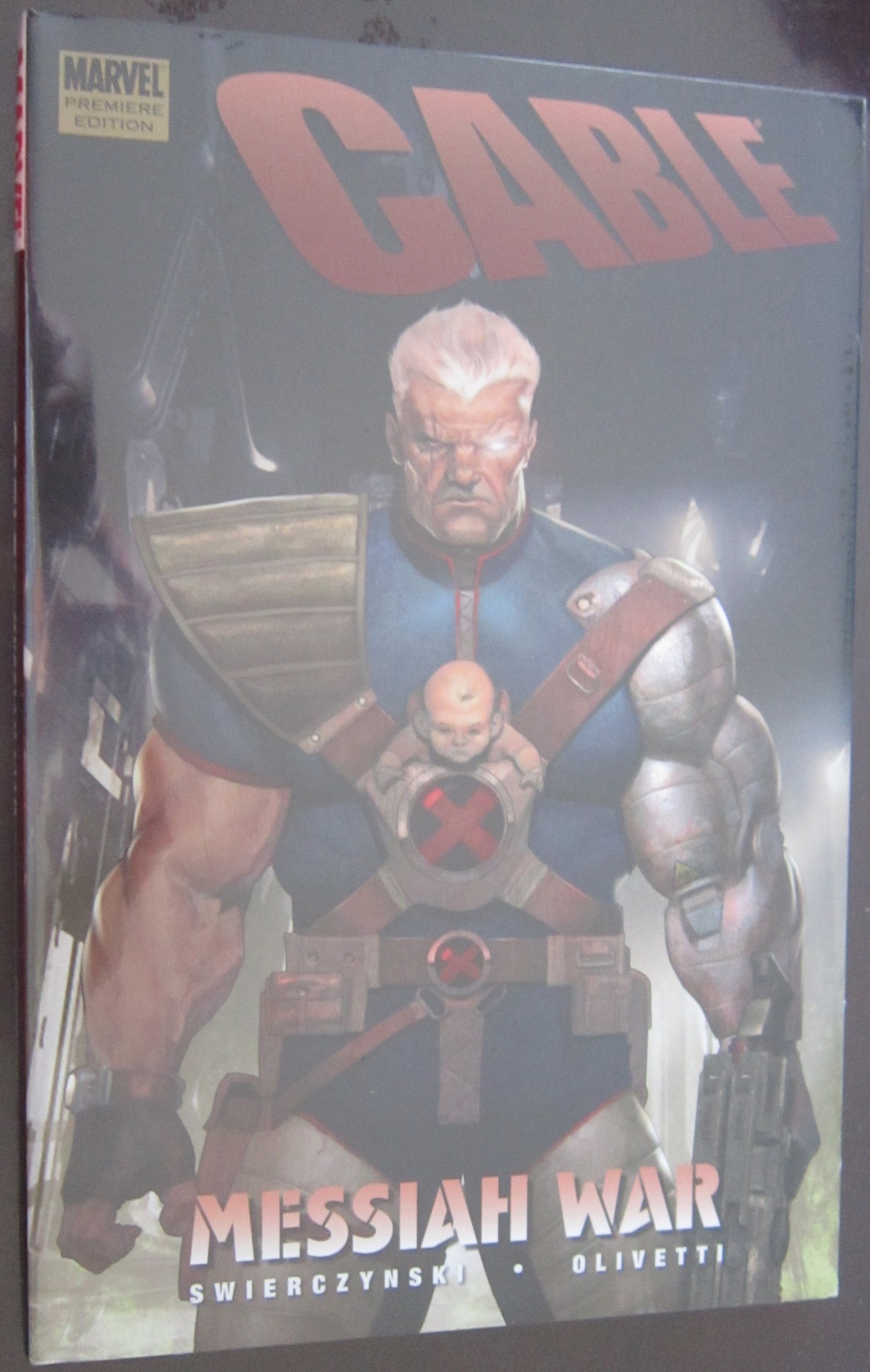
Cable #1
Cable #1 (vol. 2, March 2008) is the opening chapter of the ongoing series that set the X-Men franchise's narrative course for the next two years, picking up the moment Cyclops hands the first mutant born since M-Day — the infant who will become Hope Summers — to Nathan Summers and sends him fleeing into the timestream. The series transformed Hope from a nameless, plot-device baby into a fully realized character by charting her entire childhood and adolescence alongside Cable, making this issue the true launch pad for one of the most consequential new characters in 2000s Marvel. It served as the connective tissue of a deliberate three-act mutant-messiah saga — bracketed by Messiah Complex before it and Messiah War and Second Coming after — giving Cable his most clearly defined solo purpose since the early 1990s. The book also marked a creative left turn for the X-line: writer Duane Swierczynski brought a hard-boiled crime novelist's structural sensibility to what became an almost pure science-fiction survival story, unusual territory for an X-title of that era.
ComicBooks.com Value
Show all 18 grades ▾
Find on ebay
Where to buy
Read it digitally
Sell my copy
Have this issue — or a whole collection? Get a fair offer from us, skip the marketplace fees and the hassle.
We Buy Collections ▸History
At the Baltimore Comic-Con in September 2007, Marvel announced that a new solo Cable ongoing series — written by crime novelist Duane Swierczynski with art by Ariel Olivetti — would launch in March 2008 directly out of the conclusion of Messiah Complex. The series was conceived as a deliberate replacement for the long-running Cable & Deadpool, which Marvel canceled with issue #50 to clear the way for both this title and a new Deadpool solo book. Swierczynski, a New York Times-bestselling thriller author making a high-profile Marvel move, resolved an early structural puzzle — why wouldn't Cable simply time-jump back to safety? — by having the time machine sustain damage that limited travel to the forward direction only, a storytelling constraint that defined the entire run's survival-story tone. Rob Liefeld, the character's co-creator, contributed a retailer-incentive variant cover for the debut issue.
Trivia · 8 facts
- Published March 5, 2008, by Marvel Comics; written by Duane Swierczynski with interior art and cover by Ariel Olivetti (Cable vol. 2, #1).
- Spins directly out of X-Men: Messiah Complex (Oct. 2007–Jan. 2008), picking up immediately after Cyclops entrusts the infant mutant messiah to Cable and sends them into the timestream.
- The infant girl — who has her first on-panel comics appearance in X-Men #205 (Jan. 2008, created by Mike Carey and Chris Bachalo) — is still unnamed as of this issue; she is formally named 'Hope Summers' by Cable in Cable vol. 2 #10.
- Hope is the first mutant born after the Decimation (M-Day), the event in which Scarlet Witch's reality-altering cry stripped nearly all mutants of their powers.
- The series's central dramatic engine, established from issue #1, is Bishop pursuing Cable and the baby through future timelines, intending to kill the child to prevent the dystopian future of his own birth.
- Cable & Deadpool (2004–2008) was canceled with issue #50 to make way for this series and a new Deadpool ongoing; the announcement was made at Baltimore Comic-Con in September 2007.
- A Rob Liefeld (Cable's co-creator) retailer-incentive variant cover was produced for this issue.
- The series ran 25 issues (March 2008–April 2010) and is collected across Cable: The Last Hope Vol. 1 (issues #1–12, plus King-Size Cable #1 and supplemental material) and the earlier Cable Vol. 1: Messiah War hardcover (issues #1–5); it bridges the larger Messiah Complex → Messiah War → Second Coming trilogy.
Cast · 2 characters
Full credits
Reprints
↩ Reprints Cable #1 (2008)
Reviews
Reader reviews
No reader reviews yet.