
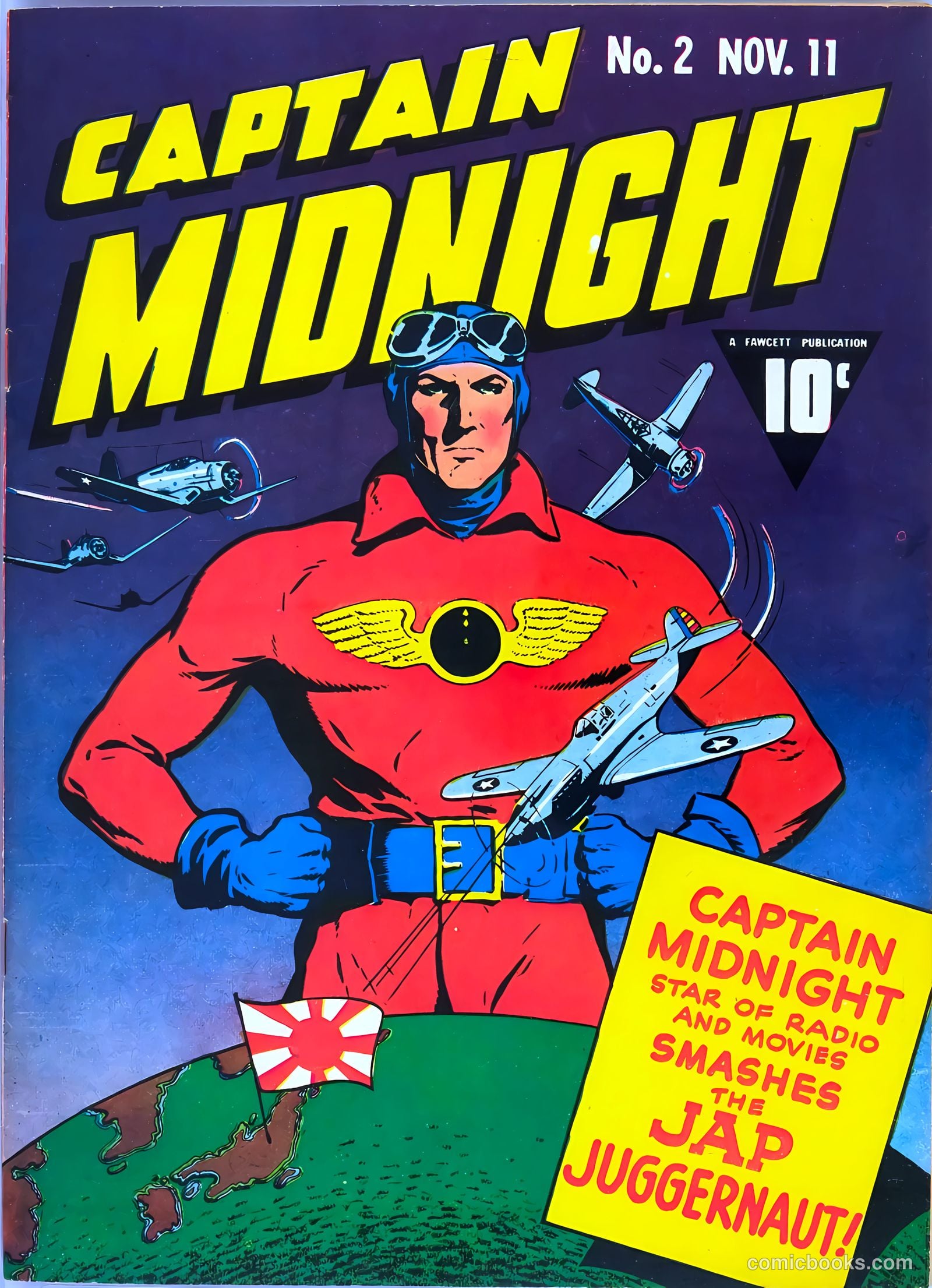
Captain Midnight #2
Captain Midnight #2 (November 1942) delivers the first comic book appearance and origin of Sgt. Twilight — the alter ego of Ichabod Mudd — who would become the series' most enduring supporting character and its primary link to the original radio property. The issue also introduces two new villains, Dr. Fate and The Black Mikado, signaling Fawcett's intent to build a distinct rogues' gallery for their comics version rather than simply repackaging radio scripts. Arriving just two months into the Fawcett run, it represents the moment the editors began actively constructing a mythology that was uniquely the comic's own, separate from the radio serial that had made Captain Midnight a household name. In doing so it exemplifies a broader Golden Age pattern: radio-born heroes being creatively reinvented for the page, with new cast members and gadgets tailored to the visual medium.
Captain Midnight discovers that the villain Von Togo has dropped a gas bomb and must retrieve it before it detonates, leading to a desperate aerial chase where three lives hang by a thread. In a parallel sequence, Ichabod's hotel room reveals a mysterious costume and Sergeant Twilight introduces himself as an operative working against the Berlin and Tokyo terror networks. The story culminates in a violent confrontation where explosions and destruction unfold as Captain Midnight battles to stop Von Togo's sinister plot.
Captain Albright heads to Hollywood to supervise filming of "Freedom's Wings," a government air epic meant to boost American morale during wartime, but an Axis plot to sabotage the production transforms the mission into a deadly struggle. When a mysterious strangler kills a pilot inside a locked cockpit mid-flight, Captain Midnight realizes the enemy will stop at nothing to wreck this vital propaganda effort. He must uncover and dismantle the conspiracy before the film—and the war effort—can be destroyed.
When a wave of mysterious bombing raids devastates American cities, Captain Midnight springs into action to uncover the truth—leading him straight to a Nazi conspiracy launching tiny attack planes from hidden locations across the nation. Captured by the villainous Baron Von Verm and his operatives, Captain Midnight must rely on his wits and the Secret Squadron to stop a coordinated strike aimed at the industrial heart of the Middle West before it's too late. A furious aerial battle erupts as Captain Midnight and his allies race to dismantle the enemy's operation and protect the country from total destruction.
ComicBooks.com Value
Show all 18 grades ▾
Find on ebay
Read it digitally
Sell my copy
Have this issue — or a whole collection? Get a fair offer from us, skip the marketplace fees and the hassle.
We Buy Collections ▸History
Captain Midnight began as a radio serial in 1938, created by Wilfred G. Moore and Robert M. Burtt, before moving through Dell Comics and then landing at Fawcett, which launched its own dedicated title in September 1942. Jack Binder — whose studio produced a great deal of Fawcett's Golden Age art — handled both interiors and covers for the series' early issues, including #2, and the GCD credits script work through textual analysis by Lou Mougin, with at least one story's authorship pinned down via Otto Binder and P.C. Hamerlinck's research published in Alter Ego #147 (July 2017). Fawcett's editorial approach deliberately reimagined the character for comics rather than adapting radio continuity, giving him a scarlet skintight suit, an array of high-tech gadgets, and a desert secret laboratory — none of which were features of the radio version.
Trivia · 8 facts
- Published November 11, 1942 by Fawcett Publications — the second issue of the 67-issue Fawcett run (September 1942 – September 1948).
- First comic book appearance and origin of Sgt. Twilight (Ichabod Mudd), who became Captain Midnight's principal sidekick throughout the series.
- First comic book appearance of the villain Dr. Fate (a Fawcett-original villain, unrelated to DC's Doctor Fate) in the story 'Captain Midnight Meets Sergeant Twilight.'
- First comic book appearance of The Black Mikado as a villain, in a separate story within the same issue.
- Art and cover by Jack Binder, the primary artist on the series' early issues.
- Script credits for the issue's stories have been attributed through textual analysis by Lou Mougin, with additional sourcing from Otto Binder and P.C. Hamerlinck in Alter Ego #147 (July 2017).
- The issue runs 68 pages in full color — a generous page count reflecting Fawcett's early investment in the title.
- Captain Midnight originated as a radio serial created by Wilfred G. Moore and Robert M. Burtt in 1938; the Fawcett comic deliberately diverged from the radio version, with Ichabod Mudd (here debuting as Sgt. Twilight) being the only recurring radio character to appear regularly in the comic.
Full credits
Reviews
Reader reviews
No reader reviews yet.