
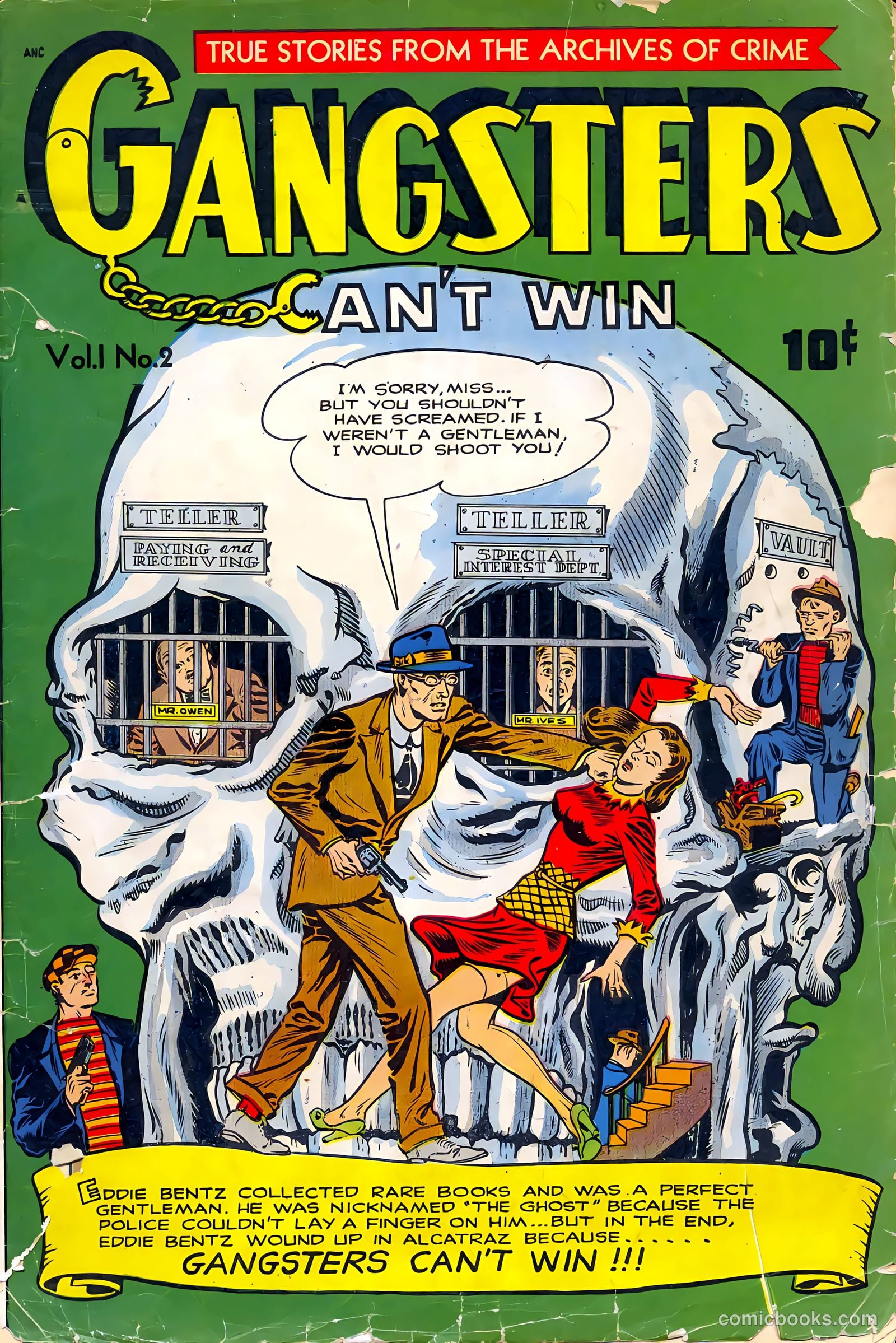
Gangsters Can't Win #2
☆ Be the first to review + Add to your collection — Join freeGangsters Can't Win #2 is a vivid example of the Golden Age true-crime comic at its most unvarnished: every story in the issue is adapted from the documented careers of real historical criminals, placing it squarely in the wave of factual-crime anthologies that Lev Gleason's Crime Does Not Pay had made commercially viable just years before. The issue's cover feature on bank robber Eddie Bentz — who collaborated with Machine Gun Kelly and Baby Face Nelson and was likely the architect of the 1930 Lincoln National Bank robbery, the largest cash heist in the country for decades — gave readers a character whose exploits genuinely rivaled pulp fiction without needing embellishment. As the second issue of D.S. Publishing's flagship crime title, it helped define the uncompromising, pre-Code storytelling voice the series would maintain through its early run before eventually softening into a conventional mystery-detective format.
Eddie Bentz, a rare book collector nicknamed "The Ghost" because police could never catch him, operates a sophisticated crime ring until he is ultimately arrested and imprisoned in Alcatraz. A second story follows a criminal named Biff who runs an extortion racket at a dance hall, demanding money from patrons under threat of violence; when Biff attempts to frame an innocent man and later tries to betray his partner Schultz, their conflict escalates into a shootout. A third narrative depicts gangsters who bungle a bank robbery after miscalculating the signal, leading to their capture by police and FBI agents who surround their hideout. Throughout these tales, the comic demonstrates that criminal schemes inevitably collapse under the weight of their own deception and violence.
Eddie Bentz, a meticulous and gentlemanly bank robber known as "the Ghost," carefully orchestrates an ambitious million-dollar heist in 1930 Lincoln, Nebraska—only to have his perfect plans unravel when one of his gang members is captured and exposes him to the authorities. Now hunted across the country by police and the FBI, Bentz must navigate a tightening net with nothing but the stolen securities he cannot access and nowhere left to hide.
Basil "The Owl" Banghart—so nicknamed for his unblinking stare—starts smart in the bootlegging racket of 1925, even impressing mob boss Roger Touhy with his skill and nerve, but his cockiness and reckless climb through kidnapping and armed robbery eventually brings federal heat down on the entire operation. Cornered in Baltimore with nowhere left to run, Banghart learns the hard way that no clever scheme or quick trigger finger can outrun the law forever. A gritty cautionary tale of ambition, arrogance, and the price of the criminal life.
Harry Brunette started as a farm boy but fell in with the wrong crowd in Milwaukee, eventually marrying a woman named Cheryl and killing a crime boss in what he claimed was self-defense. On the run ever since, Brunette has spiraled deeper into crime—robbing a post office, threatening his associates, and holing up in a New York penthouse—until his desperate situation finally catches up with him when police close in for the arrest.
"Biff" Ellison runs his protection racket with a blackjack and an iron will, terrorizing shop owners across early 1900s Coney Island—until a rival collector named Red Harrington begins muscling in on his territory. When Biff lands in jail for assault, he emerges with revenge on his mind, but Red and his crew are waiting, and a final confrontation with Officer Edwards forces Biff to learn a hard lesson about life outside the law.
Benny Rogers runs a ruthless crime-for-hire operation in 1914 New York, complete with a price list for everything from fatal shootings to horse poisoning—until Sergeant Ryan makes it personal by refusing to back down from the investigation. When Ryan's pursuit forces a desperate confrontation, Benny's empire of terror unravels, exposing a web of corruption that reaches into the city's most respectable corners. This is a story about how greed and violence, no matter how organized, ultimately fall to the law.
Harry Tracy, a cold-blooded killer, escapes from Oregon State Penitentiary in 1902 alongside fellow convict Dave Merrill, leaving dead guards in their wake. As the desperate fugitives evade an ever-closing net of lawmen and pursue-rs across the Northwest, Tracy's ruthlessness and cunning keep him one step ahead—but the walls are closing in, and his reign of terror can't last forever.
ComicBooks.com Value
Show all 18 grades ▾
Find on ebay
Read it digitally
Sell my copy
Have this issue — or a whole collection? Get a fair offer from us, skip the marketplace fees and the hassle.
We Buy Collections ▸History
D.S. Publishing Company Inc. entered comics in 1948, pivoting from a background in song-sheet magazines and trade publications that its founder Richard Davis had built since acquiring Dance Magazine in 1940. The company rode the mid-decade crime-comic boom — itself largely a consequence of Crime Does Not Pay's massive readership — launching Gangsters Can't Win alongside companion titles like Outlaws, Public Enemies, Pay-Off, Underworld, and Exposed. Issue #2, published on a bi-monthly schedule with a cover date of April–May 1948, drew on a rotating stable of contributors including artists Bill Fraccio, George Gregg, Marcia Snyder, Pete Tumlinson, and Tex Blaisdell, none of whom received prominent credits in the indicia. The publisher folded its comics operations by 1951, its final expansion plans derailed by an industry-wide paper shortage.
Trivia · 8 facts
- Published April–May 1948 by D.S. Publishing Company Inc. as the second issue of a nine-issue run; the series operated on a bi-monthly schedule.
- Cover feature: 'Eddie Bentz alias the Ghost,' a profile of real-life bank robber Eddie Bentz, who ran heists alongside Machine Gun Kelly and Baby Face Nelson and was the suspected mastermind of the 1930 Lincoln National Bank robbery in Nebraska.
- The issue contains seven story features, all grounded in documented criminal history: 'Eddie Bentz alias the Ghost,' 'Basil Banghart,' 'From the Farm to Alcatraz' (Harry Brunette), 'Black Jack Rule: The Story of Biff Ellison,' 'Do the Dead Return?,' 'Murder Pay$ Off,' and 'Oregon's Trigger-Happy Killer: Harry Tracy.'
- Harry Tracy, profiled in the issue's final story, is depicted as the last surviving member of the Hole in the Wall Gang; Biff Ellison's story covers his role in both the Five Points Gang and the Gopher Gang in early New York.
- Interior art credits for the issue include Bill Fraccio, George Gregg, Marcia Snyder, Pete Tumlinson, and Tex Blaisdell — a team that also contributed to the series' first issue.
- The cover image was taken directly from the first story's splash page, a production shortcut common to low-budget Golden Age publishers.
- The entire nine-issue run was reprinted by Gwandanaland Comics (2016 series) across two collected volumes: The Complete Gangsters Can't Win: Volume 1 (#1340) and Volume 2 (#1341), making the original stories accessible in a modern reprint edition.
- The series began as a brutal pre-Code true-crime anthology in its early issues but gradually evolved toward a standard mystery-detective format in its later numbers.
Reviews
Reader reviews
No reader reviews yet.