
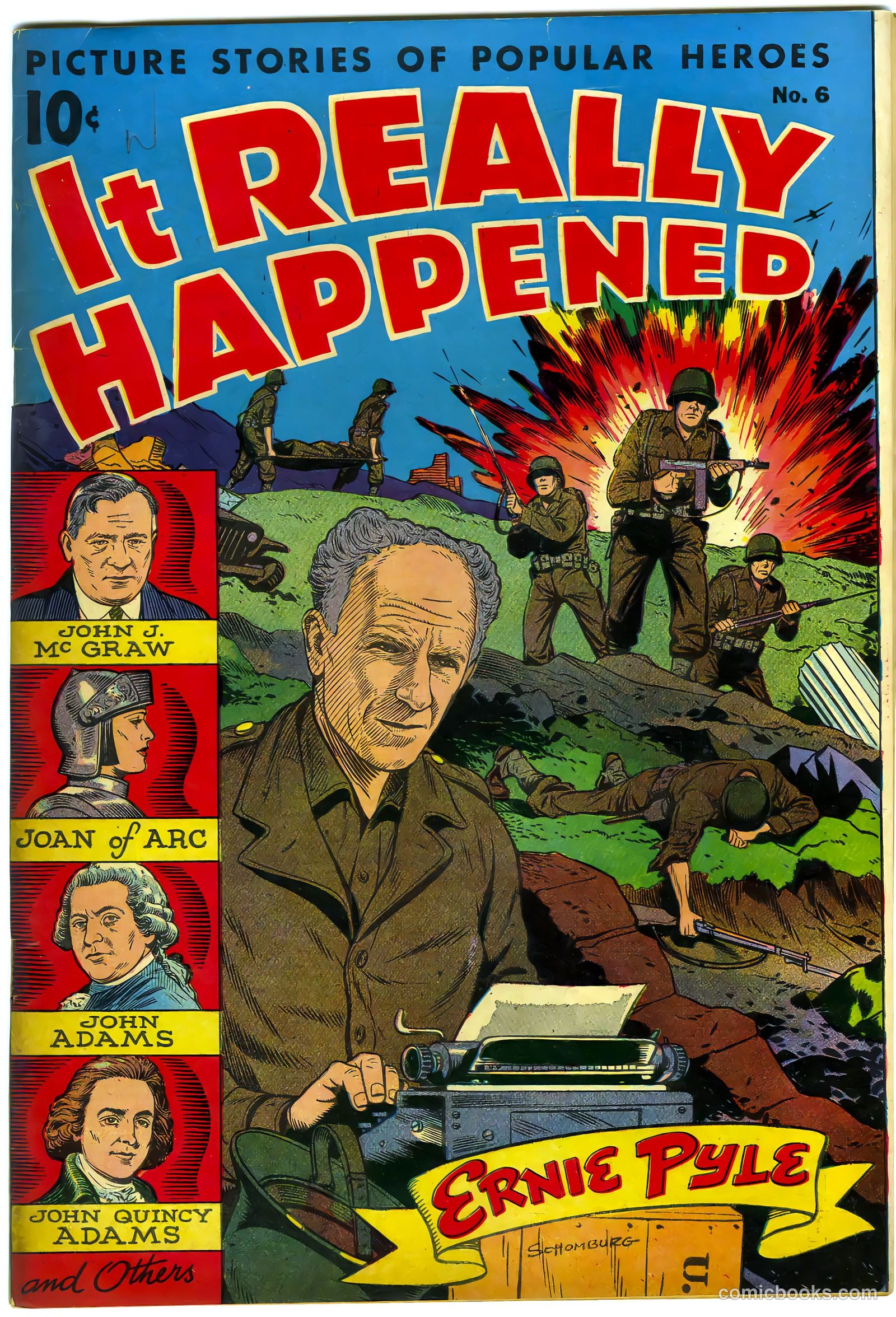
It Really Happened #6
☆ Be the first to review + Add to your collection — Join freeAn anthology featuring historical and educational tales, "It Really Happened" #6 includes a story about John Quincy Adams serving as an American diplomat negotiating peace between nations, as well as an account of Ernie Pyle, the war correspondent who returned home safely from World War II. The issue also contains "The Spider's Our Friend," a nature story presented through anthropomorphic characters explaining that spiders are beneficial creatures that help control dangerous insects like flies and mosquitoes.
This 1946 story frames the proverb "like father, like son" through two generations of American leadership: John Adams, the Second President who championed liberty during the Revolution, and his son John Quincy Adams, who rose to become the Sixth President and carried forward his father's commitment to defending the nation's freedom and independence. Through scenes spanning from the colonial resistance to British taxation through the War of 1812 and beyond, the story traces how the younger Adams inherited and upheld his father's principles of honor, courage, and service to country. It's a portrait of patriotic legacy wrapped in the warm, relatable frame of a son striving to live up to his father's example.
Air Commodore Frank Whittle, a tinkerer-turned-engineer in the Royal Air Force, pursues an audacious dream: harnessing jet propulsion to power a modern airplane engine. When initial skepticism and setbacks threaten to derail him, Whittle and a handful of believers form their own company to develop the technology, ultimately delivering a revolutionary prototype that demonstrates the raw speed and power of a radical new flight engine.
During World War II, a determined reporter named Ernie Pyle traded his typewriter for a front-row seat to history, following American troops across nearly every theater of war to tell their stories in deeply human terms. From his humble Indiana roots through a lifetime of wandering across America and the globe, Pyle found his true calling documenting the lives and sacrifices of ordinary soldiers—until his journey came to a tragic end in the Pacific in 1945. This is the true story of how a skinny, gray-haired newsman became every G.I.'s best friend back home.
A peasant girl named Joan of Arc hears divine voices commanding her to liberate France from foreign occupation, and despite skepticism from the king's advisors, she's given the chance to lead French troops. Her inspired leadership drives the invaders from Orleans and rallies the nation to crown a French king, but jealous traitors betray her to the enemy, leading to her capture and trial. Though she faces a cruel fate, her courage and unwavering faith transform her into an eternal symbol of French freedom and resistance.
Born into slavery in ancient Greece, young Aesop catches the eye of a master who recognizes his sharp wit, and over time the clever boy grows into a wise man whose fables become instruments of counsel—most memorably when he uses the tale of the frogs and the crane to steer Athens away from a dangerous political choice. This 1946 tale traces how a slave's wisdom earned him freedom and made him an enduring voice of reason whose simple legends would outlast empires.
Most spiders get a bad rap—people scream and run at the mere sight of them—but this 1946 story sets the record straight: these eight-legged hunters are actually humanity's allies, tirelessly catching the flies and mosquitoes that truly pose a danger to us. Through vivid examples of spiders at work, the story reveals just how clever and useful these often-misunderstood creatures really are.
Baseball's "Little Napoleon" John J. McGraw is remembered as one of the greatest managers the game has ever seen, but this story takes you back to his fiery days as a player—a small, scrappy teenager who became a terror on the base paths and a brilliant third baseman for the champion Baltimore Orioles. From his early years as a hard-hitting lead-off man to his later success developing talent for the New York Giants, McGraw's journey shows how his passion for the game shaped both his playing career and his legendary management style.
Dr. Harry Archer has spent half a lifetime racing to fires across New York City, earning his place as Honorary Deputy Fire Chief and a legend among the firemen he treats. From his medical school days in the 1890s through countless emergencies—from street blazes to subway rescues—"the Doc" has been there with steady hands and sage advice, even crawling through burning wreckage on hands and knees to reach those who need him. His decades of devotion to the Fire Department earned him their highest honor: the Bennet Medal for extreme heroism.
ComicBooks.com Value
Find on ebay
Read it digitally
Sell my copy
Have this issue — or a whole collection? Get a fair offer from us, skip the marketplace fees and the hassle.
We Buy Collections ▸