
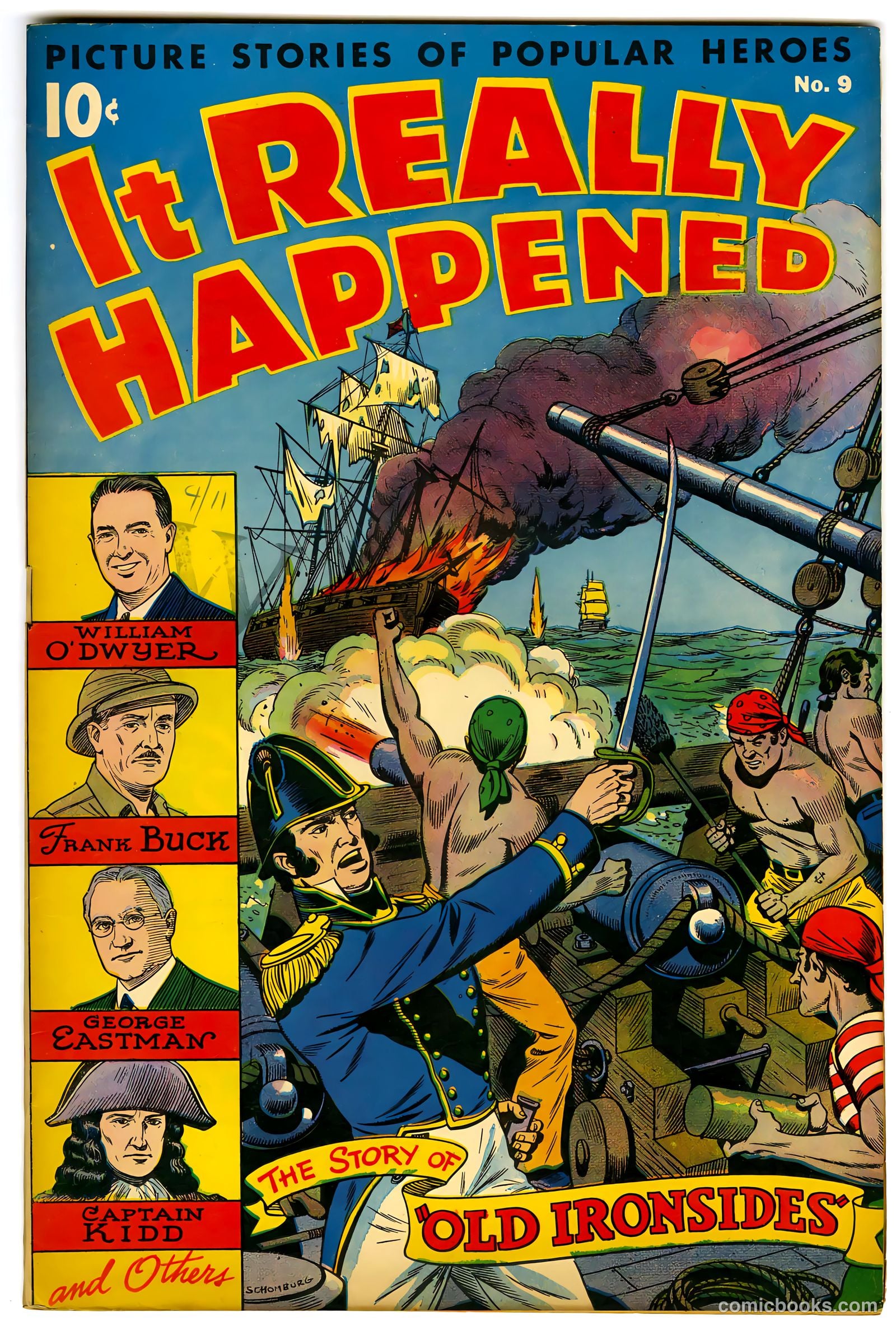
It Really Happened #9
☆ Be the first to review + Add to your collection — Join freeIn "The Little Boats," the newly elected mayor of New York City—once a police officer, a US General, a judge, and a prosecutor who took on "Murder, Inc."—faces a new kind of challenge in his first term. With Ken Battefield’s expressive art and Ed Hamilton’s crisp lettering, this 1947 story captures the weight of leadership in a city still rebuilding. The cover by Alex Schomburg, rendered in bold pencils and inks, hints at quiet tension beneath the urban skyline.
Lee Lang of Patchogue, Long Island learned to sail almost before he could walk, and racing little boats with his family across blue, dancing waves is his idea of the perfect day on the water. When he's out on the waves competing against rivals like the New Moon, Lee Lang's on top of the world.
On the Arizona frontier and across the American West, pioneer mothers proved themselves every bit as tough and resourceful as the men beside them—fighting off Indian raids from isolated cabins, tracking down wayward sons to face justice, firing cannons through bitter winters to ward off attackers, and blazing trails across burning prairies to reach California. These true stories celebrate the quiet heroism of mothers who stood their ground, made impossible choices, and refused to let circumstance defeat them. From frontier homesteads to modern wartime service, the courage that defined these women remains unchanged.
Frank Buck dreamed of adventure as a boy daydreaming through geography class in Texas, and that restless spirit never left him—from bell-hop to carnival worker to theatrical agent, he chased thrills across America until he found his true calling in 1911: hunting and capturing wild animals in the jungles of South America and the Far East. Armed with nothing but his wits and determination, Buck tracked down rare birds, massive pythons, escaped leopards, and charging orangutans, bringing specimens back alive to zoos in London and New York and eventually to his own traveling animal show. From jungle expeditions to Broadway screens to world's fairs, Frank Buck became synonymous with wild adventure—a man who proved that in the modern age, genuine excitement was still waiting for those bold enough to seek it.
Old Ironsides—the U.S.S. Constitution—rises from the scrappy early days of the American Navy through the Revolutionary War and into the conflicts of 1812, earning her legendary nickname through daring combat against the French, Barbary pirates, and the British Royal Navy. Watch as the brave little frigate and her crew, from inexperienced sailors to battle-hardened veterans, rack up victory after victory on the open seas and at pistol range, all while proving that her wooden hull is built to last. When the ship's glory dims and she faces the scrapyard, a nation's voice rallies to save the very symbol of American naval tradition.
George Eastman dreams of mastering photography after a chance encounter with a skilled photographer in Rochester, struggling through the cumbersome equipment of 1875 before discovering the promise of a new dry-plate method that could transform the medium into something accessible to everyone. Racing against time and setbacks, he perfects his process, launches his company, and introduces innovations like roll film and the compact "Kodak" camera that turn photography from a tedious professional craft into a popular national hobby. From his factory at Kodak Park, Eastman goes on to pioneer motion-picture film and build an industrial empire while generously supporting education and the arts.
Two literary giants bearing the same name: Alexandre Dumas (1802-1870), who wrote *The Count of Monte Cristo* and *The Three Musketeers*, rose from humble beginnings to become the toast of Paris, while his son, Alexandre Dumas (1824-1895), struggled to forge his own path in his father's shadow before achieving his own success as a playwright. Their story is one of ambition, respect, and the bond between a legendary author and the son determined to prove himself worthy of the Dumas name.
Carl Norden, a brilliant engineer and inventive genius, develops the Norden Bombsight—a precision instrument that becomes one of America's most crucial secret weapons during World War II. From his early work on gyroscope stabilizers through the war years, Norden's ingenious creation allows bombardiers to hit targets with remarkable accuracy, earning him recognition from the American Society of Mechanical Engineers. This is the remarkable true story of how one man's invention changed the course of modern warfare.
ComicBooks.com Value
Find on ebay
Read it digitally
Sell my copy
Have this issue — or a whole collection? Get a fair offer from us, skip the marketplace fees and the hassle.
We Buy Collections ▸Full credits
Reviews
Reader reviews
No reader reviews yet.