
Kid Cowboy #1
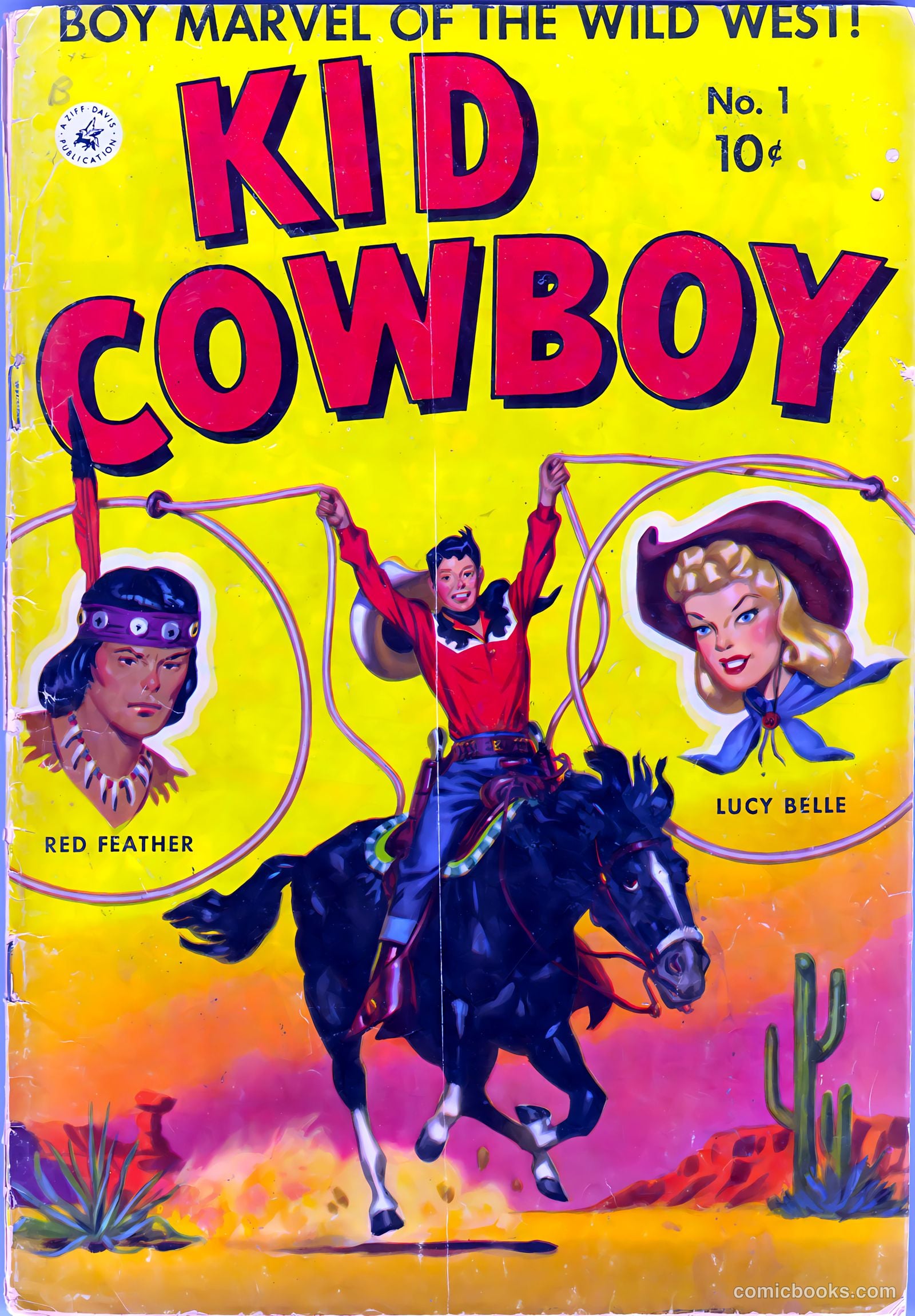
☆ Be the first to review + Add to your collection — Join freeKid Cowboy #1 marks the debut of the Kid Cowboy character and his Pawnee blood-brother Red Feather — an original fictional Western hero partnership introduced at the height of the early-1950s Golden Age Western comics boom. The issue also carries the earliest known cover work by John Buscema on a Western title, giving collectors a rare window into the pre-Marvel career of one of the medium's most significant artists. As one of a handful of Ziff-Davis titles popular enough to outlast the publisher's brief comics experiment, Kid Cowboy's origin issue stands as the foundation of a series that survived its original publisher, making it a notable artifact of the era's turbulent comics marketplace. The book's blending of fictional frontier heroes with non-fiction back-up features on real historical figures — Wild Bill Hickok, Billy the Kid, and Custer's Last Stand — reflects a storytelling convention common to early-1950s Westerns, using the genre's mythology to anchor young readers in American history.
"Wild Bill Hickok" kicks off in Kid Cowboy #1 (1950), a 10-cent Western gem where a young boy raised by an Indigenous woman after a wagon train massacre is reunited with his father's brother, Bill Dix, and his wife Martha. With a sharpshooter's reputation and a fierce sense of justice, he carves a name for himself in the frontier. The story unfolds through art by Bob Brown, with a striking cover by John Buscema.
A foundling raised by the Pawnee tribe as "Straight Nose" discovers his true identity as a white settler—and must navigate the collision between his two worlds. Now known as Randy Dix, the young man channels his Indian skills and fierce sense of justice to become a legendary frontier fighter, earning the feared respect of outlaws and rascals across the West. But as romance and duty pull in different directions, Kid Cowboy faces his greatest test yet: honoring both his past and his future.
In "Kid Cowboy," a young boy raised by an Indian woman after surviving a wagon train massacre grows into a legend known for his lightning-fast shooting and fierce defense of the helpless. Reunited with his father’s brother, Bill Dix, and his wife Martha, he must now navigate a world far removed from the tribe that shaped him.
When a young cowboy and his blood brother, a Pawnee brave, discover a poisoned watering hole that's killed the buffalo his people depend on, they turn to Jenkins, the Indian agent, for help—only to be coldly turned away. Now suspicious when Apache raiders strike the ranches and frame the Pawnee, the kid must track down the truth before his foster father and the valley ranchers wage war on an innocent tribe. With treachery and sabotage threatening to ignite the plains, only fast action and daring can expose Jenkins's sinister plot in "Treachery on the Prairie!"
When Kid Cowboy and Red Feather take shelter from an approaching blizzard at a remote cabin in the Black Timber Mountains, they discover the Corbitt Gang has already seized it—holding Jim Reynolds hostage and threatening the life of his daughter, Susan. Forced to guide the murderous outlaws across treacherous mountain terrain, Kid Cowboy must outwit a desperate criminal who's cornered but far from beaten.
When an old prospector strikes it rich in Carver City, Kid Cowboy steps in to help him transport his gold safely—but a ruthless gang led by Tate Gibbons has other plans. With the aid of his Native American friend, the Kid must outwit the criminals through cleverness and gunplay to protect Sam Grass and his fortune from falling into the wrong hands.
Born in New York City in 1859, William Bonney—known as Billy the Kid—arrived in the West as a young emigrant and quickly adopted its ruthless ways, mastering poker, sharpshooting, and violence before his teens. At just eleven years old, he killed his first victim, Jim Kirk, a blacksmith whose only offense was criticizing the boy's boasts, and by twelve he was already an outlaw living by cowardice and treachery. This is the hard truth behind the myth: a desperate killer who met his violent end at twenty-two, long after he should have faced justice.
ComicBooks.com Value
Show all 10 grades ▾
Find on ebay
Read it digitally
Sell my copy
Have this issue — or a whole collection? Get a fair offer from us, skip the marketplace fees and the hassle.
We Buy Collections ▸History
Ziff-Davis entered comic book publishing in the early 1950s, deliberately avoiding superheroes in favor of genre titles spanning horror, crime, romance, and Westerns, with Superman co-creator Jerry Siegel serving as art director for the comics line. Kid Cowboy #1 was produced with interior art by Ogden Whitney (who signed the lead origin story) and Bob Brown, while John Buscema — then a young freelancer who had recently left the Timely Comics staff and was branching out to multiple publishers — contributed the painted cover, one of his early assignments for Ziff-Davis. The series proved durable enough that when Ziff-Davis largely exited comics in 1953, Kid Cowboy was among the few titles valuable enough to be sold outright to St. John Publications, which continued the numbering from issue #11.
Trivia · 8 facts
- First appearance of Kid Cowboy (Randy Dix / 'Straight Nose') and his Pawnee blood-brother Red Feather, the series' two lead characters, in their original origin story.
- First appearance of supporting cast members Bill Dix (Randy's step-uncle), Lucy Belle Watkins, and other characters indexed in the Grand Comics Database issue entry.
- Cover is a painted work by John Buscema — one of his earliest recorded Western cover credits — produced while he was freelancing for Ziff-Davis after leaving the Timely Comics bullpen circa 1949–1950.
- Interior art on the origin story credited to Ogden Whitney (signed) and Bob Brown; Ziff-Davis Comics was helmed editorially by art director Jerry Siegel, co-creator of Superman.
- The issue contains back-up non-fiction and fictionalized features spotlighting historical figures Wild Bill Hickok, Billy the Kid (Henry McCarty), and General George Armstrong Custer ('Custer's Last Stand'), alongside the fictional lead stories.
- Kid Cowboy ran under Ziff-Davis through approximately ten issues before the publisher sold the title to St. John Publications in 1953; St. John continued the series from issue #11, with no #12 ever published. Ziff-Davis's Kid Cowboy #2 was also separately reprinted as Approved Comics #4.
- Kid Cowboy was one of only a small number of Ziff-Davis comics titles considered popular enough to be sold as a going concern rather than simply cancelled when the publisher withdrew from comics in 1953.
- The series ran 32 full-color pages at a cover price of ten cents, consistent with standard Golden Age Western anthology format.
Cast · 10 characters
Full credits
Reviews
Reader reviews
No reader reviews yet.