
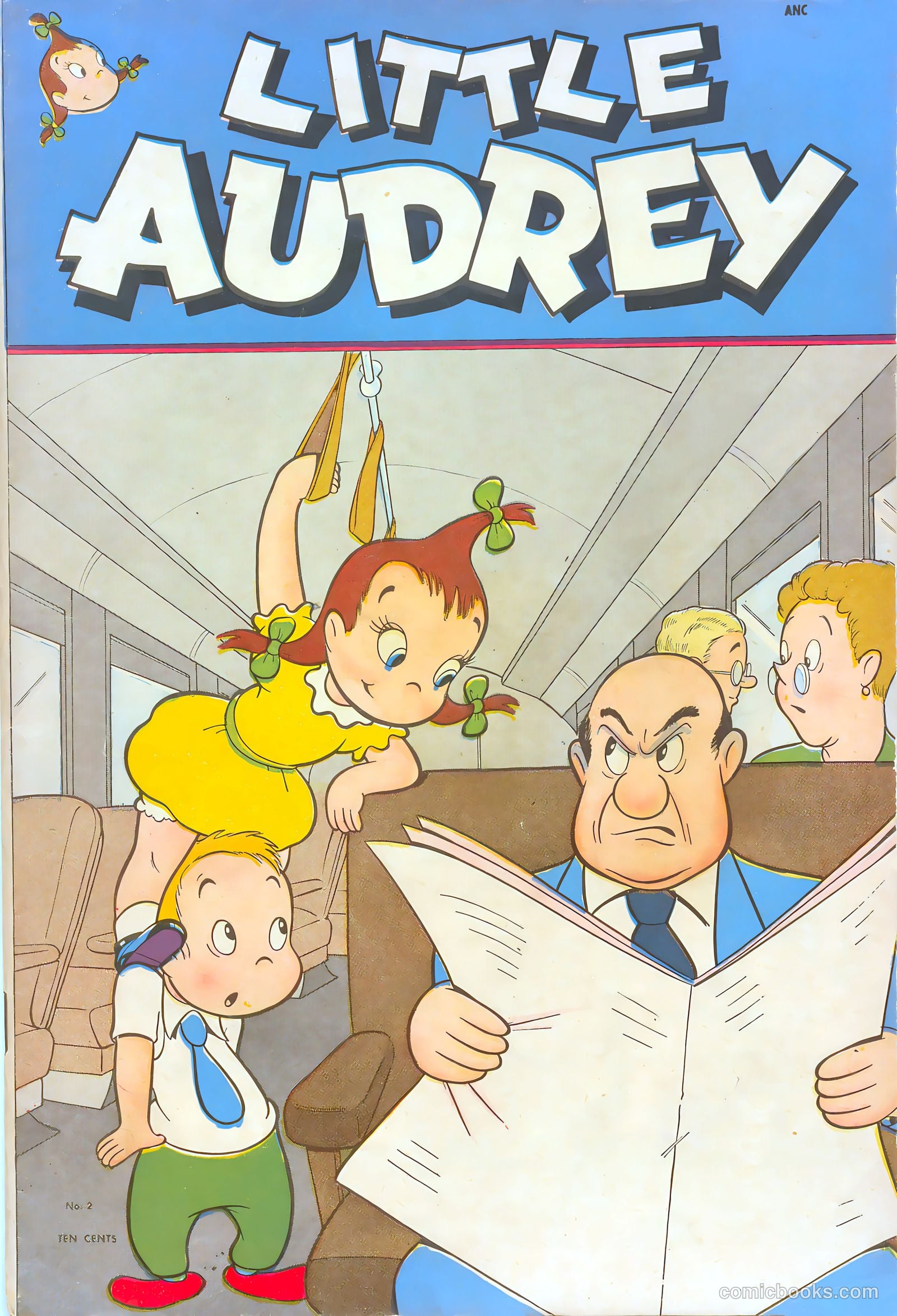
Little Audrey #2
☆ Be the first to review + Add to your collection — Join freeLittle Audrey #2 (St. John, August 1948) is the second comic book appearance of Little Audrey — a character whose origins lie in both American schoolyard folklore and Paramount Pictures' Famous Studios animation — arriving on newsstands just weeks before her first solo theatrical cartoon, Butterscotch and Soda, debuted in July 1948. The St. John run, of which this is an early chapter, holds the often-overlooked distinction of being the true founding comic series for the character: the first 24 issues were published by St. John, not Harvey Comics, which is the publisher most readers today associate with Audrey. As such, this issue belongs to the small, formative batch that established the character's comedic voice in print — domestic situational humor grounded in everyday childhood mischief — before Harvey's later redesign shaped the 'definitive' Audrey most collectors know. Together, the early St. John issues represent the comics medium's initial attempt to translate a brand-new animated property into a sustained humor format for children, predating the era of heavy TV saturation that would later make Harvey's version a household name.
Little Audrey is an anthology collection of humorous comic stories featuring the mischievous title character. "The Painted Dentist" depicts Audrey wishing for something exciting to happen, then using a garden hose to paint a dentist's office and window, resulting in chaos when the dentist emerges covered in paint. Another story shows Audrey as a baby sitter who uses anesthesia gas to put a baby to sleep, then attempts to use a scale as a weighing device before the baby inflates into a large balloon. A third story features Audrey aspiring to be a baby sitter like an experienced friend, then imagining herself as a broadcast ambassador, appearing on London radio, and running for president before seeking a job as a dressmaker's model.
Little Audrey convinces her friend to join her in imagining a monkey as a pet, leading to a playful dispute over ownership when the imaginary creature seems to take on a life of its own. As their shared fantasy blurs the line between imagination and reality, the monkey vanishes—leaving both to grapple with the consequences of their vivid imaginations.
Little Audrey, suffering from a sudden toothache, accidentally causes her own dental emergency by wishing too hard for something to happen. After a series of misadventures—including hitchhiking with her dog Patch, a bizarre encounter with a dentist who’s more interested in comic books than dentistry—she finds herself in the dentist’s office, only to discover the real trouble is just beginning.
Little Audrey stumbles upon an outdoor art exhibit where a mysterious painting seems to be made entirely of gumdrops, prompting her to wonder if it's real art or just a sticky mess. As she peers closer, she’s startled by the strange sight, but her curiosity gets the better of her, and she can’t resist getting involved.
Little Audrey tries to land a job as a child model, claiming she’s experienced because she poses in front of her mirror every day—only to be rejected when her lack of real posing experience becomes clear. After a series of misadventures, she teams up with her friend Patch to start a baby-sitting business, but her enthusiasm quickly clashes with reality when she mistakenly thinks she’s baby-sitting her own house.
ComicBooks.com Value
Show all 13 grades ▾
This exact issue on ebay
Raw / ungraded ▾ $16.39–$74.76 3 listings
Read it digitally
Sell my copy
Have this issue — or a whole collection? Get a fair offer from us, skip the marketplace fees and the hassle.
We Buy Collections ▸History
Little Audrey herself was conceived by Paramount's Famous Studios as a direct replacement for Little Lulu, after Paramount declined to renew its license with creator Marjorie Henderson Buell; veteran animator Bill Tytla designed the character, reportedly drawing inspiration from his own daughter Tammy. The first comic book series launched under St. John Publishing Co. in April 1948, with artwork on the series drawn largely in approximation of the original Famous Studios character designs — Steve Muffati handled most interior stories, while according to cartoonresearch.com, animation historian Milton Knight noted that Vince Fago also drew a significant portion of the St. John run. Issue #2 went on sale June 28, 1948 (per its copyright registration), published on a bimonthly schedule under a Paramount Pictures license, though the early St. John covers did not openly advertise the Famous Studios connection the way later Harvey issues would.
Trivia · 8 facts
- Second comic book appearance of Little Audrey (Audrey Smith), published by St. John Publishing Co., cover-dated August 1948, on sale June 28, 1948.
- Part of the first-ever Little Audrey comic book series (St. John, 1948–1952), which ran approximately 24 issues — a tenure commonly misattributed entirely to Harvey Comics.
- The St. John series was published under a Paramount Pictures license; the copyright on the series was held by Paramount Pictures, Inc.
- Interior stories were drawn in a style approximating Famous Studios' original character designs, with Steve Muffati as the primary story artist and Vince Fago also contributing to the St. John run according to animation historian Milton Knight (via cartoonresearch.com).
- Bill Tytla, the veteran animator who designed Little Audrey for Famous Studios, reportedly drew covers for the St. John series.
- Issue content is humor/domestic genre featuring multiple short stories centered on Little Audrey's everyday childhood mischief, with story beats including a dentist-office scenario.
- Harvey Comics did not publish Little Audrey until it licensed the character in 1952 (beginning with issue #25), later purchasing the full rights in 1958; the St. John issues predate and are entirely separate from the Harvey run.
- A modern reprint collecting this issue exists: 'A Little Audrey Treasury Giant-Size Standard Color Edition' (Retro Comic Reprints #245), which assembles St. John issues #2–12, 14, 15, 22, and 23 for contemporary readers.
Cast · 1 character
Reviews
Reader reviews
No reader reviews yet.