
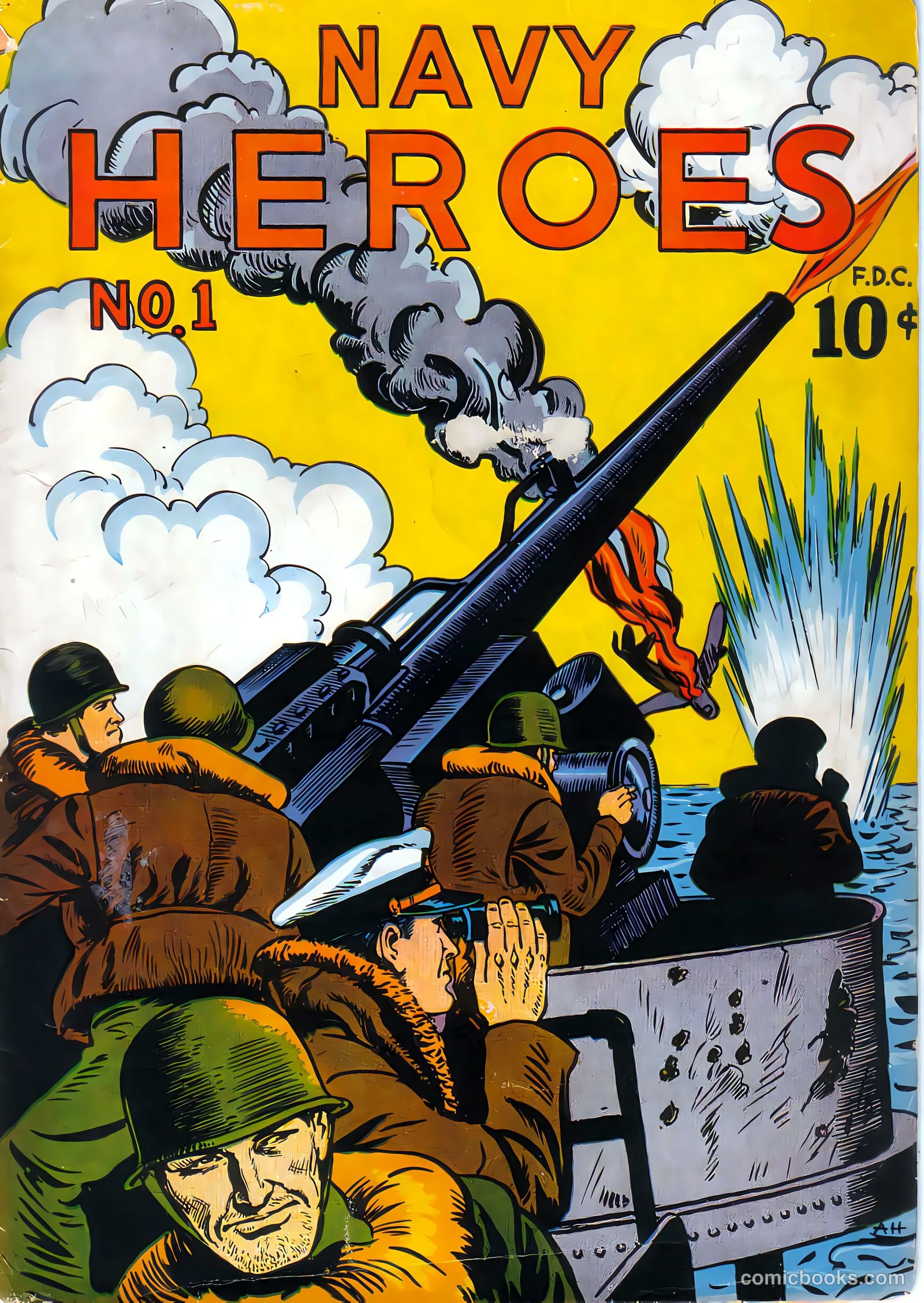
Navy Heroes #1
☆ Be the first to review + Add to your collection — Join freeThe issue contains at least one story featuring naval combat during World War II, focusing on the Battle of the Coral Sea and the attack on Pearl Harbor. The main narrative follows sailors aboard a damaged ship fighting to survive after Japanese bombardment, with crew members attempting rescue operations in the water. The issue also includes a biographical account of Chief Boatswain Edwin J. Hill, U.S.N. (Deceased), who sacrificed his life by remaining aboard his ship to move it away from other vessels during the attack, prioritizing his crew's safety over his own survival.
Commander Cassin Young is blown from the bridge of the USS Vestal by an explosion during the Japanese attack on Pearl Harbor, but he swims back through burning waters to rejoin his crew and take command of the stricken ship. With quick thinking and determination, Young works to save the Vestal from being pulled down alongside the nearby USS Arizona. This true account captures one sailor's courage under fire on December 7, 1941, and the honor that followed.
Seaman James R. Ward gave his life during the attack on Pearl Harbor, staying behind in the twisted wreckage of the U.S.S. Oklahoma's gun turret to guide his trapped comrades to safety through the smoke and darkness. This true account of sacrifice and duty honors the sailor for whom a destroyer escort was later named, serving as a reminder of the cost of freedom and the spirit of those who fought in the Pacific.
When Machinist's Mate Robert R. Scott reported for duty aboard the U.S.S. California in Pearl Harbor, he was living his navy dream—but on December 7, 1941, that dream turned into a test of courage as Japanese bombs rained down on the harbor. As his shipmates fled to safety, Scott refused to abandon his post, choosing instead to keep the ship's guns supplied with ammunition even as the vessel took a torpedo hit. His sacrifice at age twenty-three exemplifies the kind of heroism that inspired a destroyer escort vessel to bear his name.
Lieutenant Donald K. Ross rose through the ranks to earn his commission, but his true test came when his ship faced catastrophic damage and he found himself repeatedly entering the blazing dynamo rooms to keep the vessel operational. Blinded, exhausted, and rescued multiple times, Ross refused to abandon his post until finally ordered out by a superior—a display of devotion that earned him the Medal of Honor alongside several other commendations for his service.
Born in Austria, Peter Tomich immigrated to America and found a home in its promise—so much so that he enlisted in the Navy after becoming a naturalized citizen. When his ship, the U.S.S. Utah, came under attack at Pearl Harbor, Tomich remained at his post in the engineering plant, ensuring all boilers were secured and all personnel evacuated before the vessel capsized. His selfless final act earned him the Congressional Medal of Honor and a legacy that would live on in the hearts of his fellow sailors.
Chief Boatswain Edwin J. Hill valued his ship above all else, and when attack struck, his resourcefulness drove him to take command—ordering men to cut the anchor lines and guide the vessel toward open water while he swam to his own ship to release the anchors and move her to safety. Facing explosions and overwhelming odds, Hill's selfless dedication to his duty became the stuff of legend, earning him the Congressional Medal of Honor and ensuring his name would live on aboard the U.S.S. Hill.
When the U.S.S. Arizona came under attack, Lieutenant Commander Fuqua rushed to the quarter-deck to answer the call of duty—only to be knocked unconscious by a massive explosion. Upon regaining his senses, he rallied to direct firefighting efforts and rescue operations, refusing to abandon ship until the very last moment when it became clear the vessel could not be saved. His extraordinary leadership and courage under fire earned him the nation's highest honor: the Congressional Medal of Honor.
When Japanese forces attack the naval air station at Kaneohe Bay, Aviation Chief Ordnance Man John W. Finn seizes a training gun to defend against enemy strafing, and despite suffering wounds, refuses to leave his post—first continuing to fire on attackers, then supervising the re-arming of returning American planes. His extraordinary courage under fire earns him the Congressional Medal of Honor and, in time, a commission as Lieutenant (J.G.). This account celebrates the real heroism of those who stood their ground during the assault on Pearl Harbor.
ComicBooks.com Value
Show all 15 grades ▾
Find on ebay
Read it digitally
Sell my copy
Have this issue — or a whole collection? Get a fair offer from us, skip the marketplace fees and the hassle.
We Buy Collections ▸