
Out of the Shadows #8
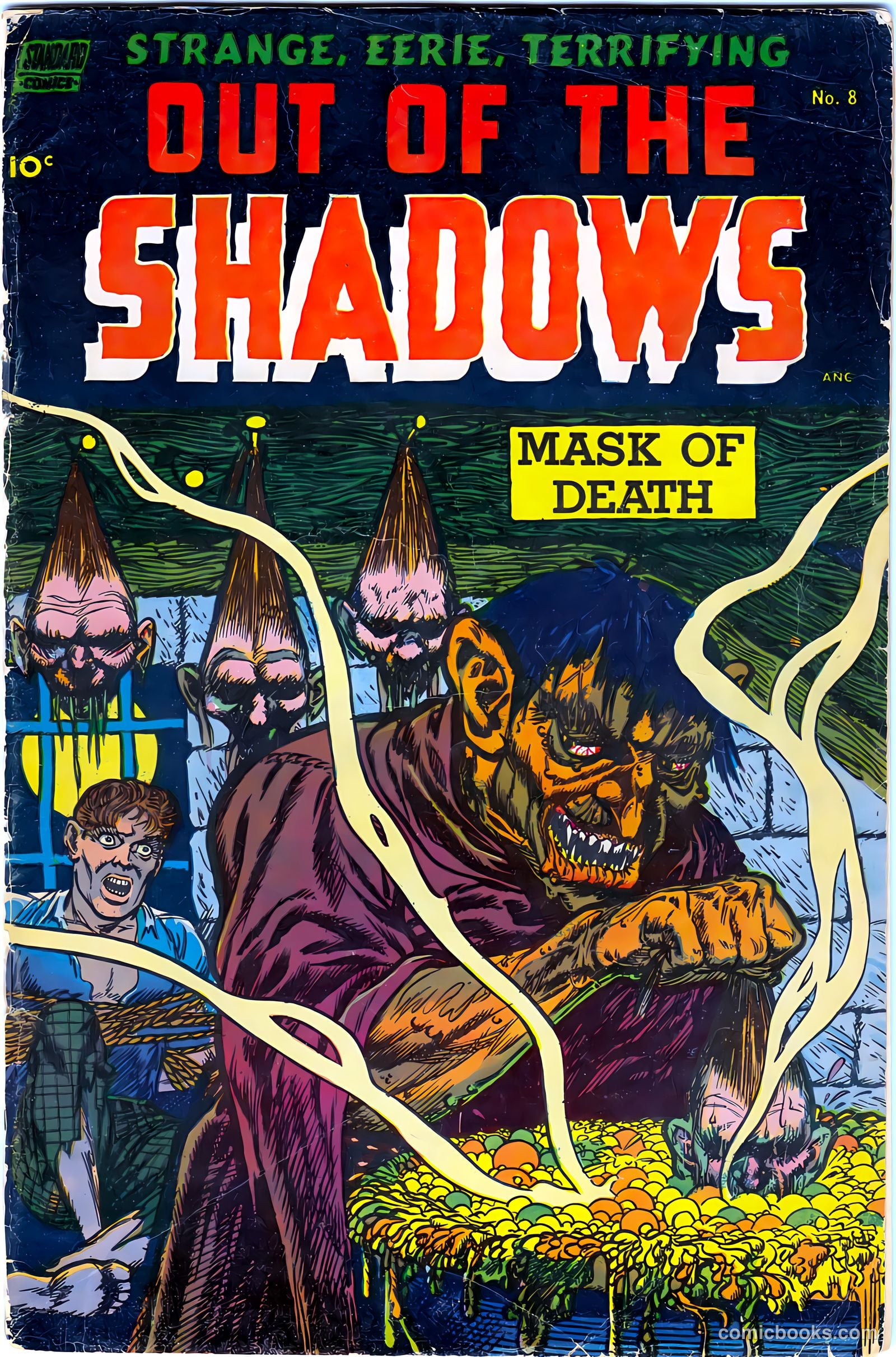
☆ Be the first to review + Add to your collection — Join freeOut of the Shadows #8 stands as one of the most talked-about covers in the pre-Code horror era, with its shrunken-head image by Jack Katz drawing enough attention from collectors and historians that it has been cited among the top pre-Code horror covers of the period. The issue is a representative artifact of the brief window — roughly 1952 to 1954 — when virtually every American publisher was racing to produce explicit horror titles before the Comics Code Authority brought that era to a close. As part of Standard/Pines's flagship horror series, it showcases the company's genuine artistic ambition, pairing a memorably grotesque cover with interior work from artists who would go on to significant careers elsewhere in the medium. Its lead story, 'The Drums of Cajou,' also reflects the era's characteristic willingness to draw on Haitian voodoo mythology as horror shorthand, a storytelling trope whose cultural assumptions have since been critically re-examined.
In "The Drums of Cajou," the eerie rhythms of Haitian voodoo drive a chilling tale of vengeance and control, as the witch doctor Cajou enslaves the beautiful Lora, turning her into a zombie to exact a long-held grudge against his enemy Neal. With the witch doctor dead and his dark spell broken, Lora’s fate hangs in the balance as the forces of the past threaten to unravel. George Roussos handles both art and inks for the story, while Jack Katz delivers the haunting cover.
In "The Drums of Cajou," a voodoo witch doctor with a deadly grudge uses ancient rituals to turn the beautiful Lora into a zombie, forcing her to carry out a vengeance against her former adversary, Neal. As the drums of Cajou echo through the night, the line between the living and the dead grows dangerously thin—until the witch doctor himself is hunted down and slain.
A mansion on St. Charles Avenue in New Orleans becomes a place of torment after a tragic murder and suicide in 1854—the jealous sweetheart who strangled Alfred Lagay takes her own life in the house, and their restless spirits begin appearing each night. General Beauregard's daughter attempts to make the mansion her home, but as tenant after tenant flees in terror, the haunted house earns its sinister reputation. What began as a lovers' tragedy becomes a curse that refuses to die, until the mansion itself is finally demolished in 1930.
When a window washer's friend falls mysteriously ill after visiting a doctor in a towering skyscraper, his desperate search for answers leads him down a nightmare spiral of missing persons, cryptic encounters, and a terrifying discovery he can't convince anyone to believe. Jim's frantic attempts to expose the sinister truth only drive him deeper into danger, as the line between reality and madness begins to blur in this chilling tale of corruption and the cost of curiosity.
In "The Man in the Mirror," the quiet Mr. Blane stumbles upon an ancient druid mirror, unaware it holds a malevolent genie. As the mirror’s dark influence takes hold, Blane is pulled into a relentless cycle of violence and dread—until he faces the chilling truth of what he must do to break free.
A young mining engineer trapped in darkness during a cave-in begins to see horrifying phantom faces that haunt him long after his rescue, blurring his perception of reality in ways that lead to tragic consequences. As Frank struggles to distinguish the monsters from his trauma against the ordinary people around him, his grip on sanity unravels with each moment of darkness, pulling him deeper into a nightmare he cannot escape.
In the suffocating dark of a collapsed mine, Frank Wayne’s mind fractures under the weight of terror, leaving him haunted by shadows and phantoms. Once a man of reason, he now flees the law after a violent act born of panic, his every step shadowed by the monsters only he can see.
A philosopher seeking affordable lodging discovers the house comes with an unwanted tenant—a restless ghost that appears on his first night. When Athenodorus follows the spectral figure into the yard, a mystery unfolds that leads him to unearth secrets buried in the very ground beneath the haunted home. Based on an account from ancient Rome, this is one of history's oldest recorded ghost stories.
ComicBooks.com Value
Show all 18 grades ▾
Find on ebay
Read it digitally
Sell my copy
Have this issue — or a whole collection? Get a fair offer from us, skip the marketplace fees and the hassle.
We Buy Collections ▸History
Out of the Shadows launched in July 1952 under the Standard Comics brand — the comic-book publishing arm of Robert Pines's company, which had been operating in pulp magazines since the late 1920s and had found Golden Age superhero success with The Black Terror and The Fighting Yank. By the early 1950s, as superhero popularity faded, Pines followed the industry-wide shift into horror and suspense titles. Issue #8 went on sale February 24, 1953, per copyright records, and was published under the Visual Editions Inc. indicia — one of the several corporate shells Standard/Pines used. No specific editor is credited in surviving records, and script credits for the interior stories have not been definitively established by comics historians.
Trivia · 8 facts
- Published by Standard Comics (Pines/Visual Editions Inc.) on February 24, 1953 (April 1953 cover date), as issue #8 of the series that ran from 1952 to 1954 (#5–#14).
- Cover — a shrunken-head image — penciled and inked by Jack Katz; it has been cited by pre-Code collectors as one of the standout horror covers of the era.
- Lead story 'The Drums of Cajou' (8 pages) drawn by George Roussos: a Haitian voodoo witch doctor named Cajou zombifies a woman named Lora to settle a vendetta, before being hunted down and killed.
- Second major story 'The Mask of Death,' drawn by Jerry Grandenetti, follows a window cleaner who discovers a vampire doctor's office and faces a fatal showdown when no one believes him.
- Additional interior stories include 'The Man in the Mirror' (inked by Rocco Mastroserio), 'Masque for a Monster' (art by Charles Sultan), a half-page 'Devil's Mansion' piece attributed to Vince Colletta, and a text story 'Plunge into Doom' by Margaret Isbell.
- Art identifications for the issue were performed by scholar Jim Vadeboncoeur, Jr., one of the leading authorities on Golden Age interior-art attribution.
- A story from this issue was reprinted in Tales Too Terrible to Tell #1 [Second Printing] (New England Comics, May–June 1993), a pre-Code horror revival anthology that also included an original Tick story by Ben Edlund.
- The series, and this issue specifically, drew on the deep roster of talent Standard/Pines employed, which across the run included George Roussos, Jerry Grandenetti, Alex Toth, Nick Cardy, Reed Crandall, Jack Katz, Ross Andru, and Rocco Mastroserio.
Full credits
Reprints
Reprinted in Seduction of the Innocent! #5 (1986), Seduction of the Innocent! #6 (1986), Tales Too Terrible to Tell #1 (1989)
Reviews
Reader reviews
No reader reviews yet.