
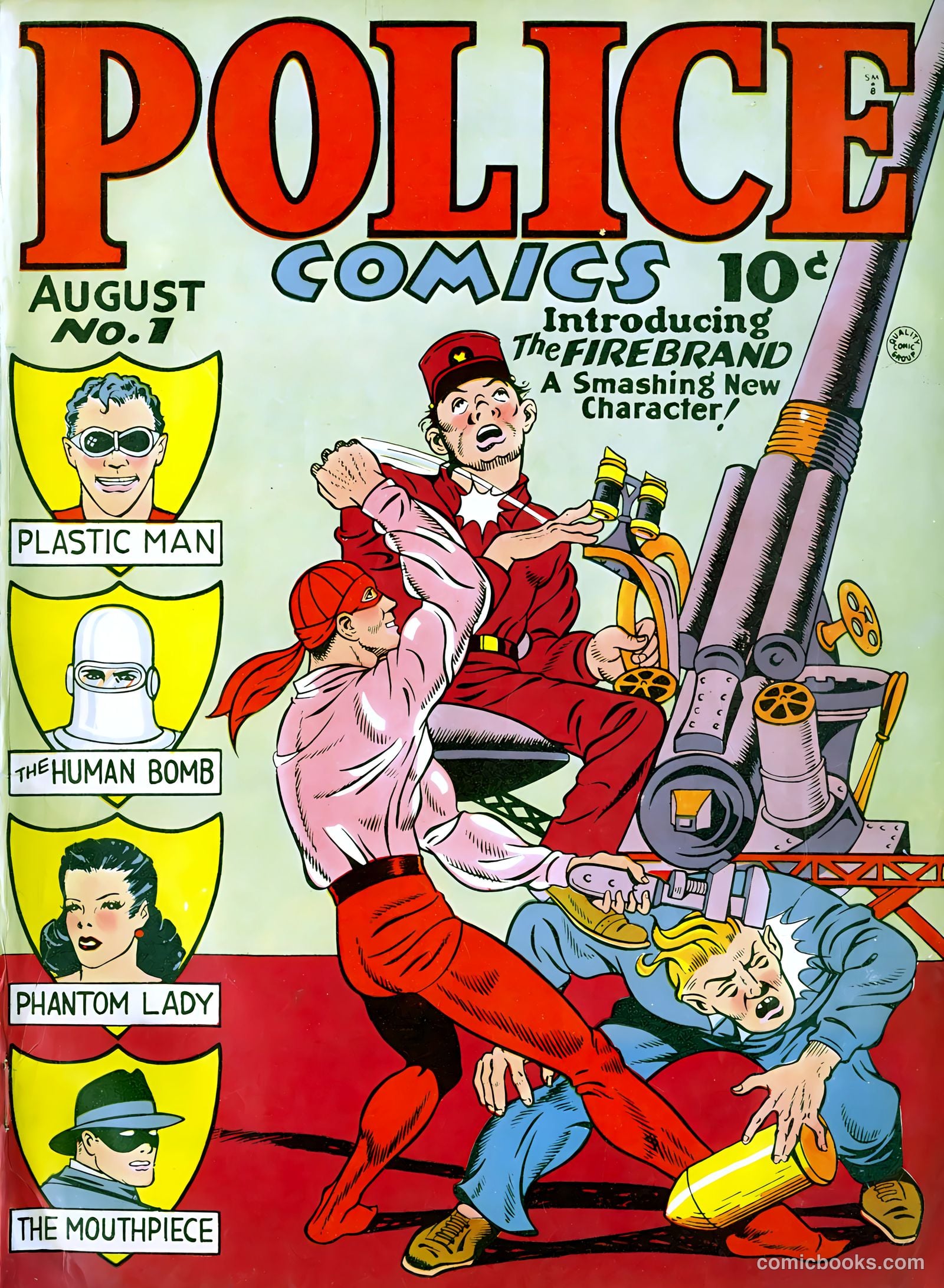
Police Comics #1
☆ Be the first to review + Add to your collection — Join freePolice Comics #1 is one of the most densely consequential debut issues of the Golden Age, introducing five distinct characters in a single 68-page anthology: Plastic Man, Phantom Lady, the Human Bomb, Firebrand, and the Mouthpiece, along with #711, Chic Carter, and others. Jack Cole's Plastic Man broke new creative ground by weaving slapstick visual invention into superhero action — a reformed crook whose rubbery body became a vehicle for page-layout experimentation that influenced the medium's visual vocabulary for decades. Phantom Lady, as one of the earliest female costumed adventurers, would go on to inspire Alan Moore's Silk Spectre in Watchmen, while Plastic Man became a Justice League mainstay whose humor-infused heroism anticipated the self-aware superhero genre. The issue also demonstrates the breadth of Quality Comics' ambitions under publisher Everett 'Busy' Arnold — crime, adventure, patriotic action, and outright comedy coexisted in a single issue at a moment when the anthology format was still defining what superhero comics could be.
Police Comics #1 is an anthology featuring multiple superhero stories. "Eagle Evans: Flier of Fortune" by Clark Williams depicts a pilot who gambles against death with his candid camera while fighting for democracy against enemy saboteurs in Cyranis. "The Firebrand" introduces a new character battling criminals on rooftops and in urban settings. "Phantom Lady" by Arthur Peddy follows Sandra Knight, a debutante senator's daughter, as she investigates a uranium explosive plot involving sabotage at a testing field in Maryland, uncovering a conspiracy with enemy agents. The issue also features additional characters including Plastic Man, The Human Bomb, and The Mouthpiece among its rotating cast of crime-fighting heroes.
Rod Reilly, a wealthy society playboy, conceals his true identity as the vigilante Firebrand—a masked crusader who wages war against organized crime from the rooftops of the city. When a brutal extortion racket targeting workers threatens an innocent steeplejack, Firebrand springs into action, but his interference with the criminals puts him at odds with the police, who view him as a dangerous outlaw. Now, hunted by both lawmen and the sinister forces behind the scheme, Firebrand must uncover the conspiracy before those responsible slip away.
In "The Attack of Ali Harid," Evans and Snap find themselves in a tense standoff after being arrested for photographing enemy activity in Cyranis—accused of violating a treaty with the enigmatic Ali Harid. With the help of a Libyan prince, they break free and race to stop Harid’s looming plans before it’s too late.
In "The Legend of the Black Baron," Chic investigates the suspicious death of art collector Curtis Randall, whose will sparks a deadly game of deception. When a spectral suit of armor appears to claim the fortune, Chic uncovers a plot orchestrated by Randall’s brother Harvey, the masked Black Baron, whose true identity is revealed in a shocking twist.
In this 1941 origin tale from Police Comics #1, Eel O'Brian’s life takes a wild turn when a vat of acid spills on him during a getaway, transforming him into a stretchable, shape-shifting hero. Now freed from his criminal past, he uses his newfound powers to turn the tables on his former gang—though his journey from rogue to protector is just beginning.
In "The Redemption of Steele Kerrigan," a man released from prison after serving time for a crime he didn’t commit finds himself framed again—this time by the very gang he once helped, now holding his former love, Betty, hostage. With the law quick to believe the worst, Kerrigan must prove his innocence before it’s too late.
In "The Alien Smuggling Racket," D.A. Perkins takes on a dangerous underworld operation in 1941, donning a mask and cape to infiltrate a brutal smuggling ring led by the ruthless Peg-Leg Friel. With refugees hidden inside fish carcasses and the city’s justice hanging in the balance, the Mouthpiece must outwit a cunning criminal before he slips away.
ComicBooks.com Value
Show all 20 grades ▾
More listings for this title
Read it digitally
Sell my copy
Have this issue — or a whole collection? Get a fair offer from us, skip the marketplace fees and the hassle.
We Buy Collections ▸History
Police Comics #1 went on sale May 14, 1941 (cover-dated August 1941), published by Quality Comics under its indicia imprint Comic Magazines Inc., with editorial oversight by editor Edward Cronin and general manager Everett 'Busy' Arnold. Arnold built Quality's creative stable partly through the Eisner & Iger packager studio, which contributed material to the title, alongside freelancers like Jack Cole, who had already been working with Arnold on The Spirit and Smash Comics before devising Plastic Man specifically for this new anthology. The issue's cover by Gill Fox spotlighted Firebrand — Quality's intended lead character — but it was Cole's six-page Plastic Man origin story, tucked further into the book, that proved to be the title's commercial engine, eventually bumping Firebrand off the cover starting with issue #5. The Human Bomb was written and drawn by Paul Gustavson, who contributed under the pen name 'Paul Carroll' in this issue, a credit that caused some later bibliographic confusion resolved only through interviews with Gustavson's son Terry Gustafson.
Trivia · 10 facts
- On-sale date: May 14, 1941 (cover date: August 1941); published by Quality Comics (indicia: Comic Magazines Inc.); edited by Edward Cronin; cover by Gill Fox.
- First appearance and full origin of Plastic Man (Patrick 'Eel' O'Brian): petty thief Eel O'Brian is shot and doused with an unidentified chemical during a robbery at Crawford Chemical Works, awakens in a monastery with elastic powers, and resolves to fight crime — written and drawn entirely by Jack Cole.
- First appearance of Phantom Lady (Sandra Knight), daughter of U.S. Senator Henry Knight, created by the Eisner & Iger studio and drawn by Arthur Peddy; the story presents her as already active and does not tell her origin.
- First appearance and origin of the Human Bomb (Roy Lincoln): chemist Roy Lincoln swallows explosive compound 27-QRX to prevent its theft by Nazi spies, gaining the ability to detonate objects by touch; written and drawn by Paul Gustavson (credited in this issue as 'Paul Carroll').
- First appearance of Firebrand (Rod Reilly), scripted by S. M. Iger and drawn by Reed Crandall; Firebrand was Quality's intended flagship and held the cover spotlight through issue #4, before Plastic Man eclipsed him beginning with issue #5.
- First appearance of #711 (Dan Dyce), written and drawn by George E. Brenner: lawyer Dan Dyce takes the rap for a friend, ends up imprisoned for life, and resolves to fight crime from inside prison walls — a concept unusual enough that the character's name derives from a craps term.
- First appearances of The Mouthpiece (Bill Perkins, by Fred Guardineer), Chic Carter (attributed variously to Will Eisner or Vernon Henkel — see flagged), Eagle Evans (Witmer Williams), Steele Kerrigan (Al Bryant), and Dick Mace also debut in this issue.
- The issue has been reprinted multiple times: in Don Maris Comics (c. 1974), DC's Plastic Man Archives Vol. 1 (1999), DC's Millennium Edition: Police Comics #1 (2000), DC's Facsimile Edition: Police Comics #1 (2024), DC Finest: Plastic Man: The Origin of Plastic Man (2025), and PS Artbooks Softee: Police Comics Vol. 1 (2025).
- After Quality Comics ceased publication in 1956 and DC acquired its characters, Plastic Man was revived in his own DC series in 1966; all surviving Police Comics #1 characters — Plastic Man, Phantom Lady, Human Bomb, and Firebrand — were eventually folded into DC continuity, most prominently as members of the Freedom Fighters.
- Alan Moore partly based Silk Spectre in Watchmen (1986) on Phantom Lady, according to statements by Moore documented in multiple comics-history sources.
Cast · 17 characters
Full credits
Reprints
Reprinted in The Great Comic Book Heroes #[nn] (1965), DC Special #15 (1971), Comic Reprints #[5] (1974), Secret Origins of the Super DC Heroes #[nn] (1976), Secret Origins of the Super DC Heroes #[nn] (1976), A Smithsonian Book of Comic-Book Comics #[nn] (1981), Gigant #5/1984 (1984), Gigant #5/1984 (1984), The Comic Book in America: An Illustrated History #[nn] (1989), Plastic Man Archives #1 (1999), Millennium Edition: Police Comics No. 1 #[nn] (2000), Plastic Man 80-Page Giant #1 (2004), Roy Thomas Presents Classic Phantom Lady Softee #1 (2013), Roy Thomas Presents Classic Phantom Lady #1 (2013), DC Comics Graphic Novel Collection #45 (2015), Police Comics 1 (Facsimile Edition) #[nn] (2024), DC Finest: Plastic Man: The Origin of Plastic Man #[nn] (2025), PS Artbooks Softee: Police Comics #1 (2025)
Key issues in Police Comics
Reviews
Reader reviews
No reader reviews yet.