
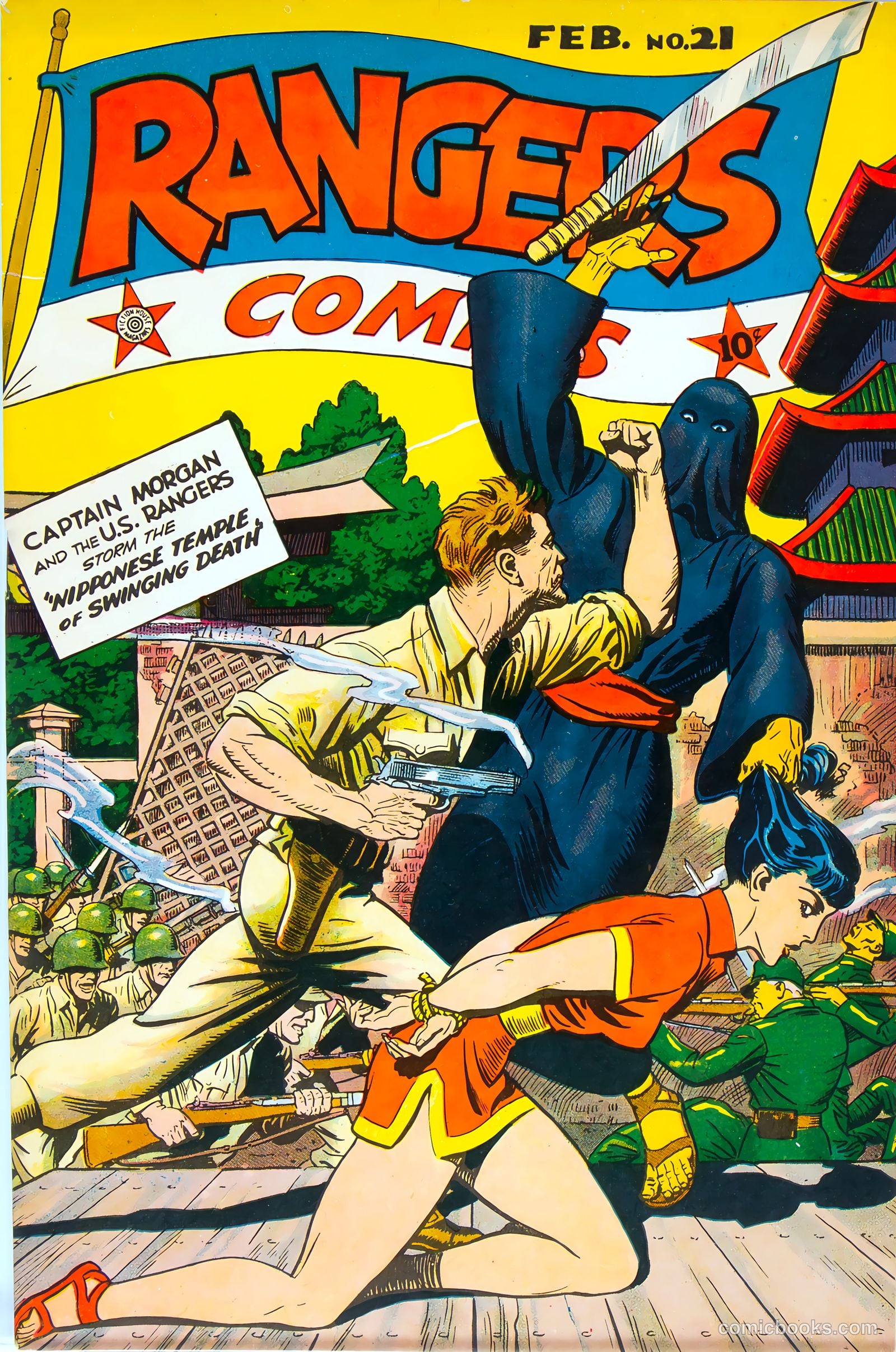
Rangers Comics #21
☆ Be the first to review + Add to your collection — Join freeRangers Comics #21 (cover-dated February 1945) marks the debut of Firehair, one of Fiction House's most distinctive Golden Age heroines and a genuinely unusual figure for the era: a Western protagonist rather than a jungle or costumed adventurer, whose stories centered on defending a Native American tribe against predatory white settlers. The character ran continuously through Rangers Comics #65 in 1952 — anchoring the book for the entirety of its latter run — and eventually earned her own solo title, demonstrating a sustained reader appetite for female-led Westerns at a time when both genre and gender combination were rare. The issue also signals Fiction House's editorial pivot toward frontier adventure as wartime themes began to recede, making it a meaningful hinge point in the publisher's history. Scholars and critics have since revisited Firehair as an early, if culturally complicated, example of a female action lead in genre comics.
Rangers Comics #21 is an anthology featuring multiple stories. The lead story, "Captain Morgan and the U.S. Rangers," follows Captain Morgan confronting a giant blue-skinned villain at a temple with swinging death traps. Another feature, "Still Life," recounts the survival ordeal of the American war freighter Richard Hovey after it was torpedoed in the Arabian Sea, detailing how the crew and passengers improvised a water still to survive in lifeboats before rescue. Additional stories include "Captains Courageous," about Captain Evensen commanding the SS Benjamin Contee while transporting 1,800 prisoners of war, and "Helping Hands," chronicling Mary Williams' experience working in a Chicago ordnance plant during wartime, where an industrial accident resulted in the loss of her hand and subsequent compensation.
When a young woman and her father arrive in the frontier West seeking a fresh start, they join a wagon train heading into dangerous territory—only to have it ambushed by ruthless raiders posing as Native Americans. Left for dead after the massacre, she's rescued by members of Chief Tehama's tribe, who recognize the attack as a false-flag operation designed to frame them, and must decide whether to protect her or cast her out. As she struggles to recover her identity and memories, her fate becomes entangled with the tribe's fight for justice against those who would use her people as a scapegoat.
Professor Broussard, the werewolf hunter, witnesses a young woman plunge from an observatory tower and narrowly escapes the same fate when a mysterious moonstone mesmerizes him into following her path. Drawn into the dark truth behind the stone's hypnotic power and its connection to the Creatures of the Moonbeams, Broussard must uncover who—or what—commands the stone before it claims another victim. A supernatural tale of otherworldly influence and the price of curiosity in the grip of forces beyond reason.
ComicBooks.com Value
Show all 20 grades ▾
Find on ebay
Read it digitally
Sell my copy
Have this issue — or a whole collection? Get a fair offer from us, skip the marketplace fees and the hassle.
We Buy Collections ▸History
The issue was edited by Jean M. Press and published by Fiction House's comics arm under its indicia publisher Flying Stories Inc., with interior art contributed by Lee Elias, George Tuska, Lily Renee, and Jack Keller. Elias, a British-American artist who had joined Fiction House in 1943 fresh from study at Cooper Union and the Art Students League of New York, drew the Firehair feature and became the character's principal artistic architect. The character's script was credited to the house pseudonym 'John Starr,' later identified by some researchers as John Mitchell, though the actual writer of the debut installment has never been definitively confirmed. Joe Doolin, Fiction House's signature cover artist throughout the 1940s, supplied the issue's cover.
Trivia · 8 facts
- First appearance and origin of Firehair (real name Lynn Cabot, alias 'Princess Smith'), a Western heroine raised by the Dakota/Sioux tribe after her Boston businessman father is murdered by outlaws — cover-dated February 1945.
- Firehair's amnesiac origin: she does not recover her identity as Lynn Cabot until Rangers Comics #24, making issue #21 the start of a multi-issue arc.
- Art on the Firehair feature by Lee Elias; additional interior art by George Tuska, Lily Renee, and Jack Keller.
- Cover by Joe Doolin — a bondage-style 'good girl art' image consistent with Fiction House's visual brand of the period.
- Edited by Jean M. Press; published by Fiction House (indicia publisher: Flying Stories Inc.).
- The issue is a 52-page, full-color anthology also containing segments: U.S. Rangers, The Werewolf Hunter, The Sea Devil, Beachheads of the World, Glory Forbes Vigilante, and The Phantom Falcons.
- Firehair ran in every issue of Rangers Comics from #21 through #65 (May 1952) and headlined her own Fiction House quarterly title across 11 issues from Winter 1948 to Spring 1952 (later retitled Pioneer West Romances featuring Firehair for issues #3–6).
- The origin story from Rangers Comics #21–23 was reprinted with incorporated artwork in Firehair Comics #2 (Winter 1949–1950), demonstrating the material's ongoing importance to the character's mythology.
Full credits
Reprints
Reprinted in Firehair Comics #1 (1948), Firehair #1 (2025)
Reviews
Reader reviews
No reader reviews yet.