
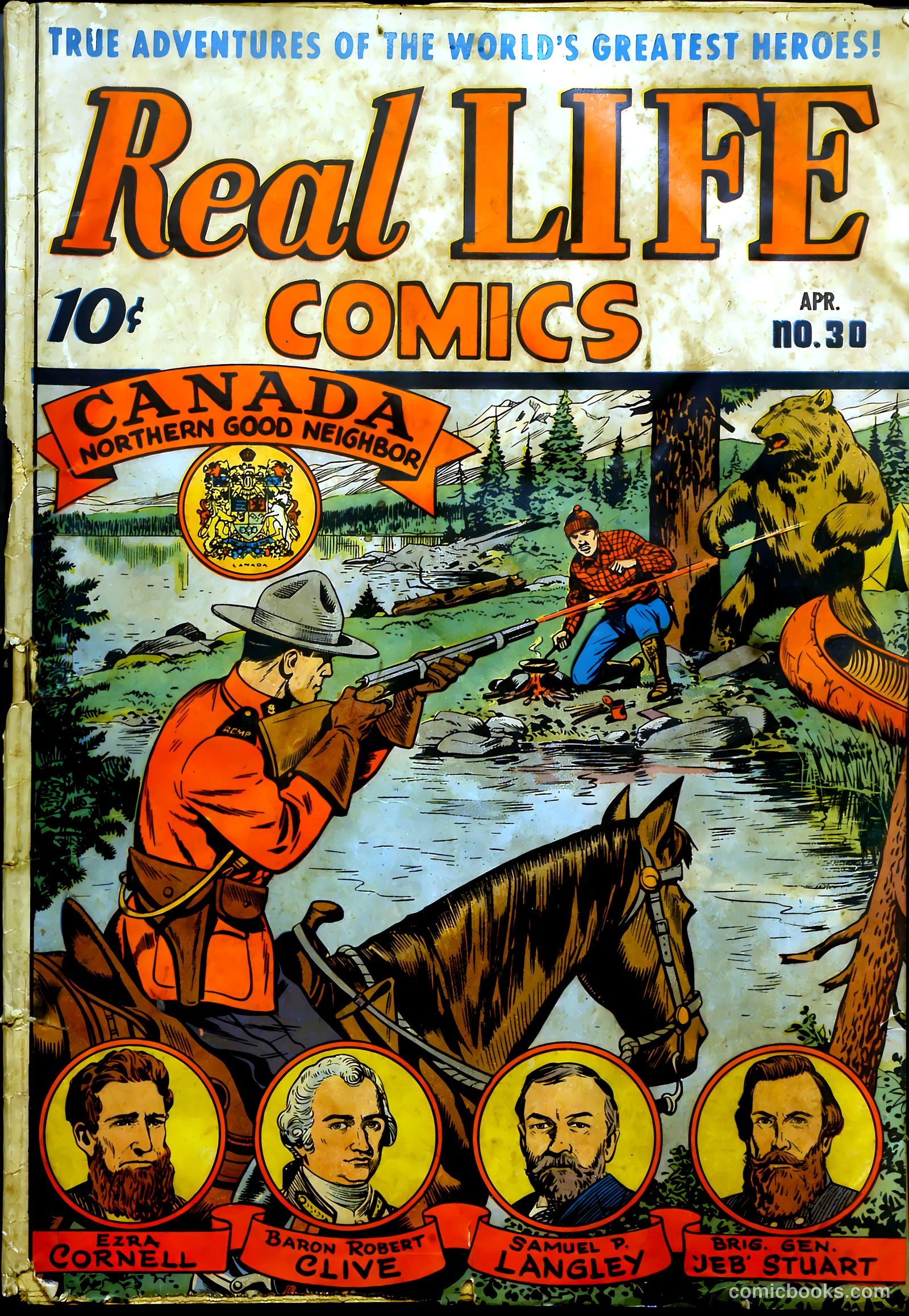
Real Life Comics #30
☆ Be the first to review + Add to your collection — Join freeThis anthology issue features two biographical stories of historical figures. The first, "Canada—Northern Good Neighbor," depicts the exploits of early Canadian explorers and military figures including Ezra Cornell, Baron Robert Clive, Samuel P. Langley, and Brigadier General Jeb Stuart in frontier and colonial settings. The second story chronicles Samuel P. Langley's pursuit of astronomy, his work at the Alleghany Observatory, and his contributions to astronomical science, followed by Baron Clive's military service in England and India, where he confronts French forces and concerned officers about his extended absence from home and the pressing need to secure settlements in India.
Next door to the United States stands Canada—a nation with a colorful past stretching back to John Cabot's voyage in 1497 and Samuel de Champlain's founding of Quebec, through its evolution from French colony to British dominion and finally to a sovereign member of the Commonwealth. This illustrated history traces Canada's journey from the fur trade and the Hudson's Bay Company through its peaceful 4,000-mile unguarded border with the U.S., then into World War II, where Canadian forces fought on multiple fronts while the home front produced weapons, medical breakthroughs like penicillin, and engineering marvels like the Alcan Highway. A tribute to Canada as both a steadfast peacetime neighbor and formidable wartime ally, with glimpses of the cooperation between North American nations and the Commonwealth that shaped the modern world.
When the Civil War erupts in 1861, young cavalry officer Jeb Stuart earns the attention of Gen. Robert E. Lee with his daring reconnaissance raids deep into Union territory—locating enemy positions, capturing supplies, and seizing vital intelligence that turn the tide of battle. Over the following years, Stuart becomes the legendary cavalry commander of the Confederacy, leading increasingly bold operations from Virginia to Pennsylvania, until his dangerous career is cut short in 1864.
Samuel P. Langley devoted his brilliant career to astronomy before turning his keen mind to the dream of human flight in his later years. This biography traces his relentless pursuit of a heavier-than-air craft—from early experiments that drew mockery from the scientific establishment, through years of failure on the Potomac River, to a triumphant moment in 1896 when his aerodrome finally sustained itself in the air. Watch as a visionary scientist races against time to prove that powered flight is possible, even as his funding dwindles and rivals emerge.
During the brutal New Georgia campaign in the Pacific, Captain Bob Scott leads his depleted company—weakened by malaria and combat fatigue—up a heavily fortified Japanese position on Morrison and Johnson Hill. When a sudden banzai charge threatens to overrun his men, Scott stands his ground despite a shattered carbine, rallying his soldiers through grenades and fierce resistance to turn back the assault. His courageous stand becomes a turning point in the campaign, helping secure the strategic hill and paving the way for broader victory in the region.
Baron Robert Clive rises from a restless East India Company clerk to a soldier-statesman whose daring leadership reshapes Britain's destiny in India. As French forces vie for control of the subcontinent and local rulers shift their allegiances, Clive must navigate both military campaigns and political intrigue—from his bold defense of Arcot to his efforts to secure English settlements against mounting threats. This sweeping biography chronicles how a man of vision and courage becomes the instrument of empire, drawing the admiration of Parliament and the respect of princes across the Indian landscape.
A Swiss-born naturalist driven since childhood to study the living world, Louis Agassiz pursued his passion for zoology despite his father's insistence on a practical career in medicine. Through brilliant glacial research that reshaped scientific understanding, groundbreaking work with fossils, and electrifying classroom instruction, he became one of the most celebrated and beloved professors of his era, eventually bringing his revolutionary vision to Harvard and inspiring countless students across two continents. His relentless dedication to unlocking nature's secrets ultimately consumed his health, but left an indelible mark on the world of natural science.
In 1858 New York, a young doctor named Stephen Smith witnesses the devastating toll of typhoid in the city's filthy tenements and sets out to force change—first confronting negligent landlords, then battling corrupt political machines, and finally rallying his medical colleagues and the press to expose the truth. Smith's relentless crusade spans decades, from his initial survey work through his fight to pass the state's first public health laws, transforming a disease-ridden city into one equipped to protect its citizens through sanitation and regulation.
A young farmer's son in 1824 New York faces an impossible choice between finishing school and helping his desperate family—but Ezra Cornell finds a way to do both, launching him on a path that will transform American communication. From inventing telegraph machinery alongside Samuel Morse to founding a revolutionary technical university, Cornell's relentless courage and vision reshape an entire industry and leave behind two enduring monuments to American progress.
ComicBooks.com Value
Show all 12 grades ▾
Find on ebay
Read it digitally
Sell my copy
Have this issue — or a whole collection? Get a fair offer from us, skip the marketplace fees and the hassle.
We Buy Collections ▸Full credits
Reprints
↩ Reprints Real Heroes #7 (1942)
Key issues in Real Life Comics
Reviews
Reader reviews
No reader reviews yet.