
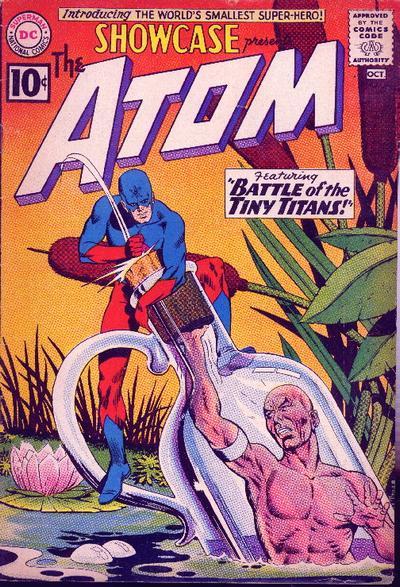
Showcase #34
☆ Be the first to review + Add to your collection — Join freeShowcase #34 marks the debut of Ray Palmer as the Silver Age Atom, making it one of the foundational issues of DC's Silver Age revival alongside the reintroductions of the Flash and Green Lantern. The issue introduced a new template for the shrinking-hero archetype, grounding its power in hard-science concepts — white dwarf star matter, molecular compression, atomic physics — at a moment when DC was deliberately engineering a more scientifically literate kind of superhero. The character's tryout here was successful enough to earn Palmer his own title within a year, cementing Showcase's role as DC's premier incubator for the Silver Age. Jean Loring's simultaneous debut also established the recurring tension between Ray's scientific heroism and his personal life that would thread through decades of storytelling, culminating most dramatically in Identity Crisis (2004).
In "Birth of the Atom!", scientist Palmer pushes the limits of his reducer lens in a desperate bid to save himself and his students during a cave-in—only to discover he can shrink to the size of an atom without harm. Written by Gardner Fox and brought to life by Gil Kane’s dynamic art and Murphy Anderson’s sharp inks, this 1961 Showcase tale explores the mind-bending possibilities of microscopic scale. The cover by Gil Kane and Murphy Anderson captures the moment of transformation with striking precision.
In "Birth of the Atom!", scientist Palmer faces a life-or-death moment when he and his students are trapped in a cave-in, forcing him to risk using his experimental reducer lens on himself. With no other choice, he shrinks to the size of an atom—only to discover he can survive and move through the world at that scale. The story follows his unexpected transformation and the strange new reality he finds himself in.
In "Battle of the Tiny Titans!", Kulan Dar, a prisoner from the planet Julnar, finds himself stranded on Earth and manipulated into committing crimes by the petty criminal Carl Ballard. When the Atom intervenes, he not only frees Kulan Dar from Ballard’s control but also clears the name of Jean Loring’s client, who was wrongly accused.
ComicBooks.com Value
Show all 21 grades ▾
This exact issue on ebay
CGC 6.5 ▾ $435–$1,120 5 listings
CGC 5.5 ▾ $575 2 listings
CGC 5 ▾ $400–$403 2 listings
CGC 4.5 ▾ $365–$450 3 listings
CGC 4 ▾ $375–$450 2 listings
CGC 3 ▾ $235–$300 3 listings
CGC 2 ▾ $210–$230 3 listings
Raw — FN ▾ $779–$798 2 listings
Raw — VG ▾ $199–$449 8 listings
Raw — GD ▾ $115–$360 6 listings
Raw — GOOD ▾ $139–$150 2 listings
Raw / ungraded ▾ $72–$650 16 listings
More listings for this title
Read it digitally
Sell my copy
Have this issue — or a whole collection? Get a fair offer from us, skip the marketplace fees and the hassle.
We Buy Collections ▸History
Editor Julius Schwartz had already been planning a reimagined Atom before fan-historian Jerry Bails wrote to him in December 1960 proposing an update to the Golden Age Al Pratt; Schwartz had already commissioned Gil Kane to develop costume sketches, which Kane produced on large illustration boards, initially without the belt that Schwartz later insisted be added. Writer Gardner Fox — who had co-created the original Atom, the Justice Society, and the Justice League — brought his science-fiction instincts to the origin, anchoring the character's power in the real astrophysics of white dwarf star matter rather than in unexplained mutation or magic. The hero's civilian name was a deliberate inside joke: Schwartz contacted science-fiction editor and early fandom pioneer Raymond A. Palmer, who stood just four feet tall due to a childhood spinal injury, and asked permission to use his name — an act that also directly inspired one of the Atom's signature abilities.
Trivia · 8 facts
- First appearance and complete origin of the Silver Age Atom (Ray Palmer), cover-dated October 1961 (on sale July 27, 1961), published by National Comics (DC).
- First appearance of Jean Loring, Ray Palmer's girlfriend and attorney, who debuts as a career-driven lawyer establishing her own practice in Ivy Town.
- Created by writer Gardner Fox and penciler Gil Kane, with inks by Murphy Anderson and editing by Julius Schwartz.
- The issue contains two Atom stories: 'Birth of the Atom!' (origin) and 'Battle of the Tiny Titans!' (first costumed adventure featuring alien Kulan Dar).
- Ray Palmer's name is a tribute to real-life science-fiction editor and early fandom pioneer Raymond A. Palmer; Schwartz reportedly phoned Palmer for permission, and that conversation inspired the Atom's ability to travel through telephone lines.
- Gil Kane designed Ray Palmer's facial features after Hollywood actor Robert Taylor.
- The issue's origin story established that Palmer's shrinking technology — a lens cut from a white dwarf star fragment — caused all other objects to explode after compression, with Palmer uniquely immune, a mystery addressed in later stories.
- Reprinted multiple times: the full issue in The Atom Archives Vol. 1; 'Battle of the Tiny Titans!' in DC 100-Page Super Spectacular #14 (1973); 'Birth of the Atom!' in Secret Origins of the Super DC Heroes; and both stories collected again in the black-and-white Showcase Presents: The Atom Vol. 1 (2007), which also includes Showcase #35–36 and The Atom #1–17.
Cast · 2 characters
Full credits
Reprints
Reprinted in Big Boss #67 (1962), 80 Page Giant Magazine #8 (1965), Superserien spesialnummer #[nn] (1967), 100-Page Super Spectacular #DC-14 (1973), Secret Origins #2 (1973), Flash #28 (1976), Secret Origins of the Super DC Heroes #[nn] (1976), Secret Origins of the Super DC Heroes #[nn] (1976), Big Boss #35 (1978), DC Special Blue Ribbon Digest #9 (1981), More Secret Origins Replica Edition #1 (1999), The Atom Archives #1 (2001), Showcase Presents: The Atom #1 (2007), Justice League: Cry for Justice #2 (2009), DC Universe Secret Origins #[nn] (2012), DC Universe: Secret Origins #[nn] (2013), DC Comics Graphic Novel Collection #50 (2016), Legends of Tomorrow: The Atom #[nn] (2018), Marvila, la Mujer Maravilla #81
Key issues in Showcase
Reviews
Reader reviews
No reader reviews yet.