
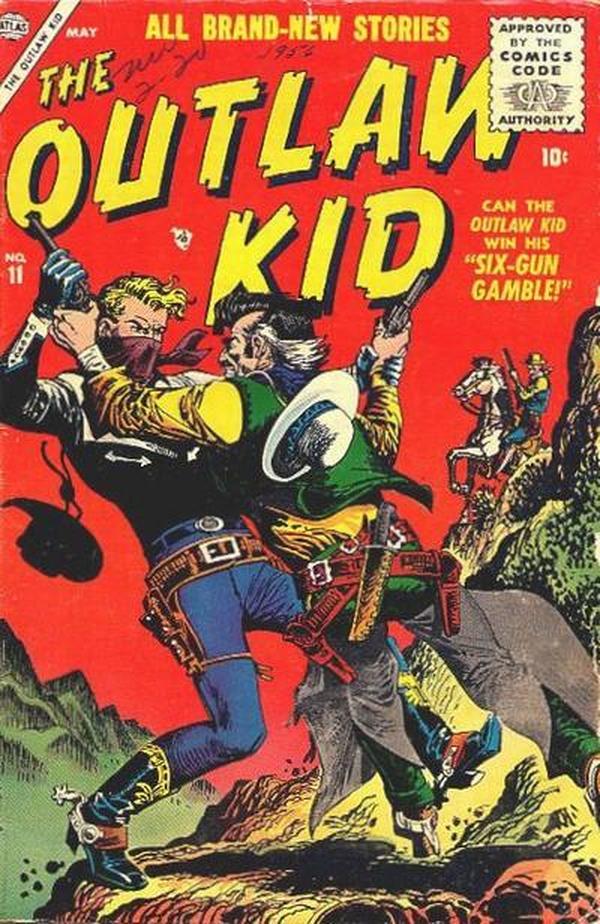
The Outlaw Kid #11
☆ Be the first to review + Add to your collection — Join freeOutlaw Kid #11 (cover-dated May 1956) holds a specific place in the history of the Comics Code Authority era: the Marvel Fandom database identifies it as the first Atlas/Marvel Western comic in which a character is shot dead on the page since the CCA was instituted in 1954, representing a documented, incremental relaxation of the Code's restrictions on lethal violence in genre comics. Beyond that narrative milestone, the issue is the one comics historian Ken Quattro singled out by number when analyzing Doug Wildey's artistic growth across the 19-issue run — the point at which Wildey's cinematic compositional instincts crystallized into consistent, professional-grade page design, with panels staged and lit like film scenes rather than flat illustration. Together these two facts make the issue a small but concrete marker on two timelines: the story of how the CCA's early rigidity quietly softened, and the story of how one of Atlas's most gifted cartoonists found his mature voice.
ComicBooks.com Value
This exact issue on ebay
More listings for this title
Read it digitally
Sell my copy
Have this issue — or a whole collection? Get a fair offer from us, skip the marketplace fees and the hassle.
We Buy Collections ▸History
The Outlaw Kid series launched in September 1954 under Atlas Comics — Marvel's 1950s publishing iteration — with Stan Lee writing and editing all installments and Doug Wildey providing pencils and inks on three to four stories per issue. The character himself, Lance Temple, descended conceptually from the earlier Atlas masked Western hero Texas Kid and was part of Lee's stable of 'Kid' Western protagonists that also included Kid Colt, Rawhide Kid, and Two-Gun Kid. By issue #11, Wildey — a self-taught artist who had honed his craft at Street & Smith and Youthful Magazines before joining Atlas — was deeply enough into the assignment that historian Quattro could point to it as the issue where his cinematic staging, chiaroscuro inking, and illustrative character realism achieved reliable, recurring polish.
Trivia · 7 facts
- Published by Atlas Comics (Marvel's 1950s imprint); cover-dated May 1956, on-sale January 26, 1956.
- Written by Stan Lee (editor-in-chief); interior art on lead stories penciled and inked by Doug Wildey; backup story by Victor Carrabotta; cover by Joe Maneely.
- According to the Marvel Fandom Database, this issue contains the first on-panel shooting death in an Atlas/Marvel Western comic since the Comics Code Authority was implemented in 1954 — a signal that CCA-era restrictions on lethal violence were beginning to ease.
- Comics historian Ken Quattro, in his study 'The Forgotten Art of Doug Wildey,' specifically cites this issue by number as demonstrating how Wildey's cinematic influences had matured into a consistent professional style — panels composed like film scenes, realistic character rendering, and varied inking from fine etched strokes to bold solid blacks for dramatic chiaroscuro.
- Supporting cast appearances include Zane Temple (Lance's blinded father), Belle Taylor (Lance's romantic interest), and Thunder (the Kid's horse), alongside antagonists Ed Corwin and hired gun Ace Barclay.
- The issue was reprinted as The Outlaw Kid Vol. 2, #4 (1970–71), part of the 30-issue Marvel reprint run that became the company's best-selling Western reprint title of that era.
- Doug Wildey later became best known for creating and designing the 1964 Hanna-Barbera animated series Jonny Quest; his Outlaw Kid work is widely regarded by critics as the comics foundation on which his distinctive cinematic visual style was built.
Full credits
Reprints
Reprinted in The Outlaw Kid #11 (1957), The Outlaw Kid #4 (1971), The Ringo Kid #9 (1971), Ranchserien #1/1974 (1974), The Outlaw Kid #20 (1974), The Outlaw Kid #24 (1974), The Rawhide Kid #148 (1978)
Reviews
Reader reviews
No reader reviews yet.