
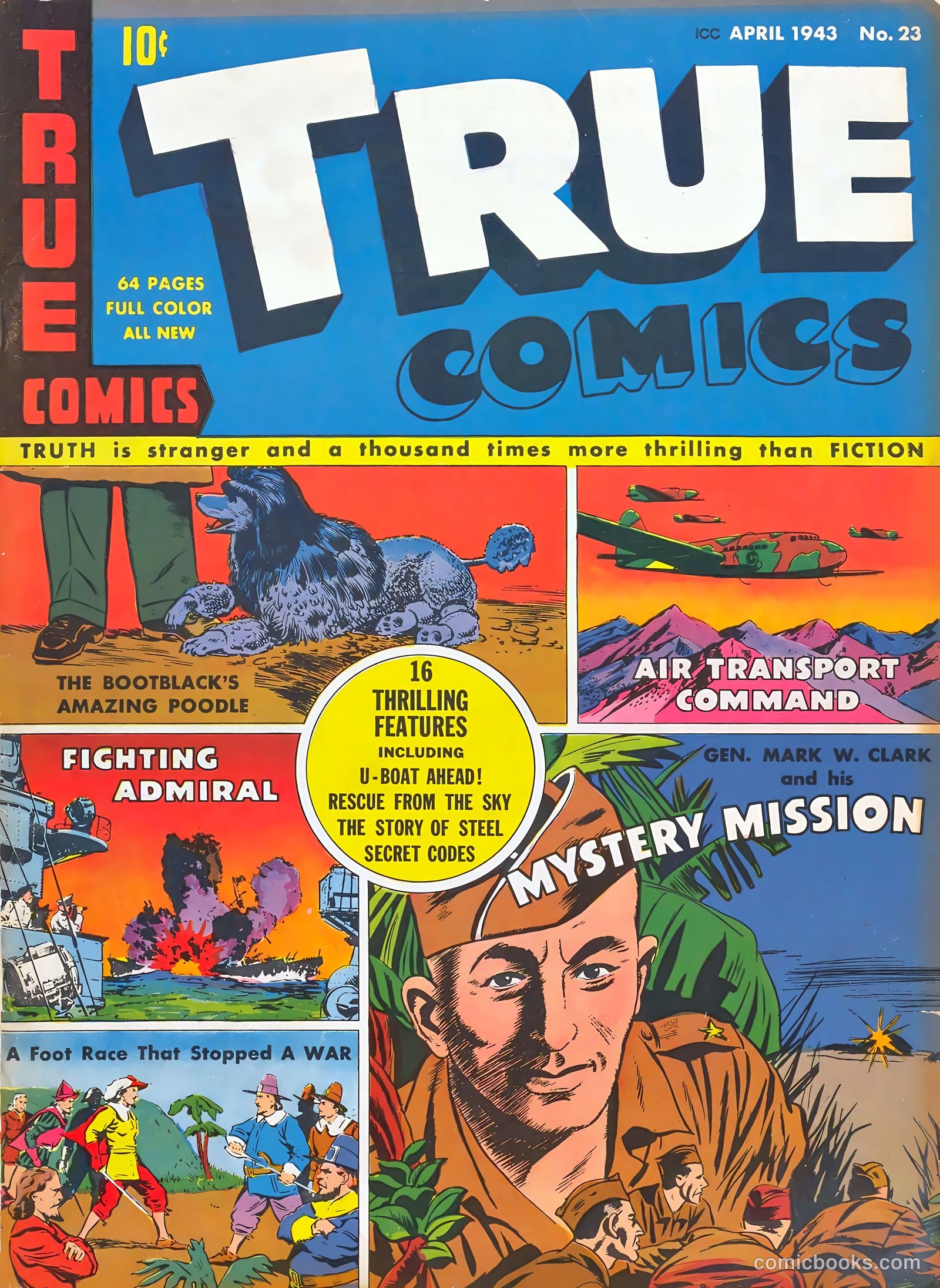
True Comics #23
☆ Be the first to review + Add to your collection — Join freeTrue Comics #23 (April 1943) holds its place as a representative artifact of the Golden Age's most ambitious experiment in educational comics: a series that deliberately deployed the comic-book format to deliver factual biography, military history, and civics to wartime American children, at a moment when the medium was under sustained cultural attack. As the final issue in the longer 68-page format before the series trimmed its page count beginning with #24, it marks a quiet production watershed within the run. The series it belongs to directly inspired DC Comics' Real Fact Comics and helped legitimize non-fiction sequential art as a viable genre, a lineage that runs forward to modern graphic journalism. Its wartime content — profiling Allied commanders, American military technology, and resistance movements — made it a document of the home-front propaganda landscape as much as a comic book.
This anthology issue contains multiple true stories presented as factual features. "A Race That Stopped a War" recounts how a footrace on the island of St. Martin in 1647 settled a territorial dispute between French and Dutch colonists, with each side claiming the island and agreeing to resolve the conflict through a running race. "Full-Time American: William T. Morris, One Man War Plant" profiles Morris, a factory worker in an oceanside basement facility who produces ship steering wheel spokes as a vital wartime contribution, earning recognition as a patriotic American laborer. Additional shorter features and humorous anecdotes fill the issue, including jokes and true incidents submitted by readers.
General Mark Wayne Clark undertakes a perilous secret mission to North Africa, infiltrating Nazi-dominated Algeria to gather vital intelligence and make contact with French allies who might aid an invasion. Disguised and hunted by Vichy police, Clark and his team must obtain detailed invasion plans while evading capture—information that will prove crucial to the largest overseas offensive in history. This is the thrilling true account of how one general's courage behind enemy lines helped pave the way for Allied victory in North Africa.
Flying from Britain's coastline, Air-Sea Rescue Squadron No. 7 answers urgent calls to pull downed pilots from the English Channel and enemy waters—a task that demands split-second flying skill and unflinching courage under fire. When a Hurricane pilot goes down off Folkestone and later a bomber crashes in a storm near Dieppe, the squadron's crews risk everything in their nimble Lysanders and powerful Sunderlands to bring men home before the sea or the enemy does. This 1943 account celebrates the real-world heroism of the fliers who turned air-sea rescue into an art of nerve and precision.
Trace iron's journey from ancient meteorites and Egyptian forges through Benjamin Huntsman's revolutionary steel-making secrets to the massive modern mills of Gary, Indiana, where the backbone of industrial civilization is forged. This 1943 account reveals how the discovery and refinement of steel shaped human progress—from tools and weapons to the rails that opened America's frontier and the furnaces now producing vital war material. Follow the transformation of raw ore into the metal that built nations and powers machines of both peace and war.
In 1647, French and Dutch colonists both claim the Caribbean island of St. Martin, and when they meet face-to-face, conflict seems inevitable—until the elders on both sides propose an unconventional solution: a footrace to determine the boundary line between their territories. The two sides select their fastest walkers and let them compete, only to discover that fortune favors the swift in ways no one anticipated, leading to an unexpected path toward coexistence.
Discover the origins and evolution of Britain's flag through three legendary crosses—from St. George's red cross that guided English crusaders and explorers like Sir Francis Drake, to St. Andrew's saltire when Scotland joined the crown, and finally St. Patrick's cross when Ireland was added under George III. This illustrated history traces how a simple religious symbol became the Union Jack, a banner that carried British power across continents and united an empire spanning one-third of the Earth's surface.
Uncle Dan Callaghan rises from naval aide to President Roosevelt to commanding officer of the USS San Francisco, a cruiser tasked with defending the Solomon Islands against a vastly larger Japanese fleet in November 1942. As the outnumbered American force engages the enemy, Callaghan leads his ship directly into the thick of battle, scoring devastating hits on Japanese warships and refusing to yield ground. This true account captures a pivotal naval engagement that shifted the war's momentum in the Pacific and cemented Callaghan's legacy among America's greatest naval heroes.
During World War II, General Eisenhower stages an audacious deception: he publicly purchases winter underwear through his aide, knowing Nazi spies will intercept the news and draw the wrong conclusion about Allied military movements. When German intelligence learns of the winter supplies, they become convinced the Allies plan to attack in the frozen north—Norway—and redirect their defenses accordingly. The true Allied invasion, launched in North Africa in November 1942, catches the enemy completely unprepared, thanks to one general's clever use of misdirection and a humble suit of flannel.
William T. Morris transforms his Long Island basement into a one-man war plant, crafting vital ship steering wheel spokes in his "second shift for Uncle Sam" after his regular workday ends. This 1943 profile celebrates how one American's dedication to home-front manufacturing demonstrates the power of free labor working for a free nation.
The U.S. Army Air Transport Command grew from experimental cargo flights in the 1910s to a global lifeline for Allied forces during World War II, ferrying vital supplies, aircraft, and even entire hospitals across continents to battle-torn fronts. This non-fiction account traces the command's evolution from its peacetime origins through the lessons of early war setbacks, showing how American pilots and engineers answered the urgent call to keep distant battlefields equipped and operational. From the Sahara Desert to Alaska, the Air Transport Command proved that speed and air power could overcome the limitations of traditional supply lines in modern warfare.
When an American bomber spots a Nazi U-boat lurking beneath the surface near a vital convoy route, it triggers a coordinated hunt involving destroyers and the Canadian corvette OAKVILLE. As the damaged submarine is forced to the surface, Lieutenant Lawrence and Petty Officer Powell board the crippled vessel to secure it—a dangerous mission that tests their nerve against desperate German sailors and the submarine's own self-destruct mechanisms. This action-packed account captures the Allied naval struggle to protect wartime shipping lanes from enemy submarines.
A Parisian bootblack and his clever poodle work the bridges of the Seine with an ingenious scheme—until the dog is sold to an English gentleman and whisked away to London. When the poodle mysteriously returns to Paris months later, he reunites with his former master and resumes their peculiar partnership, a canine feat that baffled observers for years.
During the American Civil War, Northern intelligence officers intercept a coded message from a Confederate spy—but the jumbled letters seem impossible to crack. "The Picket Fence Code" reveals the ingenious decryption method the Union used to break the cipher, transforming a meaningless string of characters into a legible military dispatch by arranging them like the alternating posts and spaces of a picket fence.
During World War I, a Frenchwoman named Alice DuBois becomes a crucial spy for the Allies while living under German occupation in Belgium, using coded messages hidden on postage stamps to relay vital military intelligence. With the help of trusted friends who assist in writing and delivering her secret correspondence, DuBois risks constant surveillance to uncover enemy shipment plans and military secrets that lead to devastating strikes against German operations. Her courageous work exemplifies the vital role women played in gathering intelligence that turned the tide of the war.
ComicBooks.com Value
Find on ebay
Read it digitally
Sell my copy
Have this issue — or a whole collection? Get a fair offer from us, skip the marketplace fees and the hassle.
We Buy Collections ▸History
True Comics was the brainchild of George J. Hecht, founder of Parents' Magazine, who launched the series in April 1941 as a direct counter to Sterling North's widely-read 1940 broadside calling comic books a 'national disgrace.' Elliott Caplin — brother of Li'l Abner creator Al Capp — served as managing editor of the series during its wartime years, with Ralph O. Ellsworth as art editor; the editorial board was unusually credentialed, including historian David S. Muzzey and public-opinion pioneer George Gallup. Issue #23 appeared in April 1943 while Caplin was still at the helm, before he left to serve in the Navy in the South Pacific, after which the managing editorship changed hands.
Trivia · 8 facts
- Published April 1943 by The Parents' Magazine Press Division of The Parents' Institute, Inc., as part of the ongoing True Comics series (April 1941–August 1950, 84 issues total).
- Issue #23 is the last issue in the original extended 68-page format; beginning with #24, the series dropped to 60 pages, and later to 52 pages.
- A scarcer variant edition of #23 exists with 'TRUE Picture-Magazine' on the cover, distinct from the standard 'TRUE Comics' cover edition — one of at least a dozen issues known to have this variant.
- Managing editor at time of publication was Elliott A. Caplin, with Ralph O. Ellsworth serving as art editor; the series ran under the direct authority of publisher George J. Hecht.
- The series carried an editorial advisory board of academics and public figures — including historian David S. Muzzey and pollster George Gallup — making it one of the first comic series formally overseen by outside subject-matter experts.
- Content throughout the wartime run (including issues around #23) comprised illustrated biographies of Allied military figures, installments of a multi-part illustrated history of America, profiles of wartime technology and resistance movements, and features on notable athletes and historical figures.
- The series was subsequently reprinted in full-color facsimile by Golden Age Reprints (via CreateSpace/Amazon), making issue #23's contents accessible to modern readers.
- True Comics as a whole spawned direct imitators including DC Comics' Real Fact Comics, cementing its role as the template for Golden Age educational/non-fiction comics.
Reprints
↩ Reprints Extra #[nn] (1942)
Reprinted in Daisy Handbook #2 (1948)
Key issues in True Comics
Reviews
Reader reviews
No reader reviews yet.