
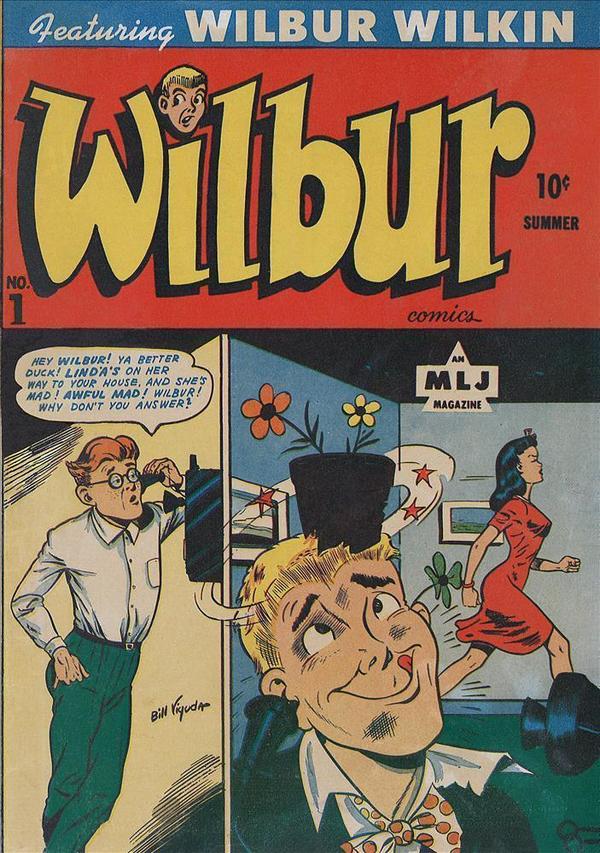
Wilbur Comics #1
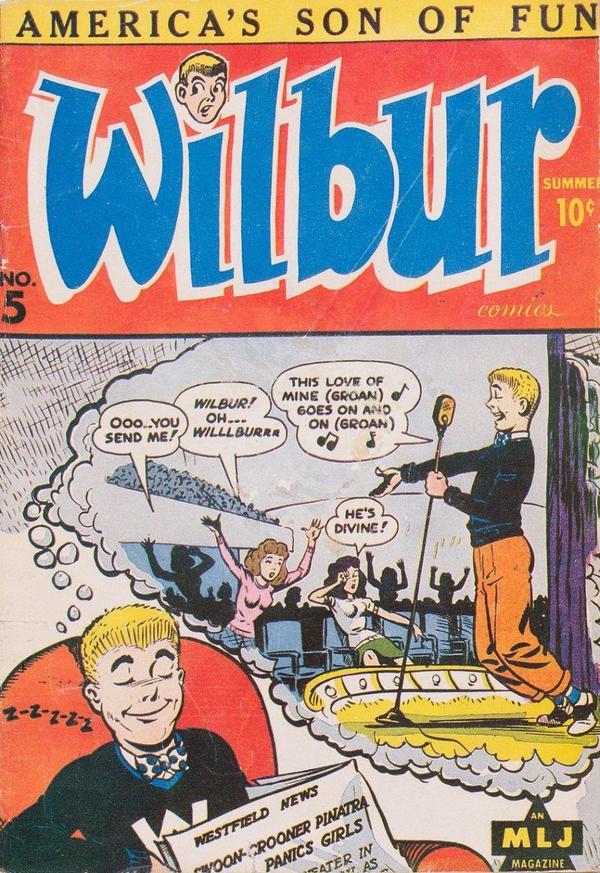
☆ Be the first to review + Add to your collection — Join freeWilbur Comics #1 (Summer 1944) formalized the solo spotlight for Wilbur Wilkin, a teen-humor protagonist who had actually beaten Archie Andrews into print by three months — debuting in Zip Comics #18 (September 1941) before Archie appeared in Pep Comics #22. That chronological curiosity reframes MLJ's teen-humor output as a deliberate parallel experiment rather than a one-character fluke: publisher John Goldwater was simultaneously test-driving multiple Andy Hardy-style figures across his anthology titles, and Wilbur's graduation to his own book proved that the market could sustain more than one lovesick teenager. The series also became the home of Linda Moore and Red Wilson from its very first issue, establishing the core supporting cast that would carry Wilbur through ninety issues and two decades, and it later served as the launch pad for Katy Keene in issue #5 — one of the more consequential character debuts in the entire Archie/MLJ library.
In "Makes a Date," Wilbur lands a job as a bus boy at Club 15, all to afford a tuxedo for his big night out with Anita—little does he know she’s planning to go there herself, unaware of his new role. Bill Vigoda’s art brings the 1944 charm to life, with crisp pencils and inks that capture the quiet tension of a date that’s about to take an unexpected turn.
Wilbur takes a job as a bus boy at Club 15, hoping to borrow a tuxedo for a date with Anita Van Streeter. When she decides to go to the club that same night, Wilbur finds himself serving her—while trying to keep his identity a secret from Mr. Sweeny, who’s already suspicious of his new employee.
Wilbur Comics #1 (1944) — In a lighthearted 1944 humor tale, Arturo, smitten with the music teacher Miss Lawson, impulsively takes up the violin in a bid to impress her—only to accidentally derail the school concert and land himself in the local paper. With Principal Bullpen fuming and the whole school buzzing, Arturo’s musical ambitions take a wildly unexpected turn.
ComicBooks.com Value
Find on ebay
Read it digitally
Sell my copy
Have this issue — or a whole collection? Get a fair offer from us, skip the marketplace fees and the hassle.
We Buy Collections ▸History
Wilbur Wilkin was co-created by writer Harvey Willard (possibly a pseudonym — the name is unverified in secondary sources) and artist Lin Streeter, with MLJ editor Harry Shorten later crediting himself as the creative force behind the concept, describing it as a strip inspired by the radio character Henry Aldrich. Early issues of the solo title were produced under the MLJ Magazines imprint; the publisher's indicia shifted to Archie Comic Publications starting with issue #8, reflecting the company-wide rebranding that followed Archie Andrews' breakout success. Writer Joe Blair and artist Lin Streeter are cited as the storytellers behind the earliest Wilbur material, with Bill Vigoda becoming a key artist on the series in later years.
Trivia · 8 facts
- Wilbur Comics #1 was published in Summer 1944 (on-sale date recorded in the Catalog of Copyright Entries, 1944, registration B632185) under the MLJ Magazines imprint.
- Wilbur Wilkin made his original first appearance in Zip Comics #18 (September 1941), predating Archie Andrews' debut in Pep Comics #22 by roughly three months — making him arguably MLJ's first successful teen-humor character.
- Issue #1 features the first appearances in the title of Linda Moore (Wilbur's initial love interest) and Red Wilson (his best friend), both of whom anchor the series' recurring cast throughout its entire 90-issue run.
- Archie Andrews and Jughead Jones appear in this issue, underscoring the shared-universe overlap between MLJ's teen-humor titles during the mid-1940s.
- The character of Wilbur was created for MLJ by writer Harvey Willard and artist Lin Streeter; editor Harry Shorten later claimed credit for conceiving the concept, citing the popular radio program Henry Aldrich as the primary inspiration.
- The series ran continuously from issue #1 (Summer 1944) through issue #87 (December 1959), went on hiatus, then returned for three final issues (#88–#90) between 1963 and 1965, ending with issue #90 in October 1965.
- Beginning with issue #8, the title's indicia changed from MLJ Magazines to Archie Comic Publications, documenting in real time the publisher's corporate rebranding.
- Archie Comics later reprinted stories from the Wilbur series in its Archie Comics Digest line, giving the material a second life for readers who never encountered the original Golden Age issues.
Cast · 5 characters
Full credits
Key issues in Wilbur Comics
Reviews
Reader reviews
No reader reviews yet.