
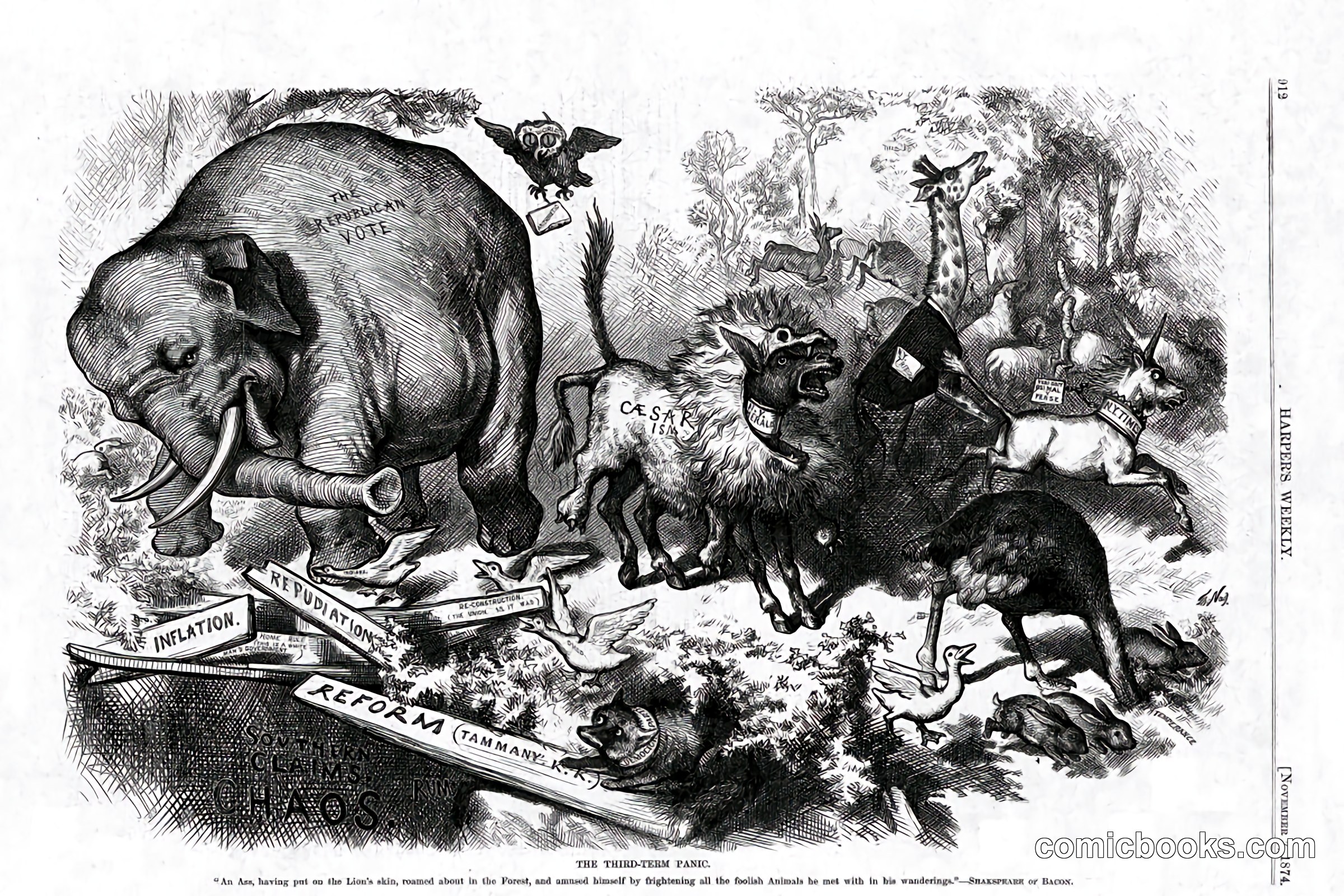
Thomas Nast did more than skewer politicians—he handed American politics its animal mascots. He is credited with popularizing the elephant as the symbol of the Republican Party, an association that took hold from his Harper's Weekly cartoons of the mid-1870s. This 1874 cartoon is the celebrated instance, in which a lumbering elephant labeled for the Republican vote blunders amid a scene of political panic, giving the party its lasting emblem. Nast also did much to popularize the donkey as the emblem of the Democrats, deploying it in his satires until the pairing became fixed in the public mind. While Nast did not invent every element of these symbols from nothing—the donkey in particular had earlier associations—it was the reach and repetition of his widely circulated cartoons that cemented both animals as the shorthand of American party politics. More than a century and a half later, the Republican elephant and the Democratic donkey remain instantly legible, a testament to how deeply a single cartoonist's imagery can embed itself in a nation's political culture. Few artists have so permanently furnished the visual language of a democracy.
About this artifact
- Creator
- Thomas Nast
- Date
- 1874
- Rights
- Public domain — free to view, share, and reuse.
- Restoration
- Digitally restored and hosted by ComicBooks.com · high-resolution version available.
Part of our mission to preserve and restore the public-domain heritage of the medium.